The Ultimate Web App Development Roadmap for 2026

Join our Newsletter!

Featured Posts

Support Is One Click Away

Home

The Ultimate Web App Development Roadmap for 2026

Web development roadmap

The Ultimate Web App Development Roadmap for 2026

Producing impactful online experiences begins with a clearly defined web development roadmap. The ultimate goal is to create an application where every click, scroll, and animation feels natural and engaging. You are not simply building webpages; you are creating experiences that resonate with people and enable ideas to be expressed, although it is an endless process that presents incredible skills to learn, tools to manipulate, and decisions that will define how your web applications will perform, appear, and feel.

Every step of this journey adds a new dimension to your skills and perspectives. From planning your layouts, designing usable interactions, creating activities, and optimizing the performance, all are built to produce something fantastic. The web development roadmap acts like a compass, guiding you towards building valuable applications for users that “stand out” in a digital moving landscape.

If you are planning to build an ultimate web app development? Mindpath’s web app development services will bring expertise and deliver digital solutions that enhance your business performance.

Understanding the Basics of Web Development

Web development is the act of developing and maintaining websites and web applications. It involves tasks like coding, design, testing, and maintaining that ensure everything is performing as it should for the user. All of these different platforms allow businesses, educational entities, governments, and other organizations to distribute information, market and sell products, provide services, and communicate with others online. Well-developed websites and web applications improve user experience, improve accessibility to information, and support business objectives, which is why they play a major role in achieving success in presently shared digital and real-world spaces.

Collectively, Business Insight Research has valued the global web development market at USD 70.6 billion in 2024, which is expected to grow to USD 141.49 billion by 2033, with a CAGR of 8.03% between 2025 and 2033. The growth is attributed to the proliferation of the internet, smartphones, and e-commerce. The globalization of business has led organizations to invest in professionals to create websites that are visually appealing, fast, and have a highly navigable experience to stay profitable.

Also Read: Web Development Trends

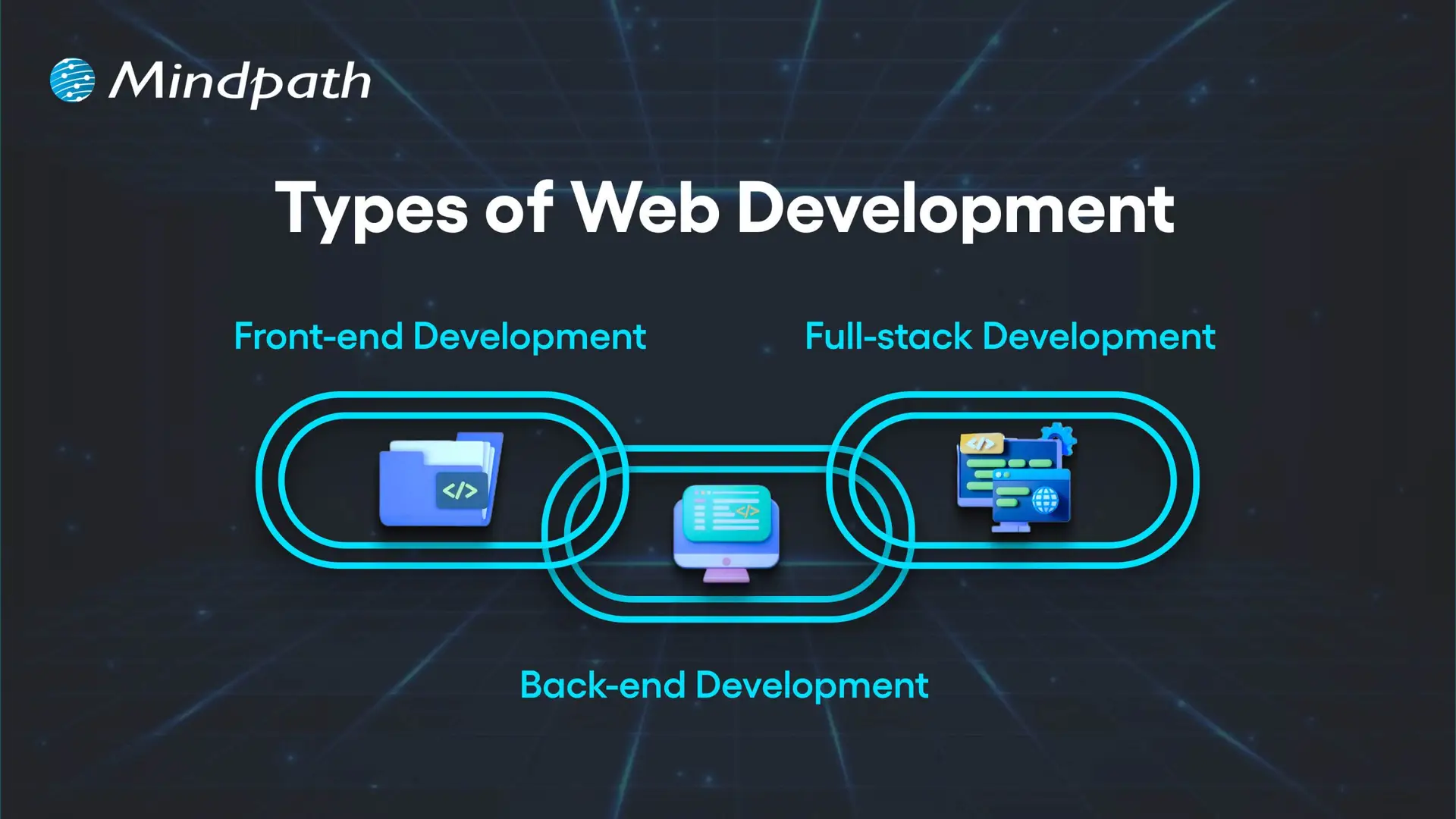
Here are the three types of Web Development
Types of Web Development

1. Front-end Development

Front-end development refers to all the content and elements that appear on the screen in a web browser. Developers using HTML, CSS, and JavaScript create page layouts, decorative elements, and interactive front-end functionality. The purpose of each front-end web page is to be visually appealing, responsive, and usable. Understanding this part is essential in any web development roadmap.

2. Back-end Development

Back-end development refers to everything that happens server-side in order for a website to run properly. Developers will work with data, databases, and user authentication and will largely be responsible for connecting the front-end to the server through application programming interfaces (API). Essentially, back-end development means processing data, executing business logic, and making sure everything is secure.

3. Full-stack Development

Full-stack development encompasses both front-end and back-end development as a way to build fully operating web apps. Developers take on user interface design, server-side, database operation, and everything in between. In this, developers are able to drive every aspect of a project and maximize consistency in integrating the interface visited by a user and the underlying system.

Curious how a web application actually works behind the scenes? Explore the role of frontend and Backend to understand how both layers drive performance and user experience.

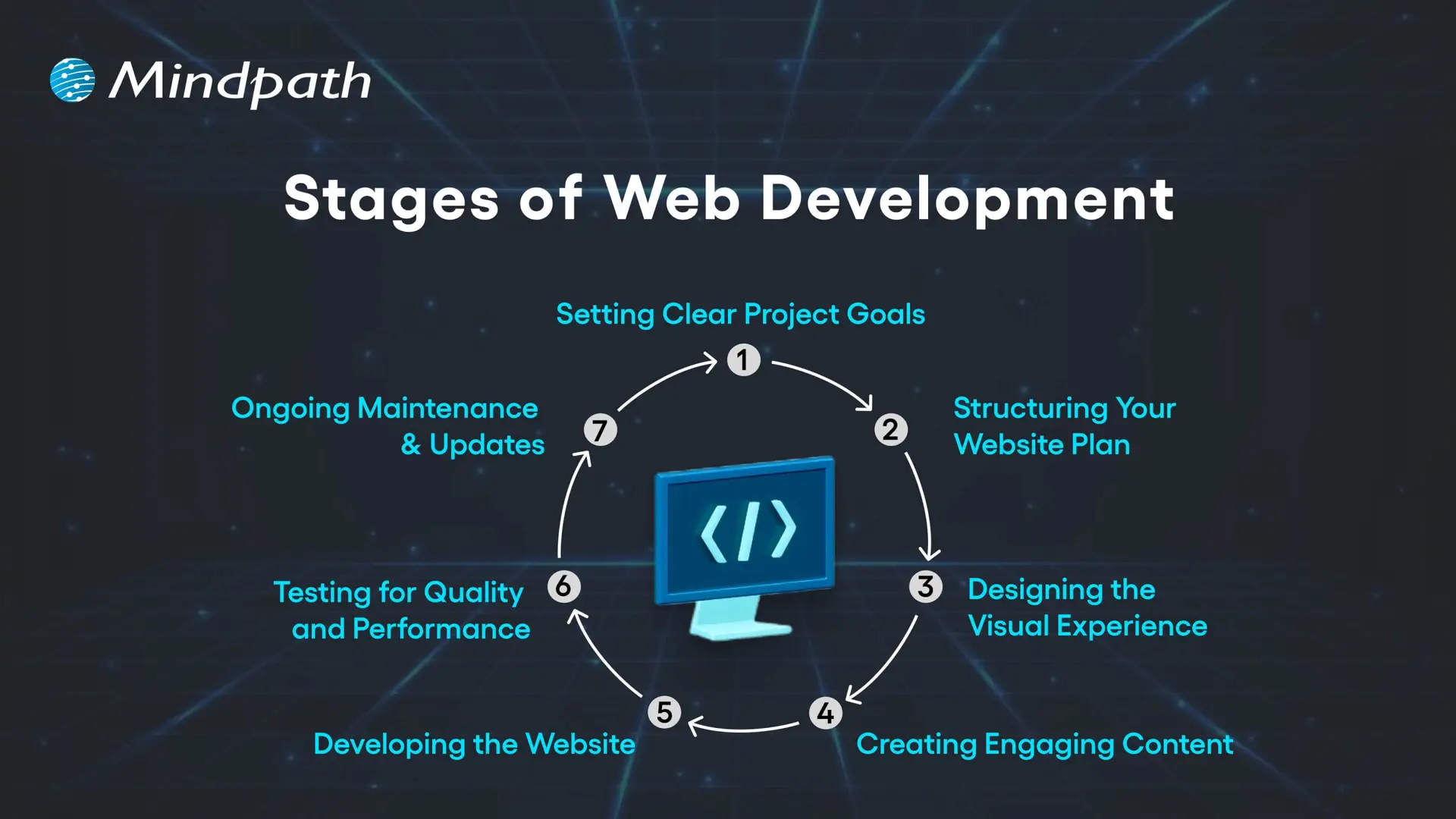
What are the 7 Stages of Web Development?

Web development is a precise discipline as it transforms ideas into interactive digital experiences. In web development, everything is sequenced and implemented purposefully, which culminates in a well-polished, functional product that leaves an impression. Each stage is dependent on the prior stage, which allows web developers to build a website or web application for a target audience. Grasping these stages is an essential step in building a successful web development roadmap.
Stages of Web Development

1. Setting Clear Project Goals

Identifying the purpose of your site is the first step, as well as how it will serve your audience. You need to identify your business goals, unique value proposition, audience preferences, and competitive space. A clear vision is the basis of the whole web development plan.

2. Structuring Your Website Plan

Developing a full model for your website will include solid materials such as sitemaps and wireframes. The sitemap will tell you how pages are linked, while the wireframes provide a visual representation of how you want the major elements of your site structured and what areas they will fill. Getting this correct will help ensure that your website navigation, layout, and the way users will travel around the site are thought out in a solid manner from the start.

3. Designing the Visual Experience

At this stage, we start to think about site aesthetic and brand elements, color, typeface, imagery, and iconography. The design must remain uniform across channels to build brand awareness. User user-friendly and aesthetically pleasing design can draw people in and build trust!

4. Creating Engaging Content

At this stage, you’ll develop content for landing pages, product descriptions, blogs, images, videos, etc., in more detail. Content not only needs to align with the needs and questions of your audience, but content also provides engagement opportunities. Keywords will be employed, and if we do this strategically, we can improve reach and connect with specific traffic that can bring targeted traffic to your site.

5. Developing the Website

Once everything about your design and content has been established, developers will start building the front end (client side) and back end (server side) of your website. Their job is to code your site, code in your required functionalities, and build a technical foundation on which the site can grow as needed. It is essential that you have the technical foundation in place, as having the right technical foundation allows your site to function seamlessly while hopefully supporting businesses in their growth.

6. Testing for Quality and Performance

Everything on your website needs to work correctly before the site launches. Prior to launch, the site must be tested on different devices and different browsers. This testing will include broken link checking, speed optimization, and mobile responsiveness. Testing is considered a crucial step in the process to ensure that the user experience is flawless when the user first experiences the website.

7. Ongoing Maintenance & Updates

Once a website is launched, it must be updated on a regular basis to remain useful, secure, and on trend. Updating a website can mean a lot of things and can include adding content, fixing bugs, adding features or functionality, and backing up. Frequent maintenance will keep you more competitive and help with longer-term success. Mastering these stages plays a vital role in shaping a clear and effective web development roadmap.

Is your web application prepared to handle modern security threats? Explore application security best practices for Web and Mobile Apps to learn how to protect your data, users, and business operations.

Web Development Roadmap 2026: A Step-by-Step Guide

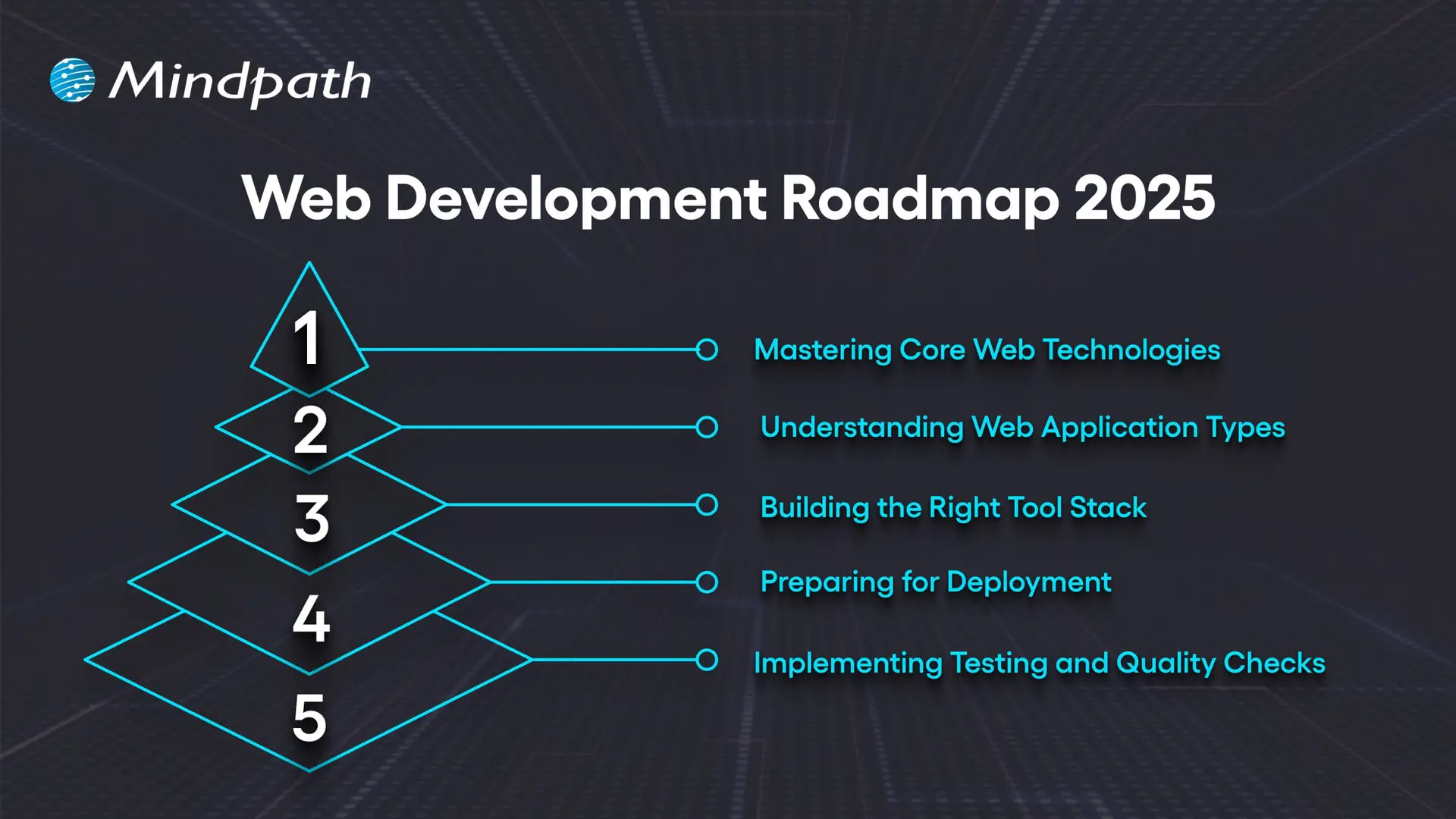
A website development roadmap is a structured plan that outlines the stages, tasks, and goals involved in building and launching a website. This web development roadmap for beginners explains what a website roadmap is by showing how each step connects, helping you create a professional, user-friendly site that meets your goals and performs well in 2026.
Web Development Roadmap 2025

1. Mastering Core Web Technologies

The important first part of the web development roadmap is getting familiar with the core technologies that underpin the internet. HTML provides the structure, CSS provides the layout, and JavaScript provides interactivity to web pages. Developers should be familiar with some protocols like HTTP/HTTPS, FTP, and TCP/IP that define how data is transferred between the server and the browser. The basics of accessibility, usability, and web semantics are important to know to create accessible, well-structured websites. The fundamentals are the starting point for anyone on the roadmap.

2. Understanding Web Application Types

Before you start building, it’s a good idea to understand the different kinds of web applications and their use cases. Static HTML pages indicate fixed content. Dynamic pages have content that changes based on user interaction. Server-side applications deliver content through languages like PHP, Python, and Java.

Single-page applications provide fast and fluid experiences, with only slight page reloads. Progressive web apps provide offline capabilities and app-like experiences. Hybrid apps combine web and native features. Understanding these types of web applications familiarizes web developers with the appropriate way to develop for each available project.

3. Building the Right Tool Stack

A complete full-stack web development roadmap involves selecting the proper tool set to orchestrate front- and back-end work simultaneously. For the front end, tools like React, Angular, and Vue.js facilitate responsive and interactive interfaces supported by a variety of CSS pre-processors like Sass for long-term maintainability. For the back end, languages like Java, Python, and PHP power the application logic supported by frameworks like Express.js and Django.

Databases like MySQL and MongoDB facilitate data storage. APIs link the client and server, which helps decouple the presentation of data and business logic. There are many elements that the client and server need against the tool stack for productivity, scaling, and performance.

4. Preparing for Deployment

Deployment refers to the process of making your application available to users on the internet. While the use of Git version control helps keep track of application code changes, Docker guarantees the environment in which we run applications will be consistent. Orchestration tools such as Kubernetes are used to serve developer needs when we are doing large deployments.

Most CI/CD pipelines, like Jenkins and GitLab CI, work together to automate the build and release process for applications. Many providers in the cloud space, such as AWS, Azure, and Google Cloud, give us secure environments where our products can be built and serve to scale with ease. Finally, monitoring tools will allow a web developer to track the service performance and ensure their application is performing as expected post-launch.

5. Implementing Testing and Quality Checks

Testing is vital in web development because it ensures that the website is functioning across devices, browsers, and user conditions. Testing types include unit tests, which test individual items (API, elements, etc at the component level) integration testing, which tests that the pieces of the application work together correctly, and end-to-end testing, such as Cypress or Selenium, which will simulate user behaviors to verify a complete workflow. Accessibility testing is a type that checks that the website can be accessed by individuals with disabilities, and performance testing looks to see how quickly the site responds and how it responds under heavy load conditions.

Periodic testing is an essential factor of this process that leads to quality and reliability in the web. The integration testing tests the pieces of the application work together correctly; and end-to-end testing, such as Cypress or Selenium, which will simulate user behaviors to verify a complete workflow.

Not sure which technologies are right for your web app? Explore the tech stack for your web app success to make informed decisions that drive growth and reliability.

Want to Turn Your Web Development Roadmap into a Success Story?

Following a clear web development roadmap ensures you move through each stage with purpose and precision. It helps align design, functionality, and performance to create websites that truly serve their audience. By mastering core technologies, understanding application types, and implementing strong testing, you build projects that are scalable, secure, and ready for long-term success.

At Mindpath, we create websites that are fast, secure, and built to grow with your business. Our web development services cover everything from front-end design to back-end functionality, ensuring a seamless user experience. We specialize in custom web applications, e-commerce platforms, CMS solutions, API integrations, and performance optimization. With a focus on scalability, usability, and innovative design, we turn your ideas into high-performing digital solutions that engage users and deliver results.
Related Post

Discover how AI enhances cybersecurity with smarter threat detection, faster responses, and proactive vulnerability management to protect your business in the digital age.

Related Post

MVP for startups

Every entrepreneur believes that they have the next big “idea” that could disrupt an industry. The chances of success for your startup depend completely on how you translate that idea into a product that solves the problems of customers. This is where you need to think about the value of MVP of startups and their impact on your growth. 

The MVP or minimum viable product is an important step in building the foundation required to achieve the desired goals for your startup. Without an MVP, you are likely to invest in developing products that may not be successful. Learning about the significance of a minimum viable product can help you identify the reasons to build one for your startup.

Are you a startup struggling to validate your idea before investing heavily? Mindpath offers MVP Development Services to help you test concepts and launch faster with minimal risk.

Understanding the Definition of MVP

Before you dive into the benefits of MVPs, you must understand its definition. The minimum viable product is the simplest version of the product you intend to sell to your customers. It includes only the basic features and helps you check the utility and relevance of the product with the help of feedback from actual users. The growing popularity of MVP development for startups across various industries has led many entrepreneurs to think about its benefits. 

Is a MVP really necessary for your startup? Many startup owners will think that investment in developing a MVP may increase their financial burden. On the other hand, you should think about the consequences of creating a full-fledged product with everything you have and more, only to end up with failure. MVPs can help startups test their ideas without investing all their resources and make necessary improvements before creating final products. 

Demystifying the Reasons to Build an MVP for Startups

The notion of establishing your own startup might be an exciting one albeit with one big challenge. Did you know that almost 90% of startups fail? Therefore, many entrepreneurs choose MVP development services for startups to increase their chances of surviving the competition. An overview of the benefits of the minimum viable product can explain for why every startup must create one. 

1. Aligning Your Product with the Target Market

One of the foremost reasons for which startups should develop an MVP revolves around ensuring that the final product is suited for the target market. Entrepreneurs should know “what is MVP” and how to use it to find the right market for their product and services. Testing the basic version of the product you want to build with real users gives you access to actual and relevant feedback. 

Your MVP will tell you whether the target market needs your product and how to improve it with useful features. Startups can leverage MVPs to experiment with product design and refine it till they achieve the right product-market fit. The MVP can easily identify whether your product cannot solve a real problem for your target audience in early stages.

2. Developing Products for Your Core Audience

A minimum viable product not only helps you develop products for the market but also for your core audience. The core audience of a startup includes customers who are more likely to buy their products and services and contribute more to their revenue. Any entrepreneur searching for MVP startup meaning must know that creating products that cater to the core audience increases possibilities of success. Tailoring your product for the core audience ensures higher customer satisfaction as they will believe that their needs have been kept in mind while developing the product. 

The MVP offers an opportunity to obtain valuable feedback from the core audience and make product improvement decisions on the basis of actual user experiences. You can not only identify the features that your customers want in a product but also discover relevant market trends. As a result, you can ensure that your product can evolve along with market demands while addressing the needs of your target audience.

3. Introducing Products at a Faster Pace

The next promising reason to look for opportunities to create an MVP is the assurance of faster time to market. Most of the startups struggle to accelerate the time to market due to various constraints. The utility of MVP solutions for startups becomes clearly visible in faster testing of product ideas. If you can identify how your product will solve the pain points of your target audience, then you will gain an early advantage over competitors.

The feedback received for an MVP from actual users help in refining your product by identifying exactly what works the best. Startup owners can avoid assumptions and use insights that help in making informed decisions for improving their products. It provides an ideal tool to reduce unwanted expenses during the development process and streamline your efforts. You can rely on the MVP for building a community of early adopters and their experiences will provide a strong foundation to attract new users.   

Preparing to build software that truly matters, you need a clear and efficient starting point. Explore our blog on MVP in software development to learn how early validation and focused execution can turn your idea into a successful product.

4. Making Your Product More Flexible

Another top reason to hire a MVP development consultant for your startup focuses on creating more responsive products. The dynamic business landscape keeps changing constantly and so do your target audience’s needs. Startups cannot afford to build products that fail to adapt to changing user requirements. Your MVP plays a major role in adapting and refining your product on the basis of user feedback. 

The minimum viable product provides the guarantee that your product can evolve according to changing preferences of your target users. Entrepreneurs can check whether their product is responsive to user-centric updates and enhances customer satisfaction. Product flexibility is a crucial advantage of the MVP approach that offers the assurance of success for your product in the long run.

5. Playing Safe with Your Investment in Product Development

Any startup that begins product development without a MVP is likely to invest everything in creating a full-fledged product. What if the product you have created with almost all of your resources does not meet your customer’s expectations? This is where MVP development can save you from unwanted expenses by helping you scale up investment as your product gains traction. Entrepreneurs can leverage MVPs as a more sustainable approach to product development with financial safety. 

You can start with the basic version that will require minimal development costs and add features according to user feedback. The MVP reduces financial risk by avoiding a full-scale product launch before creating the ‘perfect’ product. On top of it, developing the MVP helps you with strategic allocation of resources. Startup owners can use their MVP to invest gradually in product development as the product design becomes more suitable for success.  

6. Leveraging Short-Term Wins for Long-Term Success

The list of benefits associated with MVPs for any startup would be incomplete without including the short-term wins. The milestones in MVP development for startups not only provide an effective roadmap for product development but also enhance the momentum for your project. Startups can view the successful completion of milestones as a source of motivation for their teams and stakeholders. 

Stakeholders and investors will perceive the short-term wins as the representation of a startup’s capabilities to deliver on their promises. When an investor notices tangible outcomes from the product development process, they are likely to continue supporting your product. Meeting user needs in early stages helps in building a strong user base for your product and guarantees long-term success.

7. Enhancing Precision in Product Development

Most of the explanations for MVP meaning in business emphasize the ways in which it helps in identifying relevant features. The minimum viable product serves as a useful tool to adapt the core features of your product to user expectations. The feedback obtained from real users of MVPs not only helps in identifying core features but also in refining them. 

Startups can focus on features that their target users care the most about and ensure alignment with user needs. The MVP development cost can prove to be a successful investment as it enhances precision in product development. Apart from prioritizing features, your MVP also helps you understand technical complexities in the product. As a result, you can introduce improvements that help your users navigate the complexities with ease.    

Want your MVP to move from concept to reality fast? Check out our blog on hiring full-stack developers for MVP to see what skills and qualities matter most, which leads to successful builds tailored to your needs.

Final Thoughts

The benefits of a minimum viable product for startups offer strong reasons to build one for every startup product idea. Many startups fail to recognize the fact that starting small delivers massive benefits in the long run. When you build MVP for a new product, it helps you develop products that align with the preferences of your target audience. In addition, the MVP proves to be a formidable resource for earning the trust of your stakeholders and investors.

Mindpath is a MVP development company with years of experience in building minimum viable products for startups in different industries. We have guided startup owners through the process of creating their MVPs with our expertise and resources. Our strengths in creating MVPs can spell the difference between success and failure for your startup. Reach out to our consultants and create your MVP now.

web development vs software development

You are a business owner preparing your digital strategy and have difficulty finding the ideal option for software and web development. The web development vs software development comparison might be difficult to understand for a layman without technical expertise. One of the common misconceptions about the two terms is that they both mean the same thing.

Business owners must recognize the differences between software development and web development to pick the ideal approach for their digital strategy. Web development is all about establishing the online presence of a business. On the other hand, software development deals with creating customized software solutions for different needs. A deep dive into the comparison between web development and software development can help you understand which one is right for you.

Looking for the right software development partner to bring your ideas to life? Mindpath’s software development services offer end-to-end solutions tailored to your business goals, from strategy and design to development and deployment.

Fundamental Difference between Web and Software Development

The emerging requirements of the digital landscape have had businesses thinking about the best ways to reach their target audience. As the software development vs web development debate becomes a focal point of discussion, it is important to understand how they are different from each other. With an overview of the definition of the two terms, you can find a starting point to compare them.

What is Web Development?

You will get no prizes for guessing that web development is the process of creating websites. Web development involves creating everything from the server logic and databases to the visual elements that make a website attractive. Without websites, businesses will struggle to have an online presence and showcase their brand. 

You can identify the difference between a software developer and a web developer from the primary components involved in website development. Web developers have to address the requirements of frontend and backend development alongside a content management system for websites. 

Frontend development focuses on the part of a website that users see, including the layout, design, text, images, and buttons. The significance of backend development is evident from the fact that it involves the creation of the server logic and databases. Another crucial component in web development projects points to content management systems or CMS platforms. The intuitive interface of CMS tools offers easy solutions for managing and updating the content of a website.  

What is Software Development?

The next prominent approach for your digital strategy is software development. As the name implies, software development focuses on the complete development lifecycle from ideation to the deployment and maintenance of a project. You can notice the difference between a web developer and a software developer from the fact that software developers have more responsibilities. The scope of tasks in software development is bigger as it requires the creation of custom solutions to deal with specific business needs.

Software developers can create mobile apps, complex software systems for large organizations, or custom internal software. The solutions created by software developers serve distinct goals for businesses. For instance, mobile apps serve as effective tools to reach the target audience of a business and enhance customer engagement. On the other hand, custom internal software solutions can help businesses manage different business functions with ease.

Must Read: Types of Software Development

Diving Deeper into the Web Development vs Software Development Debate

The overview of web development and software development reveals the fundamental difference between the two terms. The following sections will provide a more detailed comparison between web development and software development on the basis of different factors.

1. Objectives of the Process

One of the foremost pointers for differentiating web development from software development is the objective of the process. What do the two development approaches help you achieve? The answer will help you take the best pick from a web developer vs software developer comparison. Web development focuses primarily on establishing an online presence for your organization and showcasing your brand. It is one of the most common approaches to drive customer engagement through intuitive web apps or websites.

Software development process, on the other hand, focuses on addressing specific business problems with custom solutions. Businesses can rely on software development to create software for managing different business functions or custom internal software that can be deployed on various platforms. The primary objectives of software development revolve around enhancing productivity and streamlining operations.    

2. Complexity of the Process

The next point in the comparison between web development and software development focuses on their complexity. In the case of web development, you can rely on templates or content management systems for creating web apps. 

Software development requires the creation of fully customized solutions according to the requirements of the business. Developers can create software solutions from scratch by using the client’s requirements as their reference. 

3. Maintenance Requirements

Another prominent aspect in the software developer vs web developer comparison is their responsibility for maintenance. Web developers can address the maintenance requirements through continuous security updates and frequent modifications to content. In addition, web developers also take care of the maintenance of web apps by updating the design according to the latest trends.

The responsibilities of maintenance in software development focus on introducing new features and bug fixes. Apart from addressing the errors in the functionalities of software solutions, a software developer also takes care of performance improvements.

Want technology that truly supports your business rather than slowing it down? Discover the key custom software development benefits that help companies optimize operations and innovate faster.

4. Technology Stack

The review of differences between software and web development will also draw attention towards the technology stack required for the two approaches. It is one of the biggest factors in a web development vs software development comparison, and also determines the complexity. The technology stack for website development involves frontend and backend frameworks with CMS platforms. The notable frontend frameworks include HTML, JavaScript, React, Angular, and CSS, while backend frameworks include Python, Ruby, and PHP. Some of the popular CMS platforms for web development include Joomla, WordPress, and Drupal.

For software development, the tech stack includes programming languages, cloud platforms, and databases. The most commonly used languages in software development are Java, Python, Swift, and Ruby. Software developers can use SQL or NoSQL database management systems and one of the big cloud platforms, such as AWS, Google Cloud, or Microsoft Azure.

5. Cost of Development

The most crucial pointer in the comparison between web development and software development is the development cost. You can determine whether you need a web developer or a software developer by identifying the type of project. At the same time, you must also take your budget into account before making the final choice. Web development requires a lower initial cost, primarily due to the use of templates. You can also choose a custom design for web development, which may increase the development cost. However, you will have to invest more in continuous updates of the website or web app to adapt to user requirements.

Software development costs are generally higher than those of web development projects due to many reasons. Building a custom software solution requires a lot of development time, which will lead to the consumption of more resources. On top of it, software development projects are more complex than web development projects, thereby increasing the costs. Most important of all, the customization of software solutions according to business requirements will also add more costs to the project.

Ever wondered why some websites just feel effortless while others fall flat? Discover the hidden benefits of custom website development services that turn a simple site into a powerful, user-friendly business tool.

Here is an overview of the web development vs software development comparison in a table.

Criteria Web Development Software Development
Objectives of the Process Web development focuses on building your online presence and showcasing your brand. Software development aims to resolve specific business issues and improve productivity.
Complexity Web development is a simple process with the use of templates and CMS tools. Software development is extremely complex and requires creating custom solutions from scratch.
Maintenance Requirements Maintenance tasks in web development involve ongoing updates for security, content modifications, and changes in design. Maintenance tasks in software development focus on introducing new features, performance improvements, and fixing bugs.
Technology Stack The technology stack for web development includes frontend and backend development frameworks alongside CMS platforms. The technology stack for software development includes programming languages, cloud platforms, and database management systems.
Cost of Development The initial cost of web development is lower than software development. The cost of software development is higher due to the complexity and customization needs.

Final Thoughts

The differences between software development and web development showcase that each approach has its distinctive advantages. You might face the web developer vs software engineer dilemma while thinking about resource requirements for your next project. The final choice will ultimately depend on the requirements and scope of your project. For instance, a new e-commerce business should look for web development to establish its online presence. On the other hand, a healthcare organization will need a software developer to create an ERP system.

At Mindpath, we have been delivering trust and efficiency in our expert, world-class software development services for every client. Our focus on understanding the client’s vision and requirements empowers us to deliver competent solutions that stand out in a crowded digital landscape. We have a team of dedicated experts in web development and software development, thereby offering you a one-stop solution. Pick the best talent for your next development project from our team and gain the momentum you need in this digital world now.

AI in business strategy

Think about the potential of AI in business strategy, accelerating your organization with enhanced insights and improved decisions. Imagine having intelligent tools to assess complex data, identify unseen patterns, and let your team have more freedom to genuinely innovate and grow. By adopting the right mindset, companies today are giving themselves a true competitive advantage with AI and changing every aspect of their operations daily.

This intelligent technology is helping companies find new opportunities, create more relevant customer experiences, and briskly adapt to changes in market needs. Embedding artificial intelligence benefits organizations to yield positive results. When used prudently, AI becomes a trusted partner in increasing efficiencies and establishing long-term, viable success.

In this article, you will learn about how AI can transform your strategy and scale your business. Let’s dive in!

Want to enhance your business strategy with artificial intelligence? Mindpath AI development services have a combination of providing strategic insights with hands-on expertise to provide intelligent growth across your organization.

What is an AI Business Strategy?

A business strategy is like an explicit blueprint that directs a company toward its goals. It answers important questions about where a business wants to go, how it plans to get there, and what makes it different from the rest of the marketplace. A clear strategy helps everyone understand the overall objective of the business and keeps colleagues headed in the right direction while working together.

Bringing AI into the plan strengthens the marketing strategy. An artificial intelligence strategy or AI strategy for business growth means using artificial intelligence to better facilitate your business objectives. This could mean improving customer service, making more effective decisions with your data, or even many other entirely distinct initiatives. The aim is to leverage smart tools to execute better, smarter, faster, while staying ahead of your competition.

Also Read: AI in E-Commerce

Benefits of an AI Business Strategy

Having an AI business strategy can open up new opportunities and make your company more competitive. Here are some key benefits that show why investing in AI is worth it:

benefits of an ai business strategy

1. Maximized Efficiency and Productivity

AI can take care of repetitive work, so teams can spend more time on creative ideas and solving problems. It makes daily tasks easier and quicker, which improves workflow in every department. By spotting delays and gaps in processes, AI helps companies get things done faster. This boost in productivity helps businesses stay competitive. Companies can do more with less time and effort when using AI in business.

2. Smarter Data-Driven Decision Making

Using AI in business helps leaders make better decisions based on real data. AI tools can study huge amounts of information and find trends or risks that people might miss. This means managers can act faster and with more confidence. Predictive tools even help businesses see what customers might want next. Smart decision-making is key to staying ahead in a changing market.

You can learn more about how AI can transform decision-making in our guide, Power of AI in Decision-Making.

3. New Opportunities and Innovation

AI encourages companies to try new ideas and find fresh ways to earn money. It supports innovation by helping teams develop new products or enter new markets. With AI, companies can test different ways to work and reach more people. This can create new income streams and keep a business strong in tough markets. Staying open to new ways of working keeps the company growing.

4. Superior Customer Experience

AI for customer service makes it easier to understand what customers like and want. Businesses can offer more personal services, like tailored suggestions or special offers. Chatbots and AI tools give customers quick answers, anytime they need help. This keeps people happy and more likely to come back. Good customer service is always important, and digital transformation with AI makes it even better.

5. Clearer Strategic Direction

AI business strategies help companies plan for the future with clear data. Teams can set better goals because they know what is working and what needs to be changed. AI tools keep an eye on the market and help businesses adjust plans when needed. This makes it easier to stay on track even if things shift. A strong strategy backed by AI keeps everyone moving in the same direction.

Want to know if your business is ready to implement AI in the right way? Explore our blog – AI Readiness Checklist.

How to Build an AI Business Strategy?

Building an AI business strategy takes careful planning and clear goals. Here are some practical steps to help you get started the right way:

How to Build an AI Business Strategy

1. Define Clear Business Goals

Start by deciding what you want to achieve with AI, like increasing sales, lowering costs, or improving customer service. Clear goals strategized by the expert AI consultant help you focus your efforts where they matter most. Knowing what you want makes it easier to pick the right AI tools later. A strong direction keeps your entire team aligned and motivated.

2. Spot the Best AI Opportunities

Look at your daily operations and see where AI can add the most value. This might be in customer support, marketing, supply chain, or product development. Finding the right areas will help you get quick wins and build confidence. Prioritizing these areas makes your investment more effective.

3. Get Your Data Ready

Good data is the foundation for AI success. Collect useful data from different parts of your business and make sure it’s accurate and well-organized. Clean and reliable data will help your AI tools work properly. Better data means better insights and fewer errors down the road.

4. Select Suitable AI Technologies

Explore the AI tools that match your goals and the type of data you have. This could include machine learning, chatbots, or automation software. Choose technologies that are practical and align with your strategy. Pick tools that your team can actually use and manage well.

5. Build or Adopt AI Models

Develop AI models that fit your business needs, either with your own experts or trusted partners. Some companies build custom models, while others use ready-made solutions. Test your models to make sure they perform well in real-world situations. Good models help you solve problems faster and smarter.

Ready to adopt the recent AI trends into your business? Read our detailed blog on Top AI trends, which provides a deeper understanding of how to implement AI into your business for future growth.

6. Connect AI to Your Systems

Make sure your new AI tools work smoothly with your current software and workflows. This may need teamwork between IT, data, and business teams. Good integration helps people use AI with less hassle. Seamless systems keep operations running without major disruptions.

7. Track and Improve Performance

Keep an eye on how your AI strategy is working post-implementation. Use regular checks to fix any issues and update the system with fresh data. A little maintenance keeps your strategy useful and accurate over time. Monitoring helps you spot new opportunities for improvement too.

8. Follow Ethics and Regulations

Think about the rules and responsibilities that come with using AI. Protect customer privacy and make sure your AI solution doesn’t create unfair bias. Stay up to date with local and international laws. Acting responsibly builds trust with customers and partners.

9. Support and Train Your Team

Help your team learn how AI fits into their work. Offer training so they feel comfortable using new tools and workflows. Encourage them to ask questions and share feedback. Well-trained employees make AI adoption smoother and more effective.

10. Measure Results and ROI

Decide which numbers will show if AI is really helping your business. This might be cost savings, higher sales, or better customer feedback. Keep tracking these results over time to see progress. Proving ROI makes it easier to get support for future AI projects.

11. Keep Evolving Your Strategy

Treat your AI business strategy as a work in progress. Keep testing, learning, and improving how you use AI as your goals change. Regular updates keep you competitive in a fast-changing market. A flexible approach helps you make the most of every opportunity.

Planning to leverage the power of artificial intelligence, understanding the technologies that drive it has become a crucial advantage. To dive deeper into the tools and technologies behind AI innovation, explore our detailed guide on the AI programming languages.

Ready to Transform Your Business with AI?

Adopting AI in business strategy helps your company make smarter choices, improve operations, and deliver better customer experiences. By understanding your goals and using AI wisely, you can drive innovation and stay ahead of the competition. Start with clear steps, keep learning, and stay flexible. This approach ensures that AI becomes a real advantage for your business growth.

At Mindpath, our AI development services are designed to help you unlock real results with confidence. We create solutions that match your unique needs, from custom AI models to smooth system integration. Our team works closely with you to ensure your strategy delivers value today and in the future. Let’s build an AI-powered roadmap for your success.