What is Data-Driven Decision Making? A Comprehensive Guide

Join our Newsletter!

Featured Posts

Support Is One Click Away

Home

What is Data-Driven Decision Making? A Comprehensive Guide

Data-Driven Decision Making

What is Data-Driven Decision Making? A Comprehensive Guide

In current business practices, smart choices enable success. Data-driven decision-making protects organizations from using assumptions only and enables them to act with clarity and confidence. When organizations pay close attention to what the data articulates, they will create strategies that are more accurate and outcome oriented. In many ways, the evolution of technology has made informed decisions necessary to stay ahead in a competitive field.

Due to increasing access to digital tools and analytics, data has become the most priceless asset a business can possess. With data, businesses can anticipate trends, monitor risk, and develop opportunities for expansion based on sound data. This is the difference between guessing what will work and knowing what will work. In this blog, we will discuss how data-driven decision-making enables businesses to make better decisions and ensure lasting success.

Ready to strengthen your data-driven decision-making strategy? Our AI development services help you build intelligent systems that convert complex data into a clear business direction.

What is Data-Driven Decision-Making?

Data-driven decision-making refers to the practice of using data and measurable results to inform business decisions. It means collecting data from key performance indicators, analyzing it, and then making it into usable insights to influence strategically better planning. This methodology allows companies to make decisions on quantitative data rather than instinct and intuition. By relying on accurate data, businesses will improve performance, identify new opportunities, and with greater accuracy achieve their goals.

What are Data-Driven Decisions?

Data-driven decisions are decisions based on factual information, data and analysis, rather than gut feelings. These data-based decisions will help companies to understand trends, measure performance, and select the best next steps. With factual data, companies can make better decisions that improve outcomes and can reduce uncertainty.

Importance of Data-Driven Decision-Making

DDDM is more than simply using numbers. It is a solid foundation for more intelligent business planning that allows organizations to act with clear and confident decision-making.

1. Making decisions based on data improves accuracy by grounding decisions in real facts which also leads to more reliable decision-making and reduced risk.

2. It enhances efficiency and profits by detecting waste, optimizing available resources, and enhancing overall performance.

3. When relating to planning and forecasting, data provides insights into potential patterns that enable more intelligent approaches.

4. Data supports enhanced customer knowledge, which helps businesses determine which personalized services provide the best levels of satisfaction.

5. Businesses can use data insights to engage in continual innovation and improvement of business strategy.

6. Data provides a competitive advantage by allowing businesses to undertake strategies faster and stay ahead of competitors.

7. Data-driven decision-making supports transparency and accountability when businesses set targets and make decisions based on measured facts.

Want to know more in detail? Explore our blog on the importance of data-driven decision-making to understand how data insights lead to smarter and more impactful business decisions.

Benefits of Data-Driven Decision Making

Organizations that embed data in decision-making empower themselves to move with certainty and confidence. Data turns information into a meaningful and actionable outcome that enhances strategy and improves decision-making.

1. Smarter Decisions That Save Time and Resources

Using data-driven decision-making, businesses can move quicker and make smarter decisions. It creates efficiencies in processes, decreases waste, and allocates resources where most needed or impactful. For instance, analyzing sales data and patterns allow businesses to manage inventories more effectively and decrease costs that aren’t necessary, and have efficiency improvements.

2. Stronger Market Alignment and Competitive Growth

Businesses benefit from data analytics in relation to market trends and shifts in customer needs. By tracking changes early, businesses can make adjustments to their strategy or develop a new offering that meets consumer needs. In turn, they can build a favorable market position that keeps them ahead of the competition.

3. Clear Accountability Across Teams

Using data to inform decisions makes it much easier to track results and see what worked. This increased clarity allows for accountability and transparency in every aspect of the work. The team will learn from both successes and failures and will create more enhanced results from the learnings.

4. Continuous Improvement Through Data Insights

Analyzing what has been successful before gives organizations an understanding of success factors. Additionally, conducting regular data analyses will identify inefficiencies and allow organizations to make better decisions in the future. This cyclical process keeps businesses flexible, creative, and committed to continuous growth.

5. Confident and Faster Decision Making

Data-driven decision making provides assurance by removing ambiguity, making things more factual. Leadership can act faster with confidence, knowing that their decision is based on workable data. This fast, assured decision making allows companies to take advantage of looking after positively into opportunities and challenges.

Wondering how businesses turn raw data into smarter and faster decisions? Explore AI in decision making to discover how artificial intelligence enhances data-driven strategies.

Key Steps for Making Data-Driven Decisions

Using data properly begins with a clear and structured process. Thoughtfully adhering to the necessary steps allows a business to convert raw data into valuable intelligence, which can inform better decisions.
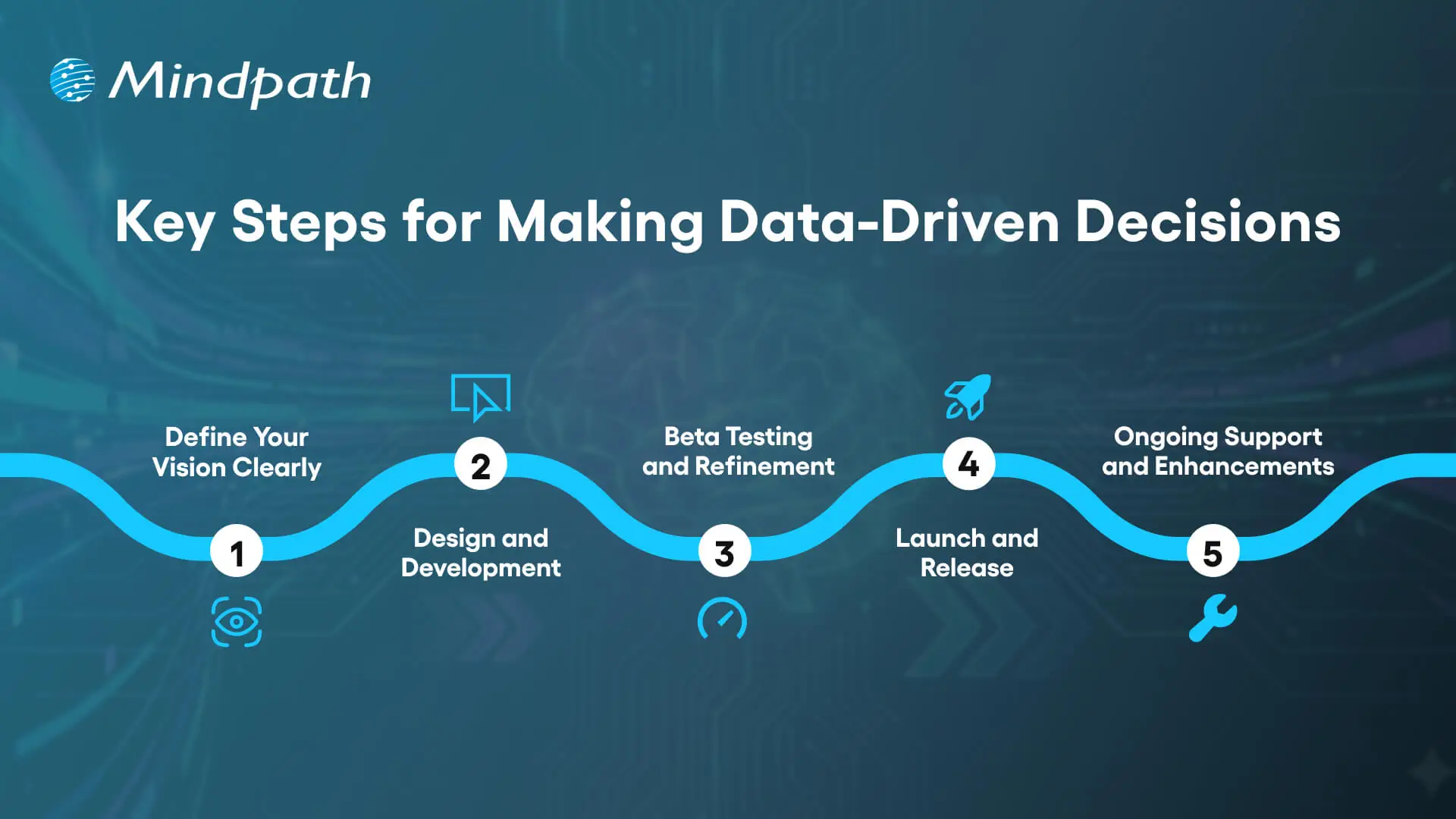
Key Steps for Making Data-Driven Decisions

1. Define Your Vision Clearly

Start by understanding your company’s main goals and direction before diving into the data. If you have a direction, that gives you an idea of how you can utilize the insights coming from the analysis as part of your overall business strategy. Data driven decision making is effective when each data point will drive measurable and long-lasting goals.

2. Identify Reliable Data Sources

After you’ve established your vision, it’s time to determine which tools and platforms are best suited to collect your data. Use sources that best match your business objectives: internal reports, customer analytics, market trends, etc. Having trustworthy data ensures that your data-driven decisions remain accurate and relevant.

3. Organize and Visualize Your Data

Consolidating key information into a clear and predetermined structure provides insight. Dashboards or reporting tools make visualization and a higher level of understanding simpler. Organized data allows for more timely and confident business decision-making, and teams can start to see connections.

4. Analyze to Discover Insights

Carefully analyze the information you’ve compiled for trends, opportunities, and challenges. Use your performance data along with genuine customer feedback to develop an even clearer picture. When you are analyzing data together with others, you can be confident that decisions represent a more comprehensive and accurate picture of your business.

5. Act on Your Conclusions

Following analysis, you should outline specific conclusions that summarize what the data is telling you, and what actions to take next. You will want to focus on linking conclusions to realizable goals and measurable results. Making conclusions and creating action steps develops from raw data to actionable steps and infers an ongoing step you will take in their continuous growth and improvement.

How can data-driven insights shape long-term business strategy? Read our blog on AI in business strategy to take a deeper understanding of how intelligent decisions fuel competitive advantage.

Tools and Technologies for Data-Driven Decision Making

Using the right tools and technology can speed up, simplify, and substantiate data-driven decision making. Beneficial technology allows organizations to collect, analyze, and visualize data to give investigators the tools to convert complicated information into digestible information in the form of insights for decision making.

1. Business Intelligence Platforms

Business‌‍ intelligence tools such as Tableau, Power BI, and Qlik Sense are utilized by businesses to display their data visually and to develop interactive dashboards. They break down complicated data sets into simple insights that can be quickly acted upon by the business. These platforms are instrumental in opening up and involving more people in the process of making decisions based on ‍‌data.

2. Programming Languages for Data Analysis

Massive datasets and high-level analytics are unimaginable without the use of programming languages like Python and R. In general, Python is the tool of choice when it comes to statistical modeling and automation, whereas R is more effective when the focus is on data visualization and statistical computing. Together they are a force to reckon with for all those professionals that solve problems and make decisions on the basis of ‍‌data.

3. Data Management and Manipulation Tools

SQL and Microsoft Excel are still the main tools used for organizing and analyzing data. SQL is used for managing and querying relational databases in an efficient manner, whereas Excel is utilized for carrying out quick analysis and generating reports. Combined, they are the means to keep data accurate and make it accessible for decisions to be taken at any level of the business.

4. Data Collection and Integration Tools

Google Analytics, Apache Airflow, and SQL databases are examples of platforms that retrieve and integrate data from various sources. They are instrumental in measuring the performance of a website, keeping an eye on the progression of tasks, and maintaining the data exchange between systems in a trouble-free manner. Such instruments provide a convenient way to obtain trustworthy data that can be used as a basis for making decisions.

5. Advanced Analytics and Machine Learning Tools

Information technologies such as SAS and Apache Spark are employed to handle massive data collections and to produce resulting projections. These tools enable businesses to foresee changes in the market and to tailor their tactics accordingly for maximum advantage. The use of machine learning in analytics further enhances the basis of data-driven decision-making.

6. Generative AI for Data Insights

Generative AI is changing the way companies understand and utilize their data. They get it done at much faster speeds with the help of AI, where it can also unveil the hidden patterns, and use predictive modeling to get the best results. This innovative technology is like an extra layer of depth and brains in the whole data-driven decision‌‍ ‍‌process.

Curious about how data-driven insights power real-world AI solutions? Discover generative AI use cases in diverse industries to explore how organizations leverage data for innovation.

Data-Driven Decision-Making Examples

Decision-making based on data is changing how companies manage strategies, operations, and growth, as it aids organizations to leverage real insights to make more intelligent and effective business decisions.
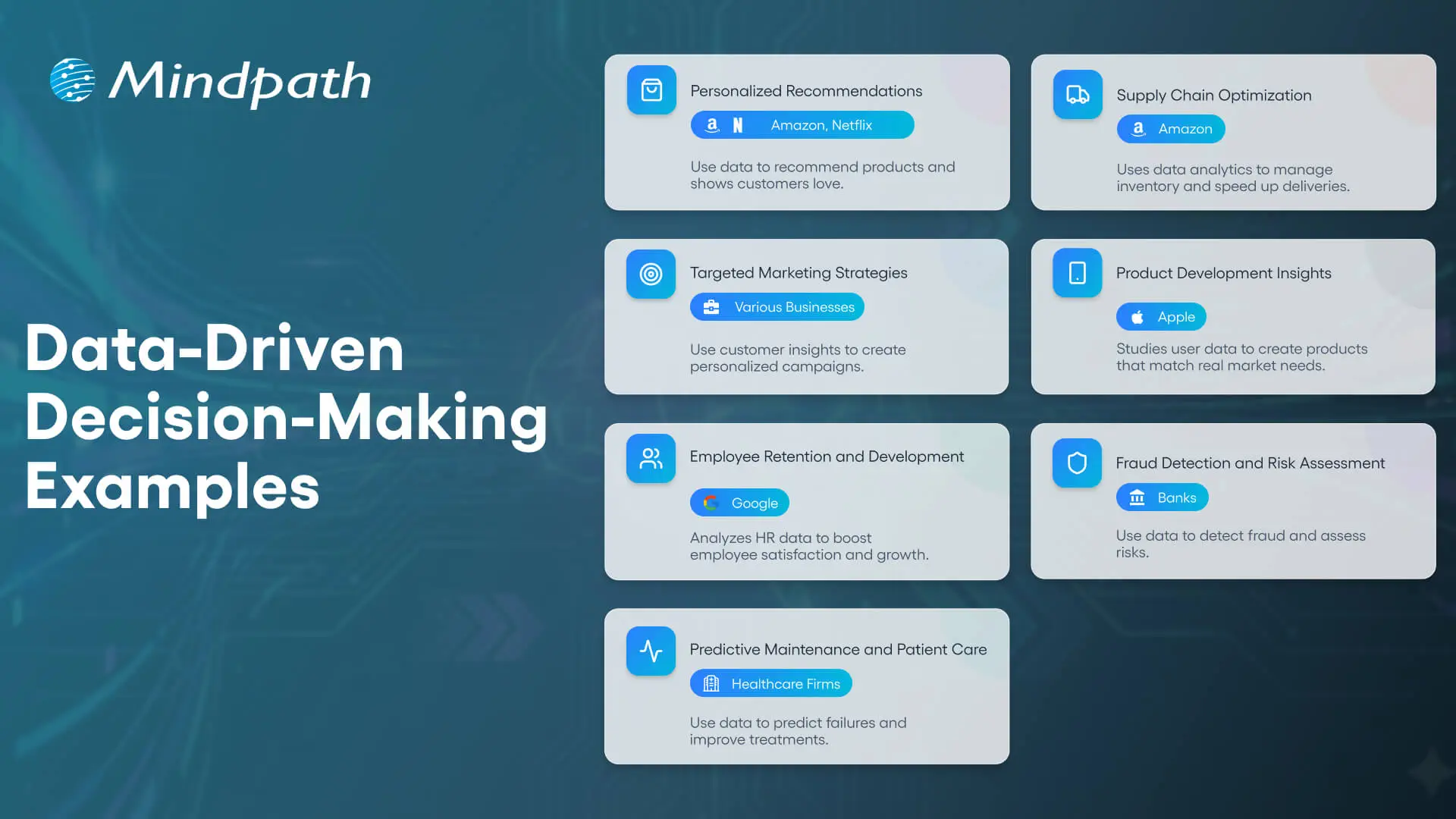
Data-Driven Decision-Making Examples

1. Personalized Recommendations

Interactive ‍data is a valuable source of information for online retailers like Amazon and for streaming services like Netflix. Based on this data, these companies suggest products or content that the customers might be interested in. As a result, customers become more engaged, produce more sales and have a better experience of the‍‌ service.

2. Supply Chain Optimization

Companies like Amazon evaluate stock levels, consumer need, and delivery time to achieve optimal efficiency in logistics while minimizing delay and cost, and ultimately completing orders faster and more efficiently.

3. Targeted Marketing Strategies

Companies look into customer data to predict buying habits and carry out an intelligent and personalized marketing campaign. The use of empirical methods has been demonstrated to be effective in raising brand awareness and increasing the conversion rate through the use of ‍‍‌data.

4. Product Development Insights

Companies such as Apple analyze data to identify user needs and market trends. This insight fosters innovation, allowing companies to create products that truly align with consumer needs.

5. Employee Retention and Development

The HR teams analyze survey data, along with performance data, to examine root causes of turnover and ways to increase employee satisfaction. Insights are also used to develop targeted training programs that can close gaps in knowledge or training to further their own career advancement.

6. Fraud Detection and Risk Assessment

Banks and other financial services organizations deploy data analytics to identify unusual behavior and reduce fraud. They also analyze customer data for risk assessment and improved product development.

7. Predictive Maintenance and Patient Care

Manufacturers use sensor data to catch and resolve a potential failure in the machinery early to mitigate down-time and related costs of maintenance. In the health care sector, using data from a patient’s medical chart will improve the quality of care by creating a more proactive treatment plan.

Looking to improve healthcare outcomes through better decision-making? Explore hospital management system insights to discover how real-time data drives operational and clinical efficiency.

Common Challenge While Implementing Data-Driven Decision Making

Without the right strategy and systems to properly execute data-driven decision-making, it can be complicated. Many organizations face challenges, often slowing their ability to adopt data-driven decision-making and, as a result, impacting the accuracy or impact of their decisions.

1. Poor data quality can lead to wrong insights and poor outcomes, making it vital to maintain accurate, consistent, and complete data.

2. Protecting sensitive information is essential, and organizations must ensure strong security measures and compliance with data privacy regulations.

3. Resistance to change can slow progress, so clear communication and proper training help employees adapt to data-driven decision-making.

4. Managing large datasets requires modern tools like cloud platforms and data lakes to ensure efficiency and accessibility.

5. Limited data skills can hold back growth, making it important to train teams and build confidence in using data effectively.

Looking to see data-driven decision-making in action? Discover AI chatbot examples that increased conversions to understand how insights improve customer engagement and sales.

Ready to Turn Data into Smarter Business Decisions?

Data-driven decision making helps businesses act with precision, clarity, and confidence. It turns raw information into actionable insights that lead to better strategies, improved performance, and stronger growth. By trusting data over assumptions, organizations can make choices that truly create impact and drive long-term success.

At Mindpath, we provide advanced AI development services that help businesses harness the full potential of data. From predictive analytics to intelligent automation, our AI solutions empower smarter, faster, and more informed decisions. Partner with Mindpath to transform your business insights into measurable outcomes and achieve sustainable success in a data-driven world.

Related Post

Discover how CI/CD pipelines streamline software development, boost quality, and reduce costs with automated processes.

Related Post

ReactJS Can Benefit

Do you ever wonder what’s the secret sauce of creating a perfect website or web application? It is the right framework! The success of your project depends on the framework you choose in the ever-changing world of web development. ReactJS is a framework that has been more popular among developers because of its comprehensive features, adaptability, and efficiency. 

ReactJS is a part of the wide JavaScript library and is quite popular amongst the developer community for its versatility. With large numbers of frameworks available and new ones coming every single year, it could be a tricky decision to choose the right one for your web project.  

In this blog, we will take a deep dive into the origins of ReactJS, its key features, and ten compelling reasons to consider ReactJS for your web development needs 

Origin of ReactJS Framework

Facebook invented ReactJS, also referred to as React, in 2011 and made it available to the public in 2013. The framework was created to help developers overcome the difficulties they encountered when creating intricate, high-performing user interfaces.  

The component-based design that React introduces makes development easier by enabling developers to create modular and reusable components. ReactJS is one of the most widely used web development frameworks nowadays, maintained by Facebook in collaboration with a sizable developer community. 

Features of ReactJS

ReactJS is a great option for web development because of its many capabilities. Important characteristics consist of: 

  1. Component-Based Architecture: React makes it possible to create independent components that are capable of independently managing their state, which makes it easier to create intricate user interfaces.
  2. Virtual DOM: React reduces rendering overhead by simply updating the UI elements that have changed, as opposed to re-rendering the entire page, thanks to the use of a virtual DOM.
  3. JSX Syntax: This JavaScript syntax extension makes it possible for programmers to write HTML-like code inside JavaScript, improving the debugging and readability of the code.
  4. Unidirectional Data Flow: Applications are simpler to debug and maintain because to React’s one-way data binding, which guarantees a consistent data flow.
  5. Rich Ecosystem: React boasts a vast ecosystem of libraries and tools that extend its functionality and streamline the development process.

10 Benefits of Using ReactJS

1. Enhanced Performance

The virtual DOM in ReactJS ensures fast and efficient updates, enabling your web application to handle high-user interactions smoothly.

2. Reusable Components 

Because of React’s component-based architecture, developers may quickly and consistently create new areas of an application by reusing components across them. 

3. Ease of Learning 

Learning ReactJS is not too difficult, especially for people who have experience with JavaScript. It is accessible to novice and seasoned developers because of its straightforward syntax and wealth of internet resources. 

4. SEO Friendly 

React’s server-side rendering features make it possible to greatly improve your web applications’ SEO, which will raise their visibility and search engine ranks. 

5. Strong Community Support

With a large and active community, ReactJS developers can easily find solutions, share knowledge, and stay updated with the latest developments, providing valuable support for troubleshooting and skill enhancement. 

6. Rich Ecosystem 

The extensive ecosystem of tools, libraries, and extensions available for React makes it highly versatile, with solutions available for state management, routing, and testing. 

7. Mobile App Development 

React Native, derived from ReactJS, allows developers to build mobile applications using the same principles and components, facilitating seamless extension of web projects to mobile platforms. 

8. Scalability 

React’s modular structure makes it highly scalable, enabling the addition of new features and components without rewriting existing code, ensuring long-term maintainability. 

9. Developer Tools 

React offers powerful developer tools, such as React Developer Tools for Chrome and Firefox, which help developers inspect component hierarchies, debug applications, and enhance productivity. 

10. Backed by Industry Leaders 

Supported by Facebook and used by major companies like Instagram and Airbnb, ReactJS is a reliable and future-proof choice, continuously evolving with strong backing from industry leaders. 

Hire ReactJS Developers with Mindpath

Now that we have established that ReactJS can benefit your web project in numerous ways, the next question is where you can hire qualified ReactJS developers. Well, look no further as Mindpath can help you hire the best ReactJS developers!  

At Mindpath, we understand the importance of skilled developers for the success of your web project. Our team of experienced ReactJS developers is adept at leveraging the full potential of the React framework to create dynamic, responsive, and user-friendly web applications.  

Whether you’re starting a new project or enhancing an existing one, our developers can help you achieve your goals efficiently and effectively. 

We are committed to delivering high-quality solutions tailored to your unique needs. Contact us today to learn more about how our ReactJS developers can contribute to the success of your web project. 

So you can end your search for React developers today with Mindpath. To know more.

Looking for a ReactJS Developer for your next project?

Discover 10 ways ReactJS can elevate your web project. Learn about its origins, key features, and why developers choose it. Boost your web development today!
Generative AI in Human Resources

Imagine a world where hiring the perfect candidate feels effortless, employee engagement is at an all-time high, and HR processes run like a well-oiled machine. Sounds like a dream, right? What if I told you that Generative AI could be the key to making this vision a reality? Have you ever wondered how technology could enhance talent acquisition, streamline onboarding, or even foster a more inclusive workplace? In this blog, we’ll explore the transformative role of Generative AI in HR. So, let’s dive in! 

What is Generative AI?

Generative artificial intelligence (generative AI) is a form of AI capable of producing new content and ideas, such as conversations, stories, images, videos, and music. AI technologies aim to replicate human intelligence in nontraditional computer tasks such as image identification, natural language processing (NLP), and translation. Generative AI represents the next phase in artificial intelligence. You can teach it to understand human language, programming languages, art, chemistry, biology, or any other complicated topic. It leverages previously trained data to tackle new issues. For example, it can acquire English vocabulary and compose a poem using the words it processes. Your organization can utilize generative AI for a variety of applications, including chatbots, media production, and product development and design.  Generative AI is important in HR because it alters old procedures and improves decision-making. HR personnel can focus on strategic efforts that encourage development by automating tedious duties like resume screening. Furthermore, Generative AI does data analysis to find insights that enhance employee engagement and talent acquisition. Integrating Generative AI in HR facilitates operations and creates a more responsive workforce, which boosts overall performance as firms look for efficiency and creativity. 

Role of Generative AI in HR

1. Smarter Recruiting

Generative AI can greatly simplify the employment and recruitment process. For instance, employment posts can be made visually appealing and with clarity using ChatGPT. In order to focus and improve the effectiveness of interviews, they can also create unique screening questions according to the position. 

AI can be used by HR departments and recruiters to save time and effort while writing various email correspondence throughout the employment process, such as outreach emails and rejection letters. 

Certain platforms now allow you to look for candidates by posing straightforward queries as an alternative to laborious search techniques. To identify the greatest fit for your vacant roles, these AI technologies may also compare the profiles of candidates with job descriptions. 

2. Streamlined Onboarding

AI chatbots can act as virtual assistants during the onboarding process, providing new hires with real-time help. The process runs more smoothly since they can respond to enquiries regarding corporate regulations, perks, salary, and how to obtain time off swiftly. These chatbots also offer assistance with utilizing the company’s systems, finding vital assets, and finishing required documentation. This not only makes the onboarding process better, but it also makes new recruits feel more at ease and established into their jobs faster. By simplifying duties, AI helps HR professionals to focus more on personal connection and assistance 

3. Training Transformation

The training and development of employees can be substantially enhanced by combining generative AI with HR. AI, for example, can evaluate a worker’s abilities, output, and career objectives to provide tailored learning programs that best suit their requirements. Additionally, AI-based training solutions are emerging. These technologies replicate the advantages of in-person coaching by giving advise, responding to queries, and providing real-time feedback. 

By automatically updating content to match industry standards, AI can maintain training materials current and guarantee that staff members are constantly learning the most recent knowledge. AI is also capable of producing realistic training simulations that adjust to the decisions made by staff members, giving them experience making decisions in actual situations. Employee confidence is increased, and practical skills are developed via this experiential learning. 

4. Enhancing Engagement

HR managers can utilize generative AI to create thoughtful survey questions for employee engagement. These questionnaires can provide insightful information on how to raise productivity, enhance workplace happiness, and resolve any issues inside the company. 

The previously discussed AI chatbots can also help to keep current employees engaged by routinely responding to enquiries about corporate perks, policies, and other important details. This enables workers to easily obtain what they want through self-service, freeing up HR personnel to concentrate on more crucial in-person contacts that enhance the working environment as a whole. 

5. Data-Driven HR Insights

Generative AI can help HR departments in analyzing enormous volumes of data and identifying relevant trends. It can also convert complicated information into simple visualizations, making data insights more understandable and appealing. 

For example, AI can analyze compensation data to identify trends or unexpected patterns, such as gaps in pay or attendance, which can indicate concerns such as employee unhappiness or management issues. AI can even construct scripts for deeper data analysis, allowing HR teams to explore more sophisticated insights and take quick action to address possible issues. 

6. Faster Task Automation

Generative AI can speed up numerous mundane operations for HR workers, such as arranging interviews, going through applicants, and creating reports. This enhanced efficiency enables HR teams to focus on higher-impact tasks such as strengthening business culture, implementing talent initiatives, and generating personalized employee development plans. 

By automating repeated operations, AI decreases the chance of human mistake while simultaneously ensuring process consistency. This not only increases HR efficiency, but it also enhances accuracy and decision-making. As a result, HR departments become increasingly important to the company’s performance, influencing its development and long-term strategy. 

7. Improving Internal Communications

Generative AI can assist in the development of internal communications that are suited to the needs of both the organization and its personnel. It can swiftly create material with the appropriate tone and voice to reflect the company’s ideals, as well as personalize messaging to better connect with each employee. AI ensures that messages within the organization are consistent, engaging, and accessible to everybody. 

AI can also personalize communications depending on an employee’s function, hobbies, geography, or career stage. Whether you’re communicating with recruits or current workers, generative AI ensures that your messages are smart, targeted, and successful at all levels. 

Generative AI Solutions at Mindpath

At Mindpath, we provide Artificial Intelligence solutions that make HR activities easier and faster. Our AI products assist HR teams in streamlining their operations by automating chores such as generating job posts, screening candidates, and drafting emails. We also utilize AI to analyze massive quantities of HR data, identifying patterns in employee performance, attendance, and pay.  HR teams can apply generative AI to develop personalized training materials, deliver targeted messages to staff, and improve internal communications. Our products allow HR professionals to devote more time to vital tasks such as employee development, talent management, and workplace culture improvement. Mindpath enables HR teams to work smarter and contribute more to company development. 

Wrapping Up!

Generative AI is revolutionizing the future of human resources by making procedures more efficient, personalized, and data driven. From smarter recruiting to increased employee engagement, AI enables HR professionals to focus on what is most important to people. As technology advances, adding AI into HR procedures will save time and effort while also creating a more inclusive, responsive, and effective workplace. At Mindpath, we help HR teams realize the full potential of generative AI, resulting in increased growth and innovation in your organization. The future of human resources is here, and it is powered by AI. 

Ready to transform your HR processes with Generative AI?

Partner with Mindpath to streamline recruitment, boost engagement, and drive business growth.

Explore how Generative AI in Human Resources is revolutionizing recruitment, making HR processes smarter and more efficient.
web development with ReactJS

Ever wondered how some applications handle thousands of users without missing a beat? Or why do certain websites stay smooth and responsive as they grow? When it comes to scaling web applications, ReactJS plays a huge role. But how exactly does it make a difference? In this blog, we will dive into how ReactJS enables developers to build applications that are ready to grow and perform at their best, no matter the user load.   

ReactJS has quickly become one of the most popular options for developers looking to construct scalable web applications. React is well-known for its flexibility, speed, and reusable components, making it simple to build dynamic and high-performance apps that can scale with your company. Whether you’re developing a simple app or a huge platform, React’s efficiency and scalability ensure that your project can manage increased user demand without sacrificing speed.  

Let’s explore how you can leverage React to create scalable web applications that stand the test of time! 

Key Features of React for Building Scalable Applications

1. Scalability 

ReactJS is an excellent solution for creating applications that can scale as your business grows. Its component-based structure enables developers to divide the software into smaller, independent sections that function together seamlessly. This implies that if new features or updates are added, individual components may be upgraded without interrupting the entire system, allowing for faster and more efficient upgrades. 

React also supports current scaling approaches like micro frontends, which let distinct elements of the user interface function as separate “mini apps.” This enables teams to work independently on various application areas minimizing, accelerating development and minimizing possible conflicts. Furthermore, React works easily with scalable backend services, allowing it to manage additional users and expanded features without losing speed or efficiency. ReactJS helps guarantee that your application can meet expanding needs by preparing for scalability from the beginning, making it responsive and adaptive over time. This technique not only enhances the user experience but also reduces long-term maintenance requirements, providing a stable basis for your program in the future. 

2. Performance 

ReactJS is designed with speed in mind, allowing you to develop apps that are both quick and responsive. Performance optimization is essential for scalable systems as they expand in size and complexity. React has various strategies to aid with this, including lazy loading, which loads components only when they are required, reducing initial load time. Memorization is another useful feature that stops React from re-rendering components that have not changed, conserving processing resources and ensuring that the app runs smoothly. By minimizing needless renderings and optimizing component loading, React guarantees that even huge apps seem snappy and responsive to the user. This attention on efficiency improves the entire user experience, making the program delightful to use regardless of size. High performance not only increases customer happiness, but it also contributes significantly to the product’s long-term success by improving application efficiency and scalability. 

3. Testability 

ReactJS facilitates application testing, which is essential for preserving high standards of quality and stability as the app expands. By creating unit and integration tests, developers may identify and address issues early on, maintaining the code’s dependability and maintainability. Tools like Jest and Enzyme are well-liked options for developing and executing tests with React since they make it easier to verify that every component of the application functions as intended. 

By simulating diverse scenarios, these testing tools help make sure the app works properly in a range of circumstances. Developers can swiftly find any problems and add new features or modifications without affecting current code by testing individual components and their interactions. This focus on testability not only improves the app’s reliability but also makes ongoing development faster and easier, supporting the application’s scalability and success over time.  

4. Routing 

Routing is crucial for travelling between various parts or pages in complicated web systems. Navigating an application is made easy with ReactJS due to frameworks like React Router, which let developers design well-structured, intuitive user pathways. Users can effortlessly access various features without having to reload the entire page by segmenting the program into discrete routes, each of which is connected to components. 

The program is kept organized by this routing system, which facilitates management and growth for developers when new features are introduced. Furthermore, usability is enhanced by designing clear, legible URLs, which make it simpler for users to locate what they need and provide a more natural experience. Developers can ensure that navigating is fluid and natural with React Router, improving user experience overall and making the application more efficient and scalable. 

5. Centralized State Management 

As React applications grow, managing state becomes increasingly important as multiple components need access to shared data. Developers may arrange this shared data in a single, easily accessible location with the use of centralized state management solutions like Redux, MobX, or React’s Context API. All components can swiftly access and update the data they require in a centralized state without the need for complicated data-sharing configurations. 

This method makes it simpler to detect and anticipate changes in the application state in addition to streamlining data flow between components. Because the state behavior is uniform throughout the program, debugging, testing, and maintenance are much easier when the state is centralized. This increases the application’s dependability, which facilitates scaling and updating, all of which are critical for long-term development success. 

At Mindpath, boost performance and flexibility with our expert

React development services.

Let’s build your future-ready application. contact us today!

Next up: Learn about scalable React components inUnderstanding React Component Architecture for Scalable Apps. 

Learn how web development with ReactJS is flexible, component-based structure and advanced features ensure seamless growth.