Software development trends are changing businesses and their innovation and competitiveness. The rapid changes in technology present businesses with risks and opportunities where using the correct tools and methodologies can be the difference between success and failure. New frameworks, better automation, and cloud-based solutions are driving change to every aspect of software development and creation. Teams are adjusting strategies rapidly, exploring AI-driven development, and integrating collaborative platforms.
As new trends continue to gather momentum, leaders must start considering how current processes might be adjusted to create opportunities today. Agile practices, low-code platforms, and modern cybersecurity are rapidly reaching a baseline requirement for organizations. Knowing these trends and making the necessary adjustments allows businesses to work smarter, drive out cost, and improve user experience moving forward into 2026. So, keep reading to know more about the trends in software development in this blog.
Ready to achieve your unique business goals with custom software solutions? Mindpath offers custom software development services, which will provide you with more knowledge on how we turn your ideas into real-world solutions.
A Quick Dive into the Software Development
Software development is the systematic process of designing, coding, testing, and maintaining applications to solve problems or meet business goals, spanning everything from initial requirements gathering to final deployment and ongoing support. It can deliver service improvements, increased efficiency and scalability, and a better user experience. Companies utilize software development to automate, optimize, and support business goals. The four main types of software development are web development, mobile development, enterprise solutions, and application software. Each of these helps companies achieve their business goals.
Grand View Research reported that the global software market stood at USD 730.70 billion in 2024 and will likely reach USD 1,397.31 billion by 2030, growing with a CAGR of 11.3% in the forecast period of 2026 – 2030. The emergence of ongoing research, new technologies, and government initiatives that promote software is helping drive this growth, further fueling software development trends across industries.
Software Development Trends 2026
New trends in software development are changing the way businesses are building smarter, faster, and more secure solutions. When companies understand these advances, they can effectively prepare for the future of software development to keep ahead of the competition.
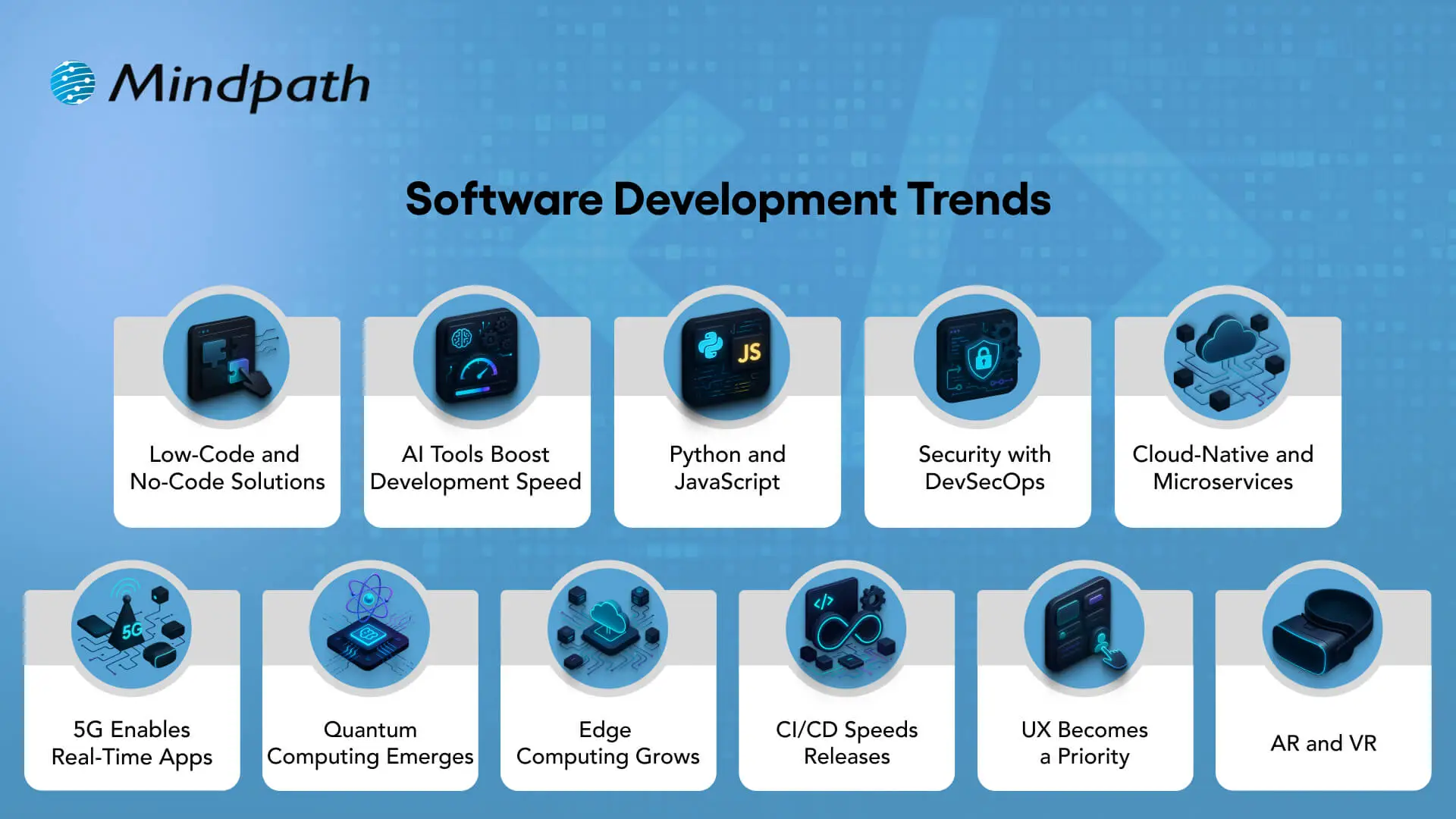
1. Low-Code and No-Code Solutions
Low-code/no-code tools enable a business to build apps with simple visual designs. The low-code and no-code platforms change the scope of full-code requirements and benefit non-developers with workarounds to build their own solutions.
This distance from the original requirement allows for enterprises and startups to accelerate their launch products. This balance between the two reflects a software development trend that benefits everyone, especially startup and enterprise applications.
2. AI Tools Boost Development Speed
AI-enabled tools are reshaping software writing and release processes for developers. GitHub Copilot instantly suggests code and removes repetitive tasks. Testing tools such as Test.ai extrapolate early bugs and generate stable releases.
This software development trend demonstrates how AI makes the overall software writing process more accurate, more rapid, and prepared for the future with cloud, along with more automation.
3. Python and JavaScript
Python and JavaScript remain at the forefront of software industry trends because of their extensive usage and flexibility. It drives AI, automation, and heavy data tasks, while JavaScript powers responsive web apps and cloud apps.
They both facilitate development cycles that enable more rapid innovation. These languages show how software development trends connect directly to real-world needs and digital transformation.
4. Security with DevSecOps
DevSecOps incorporates security into every process of the software development lifecycle. Automated scans, code checks, and in-flight monitoring can identify risks before they become threats. These tools allow teams to ensure software safety with tools like SonarQube and Checkmarx, without slowing down releases. In addition to the multitude of software engineering trends, DevSecOps is a notable software development trend that enables speed without sacrificing safety.
5. Cloud-Native and Microservices
Microservices are foundational for cloud-native development. With microservices-based applications, teams can deploy and update smaller components of an application without impacting the entire application. Docker and Kubernetes enable microservices-based development for organizations of every size. Cloud-native development is one of the many trends taking root in software development, allowing freedom of flexibility while supporting speed to growth.
Curious how cloud-native approaches boost software development agility? Discover the latest cloud computing trends that are driving innovation and growth in the industry.
6. 5G Enables Real-Time Apps
5G networks provide improved connectivity with almost no latency. This enables acceleration of applications that support smart cities, healthcare, and autonomous vehicles. For consumers, 5G improves mobile applications through richer and more interactive experiences. This advance is correlated with trending technologies in the software industry and also advances a software development trend focused on instant, connected solutions.
7. Quantum Computing Emerges
Quantum computing helps solve problems that classical systems simply cannot solve. Industries expect quantum computing to revolutionize processes like financial modeling, supply chains, and drug discovery. Quantum encryption will help keep sensitive data safe in the future.
Experts already list it as a technology trend in the Gartner Technology Trends 2026 report. This means it is a dominant trend in software development and will have a long-term impact.
8. Edge Computing Grows
Edge computing processes data close to where it is collected for faster results. This is helpful for smart factories, vehicles, and IoT devices. It allows organizations to use predictive maintenance and monitor in real time. Edge computing, as the newest form of software development technologies, allows further performance advantages and reduces the dependence on cloud computing.
9. CI/CD Speeds Releases
CI/CD pipelines enable teams to deploy faster while having fewer bugs. Developers integrate code multiple times a day, and automated deployments uphold stability and quality. This supports agility and reduces downtime. It highlights software industry trends where automation drives faster product improvement.
10. UX Becomes a Priority
User experience determines the success of modern software. Companies design apps to be intuitive, analyze behaviors, and test interface engagement. Both AR and VR make experiences immersive and interactive. One of the new technologies for software development is UX innovation, a software development trend that creates customer trust and loyalty.
11. AR and VR
Augmented reality and virtual reality are providing opportunities beyond entertainment in sectors like healthcare, training, and retail. Medicine professionals use VR to more accurately and affordably simulate surgeries; retailers use AR to display previews of products.
Both technologies provide value in learning and interaction and help to improve the customer experience. These represent the latest software development technologies to redefine industries through immersive digital experiences.
Want to know how much building software really costs? Check out our blog on software development cost to plan efficiently and maximize value.
Want to Stay Ahead with the Current Trends in Software Development?
Software development trends are reshaping the way businesses build, innovate, and compete. By adopting new technologies such as AI, DevSecOps, edge computing, and low-code solutions, companies can transform challenges into opportunities. Staying agile and forward-focused allows leaders to unlock growth, deliver better user experiences, and position themselves for success in 2026 and beyond.
At Mindpath, we align our software development services with the latest software development trends to help businesses stay competitive. Our team delivers solutions built on innovation, scalability, and security. By combining deep expertise with modern practices, we create applications that support growth and efficiency. Partnering with us helps your business achieve its digital transformation goals.