Top 10 Benefits of Custom Software development for Growing Businesses

Join our Newsletter!

Featured Posts

Support Is One Click Away

Home

Top 10 Benefits of Custom Software development for Growing Businesses

custom software development benefit

Top 10 Benefits of Custom Software development for Growing Businesses

Imagine this: your company is moving so fast, but your off-the-shelf software can’t keep pace. There are bottlenecks in your processes, your teams are slowing down, and your customers can feel the gulf. Here’s where the custom software development benefits can make a difference. You get tools that will be designed and built for your business goals. No extra features that you don’t need, and no limits that constrain you. It’s like you’re developing a system that scales with your growth, not against it. It’s smart, flexible, and designed for your journey.

As more organizations acknowledge the value of custom technology, businesses are increasingly demanding custom solutions to meet their specific requirements and functionality. Custom software solutions enable consistency and quality for your operational tasks, enhance the experience for your customers, and increase productivity for your team. Unlike off-the-shelf software, which offers limited flexibility and options for your business, custom solutions not only evolve with your organization but can reduce loss of time and expense in the long run. The benefits are real and tangible. In this blog, we will examine the top ten benefits of custom software development for growing businesses.

At Mindpath, our custom software development services are designed to help growing businesses build scalable, secure, and high-performing software solutions.

What is Custom Software Development?

Custom software development refers to the process of developing software solutions that are specifically designed to suit the needs of a particular business or user. It is different than commercially available software that is sold to a wide audience. A custom software solution is custom-built to fit important workflows, overcome specific challenges, and exceed business goals. This overall process includes planning, designing, developing, testing, deploying, and maintaining to ensure long-term continued use.

Interestingly, Grand View Research reports substantial growth in the custom software development market. According to the reports, its market value was USD 43.16 billion in 2024, and it is projected to grow to USD 146.18 billion by 2030 at a CAGR of 22.6%, from 2025. This growth in market size represents an increase in demand for digital solutions that are flexible and designed for the unique needs of organizations. The enterprise software segment represented over 60% of the market, while cloud deployment comprised 57%, all showing a movement toward systems that can be scaled and accessed remotely. Large enterprises made up more than 60% of the total revenue in the market.

Must Read: Types of Software Development

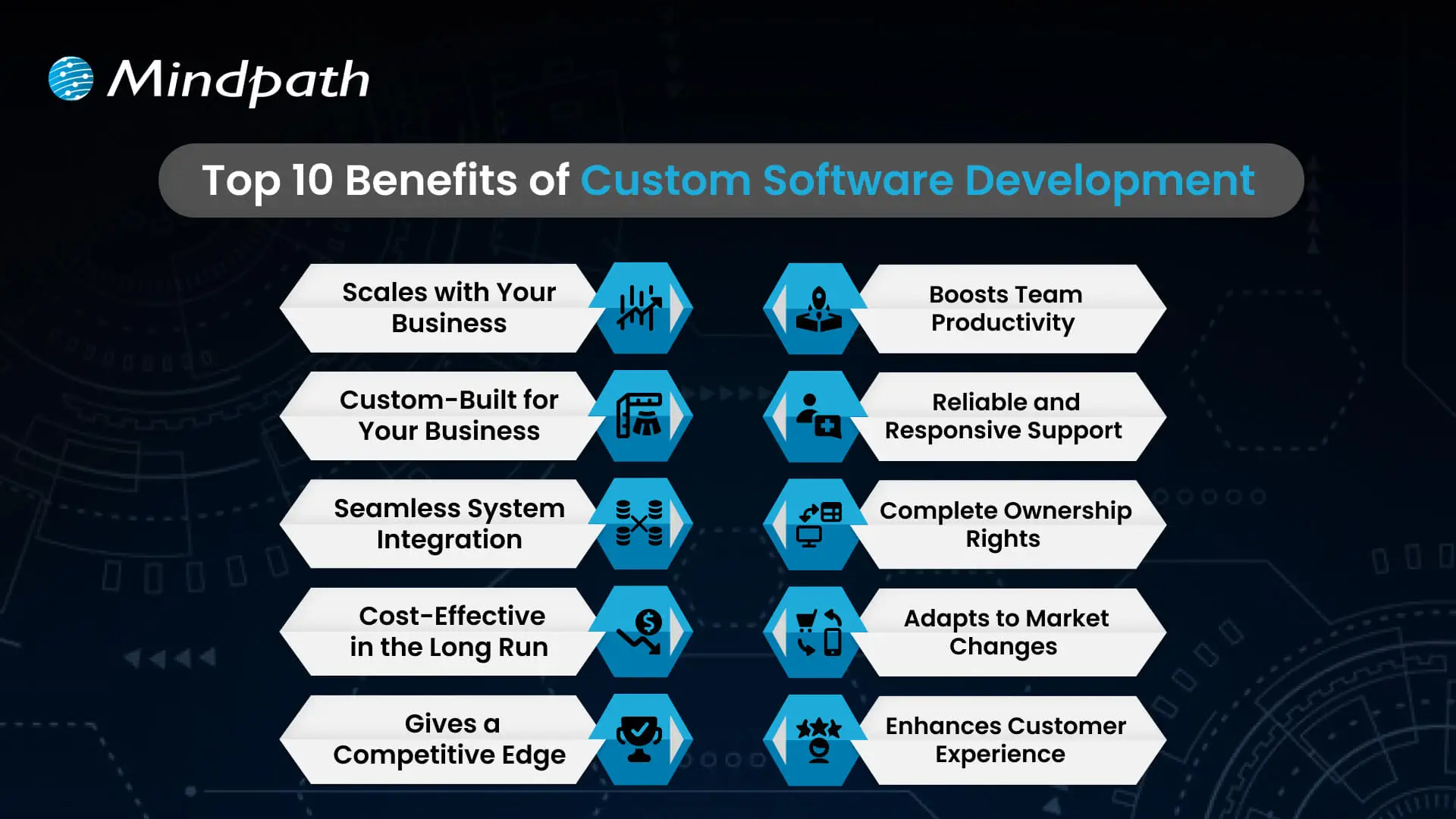
Top 10 Benefits of Custom Software Development

Picking the right software that meets the needs of your business is becoming increasingly important. If you are considering custom software development benefits for businesses, here are some of the greatest advantages that make it a brilliant and future-proof solution.
Top 10 Benefits of Custom Software Development

1. Scales with Your Business

One of the important custom software development benefits is that it grows as your business expands. Whether you open new locations or add services, customized software can easily adapt to your changing needs. It removes the limitations of ready-made tools that often require costly upgrades. With flexible and scalable features, your software stays aligned with your business goals.

2. Custom-Built for Your Business

Custom software is designed to match your specific workflows, goals, and daily operations. It helps avoid the inefficiencies that come with generic tools that don’t align with how you work. From logistics to finance, every feature is built to support what your business truly needs. This leads to better performance, less waste, and smoother processes across teams.

3. Seamless System Integration

Custom software works smoothly with your current tools and platforms. It helps different systems share data without the need for manual updates. This reduces errors and saves time across departments. The result is a more connected and efficient business operation.

4. Cost-Effective in the Long Run

A major custom software development benefit is reduced long-term costs. Unlike off-the-shelf tools, there are no ongoing license fees or expensive upgrades. You pay for what your business needs, and it stays efficient as you grow. Over time, this leads to better value and lower total cost of ownership.

5. Gives a Competitive Edge

Using custom software for a small business helps you create unique features that set you apart from others. It allows you to offer better user experiences and services tailored to your audience. This can increase customer loyalty and build a stronger brand. Staying ahead with the right technology gives your business a clear competitive advantage.

Wondering what it really takes to develop software that perfectly aligns with your business’s unique needs and goals? Explore the detailed custom software development process to see how thoughtful steps provide smooth execution and successful outcomes.

6. Boosts Team Productivity

Custom software streamlines your workflows by removing repetitive tasks and simplifying daily operations. It helps each team work faster and with fewer errors. When tools are designed for specific roles, employees can focus more on results than on fixing problems. This leads to better performance and a more efficient workplace.

7. Reliable and Responsive Support

With custom software, you get direct support from the team that understands your system inside out. This ensures quick responses and accurate fixes when issues arise. This custom software development benefits results in reduced downtime and improved reliability. Your business stays on track with expert help tailored to your specific setup.

8. Complete Ownership Rights

With custom software, your business has full control over features, updates, and improvements. You don’t have to rely on outside vendors or wait for scheduled upgrades. You can make changes anytime to match your growing needs. This gives you the freedom to make fast decisions and stay in control.

9. Adapts to Market Changes

Custom software allows your business to respond quickly when market demands shift. You can add new features or make changes without delay. This helps you stay competitive and meet customer expectations in real time. Being able to adapt fast keeps your business strong and relevant.

10. Enhances Customer Experience

Custom software allows you to create features that match your customers’ needs, making their experience smoother and more personal. This leads to higher satisfaction and stronger customer loyalty. It lets you design every interaction to reflect your brand and serve your audience better. It turns regular experiences into memorable ones that keep customers coming back.

Trying to understand the common pitfalls in creating custom software? Check out our blog to learn the essential custom software development dos and don’ts that every business should follow for a smooth process.

Looking to Build Software That Fits Your Business?

Custom software brings real value by helping your business grow, cut costs, and work more efficiently. It supports your goals with flexible tools that fit how you operate. Every custom software development benefit contributes to improving your team’s workflow and customer experience. Choosing the right solution now means fewer challenges and better results in the future.

At Mindpath, we offer expert custom software development services tailored to your business. As a trusted custom software development company, we build tools that match your goals and grow with you. From design to long-term support, our team works closely with you to deliver strong, flexible, and reliable solutions that keep your operations smooth and ready for the future.
Related Post

Discover DevOps for businesses – enhancing collaboration, reducing costs, and driving innovation for faster, high-quality software delivery.

Related Post

DevOps Trends

Have you been paying attention to the speed at which DevOps trends are changing and how they are affecting businesses? If you’re managing a tech team or are just about to scale up your operations, you may already be thinking about the implications of these trends on your success. As more companies adapt to smarter workflows and quicker ways of delivering value, being up to date is critical. So, how can you stay on top of it without falling behind?

Finding the answer to this question involves understanding the trends that affect how we run businesses in the real world. DevOps best practices today are designed to bring automation, cloud-native tools, or security-first approaches to solve the problems we face in modern situations. Being aware of what’s meaningful and useful can help your team be more effective while accelerating time to market. In this blog, we will examine key trends and look at how they can create real results for your organization.

As businesses embrace DevOps in 2026, the need for expert guidance becomes crucial. At Mindpath, our DevOps services ensure organizations can adopt the right strategies and technologies to stay competitive.

Understanding DevOps: A Quick Dive-in

DevOps is a development approach in which software developers and IT teams collaborate on software and business processes. By working together, they share responsibilities and use tools to speed things up and facilitate the flow of work. DevOps is centered around good communication, collaboration, and automation. In essence, DevOps can deliver near-instant software, identify issues sooner, and get a better and quicker flow between building and deploying applications. As a result, many organizations leverage DevOps for business strategy and agility since it can enhance both speed and efficiency.

In this approach, one team often takes care of everything, including coding, testing, releasing, and maintaining the software. This removes delays and improves software quality. Teams use automation tools to speed up tasks and reduce errors. DevOps also brings security into the process right from the beginning, so it becomes part of every step. This working method helps businesses launch better software faster while keeping systems stable and secure.

Here are some of the benefits that DevOps can offer:

Benefits of Devops

1. Creates a Stable Work Environment

DevOps helps teams handle changes easily without stress. It brings a better balance to daily work and keeps operations running smoothly.

2. Speeds Up Deployment

DevOps allows faster software releases with fewer delays. This helps businesses deliver new features quickly and stay ahead in the market.

3. Improves Software Quality

With regular testing and feedback, DevOps helps catch bugs early. Teams can focus on creating better products with fewer errors.

4. Solve Problems Quickly

DevOps uses monitoring tools to spot issues fast. Smaller and frequent updates make fixing problems easier and more reliable.

5. Supports Flexibility and Quick Changes

DevOps builds a flexible work style where teams can respond to change easily. It helps businesses adapt to market needs faster.

6. Boosts Innovation Through Automation

By reducing manual tasks, DevOps gives teams more time for new ideas. This leads to faster improvements and better products.

7. Reduces Overall Costs

DevOps combines tasks and reduces the need for rework. This saves time, uses resources better, and cuts down project costs.

8. Improves Team Collaboration

DevOps encourages better teamwork and shared goals. Clear communication between teams leads to faster decisions and stronger results.

Aiming to enhance operational efficiency and reduce development risks? Check out our blog on DevOps Challenges and Solutions to discover proven approaches that improve performance, stability, and cross-team cooperation.

Top DevOps Trends 2026

As technology continues to evolve, companies are rethinking how they build, test, and deliver software. DevOps trends for businesses in 2026 show a clear shift toward smarter tools, stronger collaboration, and faster delivery. By following the latest DevOps transformation strategies, organizations can stay ahead and build systems that are both efficient and future-ready.

top devops trends


1. DevSecOps

DevSecOps is becoming a key part of DevOps innovation, where security is built into every stage of the development process. Instead of adding security at the end, teams now include it early to catch risks before they grow. This trend helps businesses create safer applications by using automated testing and continuous monitoring within the DevOps workflow.

2. AI and Machine Learning

AI and machine learning is one of the latest DevOps trends, helping teams work faster and smarter. These technologies support intelligent monitoring, find unusual behavior in systems, and give early warnings before issues grow. By using data to guide decisions, DevOps teams can improve system performance and reduce downtime.

3. Serverless Computing

Serverless computing is becoming a popular trend in DevOps for business success because it removes the need to manage servers. It allows teams to focus only on writing code, which speeds up development and reduces overhead. This approach also helps businesses save costs by using resources only when needed, making operations more efficient.

4. Continuous Integration and Continuous Delivery (CI/CD)

Continuous Integration and Continuous Delivery (CI/CD) is a key DevOps trend that helps teams deliver software faster and with fewer errors. It allows developers to regularly merge code changes, test them automatically, and deploy updates smoothly. This approach improves software quality and supports a steady flow of new features to users.

5. Infrastructure as Code (IaC)

Infrastructure as Code is a growing trend that helps teams manage infrastructure through written code instead of manual steps. It ensures consistency across development, testing, and production, reducing errors and saving time. As one of the leading DevOps tools and technologies, it allows automated setup and easy tracking of changes in infrastructure.

6. Microservices Architecture

Microservices architecture is a DevOps approach where an application is built using many small, separate services. Each service handles a specific function and can be updated or scaled on its own without affecting the rest of the system. This makes the software more flexible, easier to manage, and better at handling changes or failures.

Must Read: DevOps for Business

7. Cloud-Native Development

Cloud-native development is a modern way of building applications that fully uses the power of cloud computing. It is one of the key DevOps trends helping businesses create software that can easily grow, move, and adapt to changing needs. By using containers and microservices, teams can build flexible and efficient systems that are ready for fast updates and smooth scaling.

8. Edge Computing

Edge computing is a growing part of modern DevOps trends that focuses on processing data close to where it is created. This reduces delays and improves the speed of applications by handling data locally instead of in a central server. It also helps save bandwidth and supports real-time decision-making, making systems faster and more efficient.

9. Hybrid and Multi-Cloud Strategies

Hybrid and multi-cloud strategies are important DevOps trends that give businesses more flexibility and control over their cloud usage. By using services from different cloud providers, teams can choose the best tools and features for each task. This approach improves performance, reduces risk, and avoids being tied to one provider.

10. Low-Code and No-Code Platforms

Low-code and no-code platforms are shaping the future of DevOps by making application development easier and faster. These tools allow non-developers to build and launch apps with simple interfaces, helping teams save time. By handling basic tasks through these platforms, developers can focus on more complex work and boost overall productivity.

11. Quantum Computing

Quantum computing is an emerging part of DevOps trends with the potential to solve complex problems much faster than traditional systems. Although still in the early stages, it may one day help teams handle advanced computing tasks more efficiently. As the technology grows, it could bring powerful new capabilities to DevOps in areas like testing, simulation, and optimization.

12. AR and VR (Augmented Reality and Virtual Reality)

Augmented Reality and Virtual Reality are becoming new DevOps trends that support better training, simulation, and team collaboration. These technologies create realistic, hands-on experiences that help teams learn and solve problems more effectively. AR and VR also improve remote teamwork by making interactions more engaging and productive.

Looking to combine fast DevOps practices with automated security checks? Check out our blog on DevOps vs DevSecOps to understand how DevSecOps adds proactive, automated safeguards to every stage of your pipeline.

Is Your Business Ready to Benefit from the Latest DevOps Trends?

DevOps trends continue to shape how businesses grow through faster delivery, better collaboration, and smarter tools. Staying updated helps teams move quickly, improve software quality, and remain competitive in a rapidly changing market. By understanding and applying these trends, companies can build stronger systems and create real value with every software release.

At Mindpath, we offer expert DevOps services that help businesses streamline processes, boost collaboration, and deliver software faster. Our team uses modern tools and proven strategies to support automation, cloud-native development, and continuous delivery. Contact us and we’ll guide you through each stage with clear planning, smooth implementation, and reliable support tailored to your business goals.

Discover the latest DevOps trends to enhance collaboration, streamline processes, and drive business success.
Cloud Disaster Recovery

Have you ever wondered what would happen to your business if a disaster struck and you lost access to critical data or systems? Whether it’s a hardware failure, cyberattack, or even a natural disaster, the impact can be devastating. But what if there was a way to ensure that your business could quickly recover and keep running smoothly? That’s where Cloud Disaster Recovery comes in. In this blog, we will explore how this powerful solution can safeguard your data and help your business bounce back faster than ever. Let’s dive in! 

What Is Cloud Disaster Recovery?

Cloud Disaster Recovery (Cloud DR) is a dependable method for organizations to backup and recover essential data and systems in the event of an unforeseen catastrophe. It entails keeping copies of apps, information, and resources in a secure cloud setting. When disaster strikes, such as a hardware breakdown or a cyberattack, organizations can swiftly recover their data and restart operations. Cloud DR also includes capabilities like automation, which make the recovery process faster and more efficient. It is adaptable, letting businesses scale their storage and recovery requirements as they develop, assuring ongoing protection and minimal downtime. 

Why is Cloud Disaster Recovery Important?

Cloud Disaster Recovery is vital because it enables organizations to remain safe and recover rapidly when unforeseen difficulties arise, such as system outages, cyberattacks, or natural catastrophes. Losing data or access to vital systems can result in delays, financial losses, and reputational damage. Businesses can use Cloud DR to swiftly recover their data and resume operations without taking extensive interruptions. It guarantees that essential information is always secure and ready for use. It also saves time and money by automating the recovery process and offering a flexible option to scale with the company’s demands. This makes it a wise and dependable option for being prepared.

Advantages of Cloud Disaster Recovery

1. Flexible Scaling

Traditional disaster recovery systems frequently rely on physical data centers, which can be expensive and limited in flexibility. Businesses must purchase servers, storage devices, and networking equipment while also maintaining the complete system for recovery operations. This method not only requires a significant initial expenditure, but it also fails to respond rapidly to changing needs. Cloud Disaster Recovery addresses this issue by providing flexible and scalable solutions. Businesses can employ resources on demand through services such as public cloud alternatives or Disaster Recovery as a Service (DRaaS). This means customers can adjust the capacity they require, like storage or processing power, immediately through user-friendly websites. This strategy saves money by removing the need for costly physical infrastructure and maintenance. It also enables organizations to adapt rapidly to expansion or unanticipated events, ensuring that they have the necessary resources when they need them. Businesses who migrate to cloud disaster recovery benefit from a cost-effective and adaptive solution to preserve their data and systems while focusing on their core activities. 

2. Fast Recovery

Cloud-based disaster recovery guarantees faster and easier recovery operations, allowing organizations to minimize downtime. One of the primary benefits is the usage of virtual machines (VMs), which allow you to verify workload availability without impacting everyday operations. This allows firms to routinely review their recovery plans and ensure they are prepared to respond in the event of an emergency. The cloud also provides high-speed bandwidth and enhanced disc performance that can be customized to meet certain recovery time objectives (RTOs). These customizable solutions let firms recover vital systems and data more effectively. Unlike traditional techniques, which rely on physical resources, cloud services allow faster access to the tools and backups required for recovery. Cloud disaster recovery minimizes the time required to restart regular operations after an interruption by combining simplicity of testing, customizable choices, and quicker data retrieval. This guarantees that firms remain robust, retain loyal customers, and reduce financial and operational losses. 

3. No Location Limits

Cloud Disaster Recovery (Cloud DR) has the benefit of being independent of a specific physical location. Unlike traditional disaster recovery solutions, which rely on local or remote data centers, Cloud DR enables enterprises to store backups in data centers located anywhere in the world. This avoids the possibility of losing access to important data and systems if a calamity strikes the principal site of the organization’s equipment. Businesses can utilize Cloud DR to pick backup facilities in various geographic areas, ensuring that their data is secured from local threats such as floods, fires, and power outages. This flexibility enables businesses to develop a disaster recovery strategy that meets their specific demands while avoiding any disruptions caused by physical location limits. Additionally, the cloud’s global reach enables organizations to expand and modify their recovery solutions to individual requirements, without being constrained by on-premises equipment. This gives greater protection and business continuity, regardless of where the calamity occurs. 

4. Geo-Redundant Backup

Geo-redundancy in cloud disaster recovery improves data security and availability by utilizing a cloud provider’s worldwide network of data centers. These data centers are dispersed across numerous areas, allowing firms to store disaster recovery resources in various places. This regional spread serves as a safety net against local calamities such as earthquakes, floods, and power outages that can affect a particular region. Businesses that deploy disaster recovery resources in several areas can ensure that if one data center fails, backup systems in other places will continue to function. This not only improves the dependability of disaster recovery plans, but it also minimizes the likelihood of downtime and data loss. Geo-redundancy also offers shorter recovery times by allowing firms to retrieve their data from neighboring regions if one location faces issues. This worldwide approach to data security is especially useful for enterprises that operate in numerous locations, as it provides a resilient and scalable solution for protecting essential data and maintaining uninterrupted operations in the face of regional interruptions. 

5. Usage-Based Pricing

The cloud disaster recovery pay-as-you-go model gives companies a cost-effective method to set up recovery facilities without having to pay large upfront fees. Unlike traditional managed co-location providers, which sometimes demand long-term contracts, cloud services allow businesses to pay only for the resources they utilize. This means that organizations might avoid making large initial expenditures and instead see catastrophe recovery costs as continuous, flexible expenses. With this strategy, corporations can adjust their payments depending on their real needs, adding or subtracting resources as needed. This allows organizations to grow their disaster recovery solutions without worrying about paying for wasted capacity. Pay-per-use alternatives assist firms in maintaining a cost-effective and adaptive data security strategy by converting substantial capital expenditures into affordable operational costs. 

Also Read: Cloud Computing Attacks: A Comprehensive Guide for Prevention

Cloud Computing Services at Mindpath

Mindpath provides flexible and dependable cloud computing services to match your company requirements. Our cloud solutions provide safe data storage and access from anywhere. We have you covered for disaster recovery, data storage, and scalable computing power. Our pay-as-you-go strategy allows you to pay for just the resources you use, making it both cost-effective and flexible. This allows you to scale up or down as needed, without incurring significant upfront expenditures. Our cloud services are supported by a worldwide network of data centers, which guarantees excellent availability and security. Fast recovery options allow you to swiftly get back on track if something goes wrong.  

Final Note!

Cloud Disaster Recovery is a crucial option for organizations seeking to secure data and reduce downtime in the event of unforeseen interruptions. Businesses can safeguard their operations while controlling costs by utilizing flexible scalability, rapid recovery, geo-redundancy, and usage-based pricing. The cloud provides unrivalled flexibility, speed, and global reach, making it the best option for modern disaster recovery. Mindpath offers dependable and scalable cloud computing services to help you stay safe, adaptive, and prepared for any emergency. With our pay-as-you-go strategy, you can focus on your core business while we handle catastrophe recovery, ensuring that your data and systems are always secure and accessible.  

Ready to protect your business with reliable cloud solutions?

Partner with Mindpath today and discover how our flexible, cost-effective cloud computing services can keep you secure and run smoothly.

Learn how Cloud Disaster Recovery safeguards your business with flexible, cost-effective solutions for fast recovery and data protection.
Magento vs wordpess

The question relating to Magento vs WordPress is not new in 2025. However, businesses as well as professionals need to know how these platforms are different from one another so that they can make a wise selection. With Adobe pushing major updates to Magento WordPress has been continuing to dominate the CMS landscape like never before. 

Several modern businesses and professionals all across the globe have been wondering, “Which is better, Magento or WordPress?” You should be able to answer this question as well. This is because the WordPress vs Magento debate has been directly impacting how online stores compete with each other in the crowded digital marketplace. Let us look at these platforms at a deeper level so that you can choose the ideal tool that perfectly aligns with your needs. 

Selecting the right platform can define website success. At Mindpath, we offer WordPress development services that help you elevate your business by creating a custom website that maximizes performance and drives results.

A Quick Overview of Magento

Magento is a popular open-source e-commerce platform that came into existence in 2008. Currently, it is owned by Adobe, and it has been rebranded as Adobe Commerce. It has certainly emerged as a powerful eCommerce platform that is built for enterprises and growing online retailers. 

One of its unique features that has contributed to its popularity is its scalability. Magento supports large product catalogs and multi-store management. It has novel B2B features going beyond the capabilities of usual CMS platforms. It offers businesses robust tools for diverse purposes, including checkout optimization and marketing automation. Over the years, Magento has gained high popularity in the dynamic business community. 

Must Read: WordPress vs Webflow

A Brief Insight into WordPress

WordPress is a top web content management system (CMS) that is known to power a large number of websites on the internet. It is known for its flexibility, ease of use, and vast plugin ecosystem. WordPress serves as a valuable tool for businesses that allows them to launch everything from blogs and corporate sites to online stores, especially when supported by custom WordPress development, which tailors the platform to unique business needs. Moreover, they do not have to worry about high development overhead.

Some of the core strengths of WordPress lie in content publishing as well as SEO optimization with robust tools such as Yoast and Rank Math. Another unique feature of WordPress is the ability to scale through a large number of themes and extensions. It is time to answer the question: Is Magento better than WordPress?

Key Differences between Magento and WordPress

WordPress and Magento have emerged as revolutionary forces in the contemporary business world. It is a must for professionals and businesses, especially e-commerce businesses, to know about Magento vs WordPress. Some of the major differences between WordPress vs Magento that you must take into account are

1. Purpose of the Platform

One of the key differences between Magento and WordPress is related to the purpose of the platforms. Magento or Adobe Commerce has been built primarily for enterprise-grade eCommerce. Its unique features relating to catalog management and multi-store support are specifically designed to create value for e-Commerce businesses. especially as AI in e-commerce becomes more influential in driving personalization and automation. WordPress was originally created as a content management system. However, it can be extended into the e-Commerce realm through plugins. It is specifically ideal for small to medium-sized online stores.

2. Performance and Scalability

Magento is capable of handling large product catalogs and high traffic. It is also an ideal tool that is designed for complex integrations. It certainly serves as the best tool for mid-sized and large enterprise businesses. It is definitely easier to set up WordPress. In fact, users can scale it for moderate traffic. However, the specific platform may require managed hosting or heavy optimization for handling large stores.

3. Ease of Use

While choosing a platform, it is fundamental for you to take into account the ease of use. WordPress is certainly more user-friendly than Magento. In fact, professionals as well as businesses can easily navigate the tool even if they have limited technical knowledge. However, that is not the case with Magento. This is because it is more complex in nature and requires technical knowledge. You need to bear in mind that it is not beginner-friendly. In case you plan to use Magento, you need to seek support from experts. 

Worried about security risks and vulnerabilities on your WordPress site? Read our guide on safeguarding WordPress vulnerabilities to learn how to protect your site and keep it secure against threats.

4. Customization

Both WordPress and Magento offer extensive customization to users. Magento allows business entities to build custom product pages. You can also integrate third-party tools in a seamless manner. Users even have the option to capitalize on its advanced features and capabilities so that their needs can be perfectly met. Even though WordPress is also customizable in nature, it highly relies on plugins. It is true that essential e-Commerce functionalities are available. However, business entities may require additional plugins for features relating to payment gateways and inventory management.  

5. SEO Capabilities

If you wish to compare WordPress or Magento, it is a must to look at their SEO capabilities. This is because search engine optimization is a must for the success of e-commerce businesses in the prevailing business landscape. Both WordPress and Magento offer robust SEO capabilities to users. But WordPress has a small edge over Magento thanks to its large library of SEO plugins. The specific tool makes it easier for businesses to optimize their content and meta tags. You can certainly leverage these capabilities of WordPress and help your business website rank higher online. Although Magento offers excellent SEO capabilities, you need to possess technical knowledge to leverage them in an optimal manner. 

6. Security Features

One of the most common concerns for online businesses today revolves around cybersecurity. So it is critical to take into account the security features while choosing a novel platform for your e-Commerce business. One of the key strengths of Magento is related to its robust security features. It has built-in security patches along with data encryption features. Another key feature that you should not miss is related to advanced fraud protection features. These security features undoubtedly make Magento a reliable and safe choice for e-commerce businesses.  In the case of WordPress, the security fundamentally depends on third-party plugins. As WordPress is commonly used, there is a chance for you to get targeted by online hackers or cybercriminals. 

Ready to make your hiring process smooth and avoid picking the wrong developer? Our WordPress Developer Checklist gives you a clear, step-by-step framework to evaluate every candidate.

Magento vs WordPress – Comparison Table

The table below gives an insight into the major differences between WordPress and Magento. As the WordPress Magento debate is gaining momentum in the e-commerce realm, you need to look at the differences so that you can choose the ideal platform that best suits your needs. However, an important thing to bear in mind while looking at the differences is that users can use Magento in WordPress in order to use them together.

Magento WordPress
Platform Purpose Designed for e-Commerce Content Management System and can be extended to e-Commerce 
Performance and Scalability Ideal for large e-Commerce businesses Well-suited for small and medium-sized business sites 
Ease of Use Need for technical knowledge Easier to use 
Customization
SEO Capabilities Depends on technical expertise  Better SEO Capabilities 
Security Features High security  Lower security

Who is the Winner: WordPress or Magento?

The exact choice between Magento and WordPress entirely depends on the needs of the users, including their business size, goals, and technical needs. You need to remember that there is no clear winner between these two platforms. 

Magento is suited for enterprise-level stores, and it is ideal for high-volume sales along with multi-store management. In case your business needs advanced features such as B2B support along with custom checkout flows, you must choose the specific platform. You can definitely leverage its strong scalability and enterprise-grade security. However, you need to remember that if you choose Magento, your business must be ready to make a higher investment, and it must possess the necessary technical expertise.

WordPress is definitely a better choice for small to mid-sized businesses. It is an excellent choice for users who are in search of a simple and pocket-friendly tool. The strengths of WordPress, such as its excellence in content publishing and SEO flexibility, can create value for both businesses and professionals. 

Want to ensure your WordPress site is running on the right PHP version for top performance and security? Check out our guide on WordPress PHP compatibility to keep your site efficient, stable, and future-ready.

Final Words

While making the comparison between Magento vs WordPress, you need to remember that there exists no one-size-fits-all solution. Magento stands out for enterprises and fast-scaling retailers that depend on novel features. WordPress is a simpler choice for small and medium-sized businesses. It is great for you if you are in search of flexibility and lower upfront costs. The best platform for you entirely depends on your business needs and goals, its size, and the available technical resources.

If you’re planning to build a website and want to use the best of WordPress, Mindpath WordPress development services will help you with that. Our experts ensure that the capabilities and functionalities of the platform can be optimally utilized to create value for your business. The decision can certainly give an edge to your business in the competitive space.