AI in Web Development – Everything You Need to Know

Join our Newsletter!

Featured Posts

Support Is One Click Away

Home

AI in Web Development – Everything You Need to Know

ai in web development

AI in Web Development – Everything You Need to Know

Have you ever pondered if machines could design, code or even personalize user experiences better than humans? Sounds like a dream, right? Well, this isn’t a dream anymore, it is the power of Artificial Intelligence. You heard it right; artificial intelligence is becoming a powerful tool in web development in today’s digital world. Want to know how AI in web development can be beneficial for you? From accelerating development to building smarter sites, AI is quietly revolutionizing the construction and experience of digital platforms. 

But what does this revolution look like? And why are businesses and developers embracing AI more than ever? The answers may surprise you. Stay tuned as we uncover the ways AI is transforming the future of web development! 

Are you ready to elevate your website? Contact us for top-notch AI development services and we will bring your AI-driven web vision to life. 

Role of AI in Web Development

AI in web development refers to the use of artificial intelligence for building websites, faster, smarter and easier to manage. It can help with a lot of things such as writing code, fixing bugs and even assisting with the design. AI can be used in web development to save time, reduce errors and create personalized websites. By leveraging AI, developers can avoid doing repeated tasks and focus on more important things. It can find errors, accelerate things and also help users get their requirements faster.

AI plays a major role in making websites better by suggesting designs, writing parts of the code and even testing how well a website works. Once the site goes live, AI can watch how people use it and make things smoother. Now you must have got a good idea about AI in web development. Let us also learn about some of its benefits: 

Also Read: Benefits of AI

Benefits of AI in Web Development

AI is simplifying website creation for everyone. It assists with coding, designing, and even communicating with users. If you’re creating a website or just beginning, AI can help you save time and get things to work more efficiently. Here are some easy ways it can actually help.
Benefits of AI in Web Development

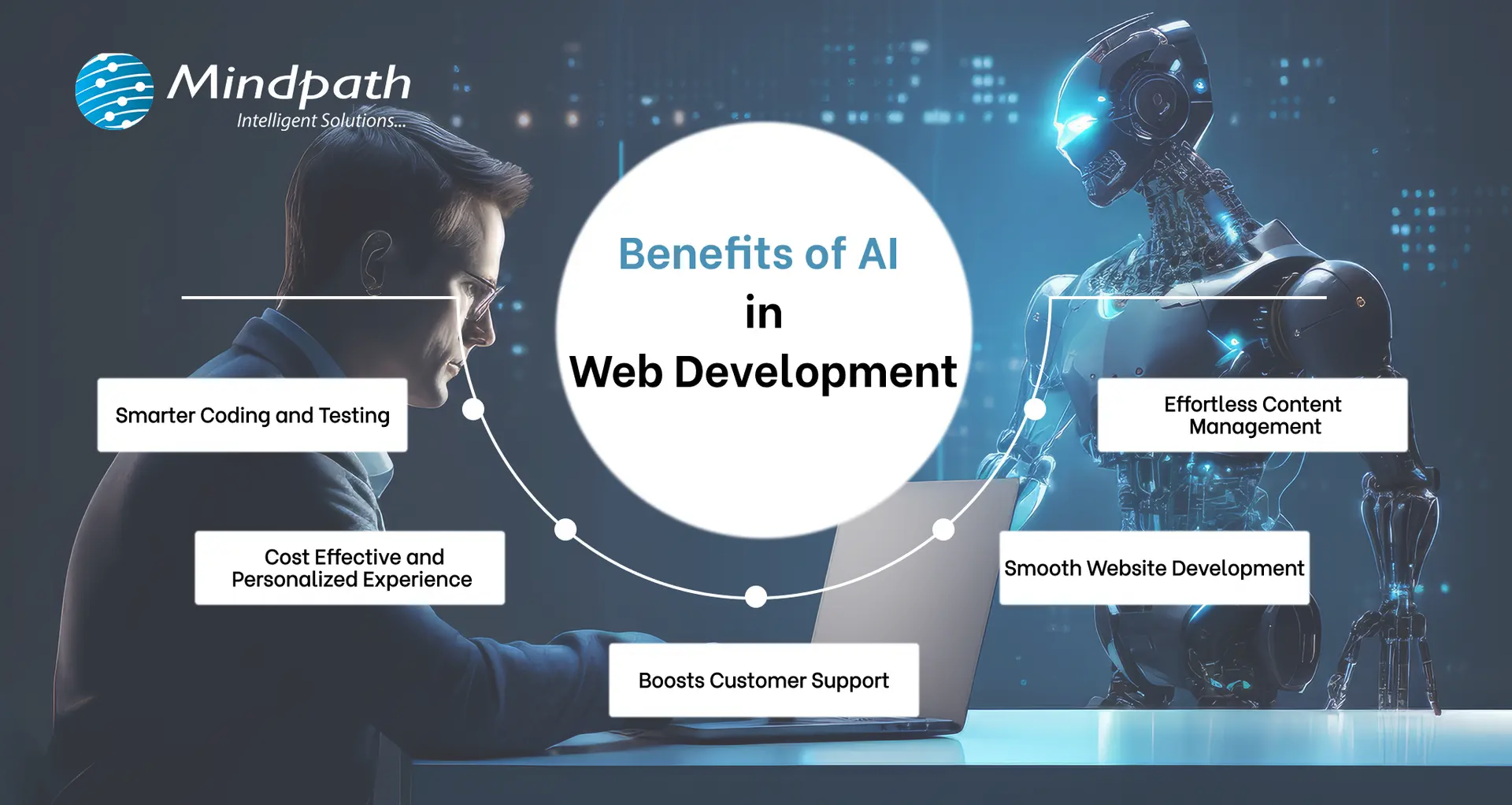
1. Smarter Coding and Testing

The powerful combination of AI and web development can help developers to write cleaner codes by spotting bugs early and improving how the code works. With deep learning, AI-based tools also facilitate automated testing, which assists quality assurance teams in verifying whether the website functions correctly. Although some problematic areas continue to require manual testing, AI streamlines the process and reduces costs. That’s one of the reasons why QA and testing budgets have declined over the past few years, and why more individuals are using AI websites for improved results. 

2. Smooth Website Development

AI in web development handles mundane and time-consuming work so developers can concentrate on the larger aspects of a project. With smart tools and data-driven choices, the entire web development process becomes more efficient and faster. This is incredibly useful, particularly if you’re new to it. By using AI to create websites, you save time and effort while building something awesome and making web development feel less stressful and a lot more efficient from the very start. 

3. Boosts Customer Support

AI in customer service makes it simple to integrate smart chatbots onto websites that are able to engage with visitors’ day and night. These virtual assistants comprehend questions and respond in natural, friendly terms. They provide instant answers, resolve issues rapidly, and never require breaks. This allows owners of websites to assist users without requiring a support team full-time. It’s an easy method to ensure visitors are satisfied and that they always receive assistance, even when there is no one present. 

4. Cost Effective and Personalized Experience

With the help of AI tools, websites are now able to provide customers with a more personalized and seamless experience at reasonable costs. Work that required time can now be processed automatically, saving time for both users and website owners. AI also assists in identifying fraudulent or toxic activities, protecting users. This is why many top AI websites utilize intelligent features to serve customers better. Ultimately, AI assists in providing more value to the customer at a low cost. 

5. Effortless Content Management

Website content management becomes a lot simpler with the assistance of AI. Through analyzing user behavior on a website, AI provides clear concepts regarding what type of content users like most. Website owners can develop improved posts, videos, or pages that genuinely interest visitors due to this. With the assistance of AI web templates and smart recommendation tools, you can lead users to whatever they require and retain them for a longer period. It’s an easy way to make content better and make each visit feel more personal.

Is your business making the most of AI to stay ahead of the competition? Explore how integrating AI in your business strategy can optimize processes, drive growth, and improve decision-making.

How to Use AI in Web Development?

Today, web development thrives on the partnership between AI and human expertise. While AI handles repetitive tasks and enhances efficiency, it still relies on human creativity and problem-solving. Here’s how you can use AI in web development to streamline your process and improve results. 

1. Artificial Design Intelligence (ADI)

Artificial Design Intelligence (ADI) assists you in creating a complete website by simply responding to a few simple questions. It selects the most suitable layout, design, and content depending on your requirements. It’s like having an intelligent assistant that designs a professional-looking site that reflects your style and objectives. This AI website generator makes the process fast and efficient, ensuring you get the site you want with minimal effort.  

2. Search Easier with Voice Assistants

Rather than typing and reading lengthy pages, users can simply speak their question. Voice AI listens, the correct answer quickly, and voices it back. Voice AI assists websites in providing rapid and clear responses, speeding up searches, making it easier, and more accessible to all. 

3. Coding Assistants

Developers can use smart coding assistants to speed up their work. These tools suggest code, spot errors, and help build websites faster. Even when working on big ideas, they take care of the small stuff. It’s like having a smart helper while writing your code. 

4. Personalize User Help with Chatbots

AI chatbots make it easy for users to get the info they need. They can ask questions in simple language, and the bot instantly provides answers or links. The benefit of chatbot is that it provides fast, accurate responses, making the experience more personal and efficient by using the website’s content.

5. Easy Search Engine Optimization (SEO)

AI can make SEO much easier by providing the best keywords, topics, and headlines for your content. It can even write parts of your text, ensuring the right keyword density for better search engine rankings. This helps your website attract more visitors without the hassle of manual research. 

AI is reshaping industries by automating the processes, empowering faster decision-making, and providing data-driven insights. Learn how AI is e-commerce is transforming the future of e-commerce sector.

Ready to Transform Your Website with AI?

AI is changing web development by making tasks faster and more efficient. From designing and coding to improving user experience, AI helps developers focus on what truly matters. By integrating AI, your website can become smarter, more personalized, and easier to manage for everyone involved. 

Mindpath offers top-tier AI development services and delivers high-performing artificial intelligence solutions that enhance your website’s design, performance, and functionality. Our expert team utilizes AI tools to streamline processes, boost user experience, and create custom solutions.  

Related Post

Discover the ultimate guide to hiring Node.js developers in London. Learn about the skills, benefits, and cost factors involved in finding the right talent for your project.
Discover how integrating AI into web development can enhance user experience, improve efficiency, and drive innovation.

Related Post

ReactJS in Social Media

Are you wondering how social media platforms manage to stay fast, interactive, and user-friendly? The secret often lies in the powerful framework behind them—ReactJS. With its ability to build dynamic and responsive user interfaces, ReactJS has become a top choice for developers creating social media apps. But how exactly does it help?  

In today’s fast-paced digital environment, social media platforms must provide smooth, responsive, and engaging user experiences to remain competitive. ReactJS  has emerged as an essential tool for constructing such platforms, providing a robust foundation for developing dynamic, high-performance apps. With its component-based design and quick rendering capabilities, ReactJS allows developers to create dynamic user interfaces that can manage enormous amounts of data and advanced functionality without sacrificing speed. This makes it an excellent alternative for social media sites that want to create a seamless and engaging user experience. 

So, let’s dive into how ReactJS is a game-changer in social media platform development. 

Guide to Build Social Media Platform Development Using ReactJS

1. Project Setup

When launching your social media platform, it’s essential to first determine what makes your network unique. Consider the type of interactions you wish to emphasize and the audience you are trying to reach. This will help you select which features to implement and will steer the general path of your project. Next, you’ll need to create your React project. Tools like Create React project can make this easier by offering a pre-built structure for your project, allowing you to focus on creating rather than setting things up from the beginning. Social media sites require a system to handle the vast amounts of data that are constantly changing, such as user profiles, postings, and comments. Using state management tools such as Redux or the Context API will help you keep everything organized and running smoothly as your platform grows. 

2. Creating UI Components

When developing the user interface for your social media platform, begin by creating components that can be utilized across the program. Examples include user profiles, post cards, and the feed display. Breaking down the UI into these modular components will ensure consistency and make future changes easy. Reusable components improve productivity by allowing you to make changes without impacting the entire project. 

Next, prioritize adding the key functionality that any social network needs, such as user registration, login, and profile editing. These are necessary for users to establish accounts and engage with the platform. Furthermore, combining password recovery and email verification guarantees customers have a smooth and safe experience. Once these foundational functions are in place, you can add more complex features such as friend requests or messaging to increase user engagement. 

3. Handling Data & APIs

When developing a social media site using ReactJS, it is crucial to address the backend. While ReactJS handles the front-end, your platform will require a powerful backend to store user data, manage features such as image uploads, and deliver alerts. Using Node.js and a database like MongoDB offers the infrastructure required to implement these functions. 

API integration is required to connect the frontend and backend. These APIs will enable your app to collect user data, create posts, and manage user interactions. Tools like Axios and Fetch make it simple to connect with these APIs and ensure smooth communication between the front and backend. Security is an important feature of every social media platform. To safeguard user information and guarantee a safe environment, secure authentication methods, the encryption of sensitive data, and the establishment of correct authorization processes must be implemented. 

4. Adding Social Features

Adding the social elements that set your platform apart is now the perfect way to make it come to life. Begin by providing key interactions such as post creation and display, comment and like functionality, and the ability to follow or connect with others. These essential elements are at the core of each social media network, driving user engagement. 

To take things a step further, you can offer real-time updates. You can employ tools like Socket.io or WebSockets to give rapid alerts for actions such as comments, likes, and messages. This keeps users interested and makes the site appear active and alive. If you want a more sophisticated experience, think about including elements that promote deeper inquiry and connections. You can establish user groups or communities, add search features to locate content and individuals, or enable direct messaging for private chats. These features improve user engagement, making your platform more engaging and interactive. 

5. Testing & Launching

To guarantee that your social media network functions effectively, conduct thorough testing. Check every area of your application, from the user interface to data flow and API connection, to ensure that users have a smooth experience. Using tools such as Jest or React Testing Library can assist you quickly find and resolve issues, making the testing process more dependable and organized. When your software is polished and ready, it’s time to release it to the public. Deployment platforms such as Netlify or Heroku provide easy and effective ways to host your application, allowing your users to access it easily. With thorough testing and deployment, your social network will be ready to provide an excellent experience to its users. 

Also Read: ReactJS – Best Choice for Progressive Web App Development

How Can Mindpath Help?

At Mindpath, we specialize in building powerful and scalable web applications, including social media platforms, using ReactJS. Our experienced team of developers can help you design and develop a feature-rich, user-friendly platform tailored to your unique needs. Whether it’s creating reusable UI components, implementing secure backend integration, or adding advanced social features like real-time updates and messaging, we’ve got you covered. We also ensure rigorous testing and seamless deployment, so your platform is reliable and ready to impress your audience. 

Wrapping Note!

ReactJS is a game-changer for social media platform development, offering speed, scalability, and flexibility to create dynamic and engaging user experiences. Its powerful tools make it easier to design user-friendly interfaces, integrate robust backend systems, and implement essential social features. If you’re ready to turn your vision into reality, Mindpath is here to help. With our ReactJS expertise, we’ll create a feature-rich, high-performance platform tailored to your needs. Let’s build something exceptional together! 

Ready to Build Your Social Media Platform?

Partner with Mindpath to create a scalable, feature-rich platform powered by ReactJS.

Discover how ReactJS powers dynamic social media platforms with seamless UI, real-time updates, and scalability.
Web development trends

The landscape of web development is evolving faster than ever. What was an innovation just a few years ago is now obsolete. Developers and businesses should stay ahead of the curve to remain relevant and competitive. From decentralized technology to AI-powered automation, the latest web development trends are redefining how web apps and websites are developed and optimized. 

These trends do not just revolve around making technical upgrades. They involve strategic shifts that influence digital growth and user experience. By embracing these advancements early, you can enjoy a decisive edge in this competitive digital world. Following a well-structured web development roadmap can help you prioritize the right technologies, tools, and methodologies for maximum impact.

In this blog, we will talk about some major trends in web development processes, methodologies, and tools that are constantly transforming this landscape. 

Using these trends in your business requires expert guidance. At Mindpath, we offer web development services where our guidance will provide you with the direction you need to stay ahead of the competition.

The New Era of Web Development

Web development is now entering a transformative era, significantly driven by user-centric designs and technological innovations. In the future, we can expect to see faster, personalized, and smarter websites.

Besides, the demand for Progressive Web Apps will increase as these apps provide users with an app-like experience without downloading an app. What’s more? With machine learning and IoT widely integrated into websites, the web will evolve into a more responsive, intelligent, and interactive ecosystem. 

Must Read: AI in Web Development

Let’s further explore the top web development trends that are shaping the next generation of digital experience.  

Top Web Development Trends 2026

As we move deeper into 2026, here are some trends that are reshaping how web applications and websites are built and deployed. These innovations enhance scalability, performance and align with increasing demand for transparency, security and personalization.

1. Code Will Become Optional: AI-Assisted Development

In 2026, AI-powered web development tools will streamline multiple tasks, from code creation to UX enhancement. Platforms such as OpenAI Codex, GitHub Copilot, Tabnine, and more help developers by suggesting improvements, writing boilerplate code, debugging, and more. 

Besides, web application development trends in 2026 include predictive analytics, AI-assisted personalization, intelligent chatbots, etc. Such intelligent capabilities have become integral to modern web development projects with source code, reducing development time and enhancing user engagement. 

2. The Rise of Jamstack Architecture

Jamstack (which combines JavaScript, APIs, and Markup) has become one of the most popular web development technologies. This modern architecture decouples the front-end from the back-end. It leads to improved security, better scalability, as well as faster load times. For marketing pages, e-commerce sites, and content-heavy platforms, Jamstack would be an excellent choice 

3. Blockchain Technology

Blockchain is here to facilitate continuous flows of records and transactions, called blocks. This technology is cryptographically secure and records every transaction in a tamper-proof and transparent manner.  

Web developers can use this to create high-performance, decentralized applications that eliminate centralized control and intermediaries. 

4. Progressive Web Apps

By combining the features and functionalities of native mobile apps and websites, PWAs are changing the web development process. These apps offer an app-like experience while being cost-effective and accessible. 

A report indicates that the global PWA market is projected to grow from USD 1.9 billion in 2014 to USD 9.7 billion by the end of 2034 (Source: Emergen Research). This clearly shows the rising adoption of PWAs by businesses.

5. Machine Learning in Browsers

Thanks to the latest web development technologies like TensorFlow.js and WebAssembly, web developers can easily run various machine learning models in browsers. This facilitates voice recognition, real-time personalization, predictive UX, and more. It is now possible to create privacy-conscious and faster applications that can adapt to user behaviour. 

Are your web apps providing the best possible experience for users? Discover UI/UX design trends in web application development to learn how modern design trends can enhance usability and engagement.

6. Micro-Frontends

It breaks down the complete UI into manageable, smaller components. This modular approach significantly enhances scalability and facilitates parallel development. This can be an excellent solution for large-scale development projects. 

7. No-Code and Low-Code Platforms

Low-code development is getting popular among developers. Platforms such as Bubble, OutSystems, and Webflow let non-technical users create functional websites with minimal coding. It reduces costs and accelerates prototyping. Low-code or no-code development is one of the impactful dev trends in 2026 for small businesses and startups.  

8. Single Page Applications

These web apps are created as a single page, and they can dynamically update content in real-time. SPAs help reduce costs, and businesses can use cloud technology to attain scalability. Some examples of popular SPAs are Google Maps, Facebook, Airbnb, Twitter, and Netflix. 

9. WebRTC Advancements

WebRTC is a major technical advancement in the field of web app development. It is an open-source technology and uses HTML and JavaScript APIs to add communication features to browsers. There is no need to use any external software or plugins.

With the help of RTCPeerConnection, RTCDataChannel, and MediaStream, it enables peer-to-peer data, video, and audio sharing. 

10. Edge Computing

It refers to the processing of data closer to the source instead of depending on centralized data centers. It reduces latency, improves privacy and performance while helping businesses to keep costs low. 

Edge computing is becoming significantly crucial for business, and it is estimated that by 2028, it will reach USD 378 billion (Source: IDC Research). 

Choosing the right technologies is crucial for building a high-performing web app. Explore the tech stack for your web app success to discover the best tools and frameworks for your project.

11. Motion UI Frameworks

These frameworks help bring a static interface to life by integrating optimized transitions and animations. For example, Animate.css offers ready-to-use animations that are compatible with multiple browsers. It is a great option for sliders and home pages. 

You can implement animations that are not just visually appealing but also serve functional purposes, such as highlighting vital information, guiding visitors through a certain process, etc. 

12. Adaptive and Responsive Design

Web development trends in 2026 also include the wide use of adaptive designs. With wearables and foldable devices entering the mainstream, adaptive design is now evolving. Developers are prioritizing gesture optimization, context-centric layouts, and device-specific breakpoints. 

This shift is central to modern web development trends, ensuring a consistent user interface across screens and devices. 

13. Server-Driven UI

It enables servers to identify the behaviour and structure of the front-end for dynamic content rendering and quick updates. It transmits JSON-based instructions to the frontend and controls the UI layouts.

This development approach allows faster deployment, seamless CMS integration, personalization, and cross-platform consistency. It is a strategic shift in today’s web development trends.

14. Data-Driven UX and Real-Time Analytics

Developers are now integrating session recording, heatmaps, real-time user behaviour tracking, and more for design decisions. This approach reduces guesswork and assumptions while enhancing user satisfaction. 

Product metrics, email analytics, Google Analytics, and social media analytics are some commonly used analytics tools to get important quantitative data. This approach aligns with new web development trends and can also boost conversion rates. 

15. AI-Assisted SEO Optimization

With search engines, SEO is also evolving. AI tools are now helping with content scoring, meta tag generation, keyword clustering, and improving internal linking. 

For developers and content strategists, it means better alignment with user needs and faster optimization cycles. 

Looking to build a website that drives engagement and conversions? Explore web design and development services to discover how professional design and development make an impact.

Latest Web Development Languages for 2026

Staying updated with the Latest Web Development Languages is also important to create future-proof and scalable web applications. Here are some key languages that cater to frontend as well as backend needs.

1. JavaScript

The backbone of front-end development, and it helps create interactive and dynamic user interfaces. 

2. TypeScript

An ideal option for large-scale projects due to its error reduction and maintainability. 

3. Go

Also called Golang, it is popular for its concurrency and speed. It is widely used for websites requiring high performance. 

4. PHP

A dominating language for server-side scripting. Frameworks such as Laravel are modernizing PHP development.

5. Rust

Well-known for performance and memory safety, Rust works well for secure backend systems and web assembly projects. 

Want a web application built to match your workflow perfectly? Discover our custom web development services to learn how we create bespoke digital experiences.

Dev Trends to Watch in 2026

In 2026, the application development trends cover CI/CD automation, AI coding, and more. Here are some major dev trends you should consider. 

1. Mico Frontends

Dividing user interfaces into independently-deployed, smaller parts with an aim to achieve flexibility, collaboration, and scalability. 

2. AI-Assisted Coding

Smart testing tools and code generation tools powered by AI are simplifying workflows. 

3. CI/CD Pipelines

Automated testing ensures that web applications and websites are updated on time and faster. 

4. Sustainable Development

Coding architectures and practices that meet global accessibility standards and reduce energy consumption are getting popular in dev trends. 

5. 5G Integration

Developers can leverage 5G technology to optimize CDNs or Content Delivery Networks and create high-performing websites. 

It can be said that the future of web development holds more such exciting innovations. 

Integrating CI/CD into your development cycle can boost productivity. Explore CI/CD Pipelines to discover tools and techniques for seamless automation.

It’s Time to Embrace the Trends

The 2026 web development trends clearly signal a shift toward adaptability, speed, and intelligence. Businesses optimizing their landing pages or creating new websites from scratch, these new technologies in web development can offer strategic opportunities to enhance the digital experience.  

If you are searching for an expert who can guide you through this evolving landscape, Mindpath would be the best option for you. We offer comprehensive web development solutions designed to take your digital experience to a whole new level. Our experts keep themselves updated with the current web development trends so that you can enjoy the desired results. Let us develop a perfect website integrated with advanced features and capabilities, and stand out in this competitive market.  

ai app development playbook

Have you ever wondered how AI app development can take a basic idea and create something that is smart, user-friendly, and helpful? Imagine an app that learns, impacts your activities, and improves your life without cognitive load! By developing an appropriate strategy, businesses can build apps that make a difference. A well-thought-out strategy will position you to create something that adds real value to users every day.

That’s why an AI app development playbook is necessary. A good playbook maps out the process into actionable steps, so it doesn’t feel overwhelming. A playbook will guide you through the process of validating your idea, selecting the right tools, developing your app, testing it, and launching it. The playbook provides a roadmap to work from, which can save time, reduce risk, and set you apart from the competition. In this blog, you will learn more about how this playbook can help you succeed. So let’s dive in!

Looking for a way to adopt an AI-powered application? Our AI development services help businesses and teams to build intelligent apps that are secure, scalable, and relevant to the needs of the user.

What does AI App Development Mean?

AI app development refers to the development of applications that use artificial intelligence to achieve tasks that typically require human-like thinking. AI functionality in applications includes understanding human language, recognizing images, making recommendations, or learning users’ preferences over time. Developers can have these applications learn and improve infinitely by using sophisticated algorithms, machine learning models, and large data samples, which allow applications to provide the most relevant and valuable experiences for the user, improving continuously.

In contrast to traditional app development, which has fixed rules and stagnant workflows, AI app development allows apps to update, evolve, and respond in real time. AI development uses data processing, pattern recognition, and predictions to be presented in a flexible state and to solve more complex problems. With the right strategy, app development with AI can equip businesses with solutions that differentiate them from competitors and adapt to new user demands.

Must Read: Role of Gen AI in app development

What is an AI App Development Playbook?

An AI app development playbook is a structured guide that helps teams and businesses create applications powered by artificial intelligence. It brings together proven methods, industry best practices, and practical tips to manage the unique challenges of building AI solutions.

Instead of approaching development without direction, a playbook provides clarity and keeps everyone aligned with the same vision and goals. It helps you make better decisions, avoid common mistakes, and use resources more effectively. Having an AI app development playbook means you have a clear plan to turn an innovative idea into an intelligent, successful application.

Looking to leverage artificial intelligence to make your mobile apps smarter and more user-friendly? Discover how AI in mobile apps can enhance functionality, personalization, and overall user experience.

Benefits of Building AI App Development Playbook

A well-crafted playbook does more than just outline steps; it brings clarity to every decision you make during AI app development. It helps you build with confidence and turn innovative ideas into real, valuable solutions. Let’s dive into some of its benefits:

Benefits of Building AI App Development Playbook

1. Faster Development and Better Efficiency

A well-structured playbook helps teams work smarter and avoid wastage of time. By following proven steps and using the right AI development tools, you can speed up tasks like coding and testing. This leads to faster delivery and more efficient use of resources.

2. Enhanced User Experience

A clear plan helps you build apps that feel more personal and easier to use. Smart features like chatbots and recommendations keep users engaged and satisfied. With the right approach, your app becomes something people enjoy using every day.

3. Smarter Decisions and More Innovation

A playbook supports better choices by using data and clear workflows. Teams can experiment and improve quickly, turning ideas into working features faster. This creates an environment where new ideas thrive.

Also Read: AI in Business Strategy

4. Higher Quality and Fewer Mistakes

When you follow a playbook, your team knows when and how to test and debug. This helps catch issues early and maintain a higher standard. In the end, users get a stable app that works as expected.

5. Responsible and Safe AI Development

A strong guide ensures your team builds solutions that are fair, secure, and trustworthy. It helps address risks like bias or privacy concerns early on. This makes your AI software development more reliable and compliant with industry rules.

6. Clear Goals and Long-Term Growth

A playbook aligns your team with clear objectives that support your business goals. It helps you plan where AI fits best, including when to add features like AI chatbot development services that bring real value. This approach keeps you competitive and ready for steady growth.

Want to enhance user engagement and automate interactions in your AI applications? Discover how lead generation chatbot strategies can streamline customer interactions and boost conversions.

Steps to Build an AI App Development Playbook

Creating an AI app development Playbook gives your team a clear roadmap to build smarter, more reliable applications. It helps you plan each stage carefully, avoid common mistakes, and deliver real value to users. Use these practical steps to shape a playbook that keeps your AI projects focused and successful.

Steps to Build an AI App Development Playbook

1. Set a Clear Vision

Begin by defining exactly what your AI app should achieve and why it matters. Know the specific problem you’re solving and the audience it will help. Make sure your vision is realistic and tied to your broader business goals. A clear vision gives your team direction and purpose. It sets the tone for every decision you make during development.

2. Do Your Research

Spend time understanding your market, target users, and any competitors. Identify the data you’ll need and check if you can access it responsibly. Look into what AI features will add the most real value. Planning for data privacy and quality early helps you avoid problems later. Good research lays the groundwork for a stronger build.

3. Build a Strong Team

Bring together people with the right mix of skills in AI, design, development, and testing. Make sure everyone understands their role and how they’ll work together. Clear communication and teamwork keep the project on track. A well-prepared team can solve challenges faster. This creates a smoother workflow and better results.

4. Pick the Right Tools

Choose AI development tools, frameworks, and cloud platforms that fit your app’s goals and budget. Look for trusted solutions that make it easier to train, test, and update your AI models. Make sure your tech stack supports scaling as your app grows. Keep your tools flexible so you can adapt to new trends and needs. The right setup saves you time and keeps development efficient.

Want to stay ahead in the rapidly evolving world of artificial intelligence? Discover the latest AI trends that are shaping applications, development, and business strategies for the future.

5. Design for Real Users

Think about how people will actually use your app in daily life. Keep the design simple, clear, and focused on solving user problems. Test early designs with real users to spot areas that need improvement. A smooth experience builds trust in your AI features. The best AI apps feel helpful and natural, not confusing or intrusive.

6. Build, Train, and Test

Start with a minimum viable product that gets the basics right. Train your AI models using clean, reliable data to get accurate results. Test often to catch problems early, rather than fixing big issues later. Use real user feedback to improve your app’s performance. A strong cycle of training and testing keeps your app working well over time

7. Keep It Safe and Fair

Map out how you will securely and responsibly handle user data. You should address any possible biases in your AI models to ensure your app is fair to all users. Stay on top of current data protection practices and regulations. Establish guidelines for your team to follow for every engagement. Following these steps will help you establish trust and remain ethical with your AI solutions.

8. Launch and Improve

Prepare to launch by testing your app in a real-world environment. Observe the ways your app works and the way users will interact with it. Explore what aspects work well and what aspects need improvement. Record these notations for use very soon after launch. Consistent updates allow you to keep your AI app up to date and trustworthy.

9. Update Your Playbook Regularly

Treat your playbook as a living document that grows with every project. After each launch, review what went well and what you could do better. Add lessons learned, updated tools, and new best practices. This keeps your team ready for future AI projects. A well-maintained playbook is an investment in long-term success.

Looking to ensure that your AI applications are secure and reliable for users? Discover essential strategies for protecting your apps by exploring web application security guide.

Want to Turn Your Smart Ideas into a Powerful AI App?

Creating an AI app development playbook helps you move an idea forward with structure, focus, and confidence. It guides your team through clear steps that save time, reduce mistakes, and make the most of available resources. With a practical playbook, you can deliver apps that adapt, solve real problems, and keep users engaged. It’s the smartest way to stand out.

Mindpath is a renowned AI development company that helps businesses build solutions that work in the real world. Our AI development services cover everything you need to plan, develop, test, and grow your app responsibly. We bring trusted strategies and proven tools to your project. Let’s work together to turn your AI app vision into a successful story.