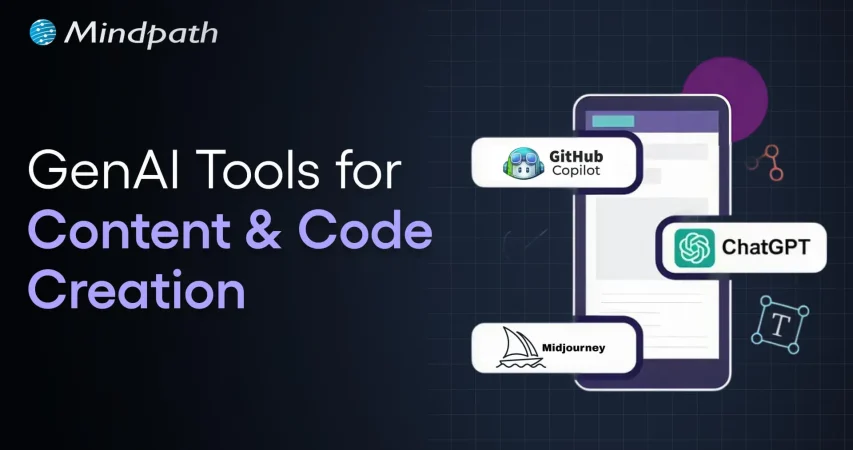
Generative AI Tools for Content & Code Creation

Join our Newsletter!

Featured Posts

Support Is One Click Away

Home

Generative AI Tools for Content & Code Creation

generative ai tools for content creation

Generative AI Tools for Content & Code Creation

Did you ever wish you could brainstorm new concepts, create beautiful visuals, or write codes without any creative personnel or technical expertise? Now that there are well-developed generative AI tools for content creation and code generation, this is not a dream anymore. These smart tools are enabling users to develop quality content and working code in a matter of minutes. Whether it is writing blogs or coming up with generative code snippets, these tools are aiding productivity and creativity in industries.

All you need is the right tool to witness the magic. Here, in this blog, you will learn about generative AI for code generation and content development. In addition to that, we will discuss some of the most essential aspects that will allow you to select a generative AI tool without any confusion.

Want to improve your business content creation and coding capabilities without increasing the workforce? Mindpath’s AI development services build custom GenAI solutions that deliver consistency and measurable results.

What are Generative AI Tools?

Generative AI tools refer to AI-based software programs that generate content such as audio, code, images, or text depending on the inputs of the users. Gen AI is changing creative work and to automate a number of repetitive processes. They are trained on a huge amount of data and generate content based on the context, which can be beneficial to teachers, marketers, developers, and designers.

Here is how generative AI can help in code and content creation.

1. Produce beautiful marketing images.

2. Write social posts, emails and articles.

3. Computerize routine development processes.

4. Write code using various languages.

Whether you are a marketer who wants to optimize the content or a developer who needs to quickly get the code finished, generative AI can serve as your creative partner.

Wondering where generative AI is making the biggest impact? Discover generative AI use cases to explore real-world applications across industries.

Let’s now learn about the most popular generative AI tools for content creation and code generation and know how to select the appropriate one for your business. 

Generative AI Tools for Content Creation

Generative AI has enabled more scalable, faster, and smarter content creation processes across industries. Here are some popular tools assisting with ideation, editing, and drafting. 

1. Copy.ai

It generally focuses on generating short-form content. Businesses can use it to generate taglines, headlines, and relevant email subject lines. Copy.ai is an ideal option for quick ideation and A/B testing across multiple campaigns. 

2. Jasper

This AI-based tool is an advanced writing assistant that is developed for sales teams, marketers, and brands in need of conversion-driven and persuasive content. It comes with built-in templates as well as SEO integration. Jasper can assist you with the social media posts, landing pages, and advertising.

3. Hypotenuse AI

This tool specializes in generating e-commerce-focused content and product descriptions. It is also able to develop SEO-friendly blogs depending on the nature of your brand so that you can gain organic traffic. Using this, you can maintain a consistent brand tone for your marketing content.

4. ChatGPT

This versatile tool is an excellent option for long-form writing, conversational content, and brainstorming. It is flexible in style and tone, and is therefore excellent for emails, product description, and blogging.

Wondering how tools like ChatGPT generate human-like responses? Explore the Large Language Models (LLM) guide to understand the technology powering content and code creation.

Wondering which AI tool is best for content creation? Well, that entirely depends on your requirement. You should choose generative AI tools for content creation considering your audience base, content format, workflow requirement, and platform. 

Top Generative AI Tools For Code Generation

AI coding tools are not here to replace developers; they are here to enhance their efficiency and capabilities. Well, if you want to experience it, here are some of the best generative AI tools for code generation that you can try. 

1. Tabnine

It is a deep-learning code assistant and can easily adapt to every developer’s style. The platform supports IDEs and multiple languages. Besides, it offers privacy-first deployment along with team-based training. With this tool, you can ensure context-aware code generation. 

2. Qodo

It is an AI-based code quality platform, which provides comprehensive test cover, compliance, and code integrity. It can easily be incorporated into CI pipelines, JetBrains, VS Code, and IDEs. Qodo also promotes features like code explanation, SDLC coverage, and automated test development.

3. GitHub Copilot

This tool is built in with Visual Studio Code and provides smart code completion, automatic snippet generation and real-time suggestions. It supports several programming languages and assists programmers to code more quickly and with minimum errors.

4. Replit

It is a browser-based coding platform that offers AI-powered contextual code generation and auto-completion. In addition, it is also capable of detecting errors and breaks down complicated code snippets efficiently with a reasonable explanation. Replit also supports real-time collaboration and rapid prototyping.

Interested in AI-powered image and media generation? Explore our Stability AI guide to see how Stability AI tools support creative workflows.

Tips to Choose the Right Generative AI Tools

Selecting the best generative AI tools for your needs requires a strategic approach. After all, not all the tools are the same, and one tool can’t fulfil all your wishes. However, you don’t have to worry at all, as here we have listed down some useful tips that will help you make an informed decision. 

1. Know Your Goals

Always begin by learning about the core objectives. Understand whether you need a tool for editing multimedia, writing SEO-optimized content, or generating code. With a clear goal, it will be easier for you to match tools to particular tasks. 

2. Pilot Various Tools

Extensively test multiple AI tools and compare their output quality, feature alignment, and usability. Piloting can help you find out which tools perfectly fit your existing workflows and adapt to your technical and creative style. 

3. Customization and Training

Opt for generative AI tools that allow quick tuning, model training, and brand voice adaptation. Flexibility in customization ensures the results are consistent and relevant.

4. Integration Compatibility

While searching for generative AI tools for content creation, you should ensure that they will integrate with your existing tools, like IDEs, CMS, etc. A seamless integration will reduce friction and increase productivity while supporting your future scalability. 

5. Support and Community

Some tools can be a little challenging to get started with. However, a tool with strong documentation and active forums will be easy to use. A growing community will accelerate learning and help you troubleshoot different issues. 

Keep these points in mind and align your organizational goals with the tool’s capabilities to find the best solutions. Only the right one can help enhance creativity as well as productivity. 

Want to stay ahead of emerging AI innovations? Check out generative AI trends to learn what’s shaping the future of AI tools.

Challenges and Considerations in Gen AI

As generative AI platforms become essential to code and content creation, many ethical considerations and challenges demand attention. Read to know more about this.

1. Ownership Conflict

One of the major concerns is ownership. Who truly owns AI-generated outputs- the developer, the platform, or the users? We all know that the current legal frameworks are not designed for technological innovation. This has created confusion around licensing, distribution rights, and copyright. Every organization should establish transparent internal policies that clearly state ownership. 

2. Ethical Grey Zones

Generative AI tools are trained on massive datasets, and that data may carry bias, cultural blind spots, and misinformation. Without proper oversight, those flaws can be seen in outputs. Organizations should consider ethical AI and focus more on fairness, transparency, and, of course, accountability. Speaking about the responsible use of models, it includes proper auditing models, flagging problematic content, and aligning outputs with societal values. 

3. Human Judgment Still Matters

Undoubtedly, generative AI tools have impressive capabilities. However, they are not infallible. These tools can misinterpret prompts, offer irrelevant content, and hallucinate facts. That’s why human oversight will remain essential for quality checks. Editorial review, domain expertise, and critical thinking are irreplaceable. 

4. Access Gaps

Powerful AI tools often need significant resources such as financial investment, computing power, and technical expertise. This may create obstacles for small creators and teams. Eliminating such issues is important for equitable innovation. Affordable pricing, inclusive design, and open-source models can lead to vast adaptation. 

Addressing these issues will ensure that generative AI tools evolve responsibly and can benefit various users. 

Wondering how businesses can adopt generative AI responsibly? Discover generative AI for business to learn strategies that balance innovation, cost, and accessibility.

Generative AI Tools – What’s There in the Future?

The future of generative AI tools for content and code creation is evolving rapidly. The trends indicate more accessible, intelligent, as well as collaborative experiences.  In the future we shall be able to observe:

  • Stunning multimodality features combining images, audio, code, and text generation.
  • More developed and elaborate fine-tuning of industry-specific code standards and writing.
  • The risk of errors will be reduced as AI will be able to comprehend context on a profound level.
  • AI will function as a technical and creative partner, helping businesses boost productivity. 
  • AI-powered content and code creation will become more accessible to small businesses, startups, and non-technical users. 

Curious how generative AI is reshaping business operations? Explore our generative AI revolution blog to see how it is transforming content creation and the future.

Generative AI Tools- Driving Innovation in Code and Content

Generative AI tools for content creation and code generation are transforming the way developers and businesses operate. These tools are driving high-speed innovation, increasing the power of creativity, and improving quality. Whether you need to write interesting marketing copy or just want to automate some of your coding tasks, these tools can help you with this seamlessly.

Mindpath’s AI development services have been leading this revolution and assisting businesses in embracing the potential of generative AI. Using our experience in offering tailored AI solutions and fine-tuning, you can have your AI tools aligned per your specific needs. With us, you can strategically select the best generative AI tools for content creation or code generation. Shine out in this changing online scenario with us!

Related Post

Discover the ultimate guide to hiring Node.js developers in London. Learn about the skills, benefits, and cost factors involved in finding the right talent for your project.
Discover how IT staff augmentation boosts project scalability with quick access to talent, cost-effective scaling, and expert support.
Hiring ReactJS developers? Follow our expert tips to find the right talent and build a strong development team.

Related Post

low-rank adaptation (lora)

The landscape of artificial intelligence is advancing at a higher rate. And it has made it crucial to ensure efficient adoption of LLMs or Large Language Models.  Low-rank adaptation (LoRA) has emerged as an effective technique to fine-tune LLMs. Developers are now looking for scalable methods to customize AI models. Well, LoRA offers them a lightweight and cost-effective technique.

Furthermore, it has made the process of low-rank adaptation of LoRA in fine-tuning feasible, accessible, and efficient. In this detailed blog, we will explore more about the LoRA adaptation, understand what it is, and how it works. Besides, we will also discuss why it is an important method for fine-tuning LLMs in 2025. So, read on!

Struggling to figure out how advanced tuning methods like LoRA can give your business a competitive AI advantage? Mindpath’s AI development services help you harness LoRA-driven fine-tuning to build smarter, faster, and more efficient AI solutions.

Low-Rank Adaptation (LoRA) – An Overview

Before exploring more about low-rank adaptation (LoRA), let’s start with the basics, i.e., what is low-rank adaptation in LoRA? It is an efficient fine-tuning method that trains large LLMs to easily handle new tasks. The best part is, with this method, developers don’t need to change any parameters. Instead of updating all parameters. LoRA freezes the model weight and then injects a few new weights or trainable low-rank matrices. Fine-tuning with LoRA significantly lowers the number of trainable matrices without affecting the model’s base knowledge.

Importance of LoRA

Large language models such as ChatGPT are powered by massive neural networks. These networks have trillions of parameters. And during pre-training, these parameters are fine-tuned to make models work properly. While it makes AI models powerful, there is no guarantee that they will work efficiently for certain tasks. Adapting a larger language model to a specific use case, like custom support automation or legal documentation, requires full fine-tuning. For instance, if you want to fine-tune GPT-4, then you will have to work on around 1.8 trillion parameters. Besides, the process demands enormous infrastructure and GPU memory.

However, low rank adoption (LoRA) provides developers with a more efficient and smarter alternative. It allows them to inject small training parameters into specific layers. This, in turn, reduces GPU memory requirements. Furthermore, it leads to minimal disruption, lower costs, and quick training. If you think Low Rank Adoption is the only parameter-efficient method, let us inform you that QLoRA or Quantization LoRA is now gaining popularity in the industry. The reason behind this is that it combines high-precision computation with low-precision storage.

Low Rank Adaptation LoRA Example

Now, let’s have a look at a Low rank adaptation LoRA example in order to get a clear idea about the impact of LoRA. Let’s assume you want to fin-tune BERT. You may opt for a full fine-tuning. But for that, you will have to retrain nearly 108,314,886 parameters. Besides, the method is resource-intensive.

On the other hand, using LoRA, you can freeze the model’s original weights. It allows you to train only the necessary adapters related to your tasks. In fact, you can achieve the desired results just by training only 78,342 parameters. As a result, you will witness a significant reduction in training time as well as machine cost.

New to fine-tuning techniques like LoRA and unsure where to start? Explore Large Language Model (LLM) to build a strong foundation before diving deeper.

Low-Rank Adaptation (LoRA) Techniques

Now that you have a clear understanding of low rank adaptation (LoRA), let’s talk about the right way to use Low-Rank Adaptation (LoRA) Techniques. To ensure desired outcomes, developers can follow these steps.

1. Selecting a Base Model

 Begin by choosing a suitable AI model. You can opt for GPT-4 or GPT-3 as per your need.

2. Create Datasets

After the selection of a model, next, you need to collect quality datasets. Here, you must ensure that those datasets match your fine-tuning objectives.

3. Deploy LoRA Modules

While deploying LoRA adapters, choose the right attention layers. To avoid any issues, ensure a balance between performance and efficiency.

4. Rank Tuning

Select an appropriate rank. While smaller ranks can lower training costs, they can limit the model’s expressiveness. In general, the value can range between 4 and 46, based on the task.

5. Train Adapter Parameters

Here you need to be careful. First of all, freeze all the original parameters. Once done, you can start training low-rank parameters on your dataset. There is no need to train all parameters.

6. Process Validation

Use a separate validation set to monitor the performance of the model. Keep in mind that if the training data is limited and the rank is too high, this can increase the risk of overfitting.

7. PEFT Libraries Integration

To streamline the implementation process, developers can deploy libraries such as Hugging Face’s Parameter-Efficient Fine-Tuning library. It offers plug-and-play support.

Wondering how LoRA compares to traditional fine-tuning approaches? Discover OpenAI’s Fine-Tuning API to understand when efficient fine-tuning matters most.

The Hidden Cost of Full Fine-Tuning

To get a clear understanding of the importance of Low-rank adaptation (LoRA), it is critical to understand the exhaustive technique it replaces, i.e., Full Fine-Tuning.

A pre-trained large language model is essentially a huge network of weight matrices that encode the learned knowledge of the model. When developers go for a full fine-tuning, they feed the model specialized datasets. After that, the model adjusts each parameter to align with the new task.

This process involves calculating errors in the output and sending gradient updates through the entire network using an optimizer such as Adam. However, this technique comes with some critical drawbacks.

1. High Computational Cost

Fine-tuning a model with billions of parameters requires massive GPU memory. To store the AI model, optimizer stats, and necessary gradients, you will need enough VRAM, around hundreds of gigabytes.

2. Storage Inefficiency

Full fine-tuning creates a new model file. A 70B model, at 16-bit precision, can be around 140GB. Storing this size of file for every user who needs a custom AI model is unsuitable. That means maintaining separate models at large is nearly impossible.

3. Risk of Forgetting

Updating all weights to understand the new tasks can overwrite the existing capabilities of the model. For instance, it may not be able to translate language. This can significantly reduce the model’s versatility.

For years, AI model customization was exclusive to the AI labs that created them. However, things have started to change, all thanks to low-rank adaptation (LoRA). It has changed the rules of fine-tuning.

Curious about what LoRA actually optimizes inside modern AI models? Explore attention mechanism explained to understand the architecture behind efficient adaptation.

Why LoRA is an Excellent Option for Fine-Tuning LLMs?

Low rank adaptation (LoRA) is an ideal method for fine-tuning LLMs. After all, it brings efficiency, scalability and versatility to the process.

Here are some benefits of LoRA that prove why it is an excellent option.

1. Parameter Efficiency

As mentioned above, LoRA reduces the number of parameters. It makes fine-tuning possible utilizing low-resource hardware. Apart from this, it opens doors for independent developers to customize AI models.

2. Retain Pre-Trained Knowledge

By preserving base model weight, LoRA eliminates the risk of catastrophic forgetting. Using this, developers can ensure that a model’s general language understanding capability remains intact while expanding to new domains.

3. Scalable Fine-Tuning

With low rank adaptation (LoRA), fine-tuning is faster compared to other techniques. Developers can fine-tune multiple versions of models for various domains. There is no need to duplicate the entire model. As a result, version control will be easier.

4. Full Impact with Zero Latency

The weights of the adapter can be easily merged with the pre-trained models during inference. This helps maintain runtime performance without added latency.

5. Versatility

LoRA seamlessly integrates with popular transformer architectures such as BERT, T5, and GPT. That’s why it is a versatile fine-tuning solution in 2026.

Thinking about where LoRA-fine-tuned models create real business value? Discover generative AI use cases in diverse industries to see how efficient AI adaptation drives impact.

Final Thoughts

Low-rank adaptation (LoRA) is now transforming the process of fine-tuning large language models. By reducing the total number of trainable parameters while maintaining the model’s integrity, LoRA has made fine-tuning more scalable, cost-effective, and accessible. Whether you are developing a multilingual translator or a healthcare chatbot, it offers the precision and flexibility required to train AI for real-world applications.

Developing and fine-tuning AI models can get complicated. This is where Mindpath comes in. Our AI development services can help you in designing and fine-tuning models using low-rank adaptation (LoRA). While doing that, we also ensure that all the things fit perfectly into your workflows. Let us make your AI solution personalized and powerful.

AI consulting services

In today’s competitive environment, organizations are consistently searching for more intelligent ways to grow, innovate, and differentiate themselves. AI consulting services support organizations to seize the opportunities that become realizable by developing distinct ways to harness data and technology as opportunities. As the velocity of digital innovation changes radically for organizations, it is clear that we can no longer take the same approaches. Why not explore the tools and experience that enable organizations to remain fluid and agile?

While organizations continue to embrace new technologies, the challenge comes in figuring out how to apply them effectively. The value of having expert advice is where the innovation matches business objectives, ultimately with measurable outcomes. Instead of being confused when adopting new technology, organizations are provided with clarity and direction as a result of skilled consultants. The right balance between strategy and technology allows organizations to leverage their growth journey with smarter decisions and sustainable results. This blog will explore why today’s organizations should consider AI consulting services as their path forward.

Want to lead the future with the use of AI in your organization, but don’t know where to begin? Our AI consulting services will guide you at every step to stay ahead and unlock measurable growth.

The Growing Demand for AI Consulting Services

Future Market Insights projects that the global AI consulting services market will grow from USD 11.07 billion in 2025 to USD 90.99 billion in 2035, representing a CAGR of 26.2% during this period. This increase represents a substantial business demand for specialist expertise as businesses look to consulting firms to navigate the additional complexities around AI adoption.

Among various industries, such as finance, healthcare, retail, and manufacturing, are generating demand from their businesses through their significant investments in AI-driven transformation. Many industries have developed into vastly different businesses fueled by big data, cloud computing, and advanced analytics, and companies are seeking AI consulting firms to provide clout to their AI strategy, system integration, governance, and security. As the use of digital technology expands through adoption, consulting firms help ensure the efficiency, ethics, and scale of innovation.

Also Read: AI in Healthcare.

Why Modern Businesses Need AI Consulting Services?

A powerful AI strategy for business growth will help organizations remain competitive in a digital world. Here are the key points to illustrate the significance of AI consulting services for contemporary businesses.

1. Expertise That Drives Value

AI consulting services give businesses the opportunity to have professionals who understand machine learning, natural language processing, and data analytics review the work. Their job is to take complex technology and make it into solutions that provide measurable outcomes. This prevents companies from spending time on unscheduled or misguided AI initiatives.

2. Building the Right Strategy

Building an AI business strategy necessitates linking technology to the company’s goals. AI consultants collaborate with the leadership teams of the companies to develop a strategy that places short-term wins and the ultimate goal into context. Understanding that context to forge the innovation pathway creates more informed decisions than through deliberations without a guide, which highlights the value of AI consulting services.

3. Assessing AI Readiness

An effective AI readiness assessment enables organizations to determine where they have gaps in data, infrastructure, and skills. Before deploying a project, AI experts from consulting firms will assess these aspects to mitigate risks and adopt AI with far fewer hurdles. This preparation will allow organizations to take advantage of the potential upside expected from their AI investment, with support from AI consulting services.

4. Guiding Through Adoption

Companies using AI adoption consulting move faster from experimentation to actual production performance. The consultant will work to apply these frameworks and best practices in a manner that creates successful adoption of AI within the company’s workflow, while avoiding disruption to current operations. The consultants direct what companies should be doing to innovate at a reasonable execution speed that allows safe scaling of that innovation.

5. Risk and Compliance Management

AI raises ethical, fairness, and compliance issues. AI consulting services provide a risk management set of capabilities that will enable organizations first to satisfy impending laws, second to safeguard their reputation, and third to make sure that every AI solution that is implemented is fair, transparent, and trusted.

Curious about what the actual benefit of AI consulting provides to your business in managing complex operations? Discover our blog on the benefits of AI consulting to understand how AI expertise and guidance can help business growth.

6. Cost-Effective Solutions

To pursue an AI consultant for businesses is likely cheaper than assembling a large internal AI team. The consultant already has the knowledge and reuses it. This minimizes time spent building knowledge and making mistakes. As such, companies are spending their time and money growing rather than waiting for long training cycles, which is why many turn to AI consulting services.

7. Driving Innovation Across Industries

Artificial Intelligence consulting companies are experts in new technology. They bring businesses new opportunities that leverage predictive analytics, computer vision, and automation that the in-house team may not even be aware of. This engages the workforce to think innovatively and keeps the enterprise ahead of the competition.

8. Tailored Support for Smaller Enterprises

AI consulting for small businesses ensures that even the smallest of businesses have access to cutting-edge expertise. The consultants are used to delivering tailored and scalable solutions that meet the budget but still provide excellent value. It allows start-ups and SMEs to compete using AI.

9. Creating a Practical Guide

An AI Consulting guide developed by consultants helps organizations understand the steps from planning to deployment. This guide covers tools, talent, risks, and governance practices tailored to the company. It acts as a reference point for making confident AI decisions.

10. Partnering With AI Consulting Firms for Growth

The biggest reason for hiring AI consulting firms is that they can integrate strategy, technology, and execution. The consultants help customers accelerate projects, reduce risks, and build systems that yield predictable business outcomes. Therefore, consultants become trusted partners under long-term digital transformation.

Many businesses have successfully driven digital transformation with the help of AI consultants. Learn more about this in our blog on the role of AI consultant.

Ready to Unlock Your Business Potential with AI?

AI consulting services enable organizations to use technology to improve processes, facilitate innovation, and demonstrate value. With the help of professional advice, organizations can navigate their AI adoption, mitigate risks, and scale their efforts and solutions. This can help align the use of AI to specific business goals and generate demonstration efficiencies, growth, and long-term value amid a rapidly changing digital and competitive landscape.

At Mindpath, we offer customized consulting services for AI that help organizations develop actionable plans, realize more advanced solutions, and optimize outcomes. Mindpath experts assist organizations with AI readiness, AI adoption, and AI innovation. They ensure that the technology aligns with unique business objectives. Mindpath focuses on measurable impact to enable enterprises to speed up growth, lower risks, and achieve ongoing success.

nodejs trends
Ever wondered how the digital world is advancing with incredibly rapid speed? One of the central performers in that play will be Node.js. So, are you curious about the trends that are pushing the potential of Node.js to the very front of technology? In this blog, we will explore the Node.js trends that are shaping the future of digital technology.  Node.js is a very powerful tool that aids the running of fast and efficient web applications running outside of browsers. It is great for real-time updates and server-side programming because it does not get stuck waiting for one task to finish before moving on to the next. According to the V8 engine of Google Chrome, Node.js is open source—that is, free to use and constantly improved by developers all around the world. Unlike traditional frameworks or libraries, Node.js is a runtime environment. It enables a developer to get all the required things for writing code and running it as fast as possible in one place.   Knowing the trends of Node.js is important in using the latest tools and methodologies to construct better and faster web applications. Knowing what is new will help you create more efficient and modern projects, keeping ahead of your competitors and ensuring that your skills are relevant. Besides, application of the newest trends will help you to work more efficiently and save a lot of time.  So, let’s dive in as we explore the top Node.js trends that are shaping the tech landscape and redefining how we interact with the digital world! 

Top 10 Node.js Trends in 2024  

1. AI in Node.js Development  

AI is making a high impact in technology, and Node.js is no exception. Combining AI and Node.js empowers developers to build smart and efficient applications. For example, AI could help automate tasks to make your applications run smoothly and fast. You can use TensorFlow.js to bring AI capabilities natively into your Node.js applications. This could be a chat application where AI helps answer questions, or a website that uses AI to change content based on user behavior. In short, AI and Node.js are quite a powerful combination, and enable new use cases for more advanced, more highly automated applications. 

2. TypeScript Adoption  

TypeScript is an advanced version of JavaScript, extending it with some extra features to make coding easier. It features classes and optional type checking, which has made it excellent at managing complex code. Many Node.js developers love TypeScript because it enables them to develop more reliable applications that can scale easily. TypeScript works very well with Node.js, offering improvements in code quality while reducing mistakes. Thus, it makes building and maintaining a project easy for the developer. 

3. Real-time Applications  

Real-time applications are finding their way into many industries, from gaming to retail, due to the ability of their users to act in real time and be updated live. Node.js is an excellent choice for developing these apps since it enables a developer to handle several requests at a time with speed. As the global real-time communication market is projected to grow by 43.4% from 2020 to 2027, it is likely that more companies will turn their backs on Node.js to fulfill their real-time requirements. Real-time technologies, like social media and messaging applications, gain their importance from being so well accepted. For example, AI-powered chatbots can be integrated into websites and mobile applications for customized experiences and smoother interactions with users. Other typical Node.js uses in real-time applications include gaming online, video conferencing, instant messaging, e-commerce transactions, document sharing, and VoIP calls. A professional Node.js developer can help in the development of such complex applications, enhancing user experience, and meeting the growing demands for real-time features. 

4. Serverless Architecture Development  

Serverless architecture is the modern pattern for building and running applications that do not require server management or infrastructure. You only pay for the computing time used, and you are freed from handling scaling and managing servers on your own. Big business names like Amazon, Google, and Microsoft propose tools that make it easier for developers to use this architecture. Node.js helps to take the lead in this tendency because it enables developers to easily write anywhere-run codes without the hassle of maintaining a server. One of the major reasons for the popularity of serverless architecture is that it speeds up time to deploy and simplifies scaling. You can put up an application within minutes, and scale to surging demand without additional resources or complex configuration changes. Basically, it lets developers focus on enhancing applications rather than managing infrastructure. 

5. Microservices  

Microservices is a modern approach in designing software where it must be broken down into small, independent services, each handling a specific function. All these services are run independently and communicate through straightforward methods—for instance, HTTP APIs. Such design offers software development at a quicker and more flexible pace since each service is developed, tested, and updated independently. Node.js is very suitable for microservices, as it supports the creation of such small, efficient services. Nest and Express are tools for smoothing the handling of microservices with Node.js and thus help the developer to effectively construct and maintain applications. Other advantages of using microservices include faster development—which is now possible as different services can be developed by developers simultaneously, better reliability, and reduced costs by allowing to outsource complex features to the best experts. In general, combining microservices with Node.js yields an application which could be scalable, strong, and cheap. 

6. GraphQL Deployment in Node.js apps  

GraphQL is a query language developed by Facebook in 2012 and published in 2015. It gives clients a much greater ability to reach databases more effectively, using a single endpoint rather than several and returning data in a single format. Such an approach helps clients to request exactly the data they need, thereby reducing excessive data transfer. Node.js contributes an important role to the GraphQL ecosystem by providing great support for a fast and scalable runtime environment for running GraphQL servers. Most developers use Node.js to build GraphQL APIs because it handles concurrent requests pretty well and has flawless integration with different GraphQL libraries, such as Apollo Server. This makes setting up and managing GraphQL servers easier. 

7. MEAN and MERN Stack  

Due to the very ease of building powerful applications, MEAN and MERN stacks are very popular in web development.  The MEAN stack constitutes MongoDB, Node.js, Express.js, and AngularJS. It is one of the most used cross-platform development tools for many startups and large companies, since it bundles all server-side and client-side development into one package. The MERN stack is the same, with React instead of AngularJS. MERN stands for MongoDB, Express.js, React, and Node.js. Both are easy and clear to use, making them great for any complex app. Companies like Netflix use the MERN stack to make their websites fast and user-friendly. Either way, you will be given a full set of perfectly fitted tools for web development, hence making it easier and quicker. 

8. Internet of Things (IoT) 

The IoT is growing in terms of its deployment, with more devices connected to the internet, including home appliances, wearable technology, and health sensors. These devices can communicate and exchange data over the internet, making the system efficient and not necessarily in need of human intervention. IoT also includes innovations such as smart homes and smart cities, where devices endowed with sensors and actuators work together to provide unique functions and cooperate within the existing internet infrastructure. Node.js is suitable for IoT application development since it is light, speedy, and convenient. It’s equally popular among developers, so it will not be difficult to find professionals with experience in skillful operations.  

9. Cloud Computing  

Cloud computing simply means the use of computer resources and data over the Internet without a personal investment in hardware or software. A movement away from traditional mainframe computing toward cloud-based services provides cost savings and efficiency by allowing users to log on to applications and files from anywhere. As more and more businesses are turning to cloud computing because of its cost-effectiveness and efficiency, Node.js is rapidly becoming one of the most preferred options in cloud solutions, like AWS Lambda and Azure Functions. Its lightweight nature and speed in execution make scaling an application easy and hassle-free. If you are developing new products or services, considering Node.js for your cloud projects can keep you flexible and efficient. 

10. DevOps 

DevOps is a process aimed at increasing the level of interaction between software developers and IT operations teams. It concerns better communication, collaboration, and integration that makes the process of coding and deploying software faster and more efficient. By automating tasks like setting up infrastructure and deploying code, DevOps shortens the time from development to production. Node.js fits well in the DevOps environment since it supports scalable and cloud-based applications. Node.js has been developed in such a way that it would enable collaboration between different developers by allowing them to use the same JavaScript source code for server-side and client-side applications. This hence implies that using one language would allow developers to collaborate much more during the development process. 

 Curious about the power of Node.js for your next project?

At Mindpath, we deliver cutting-edge solutions that propel your business forward with precision and speed.

Node.js Development Services at Mindpath 

Mindpath designs powerful digital solutions using professional Node.js development services. With our vast experience, the team develops powerful, high-performance, scalable, and real-time applications that cater to your business. Here is the list of our services:  

  1. Node.js Web App Development: We design and develop fast, lightweight web applications using Node.js. 

  2. Node.js CMS Development: We create easy-to-use and manageable content management systems. 

  3. Node.js API Development: Develop APIs that make different software systems operate flawlessly together. 

  4. Node.js Consulting Services: Offer expert advice and aid you in maximizing the use of Node.js in your projects. 

  5. Node.js Maintenance & Support: We support your applications on an ongoing basis to keep them up and running. 

  6. Node.js Migration Services: We help migrate your existing applications over towards Node.js for enhanced performance. 

Conclusion 

Within the fast-moving digital world, Node.js is a force, a multi-purpose tool driving innovations in areas such as enhanced real-time communication, microservices that scale, and artificial intelligence integration. Remaining conversant with such trends will keep the developer at full power with Node.js in making state-of-the-art applications that can fulfill all requirements of the dynamic market today. Embracing them will not only ensure one is efficient in projects and ready for the future but also help stay ahead in a competitive tech environment. 

At Mindpath, we are keen on putting the best Node.js trends into practice when developing digital solutions for our customers’ needs. High-performance, scalable, and real-time applications enable your business. We have years of experience and expertise in delivering web app development, API integration, cloud solutions, and other solutions that assure you, as our client, that our team is deeply committed to offering innovative and effective services in Node.js. 

Wondering how Node.js can transform your digital strategy?

At Mindpath, our expertise in Node.js ensures scalable and innovative applications tailored to your needs.

Discover the top Node.js trends shaping digital technology in 2024, from AI and TypeScript to IoT and cloud computing. Explore how Node.js drives innovation!