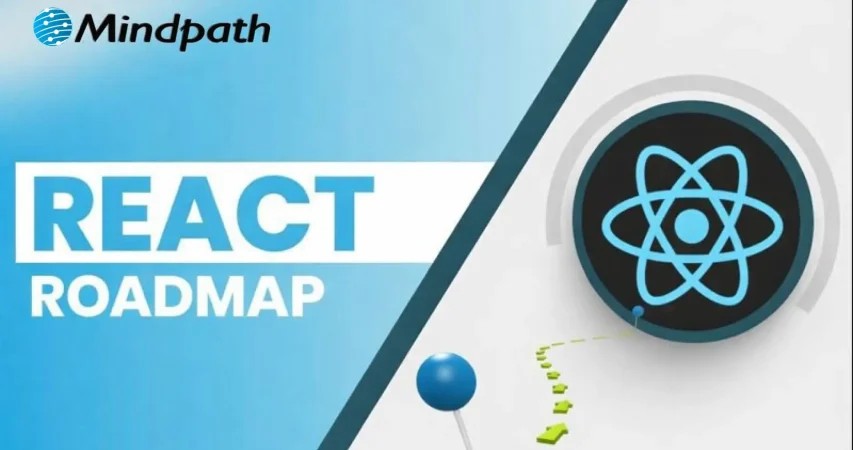
React is one of the most powerful and useful JavaScript libraries that developers around the world are using to build amazing web applications. ReactJS allows developers to create fast, interactive user interfaces for websites and apps, and has even improved their workflows. When you have the intention to progress your skills or improve your existing projects, a React roadmap can help you navigate what to learn next. Rather than blindly choosing where to begin and what is most important, a roadmap allows you to advance in your learning with confidence and real intent.
React trends in 2026 are expanding forward with new capabilities such as server components, rendering methods, and development tools, to make learning React more valuable for new and expert users. Seeing how to use your time wisely and knowing what you may look at for a specific reason helps to save you time, but also helps to make modern applications. In this blog, you will discover a step-by-step process of learning, which can simplify mastering and using React in a project. Let’s get started!
If you’re planning to leverage React in your next project, our ReactJS development services can help you in creating modern, scalable web applications meeting your business goals.
Need for React Roadmap
It’s essential to have a clear learning plan when starting with React. A ReactJS roadmap for beginners allows you to learn complex subjects such as JSX, components, state, and hooks by breaking these subjects down into smaller, more manageable pieces. Having step-by-step tasks gives you a foundation and keeps a focus on what matters. Instead of doing random tutorials every day, you have a learning path that makes sense and keeps your learning organized and flowing.
With new features and developments coming in the future of React, it’s good to be prepared. Having a React developer roadmap can give you a path of what you can learn and when you can learn it. This can help you eliminate confusion and wasted time. Roadmaps can often have actual projects where you actually perform them as a learning experience. This kind of experience will only help you to grow and develop your learning experience and skills, but it will also keep you motivated because you are able to see your progress clearly on your journey!
Planning to improve user engagement and deliver smoother interactions on your platform? Learn how the benefits of ReactJS development services help businesses create more responsive apps.
Key Concepts to Master Before Learning ReactJS
Before diving into React, it’s helpful to understand some core web development concepts that make learning smoother and more effective. These basics form the starting point of any React roadmap and give you the confidence to build with React efficiently.
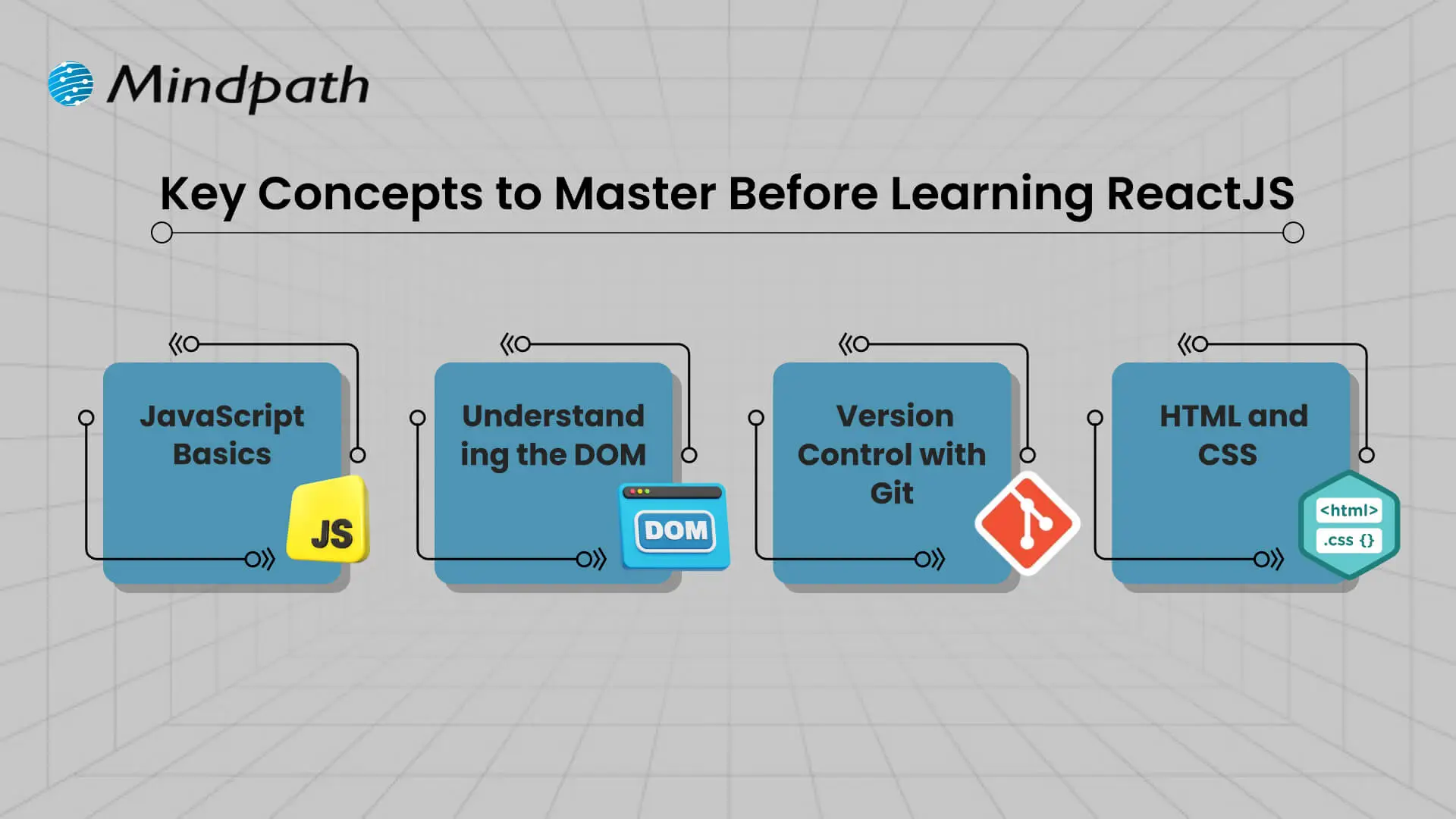
1. JavaScript Basics
It is important for you to understand variables, functions, arrays, and objects in JavaScript. These are the building blocks for the logic and data in React.
2. Understanding the DOM
It is important for you to understand what the browser is doing in terms of displaying things and changing things via the DOM. React uses the DOM structure to show on the screen and make changes to it easily and efficiently.
3. Version Control with Git
It is important for you to understand how to track and manage your changes in your projects, via version control, specifically with Git. It is a vital part of a real-world React application, especially when working with a team.
4. HTML and CSS
Learning the fundamentals of HTML for structuring web pages and CSS for styling them is important. Understanding layouts related to flexbox or grids is necessary for developing responsive user interfaces in React.
Curious to identify which technology aligns best with your development team’s strengths? Read about the practical implications of choosing React vs Vue for your business projects.
ReactJS Roadmap 2026
To become a skilled React developer in 2026, it’s important to follow a clear and practical learning path. This React tutorial, based on the latest ReactJS roadmap 2026, will guide you through the key topics to focus on at each stage of your journey.
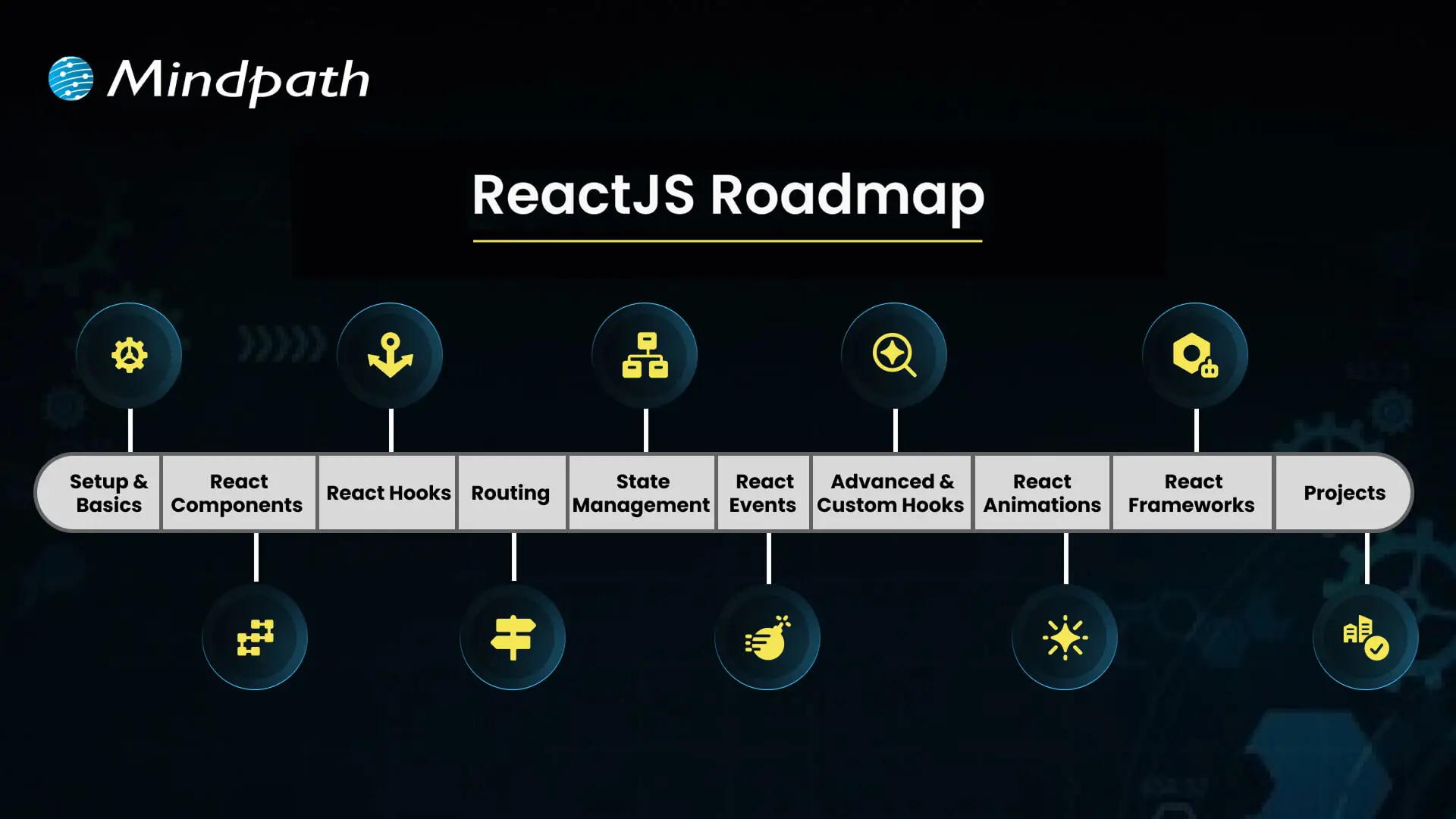
1. Setup & Basics
Start by setting up your environment with tools like Node.js and npm to begin working with React. Learn how JSX works and how it allows writing HTML-like code inside JavaScript, which is essential in any React roadmap.
2. React Components
Understand the structure and role of components, which form the UI of any React application. Functional components, props, and state are core parts of this architecture, making them a key focus in the front-end roadmap.
3. React Hooks
Hooks let you use features like state and lifecycle in functional components without writing classes. Mastering built-in hooks such as useState, useEffect, and useContext is crucial in any modern React Roadmap.
4. Routing
Routing allows smooth navigation between pages in single-page applications using tools like React Router. It enhances user experience by loading components based on the URL, as commonly seen in apps.
5. State Management
State holds the data that drives your UI and updates the app when changes. Techniques like React Context API and Redux help manage local and global states effectively within your project.
6. Event Handling
React handles user actions such as clicks, form submissions, and scrolls through event handlers. Learning how to work with these events improves interactivity and responsiveness in your application.
7. Advanced & Custom Hooks
Explore patterns like component composition, higher-order components, and custom hooks to reuse complex logic. These advanced topics align with current React trends and best practices.
8. React Animations
Animations create smooth transitions and improve the user experience using tools like Framer Motion or React Spring. These libraries offer a flexible way to add motion to your interface.
9. React Frameworks
Explore frameworks built on top of React, such as Next.js and Gatsby, that enhance app performance and SEO. These tools are often mentioned in ReactJS blogs for speeding up development.
10. Projects
Apply what you learn by building real-world applications that solve problems and test your skills. Project-based learning is a major part of the React tutorial approach and strengthens your understanding of concepts in the JavaScript roadmap.
Looking for ways to improve user engagement and overall app performance? Read the top reasons to choose ReactJS for app development and see why it’s preferred by many leading businesses.
Ready to Start Your React Journey?
Following a structured React roadmap helps you learn React with purpose and confidence. This blog covered everything from the basics to advanced tools and trends that matter in 2026. By focusing on key concepts, building projects, and staying updated, you’ll be better prepared to grow as a skilled React developer in today’s fast-moving web world.
This React roadmap is just the beginning. At Mindpath, we bring these React concepts to life through modern and scalable solutions built by expert developers. Our ReactJS development services align perfectly with what you’ve explored in this blog, delivering clean architecture, smart component reuse, and performance-focused interfaces that work seamlessly across devices. Let us help you turn learning into real results through expert-driven development.
Frequently Asked Questions
1. How long does it realistically take to follow a React roadmap completely?
It depends on your current skill level and daily learning commitment. Most beginners take six to twelve months to move from basics to advanced concepts. Consistent practice, building real projects, and staying updated with React trends 2026 will accelerate your progress far more than just watching tutorials passively.
2. Is JavaScript expertise necessary before starting with React?
A solid understanding of JavaScript fundamentals is strongly recommended before touching React. Concepts like functions, arrays, objects, and DOM manipulation appear constantly throughout React development. Jumping into React without this foundation often leads to confusion and slower progress, making the overall learning experience frustrating rather than rewarding.
3. What is the best way to practice React skills beyond tutorials?
Building real projects is the most effective way to solidify React knowledge. Start with simple apps like to-do lists or weather dashboards, then move toward more complex builds. Real projects force you to solve actual problems, which builds the kind of confidence and muscle memory that tutorials alone cannot provide.
4. Do developers still need to learn Redux in 2026 with React Context available?
Both still have their place depending on project scale. React Context works well for simpler state needs, while Redux handles complex, large-scale applications more predictably. Understanding both is part of a well-rounded React roadmap for 2026 and makes developers more versatile across different project types and team environments.
5. Should beginners learn Next.js alongside React or wait until React is fully mastered?
It is better to get comfortable with core React concepts first before moving to Next.js. Rushing into frameworks too early creates gaps in foundational understanding. Once routing, hooks, and state management feel natural, exploring Next.js becomes significantly easier and more productive as a next step in the learning journey.