
Offshore Software Development: What You Need to Know

Join our Newsletter!

Featured Posts

Support Is One Click Away

Home

Offshore Software Development: What You Need to Know

offshore software development

Offshore Software Development: What You Need to Know

Offshore software development is redefining how businesses are developing digital solutions. Are you still wondering what we mean by offshore? It means working with teams or services located in another country, often to obtain cost-effective expertise and accelerate delivery. In the world of software, this approach opens doors to global talent, allowing companies to develop high-quality products without the high expenses of local hiring

To elaborate, what we are referring to is outsourcing software development tasks to overseas teams that specialize in the technology and services. These teams are often found in areas with proven traditional IT qualifications and strong pricing competitiveness such India, eastern Europe, and southeast Asia. Do you want to learn more about this development? Don’t worry, in this blog we will be going into all you need to know about offshore software development. 

Ready to take your business to the next level? Partner with Mindpath for expert offshore development services that drive innovation, efficiency, and growth. Contact Us!

What is Offshore Software Development?

Offshore software development refers to collaborating with a software team that is located in a different country to manage your tech initiatives. An example for it can be a UK-based company that hires a Philippine development team to build a website or software tool. This helps reduce costs and makes it easier to find the right talent. Businesses prefer this model because they get quality work without spending too much money. The Philippines, for instance, offers skilled developers who are experienced and reliable. While there might be challenges like time zone gaps or communication styles, this kind of software development still helps companies finish projects faster and focus on their main goals. 

Fascinatingly, according to a Business Research Insights survey, the software offshore market was worth roughly USD 160.9 billion in 2024, and is on track to reach USD 413 billion by 2033, with a CAGR of 11.04%. Factors for this growth in the offshore software market include the affordable technology needs to increase usage, the demand for tech solutions to better connect with the global community, and also the need for talented developers. Countries such as India, China, and parts of Eastern Europe have emerged as preferred locations, because they provide access to talent, sufficient infrastructure, and a business-friendly environment.  

Also Read: Offshore Development Benefits for Businesses

What is the Offshore Development Process?

Offshore software development is the development of software with teams in other countries that help you in the efficient building and maintenance of your software. Here is a simple set of steps that companies tend to go through when working with offshore developers: 

offshore software development process

1. Recognizing the Need

The organization recognizes it has additional skills or resources requirements, and they must determine what to outsource like coding, testing, or support work.  

2. Finding an Offshore Partner

They seek a trusted team in another country with a solid skill set and experience, often in a region well known for technology. 

3. Beginning the Project

Both teams establish project goals, working timelines, and methods to communicate, likely via video calls or project tracking software. 

4. Developing and Coding

The offshore team will begin the project and communicate updates consistently, using project tracking and collaboration tools online 

5. Testing and Quality Assurance

The teams will thoroughly test the software to resolve any challenges, ensuring it all works before launching. 

6. Deployment of the Software Solution

The completed software solution will be deployed and the team will continue to provide services or updates according to demand. 

7. Continued Collaboration

The firm will still do business with the offshore team in terms of updating and improving and developing future work. 

While offshore development gives you access to global talent and cost advantages, you may also explore custom software development to better understand when tailor-made solutions are the right choice.

Benefits of Offshore Software Development

Development of offshore software is now a common approach for businesses that want to increase their tech potential. It fosters sustainable growth by providing a more intelligent way of managing development requirements across countries. Let us examine its benefits: 
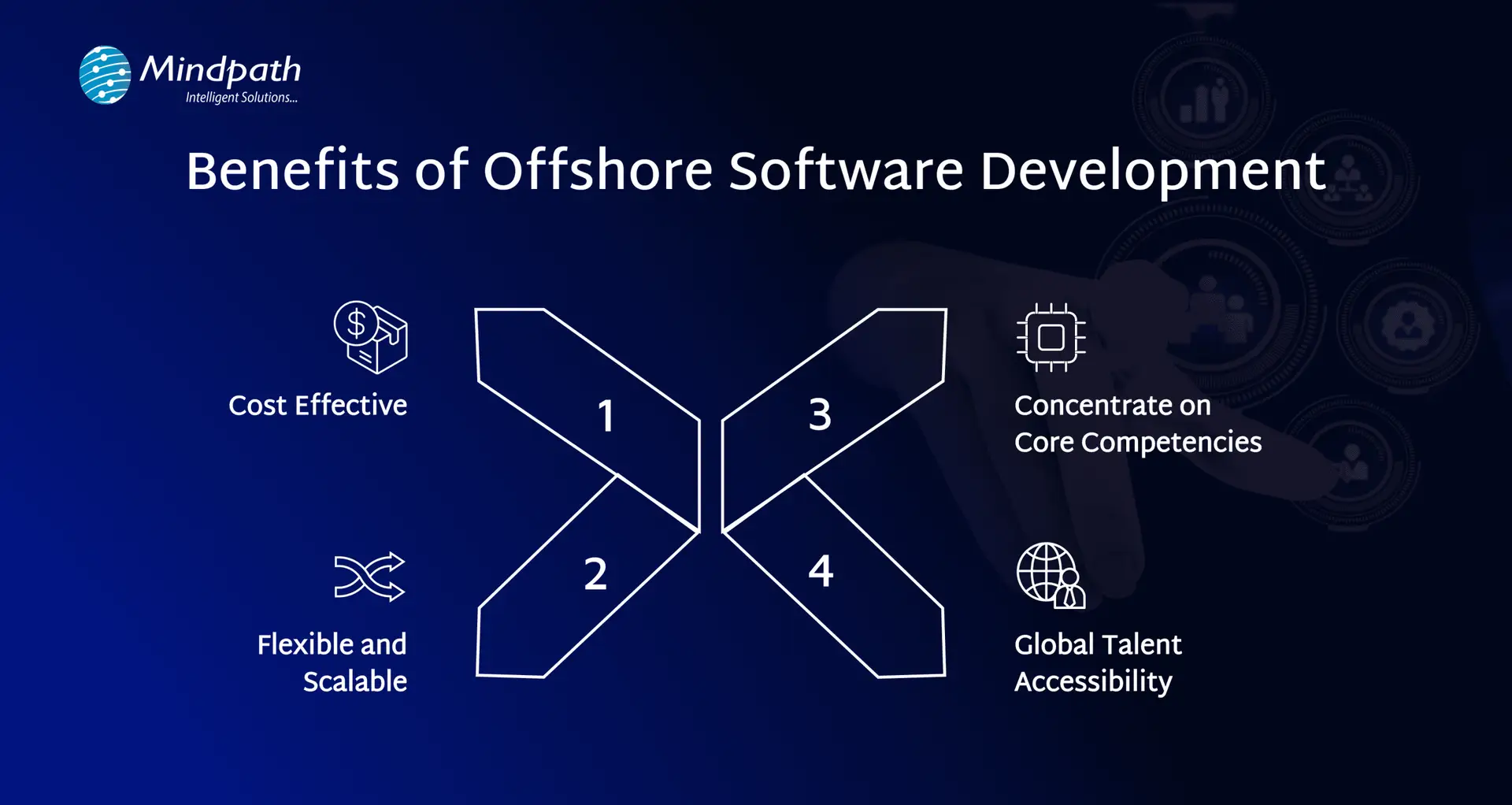
benefits of offshore software development

1. Cost-Effective

Sometimes, hiring developers from other countries can cost less than building a local team. This could help companies save money without sacrificing quality. The additional budget can be utilized to help grow the business, such as marketing or product upgrades. It is a more resourceful approach to balancing costs while remaining competitive.

2. Flexible and Scalable

Offshore development services easily allow you to adapt team sizes and add or downsize developers based on project needs. There is ease of access to add a number of developers to your team when your workload increases, or to scale down easily as workload begins to slow down. This provides operations with greater flexibility, gives you quicker access to talent while avoiding lengthy hiring processes. This engagement allows quicker delivery for your clients and provides a smoother operating working relationship for your offshore team.

3. Concentrate on Core Competencies

Future-proofing by outsourcing software work allows companies to turn their attention back to what they do best. They can manage just the right amount of technical detail, and spend more time on strategy, customer service, or new product growth. While offshore teams will take care of the technical detail while being very diligent and skilled in doing this work, allowing companies to focus on even bigger parts of the operation like overall performance

4. Global Talent Accessibility

Offshore teams also allow companies to expand their access to the world’s best talent. Instead of only hiring locally, your teams have access to experts from around the globe, which can be a huge advantage for partnerships and companies looking for the exact skills they need. Skilled and knowledgeable individuals will lead to improved, more diverse ideas, a wider range of perspectives, and improved quality assurance, all of which will lead to improved and better-quality results. It is a great opportunity to be more intentional about building and fine-tuning more creative teams. 

If reducing onboarding time and accessing a wider talent pool are priorities, our article on the key benefits of hiring remote developers shows how remote hires can complement offshore strategies.

Ready to Work with an Offshore Software Development Company?

Offshore software development has become a powerful strategy for companies looking to build high-quality digital products without stretching their budgets. By working with skilled teams from other countries, businesses can meet deadlines faster, access a wide talent pool, and stay focused on their core goals. While it may come with a few challenges like time zone gaps, the right planning and communication make it a highly effective and scalable approach for long-term success. 

At Mindpath, we provide reliable offshore software development services tailored to your business needs. Our global teams bring technical expertise, timely delivery, and smooth collaboration to every project. Whether you need help with custom software, mobile apps, or support and maintenance, we’re here to support your goals with cost-effective solutions. With clear communication and dedicated teams, Mindpath makes offshore development simple, efficient, and successful for companies of all sizes. 

Frequently Asked Questions

1. How can communication gaps be managed effectively in offshore software development?

Clear communication channels, regular meetings, and proper documentation help reduce misunderstandings. Using collaboration tools and setting overlapping working hours can improve coordination. A structured communication plan ensures both teams stay aligned, even when working across different time zones and cultural contexts.

2. What should businesses check before signing a contract with an offshore team?

It is important to review technical expertise, past projects, client feedback, and security practices. Clear agreements on timelines, deliverables, and communication methods should be defined. This helps avoid confusion later and ensures the partnership is built on transparency and mutual understanding from the start.

3. How does offshore development impact project timelines and delivery speed?

Offshore teams can often accelerate delivery by working in different time zones, enabling near round-the-clock progress. However, proper planning is essential to avoid delays caused by coordination issues. When managed well, it can significantly improve turnaround time and overall project efficiency.

4. Is offshore software development suitable for small and mid-sized businesses?

Yes, it is often a practical choice for smaller businesses looking to access skilled talent without high hiring costs. It allows them to build quality software within budget while focusing internal resources on growth, operations, and customer engagement.

5. How can businesses maintain quality control when working with offshore teams?

Quality can be maintained by setting clear standards, conducting regular reviews, and using testing frameworks throughout the project. Continuous monitoring, feedback loops, and defined performance metrics help ensure the final product meets expectations and aligns with business requirements.


Related Post

Discover the ultimate guide to hiring Node.js developers in London. Learn about the skills, benefits, and cost factors involved in finding the right talent for your project.
Discover the cost to hire Node.js developers in London: £30-£70/hour for juniors and £70-£150/hour for experienced, depending on expertise and project complexity.
Learn how to hire remote software developers in New York with expert tips on defining needs, skills, and onboarding for project success.

Related Post

Advantages of Nodejs

In today’s digital-first world, creating applications that are fast, responsive, and scalable is vital for business success. And for this, they need to choose the right technology stack as it can make or break their custom application. Among the many options available to choose from, the advantages of Node.js make it a standout option for modern businesses aiming for speed, agility as well and development efficiency. 

Since its launch in 2009 by Ryan Dahl, this backend technology has transformed how developers create scalable, fast, and real-time web applications, supporting continuous innovation across different industries. But what makes Node.js a standout choice among businesses?

In this blog, we will explore Node’s advantages and understand what it is used for. Besides, we will discuss the pros and cons of Node.js so that you can make an informed decision. 

Want to implement these advantages of Node.js into your business? Mindpath Node.js development services will guide you every step of the way on how to create a high-performing web application tailored to your business needs.

Evolution of Node.js

Before diving deep into its advantages, let’s understand how Node.js has evolved. This will help businesses appreciate their current abilities and future potential. 

The evolution of this backend tech has been a rapid journey from a simple experimental project to a mainstream web development technology. 

1. 2009

Ryan Dahl introduced Node.js. The initial aim was to offer high-performance servers through JavaScript’s V8 engine. 

2. Early 2010s

The NPM or Node Package Manager was created. It became the largest software registry ecosystem, accelerating web development projects. 

3. Mid 2010s

Socket.io and Express were launched, and in 2011, NPM 1.0 was introduced. In 2014, the project went through some major governance changes. 

4. 2015 to 2020

In 2017, when security became a top priority, HTTP/2 and Node.js 8 were launched. During that time, NPM witnessed more than 3 billion downloads.  ES modules and Node 10 were introduced in 2018. NPM was acquired by GitHub in 2020.

5. 2020 – Present

Node 16 was launched in 2021. LTS version 18 was introduced in 2022. The launch of ES Modules and other stable module systems, along with TypeScript integration, strengthened its status as a powerful enterprise platform.  Node.js 24 was released in 2025.

This continuous evolution highlights this backend tech’s growth, business adoption, and strong community, making Node.js a backbone of today’s backend development. 

Must Read: Top Node.js Libraries 

Why Global Enterprises and Businesses Choose Node.js?

Keeping pace with rapid innovation in this competitive tech landscape is not an easy task. New applications, after a few months, struggle to stay relevant as digital standards and user expectations constantly evolve. That’s why businesses need a solid backend technology that can offer better performance and grow with them. Enter Node.js for backend- a future-ready and dynamic solution that is trusted by some of the biggest and popular brands in the world.

Fortune 500 enterprises like LinkedIn, PayPal, eBay, Walmart, and Trello are using this tech as a core part of their tech stack. Node.js development allows businesses to leverage its flexibility, scalability, and speed to power modern applications and experience the amazing advantages of node.js. The rising demand for Node.js shows its ease of use and reliability, making it an excellent choice for businesses and developers. Whether you are creating a full-scale business platform, microservice, or API, Node.js can offer the innovation and consistency you need to enjoy a competitive edge. 

Now, let’s talk about some major benefits of Node.js and explore how it is helping businesses in this competitive digital landscape. 

Looking to build fast and scalable NodeJS applications? Explore our blog on hiring expert NodeJS Developers for High-Performance Apps to see how experienced developers can deliver robust, high-performing solutions for your business.

Advantages of Node.js- A Perfect Option for Your Web App

Node.js has become a game-changing backend tech for modern businesses, providing them with a perfect combination of cost-efficiency, scalability, and performance. Here are some impressive advantages of Node.js that organizations of all sizes can witness when deployed correctly.  

1. Cross-Platform Application Development

With powerful frameworks such as NW.js and Electron, Node.js supports the creation of high-performance cross-platform desktop apps. Developers can utilize Chrome Developer Tools to code, build, debug, and streamline the development process. 

Furthermore, they can leverage frontend frameworks such as React, Vue.js, and Angular to create versatile applications. This is a major Node.js advantage for every business. 

2. Reduced Loading Time

It comes with a caching module to store frequently used data in memory. This, in turn, reduces loading time while enhancing user experience. It enables efficient request handling and quick page rendering.

3. Superior Performance

Node.js uses the V8 engine to compile JavaScript into machine code and offers excellent performance. Furthermore, the single-thread event loop and non-blocking I/O model enable asynchronous tasks to function efficiently. 

4. Scalable Web Applications

One of the most significant advantages of Node.js is that the tech is scalable. It is designed to support multi-threaded execution. Besides, the cluster module helps it to balance CPU-bound tasks. As a result, multiple Node instances can run smoothly simultaneously. 

Moreover, it enables horizontal partitioning, enabling apps for personalized user experience considering the user’s location, age, interests, and languages. 

5. Efficient Handling of Concurrent Requests

It works great at managing multiple concurrent users. That’s why most e-commerce platforms and complex web apps are developed using Node.js. By handling simultaneous requests, it ensures smooth performance of your web app during high traffic. 

6. Active and Massive Community Support

Node.js has a growing global community aligned with strong corporate support from Netflix, Facebook, Amazon, and Google. The NPM provides developers with access to thousands of libraries and tools without any cost. On the other hand, GitHub offers a lot of open-source resources.

All these benefits of Node.js are enough to prove why it is a top choice among developers and organizations for backend development. 

Not sure how to choose the right NodeJS developers for your project? Read our blog on Hiring NodeJS Developers to learn key tips for selecting skilled professionals who can deliver high-performance, scalable applications.

Disadvantages of Node.js

While the advantages of Node.js are quite impressive, it’s vital to acknowledge that this technology has some challenges. Here are some key disadvantages of node js to consider. 

1. Challenge of Mastering Asynchronous Logic

For scalability, Node.js utilizes asynchronous programming. However, managing promises and callbacks can be very challenging for developers who have used linear blocking I/O programming. 

2. Dependency on Third-Party Libraries

JavaScript doesn’t have strong native libraries. That’s why developers depend on third-party packages for various tasks. This may lead to dependency management problems and security risks. 

3. Frequent API Updates

Frequent updates often break changes and force developers to refactor code after every update. Well, while updates are critical but they can disrupt workflows, demanding constant attention to version compatibility and maintenance effort. 

4. Lack of Standardized Structures

Node.js is a runtime and offers maximum flexibility. However, it lacks an opinionated, rigid structure. This may lead to inconsistencies among large teams. 

Most of these disadvantages can be eliminated with the right tooling, strategic planning, and team training. Node.js remains an excellent choice, but it’s vital to compare nodejs pros and cons, considering your project’s unique needs, to come up with the right solution. 

Want to build complete, high-performing applications from front-end to back-end? Learn mastering Full-Stack Development with Node.js to understand how Node.js empowers developers to create seamless, full-stack solutions.

Applications of Node.js

As discussed above, Node.js is a robust runtime environment that allows developers to create efficient, fast, and scalable server-side applications. Node.js benefits and versatility make it suitable for different real-world applications across various industries. 

A common application of Node.js is real-time web apps. For instance, live dashboards, chat platforms, and collaborative tools. Its support for WebSockets and event-driven architecture enables seamless bi-directional communication between server and client. Apart from this, Node.js is also a crucial tech in API development, deploying GraphQL and RESTful services that smoothly handle thousands of requests while maintaining low latency. 

Another useful application of Node.js is product catalogs for e-commerce websites. Besides, it is also used to enable real-time inventory updates and to offer personalized user experiences. Additionally, Node.js is a great choice for creating microservice architectures and desktop app development. 

In summary, its rich ecosystem and cross-platform support make Node.js a top choice across industries for modern backend development.  

Also Read: Increase Web Performance with Node.js

Future of Node.js for Backend Development

The advantages of Node.js clearly show that it is a cornerstone of today’s backend development. However, it is still evolving, and in the future, we can expect to see more innovations. The OpenJS Foundation and Node.js community will invest heavily in: 

1. Advanced Security and Diagnostic

Optimizing tooling for monitoring, performance, vulnerability management, and debugging. 

2. Worker Threads

Increasing support for CPU-intensive tasks, enabling developers to offload heavy tasks without affecting the main event loop. 

3. Expanded Serverless Compatibility

Strengthening Node.js for various serverless platforms such as Azure, AWS, etc., making it more powerful for event-driven and scalable architectures. 

4. Edge Computing and IoT

Node.js’s event-driven architecture and lightweight footprint will continue to play an important role in building IoT applications and apps for edge computing.

5. Enhanced Support for ES Modules

Node.js is expanding support for ECMAScript or ES Modules. As ES Modules are a crucial element in web development, the trend will continue, allowing developers to enjoy better compatibility with modern libraries and JavaScript code. 

With industries increasingly adopting real-time applications, cloud-native systems, IoT solutions, and micro services, Node.js will remain a dominant player in this field. Besides, we can’t ignore the Node.js advantages that support its growth. 

Looking for the right partner to build robust NodeJS applications? Read our blog on Choosing NodeJS Development Company to discover the essential checklist for selecting expert developers who deliver high-quality, scalable solutions.

Creating a Digital Future on a Robust Node.js Foundation

After going through the pros and cons of Node.js, it can be said that Node.js has a lot of benefits rather than disadvantages. And the primary reason behind this is its amazing features, active community support, and evolving architecture. If you want to experience these Node.js benefits, then it is advisable to partner with an expert who understands this technology and uses it to offer a tailored solution. 

When it comes to choosing the best Node.js expert to enjoy the maximum advantages of Node.js, you may not find a better option than Mindpath. From optimizing asynchronous performance to creating modular microservices, our Node.js development services make sure that Node.js is correctly deployed, offering you inclusive, responsive, and fast applications. Besides, we can guide you through the best practices in this tech’s architecture and security. Choose us and get ready to build faster and smarter digital solutions based on Node.js. 

Discover the top 8 benefits of Node.js for web development, from seamless scalability to cost reduction. Elevate your web app performance with Node.js today!
nodejs development companies

Almost all the businesses that exist today have a single objective in mind. The objective is to grow and stay ahead of the competitors in the market. In order to stay ahead of the curve, businesses are choosing Node.js as their ultimate development platform. Node.js has earned a solid reputation in the business world for all the right reasons. It is not only fast but also scalable. Moreover, Node.js serves as a perfect tool that businesses can use in order to build everything, from real-time chat applications to enterprise-grade systems. 

The emergence of Node.js has been a boon not only for large businesses but also for start-up businesses. The high popularity of Node.js among developers and businesses has increased the reliance on top Node.js development companies. It is high time for you to know why businesses are preferring NodeJS development companies in 2026 like never before. 

Want to deliver scalable web applications that keep your business ahead in 2026? Mindpath’s NodeJS development services provide expert solutions to turn your ideas into high-performance applications.

An Overview of Node.js

Node.js refers to an open-source and cross-platform JavaScript runtime environment. The key features of Node.js are:

1. Node.js involves the application of JavaScript for overall web development purposes. As a result, developers can build complete apps by leveraging a single language. 

2. Node.js has a non-blocking I/O model and an event-driven architecture. Such an arrangement allows Node.js to handle a large number of concurrent connections in an efficient and effective manner without creating a new thread for each request. 

3. It acts as a well-suited tool for scalable network applications as well as real-time systems. You can run Node.js on the V8 engine as it can benefit from its speed and optimizations. It can thus lead to efficient execution of code.

4. Since Node.js comes with a vast ecosystem of open-source libraries as well as modules called Node Package Manager, the development process gets simplified. NPM ensures that pre-built solutions are available for diverse tasks.

5. Node.js can be used for developing a broad range of applications and websites, such as web servers and real-time chat applications. You can also create command-line tools with the help of Node.js. 

Want to understand why Node.js continues to dominate modern backend development in 2026? Discover our advantages of NodeJS blog to learn what makes this technology a top choice for businesses.

Benefits of Choosing NodeJS Development Companies

The businesses that seek fast and efficient web or app solutions can derive immense benefits by choosing a Node.js development company. Businesses need to bear in mind that Node.js uses a non-blocking and event-driven architecture. This architecture enables high performance and real-time data processing, which is ideal for chat apps as well as dynamic websites. Some of the top benefits that your business can enjoy by choosing the best NodeJS development services provider include:

1. Developing Fast and Scalable Apps

NodeJS development solutions are the go-to option for a majority of modern businesses. This is because these solutions help to create applications that are fast as well as scalable in nature.  The non-blocking I/O model of Node.js is capable of handling a number of requests simultaneously. Thus, your business can rest assured of high performance even when the traffic is high. This is why several businesses have been choosing NodeJS development companies so that they can create robust and well-functioning business websites. 

2. Use of One Language for Diverse Needs 

Node.js uses JavaScript for both backend and frontend aspects. Thus, if you hire NodeJS developers, you only have to use a single language for everything. This can certainly create opportunities for teams to collaborate in a seamless manner. The collaboration ability can certainly simplify how your business can develop a website or app and offer an experience to the target market audience. This can be possible thanks to the unification of the user interface code and the server-side logic. 

Want to ensure you choose the right expert for your next Node.js project? Discover our factors to consider while hiring NodeJS developer blog to learn what skills and experience truly matter.

3. Ideal for Real-time Apps

You need to hire a Node.js developer if you wish to develop real-time apps for your business entity. The event-driven architecture of Node.js is capable of handling continuous data streams in an efficient manner. As a result, nodes services are ideal for gaming as well as live chats. They even support collaboration tools. You may be surprised to know that Slack uses Node.js in order to power real-time messaging for millions of users across the globe while ensuring reliability as well as speed. 

4. Building Flexible Microservices

Node.js is capable of integrating quite well with microservices. Thus, it enables applications to maintain as well as scale in an independent manner. A real-world example involves PayPal, which transitioned to microservices with the help of Node.js. This decision has led to a reduction in development time and has also improved its overall performance. 

Also Read: Top Node.js Libraries 

5. Cost-efficient Option 

Businesses have been preferring NodeJS development companies so that they can save money while building apps and websites.  Node.js undoubtedly saves costs by speeding up the development process as well as optimizing resources. Its ability to leverage JavaScript for both frontend and backend reduces the need for additional developers. Companies have the option to save money and time by using Node.js for creating their applications and websites. 

6. Existence of a Vibrant Community 

Node.js has an extremely vibrant community of developers. These developers contribute to the development of Node.js. They play a cardinal role in making the tool more innovative as well as accessible in nature. Developers get the chance to effectively collaborate with each other and track issues. It even helps with version control. 

Curious how Node.js handles high traffic and improves load times? Check out our web performance with NodeJS blog to explore strategies for building faster web applications.

7. Ideal for Mobile Devices

One of the top benefits of using Node.js for businesses is related to its use for mobile devices. Companies can easily move their application towards mobile mainstream as Node.js supports fast development time as well as ease of use. In the prevailing environment, this decision can certainly expand your reach in the market setting. Business entities that wish their mobile application to connect with their desktop application can leverage the Node.js development services offered by reliable Node.js development companies. 

8. Cross-Platform Compatibility

The cross-platform compatibility of Node.js enhances its versatility in the web development arena. It enables the creation of applications that can run in a seamless manner on diverse operating systems. It thus supports a broad reach and smooth experience for users across diverse types of operating systems. You need to bear in mind that Node.js unifies the development efforts and eliminates the need for platform-specific code. It even reduces the complexity of managing multiple codebases. Node.js thus supports a more resilient and efficient development process for business entities.  

The Node.js framework has emerged as a remarkable tool for both businesses and individual developers. Both business owners and individuals need to familiarize themselves with the key characteristics of Node.js so that they can capitalize on the framework in an effective manner. Businesses have been choosing Node.js so that they can be empowered to create scalable and exceptional apps and websites. 

Looking to accelerate AI adoption within your Node.js ecosystem? Explore our Node JS libraries for AI guide to learn which libraries drive smarter, data-powered applications.

Final Words

Modern businesses are heavily relying on Node.js development service providers. These providers can ensure that you can capitalize on the core features of Node.js to develop a well-functional and high-performance website or application. Due to various reasons, businesses have been choosing NodeJS development companies, such as developing fast and scalable apps, leveraging JavaScript, and many more. 

Mindpath’s Node.js application development is the perfect solution that can help you leverage Node.js in an optimal manner. Our experts ensure that your application is not only scalable in nature but also delivers excellent performance for your business as well as your customers. The services will certainly play a catalytic role and help your business have an edge over your competitors. 

Web Development Costs

Understanding the web development costs is a significant question many businesses struggle with before initiating a project. Web development is the easiest way to make your products and services connect with global audiences. In fact, entrepreneurs are well aware of the profitable aspects and booming growth they can adopt through the online market. Talking about the trends, progressive web applications are growing fastest at a CAGR of 14.00%. Moreover, around 71% of businesses already have a website. 

So, it becomes necessary for you to understand how much a web development costs. For your information, there are numerous factors that influence the cost of web development. This guide can help you with a complete breakdown, no matter if you are starting from scratch or have a small budget. 

Planning to build a website and need a clear cost roadmap? Mindpath delivers scalable web development services designed to fit your business goals.

What Does the Web Development Cost Include?

Before you get into the web development costs, it is necessary to research your competitors and how uniquely you need to develop your site. Moreover, developing a good and reliable website is not just about writing code or initiating good designs. The total website development cost breakdown is dependent on your website’s structure. 

Further, you need to be considerate about the functionality, technology stack, and the requirements for post-launch support. Here are some quick factors that influence the web development prices

1. Type of website

A static website might cost you less than an interactive SaaS project.

2. Technology Stack

Use of leading frameworks like Laravel, React, or Next.js can increase the development timeline along with their charges. 

3. Customization Values

If your website is developed with a pre-built template, the cost will be much lower. On the other hand, custom approaches can heighten the price range. 

4. Development Approach

If you are valuing the expertise of a professional web development company, the development charges will be higher than those for a freelancer. However, the projects from a certified company always win in the competitive edge. 

Curious why some web projects cost more than others? Discover web development tools and see how technology choices influence productivity and expenses.

What are the Average Web Development Costs for Multiple Industries?

The average web development cost majorly depends on the type of website you are relying on. Further, it also depends on the way you are creating and launching it. 

1. Small Business

A small website development cost generally falls between USD 1000 and USD 10,000. Basically, it will include 5 to 10 pages, including content management systems such as WordPress. Moreover, there will be some useful features like service pages, contact forms for reaching the business, along with mobile responsiveness. 

So, if you are serving locally or a startup business, this web development pricing can be useful. 

2. Corporate Operations

A corporate website will include some good features like ERP integrations and scalable architecture.  So, for such a business, the web development costs will be around USD 10,000 to USD 50,000. 

Such a price range offers proper performance optimization and user engagement. Further, it also enhances a business’s reach on global platforms while including many advanced options in it. 

3. E-commerce Sites

When it comes to e-commerce sites, the cost of web page development automatically heightens. Further, the cost breakdown depends on your catalog size, custom product pages, payment gateway integration, and shipping management systems. 

Many users also consider building their entry-level store through platforms like WooCommerce and Shopify. However, a completely customized e-commerce website can range up to USD 50,000. This will cover all types of essentials, such as automating the inventory management and multi-vendor benefits. To enhance your customer experience, you should be careful about the project’s security. 

4. Custom Web Applications

The overall cost of custom web development will fall in the range of USD 25,000 to USD 160,000. Your web application will include several important platforms like booking engines, SaaS products, real-time dashboards, and internal management systems. 

These are some custom solutions that need to be built from scratch and require advanced backend architecture, API integration, scalable database, etc. The web application development is comparatively challenging and requires the involvement of experts. 

This is the general idea about the average web development costs for multiple business types. So, the costs might vary depending on the various requirements of your projects. 

Looking to understand how emerging trends affect web development costs? Check out the latest web development trends to see how new technologies and practices influence project scope.

Website Development Cost Breakdown as Per the Types

You must be aware of the fact that every website has its unique development scope. So, the web development prices generally depend on your site’s functionality, complexity, and the intended need of the project. Here, you can go through the expected cost of web page development

Web Development Type Key Functions Development Phase Estimated Cost 

Basic Clean and understandable UI, contact forms, page navigation, search tools, etc., 6 to 12 weeks, USD 10,000 to USD 20,000. 

Standard User interaction, seamless content management, API usage, database support, etc., 3 to 6 months USD 20,000 to USD 45,000. 

Advanced High-level data flow, custom modules, real-time functionality, etc., 12 months plus. Starts at USD 50,000 and increases with custom inclusions. 

Planning your web development budget more effectively? Explore web development technologies to see how choosing the right stack affects cost and performance.

Website Development Cost As Per the Chosen Experts

There are multiple options available in the market to personalize your web development. Let us explore some valuable vendor types that have been offering the best web development costs while enhancing the facilities through viable inclusions. 

1. Team of Expert Web Developers

Hiring a professional web development team can be the best option available in the market. However, you might think it is an expensive investment. But remember that this option offers the highest level of security. 

Apart from this, these agencies consist of experienced people who can easily customize your projects as per your business goals. Such companies can help you with an accelerated web development process. Apart from leveraging design and developmental solutions, they also ensure website maintenance while developing a marketing strategy. The web development pricing of the full-fledged agencies will be around USD 15000 to USD 150,000 and more. 

2. In-house Development Team

Creating your own web development team offers you the advantage of having dedicated professionals at your fingertips. However, the process can be resource-intensive and time-consuming. You need to be assured of effective management and create a positive work environment. Other than this, it can be challenging for you to find candidates who match your required skills and budget. 

Remember that an in-house web development team is necessary if the website is essential to your business. The average web development cost of these experts can be between USD 80,000 and USD 200,000 per year. 

3. Freelance Developers

Freelancers will charge you around USD 15 to USD 80 per hour. They are the only viable options that come within a small budget. They are best suited for your small websites, MVPs, or any budget-centric projects. Further, they offer flexibility with the contracts and easily scale the tasks. 

4. DIY Efforts

Many businesses just take the challenge to create their website on their own. However, it takes high skills and commitment. The process remains slower, and you might commit mistakes that your business can’t bear at all. 

Curious how web development costs compare to full-scale software projects? Discover software development cost insights to understand long-term budgeting and investment planning.

How to Pick the Best Web Development Partner?

If you require your development process to be effective enough, only prioritizing the website development cost breakdown is not enough. You need to prefer the right development team or company that can make your project a success. Moreover, they should satiate your budget without being a burden on your pockets. 

A right development partner should meet your budget, business requirements, and technical needs. So, you should look for experts who have good experience with your project type and industry. The experts should follow clear communication while being transparent regarding their process and charges. They should offer a detailed proposal regarding their web development pricing. So, no matter if you are choosing a professional agency or a freelancer, just be assured of their support and clarity. 

What are Some Ongoing Costs that you might experience after a Website Launch?

Launching a site is just half of your journey. There are other elements related to it that can proceed with ongoing costs. Some of the major ones have been listed below. 

1. Hosting Charges

Hosting charges usually come on an annual or a monthly basis. Shared hosting can be a bit approachable, while cloud hosting might hamper your budget. 

2. Maintenance Efforts

To let your website offer desirable results, you need to continuously test its performance and fix bugs when required. 

3. Support Packages

Your company might require support packages from web developers to keep the website performance-oriented. 

Want to avoid unexpected web development costs? Check out the web development roadmap to understand project milestones and cost drivers.

Conclusion

It is a great thing to understand the website development cost breakdown before you think about any project. This can help you set clear goals while maintaining your budget. On the other hand, costs differ as per your goals, industry, requirements, and complexity of your projects. Breakdowns available in this guide can help you plan your projects with clarity. A well-defined budget with a solid plan can help you prevent your company from costly surprises and help your website to fulfil your business goals precisely. 

So, if you are ready to experience the next step with a personalized cost estimation and strategy customized specifically for your business needs, consider the excellence of Mindpath’s web development services. Here, the team can help you build a website that can match your vision while pushing you ahead in the market.