Generative AI Predictions for 2026 You Can’t Ignore

Join our Newsletter!

Featured Posts

Support Is One Click Away

Home

Generative AI Predictions for 2026 You Can’t Ignore

generative AI predictions

Generative AI Predictions for 2026 You Can’t Ignore

What does the future hold for generative AI in 2026? Do you think it will become smarter, more creative and give the best human-like responses? As technology continues to evolve at lightning speed, it is natural to wonder where we are headed next, isn’t it? So, if you are interested in generative AI predictions and how this advanced technology could influence industries, work and creativity, you are totally on the right page.

It is anticipated that by 2026, generative AI will be more integrated, accessible, and advanced, embedded in our daily lives. The abilities of AI are now growing rapidly, beginning with automating intricate tasks and transforming customer experiences to helping in creating content and driving personalized learning. Let’s understand what is the future outlook for generative AI and how it will be impacting the tech world.  Before we move further, let us first have an idea about the current state of GenAI market. 

Looking to stay ahead with generative AI innovations? At Mindpath, we provide AI Development Services that enhance business performance with advanced AI solutions.

Generative AI Market Overview

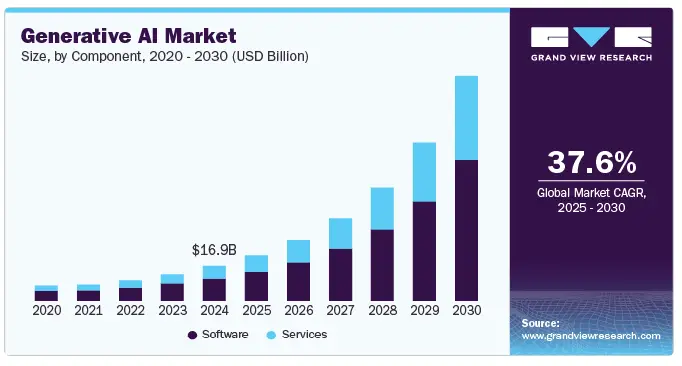
As per Grand View Research, the global generative AI market size was worth USD 16.87 billion in 2024 and will expand rapidly at a CAGR of 37.6% from 2026 to 2030. The increase is fueled by technologies such as text-to-image conversion, super-resolution and video generation. Companies are employing generative AI to transform processes and enhance creativity, and AI has become an integral aspect of day-to-day activity in sectors. 
generative ai market

Interestingly, software accounted for 64.2% of the generative AI market in 2024. Businesses are leveraging AI software to address fraud, data privacy concerns, and unpredictable outcomes. Sectors such as fashion and entertainment are embracing it rapidly. H&M and Adidas are some of the brands utilizing generative AI to design garments and create custom sneakers. These companies are expediting and streamlining the creative process for their staff.

This expanding application definitely demonstrates how generative AI trends are influencing the future of work and creation. As additional sectors turn to AI-powered solutions, demand for more intelligent, quicker, and more agile solutions will continue to increase. 

Also Read: Generative AI Use Case

Generative AI Predictions for 2026 That Will Reshape the Tech

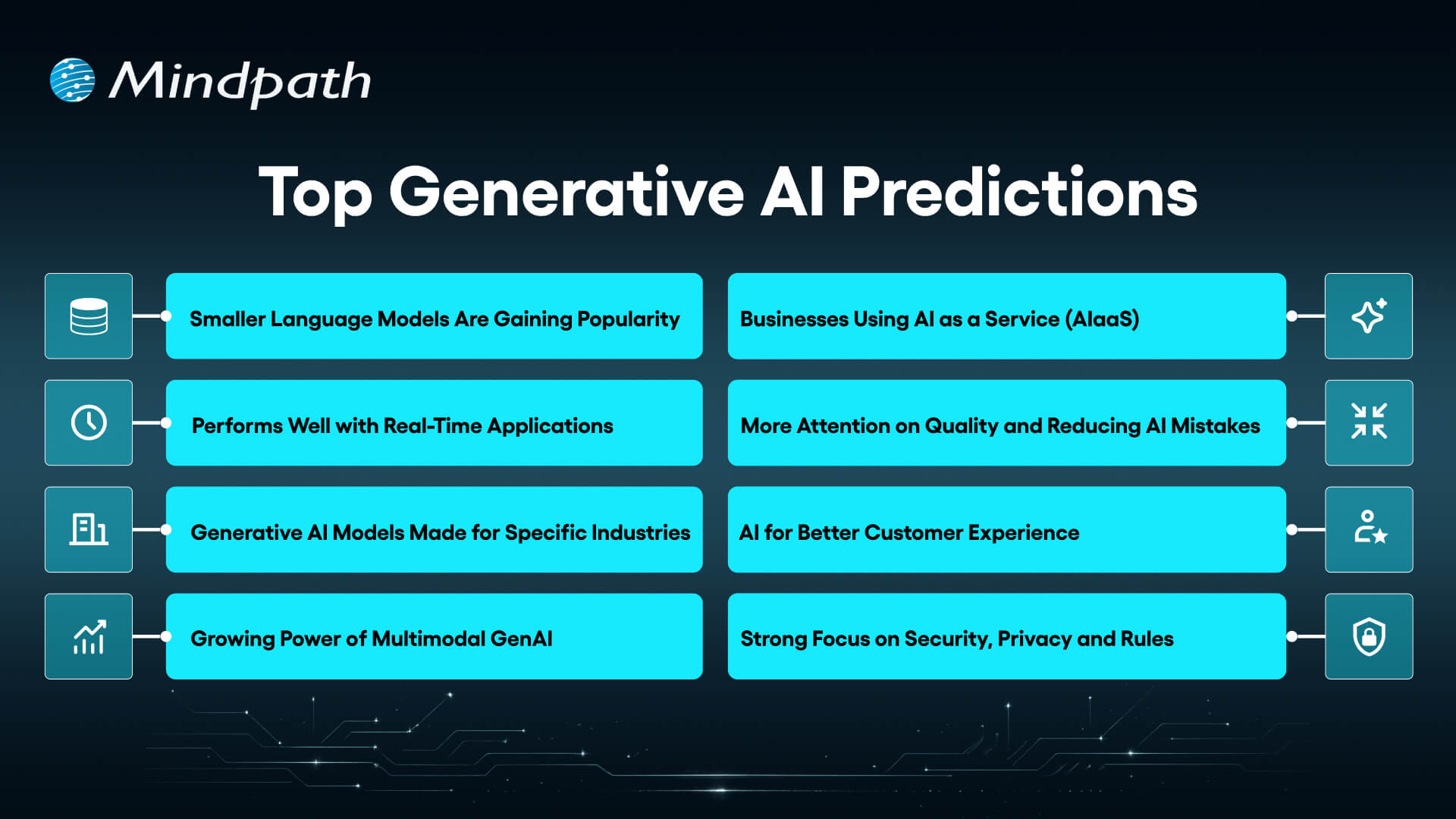
As we enter 2026, generative AI will have an even larger impact on changing how we work, create, and interact with tech. These are some of the best generative AI predictions for 2026 that outline where this revolutionary technology is going next: 
Top Generative AI Predictions

1. Smaller Language Models Are Gaining Popularity

The language model market is expanding rapidly, and now there’s a movement towards utilizing smaller models rather than larger ones. These smaller language models (SLMs) are more affordable, easier to implement, and can be used on devices such as phones and tablets. They still provide intelligent AI capabilities but require less power and data. Microsoft, Google, Meta, and Apple are at the forefront of driving this change, making AI more convenient and accessible for use in everyday life. 

2. Performs Well with Real-Time Applications

Generative AI is beginning to perform really well with real-time applications. That is, it will be able to generate content, images, or answers instantly while things are unfolding. This development is a major example of generative AI changing the creative industry, as it allows for rapid creation and adaptation of content. During live chat, it will generate custom visuals on the spot, and adjust to changing circumstances in real-time. It will enhance customer support, e-learning, and entertainment by making them more interactive and seamless, allowing users to receive speedier, more customized results in real time. 

3. Generative AI Models Made for Specific Industries

A growing trend in generative AI is building models that focus on one specific industry, like healthcare, law, or marketing. These models understand the special terms and needs of that field, so they create more accurate and useful content. Instead of trying to do everything, they do one thing really well. For example, they can write medical reports or legal documents with more detail and clarity. This makes generative AI more helpful and reliable for professional use. 

4. Growing Power of Multimodal GenAI

Multimodal generative AI means AI that can understand and create different types of content like text, images, and voice all together. OpenAI’s GPT-4 started this trend, and now Google’s Gemini and Anthropic’s Claude 3 are joining in. Soon, users will expect these features as a standard, especially in paid AI tools. As the technology improves, AI will create better images, videos, and other media, making interactions more natural and helpful for everyday use. 

Want to stay ahead in the AI-driven market? Learn how AI programming languages power intelligent solutions, from data processing to smart apps tailored for modern business needs.

5. Businesses Using AI as a Service (AIaaS)

AI as a Service (AIaaS) is becoming popular in generative AI. Instead of building AI systems from scratch, many businesses will use outside experts to help them. These consulting firms guide companies on the best AI solutions without big upfront costs. AI Modeling as a Service (AIMaaS) will grow too, offering flexible models for different needs. These services also focus on security, rules, and easy setup, making it simpler and safer for companies to use AI without having experts on their own team. 

6. More Attention on Quality and Reducing AI Mistakes

As people notice wrong or misleading info from AI, companies are working harder to improve quality and reduce errors called hallucinations. OpenAI leads by making its models more accurate and sharing clear research to build trust. Google’s Gemini lets users give feedback and compare answers with real-time internet sources, helping improve results. More AI companies will follow this approach, using user feedback and being open to make AI safer, more reliable, and trustworthy for everyone. 

7. AI for Better Customer Experience

More companies are adding generative AI into their everyday work and customer tools to make things smoother and faster. Models like GPT-3.5 and GPT-4 are used in websites, apps, and chatbots to help customers with personalized answers and recommendations. Soon, AI-powered tools will be expected by users during shopping or research. Businesses that don’t use AI this way may fall behind, as customers prefer easier, smarter, and faster experiences powered by AI. 

8. Strong Focus on Security, Privacy and Rules

With new AI laws and growing public attention, businesses and AI companies must pay more attention to AI safety, privacy, and rules. Right now, few focus on AI governance, but this will change as concerns about AI risks grow. Soon, companies will use special tools and human checks to make sure AI works responsibly and safely. Clear AI policies will help protect businesses from problems. Keeping AI secure will be very important as it becomes part of everyday work.  

If you’re exploring smarter ways to deliver customer support. Read our blog on AI for Customer Service, where we highlight how chatbots and virtual assistants can improve customer satisfaction and drive measurable business growth

Preparing for the Generative AI Shift?

The future of generative AI in 2026 looks incredibly promising. Advancements are making AI smarter, faster, and more tailored to specific industries and real-time needs. As AI becomes more integrated into everyday business and consumer experiences, the focus on quality, security, and ease of use will drive widespread adoption. These generative AI predictions highlight a transformative shift in how industries operate, innovate, and engage with technology, setting the stage for smarter, more creative, and efficient solutions. 

At Mindpath, we are committed to helping businesses harness the full potential of generative AI. Our cutting-edge generative AI solutions are designed to deliver customized, secure, and scalable AI-powered tools that boost productivity and enhance user experiences. With expertise in deploying industry-specific models, real-time applications, and AI governance, Mindpath ensures your business stays ahead in this rapidly evolving Gen AI landscape. 

Frequently Asked Questions

1. What do generative AI predictions say about how businesses will use AI by 2026?

Generative AI predictions suggest that businesses will use AI more deeply in daily operations, from automating tasks to improving customer interactions. Instead of being optional, AI tools will become a regular part of workflows across industries to increase speed, efficiency, and personalization.

2. How will smaller AI models change the way technology is used?

Smaller AI models are expected to make technology more accessible by running directly on devices like phones and laptops. This reduces dependency on heavy systems and allows faster responses, better privacy, and easier use of AI in everyday applications.

3. Why are industry-specific AI models becoming more important?

Industry-specific models focus on one field, which helps them deliver more accurate and relevant results. For example, a healthcare model understands medical terms better than a general one, making AI more reliable and useful for professional and specialized tasks.

4. How are generative AI predictions shaping real-time applications?

Generative AI predictions show a strong shift toward real-time responses, where AI can generate content, suggestions, or solutions instantly. This is especially useful in areas like customer support, live content creation, and interactive learning, where speed and accuracy matter.

5. What changes can be expected in AI security and privacy in the future?

As AI adoption grows, there will be stronger focus on data protection, transparency, and responsible use. Businesses will need better systems to manage risks, ensure compliance, and maintain user trust while using AI in their everyday operations.

Related Post

Related Post

importance of AI Security

Artificial intelligence has grown beyond a specific technology and is working as a massive force that is reshaping our everyday lives. Among all the essential developments, generative AI has been winning the trends that can write text, create images, and simulate human communication. The market size of Gen AI is going to reach 967.65 billion by 2032 (Source). So, while generative AI unlocks a series of possibilities with automation and innovations, it comes with its own security risks as well.

Here, in this blog, we will explore the importance of AI security and address all of its essential characteristics. Through this, you can easily get clarity about the user’s fears and how to implement the techniques in real-world scenarios.

Struggling to balance innovation with AI security in the age of generative AI? Our AI development services help businesses deploy advanced AI while keeping data and systems protected.

How Generative AI has been Setting Its Strong Presence in the Market?

Generative AI defines a system that is capable of producing content. Starting from natural language text to multimedia optimization, it can do everything. Further, these systems empower a business by automating the whole process while generating insights at scale. In order to do this, it assures you of custom customer experiences like never before.

However, with great power comes great responsibility. As many organizations just rush to adopt generative AI tools, some of them might underestimate the security risks behind this adoption. Traditional AI systems were already under high pressure from cyber threats. So, adding generative AI to the list can encourage benefits as well as vulnerabilities.

Why is AI Security Important?

Many users might wonder Why is AI security important. So, AI security assures that the generative AI that powers the modern tools is protected against misuse. Further, it also keeps your system away from breaches, manipulation, and operational defects. So, AI and cybersecurity are considered to be the foundational requirements that ensure safety, reliability, and trustworthy tech adoption.

If you overlook security considerations, your organization might face risks like data leaks and unauthorized access to sensitive data. This might lead to intellectual property loss while causing you to go through severe financial and reputational damage. Moreover, poorly secured AI systems can behave unpredictably or can be easily manipulated to make the outcomes harmful.

Wondering which generative AI trends could directly impact your organization’s security strategy? Explore our insights on generative AI trends to better understand what’s driving the next wave of AI transformation.

What is the Importance of AI Security in the Age of Generative AI?

Generative AI systems are not experimental tools anymore. They precisely process sensitive data, generate content, and automate decisions while interacting with users massively. So, with the growth of their influence, the risks of security failures also increase. This is why the consequences of ignoring AI security solutions can worsen the situation.

1. AI Models Can Be Manipulated

One of the highly seen risks of generative AI is model manipulation. Attackers can feed misleading data into your systems intentionally. This causes your system to produce inaccurate and false results. In other terms, it is known as data poisoning. So, without the use of AI in security, your organization might compromise with the results unintentionally. AI security solutions can easily safeguard your customer trust while maintaining compliance.

2. Generative AI Maintains Highly Sensitive Data

Generative AI models majorly rely on huge sets of data that include internal documents, customer information, and business intelligence. In order to do this, if the following systems are not effectively secured, there is a serious risk of data leakage. Unlike traditional software, AI can easily expose patterns or fragments in the sensitive data. This makes security a critical concern from the start.

3. Cybercriminals are Using AI to Initiate Smarter Attacks

You can’t consider AI to be a defensive tool only. Cybercriminals are using generative AI to generate realistic phishing emails and bypass traditional security systems. So, your organization might face faster and more convincing attacks more than ever. However, the use of AI in security can help you detect and assess these AI-driven threats before they turn into massive attacks.

4. Unsecured AI Systems Might Offer Inefficient Decisions

Gen AI is capable of supporting major business functions like customer service, content moderation, and fraud detection. So, if such systems are not properly protected, anyone can easily manipulate them to initiate harmful decisions. AI and cybersecurity ensure the integrity of the models. Further, your organization can trust the outputs that they prioritize for strategic decision-making.

5. AI Increases the Attack Surfaces

Every AI model or dataset introduces a new potential entry for attackers. As companies deploy several AI tools across departments, the attack surface also increases rapidly. So, without strong AI security solutions, these expanded access points become challenging to monitor and prevent. Further, it leads to critical data breaches.

Must Read: Generative AI Tools for Content Creation

The Importance of AI Security in Strengthening Defense

The recent digital age has given rise to a series of risks. However, AI security has been leveraging a series of tools to fight against such cyber threats. In order to do this, the valuable combination of AI and cybersecurity has become one of the essential areas for modern IT protection.

1. Adaptive Learning

AI systems continuously improve by learning from both historic and emerging patterns. This ensures security defenses have become more proactive while identifying threats before they become significant.

2. Smarter Threat Analysis

Traditional cybersecurity tools generally struggle with the speed of today’s threats. On the other hand, the use of AI in security can increase threat detection by analyzing massive datasets in real time. This can also help you in spotting abnormal behavior that could indicate an attack.

3. Automated Response

AI has the capability to automate incident response. This reduces the chances of vulnerability and allows your security teams to prioritize strategic planning instead of regular or routine monitoring.

4. Fraud Detection and Identity Protection

AI plays a crucial role in detecting fraud and misuse. So, by continuously monitoring user behavior, access attempts, and transaction patterns, AI systems can easily detect suspicious activities. Further, it can prevent unauthorized actions.

Curious about how generative AI is reshaping modern enterprises beyond just automation? Read our in-depth Generative AI for Business guide to see how organizations are successfully integrating AI solutions. 

Key Benefits of AI Security Solutions

Sticking to AI security solutions can leverage measurable advantages beyond basic threat prevention.

1. Use of AI in security can handle growing networks and data volumes without proportionally increasing the demand for manpower and cost.

2. It gives rise to accuracy while making your team spend less time chasing issues.

3. AI maintains the same level of surveillance 24/7 and doesn’t require any human intervention or monitoring.

4. Most importantly, continuous learning allows AI to diversify alongside the emerging new types of threats.

While focusing on AI security, are you overlooking critical vulnerabilities within your core applications? Explore proven Application Security Best Practices to build a stronger, more resilient security foundation

What are Some Essential Steps to Implement AI Security Solutions?

To fully discover the benefits of AI in security, organizations need to be thoughtful about their implementation strategies. Integrating AI without a proper strategy can confuse you instead of eliminating the risks. So, follow these practices to be assured of AI strengthening your security while maintaining transparency and control.

1. Gather Efficient Data

AI systems can perform well if the data they learn from serves a purpose. On the other hand, poor or biased data might lead you towards more threat detection and false alerts. 

So, your organization must prioritize gathering clean and relevant data along with security data from the applications and user activities. Regular data analysis and verification can help your AI models to be aligned with real-world threat patterns. 

2. Consider AI for Your Active Security Frameworks

AI should precisely understand your recent security infrastructure. Multiple teams already depend upon tools like firewalls and SIEM platforms. So, AI works best when integrated into such frameworks to enhance their intelligence and responsiveness.

With AI integration with existing tools, you can improve your threat detection accuracy without damaging the established workflows. Further, this approach reduces implementation risks.

3. Continuously Test and Refine

Cyber threats evolve rapidly, and AI models can’t remain static. So, without continuous testing and assessment, even modern AI systems will fail to offer reliable results when required. 

So, it is necessary for your team to regularly audit the AI models with different types of simulations. Further, they should gather real-time feedback to fix the issues as soon as possible. Continuous improvement can help the AI system to remain accurate while understanding the emerging threats. 

Are you aware of the most common security risks affecting modern web applications today? Read this insightful guide to understand how web application security protects your digital ecosystem.

The Future of AI Security

As generative AI is becoming more powerful in recent scenarios, cyber threats will become more automated and adaptive. So, organizations that completely depend on traditional security tools are more likely to struggle. Moreover, the future is all about intelligent security systems where AI can assess the risks and respond instantly while supporting human expertise. The following shift is not about replacing people but about empowering them with tools that can match the complexity level of modern risks.

Ready to Strengthen Your Business with AI Security?

No doubt, generative AI is making security challenges more dynamic than ever. So, the importance of AI security has emerged as a critical factor to counter such cyber threats with precision. Starting from detecting threats to automating responses, AI can help you stay secure in the digital environment.

At Mindpath, we provide expert AI development services focused on AI security. Our team helps businesses deploy intelligent, secure AI solutions, safeguard sensitive data, and proactively prevent cyber threats, empowering organizations to leverage generative AI safely and confidently across all operations.

benefits of ai

Can you envision a world where everyone works better, decisions are easier to make, and your team has more time to concentrate on important work? Well, this is the power behind the benefits of AI. A growing number of companies are discovering how AI can take away the recoil of repetitive, mind-numbing tasks while recognizing patterns of behavior that weren’t on your radar. These companies are now opening new opportunities that once seemed impossible!

This intelligent technology is enabling businesses to improve efficiency, satisfy customers, and keep pace with competition in an evolving marketplace. For large and small companies alike, it’s becoming a real growth engine. In this article, we will review the top 10 AI benefits for business and how they can help you unlock real, lasting growth. So, let us dive in!

Want to take advantage of AI technology to accelerate your business? Discover how Mindpath’s AI development services can help you with customized solutions that will boost the overall performance of the business.

What is Artificial Intelligence?

Artificial Intelligence (AI) is an intelligent technology that can execute tasks that, ideally, you would expect a human to do. Through AI, a system can learn from data, use that data to solve problems, make decisions, and understand and use human language.

AI is used in a wide variety of everyday tools and services today, from voice assistants and chatbots to advanced tools that help organizations analyze trends and automate business processes. One of the most prevalent areas of focus within AI at the moment is generative AI, which refers to the ability for these tools to create new text, images, videos, and more. AI, in its most basic form, is accomplished through the use of various technologies like machine learning and deep learning, which allow these systems to gain expertise while processing greater amounts of information.

Also Read: Gen AI revolution

What are the Benefits of AI for Business?

AI and business are becoming more connected than ever, opening up fresh possibilities for companies of all sizes. Understanding the artificial intelligence business benefits can help you see why so many organizations are investing in this smart technology. Let’s explore how AI helps businesses make the most of these opportunities.

1. Enhanced Customer Experience

One of the biggest advantages of AI in business is making customers happier. AI can give quick answers through chatbots any time of day. AI in customer services also learns what customers like and gives ideas just for them. This is how AI improves customer experience and keeps people coming back.

2. Smarter Business Decisions

A key example of how AI helps businesses is by supporting better decision-making. AI in decision-making can quickly study large amounts of data and find important patterns that people might miss. Teams can use AI tools to get clear answers without spending hours on research. This makes it easier for businesses to make confident, informed choices.

3. Increased Work Efficiency

AI helps teams complete tasks faster by taking care of repetitive work. It can handle things like data entry and report creation with fewer mistakes. This gives employees more time for important and creative tasks. In the end, everyone works more efficiently and gets better results.

4. Boosts Business ROI

One way AI increases ROI is by helping companies save time and money. AI can do tasks faster and with fewer mistakes. This means businesses spend less and earn more money. Over time, AI helps companies grow their profits in smart ways.

5. Improved Team Accessibility

A clear reason why businesses should adopt AI is that it is now easy for everyone to use. Employees do not need coding skills to work with AI tools. They can simply use everyday language to get help from AI. This makes it possible for more people to help improve how work gets done.

Are you missing out on the benefits AI can bring to your business? Learn how the role of an AI consultant helps organizations drive digital transformation and make smarter, faster decisions.

6. Greater Accuracy and Quality

AI helps keep work accurate by doing tasks the same way each time. It handles things like data and numbers without small slip-ups. AI can also catch and fix mistakes before they grow into bigger problems. Over time, it learns and makes work even more reliable.

7. Expanded Business Capabilities

One of the key advantages of AI in business is that it opens up new ways of working. AI can understand complex or messy data that older tools cannot handle. This makes it possible to automate tasks like reading emails and handling customer questions. It helps businesses operate more smoothly and achieve better results.

8. Improved Workplace Environment

AI helps employees by making their daily work easier and smoother. It takes care of boring tasks like data checks or planning work. This gives people more time for important and interesting projects. When work feels better, people stay happier and more engaged.

9. Enhances Innovation and Growth

AI supports teams in developing new ideas for products and services. AI trends can analyze past and current demand patterns to identify future opportunities. This helps companies plan more effectively and stay ahead in their industry. By using AI, businesses can drive continuous innovation and sustainable growth.

10. Scalable Business Operations

Using AI for digital transformation makes it easier for companies to scale their work. Cloud-based AI tools can read, write, and interact to support many tasks. They adjust quickly when business needs or workloads grow. This helps organizations expand without always needing more staff.

Is your business ready for the AI revolution? Explore our blog on AI is transforming the future, to see how AI is reshaping industries and everyday life.

Use Cases of AI in Business

AI is now part of everyday work for many companies. It helps businesses work smarter and stay ahead in a busy market. Here are some practical ways AI is used in business today.

1. Enhanced Customer Engagement

AI helps companies understand and connect with customers in smarter ways. It shares helpful ideas, predicts what people may want, and makes communication smoother. This keeps customers happy and loyal.

2. Employee Skills Development

AI shows what skills employees need and suggests good training options. It helps people learn and grow in their roles. This keeps teams ready for new challenges.

3. Streamlined Operations

AI takes care of repetitive tasks, so employees can focus on more valuable work. It helps use time and resources wisely. This keeps daily work running smoothly.

4. Valuable Market Insights

AI studies large amounts of data to spot what customers like and what trends are changing. It gives useful information for making better business plans. This helps companies stay competitive.

5. Increased Team Productivity

AI handles small, time-consuming tasks so employees can work on bigger projects. It supports tasks like notetaking and email management. This helps teams work better together.

Want to leverage AI in your business but unsure which programming languages make it possible? Read our blog on AI Programming Languages to understand the tools behind AI solutions and how they can drive growth for your company.

6. Support for Creative Work

AI brings fresh ideas for design, writing, and planning. It makes creative tasks faster and easier to manage. This helps teams deliver high-quality work.

7. Improved Data Security

AI monitors online threats and finds problems early. It helps protect important company and customer data. This keeps the business safe every day.

8. Personalized Customer Service

AI learns what people like and offers suggestions tailored to them. It helps match customers with the right products or services. This makes customers feel special and keeps them coming back.

9. Better Strategic Decisions

AI in business strategy reviews lots of information and finds helpful patterns. It supports leaders in making smart choices for the future. This makes business planning stronger and clearer.

10. Stronger Talent Acquisition and Management

AI helps companies find the right people by reviewing resumes and spotting good fits. It also helps keep employees satisfied with their roles. This helps businesses build strong teams.

How is AI reshaping the way websites are built and optimized? Explore our detailed article on AI in Web Development to see how it’s driving smarter design, faster deployment, and better user experiences.

Looking to Unlock the True Benefits of AI?

The benefits of AI are transforming how companies operate, grow, and stay ahead in today’s fast-moving market. From happier customers to smarter choices and better teamwork, AI brings practical advantages that help businesses do more with less effort. By understanding how to use AI well, your company can boost efficiency, spark new ideas, and unlock real growth for the future.

Partner with Mindpath, providing expert AI development services to turn these benefits into reality for your business. Our team designs smart, custom AI solutions that automate work, improve decision-making, and create new ways for you to succeed. Let’s shape the future of your business together with intelligent AI tools built to deliver lasting results.

Discover how AI is transforming the world. Explore the top 10 benefits of artificial intelligence, from solving complex problems to enhancing customer experiences.
Hire ReactJS developers in Canada

The pace of digital transformation makes every business think about the best ways to create intuitive, user-friendly, and visually appealing web applications. Thus, many businesses have been looking for the best ways to hire ReactJS developers in Canada and capitalize on the economies of scale. As one of the most business-friendly countries, Canada offers many reasons to choose it for any business venture.

ReactJS is the most powerful framework for frontend development, trusted by big companies such as Netflix. You can capitalize on the skills of ReactJS developers to create web apps that not only resonate with your values but also help you achieve business goals. Let us discover the notable aspects that you should keep in mind to find competent React developers for your next web project.

Want to take your web projects to new heights? Mindpath’s ReactJS developers in Canada deliver tailored solutions by creating responsive and engaging applications that will align with your business needs.

Tapping Into the Tech Scene in Canada

Many readers would have assumed that Canada is not the ideal destination for hosting technology-based businesses. On the contrary, hiring ReactJS developers in Canada might be easier than in other locations due to its tech-savvy workforce and innovative spirit. Canada has emerged as one of the prime destinations for top-tier tech talent for many reasons. Along with a highly educated workforce, the country also hosts a thriving startup ecosystem.

Canada has some of the most popular educational institutions in the world, such as the University of British Columbia and the University of Toronto. The institutions produce graduates with impeccable fluency in technical skills, and many institutions offer specialized programs for software engineering. As a result, the workforce in Canada boasts a significant number of developers who are fluent in ReactJS.

Another prominent reason to consider Canada as a prime tech hub is the growing ecosystem of tech companies. For instance, Toronto harbors the Silicon Valley of the North, while Vancouver is home to multiple startups. Businesses can look for options to hire React developers in Canada, as the country attracts top talent and also hosts events where React developers showcase their skills. Most important of all, the cost of hiring React developers in Canada is more competitive than the hiring costs in the USA or other major destinations.

Want to improve your application’s speed without increasing development time or infrastructure costs? Discover how optimizing React performance benefits business owners looking for efficiency and ROI.

Weighing the Relevance of ReactJS in 2025

New technologies and frameworks for web development can make old frameworks obsolete. However, ReactJS is still a powerhouse for web development even after more than a decade of its arrival. It was created by Meta, which still takes responsibility for its maintenance even after making it open-source. Apart from the fact that it was created by a tech giant, ReactJS is a powerful frontend development framework due to its distinctive features.

Business owners and hiring managers want to explore the React developer job market in Canada to capitalize on the utility of ReactJS. The component-based architecture of the framework helps in creating reusable UI components that ensure better speed and scalability in development. The other notable features of ReactJS include the virtual DOM and its declarative syntax, which make it easier for developers to develop high-performance web apps.

Virtual DOM is a revolutionary feature of ReactJS as it ensures code stability and better performance with the assurance of a limited number of direct modifications in the actual DOM of browsers. On top of it, the thriving ReactJS community also offers a collection of tools and learning resources that help developers address project complexities with ease.

Also Read: ReactJS Development Services Benefits

Skills Required in Top ReactJS Developers

Almost anyone in the tech landscape can become a ReactJS developer, as it is comparatively easier to learn than other frameworks. However, basic knowledge of ReactJS concepts does not make a developer the ideal pick for your web projects. The answers to “What skills should a ReactJS developer in New York have?” will help you understand that React developers’ skills must have a mix of technical and soft skills. In addition, companies searching for React developers in Canada will need developers who understand the local tech landscape.

1. Technical Skill Requirements from React Developers

Since ReactJS is a JavaScript framework, hiring managers should choose developers who have an in-depth understanding of JavaScript. It is important to ensure that ReactJS developers have a strong command of the latest ES6+ specifications of JavaScript. Fluency in functional and asynchronous programming is an essential skill that helps ReactJS developers in creating syntactically effective solutions. The important technical skills of ReactJS developers also include mastery of ReactJS concepts such as props, state management, hooks, and components. Professional ReactJS developers are also fluent in advanced features such as the React Router, Redux, and Context API.

The list of ReactJS developer skills to look for also focuses on knowledge of frontend development tools. For instance, developers must know how to work with build tools like npm and yarn. On top of it, proficiency in HTML and CSS makes a ReactJS developer capable of optimizing web apps for easier navigation. The other important skills required for ReactJS developers include the ability to understand API integration and testing. Recruiters should check whether candidates for React developer jobs know how to work with testing frameworks like the React Testing Library.

2. Soft Skill Requirements from ReactJS Developers

As a business owner, you must understand the importance of having ReactJS developers who know how to work in an organization. You cannot have technical experts who don’t know how to communicate or solve problems with innovative approaches. Most of the React developer hiring tips emphasize the necessity of having soft skills that help a developer navigate the business aspect of their job. The essential soft skills required from ReactJS developers include critical thinking, adaptability, communication, and attention to detail.

Developers without critical thinking abilities are likely to be stuck with emerging problems. Critical thinking skills can help ReactJS developers think of innovative solutions to problems from unconventional perspectives. React developers must also be adaptable to changes in the technological landscape and stay updated with new features of ReactJS. Furthermore, a React developer with attention to detail can ensure that a business gets the most efficient web apps without multiple reworks.

Want your app to be future-ready and easy to maintain? Learn how ReactJS for app development helps businesses create flexible, efficient, and scalable applications.

Ideal Hiring Model for ReactJS Developers

The hiring model defines the approach a business adopts to use the services of ReactJS developers. You can find different hiring models, such as in-house developers, freelancers, remote developers, or professional agencies. If you want to know ReactJS developer hourly rates, then you might need developers for short-term projects or to address specific skill requirements. Depending on the requirements, businesses can choose one of the following hiring models to tap into the expertise of ReactJS developers.

1. In-House Developer Teams

Many organizations have in-house developer teams to work on web development projects. However, organizations without a hefty budget for hiring developers, such as startups, will find it difficult to recruit in-house developers. In-house ReactJS developers can offer many advantages, such as direct control over how they work. On top of it, businesses can ensure that in-house developers align with the company culture in their work. In-house React developers are more likely to follow the company’s vision and values.

2. Remote ReactJS Developers

The next big option for any hiring manager to bring ReactJS developers on board is remote work. Recruiters can choose remote ReactJS developers in Canada from various platforms that offer access to pre-vetted talent. Remote developers can help a business avoid the trouble of hiring a full-time employee. The biggest advantage of choosing remote developers for ReactJS projects is the assurance of capitalizing on a global talent pool.

3. Professional ReactJS Development Services

Among the many options to add the most competent ReactJS developers to your organization, professional development services will stand tall. Why? Business owners don’t have to worry about how to hire ReactJS developers while working with professional development services. Professional ReactJS development agencies have teams of experienced developers who have worked on multiple web development projects. As a result, businesses can get the output of an in-house developer team from professional React development services without any concerns about managing resources.

Looking to scale your tech team without the overhead of traditional hiring? Read the key benefits of hiring remote developers to access global talent, reduce costs, and boost productivity.

Strategic Process for Hiring ReactJS Developers in Canada

The awareness of essential skills and hiring models to welcome ReactJS developers into your organization can provide a strong foundation to create the hiring process. You don’t have to think about ReactJS developer cost in Canada from the beginning. On the contrary, the following steps will help you with a strategic approach to pick the right talent for ReactJS web development projects.

1. Prepare a Job Description for Top-Tier Talent

The hiring process always starts with the creation of a job description that outlines key responsibilities, job title, and skills required for the job. Some hiring managers also choose to add the estimated salary in the job description. However, it is important to understand that the job description is the best resource to attract the top ReactJS talent in Canada to any company. Applicants for ReactJS developer jobs use the job description to understand what to expect from the job.

The job description helps in understanding the complexity of projects that developers have to work on and the level of experience required for the projects. As a result, the job description ensures that only qualified candidates apply for the ReactJS developer jobs.

2. Explore the Ideal Platforms to Find Talent

Hiring managers can use the job description to find the best talent only when published on the right platforms. The ideal platforms that can support your efforts to hire ReactJS developers in Canada include professional networking platforms and job boards. LinkedIn is one of the best examples of professional networking platforms to find skilled ReactJS developers. You can publish job listings on LinkedIn and also review the qualifications of candidates from their profiles directly.

The other notable places to find expert ReactJS developers include job boards like Glassdoor and Indeed. Businesses should also consider exploring online forums and visiting community meetings for ReactJS developers to pick the best talent for their web projects.

Also React: ReactJS Web development

3. Screening and Interview Process

The most crucial part of the hiring process deals with the screening of candidates and the interview process. The screening process must focus on the assessment of the job applications and resumes of applicants. Hiring managers can also call candidates to interact with them over the phone or via video calls. It will help in determining whether they will be an ideal fit for the job. The first call helps in finding a lot about the communication skills and technical fluency of candidates in React development.

Once you have completed the screening, the hiring process will shift towards interviews. The interviews for hiring ReactJS developers must include a comprehensive assessment of coding capabilities and understanding of React concepts. Live coding sessions, simulated coding challenges, and questions on core React concepts can help in testing the candidate’s practical skills.

4. Know the Hiring Costs

Another crucial aspect of hiring React developers is the hiring cost. Many people assume that hiring costs only focus on the salary of ReactJS developers. The answers to “What is the cost of hiring a ReactJS developer in Canada?” will also include the recruitment and onboarding costs. Recruitment costs include the costs of publishing job descriptions and the expenses for the screening and interview process. The onboarding costs include costs for training and the resources and equipment provided to qualified candidates after the interview.

The average annual salary of a ReactJS developer in Toronto is around CAD $68,000 for entry-level roles (Source). You can also find some platforms that predict that the average salary of React developers is almost $140,000 per year (Source). While the salary forms a major chunk of the hiring costs, it can vary according to location, experience, and responsibilities.

Do you want your web project to succeed with the right React development partner? Explore how choosing the right ReactJS development company can maximize ROI, speed, and long-term scalability.

Final Thoughts

The insights into the process of hiring professional React developers in Canada can help you recruit the best talent. With a tech-savvy workforce and thriving ecosystem of innovation, Canada is a promising destination for business growth. As businesses grow, they need proficient ReactJS developers to create engaging and intuitive web apps for their digital presence.

Mindpath offers Canada-based ReactJS development services to businesses of all sizes across various industries. Our reputation as an end-to-end IT solutions provider revolves around catering to the client’s vision and requirements. On every project, all our team members use their experience as well as insights to design elegant solutions. Connect with us and discover the ideal roadmap to create your next web project right now.

Discover the key factors influencing software development costs and how to optimize your budget. Learn how Mindpath can help.