Home

How AI Agent Memory Works: Short-Term, Long-Term, and Context

How AI Agent Memory Works: Short-Term, Long-Term, and Context

Join our Newsletter!

AI agent memory

AI agents can solve complex tasks, analyze information, and support business decisions, but what happens when they forget important details between interactions? Without a reliable way to retain information, even a capable agent can lose track of previous instructions, repeat mistakes, or deliver inconsistent results. AI agent memory helps bridge this gap by giving agents access to relevant information beyond the immediate interaction.

Key Takeaways

  • 01
    Short-term memory helps AI agents manage active conversations and current task requirements.
  • 02
    Long-term memory preserves useful facts, preferences, and decisions across multiple sessions.
  • 03
    Context management techniques help agents work within token limits without losing essential information.
  • 04
    Efficient retrieval and memory pruning improve accuracy, response speed, and computational efficiency.
  • 05
    Secure memory architecture requires access controls, retention policies, and reliable memory updates.

Memory becomes especially important when agents handle ongoing workflows, adapt to user preferences, or make decisions based on previous outcomes. The right memory architecture helps them maintain context, retrieve useful knowledge, and complete tasks more consistently. In this blog, we’ll explore how short-term memory, long-term storage, and context management work together to make AI agents more capable and reliable.

Ready to Build Smarter AI Agents?
Mindpath offers AI agent development services to help businesses build intelligent AI solutions with efficient memory management and seamless integration.

The Three Core Layers of AI Agent Memory

AI agents rely on different types of memory to retain information, follow instructions, and make decisions. Each layer serves a distinct purpose, and understanding these differences helps developers build systems that handle complex tasks more reliably.

1. Short-term memory

This layer holds information needed for the current interaction or task. It includes recent messages, active instructions, and intermediate results. For example, a customer support agent can use short-term memory to track a customer’s issue throughout a conversation without asking for the same details repeatedly.

2. Long-term memory

This layer preserves useful information across interactions. It can store user preferences, previous decisions, and relevant facts in external databases. When an agent needs information from an earlier session, it can retrieve the appropriate details instead of starting from scratch. This is particularly valuable for long-running workflows and personalized services.

3. Procedural memory

This layer stores instructions, rules, and established methods for completing tasks. It helps an agent follow a defined process, such as validating a customer request, checking available records, and escalating unresolved issues.

Together, these layers form the foundation of AI agent memory. Short-term memory supports immediate reasoning, long-term memory provides continuity, and procedural memory guides execution.

How Context Management Works in Practice

AI agents operate within a context window that limits how much information they can process at once. As conversations and tasks grow, managing this information becomes essential to prevent important details from being lost.

Developers use these techniques to manage context effectively:

  • Sliding windows: Retain recent messages and remove older, less relevant exchanges.
  • Conversation summarization: Condense lengthy conversations while preserving key decisions and instructions.
  • Retrieval-augmented generation (RAG): Retrieve relevant information from external sources and add it to the active context.
  • Token prioritization: Give important instructions and task-related information priority within the available context window.
  • Context compression: Reduce the amount of text the agent processes while preserving essential details.

These techniques help long-term memory AI agents retrieve relevant information without loading entire conversation histories into every request.

How Do AI Agents Store and Retrieve Long-Term Memories?

AI agents use external storage to retain useful information across sessions. LLM memory systems help them save relevant facts, retrieve past interactions, and apply stored knowledge when a task requires it.

The process typically involves these steps:

1. Memory Selection

Identify useful information, such as user preferences, important decisions, and recurring instructions.

2. Embedding Generation

Convert selected text into numerical representations called embeddings, which capture semantic meaning.

3. Memory Storage

Save information in vector databases, relational databases, or knowledge graphs based on the data and retrieval requirements.

4. Semantic Search

Find stored information based on meaning and relevance, even when a new query uses different wording.

5. Metadata Filtering

Narrow retrieval results using details such as dates, user IDs, categories, or access permissions.

6. Memory Updates

Add new information, revise outdated facts, or remove details that are no longer useful.

7. Context Integration

Insert relevant retrieved memories into the agent’s active context to support its response or next action.

Balancing Memory Accuracy, Speed, and Cost

An effective agent memory architecture must retrieve useful information quickly while keeping stored memories accurate and relevant. Poor memory management can increase processing costs, slow responses, and lead to decisions based on outdated information.

1. Retrieval Latency

Use efficient indexing and targeted searches to reduce the time needed to retrieve stored memories.

2. Irrelevant Results

Apply metadata filters and relevance thresholds to prevent unrelated information from entering the agent’s context.

3. Outdated Information

Add timestamps, expiration rules, and update mechanisms to keep stored facts current.

4. Hallucination Risks

Verify retrieved information against trusted sources before using it for important decisions.

5. Memory Pruning

Remove duplicate, irrelevant, or low-value memories to reduce storage and retrieval overhead.

6. Memory Decay

Lower the priority of information that becomes less useful over time, while preserving important long-term facts.

7. Computational Costs

Balance retrieval frequency, storage requirements, and model processing needs against the value of retained information.

8. Response Quality

Retrieve only the information needed for the current task to maintain relevant, consistent responses without unnecessary processing.

Best Practices for Designing an Effective Agent Memory Architecture

A reliable memory system needs clear rules for storing, retrieving, updating, and protecting information. Use this checklist when designing an AI agent memory architecture.

1. Separate Memory Type

Keep working context, persistent facts, and procedural instructions distinct to improve retrieval and task execution.

2. Store Relevant Information

Prioritize useful preferences, decisions, and recurring details instead of saving every interaction.

3. Include Episodic Memory

Record important events, actions, and outcomes to help agents handle similar situations more effectively.

4. Define Retrieval Rules

Use relevance scores, metadata filters, and access permissions to retrieve appropriate information.

5. Protect Sensitive Data

Apply encryption, authentication, and role-based access controls to safeguard stored information.

6. Set Retention Policies

Define how long memories remain stored and when outdated or unnecessary information should be deleted.

7. Control Memory Updates

Validate new information before replacing existing records to prevent conflicting or inaccurate memories.

8. Maintain User Isolation

Ensure one user’s stored information cannot appear in another user’s conversations.

Common AI Agent Memory Design Mistakes

Poor memory management can make AI agents inconsistent, inefficient, and difficult to trust. Avoid these common mistakes during implementation:

1. Storing Too Much Information

Save relevant facts and decisions instead of retaining every conversation.

2. Ignoring Outdated Memories

Use timestamps and update rules to prevent agents from relying on old information.

3. Skipping Retrieval Validation

Check retrieved facts for relevance and accuracy before using them in decisions.

4. Ignoring Memory Limits

Apply summarization and context prioritization to prevent important information from being pushed out.

5. Overlooking Data Security

Enforce access controls and user isolation to prevent unauthorized information sharing.

6. Failing to Manage Duplicates

Identify repeated records and consolidate them to improve retrieval efficiency.

7. Using Unclear Memory Rules

Define when agents should store, retrieve, update, or delete information to maintain consistent behavior.

Ready to Build Smarter AI Agents?

Effective AI agent memory combines short-term context, long-term storage, and procedural knowledge to support consistent decisions and reliable task execution. By managing retrieval, accuracy, and security, businesses can build agents that retain relevant information, adapt to changing needs, and handle complex workflows with greater confidence.

At Mindpath, we help businesses build intelligent AI agents through AI consulting, agent development, and data engineering services. Our team designs scalable memory architectures that support your business goals, strengthen data governance, and improve agent reliability across real-world applications.
Ready to Build Smarter AI Agents?

Build AI agents that remember relevant information and handle complex workflows reliably.

Frequently Asked Questions

It helps agents recall previous decisions, retain task details, and apply relevant information across sessions, reducing repeated work and inconsistent outcomes.
Outdated memories can lead to incorrect responses or decisions. Timestamps, validation checks, and update policies help maintain reliable information.
Yes. Agents can store selected preferences and relevant facts, reducing unnecessary storage while supporting personalized interactions.
Role-based access, encryption, user isolation, and clear data retention policies help protect sensitive information during storage and retrieval.
Assess retrieval accuracy, response latency, scalability, data security, storage costs, and compatibility with existing workflows before selecting an architecture.

Support Is One Click Away

Featured Posts

Related Post

ecommerce software development  

E-commerce is rapidly changing, and brands have to cope with it on a daily basis. Customer journeys need fast loading, effective information display, and dependable performance across all the devices. This compulsion makes e-commerce software development a fundamental business priority and not a peripheral activity. It influences product loading processes, payment processing, and growth of systems. We, as technology experts, are well aware of this change. It calls on teams to rebuild platforms in a purposeful, precise, and long-term growth perspective.

Key Takeaways

  • 01
    E-commerce software development helps businesses manage products, prices, orders, payments, and customer activities through connected digital systems.
  • 02
    Custom e-commerce software can improve flexibility, scalability, performance, security, and control over the customer experience.
  • 03
    Important features include simple navigation, product management, secure payments, order tracking, and mobile-ready experiences.
  • 04
    Emerging trends include mobile-first shopping, AI-powered recommendations, virtual product experiences, voice commerce, and subscription models.
  • 05
    When choosing a development company, businesses should consider experience, technology expertise, customization, scalability, communication, and ongoing support.

Based on this fact, attention turns to the planning and reinforcement of platforms. Intelligent e-commerce systems bridge the gap between business objectives and reality. They permit change and maintain performance. They also enhance brand confidence in an increasingly competitive environment. The connection between technology and strategy results in smarter decision-making. It initiates necessary debates in emerging businesses. So, this blog focuses on analyzing this field in detail and discussing what really makes e-commerce sites successful. Let’s dive in to know more!

Ready to transform your online store with a reliable and feature-rich platform? Mindpath’s software development services help businesses build innovative and scalable e-commerce solutions.

What Does E-commerce Software Development Mean?

To put it simply, e-commerce software development implies the development of digital systems that can assist businesses in selling online without any issues. These systems handle products, prices, orders, and activities of customers centrally. They assist e-stores in loading quickly and operating without failure. They are created by developers to suit the needs of customers and business objectives. Due to increasing online demand, powerful software assists brands to remain organized, responsive and engage in daily sales activity.

The process also facilitates growth and flexibility as business goes online. Through e-commerce development services, teams create a platform to facilitate payments, track orders, and manage users conveniently. Quality software links all the store’s functions intelligently. It makes teamwork easy and customers’ shopping straightforward. Such transparency enables businesses to win trust and provide a uniform online experience.

Key Benefits of E-commerce Software Development

In the contemporary world, online selling requires more than a simple web site. Brands seek speed, control and growing demand platforms. The e-commerce software development services facilitate this transition with smarter digital basics. The following are some of the main advantages which make this method worth considering.

1. Built for Your Business Needs

Each business operates in its unique way, and software must be aware of that fact. E-commerce software development assists teams to mould features in accordance with actual workflow and objectives.

2. Ready to Grow with Demand

E-commerce stores evolve with the growth of products, customers, and purchase orders. E-commerce software development helps it grow without slowing down systems and disrupting normal operations.

3. Better Control Over Design and Experience

Brands desire stores that are appealing and feel right to the customers. This method offers complete ownership over layout and flow as well as shopping experience.

4. Smooth Connection with Existing Tools

Several companies are already utilizing accounting, inventory, or CRM software. All these systems are linked through a well-planned software that maintains smooth operations of the system.

5. Faster Performance for Shoppers

Speed is important when the customers are browsing or paying over the internet. Powerful development pays attention to a rapid load and seamless action in each step.

6. Stronger Protection for Customer Data

E-commerce sites deal with personal customer information on daily basis. Dedicated systems implement protection rules which secure data and establish enduring customer confidence.

Curious how businesses build platforms aligned with their exact workflows? Check out custom software development and discover how it ensures better control and security.

Features of E-commerce Software Development

The demand of e-commerce software will keep increasing as the online firms continue to grow all over the world. Grand View Research estimated the market of e-commerce software in the world to be USD 7.12 billion in 2022. The market has the potential of reaching USD 20.90 billion in 2030 with a CAGR of 15.3 percent. This expansion is an indication that it requires functionality to handle inventory, taxation, and day-to-day operations.

1. Simple Navigation Flow

Good layouts enable the user to navigate through easily without wasting time. E-commerce software development makes categories and checkout user-friendly.

2. Smart Product Control

The stores update and sort listings effectively. This will enable customers to find products easier and also make shopping more enjoyable.

3. Secure Payment Handling

There are various payment methods, which enhances customer confidence. E-commerce software solution development assures that all dealings remain secure and intact.

4. Order Tracking System

Teams have a chance to track orders between placement and delivery. This enhances coordination, as well as minimizes errors in shipping.

5. Mobile-Ready Experience

Mobile users anticipate hassle-free browsing and purchase. Responsive design will ensure an easy experience across all gadgets.

Want to keep your online store competitive in a rapidly evolving market? Discover software development trends to learn how modern innovations are transforming e commerce platforms.

Emerging Trends in E-commerce Software Development

E-commerce environment continues to evolve along with technology and consumer demands. The trends in e-commerce software development are currently geared towards enhancing growth and user satisfaction.

1. Mobile-First Shopping

Smartphones are now taking over the online purchases. E-commerce software development achieves seamless and quick experiences across all mobile devices.

2. Smarter Recommendations

AI and ML can assist platforms in recommending the products that the users desire. This enhances interaction and marketing prospects successfully.

3. Virtual Product Experience

AR allows customers to have a virtual experience on the use of products and then purchase. It enhances confidence and decreases returns in online shopping.

4. Voice-Activated Buying

Voice commerce enables purchases by commands. It accelerates and simplifies the process of shopping among the tech-savvy customers.

5. Subscription Models

Subscription-based services provide customers with products at regular intervals. Recurring orders and automated billing are efficiently supported on platforms.

Want to plan your e commerce project without unexpected expenses? Discover software development cost to learn what factors influence budgeting and long term investment.

What to Consider While Choosing the Right E-commerce Software Development Company?

Choosing the appropriate partner determines the success of your online shop. E-commerce software development requires skills, trustworthiness and business insight.

1. Find a company that has high competence in e-commerce software development and a track record. Check on their previous works so that they could be able to cope with their business requirements.

2. Ensure that the technology stack that they are based on is reliable and up to date. Ensure that they are adept at such popular platforms such as Shopify, Magento or WooCommerce.

3. Check out their capabilities regarding the capacity to customize solutions to your business needs. A dynamic strategy assists in developing a platform that actually suits your operations.

4. Make sure that the firm is capable of developing scaled systems that increase with your business. With time, your platform is supposed to support increased traffic, products, and transactions.

5. Pay attention to effective communication and cooperation during the project. The development process is smooth and predictable due to regular updates and open discussions.

6. Consider their after-launch services such as support and maintenance. Constant support makes your online store efficient and modern.

Planning to upgrade your existing e commerce system for better performance? Discover how a skilled software development agency can modernize your platform with advanced technologies.

Ready to Take Your E-commerce to the Next Level?

E-commerce is changing at an alarming rate, and good software is one of the major factors to remain competitive. E-commerce software development assists companies to handle merchandise, finances and customer experiences effectively. It helps in growth, enhances performance, and establishes trust. Selecting suitable software and features is a guarantee of ease of operation, ease of use, and success over time. With intelligent planning and development, online stores become viable and scalable business platforms.

At Mindpath, we provide professional software development services that are specific to your business objectives. Our team is highly skilled in e-commerce software development and incorporates modern technologies in speed, security, and efficiency. They provide platforms that grow with your business, are easy to manage, and improve user experiences. Ongoing support and development means your online store will be competitive, receptive, and available to future possibilities.

AI integration in business

Artificial intelligence is one of the most powerful technologies for business transformation in 2026. As more examples of AI integration in business come to the limelight, business owners and managers want to discover effective ways to embrace AI. Businesses have been adopting AI not only to automate tasks but also to find new solutions to foster innovation, enhance process efficiency, and drive customer engagement.

Organizations have been using AI in different capacities for over a decade, and the success of their AI initiatives paved the path for broader adoption. You can come across different use cases of AI in the domain of business, ranging from predicting market trends to developing marketing content. Let us find out how AI use cases deliver results for businesses in the real world. 

Watching the use case of AI is not enough; want to adopt AI for your business? Mindpath, an AI Integration Services provider, has expertise in providing intelligent solutions that help businesses move towards real-world success.

Is AI Important for Businesses?

The biggest concern for any business in the existing technological landscape is about AI adoption. While AI use cases in business have been delivering promising results, business owners want to find out whether AI is necessary for their business. How will a business embrace AI? Artificial intelligence is still an elusive concept for many business owners owing to a lack of awareness. As a matter of fact, many people believe that the use of AI in business is only about automation. On the contrary, the utility of AI in business revolves around leveraging machine learning, natural language processing, and other AI technologies to streamline operations. 

You can discover numerous use cases of artificial intelligence for business that help in resolving challenges in different departments. For example, AI can enhance customer satisfaction levels, enable intelligent workflows, and reduce the time invested in repetitive tasks. The applications of AI in almost every department of an organization, such as sales, customer service, and operations, lead to results that add more value to the business.  

Unraveling the Top Use Cases of AI for Business

The advantages of AI for business in different real-world use cases encourage more companies to integrate AI into their operations. Artificial intelligence not only powers personalized ads and consumer-facing technologies like Alexa but also revolutionizes how businesses work, compete, and innovate. According to a survey by EY, almost 72% of executives have reported that employees use AI every day in the workplace for tasks like communication, software development, and data analysis (Source). The following real-world AI use cases will offer the best insights into the utility of artificial intelligence in the business landscape.

1. Enhancing Process Efficiency

Artificial intelligence helps in achieving significant improvements in the operational efficiency of businesses. AI plays a crucial role in automation repetitive tasks and optimizing resource allocation, thereby reducing waste. Artificial intelligence tools help in cutting costs and also contribute to the bottom line of a business. For instance, supply chain optimization tools can leverage AI to draw accurate predictions for demand and optimize the inventory.

Business leaders can also utilize AI business applications for the automation of document processing tasks, which are generally repetitive in nature. Automation of invoice processing and data entry offers an easy solution to enhance operational efficiency. On top of it, businesses can also enhance process efficiency through the use of AI in energy management. AI-powered solutions can analyze patterns of energy usage and automate processes like lighting, heating, and cooling according to usage trends.    

2. Improved Workplace Productivity

The automation capabilities of artificial intelligence can also serve a crucial role in enhancing workplace productivity. Employees can use AI for automation of repetitive tasks that consume a lot of time, thereby finding the time to focus on strategic tasks. At the same time, the benefits of AI in business point to how employees can make more informed decisions with AI. Virtual meeting assistants are the most promising example of embracing artificial intelligence to make informed decisions. 

AI tools can not only provide meeting transcriptions but also a summary of key points in the meetings. As a result, employees can focus on activities that bring more value to their organization. Artificial intelligence tools for task automation also serve as useful choices for the automation of project management workflows. For instance, Google Smart Compose allows employees to use AI for writing emails faster with better accuracy. Therefore, employees don’t have to waste a lot of time getting their emails right without compromising the quality of communication.

Curious about the different AI approaches companies are using today? Check out the types of AI and discover how they power automation, analytics, and customer engagement.

3. Predictive Analytics

The next most popular use case of artificial intelligence in the modern business landscape is predictive analytics. Companies can use AI for business growth by analysing historical data, identifying patterns, and predicting future outcomes. Businesses have been adopting AI to make smarter decisions, whether it is about identifying customer needs, reducing risk, or optimizing inventory. Artificial intelligence can tap into the power of advanced algorithms and real-time data streams to empower businesses with insights that help them make proactive decisions.

The utility of AI in predictive analytics not only helps in making informed decisions but also improves efficiency and empowers businesses to deliver better customer experiences. The value of AI for decision makers is visible in examples across retail, finance, and healthcare sectors. AI-powered predictive analytics can help businesses in the retail sector forecast demand and optimize their inventory to avoid running out of stock. Similarly, healthcare companies can use AI predictive analytics to evaluate patient history and determine the risk of diseases.       

4. Content and Product Development

Artificial intelligence gained significant popularity owing to the arrival of generative AI tools. One of the most notable use cases of generative AI is content development, which can help businesses in many ways. The curiosity to learn how businesses use AI will also point to how artificial intelligence can help in generating content, product designs, and functional prototypes for product development. As a matter of fact, many businesses already use generative AI in marketing, product innovation, and software development. 

The use cases of AI in marketing content generation involve creating blog posts, personalized emails, ad copies, and product descriptions. Businesses can also create custom training content and simulations with the help of generative AI. Artificial intelligence also provides a new direction for approaches to creating e-commerce product content based on customer behavior trends. On top of it, generative AI can offer product ideas, creative concepts, and UI mockups according to user instructions.

Want to accelerate content production and streamline coding tasks in your business? Discover generative AI tools for content creation and code creation to learn how they boost efficiency and creativity.

5. New Benchmarks of Security

The biggest impact of artificial intelligence in business is visible in the domain of cybersecurity. The advantages of AI integration in business can help in fighting against emerging security threats. Artificial intelligence can serve as a protective layer for businesses by improving threat detection capabilities with seamless analysis of datasets to recognize potential anomalies and risks of breaches. The proactive approach to cybersecurity with AI empowers businesses to respond quickly and address risks before they inflict damage. 

Artificial intelligence can not only enhance detection but also facilitate automation of incident response and alerting mechanisms. As a result, businesses can reduce the burden on security teams by initiating countermeasures instantly. AI-powered simulations can also help businesses strengthen cybersecurity training and enhance their overall resilience. For instance, AI tools can detect fraudulent transactions and anomalies in user behavior for better security in finance. 

6. Talent Acquisition and Management

Managing talent is one of the formidable challenges for business owners. Starting from the process of attracting talent to retention, businesses can use AI to empower their workforce with skilled resources. The different examples of AI implementation in companies showcase the automation capabilities of AI. Businesses can use AI-powered automation in different steps of the talent management cycle. 

The use cases of AI for talent acquisition point to the use of AI tools for resume and portfolio analysis. In addition, recruiters can also use AI to review video interviews of candidates. The comprehensive assessment with AI helps in identifying the right talent for a company. Artificial intelligence also helps in boosting employee retention, as evident in the example of LinkedIn Talent Insights. It uses AI to offer accurate predictions for employee attrition rates and also offers recommendations to enhance employee retention.

Planning to integrate AI into your business strategy but unsure where to start? Discover AI solutions for small businesses and startups to learn how tailored technologies can deliver measurable results.

Want to Harness AI to Drive Real Business Growth?

The applications of artificial intelligence in the business landscape have helped business owners discover new perspectives on efficiency and innovation. As the demand for digital transformation with AI continues to gain momentum, more businesses will join the bandwagon. However, professional assistance can help a business identify the ideal strategic approach to leverage AI for its operations.

We at Mindpath have helped thousands of clients with AI adoption in different business departments. Our experts specialize in end-to-end AI solutions, and the experience of serving a wide range of clients enhances our strengths. We are committed to understanding the client’s requirements and vision to help them achieve the best outcomes for their business with AI. Consult with our experts and find the ideal use cases to embrace AI in your business right now.

SaaS Development Services

Selecting the appropriate SaaS development services may seem like walking through a rapidly shifting technological environment. Businesses in the present day require solutions that are innovative, scalable, and flexible. You may end up comparing different providers, and each one of them claims to have unique expertise. The difficulty lies in finding a service that is consistent with your objectives and generates real value. It involves thinking outside the box and taking into account teamwork, problem-solving, and sustainability. So, how are you going to find a service that best suits your business vision?

The key is to find a partner that is knowledgeable about your growth strategy and technology needs. Successful SaaS development services engage both hands-on experience and progressive innovation. When you are seeking options, make sure you take into account compatibility with your team, development strategy, and scalability. You require a clear understanding of procedures, communication, and delivery schedule. This blog will help you make the right decision in your SaaS development journey. Let’s dive in together!

Want to choose the right partner to build scalable and efficient SaaS software for your business? Mindpath’s  SaaS Development Services provide expert developers and custom solutions to deliver growth-oriented applications.

Understanding Software-as-a-Service (SaaS) Development

SaaS development refers to the development, deployment, and maintenance of software applications delivered over the Internet as a service. These applications are cloud-based, unlike the conventional software. They are available to users either on a web browser or on an app interface. An effective SaaS development service makes applications to be scalable, secure and user-friendly. It concentrates on delivering constant updates and excellent user experiences across all devices.

SaaS development needs proper software engineering and cloud knowledge. Developers should also know what customers require and what is trending in the market. This understanding enables the creation of software, which is efficient, reliable, and sustainable. SaaS development focuses on cooperation, problem-solving, and constant enhancement in order to fulfill business objectives. It guarantees the product to expand with the user requirements without compromising the performance or security at any point.

Want to understand how SaaS can streamline your operations and drive business growth more efficiently? Discover our guide on the benefits of SaaS to explore how it enhances scalability, flexibility, and cost savings.

The following are reasons why businesses today require SaaS development services:

1. Cost Optimization

SaaS reduces start-up infrastructure and the cost of licensing. Companies enjoy the benefit of stable prices and expenditure.

2. Scalable Architecture

SaaS software development is capable of scaling users and features in an easy way. The systems can easily adapt to growth and demand.

3. Anywhere Accessibility

The use of the cloud allows remote and distributed teams. Users can be able to work anywhere safely.

4. Rapid Deployment

The SaaS solutions take a shorter time to launch via browsers. This minimizes the setup time and fast-tracks time to value.

5. Simplified Maintenance

Service providers deal with updates, security, and performance. SaaS developers assist in lowering internal IT workloads.

6. Innovation Readiness

SaaS solutions are compatible with contemporary tools and artificial intelligence. This helps companies remain competitive and data oriented.

Wondering how AI can transform your SaaS product with automation and predictive capabilities? Read our guide on the benefits of AI to discover its impact on growth and efficiency.

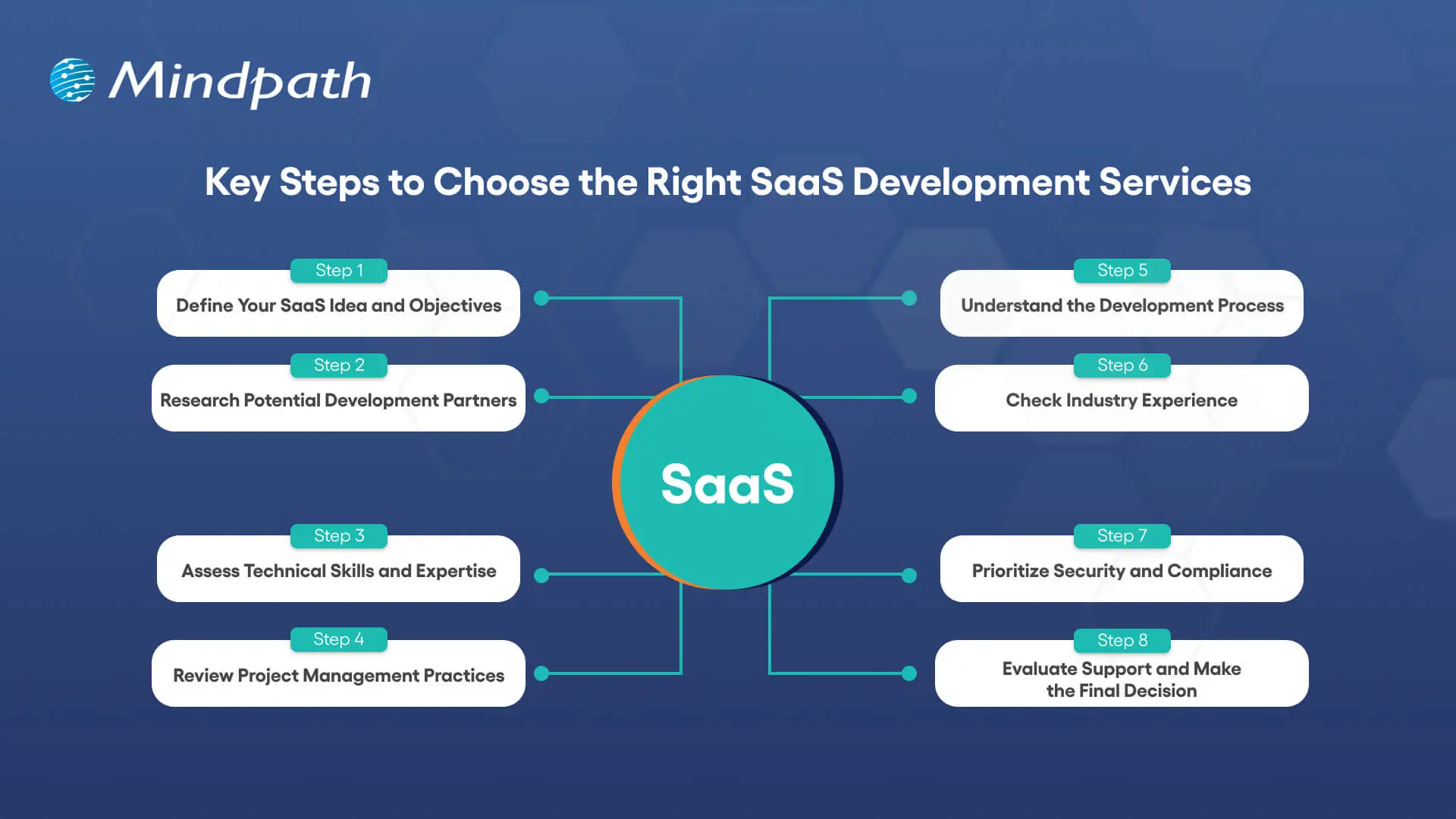
Key Steps to Choose the Right SaaS Development Services

The choice of SaaS development services requires a clear idea, planning, and business orientation. The most important steps to selecting SaaS application development services that facilitate long-term growth are as follows.

Key Steps to Choose the Right SaaS Development Services

1. Define Your SaaS Idea and Objectives

Be clear about your SaaS concept, what problem it will address, and who your audience will be. Clear goals contribute to the alignment of attributes, functionality, and business objectives in the long run. This transparency enables the SaaS development services to create a product that is focused and efficient.

2. Research Potential Development Partners

Begin by doing research on credible SaaS development companies that have a successful track record with SaaS projects. Check their portfolios, case studies, and feedback from clients to determine credibility. This study can assist you in narrowing down partners who can provide scalable solutions.

3. Assess Technical Skills and Expertise

Evaluate the technical competence of the in-house development team in the front end, back end, and cloud computing. Ensure that they know the process of developing secure and scalable SaaS applications. Well-developed technical capabilities reduce the development risks and improve the overall performance of the product.

4. Review Project Management Practices

Understand how the company manages schedules, work and communication in the development process. Agile project management is flexible and responds more rapidly to changes. Analytical thinking will ensure consistency and quality in development.

5. Understand the Development Process

Inquire about their entire development cycle such as designing, testing, and implementation. Make sure that security and performance, as well as scalability, are considered at an early stage. A trusted Saas development platform enhances easier cooperation and implementation.

6. Check Industry Experience

Experience in the industry helps teams to know more about your business challenges. Experienced developers are able to foresee risks and recommend workable improvements. This results in improved custom SaaS development projects.

7. Prioritize Security and Compliance

Make sure that the development team has good security standards and compliance requirements. The process of development should include data protection and compliance with regulations. This ensures the safety of user information and builds up confidence in the product.

8. Evaluate Support and Make the Final Decision

Evaluate the capacity of the company to offer long-term support and maintenance. Constant improvement and interaction are key to successful products. Select SaaS development services, which reflect your growth plans and vision.

Want to stay ahead in the competitive market by understanding how SaaS is evolving? Discover our guide on SaaS trends to explore the latest innovations shaping the future of the industry.

Ready to Transform Your Business with SaaS?

Selecting the appropriate SaaS development services will keep your company competitive, scalable and efficient. Successful SaaS products are the result of clear planning, technical expertise and strong project management. Using systematic steps assists in choosing partners who provide secure, reliable and innovative solutions. Having the right team ensures your software keeps up with the business requirements and enhances performance and user satisfaction.

At Mindpath, we provide professional custom SaaS development services based on your business objectives. We are a team of prolific developers and present scalable, secure, and user-friendly solutions. Our priorities are innovation, a smooth partnership, and continuous support to achieve optimal performance of your SaaS product. Mindpath is the choice that ensures a future-proofed platform that is designed to expand with your users and business vision.