Home

AI Model Monitoring: Best Practices for Production Systems

AI Model Monitoring: Best Practices for Production Systems

Join our Newsletter!

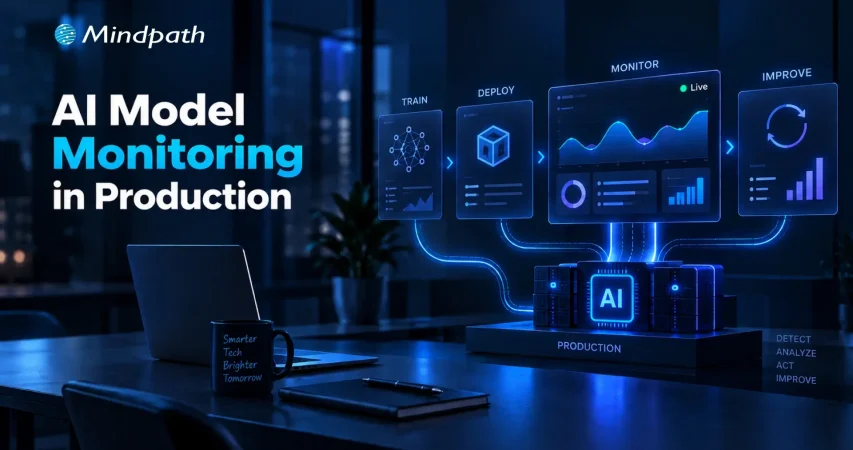
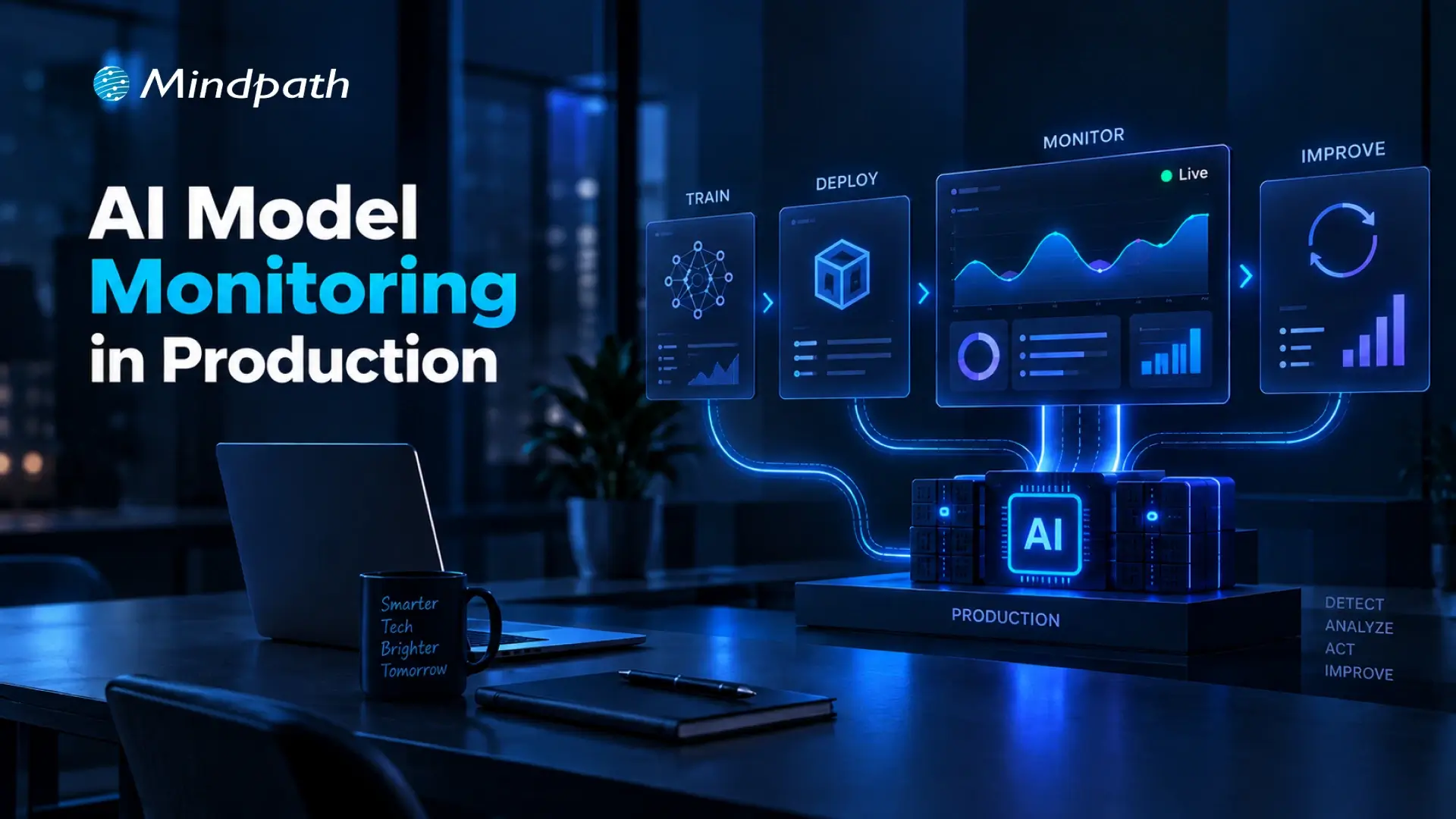
AI Model Monitoring in Production

What happens when a production model starts making weaker predictions despite passing every pre-deployment test? Changing data patterns, evolving user behavior, feature inconsistencies, and shifting business conditions can gradually affect performance. AI model monitoring gives engineering teams continuous visibility into these changes before they become costly production issues.

Key Takeaways

  • 01
    Continuous monitoring helps identify production issues before they affect business operations.
  • 02
    Clear baselines make meaningful changes in model behavior easier to detect.
  • 03
    Monitoring data quality and drift helps maintain consistent model performance.
  • 04
    Effective alerts connect detected issues with clear ownership and timely action.
  • 05
    AI monitoring should support retraining, rollback, validation, and long-term lifecycle decisions.

That visibility helps teams understand what changed, where performance is slipping, and when intervention is needed. By tracking model behavior alongside data quality, drift, operational signals, and real-world outcomes, teams can respond before small deviations become production failures. In this blog, we explore the best practices for building reliable monitoring into production AI systems.

Ready to build and operate reliable production AI systems? Mindpath offers AI Development Services to help businesses build scalable and production-ready AI solutions.

What is AI Model Monitoring?

AI model monitoring is the continuous process of observing a deployed model to understand how it performs in real-world conditions. It tracks changes in predictions, input data, output patterns, accuracy, latency, and other signals that can indicate emerging problems after deployment.

Unlike offline evaluation, which measures a model against a fixed test dataset, production monitoring observes how the model behaves as real data and usage patterns change. This ongoing visibility helps engineering teams identify performance issues, investigate their causes, and maintain dependable AI systems over time.

Why Does AI Model Monitoring Matter?

Effective monitoring gives teams the visibility needed to maintain model reliability while production conditions continue to evolve.

1. Detects Performance Changes

Identifies declining accuracy or unexpected prediction patterns early.

2. Reveals Data Issues

Highlights missing values, anomalies, schema changes, and unusual input distributions.

3. Identifies Model Drift

Shows when production data or model behavior moves away from established baselines.

4. Improves Operational Visibility

Tracks latency, failures, throughput, and resource usage alongside model metrics.

5. Supports Faster Response

Gives teams evidence needed to investigate, retrain, roll back, or review a model.

6. Connects AI to Outcomes

Helps teams understand how model behavior affects customer experiences and business processes.

Best Practices for AI Model Monitoring in Production

Reliable monitoring starts with the right signals, clear baselines, and defined actions. A practical approach to model performance monitoring helps teams spot changes early and maintain consistent production behavior.

1. Define the Right Production Metrics and Baselines

Effective monitoring starts with clear metrics and reliable baselines. Teams should track signals that reflect model quality, data health, operational performance, and business impact.

  • Model quality

Accuracy, precision, recall, F1 score, or task-specific metrics.

  • Data quality

Missing values, anomalies, schema changes, and distribution shifts.

  • Prediction behavior

Confidence scores, output patterns, and prediction frequency.

  • Operational health

Latency, throughput, errors, and resource usage.

  • Business impact

Conversion rates, customer outcomes, or process-specific KPIs.

Baselines provide a reference point for identifying meaningful changes without creating unnecessary alerts.

2. Monitor Data Quality and Model Drift

Production data can change quietly and affect model behavior over time. Monitoring input distributions, missing values, feature patterns, and prediction changes helps teams identify model drift before it affects critical workflows.

AI monitoring tools can automate these checks and flag unusual patterns against established baselines. Teams can then investigate the underlying data or model changes before deciding on actions such as retraining or rollback.

  • Data drift

Detects changes in production input distributions.

  • Concept drift

Identifies changes in the relationship between inputs and outcomes.

  • Performance decay

Flags declining model quality over time.

  • Feature anomalies

Highlights unexpected values or sudden distribution changes.

  • Drift alerts

Notifies teams when defined thresholds are exceeded.

3. Build Reliable Alerts and Response Workflows

AI model monitoring becomes useful when detected issues lead to clear action. Teams should define alert thresholds, severity levels, and ownership so production changes can be investigated without unnecessary delays.

A simple response workflow can include:

  • Detect

Identify unusual model or data behavior.

  • Alert

Route the issue to the responsible team.

  • Investigate

Check data, features, model versions, and recent changes.

  • Act

Retrain, roll back, adjust, or send cases for manual review.

  • Document

Record the issue, response, and outcome for future analysis.

Clear runbooks and ownership also reduce alert fatigue and keep production incidents manageable.

4. Extend Monitoring to AI Agents and LLM-Based Systems

AI agents and LLM applications require broader monitoring because their behavior depends on prompts, context, tools, and multi-step interactions. Teams need visibility across the entire execution flow, not only the underlying model.

Key signals include:

  • Response quality

Relevance, accuracy, and task completion.

  • Tool usage

Successful calls, failures, and unexpected actions.

  • Runtime behavior

Latency, token usage, and execution patterns.

  • Safety controls

Guardrail failures, policy violations, and risky outputs.

  • User feedback

Ratings, corrections, and recurring failure patterns.

Teams evaluating AI agent behavior can also consider dedicated AI agent testing practices to identify issues before they affect production users.

5. Connect Monitoring to the Model Lifecycle

Monitoring should feed directly into model lifecycle decisions. Production signals can show when a model needs investigation, validation, retraining, rollback, or eventual retirement.

A practical lifecycle looks like:

Monitor → Investigate → Validate → Retrain → Test → Deploy → Monitor

  • Retraining

Consider when performance declines consistently.

  • Validation

Test updated models against current production conditions.

  • Rollback

Restore a previous version when serious issues emerge.

  • Version tracking

Maintain visibility across deployed model versions.

  • Retirement

Remove models that no longer meet operational or business requirements.

A structured MLOps approach can help connect model deployment, monitoring, and lifecycle management.

6. Avoid Common AI Monitoring Mistakes

Even well-designed monitoring can become ineffective when teams track the wrong signals or lack clear response processes. Avoiding these common gaps keeps AI model monitoring focused and actionable.

  • Tracking too many metrics

Creates noise and alert fatigue.

  • Ignoring baselines

Makes meaningful changes harder to identify.

  • Overlooking model drift

Allows changing data patterns to affect predictions unnoticed.

  • Weak alerting

Delays investigation when critical thresholds are crossed.

  • Poor data lineage

Makes it difficult to trace the source of production issues.

  • Monitoring too late

Leaves gaps between deployment and reliable production oversight.

7. Choose AI Monitoring Tools That Fit Your Production Stack

The right tools should fit the model architecture, data environment, and operational workflow. Teams should prioritize capabilities that make monitoring easier to manage as deployments grow.

Look for:

  • Drift detection

Identify changes in data and model behavior.

  • Real-time monitoring

Track production signals as they occur.

  • Pipeline integration

Connect monitoring with existing ML workflows.

  • Alert management

Route critical issues to the right teams.

  • Model tracking

Maintain visibility across versions and deployments.

  • Scalability

Support cloud, on-premises, and hybrid environments.

How Can You Keep AI Models Reliable in Production?

AI model monitoring helps teams maintain reliable production systems as data, user behavior, and operating conditions change. By establishing meaningful metrics, detecting drift, creating clear response workflows, and connecting monitoring with the model lifecycle, teams can identify issues early and keep AI performance aligned with real-world requirements.

Mindpath AI development services help businesses build and operate production-ready AI systems with the right monitoring, data engineering, model lifecycle, and cloud capabilities. Our team can help establish practical monitoring frameworks that improve visibility, support faster response, and keep AI systems dependable as they scale.
Build Smarter AI Solutions

Turn your AI idea into a reliable, production-ready solution.

Frequently Asked Questions

Monitoring frequency depends on model usage and risk, but critical production systems benefit from continuous checks and timely alerts.
Drift should trigger investigation first, helping teams determine its cause before choosing retraining, rollback, adjustment, or manual review.
Monitoring cannot prevent every degradation, but it can reveal early warning signals and give teams time to investigate and respond.
Data quality, prediction patterns, latency, errors, resource usage, user feedback, and business outcomes can reveal issues accuracy alone may miss.
A structured monitoring framework provides consistent visibility across models, versions, teams, and environments as AI deployments expand.

Support Is One Click Away

Featured Posts

Related Post

Hiring NodeJS Developers
When hiring a NodeJS developer it’s essential to ensure they possess key technical skills that are fundamental to the role. Here are the core skills to look for:

1. Proficiency in JavaScript

A strong grasp of JavaScript fundamentals is crucial. This includes understanding core concepts like syntax, functions, and event handling, along with modern JavaScript features such as ES6+ (e.g., arrow functions, promises) that improve code readability and efficiency.

2. Asynchronous Programming Knowledge

NodeJS excels in handling multiple tasks concurrently, so developers need to be skilled in asynchronous programming. They should be comfortable using techniques like callbacks, promises, and async/await to perform non-blocking tasks, improving app performance.

3. Understanding of RESTful APIs

NodeJS excels in handling multiple tasks concurrently, so developers need to be skilled in asynchronous programming. They should be comfortable using techniques like callbacks, promises, and async/await to perform non-blocking tasks, improving app performance.

4. Database Handling Expertise

NodeJS developers must be familiar with various database technologies such as MongoDB, PostgreSQL, and MySQL. They should be capable of designing efficient data structures and querying the database effectively to meet the project’s data requirements.

5. Experience with Node.js Frameworks

Experience with NodeJS frameworks, like Express.js, NestJS, or Koa, is valuable. These frameworks streamline development by offering built-in solutions for routing, middleware, and handling HTTP requests, making it easier to build scalable applications.

6. Knowledge of NPM (Node Package Manager)

NPM is essential for managing third-party packages in NodeJS projects. A proficient developer should be familiar with using NPM to install and manage dependencies, ensuring the project remains organized and up-to-date with necessary tools.

7. Effective Error Handling

Proper error handling is essential for maintaining app stability. Developers should know how to catch and manage errors effectively, using techniques like try/catch blocks and logging, ensuring that the application remains reliable and easy to troubleshoot.
At Mindpath we offer a team of expert Node.js developers ready to take on your most challenging projects. With years of experience in building fast, scalable, and efficient applications, our developers specialize in leveraging Node.js to deliver top-tier web solutions. Whether it’s creating real-time applications, managing APIs, or integrating with various databases, we ensure your project is completed on time and within budget. Looking for skilled Node.js developers who can bring your ideas to life? Mindpath offers top-tier Node.js development services, ensuring high-performance, scalable, and reliable applications. Ready out now  to discuss your project needs and see how we can help you succeed!
How much does hiring a ReactJS developer cost? Learn about factors affecting rates, and how to find the best talent within your budget.
multi cloud strategy

Modern businesses operate in a highly dynamic environment. They need to focus on resilience and flexibility while performing in the market. The high intensity of competition that they encounter in their path further complicates their situation. This is when a multi-cloud strategy comes into the picture.

A multi-cloud strategy is an ideal option for contemporary businesses. It empowers business entities by increasing their flexibility and optimizing their costs. Moreover, such a strategic approach can even enhance the resilience of businesses in the unpredictable business landscape. It is the perfect time to explore the core benefits of a multi-cloud strategy for modern enterprises.

Wanting to leverage modern cloud technologies to make your operations faster and more scalable? Mindpath provides cloud infrastructure services that help you build, deploy, and manage systems with confidence.

What is a Multi-Cloud Strategy?

Before looking at the benefits of a multi-cloud approach, you need to have a clear understanding of the specific concept. A multi-cloud strategy is a plan to use computing services from two or more public cloud providers, such as Amazon Web Services (AWS), Microsoft Azure, and Google Cloud, simultaneously. Rather than relying on a single vendor, businesses distribute workloads across these providers to tap into each one’s strengths. You may be wondering why such a decision is essential. This is because a single cloud provider can restrict the full potential of the cloud strategy of a business. 

A multi-cloud strategy is ideal for businesses today because it directly addresses the key risks of single-provider dependence, namely vendor lock-in, limited flexibility, and single points of failure. It gives businesses greater control over their operations and measurably improves operational efficiency.

It’s worth noting that a multi-cloud strategy can span private cloud, public cloud, and specialized cloud services. When businesses adopt a multi-cloud infrastructure, they are no longer locked into the constraints of a single provider. Instead, they can pick the best tool for each job, choosing whichever platform best fits a specific workload while maintaining better control over their infrastructure. This flexibility lets them respond to market shifts quickly and operate with higher agility and improved system uptime.

Wondering which cloud technologies will shape the future of your business? Explore our blog cloud computing trends to discover the latest innovations driving scalability, efficiency, and growth.

How is the Multi-Cloud Strategy Different from the Single Cloud and Hybrid Cloud Approaches?

In order to get a comprehensive insight into multi-cloud architectures, you must know that it is different from single-cloud and hybrid-cloud approaches. In a single cloud approach, a business depends on a single cloud provider for all its workload. In the case of a hybrid cloud, businesses combine on-premise infrastructure with a private or public cloud. While talking about multi-cloud vs hybrid cloud, you need to remember that multi-cloud involves using multiple cloud providers for different workloads. 

In the case of a single cloud approach, the management is simplified. However, the issue relating to vendor lock-in may arise. It can automatically limit the overall flexibility for businesses. The hybrid cloud model, on the other hand, offers more balance between conventional IT and cloud solutions. 

However, businesses must remember that there is limited producer diversity. The multi-cloud approach offers multi-cloud benefits since it minimizes dependency on a single provider and boosts resilience for businesses. Thus, out of all these options, the multi-cloud approach creates immense value for contemporary business entities. 

Benefits of a Multi-Cloud Strategy

Now that you know, what is multi-cloud? It is time to look at some of the associated benefits. It is fundamental for businesses to remember that a multi-cloud strategy can give rise to a plethora of benefits. The awareness of these benefits can help them decide whether they want such a solution or not. 

1. Avoiding Vendor Lock-In

If businesses opt for the multi-cloud strategy, they can rest assured about the vendor lock-in issue. This issue mainly arises when businesses depend on a single provider; however, in the case of a multi-cloud strategy for businesses, they depend on diverse providers. Thus, the dependence on a single vendor gets reduced substantially. Thus, businesses are able to enjoy ample flexibility while operating in the dynamic and uncertain business environment.

2. Cost Efficiency

One of the main benefits of a multi-cloud strategy is related to cost efficiency. In fact, the multi-cloud strategy is ideal for businesses that intend to curb their IT spending. You need to remember that the public cloud option comes with less overhead. Moreover, it allows businesses to scale up or down as per their needs and requirements. Businesses can leverage a multi-cloud strategy and take advantage of the best pricing and performance options. 

3. High Reliability

A multi-cloud strategy undoubtedly reduces the risks relating to unplanned downtime. This is because it minimizes the risk relating to a single point of failure. An outage in a single cloud will not necessarily have an adverse impact on the services on other clouds. In case the cloud goes down, businesses can route their computing needs to another cloud. Thus, the reliability is high when businesses choose the multi-cloud strategy.  

4. Advanced Security

If businesses are looking for high security while leveraging cloud services, the multi-cloud strategy is an ideal option. This is because a multi-cloud strategy enables businesses to not only deploy and scale workloads but also implement robust security policies. You can also take advantage of compliance technologies in a consistent manner across all your workloads, irrespective of the service or vendor. In the highly unpredictable times, the role of heightened security cannot be negated for businesses.   

5. Best Feature of Each Cloud Solution

The multi-cloud approach enables business entities to choose from many cloud vendors. Thus, it offers ample flexibility in order to match the specific capabilities and features to optimize the workload of businesses. You can take into consideration diverse factors such as speed and performance, and choose the best cloud solution that perfectly aligns with your business needs.  

Looking to build applications that scale seamlessly across multiple clouds? Explore our blog cloud‑native development to discover how cloud-native architectures improve performance, flexibility, and business growth.

Disadvantages of a Multi-Cloud Approach

Businesses need to keep in mind both multi-cloud advantages and disadvantages while deciding on the multi-cloud strategy. It is necessary to be aware of the associated disadvantages so that businesses can set their expectations accordingly. 

1. Management Complexity 

One of the most common disadvantages is related to management complexity. It might not be easy for businesses to manage a multi-cloud strategy. They need to dedicate their time and effort so that the strategy can work in favor of the business. 

2. Operational Overhead

Businesses may find it challenging to coordinate between diverse platforms. Furthermore, it may increase the management overhead for the business. There is a need for sophisticated tools to manage all the platforms in a perfect manner. 

3. Heightened Cost 

Although all the services may be cheaper, the total cost may be higher. This is mainly due to the added overheads relating to the management of diverse cloud platforms. Thus, businesses need to understand the importance of careful planning as well as management. 

4. Heightened Security Risks

As each cloud provider has its own security and compliance model, ensuring consistency is not easy for businesses. The lack of consistency in terms of security can undoubtedly give rise to security risks. This is a serious disadvantage that businesses cannot ignore. 

Struggling to make informed decisions about your cloud investments? Discover our blog importance of data-driven decision making for businesses to learn how analytics and data insights improve cloud strategy outcomes.

Final Words

In the competitive business setting, businesses need to adopt a multi-cloud strategy. Before implementing the strategy, insight into the related benefits as well as disadvantages is essential. The key benefits and disadvantages relating to a multi-cloud strategy have been presented, which can guide businesses to make their cloud-related decisions. 

Mindpath’s top-notch cloud infrastructure services are ideal for modern businesses. The experts can make sure that the business can derive optimum value from their cloud approach. The strategy can certainly act as a source of competitive advantage in contemporary times. 

Discover the benefits of a multi-cloud strategy for modern enterprises, including improved security, flexibility, cost savings, and risk management.
AI integration in business

Artificial intelligence is one of the most powerful technologies for business transformation in 2026. As more examples of AI integration in business come to the limelight, business owners and managers want to discover effective ways to embrace AI. Businesses have been adopting AI not only to automate tasks but also to find new solutions to foster innovation, enhance process efficiency, and drive customer engagement.

Organizations have been using AI in different capacities for over a decade, and the success of their AI initiatives paved the path for broader adoption. You can come across different use cases of AI in the domain of business, ranging from predicting market trends to developing marketing content. Let us find out how AI use cases deliver results for businesses in the real world. 

Watching the use case of AI is not enough; want to adopt AI for your business? Mindpath, an AI Integration Services provider, has expertise in providing intelligent solutions that help businesses move towards real-world success.

Is AI Important for Businesses?

The biggest concern for any business in the existing technological landscape is about AI adoption. While AI use cases in business have been delivering promising results, business owners want to find out whether AI is necessary for their business. How will a business embrace AI? Artificial intelligence is still an elusive concept for many business owners owing to a lack of awareness. As a matter of fact, many people believe that the use of AI in business is only about automation. On the contrary, the utility of AI in business revolves around leveraging machine learning, natural language processing, and other AI technologies to streamline operations. 

You can discover numerous use cases of artificial intelligence for business that help in resolving challenges in different departments. For example, AI can enhance customer satisfaction levels, enable intelligent workflows, and reduce the time invested in repetitive tasks. The applications of AI in almost every department of an organization, such as sales, customer service, and operations, lead to results that add more value to the business.  

Unraveling the Top Use Cases of AI for Business

The advantages of AI for business in different real-world use cases encourage more companies to integrate AI into their operations. Artificial intelligence not only powers personalized ads and consumer-facing technologies like Alexa but also revolutionizes how businesses work, compete, and innovate. According to a survey by EY, almost 72% of executives have reported that employees use AI every day in the workplace for tasks like communication, software development, and data analysis (Source). The following real-world AI use cases will offer the best insights into the utility of artificial intelligence in the business landscape.

1. Enhancing Process Efficiency

Artificial intelligence helps in achieving significant improvements in the operational efficiency of businesses. AI plays a crucial role in automation repetitive tasks and optimizing resource allocation, thereby reducing waste. Artificial intelligence tools help in cutting costs and also contribute to the bottom line of a business. For instance, supply chain optimization tools can leverage AI to draw accurate predictions for demand and optimize the inventory.

Business leaders can also utilize AI business applications for the automation of document processing tasks, which are generally repetitive in nature. Automation of invoice processing and data entry offers an easy solution to enhance operational efficiency. On top of it, businesses can also enhance process efficiency through the use of AI in energy management. AI-powered solutions can analyze patterns of energy usage and automate processes like lighting, heating, and cooling according to usage trends.    

2. Improved Workplace Productivity

The automation capabilities of artificial intelligence can also serve a crucial role in enhancing workplace productivity. Employees can use AI for automation of repetitive tasks that consume a lot of time, thereby finding the time to focus on strategic tasks. At the same time, the benefits of AI in business point to how employees can make more informed decisions with AI. Virtual meeting assistants are the most promising example of embracing artificial intelligence to make informed decisions. 

AI tools can not only provide meeting transcriptions but also a summary of key points in the meetings. As a result, employees can focus on activities that bring more value to their organization. Artificial intelligence tools for task automation also serve as useful choices for the automation of project management workflows. For instance, Google Smart Compose allows employees to use AI for writing emails faster with better accuracy. Therefore, employees don’t have to waste a lot of time getting their emails right without compromising the quality of communication.

Curious about the different AI approaches companies are using today? Check out the types of AI and discover how they power automation, analytics, and customer engagement.

3. Predictive Analytics

The next most popular use case of artificial intelligence in the modern business landscape is predictive analytics. Companies can use AI for business growth by analysing historical data, identifying patterns, and predicting future outcomes. Businesses have been adopting AI to make smarter decisions, whether it is about identifying customer needs, reducing risk, or optimizing inventory. Artificial intelligence can tap into the power of advanced algorithms and real-time data streams to empower businesses with insights that help them make proactive decisions.

The utility of AI in predictive analytics not only helps in making informed decisions but also improves efficiency and empowers businesses to deliver better customer experiences. The value of AI for decision makers is visible in examples across retail, finance, and healthcare sectors. AI-powered predictive analytics can help businesses in the retail sector forecast demand and optimize their inventory to avoid running out of stock. Similarly, healthcare companies can use AI predictive analytics to evaluate patient history and determine the risk of diseases.       

4. Content and Product Development

Artificial intelligence gained significant popularity owing to the arrival of generative AI tools. One of the most notable use cases of generative AI is content development, which can help businesses in many ways. The curiosity to learn how businesses use AI will also point to how artificial intelligence can help in generating content, product designs, and functional prototypes for product development. As a matter of fact, many businesses already use generative AI in marketing, product innovation, and software development. 

The use cases of AI in marketing content generation involve creating blog posts, personalized emails, ad copies, and product descriptions. Businesses can also create custom training content and simulations with the help of generative AI. Artificial intelligence also provides a new direction for approaches to creating e-commerce product content based on customer behavior trends. On top of it, generative AI can offer product ideas, creative concepts, and UI mockups according to user instructions.

Want to accelerate content production and streamline coding tasks in your business? Discover generative AI tools for content creation and code creation to learn how they boost efficiency and creativity.

5. New Benchmarks of Security

The biggest impact of artificial intelligence in business is visible in the domain of cybersecurity. The advantages of AI integration in business can help in fighting against emerging security threats. Artificial intelligence can serve as a protective layer for businesses by improving threat detection capabilities with seamless analysis of datasets to recognize potential anomalies and risks of breaches. The proactive approach to cybersecurity with AI empowers businesses to respond quickly and address risks before they inflict damage. 

Artificial intelligence can not only enhance detection but also facilitate automation of incident response and alerting mechanisms. As a result, businesses can reduce the burden on security teams by initiating countermeasures instantly. AI-powered simulations can also help businesses strengthen cybersecurity training and enhance their overall resilience. For instance, AI tools can detect fraudulent transactions and anomalies in user behavior for better security in finance. 

6. Talent Acquisition and Management

Managing talent is one of the formidable challenges for business owners. Starting from the process of attracting talent to retention, businesses can use AI to empower their workforce with skilled resources. The different examples of AI implementation in companies showcase the automation capabilities of AI. Businesses can use AI-powered automation in different steps of the talent management cycle. 

The use cases of AI for talent acquisition point to the use of AI tools for resume and portfolio analysis. In addition, recruiters can also use AI to review video interviews of candidates. The comprehensive assessment with AI helps in identifying the right talent for a company. Artificial intelligence also helps in boosting employee retention, as evident in the example of LinkedIn Talent Insights. It uses AI to offer accurate predictions for employee attrition rates and also offers recommendations to enhance employee retention.

Planning to integrate AI into your business strategy but unsure where to start? Discover AI solutions for small businesses and startups to learn how tailored technologies can deliver measurable results.

Want to Harness AI to Drive Real Business Growth?

The applications of artificial intelligence in the business landscape have helped business owners discover new perspectives on efficiency and innovation. As the demand for digital transformation with AI continues to gain momentum, more businesses will join the bandwagon. However, professional assistance can help a business identify the ideal strategic approach to leverage AI for its operations.

We at Mindpath have helped thousands of clients with AI adoption in different business departments. Our experts specialize in end-to-end AI solutions, and the experience of serving a wide range of clients enhances our strengths. We are committed to understanding the client’s requirements and vision to help them achieve the best outcomes for their business with AI. Consult with our experts and find the ideal use cases to embrace AI in your business right now.

Frequently Asked Questions