What Skills to Look for while hiring a NodeJS Developer in Canada?

Join our Newsletter!

Featured Posts

Support Is One Click Away

Home

What Skills to Look for while hiring a NodeJS Developer in Canada?

Hire NodeJS Developer in Canada

What Skills to Look for while hiring a NodeJS Developer in Canada?

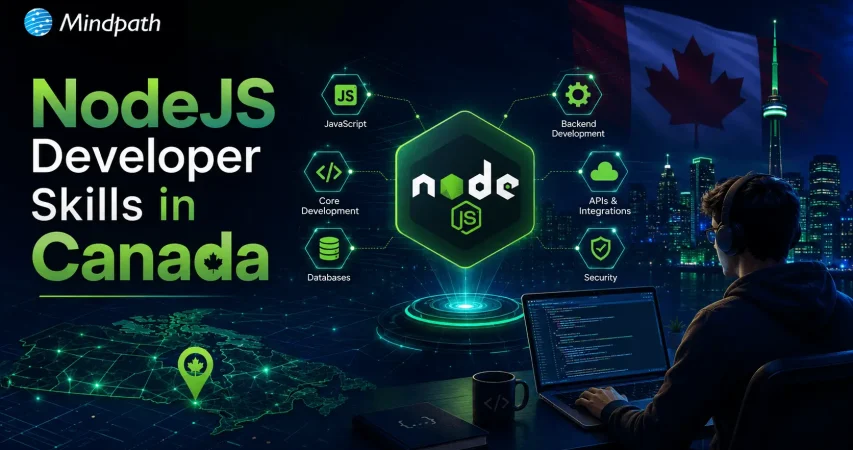
Hiring a Node.js developer in Canada necessitates a thorough assessment of technical knowledge, problem-solving ability, and collaboration capabilities. A competent applicant should understand JavaScript, Node.js frameworks, database administration, and API development, as well as be familiar with security best practices and scalability strategies. Furthermore, soft skills such as communication and flexibility are essential for successful team cooperation. The following are four crucial abilities to look for when hiring a Node.js developer in Canada.

1. Proficiency in JavaScript and Asynchronous Programming

Since Node.js is based on JavaScript, developers must have a solid knowledge of JavaScript basics such as closures, prototypal inheritance, and ES6+ capabilities. They should also be proficient in asynchronous programming, which involves efficiently handling numerous tasks with callbacks, Promises, and async/await. This knowledge enables them to create non-blocking, high-performance apps that can handle concurrent queries successfully. A deep knowledge of the event-driven architecture of Node.js is essential for developing scalable and efficient backend systems.

2. Experience with Node.js Frameworks and API Development

A skilled Node.js developer should be familiar with popular Node.js frameworks such as Express.js, NestJS, or Koa to help with backend development. They must also be skilled in designing and developing RESTful APIs while adhering to industry best practices for authentication, authorization, and error management. Knowledge of GraphQL is advantageous for applications requiring quick data retrieval. These abilities are essential for guaranteeing efficient communication between the frontend and backend, as well as optimizing web application performance overall.

3. Database Management and Security Awareness

A strong Node.js developer should be skilled in handling databases like MongoDB, MySQL, or PostgreSQL, understanding data modeling, indexing, and query optimization for efficient data retrieval. Additionally, knowledge of Redis for caching can enhance performance. Security is another critical aspect—developers should be familiar with data encryption, input validation, and protection against SQL injection and XSS attacks. Ensuring compliance with Canadian data privacy laws like PIPEDA is also essential when handling sensitive user information.

4. Version Control, Scalability, and Cloud Integration

Version control is vital in modern development, so proficiency in Git and platforms like GitHub or GitLab is a must. A Node.js developer should also have experience in scalability techniques, including load balancing, microservices architecture, and caching mechanisms, ensuring the application can handle growth. Familiarity with cloud platforms like AWS, Azure, or Google Cloud is highly valuable, especially for deploying and managing applications efficiently. These skills help create robust, scalable, and well-managed software solutions.

Need skilled Node.js developers in Canada? Mindpath provides top-tier developers with expertise in JavaScript, APIs, security, and cloud integration. Whether you need scalable backend solutions, database management, or secure web applications, our experts deliver high-quality development tailored to your needs. Ensure project success with developers who understand modern frameworks, performance optimization, and Canadian data regulations.

Partner with Mindpath today for efficient and reliable Node.js development. Get in touch now to find the perfect fit for your project!

Read our next blog: Understanding the Cost of Hiring NodeJS Developer in Canada

Related Post

Related Post

hiring reactjs developers

The fast-paced growth of the digital landscape has not only empowered businesses but also made them think about their online presence. Companies have been hiring ReactJS developers to capitalize on the diverse capabilities of ReactJS for creating robust user interfaces. The notable features of ReactJS include the virtual DOM, a thriving ecosystem, and modular architecture. Let us find out the important factors you must keep in mind while hiring React developers.

Want to hire ReactJS expert for your next project? Discover how Mindpath’s ReactJS development services will help you achieve your specific business goals.

What Should You Keep in Mind While Hiring ReactJS Developers?

The search for expert ReactJS developers has gained momentum as a response to more businesses turning towards online platforms. However, business owners might experience some trouble in hiring React developer as they will find it difficult to understand coding nuances and technical jargon. At the same time, finding the best React developer who can also be a cultural fit is a huge challenge.

Hiring managers must also go through a massive talent pool of React developers to find the top expert for their next web project. On top of it, employers have to look for more than just technical skills in React developers to create successful web projects. The following checklist can help you hire the best ReactJS developers for your web projects.

Must Read: ReactJS Trends

1. Specify the Project Requirements

One of the foremost factors to consider when hiring ReactJS developers is the outline of project requirements. You should know your project scope and complexity level to identify the ideal React developer who would align with your project vision. The project requirements should not be limited to defining the type of project, but also the timeline, desired features, budget, and complexity.

With a clear impression of these aspects of your project, you can determine the skills and experience required from candidates. For instance, you will need a junior developer for smaller tasks and a senior developer for leading initiatives to scale up web projects.

2. Never Compromise with Technical Fluency

The easiest solution to challenges in hiring expert ReactJS developers involves focusing on the technical skills of applicants. You need developers who know more than the fundamental concepts of React and have various crucial technical skills. Candidates must have strong understanding of JavaScript features such as arrow functions, closures and destructuring.

Applicants for React developer jobs should also have in-depth understanding of the important concepts in ReactJS. Some of the important React concepts include React Hooks, component lifecycle methods, virtual DOM and reconciliation. People applying for ReactJS developer jobs must also know how to work with state management libraries such as Redux.

The other crucial technical skills in a checklist for hiring ReactJS developer include fluency in HTML and CSS, version control with Git and API integration. Aspiring React developer must also know how to work with testing frameworks, build tools and package managers like NPM. Another prominent technical skill that React developers must have is performance optimization.

Want to keep your large React app fast and responsive as it scales? Discover the best practices for optimizing React performance for large applications.

3. Optimizing the Interview Process

The effectiveness of your hiring process depends a lot on the quality of the interview. If the resume serves as an advertisement, then the interview helps you test the product. Employers should divide the interview process into different stages to evaluate the distinct competencies of applicants. The best practices for hiring ReactJS developers suggest that the interview must include technical assessment, portfolio review, live coding session and behavioral interview. Each stage in the interview process will help you measure the overall proficiency of candidates rather than focusing on specific areas of expertise.

The technical assessment should have coding challenges to test the problem-solving skills and coding style of applicants. You can find out whether they use efficient algorithms, data structures and React concepts in their code. Hiring managers should choose live coding sessions in interviews for senior React developer roles. The portfolio review involves checking for active contributions of candidates on GitHub and their past projects. Employers can use the portfolio review to find out whether the applicant has problem-solving skills.

The technical assessment and portfolio review must be accompanied with behavioral interview questions. The best react developer hiring tips point out that behavioral interview questions can help you learn more about the developer. For example, you can find out how they approach complex issues, their preferred development workflow and their preferences for collaboration. The behavioral interview will help you understand the capabilities of a React developer applicant on a more personal level.

4. Don’t Forget the Soft Skills

Among the many factors that you should keep in mind while hiring React developers, the list of soft skills will never lose its significance. As a matter of fact, soft skills like communication, adaptability, problem-solving and collaboration are essential requirements for almost every job. Why are soft skills important for ReactJS developers? Soft skills serve as the catalyst for transforming a group of individuals into a powerful team.

Most of the guides on how to hire ReactJS developers also focus on other soft skills such as attention to detail, proactivity and accountability. React developers need attention to every detail of the UI development process as it can help in crafting robust and engaging user experiences. On top of it, proactivity implies that the candidate will be always ready to take initiative. At the same time, accountability can ensure that the developers take responsibility for all their actions.

5. Determine Realistic Compensation

The most crucial highlight in the hiring process is the cost of hiring ReactJS developers. Hiring managers must offer a compensation package that fits perfectly with the role and responsibilities of the developer. For example, junior developers can earn between $70,000 and $90,000 while senior developers can earn more than $150,000.

The ideal way to make sure that the candidates feel that the compensation is right involves a clear job description and smooth onboarding process. Tell the developers what they have to do on the job to make them understand why they are being paid a specific amount. In addition, try to include programs for continuous learning and growth of developers.

Looking for specialists who can handle complex front-end challenges in your business? Learn why partnering with an expert React Development Company is a smart move.

Looking to Hire a ReactJS Developer Who Truly Understands Your Business Goals?

The answers to “What are the key things to consider before hiring a ReactJS developer?” focus specifically on project requirements, technical skills, soft skills and the interview process. On top of it, determining the ideal compensation for ReactJS developers is also an important concern in the hiring process.

Do you need professional ReactJS development services for your next web application? At Mindpath Tech, we have the best developers who can handle all your frontend development needs. Our team of proficient ReactJS developers has the experience of working on multiple projects. We not only offer the assurance of efficient web development but also resourceful solutions to optimize your digital presence. Join us and work with top-tier ReactJS talent on your revolutionary web app right now.

Frequently Asked Questions

1. What are the key factors to consider when hiring ReactJS developers for the first time?

Start with absolute clarity on project scope, complexity, and timeline before evaluating any candidates. These three elements directly determine the experience level, technical skills, and compensation range required. Businesses that define requirements precisely before posting job listings consistently attract more relevant applicants and complete the hiring process significantly faster.

2. How much technical depth should a ReactJS developer realistically demonstrate during interviews?

Beyond basic React fundamentals, strong candidates should demonstrate confident knowledge of Hooks, state management libraries, virtual DOM behavior, and performance optimization techniques. The ability to explain technical decisions clearly, not just write correct code, separates genuinely experienced developers from those who have simply memorized common interview answers without deeper understanding.

3. How does a portfolio review differ from a technical assessment during ReactJS hiring?

A technical assessment tests current coding ability under structured conditions. A portfolio review reveals consistency, project diversity, code quality over time, and real-world problem-solving patterns. GitHub contributions add another layer by showing collaborative habits and open-source engagement. Together, both evaluation methods provide a far more complete picture than either approach alone.

4. Why do so many ReactJS hiring processes fail despite attracting strong technical candidates?

Usually because soft skills are evaluated too casually or skipped entirely. Technically strong developers who struggle with communication, accountability, or collaboration consistently create team friction and project delays. Behavioral interviews designed to assess real working style and cultural alignment are just as critical as any coding challenge during the evaluation process.

5. What compensation package actually attracts quality ReactJS developers in a competitive market?

Competitive salary is only part of the equation. Developers also value clear growth pathways, continuous learning opportunities, and transparent role expectations. Junior developers typically expect between $70,000 and $90,000 annually, while senior talent commands above $150,000. Pairing fair compensation with a well-structured onboarding experience significantly improves both acceptance rates and long-term retention.

Hiring ReactJS developers? Explore essential factors like experience, skills, and project requirements to ensure a successful collaboration.
AI in Personalized Banking Experiences

Artificial Intelligence is redefining how individuals will interact with their banks in the future. By leveraging AI in personalized banking experiences, financial institutions can better understand their customers and serve them with both precision and care. Picture receiving financial advice that is based on your lifestyle or alerts that predict your spending needs, even before you notice them. This is no longer a dream, but rather a progressive reality that is evolving our customer relationships with the banking experience.

As technology continues to grow smarter, banks are leveraging AI to enable a more seamless, rapid, and meaningful experience at each and every interaction with customers. Technology provides opportunities to design experiences that feel human, not automated, so clients feel understood at every step. With this growing innovation, personalization is now emerging as a key competitive advantage. In this blog, we’ll explore how AI is revolutionizing the banking experience into one that is less intuitive and more focused on the customer.

Ready to revolutionize the customer experience in their banking journey with the use of AI? Mindpath offers AI development services that help you put together tools that give you personalized financial experiences.

What is AI in Personalized Banking Experiences?

AI in personalized banking experiences is when artificial intelligence is used to create more purposeful banking for all customers, using information to identify spending, saving, and investing patterns to establish services that meet needs. This provides a thoughtful and engaging experience, ultimately increasing customer satisfaction and trust with the bank.

The use of AI in banking enables banks to provide certain services beyond basic transactional exchanges. With AI, banks are able to predict and suggest to the consumer the most likely need, for instance, recommending budgeting plans or how to spend money more wisely. The smart utilization of data and technology is a way to transform and personalize a traditionally impersonal banking experience into something humanized and connected to the customer.

Personalized banking is becoming a strategic advantage for business owners managing finances at scale. Explore AI in business strategy to understand how AI-driven banking solutions support long-term growth.

How Does AI Provide Personalized Banking Experiences?

AI is redefining banking by transforming data to drive understanding and inform the experience customers will have with a bank. Below are the roles of AI in delivering personal and valued banking experiences. This makes every interaction more meaningful, predictive and customer-centric.

1. Smarter Customer Insights

The use of AI in personalized banking experiences enables banks to know their customers more deeply. It analyzes various aspects of the customers’ lives, such as their spending habits, income patterns, and financial goals to be able to provide them with what they may require next. Based on these findings, banks are empowered to give the right advice at the right time and thus enhance customer experience.

2. Personalized Product Recommendations

Artificial Intelligence in finance gives banks the ability to create money management tools that go hand in hand with the everyday life and objectives of each client. After analyzing data like saving habits or risk tolerance, AI comes up with a credit card, a loan, or an investment that is an ideal match. Such customer experience retains customers’ faith and increases their confidence in the company, making them feel recognized and appreciated.

3. Enhanced Fraud Detection and Security

AI in personalized banking experience is a great tool for making customers feel safe when handling their money. It keeps an eye on transactions in real-time, and thus, any strange activities, which are possibly fraudulent, can be easily detected. Besides an increase in safety, this reactive security system also helps to establish trust in each digital interaction made by the customer.

4. Intelligent Virtual Assistance

AI-based virtual assistants and chatbots in banking are revolutionizing the way customer service is delivered. These AI assistants are available 24/7, so customers can always rely on them to get help. These empathetic interactions help to democratize banking.

5. Targeted Marketing with a Personal Touch

One of the conveniences of AI in banking is illustrated in customized marketing strategies as well. Banks are employing insights derived from data-driven decision making to deliver communications and to extend offers that are an authentic fit for the requirements of each customer. This targeted tactic heightens the interaction and facilitates customers in discovering services which really advantage them.

6. Smarter Credit Risk Assessment

AI-powered personalized banking experiences change the way that financial institutions determine a customer’s creditworthiness. Banks using AI check quite a few different aspects of a person’s life, such as income, payment behaviors, and even spending trends, to make a more just decision about who gets the loans. This precision opens the doors to better financial products for customers, while it is a relief to the banks that the risks are minimized.

Want to know how business owners can gain better control over cash flow and financial decisions? Explore AI in decision-making to see how personalized banking insights help businesses make faster choices.

Real-World Examples of AI in Personalized Banking Experience

Throughout the finance sector, AI is developing new methods of communicating with clients and assisting them with everyday banking. Presented below are some examples of AI in banking to illustrate how financial institutions are leveraging intelligent technology to provide clients with more personalized and valuable experiences.

1. Smart Virtual Assistants

AI in personalized banking experiences uses virtual assistants to simplify daily banking tasks. They help customers manage accounts, pay bills, and get instant updates anytime.

2. Personalized Financial Guidance

AI studies customer behavior to offer tailored budgeting tips and spending insights. It helps people make smarter financial decisions that match their goals.

3. Smarter Investment Support

AI analyzes market data and customer preferences to suggest better investment options. It helps both investors and advisors plan strategies more effectively.

4. Stronger Fraud Protection

AI tracks transactions in real time to detect unusual activity quickly. This smart monitoring keeps customers’ accounts secure and builds greater trust.

Wondering what type of AI actually powers personalized banking for businesses? Explore the types of Artificial Intelligence (ANI, AGI, and ASI) to learn how banks apply intelligent systems to serve business owners better.

Ready to Transform Banking with AI Innovation?

The application of AI in customized banking experiences is transforming the way people handle their finances and interact with their bank. Through the intelligent use of data to understand the needs of each customer, AI helps making financial services more accessible, secure, and meaningful to consumers. As technology continues to evolve, AI will continue to offer everyday consumers greater personal, intelligent, and seamless experiences in modern banking.

At Mindpath, we assist financial institutions in developing intelligent and customer-centric AI solutions that redefine banking. Our AI development services allow banks to provide predictive insights, personalized products, and improved security. We leverage our expertise to help you build smart systems that convert customer interactions into trusted and lasting relationships.

Remote development team
Globalization has been a phenomenon that blurred boundaries and helped many businesses expand internationally. While the world is reaching toward realizing the idea of a “Global Village”, reservations and misconceptions about hiring remote employees and teams prevail.   COVID-19 showed business leaders the endless potential of remote working. While the world remained locked up, remote working allowed businesses to keep going, especially the ones dependent heavily on IT services  With rapid digitization, IT services have become more crucial than ever for businesses belonging to all categories and industries. According to Statista, the revenue of the IT services market is projected to reach USD 1,420 billion by 2024. Out of the total revenue, the IT Outsourcing segment is dominating the market with a projected volume of USD 541.10 billion in 2024.   Hiring a remote development team is a sound business decision with multiple benefits. In this blog, we will cover all the information essential if you are considering hiring remote developers or development teams for your business.  

Remote IT Development Teams: An Overview

Remote development teams consist of developers and tech professionals working from different geographical locations. These teams collaborate with businesses virtually, understanding their requirements, creating various wireframes, creating delivery plans, working on development, and delivering, deploying, and testing the final product. When hiring talent via staff augmentation, it’s essential to ensure that these remote teams are well-integrated into your project, enabling seamless collaboration and meeting your business goals efficiently.  Businesses are inclined towards hiring remote developers to access a wide talent pool within budget. Especially mid-sized and small businesses that cannot accommodate a full-fledged IT team to develop and maintain their website, apps, and other digital platforms can hugely benefit from hiring an offshore team.  

Benefits of Hiring a Remote Development Team

1. Access to a Global Talent Pool

One of the primary benefits of hiring a remote development team is the ability to access a diverse range of skills and expertise. Casting a wider net can help businesses recruit the top talents in the technology fields such as development, design, implementation, etc.   Emerging technologies like AI, ML, data science, DevOps, Blockchain, Cloud Computing are taking over the world. By looking beyond geographical boundaries, you can find developers with specific technical capabilities that may not be available locally.

2. Cost Efficiency

Hiring remote developers can be more cost-effective than maintaining an in-house team. A report by Deloitte suggests that 63% of companies outsource their development tasks to reduce costs.   You can reduce expenses related to office space, equipment, and other overhead costs. Moreover, the ability to hire from regions with lower living costs can further reduce payroll expenses without compromising on talent quality. 

3. Flexibility and Scalability

Remote teams offer greater flexibility. You can scale your team up or down based on project requirements without the logistical challenges associated with in-house teams. According to studies, 53% of businesses have dealt with capacity issues, and 38% improved the service quality by hiring a remote development team.   This flexibility allows you to manage resources more efficiently and respond quickly to changing project needs. 

4. Increased Productivity

Remote developers often experience fewer distractions than traditional office environments, increasing productivity. There is also no time for commuting to a physical workplace, saving time for more strategic actions.   With a properly managed remote team, you can leverage different time zones to maintain a near-continuous workflow, ensuring that your project progresses even outside typical working hours. 

5. Environmental Benefits

Hiring a remote development team not only saves your costs and improves productivity but can also contribute to reducing your company’s carbon footprint. With fewer employees commuting to a central office, there are fewer greenhouse gas emissions, aligning your business with environmentally sustainable practices.

Challenges to Consider

1. Communication Barriers

Effective communication is crucial for the success of any development project. When working with a remote team, time zone differences and language barriers can pose significant challenges. It is essential to establish clear communication protocols and utilize collaboration tools to ensure everyone is on the same page.

2. Managing Productivity

Tracking productivity can be more challenging with a remote team. Setting clear expectations, establishing measurable goals, and using project management tools are vital for keeping remote developers on track. Regular check-ins and progress updates can also help in maintaining accountability. 

3. Cultural Differences

Cultural differences can impact team dynamics and workflow. Understanding and respecting these differences is important for fostering a collaborative environment. Encouraging an inclusive culture where all team members feel valued can help mitigate potential conflicts and improve overall productivity. 

Best Practices for Working with Remote Developers

1. Define Clear Objectives

Before hiring a remote development team, define your project goals, timelines, and deliverables. Clear objectives provide a roadmap for the team and help in aligning their efforts with your business objectives. 

2. Invest in the Right Tools

Leverage technology to bridge the gap between remote team members. Tools like Slack/MS Teams for communication, Jira/Azure DevOps for project management, and GitHub for version control can enhance collaboration and streamline workflows. 

3. Build a Strong Onboarding Process

A well-structured onboarding process ensures that remote developers understand your company culture, project expectations, and their specific roles. Providing comprehensive training and resources can help new team members integrate smoothly and start contributing quickly. 

4. Foster Team Engagements

Regular team-building activities, virtual meetups, and open communication channels can help in building a cohesive team. Encouraging social interaction and recognizing individual contributions can boost morale and foster a sense of belonging among remote developers. When comparing IT staff augmentation vs. traditional hiring, these practices are essential in maintaining a strong, engaged team, regardless of the hiring model, while benefiting from the flexibility and scalability that staff augmentation offers.

Wrapping Up

Hiring a remote development team can offer numerous benefits, from access to a global talent pool to cost savings and scalability. However, it also requires careful planning and management to overcome challenges such as communication barriers, productivity tracking, and cultural differences.  If you’re considering hiring a remote development team, Mindpath’s Team Augmentation services can be an invaluable resource. Our experienced professionals can seamlessly integrate with your existing team, bringing specialized skills and expertise to help you achieve your project goals. With Mindpath, you get the flexibility and scalability of remote development without the common pitfalls. Partner with us to unlock the full potential of your development projects.  Feel free to reach out to us with any questions or to discuss your specific requirements. Together, we can build something great! 
Hiring a remote development team is a sound business decision with multiple benefits. Read things to keep in mind while hiring a remote team.