Home

Budgeting for AI: What Every Business Owner Should Know

Budgeting for AI: What Every Business Owner Should Know

Join our Newsletter!

AI Budgeting

Artificial intelligence is becoming a strategic investment for businesses seeking better efficiency, faster decisions, and sustainable growth. However, understanding AI costing remains essential before committing resources to an AI initiative. A clear view of development, infrastructure, data, integration, and operational expenses help businesses create realistic budgets and avoid unexpected financial pressure.

Key Takeaways

  • 01AI costing should include development, infrastructure, data, and maintenance.
  • 02Clear objectives help businesses create realistic AI budgets.
  • 03Hidden AI costs can affect long-term investment decisions.
  • 04AI investments should align with measurable business outcomes.
  • 05Regular budget reviews support sustainable AI growth.

Effective AI adoption requires more than allocating funds for technology development. Businesses must evaluate their objectives, expected returns, scalability needs, and ongoing operational requirements before investing. A structured budgeting approach helps decision makers prioritize valuable use cases while controlling unnecessary expenses. In this blog, we will explore the key costs, planning considerations, hidden expenses, and investment strategies businesses should understand before budgeting for AI.

Ready to turn your AI idea into a cost-effective solution? We offers custom AI development services to help businesses build scalable solutions aligned with your goals and budget.

What Does AI Costing Actually Include?

AI costing refers to the complete financial assessment required to plan, develop, deploy, and maintain an AI solution. It covers far more than the initial development expenses. Businesses need to consider technology, data, infrastructure, integrations, security, employee adoption, and ongoing maintenance when estimating their overall AI investment.

The total cost can vary significantly based on the business objective, solution complexity, data requirements, and expected scale. A simple AI automation may require limited resources, while an enterprise AI platform can involve extensive development and infrastructure. Understanding these factors helps businesses create realistic budgets and make informed investment decisions.

Key Factors That Influence AI Costing

  • Business requirements: Complex business objectives usually require more planning and development resources.
  • Data readiness: Poor quality or unstructured data can increase preparation and management costs.
  • Solution complexity: Advanced AI applications often require specialized development and testing.
  • System integration: Connecting AI with existing CRM, ERP, or business applications can add implementation costs.
  • Infrastructure: Computing, storage, APIs, and cloud services contribute to ongoing expenses.
  • Security and compliance: Businesses may need additional controls to protect sensitive information and meet regulatory requirements.
  • Maintenance and scaling: AI systems require monitoring, updates, optimization, and additional resources as usage grows.

What Are the Main Costs of Implementing AI in Business?

The cost of implementing AI in business depends on the solution, technology, data, and resources required. Effective AI budget planning helps businesses account for these expenses before implementation begins.

1. AI Strategy and Planning

Businesses need to identify the right AI use case and define clear objectives. Strategy and feasibility planning help align the investment with business goals.

2. Data Preparation and Management

AI requires clean, structured, and relevant data to deliver reliable results. Data cleaning, labeling, storage, and governance can add to the overall investment, especially when leveraging augmented analytics for deeper insights.

3. AI Development and Customization

Development costs depend on the type and complexity of the AI solution. Custom applications, AI agents, and model customization generally require greater development resources, including hiring specialized developers.

4. Integration With Existing Systems

AI solutions often need to connect with existing business systems and applications. APIs, databases, CRM, ERP, and security integrations can increase implementation costs, particularly when aligning with modern IT infrastructure.

5. Infrastructure and Cloud Services

AI applications require computing power, storage, and other infrastructure resources. Cloud usage and API consumption can also create recurring operational expenses.

6. Maintenance and Optimization

AI systems require continuous monitoring, updates, testing, and performance improvements. Businesses should include these recurring expenses when calculating their overall AI budget.
How to Plan an AI Budget for Your Business?

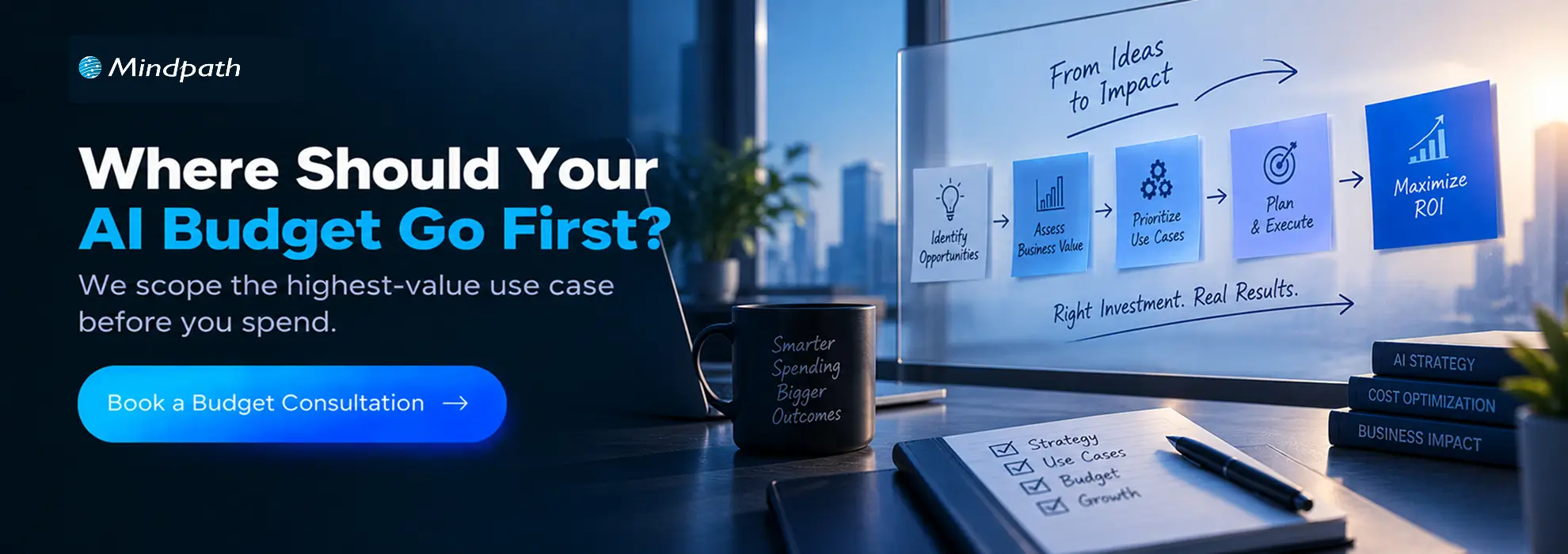
Knowing how to plan an AI budget helps businesses control spending while keeping their AI initiatives aligned with measurable goals. A structured approach also makes AI investment planning easier by showing where resources are needed at each stage.

1. Define Your Business Objective

Start by identifying the specific business problem AI should solve. A clear objective helps determine the right technology and required investment.

2. Choose the Right AI Use Case

Prioritize use cases that offer measurable business value. Starting with a focused use case can help control initial spending and validate results.

3. Assess Your Data Readiness

Evaluate the quality, availability, and structure of your existing data. This helps identify additional data preparation costs before development begins.

4. Estimate Initial and Recurring Costs

Calculate development, integration, infrastructure, and deployment expenses. Also include recurring costs such as cloud usage, maintenance, and support.

5. Set a Realistic Contingency Budget

AI projects can encounter unexpected technical or operational requirements. Keeping a contingency amount helps manage these expenses without disrupting the project.

6. Define Expected ROI

Set measurable outcomes before approving the investment. These can include cost savings, productivity improvements, faster processes, or increased revenue.

7. Plan for Future Scaling

Consider how costs may change as users, data, and AI workloads increase. A scalable budget helps businesses expand their AI capabilities without major financial disruptions.

What Hidden Costs of AI Should Businesses Consider?

AI costing should account for expenses that may appear after implementation. Understanding the hidden costs of AI helps businesses create a more realistic budget.

1. Employee Training

Teams may need training to use new AI tools effectively. This can add training and productivity costs.

2. Data Improvement

Existing business data may require cleaning or restructuring. Additional data work can increase implementation expenses.

3. Security and Compliance

AI systems may require stronger security controls and compliance measures. These requirements can add development and operational costs.

4. Ongoing Maintenance

AI solutions need regular monitoring, updates, and optimization. These recurring expenses should remain part of the long-term budget.

5. Third-Party Services

AI applications may depend on external APIs, models, or cloud platforms. Usage-based charges can increase as adoption grows.

6. Change Management

Employees may need support when workflows change after AI adoption. Proper change management can improve adoption and reduce implementation challenges.

7. Scalability Costs

Growing usage can increase computing, storage, and infrastructure requirements. Businesses should account for these expenses when planning future AI expansion.

How Does AI Investment Planning Support Better Business Decisions?

AI investment planning helps businesses allocate resources based on expected value, business priorities, and long-term requirements. It allows decision makers to evaluate AI opportunities before committing significant resources.

1. Prioritize High Value Use Cases

Invest in AI initiatives that address important business challenges. This helps direct budgets toward measurable outcomes.

2. Start With a Focused Investment

Begin with a manageable AI initiative before expanding across the organization. Early results can guide future investment decisions.

3. Balance Initial and Recurring Costs

Consider development expenses alongside infrastructure, maintenance, and usage costs. This provides a more accurate view of the total investment.

4. Align Investment With Business Goals

AI spending should support clear organizational objectives. This keeps technology investments connected to business growth.

5. Evaluate Scalability

Consider future users, data volumes, and operational requirements before selecting a solution. A scalable approach can reduce the need for costly redevelopment later.

6. Review Investment Performance

Track business outcomes against the original investment goals. Regular reviews help identify where additional funding can create greater value.

AI Budget Planning Across Different Project Stages

AI budgets change as a project moves from initial planning to full-scale deployment. Businesses should review AI costing at every stage to maintain better control over their overall investment.

Project Stage Key Budget Areas Business Focus
Discovery Strategy, research, and feasibility Identify the right AI opportunity
Proof of Concept Development, data, and testing Validate the solution and its potential
Development AI development, integration, and security Build a reliable business solution
Deployment Infrastructure, training, and implementation Introduce AI into daily operations
Scaling Cloud usage, maintenance, and optimization Support growing business requirements
Continuous Improvement Monitoring, updates, and enhancements Improve performance and long-term value

Ready to Build a Smarter AI Budget?

Effective AI budget planning helps businesses understand total costs, prioritize valuable use cases, and prepare for ongoing expenses. A well-structured budget reduces financial uncertainty while keeping AI investments aligned with measurable business goals. Businesses that plan carefully can scale AI with greater confidence and achieve sustainable long-term value.

Mindpath helps businesses turn AI opportunities into practical, scalable solutions aligned with their goals and budgets. Our AI development expertise supports strategy, solution development, integration, deployment, and optimization. With the right technical guidance, businesses can invest in AI confidently while building solutions designed for measurable performance and sustainable growth.
Frequently Asked Questions

Start with a clear business goal, prioritize valuable use cases, estimate ongoing expenses, and maintain a contingency budget for unexpected requirements.
Solution complexity, data readiness, system integrations, infrastructure requirements, security needs, and ongoing maintenance can significantly influence the overall investment.
Budget reviews should happen throughout the project lifecycle, especially during development, deployment, scaling, and major changes in usage or business requirements.
AI costing provides a clearer view of total expenses, helping businesses compare opportunities, prioritize investments, and plan resources according to expected business value.
Yes. Starting with a focused use case allows smaller businesses to control initial spending, measure results, and gradually expand successful AI initiatives.

Support Is One Click Away

Featured Posts

Related Post

AR and VR in Education

Student engagement is a critical factor when it comes to effective education. While curriculum and subjects might differ globally, engagement remains the cornerstone of learning. Today’s learners are valuing the essentiality of more interactive and practical experiences. This is where the relevance of AR and VR in education makes a real impact.

Starting from virtual science labs to 3D anatomy lessons and skill training, these technologies are changing how students learn. This also impacts the teaching methods of educators. As per the reports, the AR and VR education market is going to reach USD 28.70 billion by 2030. In fact, it is quickly turning into a powerful tool that can serve proper engagement.

Looking to enhance learning and boost student engagement in a digital world? Contact us to discover how we help deliver immersive experiences with AR and VR solutions.

What are AR and VR in Education?

Before you go through the impact of these technologies, it is necessary to understand the critical difference between the two.

  • Augmented Reality adds digital elements like animation, 3D models, labels, and audio to the real world. It takes the help of devices like tablets, smartphones, or AR glasses. So, when it comes to a classroom setting, AR can turn your printed diagram into an interactive visual while putting life into the pages.
  • On the other hand, virtual reality places learners inside a complete digital environment using a headset. So, students can easily conduct experiments or walk through historic civilizations.

Together, these AR and VR technologies can generate more active and student-specific learning environments for the best results.

Why are AR and VR important in Today’s Modern Education?

No doubt traditional learning methods have relevance in the market. But they often struggle to keep students completely engaged. This gap has become significant in this digital-first world. So, you need to understand that learners need to understand concepts better. So, this is possible when they see, explore, and interact with information instead of only reading and hearing about it.

  • This is where the impact of augmented reality in education and the values of virtual reality come into the picture.
  • These valuable tools can make your learning more effective.
  • Further, they value multiple learning styles to help fill in the gap between theory and practical understanding.
  • Whether it is a school classroom or a corporate training session, AR and the impact of virtual reality in education can make information easier to absorb.

What are the Essential Benefits of AR and VR in Education?

There is a series of benefits of AR and VR in education that you can go through in this section. However, these technologies need to be used strategically for the best results.

1. Improved Understanding

Core subjects like science, engineering, and medicine generally include complicated concepts. So, AR and VR can easily simplify such topics by visualizing them in ways that are easier to understand.

For example, instead of looking at a flat image of the human heart, you can assess the rotating model while observing the functions of each section. This is one of the major benefits of augmented reality in education.

2. Personalized Learning

Every student has their own learning capabilities. Some might be visual learners, and some might need repetition or practical examples. AR and VR can help you understand such differences by offering adaptable learning experiences.

3. Better Knowledge Retention

Students will be able to remember what they actively experience through these valuable technologies. Immersive learning can boost your memory by including a participatory approach.

So, when the learners can interact with the concept more effectively, their learning becomes more successful.

4. Safe Practice Environments

One of the most practical benefits of VR in education is that it allows you to practice without any real-world challenges and risks. As a medical student, you can easily simulate surgeries, and engineering students can easily interact with machinery.

Major Examples of AR and VR

To better value the core of immersive learning, here are some major examples of AR and VR in education.

  • Virtual field trips can allow you to visit museums and historical sites right from the same location.
  • You can easily perform experiments in virtual science labs.
  • AR-enriched textbooks can easily turn printed pages into essential interactive learning tools.
  • You can experience technical and vocational training modules for machinery, construction, and equipment handling.

These real-life applications show that AR and VR are not limited anymore. Moreover, they are already solving real educational challenges.

Challenges of Adopting AR and VR

No doubt the use of AR and VR in education offers a series of benefits. However, successful implementation needs proper planning. Some of the major ones have been listed in this section.

  • Teacher training and onboarding process.
  • The high cost of hardware and software.
  • Technical maintenance and support.

These challenges are becoming easier to manage as the technologies have become more affordable. So, institutions that invest thoughtfully can seek long-term values.

Conclusion

The role of AR and VR in education has been drastically changing with a series of features. These technologies are helping educators generate more engaging lessons while enabling you to understand more complex topics. From better retention to higher engagement, the benefits of AR and VR remain effective.

So, if your business is looking forward to building future-ready learning experiences, the right technology partner can make all the difference. Mindpath can be your ultimate partner that can create and innovate impactful learning environments customized for your modern needs. We can offer you user-centric digital products that align with your needs.

FAQs

1. What is the Major Difference Between AR and VR in Education?

AR can add digital elements to the real-world environment, whereas VR generates a completely immersive digital space for better learning.

2. What are Some Essential Benefits of AR and VR in Education?

The major benefits include better engagement, improved understanding, and safe skill practice while helping you get more interactive learning experiences.

3. How to Use AR and VR in Classrooms?

You can use AR and VR for your virtual field trips, 3D visual learning, and even for lab practice. People also use it for language training and interactive lesson delivery.

4. Can AR and VR Improve My Learning Outcomes?

AR and VR can easily encourage your learning outcomes by making your lessons more interactive and visually practical.

5. Which Subjects Mainly Use AR and VR for Better Understanding?

AR and VR are majorly effective in subjects like science, medicine, engineering, and mathematics.

AI Tech Stack Guide

A solid and consistent AI tech stack is crucial to building powerful AI applications that actually operate. It merges the right data tools, machine learning frameworks, cloud environments, and deployment platforms to ensure your app absorbs data, learns from it, and improves over time. Smart decisions made at each layer will create a smoother development cycle, giving you a more powerful and scalable final product.

Every component of an AI tech stack combines to enable your application to be precise, quick, and able to handle real-world obstacles. Understanding how each piece is put together will enable you to sidestep potential obstacles and build smarter solutions. In this blog, you will see how to combine all of these pieces to build AI-powered applications that pass the real-world test.

Want to enhance your product with intelligent features? From recommendation engines to predictive analytics, Mindpath’s AI development services bring advanced capabilities to your applications.

What is a Tech Stack?

A tech stack is the group of tools and technologies used to build and run a software application. It includes everything from the AI programming languages and frameworks to the databases, servers, and APIs that help different parts work together. Every choice you make for your tech stack shapes how your product works, how easily it can grow, and what skills your team will need to keep it running smoothly.

A good tech stack also makes it easier to track how people use your product and see where you can improve. For any company building software, investing in the right tech stack is an important step. It gives your team what they need to create, maintain, and improve your product, so it keeps meeting customer needs as you grow.

What Does AI Tech Stack Mean?

An AI tech stack encompasses all of the required tools, frameworks, libraries, and systems for the full development, deployment, and management of an AI-powered application. It covers the whole journey of an AI application from when you find and clean data, to training your model, to getting it in action. Whether it is a chatbot, image analysis, or a predictor, the right tech stack will seamlessly work in the background to optimize the performance of your solution while it learns.

Finding the right combination of tools can keep your team organized and the project prepared to scale. Having a clear tech stack allows you to spend less time fixing a glitch and more time creating a smart feature that provides value. Preparing a clear tech stack can also provide you with a solid foundation to better manage more users, test new ideas and iterate on the AI solution, while adapting to the changing requirements of the technology.

Looking to align your AI tech stack with the most impactful advancements in the industry? Discover the top AI trends shaping the next generation of intelligent solutions.

Types of AI Tech Stack

There are different types of Artificial Intelligence tech stacks, each designed to handle specific tasks and goals. Understanding these categories helps you choose the right tools for your project’s needs.

Types of AI Tech Stack

1. Generative AI

The GenAI tech stack provides the means to build intelligent systems that can produce new products like text, images, or audio. It blends together the powerful models available, the right data, and the handiest tools to streamline and improve development.

2. Domain-Specific AI

Some sectors require targeted stacks to accommodate specialized needs and regulations, such as healthcare, finance, and retail, that engage with trusted AI outcomes.

3. Enterprise AI

This works with large organizations and allows them to develop their own AI capabilities with respect to their internal processes and suitability for their growth. It integrates bespoke development, optimal operations, and seamless integration, providing an organized approach to their more complex requirements.

4. Consumer AI

It focuses on delivering users top-level, helpful, simple, and fast AI experiences they can engage with every day. Consumer AI taps into models, smart apps, and solid cloud or edge connections to produce a seamless experience for users.

Curious about where AI is headed? Head to our blog The Future of AI: How AI is Transforming the World to learn more!

Layers of an AI Tech Stack

Building an effective AI system means understanding how each layer supports the next. These layers work together to turn raw data into smart, reliable applications.

layer of an AI tech stack

1. Infrastructure Layer

This layer forms the base of a modern AI stack, giving you the hardware and software needed to build and run AI systems. It covers everything from powerful processors to storage and operating systems that keep everything running smoothly. Without a strong foundation here, AI development would be slow and unreliable.

2. Data Layer

Good data is the heart of AI application development. This layer handles how data is collected, stored, cleaned, and prepared for use. Clean, well-organized data helps models learn accurately and perform better.

3. Model Layer

This layer is where you build and train the brains of your AI. It includes frameworks and tools that make it easier to design, test, and deploy models. A well-managed model layer speeds up AI app development and boosts results.

4. Application Layer

Here, all your hard work connects directly with users. This AI tech stack layer includes the user interface, APIs, and logic that bring your AI features to life. A clear application layer ensures people get real value from your AI.

5. Observability and Governance Layers

These layers help you keep an eye on how well your AI works and that it stays secure and fair. They cover monitoring, performance checks, and rules for data protection. Together, they build trust and long-term success.

6. Orchestration Layer

This part keeps every piece of your AI system working together smoothly. It manages workflows and automates tasks to save time. Proper orchestration means you spend less effort fixing things and more time improving them.

7. Generative Model Layer

This layer focuses on models that can create new content like text or images. It uses strong foundation models and customizes them for what your project needs. A good setup here drives innovation for creative AI solutions.

Struggling to choose the right AI model to power your AI-driven application? Explore our detailed guide on the top AI models to understand their capabilities, strengths, and real-world applications

Best Practices for Building an AI Technology Stack

Building an effective AI tech stack takes careful planning and the right approach for your goals. Following best practices helps you make smart choices and get the most out of your AI development tools and resources.

1. Define Your AI Goals Clearly

Start by knowing exactly what you want your AI tech stack to do. Clear goals help you choose the right tools and avoid wasting time on things you don’t need. It could be improving customer service, automating tasks, or predicting trends. When everyone understands the goal, the project runs smoother and stays focused.

2. Prioritize Good Data Early

Good AI starts with good data that’s clean, organized, and reliable. Make sure you have a strong system to collect and manage your data from day one. Accurate data helps your models learn better and make smarter decisions. Invest time in setting up clear data processes to get the best results.

3. Keep It Flexible and Automated

A flexible setup makes it easier to update or add new tools as your needs change. Modular systems let you swap parts without starting over, saving time and money. Use automation to handle boring, repetitive tasks, so your team can focus on important work. This approach helps you scale and stay ready for growth.

Wondering which generative AI tools are transforming modern AI application development? Learn more about the top GenAI tools for the future of AI development to strengthen your AI tech stack.

4. Ensure Security and Teamwork 

Keeping your AI secure should always be a top priority, especially when handling private data. Follow all rules and regulations to stay compliant and avoid risks. Make sure your team works well together by setting clear roles and sharing information. Strong teamwork and security build trust in your AI system.

5. Keep Improving Your Models

Your AI models should never stand still. Create a process to check how they perform and update them with fresh data. This helps your system stay smart and relevant as things change. Regular updates mean better results and a competitive edge.

6. Plan for Easy Growth

Think ahead so your system can handle more users, bigger data, and new features as you grow. A scalable setup saves you from costly rebuilds later. Make sure your tools and infrastructure can expand without any problems. This way, your AI stays strong no matter how much your business grows.

Not sure how to strategically implement AI beyond just the technical stack? Explore our detailed guide on AI in business strategy to understand how to turn AI capabilities into measurable business value.

Looking to Power Your Business with Smart AI Tech Stack?

A clear and well-structured AI tech stack makes it easier to turn complex ideas into reliable AI applications. By choosing the right tools and following smart practices, you can handle data better, keep your systems secure, and scale with confidence. A good foundation now means your solutions will adapt smoothly as your needs and goals grow.

At Mindpath, we offer trusted AI development services to help you build and maintain AI solutions that work in real business scenarios. Our team combines the best tools and strategies to design applications that learn, perform, and deliver results. Let us help you leverage AI to achieve your goals and maximize the value of your investment.

healthcare software development services

Ever Wondered how technology is really influencing the healthcare sector? From electronic health records and telemedicine to mobile health apps, today healthcare software development plays a great role in changing the way patients receive and providers provide treatment.  

But what exactly are healthcare software development services, and why are they crucial for modern medicine? In this blog we will explore healthcare software development services and how these cutting-edge solutions are going to shape the future of healthcare, improve patient outcomes, and smooth operations. 

What is Healthcare Software?    

Healthcare software development is the process of developing individualistic computer programs designed for hospitals, clinics, and all other types of healthcare organizations. These programs assist in enhancing how healthcare providers render care by making processes more effective, accurate, and oriented towards patients. Healthcare software creates a complete digital system within a healthcare organization.  

This allows medical professionals to offer better and more accurate clinical services. To doctors, this represents an easy way to do follow-ups and monitor the health of their patients, schedule appointments, and get access to medical reports, all from the comfort of managing staff. To patients, it offers online appointment booking, live chat with doctors, sharing of medical reports, and receiving health advice.   

These software solutions come with various benefits associated with the improvement in patient care, efficiency, and reduction in medical errors. They can digitize the traditional paper-based systems and take care that patient care is performed quicker and much more safely. Healthcare software is further creating new sectors, such as patient engagement, clinical robotics, and telehealth, driving a lot of startups to bring ideas into life. 

 Types of Healthcare Software Development Services  

Types of Healthcare Software Development Services - infographic

1. Electronic Health Record (EHR) Software   

EHR software is being used by hospitals and clinics like any CRM, but with a healthcare tune. It contains all the relevant information concerning every patient, among them what medicines they use, the various doctors’ advice, and the medical processes that they have gone through. Many EHRs incorporate mechanisms for billing, collection, and even a patient portal that allows patients to view consultation history, medical records, and prescriptions. There are two types of EHR software: the electronic patient record, which is used in hospitals for management purposes concerning a patient internally, and the electronic medical record, which keeps track of information like medications, past and future procedures, and how well the patient is recovering. 

2. Medical Database Software   

Medical database software can be called a huge library of information about medicine, not according to the profiles of patients but according to diseases. This tool aids doctors in looking through cases like one that is being treated and thus making informed decisions about its cure. It is also used for learning by allowing doctors to know more about certain diseases. For example, a dermatologist using medical database software can view all the patients diagnosed with Atopic Dermatitis, compare their symptoms, treatments, and recovery plans, and find the best approach for their current patients. 

3. Health Tracking Apps 

Health-tracking apps are part of the fast-growing industry called mHealth, which stands for “mobile health.” This industry, valued at $37 billion globally for 2019 alone, allows users to trace and manage their health from their smartphones. Some of the popular health monitoring apps include fitness apps such as 8fit, diet apps such as Fitatu Calorie. For instance, sleeping patterns are monitored by the FitBit wristband, while the Oura Ring is responsible for monitoring several health metrics. Others include glucometers for testing blood sugar levels and, of course, thermometers in general—for instance, tracking menstrual cycles like the Kindara app. All these tools work together to give users a better understanding of their health and wellness. 

4. E-prescribing Software 

The e-prescribing software is becoming a tool that every doctor must have, with countries all over the world rapidly adopting electronic prescriptions. Such software allows doctors to easily manage all prescriptions for all patients by tracking, renewing, and canceling them as need be. It is also connected to national drug reference databases that help in picking up the right medications and making sure there is no error. Examples include MediTab and ScriptSure, two software programs designed to ease e-prescribing and improve the capabilities of health professionals to deliver accurate and effective care. 

5. Appointment Scheduling (booking) Software 

Appointment scheduling software is designed to assist hospitals, clinics, and medical practices in managing their appointments online. This normally allows the provision of a user-friendly platform through which patients can easily book appointments via an app or website without calling up the office. This type of software normally features email notifications and automatically sends reminders to doctors and patients about upcoming appointments. It accommodates multiple doctors’ schedules, cancellations, or rescheduling of appointments, and does much more to provide appointment trend data that helps in bringing efficiency to the practice. Additionally, AI chatbots are integrated into these systems to enhance the booking experience. These chatbots can handle appointment scheduling, provide immediate responses to patient inquiries, and assist with rescheduling or cancellations. 

Looking to boost your healthcare operations with top-tier software solutions?

At Mindpath, we deliver cutting-edge, customized healthcare software to empower efficiency and elevate patient care.

Why Are Healthcare Practitioners Going Digital? 

Health practitioners use digital technologies greatly because of the great advantages they present in improving patient care and practice management. Digital healthcare solutions help doctors in the management of patient information. Therefore, record-keeping becomes more accurate and efficient while diminishing the burdens of paperwork.  

Healthcare IT has been one of the fast-growing markets and is expected to grow further. From $303.4 billion in 2022, this is projected to rise as high as $974.5 billion by 2027 with a good annual growth rate. The market is expected to grow to $728.63 billion by 2029 and even further to $1,069.13 billion by 2032. Healthcare provider solutions take up about 38% of the market, such as those in Electronic Health Records. On the other hand, IT services form 52% of the market, including online payments and cybersecurity. Growth is fueled by new technologies, increased spending by consumers, and government initiatives; however, challenges persist, with the most important ones being related to cybersecurity risks. It has the maximum market share in North America due to its better and advanced infrastructure. The European region is predicted to grow fast with government help and support, adoption of AI soon. Some major players in this field are GE Healthcare and Philips, which are carrying the industry forward. 

Leading Healthcare Software Development Services at Mindpath 

Mindpath offers a full cycle of healthcare software development services that meet all the needs of healthcare providers, patients, and all those concerned. Our offered solutions work toward better patient care while easing operations. Here are the services we provide: 

Leading Healthcare Software Development Services at Mindpath - infographic format

1. Healthcare Software Development Consultation: 

We assist in planning and designing your healthcare software project from an idea to detailed planning. Our advice ensures you will have a clear roadmap for developing effective healthcare solutions.  

2. Healthcare Software Development: 

We develop various healthcare IT software solutions, including Electronic Health Record (EHR) software, practice management systems, patient portals, among others. The solutions are secure, scalable, and well-built according to the industry regulations to ensure better patient care and efficiency. 

3. UI/UX Development: 

We design easy-to-use interfaces that will be convenient and pleasant for the eye. We focus on bringing your healthcare software both functionality and user experience. 

4. AI Chatbot for Healthcare: 

Our AI chatbots for healthcare answer questions, provide appointment scheduling, and disseminate medical information. They help improve interaction with patients and relieve some workload from the health staff. 

5. Modernization of Healthcare Software: 

Legacy system upgrade and migration to state-of-the-art platforms, enrichment of new functionalities, and updating of old technologies to manage your software and keep it relevant. 

6. Maintenance & Support: 

Ongoing support and maintenance are available to make sure that your healthcare software keeps running smoothly and aligns with your changing needs. 

Conclusion  

The huge effects of rapid growth in technology reshaping healthcare to become more effective, accessible, and patient-centered are undeniable. It is evident from the adoption of electronic health records and e-prescribing software at the end of the spectrum to health-tracking apps and AI-driven tools that are revolutionizing how healthcare providers care for patients and their practices.  

Such innovations not only improve the quality of care provided to patients but also the administrative flow, hence making healthcare very responsive and effective. Adopting the newest technology is crucial for healthcare organizations to keep ahead of these trends as the sector continues to change. This is where a holistic approach to healthcare software development is necessary. Healthcare providers may enhance patient outcomes, streamline operations, and more adeptly navigate the digital terrain by incorporating cutting-edge software solutions.  

At Mindpath, we are dedicated to supporting healthcare providers through every step of this transformation. From development and consultation to UI/UX design and modernization—our services cover a large area of needs, all meant to make sure you can drive positive change in healthcare through digital technology. Be it building new systems, updating existing ones, or ensuring ongoing support, Mindpath makes sure that your healthcare software is of the highest quality and effectiveness. 

Are you curious about how cutting-edge medical software might transform your business?

At Mindpath, we develop solutions that improve patient care and expedite operations.

Explore how healthcare software development enhances patient care and operations. Discover services like EHR, medical databases, and more. Transform your practice today!