Generative AI for Business: Your Key to Success

Join our Newsletter!

Featured Posts

Support Is One Click Away

Home

Generative AI for Business: Your Key to Success

generative ai for business

Generative AI for Business: Your Key to Success

Ever imagined a machine that could produce articles, logos, and new content to power your business? Sounds intriguing, isn’t it? Well, that is what generative AI can do for your business. This new-generation artificial intelligence is transforming future of businesses by generating new content, images, product designs and even strategy concepts from patterns it has acquired by analyzing the existing data. In this blog, we are going to discuss how generative AI for business can create innovation and give a competitive advantage.

So, before we learn about how generative AI can transform businesses, let’s understand what is generative AI.

Looking for ideas to reshape your business with generative AI? Unlock smarter growth, faster innovation, and personalized customer experiences with Mindpath’s AI-powered solutions

What is Generative AI?  

In simple terms, generative AI is an artificial intelligence that takes huge datasets and algorithms to learn the pattern and then generates new outputs based on its understanding. While AI is all about recognizing data, classifying it, or predicting, generative AI takes it a step further—it produces new content. For instance, it can author customer emails, create social media posts, produce product descriptions, and even assist in designing user experiences. 

Generative AI has the ability to provide enterprises with numerous benefits like enhancing innovation and creativity, enhancing productivity and reducing expenses. Generative AI also facilitates original idea creation, speed in product development, and custom-built customer experiences. In addition, it has the potential to enable workers to focus on more critical activities and reinforce security and raise the satisfaction levels of customers. 

Also Read: Generative AI Revolution

Let’s dive in how generative AI can drive business innovation and creativity for businesses. But before that have a quick look at the Google Trends for Generative AI for Business.

generative ai for business trends

How does Generative AI Drive Innovation for Businesses? 

In today’s fast-moving digital world, innovation is the key to staying ahead. Generative AI in business is assisting companies in igniting new ideas, enhancing content, and accelerating processes. Let us see how generative AI for innovation is changing the way companies think and create. 

1. Personalization Fuels Innovation 

Building a strong customer connection helps in driving business growth and personalization plays a major role in it. Companies can deliver tailored content and better user experiences with the help of smart tools that can understand customer behavior. This is precisely where generative AI for innovation can make a huge difference by helping businesses personalize at a scale which is much faster and more accurate than manual efforts.  

2. AI Creativity and Human Creativity: A New Partnership 

There is much discussion circulating about AI creativity vs. human creativity. It shouldn’t be about who is superior, but how they can both contribute to success. Humans can provide emotion, context and novel ideas to which AI can provide structure and new insights based on data. Merging the two can assist businesses to work more smartly. For example, how generative AI can augment human creativity is seen when it rapidly produces ideas or content, and humans are able to edit and make them work for the brand’s voice and objectives. This also ties into how AI is redefining job roles in tech, showing the evolving collaboration between human expertise and AI capabilities.

3. Unlocking Potential through Data-Driven Creativity 

Generative AI for business enables companies to convert information into intelligent ideas through analysis of customer behaviors, market patterns, and performance outcomes to develop valuable content, product layouts, or advertising campaigns. Humans contribute creativity, passion, and profound meaning, while AI contributes pace, logic, and the capacity to process vast volumes of data rapidly. When combined both, companies are able to develop meaningful experiences that connect with people and result in improved outcomes. aligning with the latest Gen AI trends in business intelligence.

4. Streamlining Operations 

When used properly, Generative AI in business enables companies to save time by automating routine work and processing large sets of data. This allows teams more time to come up with new ideas and more efficient ways of working. When businesses apply this type of thinking, they can grow more quickly, plan more smartly, and stay ahead of market change. That’s how generative thinking helps businesses innovate smarter because it provides them with the space, tools, and insights to grow more smartly. 

5. Securing Financial Transactions 

Generative AI is becoming a necessity for securing financial systems and mitigating risks. It enables companies to identify potential financial risks by processing vast amounts of data efficiently and accurately. The technology also helps in forecasting market trends, enhancing decision-making. Additionally, generative AI is improving fraud and suspicious activity detection in real-time. It’s transforming trading by offering insights from enormous data sets, ensuring smarter and safer transactions. 

Wondering how generative AI is influencing content creation and design strategies? Check out our blog generative AI changing creative industries  to see how AI-driven creativity is shaping the future of industries.

Use Cases of Generative AI for Business Growth 

Generative AI for business is revolutionizing the way companies develop by enhancing customer experience, increasing productivity of employees, and accelerating innovation. From conversational tools like ChatGPT, Bard, and Midjourney to live business applications, the effects are tangible. Here are some simple yet impactful generative AI use cases that fuel business growth today:
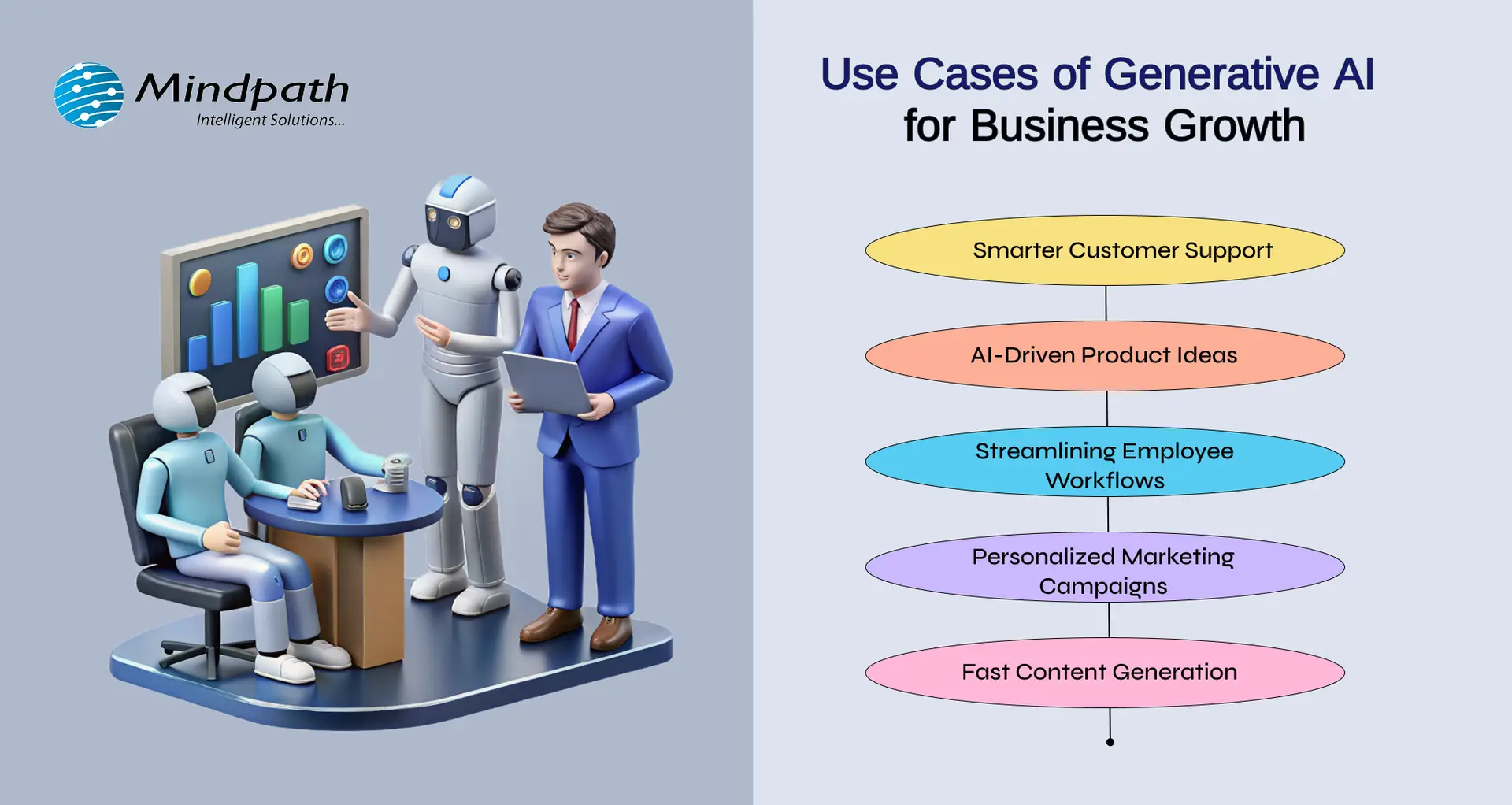
Use Cases of Generative AI for Business Growth 

1. AI-Driven Product Ideas

With tools such as Midjourney, businesses are able to create product ideas, packaging, and graphics. It illustrates how AI can be applied in innovation, by assisting teams to come up with creative ideas quicker and validate what is effective with actual audiences.

2. Smarter Customer Support

Tools like ChatGPT help companies create AI-powered chatbots that answer customer questions instantly. This improves response time and frees up human agents to focus on complex issues. It’s a simple way to offer 24/7 support and boost customer satisfaction.

3. Streamlining Employee Workflows

According to the McKinsey Generative AI Report, generative AI can automate tasks that take up 60–70% of employees’ time today. This includes writing emails, summarizing reports, and generating presentations—especially helpful for knowledge workers and high-skill roles.

4. Personalized Marketing Campaigns

Generative AI technology assists companies in crafting customized ads and suggestions based on user data. This renders marketing more precise and efficient, enabling more engagement and sales while saving time for marketers.

5. Fast Content Generation

With platforms like Bard, teams can quickly write blogs, product descriptions, and emails. This saves time and allows employees to focus on strategy. It’s one of the most practical generative AI examples used daily across industries. 

Looking to leverage generative AI for smarter, more adaptive app solutions? Explore our blog on Generative AI in App Development highlights practical applications, transformative benefits, and strategies to stay ahead in the digital landscape.

Ready to Make Your Business AI-Ready? 

Generative AI is changing the way businesses work, think, and grow. It’s not just about automation, it’s about helping teams be more creative, make faster decisions, and offer better experiences to customers. Be it creating content, improving support, or building new ideas, generative AI for business is making every day work smarter and more efficient. 

At Mindpath, we specialize in delivering cutting-edge AI development services tailored to meet the unique needs of modern businesses. Our expertise in generative AI enables companies to streamline operations, boost productivity, and create intelligent solutions that drive real value. Whether you’re looking to implement AI-powered automation, enhance customer engagement, or accelerate innovation, Mindpath is your trusted technology partner for consistent business growth! 
Frequently Asked Questions

1. What is generative AI for business users?

Generative AI for business refers to AI systems that create new content, ideas, designs, or solutions based on existing data. Instead of only analyzing information, it generates emails, reports, marketing copy, product concepts, and more. Business users can apply it to improve creativity, automate tasks, and make smarter decisions faster.

2. What are some applications of generative AI in business?

Businesses use generative AI for content creation, customer support chatbots, product design concepts, personalized marketing campaigns, and financial risk analysis. It also helps generate reports, automate emails, and create digital assets. These applications support innovation, reduce manual work, and improve overall operational efficiency.

3. How can we implement GenAI to improve efficiency?

To implement GenAI effectively, businesses should first identify repetitive tasks and content-heavy processes. Next, integrate AI tools with existing systems like CRM or ERP platforms. Start with pilot projects, measure performance, and scale gradually. Proper data management and employee training are essential for long-term success.

4. What is the future of GenAI in business?

The future of Generative AI for business looks highly promising. It will continue enhancing personalization, predictive decision-making, and intelligent automation. As technology advances, AI systems will become more context-aware and collaborative, working alongside humans to drive innovation, improve productivity, and create smarter digital ecosystems.

5. What is one limitation of generative AI in business?

One major limitation of Generative AI for business is its dependence on data quality. If trained on biased or inaccurate data, outputs may be misleading. It also lacks true human judgment and emotional understanding, which means human oversight remains necessary to ensure accuracy, brand alignment, and ethical use.

Related Post

Discover the power of Conversational AI! Learn its benefits, features, and how Mindpath can help transform your customer interactions.
Discover how augmented analytics revolutionizes business intelligence with real-time insights, smarter decisions, and data democratization for faster growth.

Related Post

Sustainable DevOps

Have you ever wondered how DevOps practices can be both efficient and environmentally friendly? As technology evolves, so do our approaches to software development—and sustainability is now a key part of the equation. In this rapidly changing world, what role does Sustainable DevOps play in shaping the future of software development? Let’s explore how adopting eco-conscious strategies can transform the way we build, deploy, and manage applications. 

What is Meant by Sustainable DevOps?

Sustainable DevOps, also known as green DevOps, aims to make software development and delivery more ecologically friendly. It entails implementing strategies that decrease energy usage, waste, and the carbon footprint of DevOps operations. This involves optimizing the use of servers and cloud resources, automating operations to decrease human labor, and selecting environmentally friendly solutions. Teams can lower their environmental effect by making wise decisions such as decreasing the need for excessive computing power, deploying energy-efficient data centers, and using sustainable tools. Sustainable DevOps aims to strike a compromise between the requirement for rapid and efficient software delivery and the duty to safeguard the environment. As businesses become more conscious of their ecological impact, integrating sustainability into DevOps processes is becoming increasingly important for establishing a greener future while maintaining high-quality software.  

Advantages of Sustainable DevOps

1. Improved Regulatory Compliance

Governments and organizations throughout the world are enacting new regulations to encourage eco-friendly behaviors and prevent environmental harm. Following these guidelines is not an option for organizations; it is required to avoid penalties and reputational damage. Sustainable DevOps assists businesses in meeting environmental standards by improving the sustainability of their software development and delivery operations. Businesses may better match their activities with these requirements by implementing energy-efficient technologies, optimizing resources, and eliminating waste. This reduces the likelihood of sanctions or public outrage for failing to fulfil environmental standards. At the same time, it communicates to customers, suppliers, and stakeholders that the organization is dedicated to sustainability. Businesses that use sustainable DevOps not only remain compliant, but also establish a favorable reputation, fostering market confidence. This proactive approach ensures they are ahead of the curve, meeting legal requirements while contributing to a greener planet. 

2. Enhanced Competitive Edge

Customers and stakeholders are increasingly choosing which firms to support based on sustainability. People are increasingly preferring firms that care about the environment and actively lower their ecological footprint. Businesses that implement sustainable DevOps practices can demonstrate their commitment to building a greener future and taking significant action for our planet. This dedication distinguishes businesses from competition, attracts environmentally concerned clients, and strengthens ties with investors who value sustainability. A sustainable strategy also promotes a favorable brand image, which increases customer trust and loyalty. It also displays the firm as an industry leader who thinks forward and is responsible. In today’s economy, where customers “vote with their wallets,” adopting sustainable DevOps not only benefits the environment but also improves a company’s reputation, customer base, and long-term growth potential, making it a smart and impactful business strategy. 

3. Increased Resilience and Longevity

Sustainability is more than simply solving today’s environmental concerns; it is also about preparing businesses for the future. As environmental concerns rise and customer expectations shift, businesses that use sustainable DevOps practices position themselves for long-term success. Businesses can lower their reliance on finite materials and adapt to an increasingly sustainable environment by focusing on energy efficiency, waste reduction, and resource optimization. Sustainable DevOps also assists firms in mitigating environmental risks such as tougher legislation or resource scarcity, ensuring that their operations stay stable and efficient over time. This forward-thinking strategy not only saves the environment, but it also builds a solid basis for future prosperity. Businesses that embrace sustainability now are more likely to succeed tomorrow, maintaining their competitiveness and relevance in a continually changing environment. Sustainable DevOps is, thus, a key strategy for building resilience and ensuring the longevity of modern enterprises. 

4. Reduced Costs

When DevOps operations are not properly managed, they can use a lot of resources, such as electricity to power servers and infrastructure and supplies for hardware. Adopting sustainable DevOps methods enables firms to use these resources more efficiently, resulting in significant cost reductions. Companies can save energy and money by optimizing server utilization, automating procedures, and minimizing waste. For example, implementing energy-efficient infrastructure and cloud solutions lowers power expenses, whilst extending hardware lifespan lowers replacement costs. Sustainable DevOps is not just good for the environment; it is also a wise financial decision. Lowering operational expenses while maintaining high-quality services enables firms to redirect savings into innovation and development. This cost-effective method helps organizations achieve their goals while staying environmentally responsible, proving that sustainability and profitability can go hand in hand. 

DevOps Services at Mindpath

Mindpath offers DevOps services that will make your software development process faster, smoother, and more efficient. Our strategy combines development and operations teams, allowing firms to produce high-quality software rapidly while decreasing mistakes. To increase total efficiency, we automate repetitive processes, streamline procedures, and optimize resources. From establishing continuous integration and delivery pipelines to managing cloud infrastructure, we assure your systems’ dependability and scalability. Our skilled staff additionally prioritizes monitoring and maintenance to ensure that your apps work smoothly. We help you respond to changes faster and fulfil your business goals more easily by utilizing cutting-edge DevOps technologies and methods. Mindpath’s DevOps services provide you with a partner who assures efficiency, dependability, and innovation at all times.  

Final Thought!

Sustainable DevOps is reshaping the future of software development by combining efficiency with environmental responsibility. It helps businesses stay compliant, improve their competitive edge, and reduce costs while ensuring long-term resilience. At Mindpath, our DevOps services support your commitment to sustainability, helping you streamline processes, cut operational costs, and build a greener future. Let’s work together to create efficient, eco-friendly software solutions that drive both success and sustainability. 

Ready to embrace Sustainable DevOps?

Partner with Mindpath to optimize your development processes and drive eco-friendly innovation today!

Explore how Sustainable DevOps is transforming software development by reducing costs and promoting environmental responsibility.
woocommerce vs shopify

In the e-commerce landscape, businesses need to make a number of critical decisions. In case you are planning to venture into the e-commerce space, it is imperative to choose the right platform. This decision can certainly influence the success of your business in the dynamic e-commerce arena. 

The platform that you choose for your e-commerce store can undoubtedly influence the overall performance and success of your business. The top names that are ruling the e-commerce platform setting are Shopify WooCommerce. You need to dive into the world of WooCommerce Shopify so that you can make a proper comparison between these platforms. You need to know how these e-commerce platforms differ from one another so that you can make the ideal selection.

Planning to grow your online business and make a real difference in sales and customer experience? At Mindpath, we provide expert web development services that create user-friendly online stores designed to boost conversions and engage your customers.

An Insight into Shopify

Shopify refers to a cloud-based e-commerce platform. It offers a diverse range of tools for business entities so that they can sell their offerings online as well as in person. It is undoubtedly considered to be one of the most popular platforms that empowers entrepreneurs and large brands to not only create but also manage their online store. It has a diverse range of features that you can capitalize on in order to give an edge to your business in the competitive space. 

You must get a holistic insight into Shopify and its features to understand its true capabilities as an e-commerce platform. One of its distinguishing features is related to the creation of a store. Businesses can also use their selling tools and payment processing features to streamline their practices and operations. 

An Insight into WooCommerce

WooCommerce is an open-source e-commerce plugin for WordPress. It is completely free for users. WooCommerce enables users to transform a WordPress website into an entirely functional online store. It offers a diverse range of tools so that you can add products and set up payment options for your target audience. 

A unique thing about WooCommerce is that it is ideal for experienced sellers in the e-commerce domain. You can extend its functionality with the help of a number of add-ons and themes. Businesses need to familiarize themselves with the core features of WooCommerce so that they can make use of the platform in an optimal manner. Its key features that you need to know about include the availability of a large library of themes and high extensibility.  

Must Read: AI in E-commerce

Difference Between WooCommerce and Shopify

Now that you have a basic understanding of Shopify and WooCommerce, it is time to look at them at a closer level. Businesses that plan to establish themselves on the online platform need to know the key differences between these platforms so that they can have clarity on WooCommerce vs Shopify. The insight into this area is crucial to choosing the suitable platform and thriving in the market. 

1. Cost

While talking about WooCommerce vs Shopify, one of the key differences between the two options revolves around their cost. WooCommerce and Shopify have entirely different pricing structures. WooCommerce is entirely free for users, so you do not have to pay anything to use it for your online business. Thus, it offers ample flexibility with variable costs for users. 

On the other hand, when it comes to Shopify, it has a subscription model for its users. WooCommerce vs Shopify pricing is a major point of difference that you need to take into consideration for your e-commerce business. The ultimate budget of businesses can play a catalytic role in choosing their ideal e-commerce option.  

2. User-Friendliness

The ease of use or user-friendliness is a key dimension that you need to bear in mind while selecting between WooCommerce and Shopify. You must keep in mind that both these e-commerce solutions offer a diverse user experience. As WooCommerce is an open-source plugin for WordPress, which is self-hosted, it requires manual setup. 

Every aspect has to be handled separately by businesses while using the plugin. Moreover, businesses should know that it requires ongoing management as well. When it comes to Shopify, it has an all-in-one dashboard that users can use for their needs.  Thus, users can have a hassle-free experience if they choose Shopify. 

Not sure which technologies will give your e-commerce business the best performance and scalability? Explore our blog tech stack for your web app success to learn how to choose the right tools for long-term growth.

3. Themes as well as Templates

While talking about shoplift vs WooCommerce, it is key to understand how they differ in terms of available themes and templates. WooCommerce offers a humongous library of premium as well as free WordPress themes. You can choose the specific theme that is ideal for your business. The good news for users is that there is an opportunity to customize the themes on WooCommerce. 

When it comes to Shopify, businesses can use professionally designed themes. Such themes can certainly give an edge to your business. But you have to bear in mind that there are limited options to customize the themes. You need to take into account WooCommerce vs Shopify themes while choosing the ideal option out of the two options.

4. Scalability

Scalability is an important dimension that every e-commerce business needs to prioritize. You need to make sure that your online store grows in a seamless manner as your business expands. Your store must be able to handle additional product offerings and additional users. WooCommerce serves as a highly flexible option for e-commerce businesses. 

However, in order to leverage the flexibility that it offers, businesses must be aware of how to use the available tools. Shopify undoubtedly simplifies the degree of flexibility by offering built-in tools for businesses. You can leverage these tools as they will handle most of the work for your business. 

5. Security

Security is undoubtedly a non-negotiable element you need to look at while understanding the difference between WooCommerce and Shopify. If you plan to use WooCommerce, you need to know that, since it is a self-hosted solution, the onus of security lies with you. Although it offers certain security features, most of the security depends on elements such as the hosting environment and plugins. 

Similarly, the manner in which businesses maintain their websites also influences the quality of security. On the other hand, Shopify offers robust security to e-commerce businesses. This specific platform has in place holistic security measures that can safeguard both customer and store-related data. 

Concerned about keeping your online store and customer data secure? Read our blog application security best practices for web and mobile apps to learn proven methods to protect your business.

6. Payment Gateway 

As a majority of online customers are making online payments, it is essential for e-commerce businesses to have in place a robust payment gateway mechanism. Both Shopify and WooCommerce offer a diverse range of payment gateway options that you need to be aware of. As WooCommerce is integrated with WordPress, it offers a high degree of flexibility when it comes to payment gateways. 

It is possible to integrate almost any gateway. But the particular process may require additional setup for businesses. When it comes to Shopify, it comes with built-in options. The built-in payment option offered by Shopify makes it simpler for businesses to accept payments from customers without requiring additional setup. Moreover, it supports international payments, thereby creating value for modern businesses. 

7. Customization

The difference between WooCommerce and Shopify arises when looking at the customization dimension. You can look at WooCommerce as a blank canvas. It offers high power to businesses to customize their online store based on their needs and requirements. On the other hand, Shopify keeps things simple for businesses. 

It offers limited customization ability as a business. Without having to do much customization, businesses can have a professional-looking online store. You can take advantage of the drag-and-drop editor to build your store. However, this feature limits the ability to customize for users. 

Looking for innovative ways to stand out in the crowded e-commerce space? Learn from our blog, augmented reality in e-commerce, and see how AR technology can transform your online store.

The table presented below gives an overview of the main differences between Shopify and WooCommerce. Businesses can certainly refer to it while making the selection between WooCommerce or Shopify.

Basis WooCommerce Shopify
Cost Free  Monthly subscription model 
User-friendliness Not beginner-friendly and requires manual setup Beginner-friendly and intuitive
Themes and Templates Offers a large library of WordPress themes and high customization ability Offers professionally developed themes and low customization ability
Scalability Flexible but requires good hosting and optimization Effortless scaling with business
Security Security level depends on hosting and manual updates Security is fully managed and comprehensive 
Payment Gateway Multiple payment gateways with no additional charge Shopify payments and external payments with applicable fees
Customization High customization Limited customization

Selecting Between WooCommerce and Shopify

It is crucial for businesses to remember that the ultimate choice of WooCommerce and Shopify depends on the goals as well as the needs of businesses. You need to keep in mind your budget and WooCommerce vs Shopify payments while choosing the ideal platform for your e-commerce business. You must remember that both platforms offer a unique set of advantages for businesses. 

As the pros and cons of each of these options vary, you need to carefully consider them while making your choice. WooCommerce empowers businesses to customize their online stores. On the other hand, Shopify offers a professional-looking store thanks to its drag-and-drop option. 

Struggling to make informed platform decisions for your e-commerce business? Explore our blog on the  importance of data-driven decision-making for businesses to learn how data insights can guide your choices.

Final Words

In the cut-throat competitive business space, it is mandatory to choose the ideal platform for e-commerce success. In order to make the right choice, you need to have clarity on your basic requirements. This insight can guide you to choose the best platform that perfectly meets your needs and expectations. 

Mindpath provides web development services that understand the need to choose the right platform for e-commerce businesses. Businesses can undoubtedly rely on our experts to make use of high-quality WooCommerce and Shopify solutions. These high-quality solutions can make sure that your business can thrive in the unpredictable e-commerce realm and gain an edge over its competitors. 

The ultimate eCommerce showdown: WooCommerce vs. Shopify! Explore their features, benefits, and which platform is right for your business.
application security best practices

In this modern tech world, keeping your app safe and secure isn’t just a minor task anymore, but rather it has become a business priority. Whether you have built a mobile app or a web platform, the users trust you with their personal information every time they log in or make any transaction. Isn’t it true? This is the reason for which you should follow application security best practices because it can help you in protecting your app from hackers, data leaks and even costly breaches.

Strong security starts when you understand the correct strategy, starting from secure coding to regular updates and data protection. Do you want to know what is the best practice for application security for your web and mobile apps? Don’t worry, we will cover essential techniques for securing your applications in this blog, which can help you in staying one step ahead of threats and building trustworthy digital experience.

According to MarketsandMarkets Analysis, The mobile apps and web analytics market is expected to grow from 9.4 billion in 2022 to USD 20.2 billion by 2027, at a CAGR of 16.4%.

What is Application Security?

Application security refers to the practice of protecting your apps from threats that could steal all the data and even harm the system. It involves adding security features during the development stage and continuing to protect your app even after it is launched. This can ensure that both your app as well as the information it handles, are safe from hackers and other risks.

This protection can include hardware tools, software settings and regular security settings. For instance, a powerful router that obscures a device’s IP address provides hardware protections, while an application firewall embedded in the software frames actions. Security protocols, such as routine testing and upgrades, help to ensure risks are identified and rectified quickly so that the app continues to secure itself for years to come.

Want to transform your ideas into seamless applications?  Our Web and Mobile Application Development Services offer end-to-end development to create scalable and high performing apps which are designed accoridng to the business needs.

What are the 3 Pillars of Application Security?

To build a strong foundation for protecting any app, it’s important to focus on the core elements of security. These three pillars work together to keep applications safe and trustworthy.

1. Process:

This pillar includes the policies, procedures, and workflows that help manage and secure applications. These processes are designed to reduce risk and protect the app throughout its entire lifecycle.

2. Technology

Technology covers the tools and security controls used to keep applications safe. While new solutions keep emerging, it’s important to focus on the core security needs that protect the application effectively.

3. People

People are often the most overlooked part of application security, even though they play a key role. This pillar focuses on managing human risk, which includes the behaviors and actions of employees, contractors, and partners who have access to the system.

Also Read: Custom Web Development Services

Web Application Security Best Practices

In today’s digital world, keeping your application and security strong is more important than ever. A single loophole can lead to serious trouble. That’s why it’s essential to follow a smart plan to protect your app from threats. Here are some best practices you can follow:

Web application security Best Practices

1. Spot and Understand the Weak Points in Your App

After setting up your app security plan, it’s time to check for weak spots. You are likely to find many issues, but not all are serious. Focus on the most dangerous ones first. Use a custom threat model or OWASP risk scores to help you sort and fix them smartly

2. Use Quick Fixes Like Virtual Patching and WAF

Waiting months to fix app issues is risky. Virtual patching and a Web Application Firewall (WAF) can protect your app right away. They block attacks, even before a complete fix is ready. Also, limit app features and keep watching traffic to catch problems early and stay safe.

3. Start with Fixing the Most Important Issues

Fixing every issue at once can feel overwhelming. Focus first on the critical and high risks that could hurt your business or brand the most. Once those are handled, move on to the lower-risk ones. This smart step-by-step plan helps save time and protects what matters most.

4. Group Your Apps by Risk Level

When you have many apps, it helps to sort them by priority. Put them in buckets like critical, serious, and normal based on how sensitive the data is. Fix the most important ones first. Retire unused apps, and keep your list updated to stay organized and reduce risk.

5. Build a Clear Map of Your App Security

When apps grow fast, it’s easy to lose track. Start by making a full list of all your apps, their purpose, and update status. Add details like how they’re used and update security steps. This clear picture helps you fix issues quickly and build stronger web application security.

6. Monitor Your Application Every Time

Virtual patching through a WAF helps you fix issues faster and keeps your app under watch. It shows which attacks are blocked and where they come from. This ongoing monitoring builds useful security insights and also helps stop app-layer DDoS attacks before they cause trouble.

Curious about the next step in mobile innovation? Explore Progressive Web Apps (PWA): The Future of Mobile-First Development to see how PWAs combine the best of web and mobile apps for faster, engaging experiences.

Mobile Application Security Best Practices

Mobile apps are a big part of our daily lives and keeping them secure is a must. Whether you’re building an app or managing one, these simple practices can help you protect your users and data from unwanted threats.

mobile application security best practices

1. Be Careful with Third-Party Libraries

Third-party libraries can save time but might bring security risks if not handled right. Always keep them updated and patched. Take time to check their safety before using them to avoid accidentally opening doors for hackers.

2. Make Login Stronger with Better Authentication

Use strong login methods to keep your app safe. Combine passwords with extra checks like one-time codes or fingerprint scans. Multi-factor authentication (MFA) makes sure only the right users can get in by asking for two or more ways to prove who they are.

3. Monitor and React to Threats Instantly

Use tools that keep an eye on your app and spot threats right away. When something suspicious happens, act quickly to protect your app. Having a clear plan for responding helps your team fix issues fast and keeps your app secure, following the best mobile security practices.

Also Read – Top Mobile App Development Trends in 2025

4. Set Clear Access Controls

Control what users can see and do in your app to keep data safe. By limiting access, you prevent unauthorized people from reaching sensitive information. This simple step is key to strong mobile app security and helps protect your app and users effectively.

5. Keep Your App Secure with Regular Updates

Regularly update your app and fix any security issues quickly. Patching helps close gaps that hackers could exploit. Setting up a routine for updates ensures your app stays protected and reduces the chance of breaches, keeping both your app and users safe.

6. Protect Your App with Tamper Detection

Use tamper detection to spot if your app’s code has been changed. Tools like checksums or digital signatures check the app’s integrity. If something is off, the app can stop running, alert your team, or even erase sensitive data to keep everything secure.

Wondering how a mobile app can boost your business? Explore the Benefits of Mobile App Development to discover how apps improve engagement, sales, and customer loyalty.

Are You Protecting Your App in the Right Way?

Application security best practices matter for everyone, not just tech teams. They help build trust, prevent data leaks, and keep users safe. Simple actions like checking your code, controlling access, and updating often can make a big difference. Staying secure today means staying ahead of threats.

At Mindpath, building secure digital experiences is our priority. Our web and mobile application development services follow proven application security best practices to ensure safety, performance, and reliability at every step. Partner with us to deliver robust and secure solutions you can trust.

Frequently Asked Questions

1. Why are application security best practices important for both web and mobile apps?

Application security best practices help protect user data, prevent unauthorized access, and reduce the risk of cyberattacks. Since both web and mobile apps handle sensitive information, following these practices ensures safer user experiences and helps maintain trust over time.

2. When should application security best practices be applied during development?

Security should be considered from the very beginning of the development process, not added later. Building security into design, coding, testing, and deployment stages helps prevent vulnerabilities early and reduces the chances of costly fixes after launch.

3. What are common mistakes that can weaken application security?

Common mistakes include ignoring regular updates, using outdated libraries, weak authentication methods, and poor access control. These gaps can make applications vulnerable to attacks, which is why consistent monitoring and timely fixes are essential for maintaining strong security.

4. How often should applications be tested for security issues?

Applications should be tested regularly, especially after updates or new feature releases. Continuous testing, including vulnerability scans and security audits, helps identify risks early and ensures the app remains protected against evolving threats over time.

5. Can small businesses also follow strong application security practices?

Yes, even small businesses can implement effective security measures. Simple steps like using secure coding practices, enabling strong authentication, and keeping systems updated can significantly reduce risks without requiring large resources or complex infrastructure.