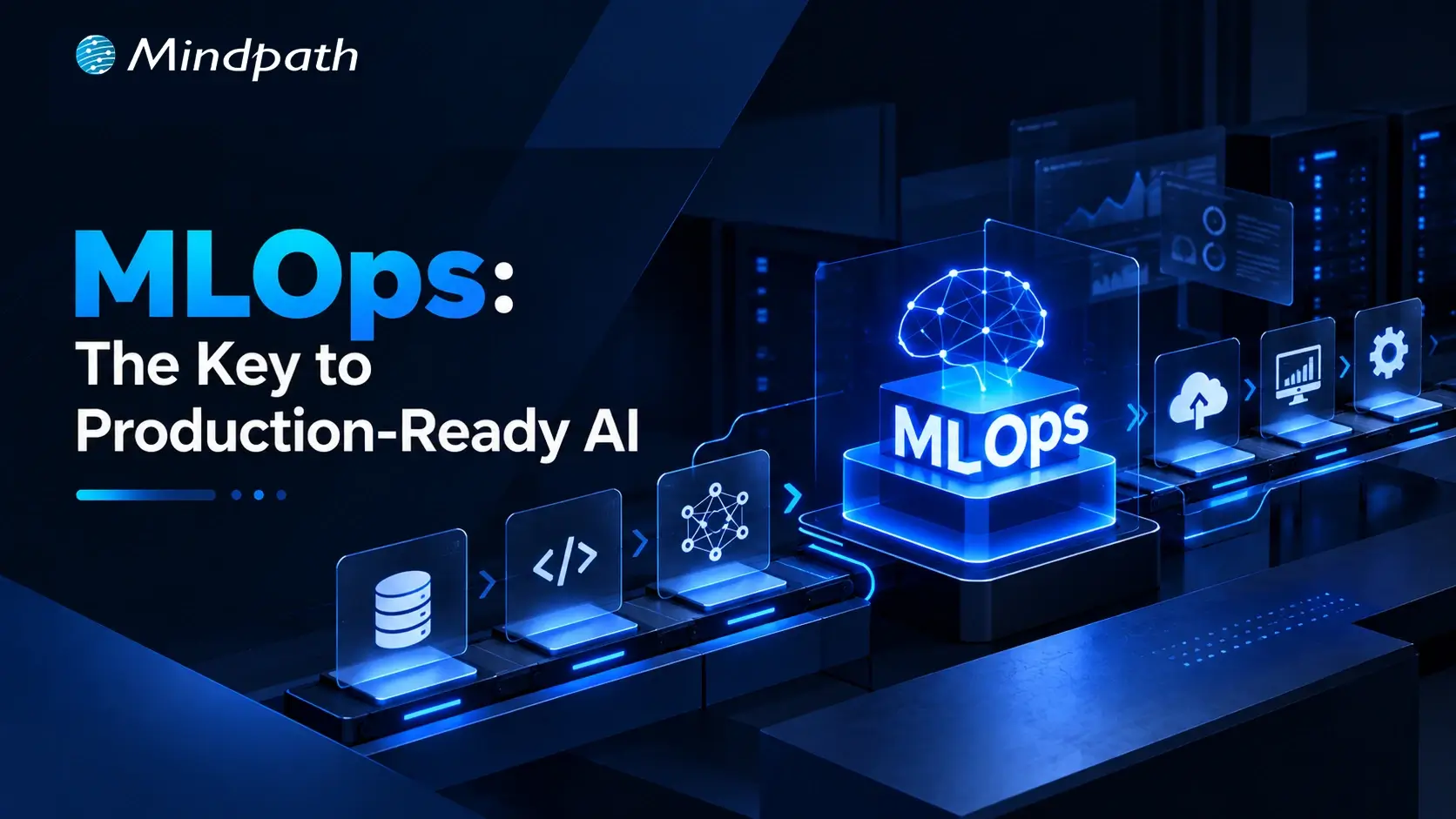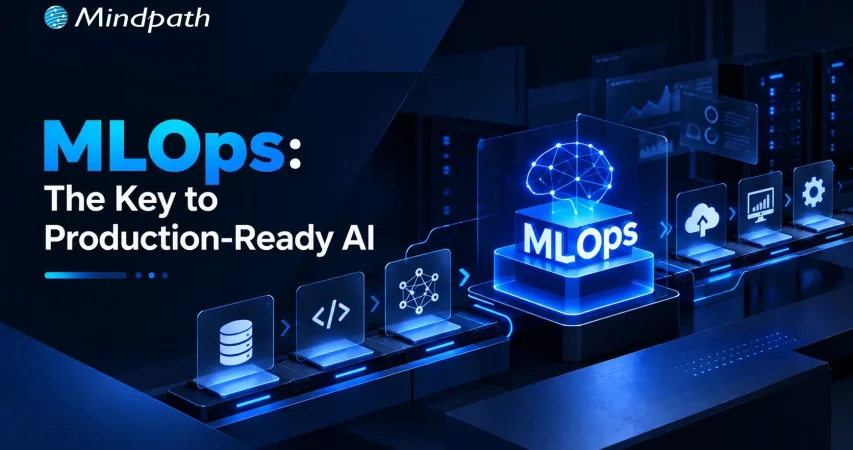
A machine learning model can achieve strong results in development and still struggle once exposed to live data. What is MLOps becomes an important question when deployment brings data drift, versioning gaps, monitoring challenges, security concerns, and inconsistent model performance. MLOps in AI addresses these operational complexities systematically.
Key Takeaways
- 01
MLOps connects machine learning development with reliable production operations and continuous model management. - 02
Production AI needs monitoring, versioning, validation, retraining, security, and scalable deployment workflows. - 03
The MLOps lifecycle helps teams continuously develop, deploy, monitor, and improve machine learning models. - 04
Automation and version control improve reproducibility while reducing manual effort across machine learning workflows. - 05
Strong MLOps practices help organizations build reliable, observable, and maintainable AI systems in production.
Production AI requires continuous oversight across data, models, infrastructure, and deployment pipelines. A reliable MLOps approach connects development with operational processes, helping teams validate, deploy, monitor, and improve models throughout their lifecycle. It treats machine learning as a continuously managed system rather than a one-time deployment. In this blog, we examine how MLOps supports reliable production AI.
Ready to build reliable AI systems for production?
Mindpath provides MLOps consulting and development support to help businesses build scalable, monitored, and production-ready machine learning workflows.
What is MLOps in AI?
MLOps is a set of practices that applies software engineering and operational discipline to machine learning workflows. It connects data preparation, model development, testing, deployment, monitoring, and retraining into a continuous process. This helps teams manage models consistently as data, infrastructure, and production requirements change over time.
In MLOps in AI, the focus extends beyond getting a model into production. Teams need version control for datasets and models, automated validation, reproducible training pipelines, deployment workflows, observability, and governance. These capabilities create a controlled MLOps lifecycle, allowing engineering teams to identify performance issues, respond to data changes, and update models without disrupting production systems.
Why Does MLOps Matter for Production AI?
A model’s performance in a controlled development environment does not guarantee reliable behavior in production. Live data changes, infrastructure scales, and business requirements evolve. MLOps development services help teams build the operational foundation required to manage these changes while keeping machine learning workflows consistent and measurable.
Key areas where MLOps supports production AI include:
1. Reliable Deployment
Automated pipelines move validated models into production with consistent release processes.
2. Continuous Monitoring
Teams can track model performance, latency, errors, data drift, and infrastructure health after deployment. AI model monitoring helps maintain visibility into model behavior after deployment.
3. Data Quality Control
Validation workflows identify unexpected changes in incoming data before they affect predictions. Strong data engineering and AI practices can support reliable data workflows throughout the model lifecycle.
4. Model Versioning
Teams can track models, datasets, configurations, and experiments to maintain reproducibility.
5. Automated Retraining
Defined triggers can initiate retraining when performance or data conditions require an updated model. AI model fine-tuning can also support model improvement when updated requirements or data conditions require changes.
6. Scalable Operations
Standardized workflows make it easier to manage multiple models, environments, and production workloads.
7. Security and Governance
Access controls, audit trails, validation gates, and model lineage support responsible AI operations.
These capabilities explain how MLOps helps deploy AI models in production while creating a repeatable foundation for continuous model management.
Understanding the MLOps Lifecycle
The MLOps lifecycle provides a structured path for moving machine learning models from development into reliable production environments. Understanding what is MLOps becomes clearer when the lifecycle is viewed as a continuous loop, where models are developed, deployed, monitored, and improved based on real-world performance.
1. Data Preparation
Teams collect, clean, validate, and version datasets before using them for model training.
2. Model Development
Engineers train models, run experiments, evaluate results, and track configurations for reproducibility. AI development practices help teams structure model development around specific business and technical requirements.
3. Testing and Validation
Models undergo technical and business validation before they are approved for production deployment.
4. Deployment
Validated models are packaged and released through automated deployment pipelines across the required environments.
5. Monitoring
Production systems track accuracy, latency, errors, data drift, resource usage, and other operational signals.
6. Retraining
New data and monitoring results help determine when a model requires retraining or replacement.
7. Governance
Teams maintain model lineage, access controls, documentation, approvals, and auditability throughout the lifecycle.
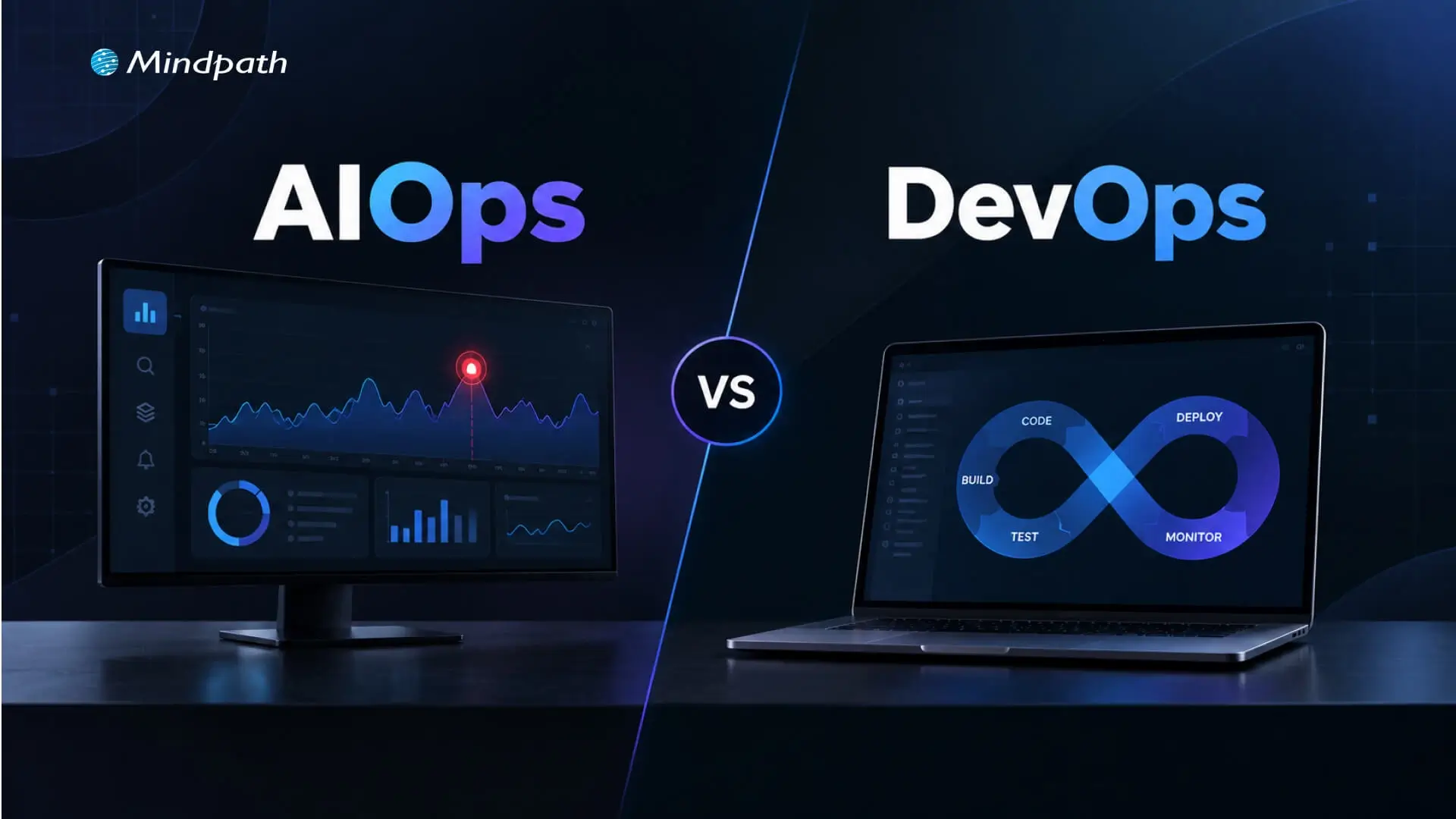
MLOps vs DevOps: What Changes in Machine Learning?
MLOps builds on many DevOps principles, but machine learning introduces additional dependencies that traditional software delivery does not have. Alongside application code and infrastructure, teams must manage training data, model artifacts, experiments, and changing model behavior. AI in DevOps can further extend these workflows by applying AI capabilities to development and operational processes.
1. Development Assets
DevOps primarily manages application code, while MLOps manages code, datasets, models, features, and configurations.
2. Testing
Software testing focuses on application behavior, while MLOps also validates data quality, model performance, and training outcomes.
3. Deployment
DevOps automates application releases, while MLOps supports repeatable model packaging, validation, deployment, and rollback.
4. Monitoring
Traditional monitoring tracks applications and infrastructure; MLOps also monitors prediction quality, data drift, model behavior, and inference latency.
5. Version Control
MLOps requires traceability across datasets, model versions, experiments, and code to maintain reproducibility.
6. Continuous Improvement
MLOps incorporates retraining and model evaluation because production data and model performance can change over time.
This is why DevOps best practices can provide a foundation, while MLOps implementation services typically extend existing DevOps capabilities rather than treating machine learning deployment as a standard software release process.
MLOps Best Practices for Reliable AI Systems
Successful production AI depends on how consistently teams apply MLOps practices across data, models, infrastructure, and monitoring. The following MLOps best practices can help engineering teams build machine learning systems that remain reproducible, observable, and easier to maintain.
1. Version critical assets
Track datasets, source code, models, configurations, and experiment results to maintain reproducibility.
2. Automate ML pipelines
Automate data validation, training, testing, deployment, and retraining wherever practical.
3. Validate before deployment
Establish automated quality and performance checks before promoting a model into production.
4. Monitor continuously
Track model quality, data drift, latency, failures, resource usage, and other production signals.
5. Define retraining triggers
Use measurable changes in data or model performance to determine when retraining is required.
6. Maintain model lineage
Record how data, code, experiments, and model versions connect across the MLOps lifecycle.
7. Build security into workflows
Apply appropriate access controls, audit trails, environment separation, and governance throughout the pipeline.
8. Design for rollback
Maintain previous model versions so teams can quickly restore a stable version when production issues occur.
How MLOps Helps Deploy AI Models in Production?
A production deployment requires more than moving a trained model onto a server. Teams need repeatable release processes, validation, monitoring, and recovery mechanisms to keep AI systems dependable after launch. MLOps helps deploy AI models in production by connecting these operational requirements into a controlled workflow.
1. Automated Model Packaging
Standardized pipelines package models with their dependencies and required configurations for consistent deployment.
2. Pre-Deployment Validation
Automated checks evaluate model quality, data compatibility, and operational requirements before release.
3. Controlled Releases
Teams can use staged deployments, approval gates, and rollback mechanisms to reduce risks during model updates.
4. Production Monitoring
Monitoring tracks inference latency, errors, resource consumption, data drift, and model performance.
5. Scalable Infrastructure
Deployment workflows can support changing inference workloads while maintaining predictable resource utilization.
6. Feedback Loops
Production signals can flow back into training pipelines to support model improvement and retraining. AI data analytics can help teams turn production data into actionable insights for ongoing model and business improvements.
7. Traceable Releases
Versioned models, datasets, and configurations make it easier to identify what changed when production behavior shifts.
Is Your AI Ready for Production with MLOps?
Understanding what is MLOps helps teams see why production AI needs continuous monitoring, automated deployment, version control, retraining, and governance. A structured MLOps approach connects these processes, helping organizations maintain reliable, scalable, and observable machine learning systems as production requirements evolve.
Mindpath provides MLOps consulting services and MLOps development services to help businesses design, implement, and manage production-ready machine learning workflows. Build reliable AI operations with the right architecture, automation, monitoring, and lifecycle management.