Top Cloud Security Risks You Need to Know About

Join our Newsletter!

Featured Posts

Support Is One Click Away

Home

Top Cloud Security Risks You Need to Know About

Cloud security risks

Top Cloud Security Risks You Need to Know About

Cloud Computing has certainly emerged as a breath of fresh air for modern organizations. The novel technology has empowered businesses to carry out their operations in a flexible and scalable manner. However, you need to bear in mind that the adoption of cloud also gives rise to a number of risks and threats for businesses. 

Businesses need to broaden their insight into Cloud security risks. The knowledge can help them prepare themselves to strategically tackle the risks of cloud computing. It is time to dive into the realm of cloud computing and learn about the main risks that threaten businesses.

Looking for a reliable way to manage cloud security risks without putting your business data and operations in danger? Mindpath offers managed cloud services that help in mitigating risks by providing proactive monitoring.

Insight into Cloud Computing

Before looking at the top Cloud security risks, you need to have a clear insight into cloud computing technology. Cloud computing refers to the on-demand delivery of computing services, such as storage servers, and many more. These services are available over the internet to the users, thereby allowing them to access the necessary services and make payment for only what they use. These capabilities have contributed to some of the most important cloud computing trends in recent years. 

Due to cloud computing, individuals and businesses do not need to purchase and maintain any physical hardware. They have the option to simply leverage the remote data centers of cloud providers. By doing so, they can access computing power as well as data in an efficient manner. 

Want to protect your cloud workloads from emerging threats? Learn about cloud security tools that help prevent and manage security risks effectively.

Top Cloud Security Risks

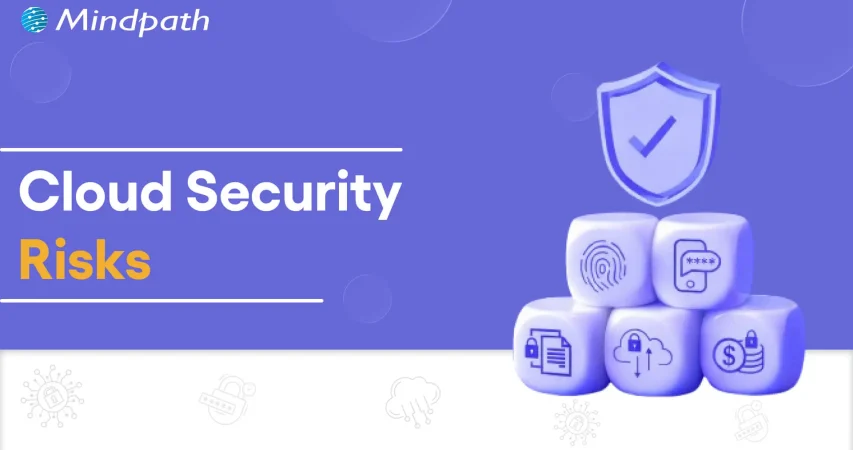
Poor cloud security practices have the potential to give rise to a broad range of security risks and threats. Both individuals and businesses need to be aware of such Cloud security challenges and risks. Some of the top risks include:

1. Data Breaches

Such types of risks arise when unauthorized actors gain access to sensitive data or information that is stored on the cloud. Such types of risks can give rise to grave consequences, such as financial damage and losses. Legal consequences may also arise for businesses because of data breach incidents. Some of the common causes of data breaches on the cloud include compromise of credentials, existence of vulnerable applications, and many more.

2. Poorly Configured Cloud Settings

Cloud security misconfiguration is a serious risk that may compromise the quality of security. These security challenges in cloud computing may arise because of open storage buckets, highly permissive IAM policies, and poor configuration settings. Organizations need to be extremely careful about the cloud settings that are in place so that such a risk can be tackled effectively. 

3. Insecure APIs 

The role of APIs is critical for the functionality of the cloud. In such a case, an insecure API may be a reason for cloud security issues and vulnerabilities. Typically, insecure APIs have weak encryption or authentication, which may be exploited by hackers. As a result, they may be able to gain access to valuable resources on the cloud. Since API vulnerabilities may go under the radar at times, they can be the favorite target for malicious actors. 

4. Account Hijacking

Account hijacking refers to the security risks of cloud computing, which occurs when an attacker makes use of stolen credentials to gain access to a cloud account. An attacker can carry out diverse manipulations with the data after they have taken over the account. For instance, they may steal the information, which may lead to the disruption of service. 

5. Insider Threats

These cloud security issues arise because of internal stakeholders. They could be employees, partners, or contractors who have access to the cloud resources of a business. They may either intentionally or unintentionally misuse the access that they have. You need to keep in mind that insider threats are extremely dangerous as they are carried out by people who are trusted. Such cloud security threats can easily bypass conventional security measures and thus may be hard to discover as well as mitigate. 

Want to understand what puts your cloud systems at risk? Discover cloud computing attacks and see how organizations mitigate modern threats effectively.

6. Data Loss

The data that is saved on the cloud may be lost because of diverse reasons. It may be lost due to accidental deletion, hardware failure, or the actions of malicious actors. In case organizations do not maintain regular backup, they face the risk of losing their valuable data on a permanent basis. Businesses need to be extremely cautious while handling their data on the cloud in order to prevent data loss of any kind.

7. Lack of Proper Visibility

When business entities grow, it may get difficult to maintain holistic visibility into the cloud environment. The lack of cloud visibility is one of the major security issues with cloud computing. This is because it can act as a barrier to threat detection as well as response. Malicious actors such as cybercriminals and hackers may get the opportunity to gain unauthorized access and compromise the security. It can heighten the risk relating to undetected breaches.  

8. Absence of Encryption Practice

Encryption is an integral part of safeguarding sensitive data that is stored or in transit in cloud environments. The data or information that is not properly encrypted is likely to become easy prey for access or interception by unauthorized users. The business entities that are unable to encrypt their sensitive data are exposed to the dangers of cloud computing.

9. Ineffective Identity and Access Management (IAM)

Poor practices relating to Identity and Access Management are considered to be serious cloud computing security problems. Poor practices may include weak password policies or giving undue permission to employees within the organization. Such poor practices can give rise to opportunities for cybercriminals to compromise cloud security.

10. Third-Party Risks

Third-party risks arise because of vendors or partners that deal in the cloud environment. Due to their poor security practices, security concerns may arise for businesses. There is a possibility that attackers may target a third-party vendor in order to gain access to the broader cloud ecosystem. In order to reduce this risk, it is essential for businesses to prioritize vendor risk management.

Looking for insights on cloud security risks? Check out cloud computing vulnerabilities to see how weaknesses are exploited and how to mitigate them.

Best Practices for Cloud Security

As security risks in the cloud setting are growing like never before, organizations need to adopt best practices to deal with such concerns. These practices can act as the ultimate cloud security solutions that can help you strengthen your security posture. Some of the best practices include:

1. Maintaining Solid Access Controls

Businesses should make sure that they have strong access controls in place. Some of the controls that you can introduce include multi-factor authentication along with strong password policies. They are believed to be good measures for securing access to cloud accounts. 

2. Encryption Practices 

Business entities need to place high emphasis on both data at rest and data in transit encryption. It is vital to encrypt sensitive data at all times by following strict encryption protocols.  Moreover, the implementation of encryption key management policies is also crucial to protect data in the best way possible. 

3. Monitoring and Auditing of Cloud Activities 

Businesses need to use advanced monitoring tools for the purpose of keeping a tab on the activities that take place on the cloud. You need to perform the audit of logs on a continuous basis so that you will be able to locate suspicious activities such as unauthorized access.

4. Safe APIs

You need to know that APIs serve as common entry points for cybercriminals as well as attackers.  In order to tackle the security risks of cloud computing relating to insecure APIs, you need to use safe APIs. You must ensure that there exists strong authentication as well as encryption for all types of API communications. 

5. Principle of Least Privilege

Businesses need to adopt the principle of least privilege. It will help you limit the access rights relating to users. Moreover, it is essential to monitor, review, and update controls on a frequent basis. This will help you identify if users get extra access in the cloud environment. 

Struggling to manage security risks in cloud applications? Learn about cloud-native development and discover how secure development practices protect your environment.

Final Words

There exists a diverse range of risks in the cloud environment that business entities need to be aware of in the current times. Some of the main risks include Data Breaches, poorly configured cloud settings, and many more. In addition to gaining knowledge about such risks, it is essential to familiarize yourself with the best practices relating to cloud security. Some of the best practices include maintaining solid access controls, encryption, and many more. 

You need to leverage Mindpath’s top-quality cloud solutions. The cloud managed services are perfect as they can help your business to flexibly leverage the resources. Moreover, the experts will ensure that you are safe from cloud security risks that exist in the current business world. 

Related Post

Explore the key comparison between DevOps vs DevSecOps to find out which approach best enhances your development pipeline.

Related Post

Top Node.js Features for Backend Development – A Complete Guide
Is Node.js still the best choice for backend development in 2025? With technology evolving rapidly, developers need efficient, scalable, and high-performance solutions. Node.js continues to power modern applications, but what makes it so relevant today? Let’s dive into the latest trends and see why Node.js remains a top choice for backend development this year!

1. JavaScript familiarity

If a developer is familiar with JavaScript on the front end, transitioning to backend programming using Node.js becomes considerably easier. Since they both speak the same language, there is no need to learn anything entirely new. This enables developers to work quicker and construct apps more seamlessly. It also saves time during training and avoids errors. Node.js allows frontend professionals to swiftly improve their abilities and handle full-stack development without a high learning curve.

2. Real-time applications

Node.js is ideal for real-time applications, due to frameworks such as Socket.IO. It enables immediate connection between users and servers, making services such as live chat, notifications, and real-time updates effortless. Node.js guarantees seamless and quick interactions across chat applications, online games, and collaboration tools. Users do not need to refresh their displays to receive new updates; everything happens immediately. This makes programs more interesting and responsive, which enhances the entire user experience.

3. High concurrency

Node.js is built to accommodate a large number of users simultaneously without slowing down. Its non-blocking I/O mechanism allows for the efficient processing of many requests without the need for queues. This makes it perfect for apps that experience high traffic, such as online gaming, streaming services, and real-time chat. Instead of generating a new thread for each user, Node.js handles connections efficiently, allowing applications to remain quick and responsive even when under heavy demand.

4. Microservices architecture

Node.js is ideal for creating microservices, which split a program into separate, independent services. Each service performs a specific purpose and operates independently, making development and upgrades easy. Since these services interact rapidly, applications remain adaptable and scalable. This method is ideal for complicated applications because it allows teams to work on separate portions without impacting the overall system. Businesses can utilize Node.js to create quick, maintainable, and extendable apps.

5. Lightweight and efficient

Node.js is lightweight and efficient, allowing it to operate quicker with less resources. Its compact footprint enables applications to complete tasks rapidly, making it excellent for dealing with large traffic without overwhelming the system. Node.js ensures that your app operates effectively even when it is heavily loaded by consuming less memory and CPU. This efficiency results in faster response times and better user experiences, all while keeping operating expenses down.

Ready to build fast, scalable, and efficient applications with Node.js? At Mindpath, we specialize in creating high-performance solutions using the power of Node.js. Whether you’re looking for real-time features, microservices, or high-concurrency handling, our expert team is here to help.
Contact us today to discuss how we can take your application to the next level with Node.js!

How much does hiring a ReactJS developer cost? Learn about factors affecting rates, and how to find the best talent within your budget.
Node.js

Looking to build a real-time chat application? Have you ever wondered how chat apps handle instant messages so efficiently? With Node.js, you can create a fast, scalable solution that supports real-time communication. Let’s explore how Node.js can power your next chat app and bring your ideas to life!

Overview of NodeJS

Node.js is a platform that enables developers to run JavaScript outside of a web browser, making it ideal for developing server-side apps and tools. Instead of merely running code in the browser, Node.js allows you to utilize JavaScript for activities such as web server management and networking. It operates by utilizing an “event loop.” When several requests are received, Node.js adds them to a list and processes them one by one, ensuring that everything goes smoothly and without getting stuck. Node.js employs a strong engine called V8, which is the same engine used by Google Chrome, to convert JavaScript into rapid machine code. It also includes a big library of reusable code known as npm, which developers can utilize to simplify and speed up the development process. 

Advantages of NodeJS in Building Real -Time Chat Applications

1. Event-Driven Design

Node.js uses an event-driven design, which makes it ideal for developing real-time chat apps. New messages, user connections, and disconnections are all common in real-time chat apps. Node.js handles these events effectively, responding to each one as it happens. Instead of waiting for one process to complete before beginning another, Node.js employs an event loop. This implies it can do numerous jobs simultaneously without slowing down. When a new message comes or a person enters a conversation, Node.js creates an event and processes it right away. This allows chat apps to work smoothly even when there are a large number of users or messages active at the same time. This method enables Node.js to handle real-time communication rapidly and with minimal delays. It’s ideal for designing rapid, engaging experiences where customers anticipate immediate replies, such as a chat app. Node.js allows developers to design apps that respond rapidly to users, resulting in a smooth and engaging experience.  

2. Quick Development and Launch

Node.js’ enormous and active developer community makes it faster and easier to construct real-time chat apps. This community gives access to a diverse set of libraries, frameworks, and tools for simplifying complicated tasks. Instead of starting from scratch, developers can take advantage of these tools to accelerate the development process. In addition to rapid development, Node.js apps are simple to deploy. Its lightweight and efficient architecture enables applications to function seamlessly across several devices and servers. Node.js simplifies the deployment process, whether you’re using a tiny server or a cloud platform. Node.js also makes scalability easy. As your chat app grows and draws more users, you can quickly increase its capacity without making significant modifications to the code or infrastructure. This flexibility is especially valuable for real-time chat applications, which need to handle increasing user traffic efficiently. By enabling quick development and easy deployment, Node.js saves time and effort while ensuring your chat app is ready to perform at its best. 

3. Real-Time Communication Tools

Node.js provides a diverse set of modules and frameworks that are ideal for developing real-time chat apps. These technologies are particularly intended for real-time collaboration, making the development process considerably easier and faster. One of the most popular libraries is Socket.IO, which is frequently used in real-time applications. It gives developers everything they need to add features like instant chat, live alerts, and user status updates. Socket.IO enables developers to effortlessly establish two-way communication between the server and clients, resulting in a seamless and responsive chat experience. The availability of such ready-to-use libraries shortens the time and effort necessary to develop real-time functionality from scratch. Instead, developers can concentrate on customizing the chat application to satisfy specific purposes, such as group chats, one-on-one interactions, or advanced features like typing indicators. 

4. Speed and Scalability

Node.js is recognized for its great performance and scalability, making it ideal for real-time chat apps. Its non-blocking I/O paradigm enables the server to do several jobs concurrently without being overloaded. In a real-time chat app, users continually send and receive messages, as well as connect and disconnect. Node.js does all of these tasks effectively by managing several connections at the same time. Unlike conventional servers, which might slow down when there are too many users online, Node.js maintains seamless performance even with a large user base. This performance is especially critical for chat apps, as users demand immediate conversation with no delays. Whether your project serves a few or millions of people, Node.js scales quickly to meet demand. By adding more servers or resources, your app can grow alongside its user base without needing a complete overhaul. With Node.js, you can build chat applications that are fast, reliable, and capable of handling heavy traffic, ensuring a great experience for all users. 

5. WebSocket Integration

Node.js is extremely compatible with WebSockets, an essential technology for real-time communications. WebSockets establish a permanent connection between the server and the client, allowing for immediate two-way communication. This is required for features such as live messaging and alerts in real-time chat apps. Node.js, when used with frameworks like Socket.IO, makes WebSockets easy and efficient. Socket.IO not only makes it easier to implement WebSockets, but it also adds features like managing reconnections and offering fallback alternatives for older browsers that may not completely support WebSockets. This strong support ensures that real-time chat apps developed with Node.js provide a consistent and dependable experience independent of the user’s device or browser. Using WebSockets, developers can construct quick, responsive chat apps that seem immediate to the user, meeting the expectations of modern real-time communication. 

NodeJS Services at Mindpath

At Mindpath, we specialize in creating high-performance and scalable Node.js solutions. Our team of experienced developers is dedicated to delivering outstanding results by catering to your business needs. Be it the development of a new application or the enhancement of an existing one, our experts will help you get it right. Here’s a rundown of what our Node.js development services look like: 

1. Node.js Web App Development

Our developers create high-performance, scalable web applications using Node.js. We are committed to providing your digital appearance with an invulnerable add-on, optimized completely with the business goals, to create applications that will create a lasting impression. 

2. Node.js CMS Development

We develop custom-made content management systems to assist in the effective management of your content. Our CMS solutions are designed to simplify content management, providing you with an intuitive interface to handle all your content effortlessly.

3. Node.js API Development

We create strong and powerful APIs that will enable other systems to be smoothly integrated. Our APIs are designed to enhance functionality and connectivity, ensuring smooth and reliable communication between different applications. 

4. Node.js Consulting Services

We assure you expert help in maximizing your business projects with Node.js potential. We provide strategic guidance and technical insights to optimize your Node.js applications, driving innovation and efficiency. 

5. Node.js Maintenance & Support

Our maintenance and support practice are continuous for on-the-go help. Our team is always ready to address any issues and provide continuous improvements, ensuring optimal performance and reliability. 

6. Node.js Migration Services

We will support you in the node.js migration of your existing applications for scalability and performance improvements. Our migration services are designed to minimize disruption and ensure a seamless transition to a more efficient and powerful platform. 

Wrapping Note

Node.js is an excellent platform for building real-time chat applications, offering speed, scalability, and efficient real-time communication. Its event-driven design, robust libraries, and WebSocket support ensure seamless and responsive interactions, even with a large user base. At Mindpath, we specialize in crafting innovative and scalable Node.js solutions tailored to your unique needs. Whether you’re starting fresh or enhancing existing systems, our team is here to bring your ideas to life. 

Ready to build your real-time chat app with Node.js?

Partner with Mindpath for expert development and scalable solutions.

Learn how Node.js powers real-time chat apps with speed, scalability, and WebSocket support. Discover Mindpath’s expert Node.js services.
top genAI tools

If you’ve been paying attention to the tech world lately, you must have seen how the best GenAI tools are revolutionizing the way we can accomplish our jobs. Whether it is writing content in seconds or smartly developing sophisticated apps without heavy layers of coding, innumerable examples exist of how these tools are helping people do more with less effort. These AI tools are quickly becoming the new solution for developers, creators, and organizations who want to increase their speed and get better results.

The evolution of GenAI is transforming how industries approach work and innovation. Work that could take hours, and manual efforts are now being dramatically reduced to minutes through intelligent tools. Developers and organizations are employing GenAI tools in many everyday tasks. They provide efficiency, less effort, and improved outcomes. In this blog, we will showcase the most powerful GenAI tools carving the future of AI development. You’ll get a quick look at what they do and why they matter.

Looking to transform your ideas into intelligent, future-ready solutions with Generative AI? Our expert AI development services help you build scalable, smart systems that drive real business impact.

What is Generative AI?

Generative AI is an intelligent technology that creates new things using AI, like text, images, video, and even code. Generative AI can move beyond simply answering questions or completing simple tasks; it is able to generate something new. This allows businesses to operate more quickly and continually come up with new ideas.

Countless organizations are now taking advantage of generative AI to save time and operational efficiencies. Businesses apply it to write emails, design graphics, make advertisements as well as create chatbots. By leveraging generative AI, businesses can reduce manual labor, have fewer errors, and provide customers with their services in a more personalized and timely manner.

Here are some advantages of generative AI for businesses:

  • Creativity and Innovation – Generative AI allows businesses to develop more ideas and make new content.
  • Productivity – It saves time by taking responsibility for boring, menial tasks.
  • Efficiency – It allows work to be completed more quickly and with fewer errors.
  • Personalized Customer Experience – Business can create more personalized and relevant content for the customer.
  • Product Development – It can develop new products faster through automated coding, idea generation, and design enhancements.
  • Support Service/AI chatbots – It supports customer service chatbots that are capable of answering customer questions.
  • Better Decision-making – It provides some basic recommendations to businesses using data so they can make better decisions.
  • Reduction in Costs – It results in cost savings through automation of tasks and improved operations.

Curious about where Generative AI is headed next? Explore the top Generative AI Trends for 2025 and stay ahead of the innovation curve.

Best Generative AI Tools Driving the Future

Generative AI tools are making a big impact by helping businesses create content, improve services, and speed up their workflows. These tools are easy to use and offer smart solutions for many daily tasks. Below is a generative AI tools list that showcases the top tools shaping the future of work and technology.

1. Gemini 

Gemini is one of the best AI tools for students who need help with research, writing, and learning new topics. It works like a smart assistant that gives clear answers, supports multiple languages, and connects well with Google’s tools. It’s great for organizing ideas and understanding complex information more easily.

2. ChatGPT

ChatGPT is a helpful AI tool for writing, support, and idea generation. It can answer questions, create content, and help you think through new ideas. Whether you’re stuck on a project or need help with writing, it’s like having a smart assistant that’s ready to guide you anytime.

3. Cohere

Cohere is one of the useful generative AI tools for developers who want to build smart apps with language features. It helps create text for chatbots, search tools, and marketing content. Developers can use its API to train custom models and add natural language understanding to different types of projects.

4. GitHub Copilot

This tool is a great example of generative AI for coding, helping developers write code faster with real-time suggestions. It works smoothly with popular editors like Visual Studio Code and supports many languages. It also learns your coding style to give more personalized tips, making your development process easier and quicker.

5. AlphaCode

AlphaCode is a helpful generative AI coding tool that supports developers with tasks like writing code, fixing bugs, and learning new programming languages. It can save time by handling repetitive work and giving smart suggestions. It also helps improve code quality and makes team coding easier with shared ideas and solutions.

6. Microsoft Copilot

Microsoft Copilot is a smart assistant that helps with both coding and office work. It gives helpful code suggestions, writes documentation, and works well with tools like Visual Studio and Microsoft 365. It’s a great support tool for developers and teams who want to work faster and more efficiently.

7. Canva AI

Canva AI makes graphic design simple and fast, even if you’re not a designer. With its easy drag-and-drop setup and ready-made templates, you can create eye-catching visuals in minutes. It also gives smart design suggestions and helps keep your brand style consistent across all your projects.

8. DALL-E 2

This is one of the most creative generative AI applications, turning simple text into detailed images. You just describe what you want, and it creates visuals in different styles. It’s great for bringing ideas to life, whether you’re designing something new or showing a concept in a fun, visual way.

9. Microsoft Power Apps

This tool makes building apps easier by letting you use simple chat-like prompts instead of writing a lot of code. It helps create database layouts and app designs quickly. It’s great for teams working together and speeds up the whole process, though it works best within the Microsoft environment.

10. Turing’s CodeGen Copilot

This tool is one of the useful generative AI tools for programmers who want to save time and avoid repeating the same coding tasks. It fits well with tools like GitHub and Jira, making the workflow smoother. It helps boost productivity and lets developers focus more on creative and important work.

To explore how Generative AI is reshaping mobile and web experiences, check out our in-depth article on the Role of Generative AI in App Development. It dives into real-world applications and how this technology accelerates innovation in app design and functionality.

Want to Boost Your Workflows with the Best GenAI Tools?

GenAI tools are changing how we work, learn, and innovate. From faster coding to better customer service and content creation, these tools help users do more in less time. They are now essential for staying efficient, creative, and competitive in today’s fast-moving digital world.

Mindpath offers GenAI powered solutions to help businesses automate tasks, build smarter apps, and improve customer experience. Our expert team delivers AI tools that fit your goals, helping you reduce time, cut costs, and grow faster. Let us help you transform your business with our world-class, customised AI development services.

Discover top GenAI tools revolutionizing AI development. Enhance creativity, automate tasks, and streamline processes for your business success!