Modern IT teams don’t struggle to collect operational data. They struggle to make sense of it. A single incident can trigger hundreds of alerts across monitoring tools, leaving engineers to sort through noise before they can even start fixing the problem.
Key Takeaways
- 01
DevOps improves software delivery through collaboration, automation, CI/CD, and continuous monitoring. - 02
AIOps applies AI to analyze operational data, detect patterns, and support faster incident response. - 03
AIOps and DevOps address different needs but can work together across modern IT environments. - 04
Successful AIOps adoption depends on reliable data, strong observability, integration, governance, and human oversight. - 05
Organizations can introduce AIOps gradually by applying AI to specific operational use cases.
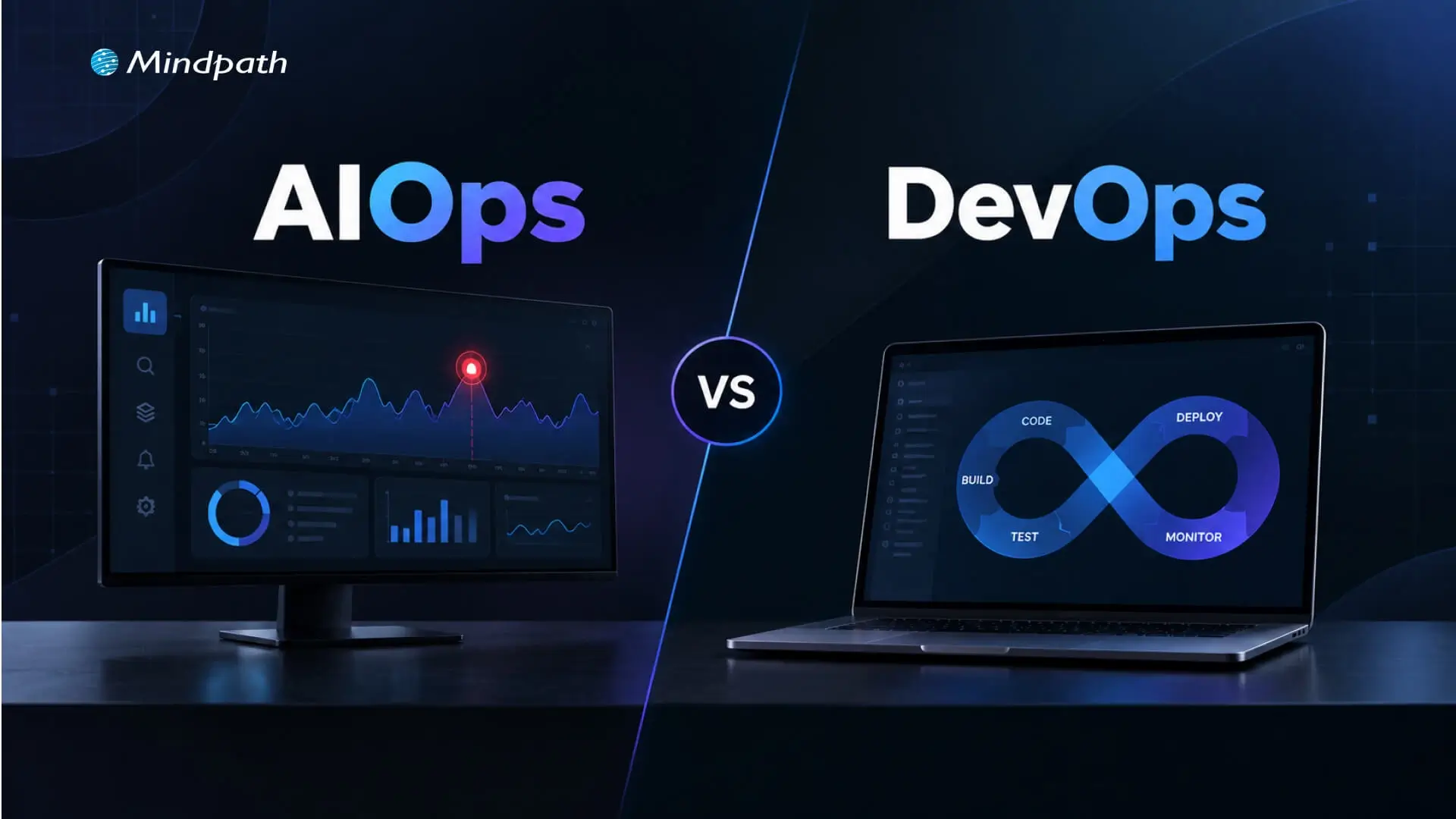
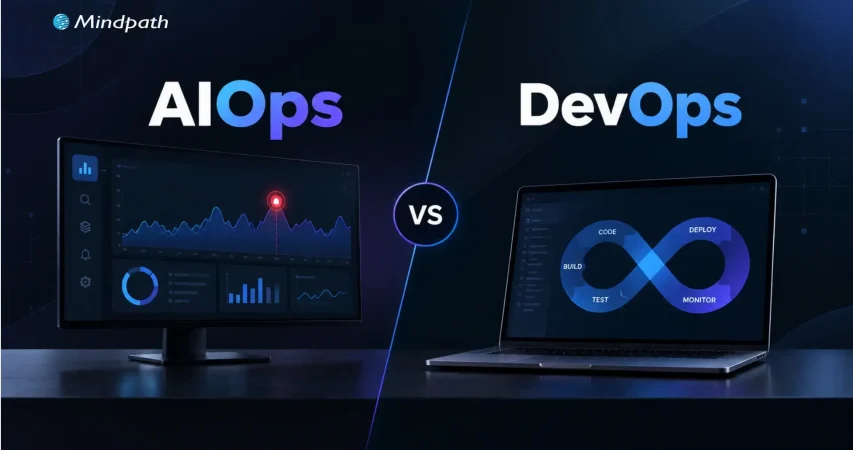
DevOps gave teams the pipelines, automation, and collaboration to release software quickly and reliably. But faster delivery also means more services, more deployments, and more data to interpret. That’s why AIOps vs DevOps has become an important question for IT teams. DevOps speeds up how software is built and shipped, while AIOps uses AI to cut through alert noise, find root causes, and respond faster. In this blog, we’ll explore how the two differ and how an AI DevOps approach can bring them together.
Ready to build more intelligent IT operations?
Mindpath helps businesses apply AI to operational workflows, data, monitoring, and automation.
What Is DevOps?
DevOps is a software development and operations approach that brings teams, processes, and technologies together across the application lifecycle. It focuses on improving collaboration, automating repetitive tasks, and creating consistent workflows for building, testing, deploying, and maintaining applications.
By integrating development and operations practices, DevOps helps teams release software more frequently while maintaining reliability and operational control. It also supports continuous feedback, infrastructure automation, and faster responses to issues across development and production environments.
Key features and benefits of DevOps:
1. Continuous Integration and Delivery
2. Automated Testing and Deployments
3. Infrastructure and Configuration Automation
4. Faster Software Release Cycles
5. Improved Collaboration Across Teams
6. Continuous Monitoring and Feedback
What Is AIOps?
AIOps applies artificial intelligence and machine learning to IT operations, helping teams analyze the large volumes of data generated by applications, infrastructure, networks, and monitoring systems. It combines operational data with intelligent analysis to identify patterns and surface relevant insights.
AIOps can correlate events across multiple systems, detect unusual behavior, support root-cause analysis, and automate selected operational responses. This helps IT teams handle complex environments with greater visibility while reducing the manual effort involved in monitoring and incident investigation.
Key features and benefits of AIOps:
1. Intelligent Event Correlation
2. Anomaly and Pattern Detection
3. Automated Alert Analysis
4. Faster Root-Cause Investigation
5. Predictive Operational Insights
6. Automated Incident Response
7. Reduced Alert and Operational Noise
AIOps vs DevOps: What Is the Difference?
AIOps and DevOps both aim to improve IT operations, but they address different aspects of the technology lifecycle. DevOps focuses on collaboration, automation, and software delivery, while AIOps uses AI-driven analysis to make IT operations more intelligent and responsive.
| Area | DevOps | AIOps |
|---|---|---|
| What it is | A culture and set of practices that unites development and operations | An approach that applies AI/ML to IT operations data |
| Core objective | Ship software faster and more reliably | Detect, diagnose, and resolve operational issues faster |
| Main question it answers | “How do we build and release this efficiently?” | “What is going wrong, why, and what should we do?” |
| Where it operates | Build → test → deploy → operate | Monitor → detect → analyze → respond |
| Type of automation | Rule-based and scripted (pipelines, IaC, deployments) | Adaptive and data-driven (correlation, anomaly detection, suggested or automated remediation) |
| Data used | Code, build logs, pipeline results, deployment history | Logs, metrics, traces, events, alerts, and tickets at large scale |
| How decisions are made | Predefined workflows and thresholds | Learned patterns and statistical models |
| Typical use cases | CI/CD, infrastructure automation, release management | Alert noise reduction, anomaly detection, root-cause analysis, predictive alerts |
| Example tools | Jenkins, GitHub Actions, GitLab CI, Terraform, Ansible, Kubernetes | Dynatrace, Datadog, Splunk, PagerDuty, BigPanda |
| Key metrics | Deployment frequency, lead time, change failure rate | MTTD, MTTR, alert volume, false-positive rate |
| Primary users | Developers, DevOps and platform engineers | SREs, IT operations, NOC and incident response teams |
| AI dependency | Not required | Central to the approach |
| Main limitation | Struggles to interpret huge, noisy operational data manually | Depends on data quality and needs human validation |
What Should Organizations Consider Before Adopting AIOps?
AIOps works best when organizations have the right operational foundation in place. AI-driven analysis depends on the quality of the data, systems, and workflows available to it. Before adoption, teams should assess how their existing IT environment can support intelligent analysis and automation.
1. Data Quality
AI is only as good as its input. Are logs, metrics, and events consistent and complete?
2. Observability
Observability provides context for accurate analysis. Do we have visibility across apps, infrastructure, and services?
3. Tool Integration
Integration enables cross-system analysis. Can monitoring, cloud, and ITSM tools share data?
4. Security and Governance
Security and governance help prevent unsafe automated actions. Do AI actions follow our access controls and policies?
5. Human Oversight
Human oversight keeps risk under control. Which actions are automated and which need approval?
6. Team Readiness
Team readiness drives trust and adoption. Do engineers know how to validate AI-generated insights?
AIOps adoption should therefore align with the organization’s existing DevOps practices and operational maturity. Starting with well-defined use cases, reliable data, and controlled automation can help teams introduce AI into IT operations without disrupting established processes.
How DevOps and AIOps Work Together?
The need for AIOps generally becomes clearer as IT environments grow in scale and complexity. Teams managing distributed applications, cloud infrastructure, multiple monitoring systems, and high volumes of operational data may need capabilities that extend beyond conventional DevOps automation.
For organizations building an AI DevOps strategy, AIOps can complement existing processes by adding intelligence to monitoring, incident analysis, and operational decision-making. The approach can be particularly relevant when teams face recurring incidents, excessive alert volumes, fragmented operational data, or increasing pressure to respond quickly.
1. Handle Growing Operational Data
Analyze large volumes of logs, metrics, events, and traces.
2. Reduce Alert Overload
Identify relationships between related events and focus attention on significant issues.
3. Improve Incident Response
Provide additional context during investigation and troubleshooting.
4. Manage Complex Environments
Connect operational signals across cloud, applications, infrastructure, and services.
5. Extend Automation
Support intelligent actions alongside established DevOps workflows.
| Lifecycle Stage | DevOps Contribution | AIOps Contribution |
|---|---|---|
| Build and test | Automated CI pipelines and testing | Flags patterns in failed builds or flaky tests |
| Deploy | Automated, repeatable releases | Detects anomalies right after a release |
| Monitor | Dashboards, alerts, and feedback loops | Correlates events across systems and reduces noise |
| Incident response | Runbooks, on-call processes, rollbacks | Suggests probable root cause and triggers low-risk fixes |
| Improve | Post-incident reviews and process updates | Surfaces recurring issues and trends |
The decision does not have to be framed as AIOps vs DevOps. DevOps can remain the foundation for software delivery and automation, while AIOps adds intelligence where operational complexity demands deeper analysis and faster response.
Building an Intelligent IT Operations Strategy
Building intelligent IT operations is not about replacing existing DevOps practices with AI. It involves strengthening the operational foundation first, then introducing AI where it can provide meaningful analysis, automation, and decision support.
| Step | Action | Example | Success Metric |
|---|---|---|---|
| Strengthen DevOps | Standardize CI/CD, IaC, and workflows | Unified pipeline templates | Deployment frequency, change failure rate |
| Improve observability | Centralize logs, metrics, traces, and events | One monitoring platform or data layer | Coverage of monitored services |
| Connect data | Integrate cloud, app, and ITSM tools | Alerts linked to tickets and deployments | Reduction in data silos |
| Introduce AI selectively | Start with one use case | Event correlation for one service | Alert volume reduction |
| Automate carefully | Begin with low-risk, repetitive actions | Auto-restart a failed service | MTTR, automation success rate |
| Measure and refine | Review outcomes regularly | Monthly incident trend review | MTTD, MTTR, recurring incidents |
This approach allows organizations to introduce AIOps gradually while building on established DevOps processes. The result is a more connected operating model where automation handles defined workflows and AI helps teams interpret complex operational signals.
How Can Your Team Combine AIOps and DevOps?
The AIOps vs DevOps discussion shows that both approaches address different operational needs. DevOps establishes efficient delivery and automation practices, while AIOps adds AI-driven analysis to complex IT environments. Together, they can help teams improve visibility, respond to incidents faster, and build more intelligent operational workflows.
At Mindpath, our AI development services help businesses apply AI across operational workflows, data environments, and business processes. From AI strategy and data engineering to intelligent automation, we help teams build practical AI capabilities aligned with their technical requirements and operational goals.