Home

How SMBs Can Build AI Solutions Without an In-House AI Team?

How SMBs Can Build AI Solutions Without an In-House AI Team?

Join our Newsletter!

AI for small and medium businesses

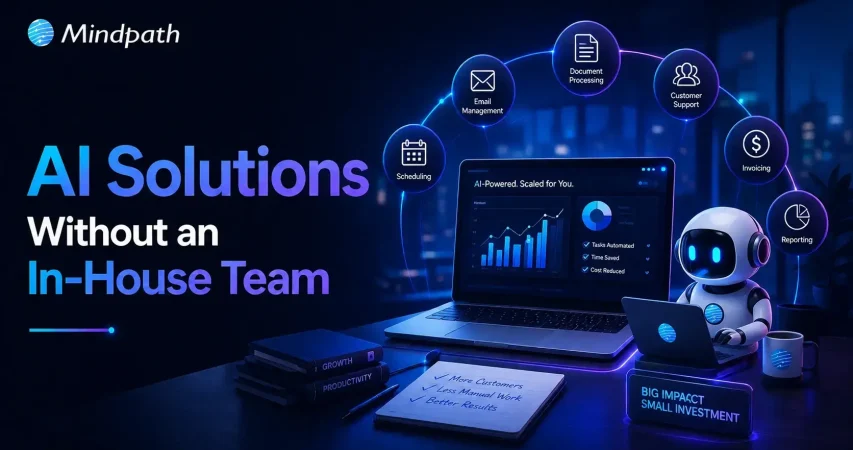
Businesses of every size now recognize artificial intelligence as a practical tool for improving operations and customer experiences. However, many smaller organizations assume successful adoption requires hiring expensive AI specialists and building dedicated internal teams before starting their transformation journey. 

Key Takeaways

  • 01
    SMBs can successfully adopt AI without hiring dedicated in-house AI specialists.
  • 02
    Focusing on one high-impact business challenge delivers faster, measurable AI results.
  • 03
    Experienced AI development partners simplify implementation, deployment, maintenance, and long-term optimization.
  • 04
    Cloud-based AI platforms reduce infrastructure costs while enabling secure and scalable deployments.
  • 05
    Regular monitoring, updates, and optimization ensure AI solutions remain accurate, reliable, and valuable over time.

The reality looks very different today because experienced technology partners, cloud platforms, and ready-to-use AI services simplify implementation. AI for small and medium businesses has become accessible through outsourcing, allowing organizations to deploy practical solutions without maintaining large in-house AI departments.

Why are SMBs Investing in AI Today?

Small and medium businesses face increasing pressure to improve productivity while controlling costs and maintaining competitive customer experiences. AI offers practical opportunities to automate repetitive work, analyze business data, and support faster decision-making across different business functions.

Recent advances in cloud computing, large language models, and managed AI platforms have significantly reduced implementation complexity. Instead of building everything internally, businesses can work with specialized development partners that provide technical expertise throughout the project lifecycle.

  • 80% to 89% of SMBs use AI daily. (Forbes)
  • 50% to 68% of marketing teams automate content creation with AI. (Booth Associates LLC)
  • AI software spending continues to grow as SMBs prioritize scalable generative AI solutions. (Gartner)

Why are In-House AI Teams No Longer Essential?

Many organizations believe AI success depends on hiring data scientists, machine learning engineers, and AI architects. While these professionals remain valuable, modern AI development offers alternative approaches that reduce staffing requirements.

1. Cloud AI Platforms Simplify Development

Leading cloud providers offer managed AI services requiring minimal infrastructure management. Businesses can focus on solving operational problems instead of maintaining complex technical environments.

2. Pre-Trained AI Models Reduce Development Time

Modern foundation models already understand language, documents, and business workflows. Developers can customize existing models instead of building entirely new systems.

3. Experienced AI Partners Provide Specialized Expertise

External AI specialists bring proven implementation experience across multiple industries and business environments. This reduces learning curves while improving project quality.

4. Scalable Engagement Lowers Operational Costs

Companies only pay for the expertise they need during planning, development, deployment, and optimization. This eliminates the cost of maintaining a permanent in-house AI team.

5. Faster Deployment Improves Business Value

Established AI development processes shorten implementation timelines while reducing technical risks. Businesses begin seeing measurable improvements much sooner.

6. Ongoing Support Remains Available

Reliable AI development partners continue monitoring, updating, and optimizing AI systems after deployment. This allows internal teams to focus on core business activities instead of managing complex AI maintenance.

What Challenges Do SMBs Face Without AI?

Many businesses delay AI adoption because they believe limited resources prevent successful implementation. Understanding these challenges helps organizations choose practical solutions instead of postponing innovation.

1. Limited Technical Expertise

Most businesses lack experienced AI professionals within their existing technology teams. Recruiting specialized talent often requires significant investment and lengthy hiring processes.

2. Budget Constraints

Building internal AI capabilities involves recruitment, infrastructure, training, and software licensing expenses. Smaller organizations usually prefer predictable project-based investments.

3. Unclear Implementation Strategy

Many businesses understand AI’s potential but struggle to identify suitable business problems. Poor planning often results in delayed projects and limited business outcomes.

4. Data Preparation Challenges

Business information frequently exists across multiple systems with inconsistent formats and quality. Preparing reliable data requires structured planning before implementation begins.

5. Integration with Existing Systems

AI solutions must connect smoothly with existing business applications and operational workflows. Poor integration reduces adoption and overall business value.

6. Long-Term Maintenance Concerns

AI systems require monitoring, updates, and performance improvements after deployment. Many organizations worry about supporting these responsibilities internally.

How Can SMBs Build AI Solutions Without an Internal AI Team?

Building AI successfully starts with solving real business challenges instead of pursuing technology trends. A structured implementation approach helps businesses reduce risks while achieving measurable operational improvements.

1. Identify a High-Value Business Problem

Begin with one operational challenge that creates measurable business impact.

  • Focus on Repetitive Tasks
    Automation delivers faster improvements with lower implementation complexity.
  • Measure Business Impact
    Select problems affecting costs, productivity, customer service, or revenue.
  • Avoid Overly Complex Projects
    Smaller projects reduce implementation risks and accelerate business learning.
  • Gather Stakeholder Input
    Teams understand existing workflow challenges and improvement opportunities.
  • Define Success Metrics
    Establish measurable business outcomes before development begins.

2. Partner with an Experienced AI Development Company

External expertise reduces technical complexity while accelerating implementation.

  • Access Experienced Specialists
    Proven experts avoid common implementation mistakes.
  • Receive Strategic Guidance
    Experienced partners recommend practical AI approaches.
  • Reduce Recruitment Costs
    Businesses avoid expensive permanent hiring requirements.
  • Improve Project Quality
    Established development practices deliver reliable business solutions.
  • Gain Ongoing Technical Support
    Expert assistance continues after successful deployment.

3. Start with Cloud-Based AI Services

Cloud platforms simplify deployment while reducing infrastructure investments.

  • Lower Initial Costs
    Businesses avoid purchasing expensive computing infrastructure.
  • Scale When Required
    Resources increase alongside business growth.
  • Improve Reliability
    Cloud providers maintain secure and highly available environments.
  • Deploy Faster
    Existing AI services significantly shorten implementation timelines.
  • Simplify Maintenance
    Infrastructure management remains largely handled by the cloud provider.

4. Build an MVP Before Expanding

Start small before investing in broader organizational automation.

  • Validate Business Value
    Early feedback confirms practical business benefits.
  • Reduce Implementation Risks
    Smaller deployments identify improvement opportunities quickly.
  • Collect Employee Feedback
    Users provide valuable recommendations for future enhancements.
  • Improve Adoption
    Teams become comfortable using AI gradually.
  • Expand Strategically
    Successful pilots guide future AI investments confidently.

5. Continuously Optimize AI Performance

AI implementation remains an ongoing business improvement process.

  • Monitor Performance Regularly
    Review business outcomes using measurable performance indicators.
  • Update Business Data
    Fresh information improves AI accuracy consistently.
  • Refine Workflows
    Operational improvements increase long-term business value.
  • Strengthen Governance
    Maintain responsible AI usage through clear internal policies.
  • Plan Future Expansion
    Successful projects create opportunities across additional departments.

What AI Solutions Deliver the Greatest Value for SMBs?

Not every AI project requires significant investment or complex technical implementation. The best AI solutions for small businesses focus on improving everyday operations while delivering measurable returns within reasonable implementation timelines.

  • Customer Support Chatbots
    Automate customer interactions, answer common questions, and provide faster support around the clock.
  • AI Document Processing
    Extract, organize, and process invoices, contracts, forms, and business documents with greater accuracy and efficiency.
  • Predictive Analytics
    Analyze historical business data to forecast trends, optimize inventory, and support better decision-making.
  • Intelligent Sales and Marketing Automation
    Automate lead qualification, personalized campaigns, customer segmentation, and follow-up activities to improve conversions.
  • AI-Powered Knowledge Management
    Centralize business information and provide employees with instant access to accurate answers through AI-powered search.
  • Workflow Automation
    Streamline repetitive processes across finance, HR, operations, and customer service to improve productivity and reduce manual work.


These AI solutions demonstrate how AI for small and medium businesses delivers measurable business value without requiring extensive in-house technical expertise. Organizations can successfully implement AI by partnering with experienced technology providers that manage planning, development, deployment, and ongoing optimization.

Businesses that choose outsourced AI development gain faster access to specialized expertise while reducing recruitment costs, implementation risks, and project complexity. This approach enables SMBs to adopt AI confidently, even with limited internal resources.

Ready to Build AI Without an Internal AI Team?

Artificial intelligence is no longer limited to large enterprises with dedicated research teams and extensive technology budgets. Today, AI for small and medium businesses enables organizations to automate operations, improve productivity, and deliver better customer experiences by partnering with experienced AI development companies.

Looking to build AI solutions without expanding your internal team? Mindpath offers AI development services that help SMBs design, develop, deploy, and optimize customized AI solutions tailored to their business goals. Our experienced AI specialists deliver secure, scalable, and cost-effective AI applications that accelerate innovation while reducing implementation complexity and long-term operational risks.

Frequently Asked Questions

Yes. SMBs can partner with experienced AI development companies that handle planning, development, deployment, and maintenance while the business focuses on achieving its operational goals.
Start with a repetitive, high-impact process such as customer support, document processing, or workflow automation where results are measurable and implementation remains manageable.
For most SMBs, outsourcing reduces recruitment, infrastructure, and training costs while providing access to experienced AI professionals and faster project delivery.
The timeline depends on project complexity, data availability, and integrations. Many focused AI solutions can be planned, developed, and deployed within a few months.
Monitor business performance regularly, update data sources, gather employee feedback, and work with your AI partner to optimize the solution as business needs evolve.

Support Is One Click Away

Featured Posts

Related Post

scalable software architecture

Business and technology leaders have to deal with one of the biggest challenges that come with rapid growth, which is scalability. You have to think how to expand technical teams, accelerate product development and obtain new funding as your business grows. This is where CTOs are under pressure to rely on scalable software architecture to accommodate the new demands emerging as the business grows bigger. Do you think that scalability in 2026 is all about managing a holiday season spike in demand for your products and services?

Technology leaders have to think beyond adopting specific solutions and build architectures that can survive amidst the chaos of emerging technologies. Gartner predicted that almost 90% of organizations worldwide will have adopted hybrid cloud architectures by 2027 (Source). Do you notice that buying more servers or adopting cloud architecture will only pile up costs on a business? CTOs should think of ideal solutions that help them in scaling technology without increasing the cost burden.

Ready to scale your technology without increasing operational costs or complexity? Mindpath offers managed IT services to help you optimize infrastructure, reduce expenses, and support sustainable business growth.

Unraveling the Need to Choose an Ideal Approach for Scaling Technology

Many business leaders are worried about the ‘how’ of scaling technology and miss the ‘what’ of scaling. It is important to understand that cost-efficient tech scaling is possible only when CTOs know scaling as something more than handling an increasing amount of work. You have to focus on the difference between horizontal and vertical scaling to figure out how to achieve scaling at lower costs.

Vertical scaling is similar to buying a bigger and faster grill for your burger shop when you get more customers. Even though the new grill will work for some time, you will eventually have to need another grill to meet growing demand. On the other hand, horizontal scaling is like building ten more shops with a small machine, which offers limitless capability to deal with increasing demand.

You can consider vertical scaling as something like trying to make cars drive faster on a highway. Horizontal scaling is like adding more lanes to the highway, thereby making driving safer while reducing traffic on the highway. It definitely sounds like a recipe for long-term growth in the context of software architecture.

Defining the Mental Approach to Scaling Technology

CTOs should also think about the type of approach they want to follow for scaling technology. Most of the companies choose cloud optimization or other scalability techniques as a reactive measure. It means that organizations respond to increasing traffic or system downtime by pressurizing CTOs to bring more power. However, the reactive approach does not rely on planning and ultimately leads to a pile of unorganized resources, which increase costs.

How would a CTO think of an innovative solution to this problem? The ideal answer will come with a predictive approach to scaling technology. CTOs should assume that their software architecture will grow in future and they will focus on building architectures that can accommodate the growth naturally. It is just like building a Lego set with the help of clear instructions rather than throwing them in a pile.

The high level of planning and organization of resources in the predictive approach to scaling ensures easier management alongside reducing costs.

Planning to scale your technology infrastructure without inflating your cloud expenses? Explore our guide on cloud cost optimization to discover strategies for reducing costs while maintaining performance and scalability.

Solving the Technology Scaling Problem with Architecture

Every CTO must know that the decisions made for designing the architecture of software will have the largest impact on costs of scaling in future. Fixing the problems in a faulty architecture will be more expensive than building the right one in the first place. Which software architectures do you think will improve engineering efficiency and provide room for scaling technology at lower costs?

1. Explore the Potential of Serverless Computing

The traditional approaches to software architecture revolved primarily around renting a server and keeping it operational even when no one is using the app. Serverless computing offers a promising solution to build your software architecture in a way that delivers specific functions as services.

With serverless architecture in cloud computing, you will only have to pay when someone actually uses your app or clicks a button. If your app does not have any users, then you don’t have to pay anything, thereby saving your from costs you pay for idle time.

2. Building Smaller Components with Microservices

One of the biggest trends in software architecture that has gained traction in recent times is the use of microservices. You don’t have to build a huge and resource-intensive application with microservices. On the contrary, you build small and independent pieces for your app, which will work in unison with each other.

If one of your components is busy and experiencing more traffic, then you can focus on scaling that component alone. As a result, you will save a lot of money by avoiding the need to scale the whole application.

Looking to break down your monolithic applications for greater flexibility and scalability? Discover our guide on transitioning from monolith to microservices to explore how this approach reduces complexity and optimizes costs.

How Will Data Management Help in Scalable Software Architecture?

Databases form a huge portion of the tech stack in your software architecture. The ideal solution to achieve efficient architecture scaling with reduced costs will obviously involve choosing smarter approaches for database management. You can end up with a huge budget to achieve scalable systems design when you fail in database management. CTOs should opt for innovative approaches to manage databases to design software architecture for enhanced scalability.

1. Caching

Your app adds more to your budget every time it requests the database for information. Caching involves maintaining a ‘cheat sheet’ of the most frequently provided answers. It ensures that your app will not recalculate a complex request and ask the database for information. On the contrary, your app will look towards the cache and help you manage most of the traffic to your app.

2. Storage Tiers

Data storage takes up a lot of your budget and choosing one monolithic approach to data storage is not cost-efficient during scaling. Therefore, you should choose a mix of hot and cold storage for your data to reduce data storage fees. Hot storage is the ideal option for data required in everyday uses of your app while cold storage stores data that is required only for audits or history. You can move old data to cold storage and reduce your monthly storage fees during scaling initiatives.

Looking to build scalable and resilient applications that fully leverage the cloud? Discover our guide on cloud-native development to explore how this approach enhances performance, flexibility, and cost-efficiency.

Scaling Technology without Bankruptcy with Spot Instances

The CTO will also have to think about the financial aspects of scaling solely for performance. You can build scalable software architecture with AI resources that eat up a huge share of your scaling budget. Will it prove feasible in the long run? No. It is important to look for modern orchestration tools that consider budget as a huge constraint. For instance, configuration of Kubernetes clusters to scale up with spot instances for non-critical workloads will offer cheaper cloud capacity.

Final Thoughts

The burden of the responsibility of scaling technology has a huge impact on the decisions taken by CTOs. It is important to know that building scalable architectures from scratch is the ideal approach to scale with high costs. You can choose microservices and serverless computing to facilitate easier scalability with lower costs. Most important of all, CTOs have to choose resources that are cost-aware and provide the benefits of scaling.

Mindpath is a leading IT service provider, specializing in technology scaling solutions. We have built software architectures for diverse use cases for different organizations across industries. Our primary focus on quality alongside helping clients achieve resource efficiency makes us a reliable choice for technology scaling initiatives. Reach out to our experts and discover the ideal approach to scale technology without excessive scaling costs now.

Frequently Asked Questions

Staff augmentation meaning 

The hiring process for finding the right employees is more complex than ever before. In today’s world, businesses are under constant pressure to grow quickly, remain lean and produce results. Leaders can make better workforce decisions when they grasp the staff augmentation meaning. It’s not all about filling seats. It’s all about the right team at the right time. Many companies continue to hire traditionally because that’s the way they’ve always done it. But the world of business has undergone significant changes. So, the question is, is traditional hiring still the most effective approach?

This answer will depend upon your objectives. Projects require permanent staff members for long periods of time. Others require skills that are specialized for several months. Both models have their own merits and demerits. You could lose time, money, and momentum if you select the wrong one. Talent markets will become more competitive, and flexibility will be a game-changer. We will explain these two models in this blog in a clear way, so that you can make a confident selection. So, let us keep reading further!

Looking for a reliable partner who handles the entire talent search so you can stay focused on delivery? Mindpath offers end-to-end IT staff augmentation services that connect you with experienced professionals who are ready to contribute from day one.

What is Staff Augmentation?

Staff augmentation meaning is easy to understand. Essentially, you bring in outside experts on a temporary basis to enhance your current team. These experts are not separate from your staff but rather work with them. They help in areas where skills are lacking without the need for permanent hires. Companies in various industries like IT, finance, healthcare, etc. adopt this model. It allows them to get the right people at the right time.

Think of it as a hiring strategy that offers a lot of flexibility. Rather than spending lots of time hiring, you simply get highly-skilled professionals who are ready to work almost immediately. Typically, a third-party staffing agency takes care of uncovering candidates for you. Not only will your workforce be strengthened but also your work will be expedited by this method. It’s as simple as that.

Must Read: Staff Augmentation Trends

Key Benefits of Staff Augmentation

Staff augmentation offers more than just the number of workers. It provides the enterprise a wise, speedy, and adaptable route to expansion. Here are the main advantages of why most companies decide to switch.

1. Access to Specialized Skills

Skill deficiencies may hinder progress of ambitious projects. With staff augmentation, you can get niche experts right away, be it AI developers or specialized engineers, without spending months on training.

2. Faster Hiring

Traditional recruitment methods only offer the quality of well vetted, experienced professionals but it takes the advantage of time. Staff augmentation meaning is that it can give you professionals who are ready to work at a short notice.

3. Control Over Projects

In ‍‌‌‌‍staff augmentation work, you are given full control over the management team which is completely different from traditional outsourcing. You are the one leading the team, deciding the priorities and having full control over every project ‍ ‌‍ ‍‌decision.

4. Enhanced Productivity

Overworking your permanent team is a sure way to cause burnout and reduce productivity. Hiring augmented personnel is an effective way to balance the workload efficiently, enabling each team member to deliver their highest level of performance.

5. Flexibility and Scalability

Project needs are always changing, and your team size has to change accordingly. Staff augmentation gives you the opportunity to increase or decrease your team size with great simplicity. It makes your business able to respond to changes at all times.

Drawbacks of Staff Augmentation

Each of the hiring models presents its own set of challenges. Here are some of the disadvantages to consider.

  • Contract rates are higher on extended projects than on full-time salaries.
  • It takes time for external personnel to get to know the internal processes.
  • Transient employees have a difficult time with company culture.
  • Important project information is lost when the contract is terminated.
  • Access to the system for others poses significant threats to data security.
  • Taking on external professionals puts additional strain on the internal managers.

What is Traditional Hiring?

Traditional hiring meaning is a simple concept. First, a business posts the available position, then goes through the submitted resumes, eventually interviewing the potential candidates, and ultimately deciding on the one that is the best fit. Companies assess individuals mainly on their qualifications, work history, and alignment with company culture. For many years, it has been the default method of recruitment.

This model emphasizes on long-term commitment of both sides. The employer spends time and other resources to recruit a permanent employee who will fit the company well. The process is quite extensive but the progress is usually slow. It is the most appropriate model when a company needs devoted, full-time employees for their continuous positions.

Key Benefits of Traditional Hiring

Let’s examine the main advantages that continue to make traditional hiring a relevant and widely trusted method.

1. Stronger Team Cohesion

Working in permanent teams helps establish closer relationships and make collaboration smoother as time passes. Regular teamwork tends to establish trust and boost productivity.

2. Better Cultural Alignment

Traditional recruitment enables you to hire candidates that fit your values perfectly. Employees who are a good cultural match adjust more quickly and make a significantly higher contribution.

3. Greater Long-Term Commitment

When a person works full-time, they usually immerse themselves fully in the growth and success of your business. Their dedication leads to stability and a greater feeling of personal responsibility.

4. Continuous Skill Development

Businesses have the option of upskilling their employees and preparing them for bigger responsibilities down the line. This not only results in a skilled and dedicated team but also reduces the need for frequent external hiring.

Staff Augmentation vs Traditional Hiring: A Comparison Table

Figuring out which model suits your business better is way easier when you put them next to each other visually. Here’s an overview that explains what is staff augmentation meaning and how do the traditional hiring compare to staff augmentation on the aspects that matter the most to your company.

Criteria   IT Staff Augmentation   Traditional Hiring  
Flexibility High – Can scale up/down as needed Low – Fixed, long-term commitments
Cost Cost-effective, reduced overhead Higher costs, including benefits and office space
Time to Hire Quick onboarding with pre-vetted candidates  Lengthy recruitment and onboarding process
Access to Talent Access to specialized, global talent quickly Limited to available local talent
Project Adaptability Easily adapt to changing project needs Rigid, less adaptable to project changes
Commitment Short-term or project-based Long-term employment contracts

Which Hiring Model is Right for Your Business?

Traditional hiring has its place, but today’s fast-moving business world demands more flexibility. Staff augmentation meaning becomes clear when speed, skills, and cost-efficiency matter most. When comparing staff augmentation or traditional hiring, augmentation consistently proves smarter for businesses that need to scale without long-term burdens or heavy recruitment cycles.

At Mindpath, we provide staff augmentation services that connect you with top-tier talent instantly. Our vetted professionals plug into your team seamlessly and deliver results from day one. Let us help you build smarter, move faster, and grow confidently.

Frequently Asked Questions

1. Is staff augmentation only suitable for large enterprises?

Not at all. Businesses of every size use staff augmentation today. Startups benefit greatly from accessing senior talent without full-time costs. It is equally powerful for mid-sized companies managing rapid growth or unexpected project demands.

2. What is the typical duration of a staff augmentation contract?

Contracts vary based on project needs. Some last a few weeks, others run for several months. The flexibility is actually one of its strongest advantages, letting businesses extend or conclude engagements based on real-time project progress.

3. How is staff augmentation meaning different from a freelancer arrangement?

Freelancers work independently on their own terms. Staff augmentation professionals, however, work directly under your management and follow your processes. They function as true team extensions, not outside contractors operating on a separate agenda.

4. Can augmented staff work remotely or only on-site?

Both options are completely viable. Many businesses today prefer remote augmented teams for cost savings and wider talent access. On-site arrangements work better for projects requiring close collaboration or access to physical infrastructure.

5. What industries benefit the most from staff augmentation?

Technology, healthcare, finance, and e-commerce lead the way. However, any industry facing skill shortages or fluctuating project demands can benefit. The model adapts well across sectors wherever speed and specialized expertise are business priorities.

Factors to Consider while Hiring Expert ReactJS Developers in London
Hiring ReactJS developers in London necessitates careful consideration to guarantee that you select the best candidate for your project. London’s IT sector is competitive, and pricing, employment practices, and legal considerations all play an important part in decision-making. Whether you require a full-time developer, a freelancer, or an offshore team, recognizing these essential elements will help you make an educated decision. Here are some crucial considerations when hiring ReactJS developers in London: 

1. London’s Talent Market

London is home to many skilled ReactJS developers, however finding them can be difficult due to strong demand. Many firms compete for great personnel, so providing a competitive wage, perks, and career advancement possibilities is essential. Developers want positions that offer stability, learning opportunities, and a nice work atmosphere. To attract the top candidates, make your job offer stand out by offering a competitive salary, flexible work arrangements, and opportunities to advance their talents. Understanding the competitive employment market in London allows you to hire the ideal ReactJS developer for your project.  

2. Cost of Hiring in London

Hiring ReactJS developers in London might be expensive due to high demand and living costs. Before hiring, determine whether you require a full-time, contract, or freelance developer based on your budget. Full-time developers offer long-term stability yet pay greater salaries and perks. Short-term projects may be more cost-effective using freelancers or contract developers. Outsourcing to offshore teams can also save money while maintaining quality. Understanding your financial constraints and project requirements will enable you to make the best hiring option without overpaying.  

3. Work Model: Remote vs. On-site

Before recruiting, determine if you require remote or on-site ReactJS developers. On-site developers work from your office, facilitating communication and collaboration. They’re great for initiatives that require tight collaboration. Remote developers, on the other hand, provide greater flexibility and cost savings, particularly when recruiting from worldwide talent pools. However, managing remote teams needs effective collaboration tools and clear communication. Choose the appropriate model for your project’s complexity, budget, and working style.  

4. Legal and Contractual Factors

When recruiting ReactJS developers in London, you must adhere to UK employment rules concerning contracts, taxes, and work permits (for non-UK developers). Hiring full-time staff necessitates legal agreements that address wages, working hours, and benefits. If you use freelancers or contractors, ensure sure their contracts explicitly state the project scope and payment conditions. Non-UK developers need work permits or visas, therefore follow immigration restrictions. Following legal criteria helps to prevent disagreements and assures a smooth recruiting procedure.  

Mindpath offers expert ReactJS development services in London, helping businesses build high-quality applications with skilled developers. Whether you need a full-time, freelance, or offshore ReactJS expert, we ensure a smooth hiring process tailored to your needs.   Get in touch with us today! today to find the right ReactJS developer for your project.
Next, explore what skills to look for while hiring a ReactJS developer in London to ensure you hire the best talent for your development needs.
How much does hiring a ReactJS developer cost? Learn about factors affecting rates, and how to find the best talent within your budget.