Home

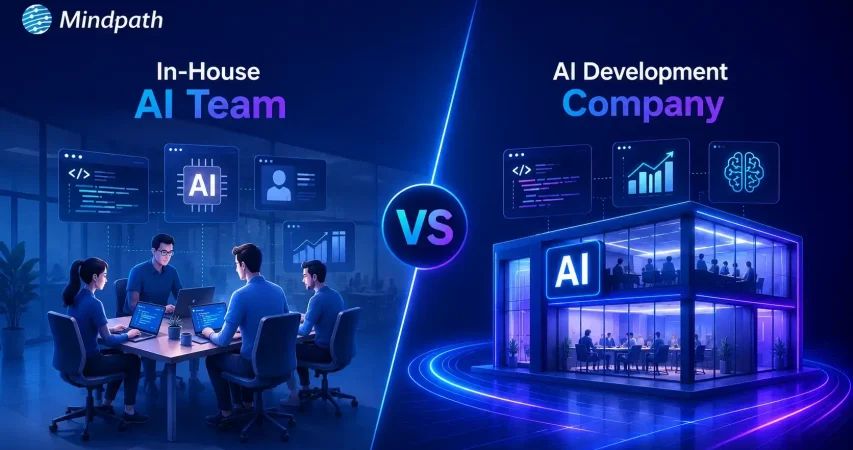
In-House AI Team vs Hiring an AI Development Company: Which Is Best for Your Business?  

In-House AI Team vs Hiring an AI Development Company: Which Is Best for Your Business?  

Join our Newsletter!

in-house vs outsourcing AI development

Businesses increasingly adopt AI to improve operations, customer experiences, and decision-making across industries. Many leaders now hire AI development company partners to access specialized expertise, reduce implementation risks, and accelerate AI projects without lengthy recruitment or infrastructure investments.

Key Takeaways

  • 01
    Evaluate business goals before choosing in-house or outsourced AI development approaches.
  • 02
    AI development companies accelerate delivery while reducing hiring and infrastructure challenges.
  • 03
    In-house AI teams offer stronger control, ownership, and long-term organizational expertise.
  • 04
    Compare total ownership costs instead of focusing only on initial development expenses.
  • 05
    Select the approach that best supports scalability, innovation, and measurable business outcomes.

Choosing between in-house vs outsourcing AI development depends on your budget, technical expertise, project complexity, and long-term goals. Each approach offers distinct advantages for different business needs. In this blog, we compare both options, explain their key differences, and help you choose the right approach for your business. So, let’s keep reading further!

Need a reliable partner to accelerate your AI initiatives? At Mindpath, we offer AI Development Services to design, develop, and deploy scalable AI solutions.

What Does an In-House AI Team Mean?

An in-house AI team consists of full-time professionals who design, develop, and maintain AI solutions within your organization. Companies that build in-house AI team capabilities gain direct control over development, workflows, and long-term technology planning.

These teams typically include machine learning engineers, data scientists, AI developers, and product managers with specialized expertise. They collaborate closely with internal departments, understand business objectives, and continuously improve AI systems as organizational needs evolve.

Here are the core benefits of in-house AI team:

1. Strategic Alignment

Internal teams understand business goals and operational priorities. AI initiatives support long-term company growth strategies.

2. Ownership of Intellectual Property

Your organization retains complete control over AI assets. Proprietary models remain protected from external competitors.

3. High Customization and Control

Teams adjust solutions for unique business workflows. You control timelines, priorities, and implementation decisions.

4. Stronger Data Security

Sensitive information stays within company infrastructure securely. Compliance requirements become easier to manage internally.

5. Long-Term Capability Building

Internal expertise grows stronger with every AI project. Knowledge remains within the organization for future innovation.

Challenges at a Glance

1. Talent Shortages

Finding experienced AI professionals remains difficult in a highly competitive market.

2. High Operational Costs

Infrastructure, hiring, and retention significantly increase long-term AI expenses.

3. Data Readiness Issues

Poor data quality delays development and reduces AI model accuracy.

4. Legacy System Integration

Older systems complicate AI deployment and slow implementation timelines.

5. Security and Compliance

Managing privacy, governance, and regulations requires continuous internal oversight.

What Does It Mean to Hire an AI Development Company?

Businesses hire AI development company experts to design, develop, and deploy custom AI solutions for specific operational needs. These companies provide specialized technical expertise, proven development processes, and experienced professionals without requiring businesses to build large internal AI teams.

AI development companies create tailored solutions such as intelligent automation, predictive analytics, machine learning models, and computer vision applications. They align every solution with business goals, accelerate project delivery, and provide ongoing support to ensure long-term performance and scalability.

Here are the core benefits of hiring an AI development company:

1. Specialized Expertise

Access experienced AI professionals with specialized technical knowledge. Solve complex challenges using proven development expertise.

2. Cost Efficiency

Avoid expensive hiring and infrastructure investments. Reduce overall AI development costs significantly.

3. Accelerated Time to Market

Launch AI solutions faster with experienced teams. Streamlined processes shorten overall development timelines.

4. Process Automation

Automate repetitive tasks using intelligent AI solutions. Improve productivity while reducing operational effort.

5. Enhanced Customer Experience

Deliver personalized interactions across customer touchpoints. Increase engagement through AI-powered experiences.

Challenges at a Glance

1. Data Quality Challenges

Poor-quality data reduces AI accuracy and overall project performance.

2. Limited AI Expertise

Inexperienced teams may struggle with complex AI development requirements.

3. Legacy System Integration

Older systems delay seamless AI deployment and business scalability.

4. Cost Overruns

Unexpected infrastructure and maintenance expenses increase total project costs.

5. Business Alignment Issues

Unclear objectives reduce AI effectiveness and expected business value.

In-House vs Outsourcing AI Development: Key Differences

Every AI development approach offers different advantages depending on your business requirements and available resources. The comparison below highlights the key differences across cost, expertise, scalability, security, and long-term management.

1. Cost and Initial Investment

In-House AI Team: Building an internal AI team requires significant hiring and infrastructure investments. Ongoing salaries, training, and technology expenses increase long-term costs.

Hiring an AI Development Company: AI development outsourcing reduces upfront hiring and infrastructure expenses. Businesses pay for specialized expertise without maintaining a permanent AI workforce.

2. AI Expertise and Talent

In-House AI Team: Internal teams develop deep knowledge of company processes and goals. However, hiring experienced AI professionals can take considerable time.

Hiring an AI Development Company: Development companies provide immediate access to experienced AI specialists. Their teams bring expertise from delivering diverse AI projects.

3. Development Speed

In-House AI Team: Building the team and setting up infrastructure extends project timelines. Initial development often progresses slower during the hiring phase.

Hiring an AI Development Company: Experienced teams begin development quickly using established workflows. Faster execution helps businesses launch AI solutions sooner.

4. Scalability and Flexibility

In-House AI Team: Expanding internal teams requires additional recruitment and training efforts. Scaling projects often increases operational complexity and costs.

Hiring an AI Development Company: External teams scale resources according to changing project requirements. Businesses can quickly increase or reduce development capacity.

5. Data Security and Control

In-House AI Team: Organizations maintain direct control over sensitive business information. Internal governance simplifies compliance with company security policies.

Hiring an AI Development Company: Trusted partners implement secure development practices and compliance measures. Clear agreements help protect business data throughout development.

6. Long-Term Maintenance and Support

In-House AI Team: Internal teams continuously monitor, improve, and maintain AI systems. Long-term ownership supports ongoing innovation and optimization.

Hiring an AI Development Company: Development companies provide continuous maintenance and technical support services. Regular updates help keep AI solutions reliable and scalable.

In-House AI Team vs Hiring an AI Development Company: Quick Comparison

Here’s a quick comparison of an in-house AI team and hiring an AI development company. This table highlights the major differences to help you compare both approaches at a glance.

Factor In-House AI Team Hiring an AI Development Company
Initial Cost High upfront investment required. Lower initial project costs.
Time to Start Longer hiring and setup. Faster project onboarding.
AI Expertise Depends on hired talent. Access to experienced AI specialists.
Development Speed Slower initial development cycle. Faster delivery with proven processes.
Scalability Hiring required for scaling. Easily scale development resources.
Technology Access Requires separate infrastructure investments. Ready access to modern AI tools.
Flexibility Limited by internal capacity. Adapts quickly to project needs.
Maintenance Managed by internal teams. Continuous expert support available.
Business Control Complete internal project control. Shared oversight with expert execution.
Data Security Full internal data control. Strong security with compliance standards.
Best For Long-term internal AI initiatives. Faster, cost-effective AI implementation.

When Should You Build an In-House AI Team?

  • Your business has long-term AI goals.
  • AI supports core business operations.
  • You require complete project control.
  • Sensitive data must remain internal.
  • You have budget for AI hiring.
  • Continuous AI innovation is a priority.

When Should You Hire an AI Development Company?

  • You need faster AI implementation.
  • Specialized AI expertise is unavailable internally.
  • Project budgets require greater flexibility.
  • You want lower upfront investments.
  • Your team needs external AI support.
  • Rapid project scaling is essential.

How to Choose Between In-House and AI Development Outsourcing?

Every business has different AI goals, budgets, and technical capabilities. Use this checklist to identify which approach aligns better with your project requirements and long-term strategy.

Business Requirement Recommended Approach Reason
Need an AI solution within weeks Hire an AI development company Faster project delivery.
Building AI as a long-term capability Build an in-house AI team Greater long-term ownership.
Limited AI expertise internally Hire an AI development company Access specialized AI professionals.
Large budget for hiring and infrastructure Build an in-house AI team Supports permanent AI operations.
Want lower upfront investment Hire an AI development company Avoid hiring and infrastructure costs.
AI workload changes frequently Hire an AI development company Scale teams as needed.
AI is central to daily operations Build an in-house AI team Better internal collaboration.
Need niche AI skills temporarily Hire an AI development company Experts available immediately.
Strict internal governance requirements Build an in-house AI team Maintain direct operational control.
Launching your first AI initiative Hire an AI development company Reduce risks with experienced guidance.

Ready to Choose Between In-House vs Outsourcing AI Development?

Selecting the right approach for in-house vs outsourcing AI development depends on your business objectives, available resources, budget, and implementation timeline. A well-informed decision helps reduce risks, improve efficiency, and create a stronger foundation for long-term AI success.

Mindpath supports businesses with expert AI consulting services and flexible staff augmentation solutions for every stage of AI adoption. Our specialists help you plan, develop, and scale AI initiatives with confidence. Contact us to discuss your business requirements and find the right AI solution.

Frequently Asked Questions

Yes. Many businesses combine internal teams with external AI specialists. Internal employees manage business priorities, while the development company provides specialized expertise, accelerates delivery, fills skill gaps, and supports complex AI projects without expanding permanent headcount.
Review the company’s AI project portfolio, technical expertise, security practices, communication process, industry experience, and post-deployment support. Clear project scope, measurable milestones, and transparent pricing also indicate a reliable long-term development partner.
Not necessarily. Businesses retain ownership of project goals, requirements, and approvals while external teams manage technical execution. Regular progress reviews, defined milestones, and transparent communication ensure visibility throughout the entire development lifecycle.
Compare recruitment expenses, salaries, infrastructure, software licenses, cloud services, maintenance, training, and long-term operational costs. Evaluating the total cost of ownership provides a more accurate comparison than considering initial development expenses alone.
A hybrid approach works well for businesses that need long-term internal ownership while accessing specialized AI expertise. Internal teams guide strategy and business priorities, while external experts accelerate development, solve technical challenges, and support future scalability.

Support Is One Click Away

Featured Posts

Related Post

challenges of AI adoption

The potential of artificial intelligence to revolutionize business processes revolves around enhancing efficiency, driving smarter decision-making, and fostering innovation. According to Forbes, generative AI can add $4.4 trillion to the global economy, which is hard to ignore for any business (Source). However, the challenges of AI adoption have held back many businesses from tapping into the full potential of AI.

With AI becoming a hot topic in team chats and boardroom meetings, it is reasonable to wonder why business owners think twice before AI adoption. The problem is that around 74% of businesses struggle to achieve anything of value from their AI initiatives (Source). Many organizations encounter different types of challenges during AI adoption, and understanding them can help in finding the ideal solutions.

Handling the challenges of AI Adoption can be complex, but technical expertise can help you overcome hurdles. Our AI development services help businesses overcome challenges and provide tailored solutions.

Unravelling the Common Challenges for AI Adoption

The utility of artificial intelligence for businesses and predictions regarding its value in the future encourage business leaders to think about AI adoption. At the same time, many businesses that have implemented AI in their processes and systems have not captured value from their AI projects.

The journey of AI adoption in business presents formidable challenges, which businesses must understand before implementing artificial intelligence. The following challenges for AI adoption serve as the biggest roadblocks in making the most of the capabilities of artificial intelligence.

1. No Strategy or Vision

The biggest barrier to successful AI implementation is the lack of strategy and vision. If your organisation doesn’t have a well-defined AI strategy, the risks of misalignment grow stronger, especially when considering the future of AI. Without a strategy, businesses might begin their AI initiatives without understanding how AI will align with business goals. The outcome of ignoring strategy manifests in the form of disjointed pilot projects and a lack of quantifiable goals.

Strategy and vision are the foremost AI implementation challenges that organizations should focus on to capture tangible value from AI. The lack of these two things will turn any AI adoption project into an expensive experiment. Furthermore, leaders without a vision and understanding of how AI will contribute to strategic goals can fail after the initial excitement fades away.

2. Lack of AI Expertise

One of the formidable challenges to the success of AI projects is the lack of AI experts. The skill gap in the AI landscape is extremely huge as demand for AI talent outweighs the supply by significant margins, with AI redefining job roles in tech. Many companies don’t have the professionals with technical expertise required for developing, deploying, and managing AI solutions. Some of the notable AI jobs, including data scientists, AI ethicists, and machine learning engineers, have been gaining a lot of attention. However, businesses have to struggle a lot to find the right professional for such jobs.

The list of artificial intelligence challenges will also shed light on the fact that existing IT teams may not have the knowledge to incorporate AI in legacy systems. On top of it, everyone in the workforce cannot understand the nuances of deploying AI models and maintaining them. The talent deficit drives companies to invest heavily in training their existing employees, thereby imposing the burden of time and training costs.

3. Upfront Costs and ROI Uncertainty

Speaking of the burden of costs, business owners must know that the initial investment for AI projects can be huge. The massive upfront costs for AI initiatives include costs of technology infrastructure, software licenses, maintenance costs, and talent acquisition. While enterprise AI adoption offers promising results in the long run, the initial investment is difficult to procure for many businesses. In addition, many businesses could not come up with a justification for the huge upfront investment in specific business use cases of AI.

The uncertainty regarding ROI expected from AI projects can create difficulties in measuring potential cost savings, competitive advantage, or expected revenue growth. As a result, the business leadership might not buy into the project, ultimately leading to difficulties in funding. Such types of AI projects generally fail to move beyond the pilot phase, and some never see the light of day.

Looking to turn AI from an experiment into a strategic advantage? Explore AI in business strategy to understand how the right approach drives measurable impact.

4. Cultural Resistance

Cultural resistance from employees of an organization is obviously one of the most prominent challenges for AI adoption. It provides a clear explanation of why AI projects fail, as disgruntled employees can be the biggest roadblock for an organization’s growth. Employees are likely to harbor fears that AI will replace them, thereby making them more resistant to AI tools and technologies.

Without understanding the purpose and benefits of AI, employees will become more critical of AI and create new challenges. The fear of losing their jobs can make employees more resistant to training, which will result in a lack of enthusiasm for AI projects. On top of it, lower user adoption due to cultural resistance can have a negative impact on the most carefully planned AI projects.

6. Blending with Legacy Systems

Another formidable challenge for AI adoption is the integration with legacy systems. The line of difference between modern AI tools and the outdated legacy systems and the need for modernizing legacy systems can be the biggest headache for business owners. Existing legacy systems might not have the flexibility, interoperability, or scalability to work with new AI platforms. It is one of the common AI integration issues that results in operational inefficiencies, technical complexities, and data silos.

Some businesses might assume that forced integration of AI with legacy systems can solve the problem. However, it would lead to consequences like unexpected costs, project delays, and large amounts of technical debt. Many businesses have failed in their AI initiatives due to the inability to map system connections and facilitate seamless data flow across different platforms.

7. Data Quality and Governance

The effectiveness of AI models depends significantly on the quality of data used to train them. Data quality and governance also take a top spot among the challenges in AI adoption as businesses struggle to find the ideal data for their AI systems across different types of AI. For example, businesses have massive collections of data, plagued by the issues of accessibility, governance, and quality. Businesses have to struggle with issues due to inaccurate, inaccessible, biased, or incomplete data, as they cannot be used in training AI models.

Almost every business that aims to adopt AI cites data accuracy and bias as major challenges. On top of it, the lack of proprietary data for customizing models can restrict the possibilities of effective AI implementation. It is also important to note that data privacy and confidentiality also emerge as prominent challenges for AI projects that deal with sensitive information.

Wondering if your organization is truly ready to adopt AI? Check out our AI readiness checklist to see how businesses can align strategy, data, and technology for successful AI adoption.

How Can Businesses Overcome the Challenges to AI Adoption?

The best way to address the challenges for AI adoption in business involves a strategic and multi-faceted approach. Businesses must aim to fight against the challenges with technology, processes, and people rather than focusing on a specific domain. The following sections offer some valuable recommendations to overcome the challenges in adopting AI for businesses.

1. Develop an AI Strategy

Before starting any AI project, businesses must have a clear and actionable AI strategy that aligns with business goals. The strategy will help you identify the use cases that deliver the most significant impact by addressing specific pain points. Business leaders must focus on projects that promise measurable value advantages in different business operations. Another suggestion to address such challenges involves explaining AI risks and limitations to business leaders. On top of it, businesses must establish an AI governance team, a clear AI roadmap, and measurable KPIs for AI initiatives.

2. Bridging the Skill Gap

Business owners should adopt an innovative approach to address the challenge of skill deficit for AI projects. As AI trends continue to evolve, the approach should begin with training the existing workforce through internal training programs, online learning platforms, and workshops. Apart from promoting AI literacy, businesses should also bring in AI specialists or collaborate with AI vendors when required. Another crucial aspect of the upskilling initiatives for AI projects focuses on AI ethics training to ensure responsible AI development.

3. Show Clear Business Value

The strategic approach to resolving AI adoption challenges must also focus on creating a clear business case for AI. Smaller pilot projects that showcase measurable business value can be the best place to begin. Most important of all, business leaders must also establish benchmarks for success before implementation and track the progress of projects. Quantified impression of benefits, including revenue growth, cost savings, and customer engagement, can provide a clear idea of project success.

4. Seamless Integration and Data Governance

Integration with legacy systems does not have to be a challenge in AI projects, as foresight can solve the problem. Businesses can integrate IT teams in AI initiatives to map out system connections and prepare for integration challenges. Leaders should also take the initiative to foster collaboration between IT and business teams to ensure alignment with business needs. Furthermore, implementing data governance helps in avoiding conflicts during integration while ensuring privacy and quality training of AI models.

Struggling to turn AI strategies into real business outcomes? Explore our AI consulting guide to learn how expert guidance helps organizations overcome adoption challenges and implement AI successfully.

Final Thoughts

The challenges in the journey to adopt AI create huge roadblocks for any type of business trying to embrace AI. However, the solution to prominent business challenges in implementing AI revolves around identifying and understanding the challenges. For instance, business owners must learn how the lack of a clear strategy can affect AI adoption. As a result, business owners will pay attention to developing a well-defined AI roadmap.

We at Mindpath will help you find the ideal solution to overcome AI adoption challenges in any industry. Our years of experience in implementing end-to-end AI solutions have empowered us to address any problem in implementing AI. Reach out to our consultants and figure out the best strategic approach to embrace AI in your organization right now.

Frequently Asked Questions

The cost of hiring a ReactJS developer in Canada varies based on several factors, including experience level, location, project complexity, and hiring model. Developers with advanced skills command higher rates, while junior developers are more budget friendly. Additionally, hiring models like freelancers, agencies, or full-time employees can influence pricing. Understanding these cost variations helps businesses plan their budget effectively. Below is a breakdown of the hourly rates for ReactJS developers in Canada and the key factors that affect pricing.

1. Cost of Junior ReactJS Developers

Junior ReactJS developers in Canada typically charge $55 – $75 per hour. These developers have basic knowledge of React fundamentals, JavaScript, and frontend technologies but may lack hands-on experience with complex projects. They are ideal for small-scale applications, maintenance tasks, and assisting senior developers. While cost-effective, hiring junior developers may require additional training and guidance to ensure quality output. They are best suited for businesses looking for affordable development resources without the need for deep technical expertise.

2. Cost of Mid-Level ReactJS Developers

Mid-level ReactJS developers charge $80 – $120 per hour in Canada. They possess strong expertise in React, state management (Redux), API integration, and front-end best practices. These developers can handle end-to-end development, optimize performance, and manage application scalability. They are suitable for medium to complex projects where independent problem-solving is required. Businesses hiring mid-level developers can expect efficient coding, reduced development time, and well-structured applications while maintaining a balance between cost and expertise.

3. Cost of Senior ReactJS Developers

Hiring senior ReactJS developers in Canada costs $120+ per hour, depending on expertise and project scope. They have extensive experience with React, advanced state management, performance optimization, and architecture design. Senior developers are ideal for large-scale applications, enterprise solutions, and complex integrations. They provide technical leadership, mentoring, and strategic planning to ensure high-quality development. While expensive, their expertise significantly reduces project risks and ensures long-term success by delivering optimized, scalable, and maintainable applications.

4. Factors Affecting ReactJS Developer Costs

Several factors influence ReactJS developer rates in Canada:

Experience level: Senior developers demand higher rates due to their expertise.

Location: Cities like Toronto and Vancouver may have higher costs than smaller regions.

Project complexity: Advanced features, AI integration, or real-time capabilities increase pricing.

Hiring model: Freelancers may charge lower hourly rates, while agencies offer full-service teams at a premium. Full-time employees require salaries, benefits, and overhead costs. Businesses should assess these factors when planning their development budget.

Need skilled ReactJS developers in Canada at the right price? Mindpath, connects you with top-tier talent, from junior to senior developers, tailored to your budget and project needs. Whether you’re building a scalable web app or optimizing an existing one, our experts ensure high-quality, cost-effective development. Let’s bring your project to life with the best ReactJS professionals in Canada. Contact Mindpath today and hire expert developers for your business!

Get in Touch Now!

Discover the key factors influencing software development costs and how to optimize your budget. Learn how Mindpath can help.
trends in education

The transformative changes in the world of education have been fuelled by a wave of technological innovation. Just like other big sectors like finance, technology has had a formidable impact on the education industry. The emphasis on trends in education technology is gradually increasing as education has moved beyond the boundaries of classrooms. Education is becoming more personalized and dynamic with the help of different technologies, thereby establishing the foundations of EdTech. It is important to understand that EdTech is no longer another emerging trend. Educational technology, or EdTech, is now an integral element in the basic approach for acquiring knowledge. Let us find out the most notable trends that will dominate educational technology in 2026 and beyond.

Not sure how to move forward with education technology for your business? Contact us, we support organisations in building reliable and future-ready solutions.

Existing State of Education Technology

Before you learn more about the emerging education trends, you must understand the existing state of education technology or EdTech. The future of educational technology can revolutionize education on a global scale and create opportunities for students and educators. The EdTech industry is expected to become a $400 billion market by 2026 with new technologies redefining leaning experiences. Educational technology has the potential to address long-standing challenges in education alongside introducing the benefits of inclusivity, adaptability and accessibility.

As education gears up to become a $10 trillion industry by 2030, it is important to understand the scope of education technology. The integration of EdTech solutions has helped in creating ecosystems where learners can access knowledge anytime, anywhere. According to the World Economic Forum, the EdTech industry will serve more than 350 million post-secondary graduates and 800 million K-12 graduates worldwide in 2026. With such impressive numbers expected from the EdTech industry, you have strong reasons to believe that the industry will foster new trends.

Want to explore how AI can enhance teaching and learning experiences? Check out chatbots in education to discover how intelligent assistants provide real-time guidance and improve knowledge retention.

Unraveling the Big Trends for EdTech in 2026 and Beyond

The digital transformation of education with EdTech has been nothing short of a revolutionary experience for educators, learners and management. If you take a look at current educational trends, you will discover the significance of EdTech in transforming classrooms. Innovative technologies like artificial intelligence, virtual reality and other adaptive technologies have served as powerful tools for learners. The following sections will introduce you to some of the emerging trends in EdTech for 2026 and beyond.

1. Hyper-personalized Learning

The future of learning will rely a lot on artificial intelligence and there is no doubt in it. With the rising use of generative AI in education, learners and educators can capitalize on multiple advantages for better learning. Artificial intelligence plays a major role in adapting the learning experience to unique strengths, weaknesses and learning styles. Generative AI is shaping a new reality of education where personalized learning systems will ensure efficient learning experiences for every learner.

AI-powered learning systems can review the performance of learners, identify their knowledge gaps and also understand their individual learning styles. The systems can use the data to generate customized lessons, learning paths or adjust the difficulty of lessons. As a result, no student will be left behind in the learning journey and everyone will find equal opportunity to grow further.

2. New Role of Blockchain

Blockchain technology has been associated frequently with transformation of the education sector for its distinctive traits like cryptography or immutability. Blockchain is one of the biggest tech trends in education that can provide a completely new and efficient solution to verification of academic achievements. The concerns of fake certificates create troubles for deserving candidates who miss out on opportunities due to lack of verifiable credentials.

Blockchain can help in secure storage and verification of academic credentials like diplomas, degrees and certifications. As a result, learners will have more control over their academic records while enjoying the flexibility of distributing their credentials without the fear of copyright infringement. Blockchain can provide tamper-proof or immutable digital identities on a public ledger, thereby reducing the possibilities of fraud.

3. Adaptive Learning

Most of the discussions about the use of artificial intelligence in the education sector revolve around personalized learning. You can find many applications of AI in the field of education such as education chatbot apps that can solve learner queries at different stages. Adaptive learning through chatbot apps will emerge as one of the biggest trends in EdTech in 2026 and beyond. The primary goal of adaptive learning will focus on dynamic modification of lessons and content difficulty according to real-time assessment of student performance and engagement.

Adaptive learning systems will measure the progress of learners, identify their weaknesses and prepare learning paths that can guarantee success. The emphasis on lifelong learning along with growth of the online learning market creates more opportunities for adoption of adaptive learning systems. With the combination of predictive analytics, educators can use adaptive learning systems to create refined learning paths for truly personalized experiences.

4. Mix of Virtual and Augmented Reality

The list of top EdTech trends for 2026 and beyond will be incomplete without mentioning virtual and augmented reality. VR and AR have been implemented as solutions to create immersive learning experiences by transforming learners to places and situations that were previously unimaginable. For instance, VR can help learners visit historical sites in the classroom while AR displays overlay of digital information on the real-world objects.

The growing demand for immersive learning is one of the notable indicators of the rise of VR in education. At the same time, you must know that AR and VR encourage motivation, foster collaboration and improve comprehension. Virtual lessons have proved useful in enhancing the understanding of abstract concepts. Most important of all, VR and AR also present new opportunities for encouraging collaboration between learners and educators.

5. Bridging the Accessibility Gaps

As the world ushers in a new era of education, the primary use of IT in education will become more about making education accessible to everyone. The innovative use of technology in education with new EdTech solutions helps in achieving digital equity and accessibility. Learners can rely on EdTech to access education irrespective of their socio-economic background, physical abilities or geographic location.

Big organizations such as UNESCO recommend that local solutions will play a crucial role in transforming digital learning. One of the prominent emerging trends in educational technology will focus on creating infrastructure for digital literacy training, especially in low availability of resources. The only goal behind reducing the accessibility gaps will be about ensuring that every learner gets the opportunity to achieve their dreams.

Final Thoughts

The most noticeable trends for the domain of EdTech in 2026 and beyond include AI, blockchain and adaptive learning. VR and AR will also be the most prominent technology trends in education in future. You should know that these technologies will define future trends in education in 2026 and beyond with their transformative potential. For instance, AI can not only provide the foundation for hyper-personalized learning experiences but also create adaptive learning systems. You should also remember that data privacy and security will be prominent areas of concern in the future of EdTech. The challenges of potential biases in algorithms and the cost of implementing EdTech solutions will also create obstacles in future.

One of the crucial highlights that you should know about the higher education industry trends and EdTech focuses on opportunities. Educational technology will provide more productive and engaging learning experiences to every learner without any boundaries. At the same time, EdTech will also empower educators with resources that make them focus more on meaningful interactions. At Mindpath, we help organizations adapt to these evolving trends by building scalable and future-ready EdTech solutions.