What happens when an AI model has the right instructions but lacks the information needed to act on them? This is where Context Engineering becomes important. As AI systems take on complex tasks, developers need to think beyond prompts and focus on what information models receive.
Key Takeaways
- 01
Prompt engineering improves AI responses by providing clear, specific, and well-structured instructions. - 02
Context engineering gives models relevant information needed to understand tasks and situations better. - 03
Prompt and context engineering work together to improve accuracy across complex AI workflows. - 04
MCP can connect AI applications with external tools, systems, and relevant business information. - 05
The right approach depends on data needs, task complexity, security, scalability, and maintenance requirements.
Prompt engineering still plays an important role in shaping AI responses, but modern systems need deeper context to make informed decisions. This shift is especially important for AI agents working with business data, tools, and changing information. In this blog, we will explore how both approaches differ and work together. Let’s keep reading further!
Ready to build AI systems that can work with reliable business context? Mindpath offers RAG Development Services to help businesses connect AI applications with relevant data and deliver more context-aware responses.
Understanding Both Approaches
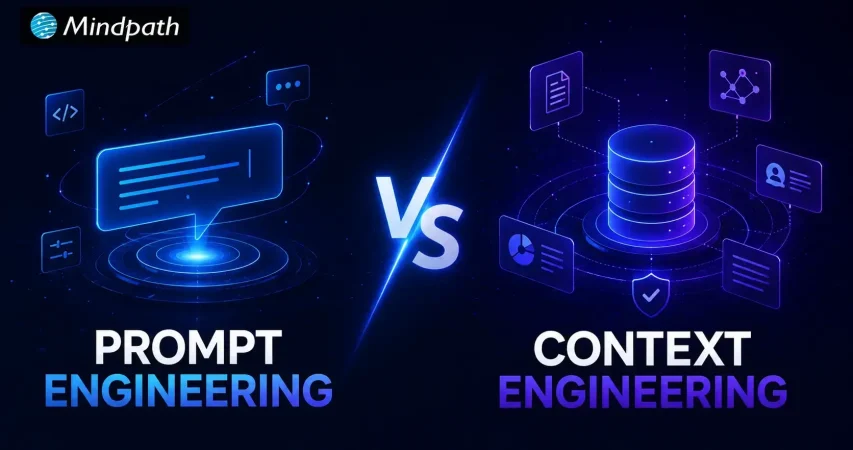
Both approaches help developers get better results from AI, but they solve different problems. One improves the instructions, while the other improves the information available to the model.
1. Prompt Engineering
Prompt engineering is about writing clear instructions that guide an AI model toward the desired response. It involves choosing the right wording, adding useful constraints, setting expectations, and giving examples when needed. A well-crafted prompt helps the model understand the task, follow the intended direction, and produce more consistent results.
Here are the benefits it offers:
- Clear Instructions: Gives models a direct understanding of what needs completing.
- Better Outputs: Reduces vague responses by setting specific expectations upfront.
- Greater Control: Helps developers guide tone, format, reasoning, and response style.
- Faster Iterations: Makes it easier to test, refine, and improve outputs.
- Task Specific: Works well for focused tasks with clearly defined goals.
- Easy Adoption: Requires minimal changes to existing AI development workflows.
Challenges To Watch For
- Maintaining consistent outputs across different model versions.
- Managing complex instructions without making prompts overly lengthy.
- Preventing ambiguous wording from producing unexpected responses.
- Testing prompts across varied inputs and edge cases.
- Updating instructions when business requirements or workflows change.
2. Context Engineering
Context engineering focuses on selecting and organizing the information an AI model needs before responding. This can include documents, conversation history, business data, tools, user details, and retrieved information. The goal is to give the model relevant context at the right time, helping it respond with greater awareness.
Here are the benefits it offers:
- Relevant Knowledge: Provides information directly connected to the current task.
- Better Decisions: Gives AI systems stronger grounds for making informed decisions.
- Fewer Hallucinations: Reduces unsupported responses by supplying reliable information.
- Dynamic Responses: Allows models to work with changing information and situations.
- Agent Support: Helps AI agents understand tasks, tools, users, and environments.
- Scalable Workflows: Supports complex systems that depend on multiple information sources.
Challenges To Watch For
- Selecting relevant information from multiple available data sources.
- Keeping retrieved information accurate, current, and properly structured.
- Managing token limits while preserving essential context.
- Preventing sensitive information from entering unintended model interactions.
- Maintaining retrieval systems as business data continuously evolves.
Prompt vs Context Engineering: A Key Difference
The difference becomes clearer when we look at how AI context shapes the model’s understanding. While prompts guide the response, context gives the model the information it needs to respond appropriately.
| Comparison Point | Prompt Engineering | Context Engineering |
|---|---|---|
| Primary Focus | Shapes instructions given to the AI model | Shapes information available to the AI model |
| Main Purpose | Guides the model toward a specific response | Helps the model understand the situation |
| Information Used | Instructions, examples, rules, and constraints | Data, documents, memory, history, tools, and APIs |
| Scope | Usually focused on a specific task | Often supports entire workflows and systems |
| Data Dependency | Can work with limited external information | Often depends on relevant external information |
| Information Retrieval | Information is usually provided within prompts | Information can be retrieved dynamically when needed |
| Role in AI Agents | Defines tasks, goals, and expected behavior | Provides knowledge, state, tools, and situational awareness |
| Maintenance | Requires refining instructions as needs change | Requires managing sources, retrieval, memory, and context quality |
| Best For | Content generation, classification, summarization, and focused tasks | Customer support, knowledge systems, RAG pipelines, and AI agents |
Where Each Approach Fit in AI Workflows?
Both approaches have a place in modern AI workflows, but their roles are different. The right approach depends on what the system needs to understand, produce, or act on.
1. Where Prompt Engineering Fits?
Prompt engineering works best when the task is clearly defined and the desired output can be guided through instructions.
- Content Creation: Guides AI to follow a specific tone, structure, format, or writing style.
- Task Automation: Gives models clear steps for completing repetitive and predictable tasks.
- Data Analysis: Directs AI to identify patterns, summarize findings, or explain results.
- Customer Queries: Helps define how AI should respond to common and straightforward questions.
- Creative Work: Controls ideas, language, tone, and presentation across different creative tasks.
2. Where Context Engineering Fits?
Context engineering becomes valuable when AI needs information from different sources to understand the situation before responding.
- Customer Support: Combines customer history, product information, and previous interactions for relevant responses.
- Knowledge Retrieval: Supplies models with relevant documents instead of relying on general model knowledge.
- AI Agents: Gives agents access to business data, tools, memory, and information needed for decisions.
- Business Workflows: Connects AI with relevant systems, records, policies, and operational information.
- Dynamic Tasks: Provides updated information when decisions depend on changing business conditions.
Key Implementation Considerations
Choosing between prompt and context engineering depends on how your AI system handles information, tasks, and changing requirements. A practical implementation should consider the following factors before deciding how much weight to give each approach.
1. Token Limits
Prompts need to stay focused because unnecessary instructions can consume valuable tokens. Context also needs careful filtering, since sending too much information can increase costs and distract the model from relevant details.
2. Data Freshness
Prompts may need regular updates when instructions, rules, or business requirements change. Context engineering can pull fresher information from connected sources, but those sources must remain accurate and up to date.
3. Retrieval Accuracy
Prompt engineering can specify exactly what information the model should consider during a task. Context engineering depends on retrieving the right information, making search quality and retrieval accuracy important for reliable results.
4. System Integration
Prompts can define how an AI system should interact with connected applications and tools. Context engineering can bring information from those systems into the workflow, with protocols such as MCP helping AI applications connect with external tools and data.
5. Security and Access
Prompts should avoid exposing sensitive information unnecessarily and should clearly define permitted actions. Context engineering requires stronger controls around which users, systems, and agents can access specific data.
6. Maintenance
Prompt based systems often require ongoing testing and refinement as model behavior or requirements change. Context based systems also require maintaining data sources, retrieval pipelines, memory, and connected tools.
7. Latency and Cost
Well-structured prompts can reduce unnecessary processing by keeping instructions concise and focused. Context engineering may increase processing requirements when systems retrieve, filter, and pass additional information to the model.
Ready to Build AI Systems That Understand More?
Prompt engineering and context engineering solve different parts of the AI development challenge. Prompts shape how models respond, while context gives them the information needed to understand each situation. As AI workflows become more complex, combining both approaches can improve accuracy, consistency, and decision making across modern applications and AI agents.
Mindpath helps businesses build AI solutions that combine intelligent prompts with reliable context, connected data, and practical workflows. Our AI development services support RAG, AI agents, MCP integrations, and custom AI systems designed for real business needs. Partner with us if you are looking to build an AI solution that can understand your data and act with confidence. Contact Mindpath to discuss your AI requirements.