Home

AI Deployment Checklist to Reduce Enterprise AI Risks

AI Deployment Checklist to Reduce Enterprise AI Risks

Join our Newsletter!

Enterprise AI Deployment Checklist

What happens when an enterprise AI system reaches production before the business is truly ready? Small gaps in data, security, infrastructure, or ownership can quickly turn into costly problems. An enterprise AI deployment checklist helps teams catch these gaps early and create a smoother path to production.

Key Takeaways

  • 01Define clear business goals, ownership, and success measures before starting enterprise AI deployment.
  • 02Validate data quality, infrastructure, access controls, and production requirements before moving AI systems into production.
  • 03Build security, governance, compliance, monitoring, and rollback controls into the deployment process.
  • 04Track technical performance, operational costs, and business value to measure AI success after deployment.
  • 05Standardize deployment practices to scale AI securely across teams, systems, and business workflows.

Enterprise AI deployment needs careful planning because production systems must support real users, business workflows, sensitive information, and changing demands. A structured checklist brings these moving parts together and gives teams a practical way to review readiness before launch. In this blog, we explore the key areas every enterprise should review before deploying AI. Let’s keep reading further!

Ready to make your enterprise AI deployment more reliable? Mindpath offers AI Consulting Services to help businesses plan, deploy, and scale AI solutions around clear business goals. 

Why Enterprise AI Needs a Deployment Checklist?

Enterprise AI systems influence business decisions, workflows, customer experiences, and sensitive data. A deployment checklist gives teams a clear process for reviewing critical requirements before launch, helping them identify gaps that could affect performance, security, compliance, or business outcomes.

It also creates consistency across AI projects by giving technical and business teams shared expectations. As deployments become more complex, a checklist makes responsibilities clearer, reduces avoidable errors, and helps organizations establish a stronger foundation for reliable and scalable AI adoption.

An AI deployment checklist is important because it helps teams:

  • Reduce deployment risks by identifying technical and operational gaps early.
  • Strengthen security by reviewing access, data protection, and control requirements.
  • Improve consistency by following a standard process across AI deployments.
  • Clarify ownership by assigning responsibilities before the system reaches production.
  • Support compliance by documenting governance and regulatory requirements.
  • Measure readiness by validating performance, infrastructure, and business requirements.
  • Prepare for scale by creating processes that can support future AI deployments.
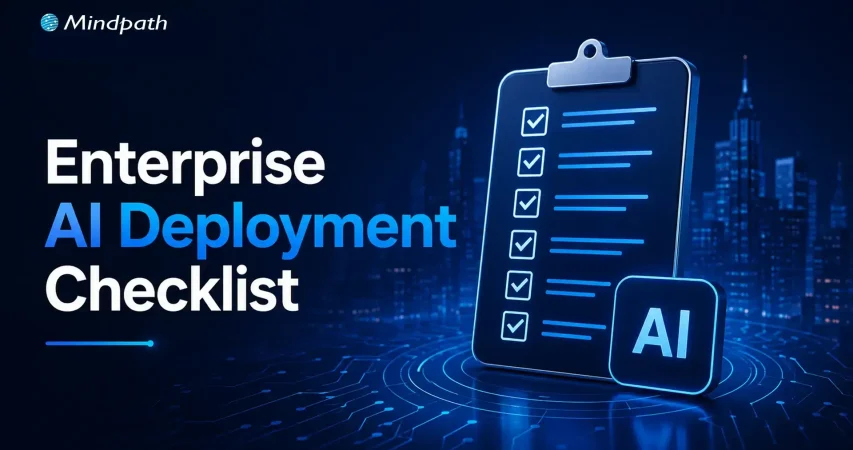
Enterprise AI Deployment Readiness Checklist

A clear enterprise AI roadmap gives teams direction as they move toward an important stage of AI adoption. The following checklist brings together the key areas that deserve attention before moving forward.

1. Preparing the Business Case and Objectives

Before starting AI implementation, enterprises need a clear reason for investing in the technology. Defining the expected outcome, business owner, target users, and success measures helps teams stay focused and gives every stakeholder a shared understanding of what the deployment should achieve.

  • Define the business problem the AI solution is expected to address.
  • Assign clear ownership across business, technical, and operational teams.
  • Set measurable outcomes that show whether the deployment is successful.
  • Identify key stakeholders who influence adoption, approval, and ongoing use.
  • Establish ROI targets based on expected business value and costs.

2. Assessing Data and Infrastructure Readiness

Strong data and reliable infrastructure create the foundation for successful AI implementation. Before deployment, teams should confirm that production data is accurate, accessible, protected, and ready for use. They should also verify that the technical environment can support expected workloads, integrations, and future requirements.

  • Validate data quality for accuracy, completeness, consistency, and relevance.
  • Check pipeline reliability to ensure data reaches AI systems consistently.
  • Review access controls and limit data access to authorized users and systems.
  • Apply data masking where sensitive or confidential information requires protection.
  • Confirm versioning and infrastructure for models, data, compute resources, and production platforms.

3. Designing Security, Governance, and Compliance

A strong AI Deployment Checklist should cover the controls that keep enterprise AI secure, accountable, and compliant. Before launch, teams need clear ownership, defined policies, and safeguards that continue throughout the AI lifecycle. These measures help reduce exposure while supporting responsible and controlled AI use.

  • Assign ownership for the AI system, data, security, and ongoing decisions.
  • Define lifecycle controls for development, approval, deployment, updates, and retirement.
  • Maintain audit trails to track important system activity, changes, and decisions.
  • Apply responsible AI practices covering privacy, fairness, transparency, and model behavior.
  • Align with requirements from applicable regulations and internal enterprise policies.

4. Building a Repeatable Deployment Process

A structured AI rollout process helps teams move from testing to production with fewer surprises. Instead of relying on individual judgment at every stage, organizations can use consistent checks to validate readiness, monitor performance, and respond quickly when something goes wrong after launch.

  • Validate model readiness against agreed performance, quality, and reliability requirements.
  • Complete release testing across workflows, integrations, security, and expected production conditions.
  • Set monitoring and alerts for performance changes, errors, usage, and unusual behavior.
  • Define rollback procedures so teams can quickly restore a stable version when required.
  • Document release approvals to reduce human error and maintain accountability throughout deployment.

5. Measuring Performance, Cost, and Business Value

An AI system should continue proving its value after deployment. Teams need to track technical performance, operational costs, and business outcomes together to understand what is working and where improvements are needed. Regular reviews help keep AI investments aligned with changing business priorities and expected ROI.

  • Track technical performance through accuracy, response quality, latency, reliability, and error rates.
  • Monitor operational costs including infrastructure, model usage, maintenance, and support expenses.
  • Measure business outcomes against the objectives and baseline established before deployment.
  • Set review schedules to identify performance gaps, rising costs, or changing business needs.
  • Optimize continuously by improving models, workflows, infrastructure, and resource usage based on results.

6. Scaling AI Across the Enterprise

As AI adoption grows, organizations need a consistent approach for expanding successful solutions across teams and workflows. An AI Deployment Checklist helps maintain common standards while new use cases are introduced, ensuring integrations, governance, user readiness, and performance remain aligned as adoption increases.

  • Integrate existing systems with enterprise applications, APIs, data platforms, and business workflows.
  • Enable teams through practical training, clear responsibilities, and ongoing technical support.
  • Extend governance with consistent approval, security, monitoring, and lifecycle practices across deployments.
  • Standardize deployment processes so teams can replicate successful AI solutions efficiently.
  • Improve continuously using user feedback, performance data, business results, and changing requirements.

Common Enterprise AI Deployment Mistakes to Avoid

Enterprise AI deployments can lose momentum when teams focus heavily on the technology but overlook preparation and ongoing management. Recognizing common mistakes early helps organizations address weak points before they affect users, operations, security, or business outcomes.

1. Starting without clear objectives

Teams may deploy AI without defining what success should look like. This makes business impact difficult to measure and justify.

2. Ignoring data readiness

Poor quality or inconsistent data can affect AI performance from the beginning. Teams should validate data before moving into production.

3. Leaving ownership unclear

AI projects can stall when no one is accountable for key decisions or issues. Clear business and technical ownership keeps deployment responsibilities defined.

4. Skipping security and governance

Missing controls can expose sensitive data and create compliance risks. Security and governance should be addressed before the system goes live.

5. Neglecting post-launch monitoring

AI performance can change as data, users, and business conditions change. Regular monitoring helps teams identify problems and improve the system over time.

Ready to Make Your Enterprise AI Deployment More Reliable?

Enterprise AI deployment becomes easier to manage when every critical area is reviewed before launch. From business objectives and data readiness to security, governance, monitoring, and scalability, a structured checklist helps teams reduce risks and create a repeatable path toward reliable AI adoption. It also keeps technology decisions connected to measurable business outcomes.

Mindpath helps enterprises turn AI initiatives into secure, scalable, and production-ready solutions through our expert AI development services. Our team supports businesses across AI strategy, development, integration, deployment, and ongoing optimization. By combining technical expertise with business-focused planning, Mindpath helps organizations move from AI ideas to solutions that deliver practical value. Contact us to discuss your enterprise AI requirements.
Frequently Asked Questions

The timeline depends on data readiness, system complexity, integrations, security requirements, testing, and the level of customization required.
Business goals, data readiness, ownership, security requirements, infrastructure, and measurable success criteria should be established before technical work begins.
It gives teams a consistent way to review critical requirements, identify gaps early, assign responsibilities, and prepare for potential issues before launch.
Monitoring should identify performance issues quickly, while defined rollback procedures allow teams to restore a stable version and investigate the underlying problem.
Standardized processes, strong governance, reliable integrations, team training, and continuous performance reviews help organizations expand AI across departments safely.

Support Is One Click Away

Featured Posts

Related Post

Infrastructure as Code

If you are into IT operations, you might have noticed that there is constant pressure to deploy faster and maintain reliability across complicated IT environments. But with traditional infrastructure management, you can’t keep up with the trends. Further, manual configuration might push you out of the competition. This is where Infrastructure as Code steps in as the game changer.

The market value of IaC is ready to reach USD 1582.04 million in 2026, and it can stretch up to USD 6939.73 million by 2034. In this blog, we will further explore the importance of IaC along with its practical values in modern IT operations.

Looking to simplify infrastructure management and scale your IT operations with speed and consistency? Mindpath delivers expert DevOps services, including Infrastructure as Code (IaC), to automate provisioning and accelerate delivery.

What does Infrastructure as Code mean?

Now you might be wondering about infrastructure as code meaning. So, it is the process of managing and provisioning your infrastructure through code instead of manual procedures. It allows your developers and IT teams to define servers, databases, and networks along with other resources through scripts and configuration files.

So, instead of setting up the whole infrastructure manually, you can get it done through code. Further, the process remains automatic and consistent. This approach ensures your infrastructure environments are repeatable and version-controlled.

Why is Infrastructure as Code Important for Modern IT Operations?

Today’s modern IT operations completely depend on speed, automation, and reliability. So, IaC can help you gain these capabilities with a lot of features.

  • It is capable of eliminating manual configuration errors from the beginning.
  • It supports quick deployment and rapid scaling for the company’s betterment.
  • You can be assured of better collaboration between your development and operations teams.
  • It can be integrated seamlessly with DevOps workflows.

IaC is also a strong pillar of infrastructure as code in DevOps. Additionally, it helps organizations in implementing CI/CD pipelines while delivering software quickly and efficiently.

Struggling to manage complex infrastructure and streamline your IT operations? Check out our blog on AI in DevOps to explore how intelligent automation is transforming modern workflows.

Infrastructure as Code Benefits for Quick Development Approaches

The IaC market has been growing effectively with a CAGR of 24.39%. Here are some evident infrastructure as code benefits that your company can leverage to win the interest of the market.

1. Standardization and Consistency

IaC can help you apply the same configurations across all system environments. So, it lowers the chances of any system failures because of any misconfigurations.

2. Speed and Efficiency

When you automate the management and provisioning of your infrastructure, the time taken to configure and set up the environment will be lessened.

3. Flexibility

IaC accesses your organization to scale resources up and down as per your requirements. Further, it doesn’t require any manual interventions.

4. Better Collaboration

Infrastructure as Code enables your team to use version control systems to handle the infrastructure. This enables better collaboration.

5. Cost Efficiency

Automation can easily reduce operational charges while minimizing the chances of resource wastage. This leads to better cost management.

Ready to simplify and automate your IT infrastructure with Infrastructure as Code (IaC)? Discover DevOps trends to stay ahead with the latest innovations in modern IT operations.

Popular Infrastructure as Code Tools and Platforms

To integrate IaC effectively, companies generally rely on a series of infrastructure-as-code tools and platforms. Further, each tool serves multiple purposes, like provisioning and configuration. Some of the most commonly used tools have been listed here.

1. AWS CloudFormation

It is used for Native IaC service for AWS environments.

2. Terraform

It ensures infrastructure provisioning across multiple cloud providers.

3. Azure Resource Manager

This is Microsoft’s IaC solution.

4. Puppet

It offers infrastructure configuration and management.

These infrastructure-as-code platforms can help you standardize processes and simplify complicated IT environments.

Want to improve scalability and efficiency through Infrastructure as Code (IaC)? Check out our blog on AI tools in DevOps to learn how automation is driving smarter IT operations.

Use Cases and Infrastructure as Code Examples

Infrastructure as Code has already become an integral part of modern IT operations. Further, it has offered a wide range of applications across multiple industries.

1. Cloud Deployment

This is the best infrastructure as code example you can think of. You can use IaC to set up and handle the whole cloud environment across multiple or single clouds. With IaC, you can codify your cloud infrastructure to ensure authentic resource allocation.

2. Automated Web App Deployment

This is also another impactful use case of IaC. You can define all important components for a web app, including databases, virtual machines, load balancers, and networking configurations.

3. Security and Automation

IaC includes security configurations and regulatory rules. Therefore, you can automatically apply security policies like firewall rules.

Planning to enhance your IT operations with more scalable and automated infrastructure? Explore our blog on DevOps best practices to discover proven strategies for efficient and reliable deployments.

What are Some Infrastructure as Code Best Practices?

To completely adopt the power of IaC, you should follow some proven infrastructure as code best practices.

1. Use Version Control

Store infrastructure code in repositories like Git to trace changes and enable collaboration.

2. Keep Your Codes Modular

Break your infrastructure into reusable components for better flexibility & scalability.

3. Ensure Testing & Validation

Always test your configurations before the deployment process to avoid errors in production.

4. Use Declaration Approach

Explain the desired state of infrastructure instead of step-by-step instructions.

5. Automate the Functions

You should integrate IaC with CI/CD pipelines for effective automation while getting rid of the manual workforce.

6. Ensure Security

Apply security verification and policies within your IaC workflows for better implementation.

What is the Role of Infrastructure as Code Software in the Future?

As businesses continue adopting cloud and automation, infrastructure-as-code software will be even more essential. Some of the evident trends include increased adoption of GitOps and AI-driven infrastructure automation. Further, it will encourage security and compliance tools while allowing you to use multi-cloud and hybrid cloud management.

IaC will continue to shape the future of modern IT operations while making the system more stable and flexible.

Challenges of Adopting Infrastructure as Code

While IaC offers a number of benefits, it still holds some challenges, as given here.

  • It offers a learning curve for teams that are not well aware of coding.
  • It might be difficult for you to manage complex configurations across a wide range.
  • You might expect risk of misconfigurations if you don’t test it properly.
  • Teams can expect security alerts if the scripts are poorly written.

However, with proper planning and best practices, you can easily avoid these challenges.

Want to streamline deployment processes with Infrastructure as Code (IaC)? Check out our blog on DevOps challenges and solutions to gain insights into solving modern IT issues effectively.

Final Words

Infrastructure as Code is not an option anymore. It’s essential for organizations that want to stay ahead of the competition in the current digital landscape. By automating infrastructure management and improving consistency, you can enable faster deployments while allowing you to innovate efficiently.

You can consider the efficiency of Mindpath, which can help your company adopt IaC and modern DevOps best practices. We can help you transform your IT operations while achieving long-term success. This way, your team can easily create, manage, and scale automation across your organization.

FAQs

What Does Infrastructure as Code Mean in Simple Terms?

IaC is a way to manage and set up your IT infrastructure using code instead of manual processing. It helps with automating tasks like making your deployments faster.

What are Some of the Most Adopted Infrastructure as Code Tools?

Some of the most widely used Infrastructure as Code tools include AWS CloudFormation, Azure Resource Manager, Terraform, etc.

How can Infrastructure as Code Improve My IT Operations?

IaC can improve your modern IT operations by automating the infrastructure provisioning while reducing the chances of human errors.

Is IaC Difficult to Learn for Beginners?

It might feel challenging in the initial days, especially for non-developers. But with basic knowledge of scripting, you can easily learn IaC.

When Should I Start Using IaC?

You should consider using IaC if you handle multiple environments or face frequent deployment challenges.

ai in mobile apps

Every day, AI in mobile apps revolutionizes user interaction with technology. Just think of a single application that understands your behavior, foresees your requirements, and adjusts its capabilities for a smooth and unique experience. Enterprises are equipped with smart features such as conversational agents, personalized algorithms, and speech assistants to attract user interaction in a better way. This transformation is making regular applications become intelligent friends that facilitate actions and offer answers that are convenient and timely.

Beyond convenience, AI in application development brings innovation and returns efficiency. In a nutshell, developers can analyze real-time data, discover patterns, and tailor personalized experiences for users, keeping them more engaged for longer periods. Companies can gain insight into users through actionable data, and users enjoy quicker, seamless, and more meaningful interactions. As the future of AI continues to unfold, this new progress opens the doors to new opportunities in retailing, healthcare, education, and entertainment. This article shall delve into the positive impacts, utilization, and practical scenarios of AI in mobile apps. So, keep reading further!

Ready to bring AI into your mobile app development, but confused about where to start? Mindpath provides full guidance on mobile app development services to help you gain user attraction and create powerful digital experiences.

Evolution of AI in Mobile App Development

AI in mobile app evolution has changed the design of the same user simple tools into smart, user-engagement-focused experiences. The earliest examples of AI in mobile applications were predictive text and basic speech recognition, while mid-level AI brought in personalized recommendations, more intelligent search functions, and AI-enabled chatbots. All these technological innovations enabled the most efficient user-behavior apps to comprehend and reply to users without wasting time.

Currently, artificial intelligence in mobile applications powers advanced features such as real-time analytics, augmented reality, and the ability for apps to operate autonomously. Besides, AI dramatically simplifies the development process by automatic testing, code generation, and cross-platform integration. These innovations reflect the consistent trend of AI eventually transforming mobile into more intelligent, rapid, and personalized user experiences, hence driving app usage to be a natural daily occurrence.

Looking to understand how mobile apps can enhance the impact of AI and unlock greater value for your business? Discover more insights in our blog on the Mobile App Development, which benefits your business by improving customer engagement and driving measurable growth.

Benefits of Artificial Intelligence in Mobile Apps

AI-enabled mobile app development is a game-changer as it opens opportunities for intuitive, personalized and efficient apps. Developers can thus use smart features to build apps that not only attract users but also make their routine tasks effortless.

1. Tailored Experiences for Users

Mobile applications powered by Artificial Intelligence will eventually have the capability to study user behavior and preferences so as to offer customized content and recommendations. This means that the applications will be more engaging, and the users will have a custom-made experience which gives them the impression that the entire thing is just for them.

2. Stronger Security Measures

AI is one of the factors that revolutionize the environment of mobile applications to uncover unconventional user behaviour patterns with the aid of artificial intelligence technology, to prevent unauthorized access, and ensure the safety of the data. If you associate with a firm that is proficient in AI app development, then you will definitely have security protocols being implemented in a proper way.

3. Instant Customer Support

AI-driven virtual assistants solve problems right away, thus increasing user delight. Consequently, the need for human support is made smaller although the speed and correctness of the answers are maintained.

4. Smarter Search and Navigation

The power of AI allows applications to interpret voice inputs, pictures and even the users’ thoughts in order to deliver more accurate search results. Thus, users are able to locate their desired items in less time, which means the experience is more fluid and user-friendly.

5. Predicting Trends and Behavior

The AI in mobile apps is capable of studying user actions which were done in the past to predict their future inclinations and the general trend of the market. Thus, enterprises will be able to have a clearer vision of the suitable decisions to take, which will further promote the involvement of clients.

6. Streamlined Tasks and Efficiency

Artificial intelligence can automate the execution of monotonous operations that include scheduling, setting of reminders, data handling, and so on, thereby saving valuable time and eliminating errors. A company can utilize AI app ideas to create apps that are both quality-excellence and user-friendly.

Curious how mobile apps can leverage AI to transform your business and stay ahead in 2025? Explore our blog on Mobile App Development Trends to discover how these innovations can enhance user experiences.

Use Cases of AI in Mobile App Development

Artificial Intelligence is transforming how mobile applications function and enabling them to become smarter, faster, and more adaptable. The use of artificial intelligence in mobile application development is progressing and promotes opportunities for interesting new applications across industries.

1. Personalized Content and Recommendations

AI in mobile apps can use advanced data analytics of users’ intent and behaviors to formulate personalized content and product recommendations and offerings. By suggesting items or services they might like, apps proactively enhance user engagement and satisfaction, and they also help businesses utilize data to make informed decisions.

2. Intelligent Virtual Assistants

Applications incorporate artificial intelligence technology for mobile app development, and voice assistants now exist that can take user directions. These voice assistants can help navigate tasks quickly, without even using your hands, allowing access to information obtained faster and can speed up your daily tasks.

3. Automated Task Management

AI takes over basic responsibilities, such as scheduling and reminders, or the organization of emails from mobile applications. This increases efficiency and minimizes the time a user will spend on monotonous tasks.

4. Enhanced Security and Fraud Detection

AI in mobile apps identifies unusual patterns of user behaviour and prevents fraud from happening right away. Businesses can leverage advanced monitoring and threat detection functionality to safeguard sensitive information and ensure user safety.

5. Industry-Specific Smart Solutions

Artificial intelligence powers the development of applications in the healthcare, finance, and e-commerce arenas which can provide personalized services, forecasts, and automation. Working with an AI application development company can help ensure applications comply with industry standards, while also improving the user experience.

Want to make sure that your applications are not only functional but also secure, compliant, and trustworthy for your users? Discover our blog on application security best practices to explore essential techniques for protecting your software and building trust.

Real-World AI in Mobile Application Examples

AI in mobile apps is transforming everyday interactions by making them smarter, faster, and more intuitive. Real-world examples show how AI improves user experiences, streamlines tasks, and delivers personalized solutions across different industries.

Real-World AI in Mobile Application Examples

1. Voice Control with Siri, Google Assistant, and Alexa

These virtual assistants use artificial intelligence in mobile applications to understand voice commands and perform tasks like setting reminders or controlling smart home devices.

2. Personalized Streaming on Netflix and Spotify

Streaming apps use AI in mobile apps to analyze user behavior and recommend movies, shows, or music that match individual preferences.

3. Smart Social Feeds on Facebook and Instagram

Social media platforms use AI mobile app development to personalize news feeds and suggest relevant content, friends, and groups for each user.

4. Tailored Shopping on Amazon

Amazon uses AI in mobile apps to recommend products based on browsing history and past purchases, creating a personalized shopping experience.

5. Visual Search with Google Lens

Google Lens uses AI technology for mobile app development to recognize images and provide instant results through photo-based searches.

Want to build a mobile app but don’t know which technology to use for better execution? Learn from the mobile app development technologies blog to understand what suits best for your business.

Ready to Build Smarter Mobile Apps with AI?

The use of AI in mobile apps introduces new opportunities for businesses and users. This advancement creates great user experiences, strengthens security, and provides more effective daily interaction. As industries pursue innovation, apps will work smarter, adapt more quickly, and become infinitely personal, helping brands engage with users, in meaningful and authentic ways.

Working with Mindpath gives organizations access to superior AI mobile application development services built for measurement. We build intelligent, fast, and user-friendly applications to support your organizational priorities. We provide a blend of strategy, innovation, and technology to design digital solutions that drive growth and maintain user engagement.

offshore software development

Offshore software development is redefining how businesses are developing digital solutions. Are you still wondering what we mean by offshore? It means working with teams or services located in another country, often to obtain cost-effective expertise and accelerate delivery. In the world of software, this approach opens doors to global talent, allowing companies to develop high-quality products without the high expenses of local hiring

To elaborate, what we are referring to is outsourcing software development tasks to overseas teams that specialize in the technology and services. These teams are often found in areas with proven traditional IT qualifications and strong pricing competitiveness such India, eastern Europe, and southeast Asia. Do you want to learn more about this development? Don’t worry, in this blog we will be going into all you need to know about offshore software development. 

Ready to take your business to the next level? Partner with Mindpath for expert offshore development services that drive innovation, efficiency, and growth. Contact Us!

What is Offshore Software Development?

Offshore software development refers to collaborating with a software team that is located in a different country to manage your tech initiatives. An example for it can be a UK-based company that hires a Philippine development team to build a website or software tool. This helps reduce costs and makes it easier to find the right talent. Businesses prefer this model because they get quality work without spending too much money. The Philippines, for instance, offers skilled developers who are experienced and reliable. While there might be challenges like time zone gaps or communication styles, this kind of software development still helps companies finish projects faster and focus on their main goals. 

Fascinatingly, according to a Business Research Insights survey, the software offshore market was worth roughly USD 160.9 billion in 2024, and is on track to reach USD 413 billion by 2033, with a CAGR of 11.04%. Factors for this growth in the offshore software market include the affordable technology needs to increase usage, the demand for tech solutions to better connect with the global community, and also the need for talented developers. Countries such as India, China, and parts of Eastern Europe have emerged as preferred locations, because they provide access to talent, sufficient infrastructure, and a business-friendly environment.  

What is the Offshore Development Process?

Offshore software development is the development of software with teams in other countries that help you in the efficient building and maintenance of your software. Here is a simple set of steps that companies tend to go through when working with offshore developers: 

offshore software development process

1. Recognizing the Need

The organization recognizes it has additional skills or resources requirements, and they must determine what to outsource like coding, testing, or support work.  

2. Finding an Offshore Partner

They seek a trusted team in another country with a solid skill set and experience, often in a region well known for technology. 

3. Beginning the Project

Both teams establish project goals, working timelines, and methods to communicate, likely via video calls or project tracking software. 

4. Developing and Coding

The offshore team will begin the project and communicate updates consistently, using project tracking and collaboration tools online 

5. Testing and Quality Assurance

The teams will thoroughly test the software to resolve any challenges, ensuring it all works before launching. 

6. Deployment of the Software Solution

The completed software solution will be deployed and the team will continue to provide services or updates according to demand. 

7. Continued Collaboration

The firm will still do business with the offshore team in terms of updating and improving and developing future work. 

While offshore development gives you access to global talent and cost advantages, you may also explore custom software development to better understand when tailor-made solutions are the right choice.

Benefits of Offshore Software Development

Development of offshore software is now a common approach for businesses that want to increase their tech potential. It fosters sustainable growth by providing a more intelligent way of managing development requirements across countries. Let us examine its benefits: 

benefits of offshore software development

1. Cost-Effective

Sometimes, hiring developers from other countries can cost less than building a local team. This could help companies save money without sacrificing quality. The additional budget can be utilized to help grow the business, such as marketing or product upgrades. It is a more resourceful approach to balancing costs while remaining competitive.

2. Flexible and Scalable

Offshore development services easily allow you to adapt team sizes and add or downsize developers based on project needs. There is ease of access to add a number of developers to your team when your workload increases, or to scale down easily as workload begins to slow down. This provides operations with greater flexibility, gives you quicker access to talent while avoiding lengthy hiring processes. This engagement allows quicker delivery for your clients and provides a smoother operating working relationship for your offshore team.

3. Concentrate on Core Competencies

Future-proofing by outsourcing software work allows companies to turn their attention back to what they do best. They can manage just the right amount of technical detail, and spend more time on strategy, customer service, or new product growth. While offshore teams will take care of the technical detail while being very diligent and skilled in doing this work, allowing companies to focus on even bigger parts of the operation like overall performance

4. Global Talent Accessibility

Offshore teams also allow companies to expand their access to the world’s best talent. Instead of only hiring locally, your teams have access to experts from around the globe, which can be a huge advantage for partnerships and companies looking for the exact skills they need. Skilled and knowledgeable individuals will lead to improved, more diverse ideas, a wider range of perspectives, and improved quality assurance, all of which will lead to improved and better-quality results. It is a great opportunity to be more intentional about building and fine-tuning more creative teams. 

If reducing onboarding time and accessing a wider talent pool are priorities, our article on the key benefits of hiring remote developers shows how remote hires can complement offshore strategies.

Ready to Work with an Offshore Software Development Company?

Offshore software development has become a powerful strategy for companies looking to build high-quality digital products without stretching their budgets. By working with skilled teams from other countries, businesses can meet deadlines faster, access a wide talent pool, and stay focused on their core goals. While it may come with a few challenges like time zone gaps, the right planning and communication make it a highly effective and scalable approach for long-term success. 

At Mindpath, we provide reliable offshore software development services tailored to your business needs. Our global teams bring technical expertise, timely delivery, and smooth collaboration to every project. Whether you need help with custom software, mobile apps, or support and maintenance, we’re here to support your goals with cost-effective solutions. With clear communication and dedicated teams, Mindpath makes offshore development simple, efficient, and successful for companies of all sizes. 

Frequently Asked Questions

1. How can communication gaps be managed effectively in offshore software development?

Clear communication channels, regular meetings, and proper documentation help reduce misunderstandings. Using collaboration tools and setting overlapping working hours can improve coordination. A structured communication plan ensures both teams stay aligned, even when working across different time zones and cultural contexts.

2. What should businesses check before signing a contract with an offshore team?

It is important to review technical expertise, past projects, client feedback, and security practices. Clear agreements on timelines, deliverables, and communication methods should be defined. This helps avoid confusion later and ensures the partnership is built on transparency and mutual understanding from the start.

3. How does offshore development impact project timelines and delivery speed?

Offshore teams can often accelerate delivery by working in different time zones, enabling near round-the-clock progress. However, proper planning is essential to avoid delays caused by coordination issues. When managed well, it can significantly improve turnaround time and overall project efficiency.

4. Is offshore software development suitable for small and mid-sized businesses?

Yes, it is often a practical choice for smaller businesses looking to access skilled talent without high hiring costs. It allows them to build quality software within budget while focusing internal resources on growth, operations, and customer engagement.

5. How can businesses maintain quality control when working with offshore teams?

Quality can be maintained by setting clear standards, conducting regular reviews, and using testing frameworks throughout the project. Continuous monitoring, feedback loops, and defined performance metrics help ensure the final product meets expectations and aligns with business requirements.