Home

10 Everyday Business Tasks You Can Automate with AI Today  

10 Everyday Business Tasks You Can Automate with AI Today  

Join our Newsletter!

Business task automation

Business process automation is changing how companies manage routine work without adding unnecessary complexity. Many daily activities still consume valuable time, even though AI can now complete them faster and with greater accuracy. Businesses adopting intelligent automation are creating more space for innovation, better customer experiences, and sustainable growth.

Key Takeaways

  • 01
    Business process automation eliminates repetitive work while improving efficiency across everyday operations.
  • 02
    AI enables smarter automation by handling decisions, language, and unstructured business data.
  • 03
    Prioritizing high-impact workflows delivers faster results and a stronger return on investment.
  • 04
    Successful automation requires secure integration, employee training, and continuous performance monitoring.
  • 05
    Custom AI solutions create scalable automation tailored to evolving business goals and processes.

Choosing the right tasks to automate often delivers greater value than simply adopting new technology. Understanding where AI fits within existing workflows helps organizations improve efficiency without disrupting essential operations. In this blog, you’ll discover ten everyday business tasks that can be automated with AI. So, let’s keep reading!

Want to automate more than just everyday business tasks? Explore Mindpath’s AI Development Services to build custom AI solutions that streamline operations, improve productivity, and support long-term business growth.

What is Business Process Automation?

Business process automation refers to the use of technology to streamline repetitive workflows and reduce manual effort across business operations. It automates routine tasks using predefined rules, helping organizations improve efficiency, maintain consistency, reduce errors, and complete everyday processes faster while allowing teams to focus on more valuable work.

Today, AI is making business process automation more intelligent by handling tasks that require analysis, language understanding, and decision-making. Instead of following fixed rules alone, AI learns from data and adapts to changing situations. This shift is driving smarter business task automation across departments and industries.

Key Benefits At a Glance

  • 01
    Reduces Manual Errors: Standardized workflows improve accuracy and minimize mistakes in everyday business operations.
  • 02
    Improves Operational Efficiency: Automated processes complete routine tasks faster with minimal human intervention.
  • 03
    Optimizes Employee Productivity: Teams spend less time on repetitive work and more on strategic priorities.
  • 04
    Lowers Business Costs: Automation reduces operational expenses by minimizing manual effort and repetitive workloads.

Why Businesses are Prioritizing AI Automation?

Businesses are accelerating AI adoption as automation becomes a competitive advantage rather than a future investment. According to Gartner, 80% of CEOs expect AI to significantly reshape their operational capabilities, reflecting a shift toward smarter and more autonomous business operations. As organizations look to automate repetitive tasks, AI is helping them improve efficiency, agility, and long-term business value.

1. Improved Productivity

AI completes repetitive work quickly and operates without interruptions. This allows employees to focus on strategic and creative responsibilities.

2. Better Customer Experience

AI-powered assistants respond instantly and provide support throughout the day. Faster responses help improve customer satisfaction and engagement.

3. Smarter Decision Making

AI analyzes large volumes of business data within minutes. These insights help leaders make faster and more informed decisions.

4. Reduced Operational Costs

Automating routine workflows lowers administrative effort and operating expenses. It also minimizes costly manual errors across business processes.

5. Higher Accuracy

AI follows consistent rules when processing information and completing tasks. This improves data quality and reduces the chances of human mistakes.

6. Easier Business Growth

AI for business operations helps organizations handle increasing workloads efficiently. Businesses can scale processes without expanding teams at the same pace.

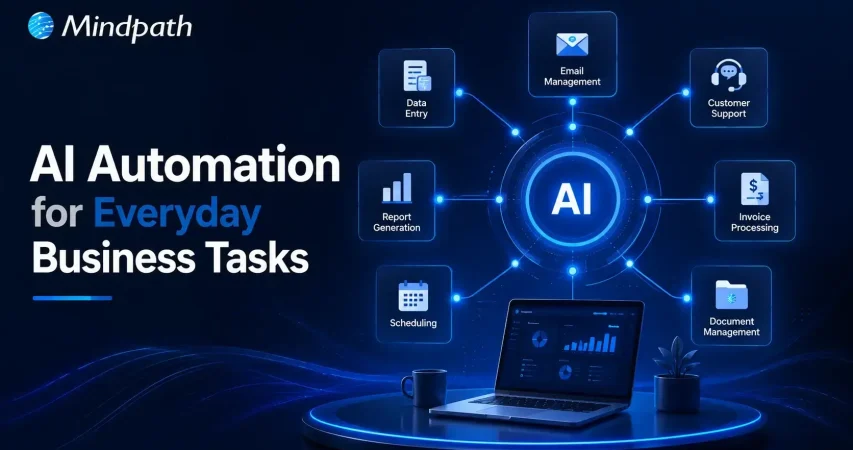
10 Everyday Business Tasks You Can Automate with AI Today

Business process automation helps organizations eliminate repetitive work and improve everyday efficiency with AI. Here are ten common business tasks that businesses can automate today to save time, reduce errors, and support sustainable growth.

1. Customer Support

AI chatbots answer common customer questions instantly and provide support around the clock. This reduces response times and allows support teams to handle more complex issues.

2. Email Management

AI organizes inboxes, prioritizes important messages, and drafts professional replies. Teams spend less time managing emails and more time on meaningful work.

3. Meeting Summaries

AI records conversations, creates concise meeting notes, and highlights action items. Everyone stays aligned without manually documenting every discussion.

4. Lead Management

AI captures new leads, qualifies prospects, and updates CRM records automatically. This helps sales teams respond faster and improve conversion opportunities.

5. Invoice and Expense Processing

AI generates invoices, categorizes expenses, and tracks payment reminders efficiently. Business task automation reduces manual effort while improving financial accuracy.

6. Social Media Content

AI creates captions, suggests content ideas, and repurposes existing materials. Marketing teams can maintain consistent posting with less manual work.

7. Document Review

AI summarizes lengthy documents and identifies important information within seconds. It speeds up reviews while helping teams make informed decisions.

8. Data Reporting

AI analyzes business data and generates dashboards with meaningful insights. Leaders can monitor performance without spending hours preparing reports.

9. Inventory Management

AI tracks inventory levels and predicts future demand using historical trends. Businesses can avoid stock shortages and improve supply planning.

10. Internal Knowledge Support

AI assistants help employees quickly find policies, documents, and training resources. These are among the most valuable business tasks that can be automated to improve workplace productivity.

How to Decide Which Business Tasks to Automate First?

Knowing how to automate business tasks starts with identifying processes that consume the most time and resources. Focusing on the right workflows first helps businesses achieve faster results and long-term operational improvements.

  • Identify Repetitive Tasks: Automate activities performed every day across business workflows. Business task automation saves valuable time and improves overall productivity.
  • Choose Rule-Based Processes: Select workflows with simple and consistent decision-making. These processes are easier to automate with reliable accuracy.
  • Reduce Manual Errors: Prioritize tasks where human mistakes happen frequently. Automation improves consistency and minimizes costly operational errors.
  • Start with Quick Wins: Focus on processes delivering immediate measurable business improvements. Early success builds confidence for broader automation initiatives.
  • Improve Employee Experience: Automate routine administrative work that slows daily productivity. Employees can concentrate on higher value and strategic responsibilities.

Best Practices for Successful Business Process Automation

Successful automation begins with clear goals and well-defined business processes. Choosing the right AI automation tools helps organizations improve efficiency while achieving consistent and scalable results.

  • Start with One Process: Automate a single workflow before expanding across the organization.
  • Integrate Existing Systems: Connect AI with everyday business applications for smoother workflows.
  • Review AI Outputs: Verify AI-generated results before using them in critical business tasks.
  • Protect Sensitive Information: Choose secure AI platforms that safeguard business and customer data.
  • Train Employees Effectively: Equip teams with practical AI skills for successful adoption.

Ready to Transform Your Business with AI Automation?

Business process automation is no longer limited to large enterprises. Organizations of every size can automate routine workflows, improve operational efficiency, and reduce manual effort with the right AI strategy. Starting with high impact tasks allows businesses to achieve measurable results while building a strong foundation for long term growth and innovation.

At Mindpath, we develop custom AI solutions that align with your business goals and existing workflows. From intelligent automation and AI agents to enterprise AI applications, our experts help organizations streamline operations, improve productivity, and accelerate digital transformation with scalable AI development services.
Frequently Asked Questions

Track metrics such as time saved, error reduction, operational costs, employee productivity, and customer satisfaction to evaluate the impact of automation.
The right choice depends on business goals, existing systems, scalability needs, and the level of customization required for long term growth.
Simple workflows can deliver measurable improvements within weeks, while larger automation projects may require several months to achieve full business value.
Yes. Modern AI solutions can integrate with many CRM, ERP, accounting, and collaboration platforms without replacing existing infrastructure.
After initial success, businesses should prioritize high impact workflows that involve repetitive tasks, multiple departments, or frequent manual processing.

Support Is One Click Away

Featured Posts

Related Post

generative ai development cost

Planning a custom GenAI solution often begins with one difficult question: what will it cost? The generative AI development cost can look simple at first, yet many details shape the final investment. Data preparation, model selection, security, integrations, and ongoing support all influence pricing. So, how can you budget confidently without missing essential costs?

Key Takeaways

  • 01
    A basic GenAI MVP typically requires a $20,000 starting investment. 
  • 02
    Enterprise GenAI platforms can exceed $500,000 with complex security requirements. 
  • 03
    Data preparation and RAG setup can add $10,000 to $40,000. 
  • 04
    Monthly API and cloud usage can significantly increase long-term project costs. 
  • 05
    Clear scope and vendor expertise prevent budget overruns during GenAI implementation. 

That question becomes even more important when every decision affects your project’s value. A basic tool and a fully customized solution can require very different investments. You also need clarity before resources, timelines, and expectations start moving forward. Interested in knowing the real pricing breakdown? We have got you covered! This article breaks down the cost to build a GenAI solution, major pricing factors, hidden expenses, and practical planning considerations. So, let’s get started!

Need a cost-effective custom GenAI solution for your business? We offer generative AI development services to build secure, scalable, and ROI-driven AI solutions.

Why Are Businesses Seeking Custom GenAI Solutions in 2026? An Overview

As we know, custom GenAI development creates tailored AI applications for specific business needs. These solutions combine foundation models with internal data, workflows, and brand requirements. They help organizations automate complex work, protect sensitive information, and deliver more relevant insights than standard tools.

Businesses are seeking custom GenAI solutions because standard tools cannot fully support unique processes and goals. They need AI that understands internal data, protects sensitive information, and delivers relevant outcomes.

Here’s what custom GenAI solutions can do for a business.

1. Smarter Business Decisions: Turn scattered internal data into faster, more informed decisions.

2. Secure Innovation: Use proprietary knowledge to support product development, coding, and content creation.

3. Personalized Customer Support: Deliver relevant recommendations, interactions, and assistance at scale.

4. Streamlined Daily Workflows: Automate repetitive tasks across systems, teams, and business processes.

5. Stronger Compliance Controls: Generate secure, compliant outputs for sensitive and regulated operations.

 Must-Know Insights

  • Over 80% of enterprises will use GenAI in production. (Gartner)
  • 74% of companies plan multi-agent AI deployments soon. (Gartner)
  • AI spending could reach $2.59 trillion worldwide. (IMF)
  • Security incidents will shape enterprise GenAI design decisions. (Gartner)

What Drives the Cost to Build GenAI Solution?

A custom GenAI solution does not come with a fixed price tag. Each business brings different data, goals, systems, and security needs to the project. That is why GenAI development pricing can vary widely. The following are the key factors that influence the final cost.

1. Data Preparation and RAG

Clean, structured business data forms the foundation of a useful GenAI solution. Secure data pipelines and vector databases can increase the custom generative AI development cost.

2. Security and Compliance

Strong security controls protect sensitive business and customer information. Compliance requirements can add significant effort to the overall generative AI implementation cost.

3. Integration and Workflow Design

Connecting GenAI with existing systems requires careful planning and development. Complex workflows and multi-agent capabilities can raise the cost to build GenAI solution.

4. Model Strategy and API Usage

The selected model directly affects GenAI development pricing and ongoing expenses. High API usage, fine-tuning, and longer outputs can increase costs.

5. Infrastructure and Compute

Cloud hosting, storage, GPUs, and data transfers support reliable GenAI performance. Higher usage and scaling needs can increase long-term operational costs.

How Much Does Generative AI Development Cost in 2026?

Every GenAI project has a different price because every business has different needs. So, how much does generative AI cost for your goals? The answer depends on the solution’s scope, data, integrations, and security needs. For a clear understanding, let us break down the expected cost ranges.

1. Proof of Concept or GenAI MVP

Estimated cost: $20,000 to $60,000

This option helps businesses test one focused GenAI idea before making a larger investment. It may include a basic interface, model API integration, limited data access, and simple workflows.

2. Production GenAI Features

Estimated cost: $60,000 to $150,000

This range suits customer assistants, content tools, internal knowledge search, and automated workflows. It usually includes stronger integrations, better user controls, and more complete testing.

3. Custom AI Agents and Workflow Automation

Estimated cost: $100,000 to $250,000

These solutions complete multi-step tasks by connecting with business tools and systems. Costs increase when agents need approvals, memory, tool access, monitoring, or complex workflow logic.

4. Enterprise GenAI Platforms

Estimated cost: $250,000 to $500,000+

Enterprise solutions support multiple teams, larger data volumes, and broader business use cases. They often require scalable infrastructure, advanced security, governance controls, and detailed audit records.

What Is Included in the Custom Generative AI Development Cost?

A reliable custom generative AI development cost estimate should cover more than coding. It should include the work needed to make the solution useful, secure, and ready for real business use.

1. Discovery and solution planning: $5,000 to $20,000

2. UI/UX design and application development: $8,000 to $30,000+

3. Data preparation and RAG setup: $10,000 to $40,000

4. API and model integration: $10,000 to $50,000+

5. Testing and quality assurance: $5,000 to $30,000

6. Security and compliance: $10,000 to $50,000+

Hidden Costs to Consider Before Building a GenAI Solution

The initial Generative AI implementation cost does not cover every expense. These ongoing or overlooked costs can affect the total cost to build GenAI solution over time.

1. Cloud hosting and GPU compute: $1,000 to $30,000+ per month

2. API usage and token consumption: Varies based on users, prompts, and output length

3. Model monitoring and evaluation: $10,000 to $40,000+ per year

4. Data updates and scheduled retraining: $15,000 to $80,000 per year

5. Third-party tools and subscriptions: Varies by platform and workflow needs

6. Ongoing maintenance and support: $15,000 to $80,000 per year

7. Security reviews and compliance audits: $10,000 to $50,000+

Custom Generative AI Development Cost Planning Checklist

To understand the cost to build GenAI solution in a better way, follow this table. You will have better knowledge and can plan your budget accordingly.

Cost Area  Include in Initial Budget  Plan as Ongoing Cost  Why It Matters 
Discovery and solution design Yes No Defines scope, priorities, and technical requirements
Data preparation and RAG setup Yes Yes Internal data needs setup, updates, and quality checks
Application development and integrations Yes No Connects GenAI with workflows and business systems
Security and compliance Yes Yes Requires implementation, reviews, monitoring, and updates
API and token usage No Yes Costs grow with users, prompts, and response length
Cloud hosting and infrastructure No Yes Supports storage, processing, availability, and scaling
Testing and model evaluation Yes Yes Maintains accuracy, safety, and output quality
Maintenance and support No Yes Covers fixes, improvements, and model or API changes

Best Practices to Plan GenAI Budget More Effectively

Businesses can control costs by defining the right scope before development begins. A phased approach also helps teams prove value before scaling investment.

  • Start with one high-value and measurable use case
  • Define success metrics before selecting technology
  • Separate one-time build costs from ongoing operating costs
  • Confirm data security and compliance needs early
  • Plan for testing, monitoring, and future improvements
  • Work with a GenAI development partner that understands your industry

  Consider these Factors to Choose the Right GenAI Development Partner

1. Review Technical Expertise: Choose a partner with proven RAG, agent, integration, and evaluation experience.

2. Check Security and Compliance Practices: Confirm how they protect data and support relevant compliance requirements.

3. Understand Their Cost Approach: Ask for clear build, API, cloud, maintenance, and support estimates.

4. Discuss Outcome-Based Engagements: Align project pricing with measurable business goals and expected results.

5. Set Clear Service Agreements: Define uptime, response times, support responsibilities, and knowledge transfer expectations.

Looking for a Custom GenAI Solution Built Around Your Business?

A successful GenAI project starts with a clear scope, realistic budget, and long-term operating plan. By considering data, integrations, security, and maintenance early, businesses can manage the generative AI development cost while building a solution that delivers meaningful and measurable value.

At MindPath, we create custom GenAI development solutions around your business goals, workflows, and growth plans. Our team helps you define the right approach, control costs, and build secure AI capabilities that scale.

Frequently Asked Questions

AI implementation
Have you ever wondered how companies such as Amazon or Google come to decisions quickly and easily, and how they use technology to simplify complex tasks? The answer lies in Artificial Intelligence (AI). But how can you harness this powerful technology to transform your own business? In this blog we will explore the implementation of Artificial Intelligence which can be the solution for you. So, let us dive in! 

What is AI Implementation?   

AI implementation makes use of smart technology in making your business function better. It simply embeds AI tools into your daily activities to make them easier and more efficient. This could be anything from responding to customer inquiries to analyzing massive data or even predicting what the next possible sale to a given customer would be. Basically, this is meant to save time and improve customer service and think smarter. This way, your business will be able to grow and make your goals a reality very fast due to working smarter, not harder.  Artificial Intelligence is important in today’s world because it makes life and working procedures easy. It helps organizations in automating tasks, analyzing data, and making speedy decisions. AI improves healthcare by supporting doctors in the diagnoses of diseases and improves the customer experience within retail shops through the personalization of shopping activities. As technology grows, AI becomes even more vital in helping us innovate and stay competitive. 

AI Implementation Strategy    

1. Data Type   

If you really want to start leveraging the power of AI properly, then it becomes quite important to use the right model for your data type. Use models that treat pictures well for image data, those that understand the language for text, and those that track changes over time for time-based information such as stock prices. Using the appropriate AI model according to your data makes it work better and gives you more accurate results. 

2. Problem Complexity   

Keep in mind how complex your problem will be when using AI. Easy problems likely can be satisfactorily solved with some pre-trained model that has been set up for common issues. For more unique or complex problems, you will want an AI tailor-made for your requirements. Matching an AI model with your problem’s complexity enables much better results and effective solutions. 

3. Labeled Data  

Deep learning requires a lot of labeled data—information that has been tagged with correct answers. Check whether you have enough labeled data for the project to be executed; otherwise, you can use techniques such as transfer learning, where you get a model that is already trained on similar data. In that case, you can still have good results with limited labeled data. 

4. Managing Computational Resources  

While using AI, do not forget to think about what kind of computing power you have. Big models, like GPT-3, really eat through resources—of course, not all companies will have these resources. Therefore, ensure that your infrastructure can sustain the computing burden for the kind of AI model you intend to use. This way, it will align the needs of the model with your computing means, thus implementing both smoothly and effectively. 

5. Interpretability  

Consider the interpretability at which you need to understand how your AI model works. In domains like healthcare or finance—where models must explain their decisions to be compliant and build trust—choose AI models that are transparent enough to interpret and justify their outputs. 

Step For Successful AI Implementation   

1. Set Clear Goals and Objectives  

Clearly define what you want to achieve before implementing AI in business. Be specific on the problems that must be solved, the gains to be achieved, improve customer satisfaction, or boost productivity. Knowing the target will help in choosing the correct tools and technologies of AI for you. 

2. Find the Best Data Sources  

AI’s ability to work correctly depends on the use of relevant data sources. This can involve using either internally generated data, like customer information or financial information, or even external sources such as social media and news feeds. Ensure that data used is relevant, accurate, and up to date. 

3. Pick the Right AI Tools  

With the plethora of tools in artificial intelligence at your fingertips, select only those that work for your business. These could be machine learning, language processing, or even analytic tools. Consider things like cost, scalability, and usability in finding the right fit for your business. 

4. Create a Solid Data Plan  

AI systems require enormous amounts of data to perform well. Build a robust data plan indicating how you will collect, store, process, and analyze your data. This includes setting up data management policies, ensuring the security and privacy of your data, and architecting a data system that works for your AI needs. 

5. Invest in Training and Skill Development  

An AI business can only succeed past the tools if equipped with the right people for the job. Invest in training and education for workers so that they develop appropriate skills for working with AI. The upskilling may entail learning more about data science, machine learning, or other skills that are relevant in AI. This will equip your team to effectively use the AI system to maximize its benefits. 

6. Start with Small Projects and Expand  

AI implementations can be very complex and time-consuming. Start small, engage in doable tasks that will yield some sense of how AI works for you in business. Test it in only one area or department of your business. From the experience and confidence, you will build from these first projects, over time, you can spread AI to other areas of your business. 

7. Monitor and Adjust 

Once your AI system is in place, monitor its performance. Key metrics should be observed, which include accuracy, speed, and efficiency. Monitor user feedback and adjust your AI algorithms or data strategy accordingly. Regular adjustments help ensure that your AI will continue working effectively for you.

Ready to take your business to the next level with AI?

At Mindpath, we offer cutting-edge AI development services designed to enhance efficiency and drive innovation.

AI Development Services at Mindpath    

Enrich your business with cutting-edge AI development services at Mindpath. We deal in predictive analytics, helping you foresee future trends and make decisions in advance. Machine learning applications will let you create automated decision-making for the enhancement of operational efficiency in your business. Additionally, data-driven insights are delivered to let your business understand and act upon the data appropriately. Our Business Intelligence services turn raw data into insightful visualizations and comprehensive reports so that you have a view of the performance of your business from a bird’s eye perspective. You could, therefore, make informed decisions that would drive strategic planning and make processes optimized with data-driven intelligence.  We also offer conversational AI services in developing smart chatbots and virtual assistants that increase engagement, provide real-time support, and automate tasks to create a seamless, highly personalized experience for users. At Mindpath, our AI development services are designed to innovate efficiency in your business to make it thrive in the rapidly changing digital landscape. 

Conclusion 

Artificial Intelligence offers transformative power to any business that can innovate and adapt. It aids in understanding and implementation of artificial intelligence at each level of your journey—from defining clear goals and selecting the right tools for your job through managing data—so that you unlock new levels of efficiency and insight. The AI development services offered at Mindpath will help you harness this power by turning complex data into actionable intelligence and automating processes for fueling growth. Embrace the future of technology with AI and see your business not only competing but leading in today’s dynamic market. 

Want to see how AI can revolutionize your business?

Mindpath’s expert team is here to help you leverage advanced AI technologies for smarter decision-making and greater success.

Discover how AI can revolutionize your business with predictive analytics, machine learning, and conversational AI for smarter decisions and improved efficiency.
sustainable technology

Ever wondered why many businesses are rushing into sustainable tech? Why is it so crucially important in today’s fast-changing world? In this blog we will explore how sustainable technology is changing business, and why it is essential. Understanding how these technologies work and the value they can bring to business enterprises can help in meeting regulatory requirements, enhancing brand reputation, and enhancing environmental performance. We can learn how embracing sustainable technology is already helping companies meet today’s needs while positioning themselves for a successful and responsible tomorrow.

So, let us dive in!

What is Sustainable Technology? 

Sustainable technology is the design and use of technology to benefit the environment, society, and the economy. This means two things: creating technology with eco-friendly processes and materials and using technology to help solve environmental and social problems. Other examples include solar panels, which provide clean energy, and software enabling businesses to trace their environmental footprint.

While developing sustainable technology, companies are very considerate about the resources used, their origin, and how to reduce the negative effects in the form of pollution or electronic waste. Businesses use sustainable technologies to realize some of the desired environmental targets, such as reducing fossil fuel use or source reduction of waste.

For example, they can work on an electric car or initiate projects that reduce carbon emissions. Businesses can also make use of technologies such as Artificial Intelligence to find areas where it can slash down on waste and reduce emissions, thus switching over to renewable energy sources and decreasing their carbon footprint.

Sustainable Technology Solutions That are Revolutionizing Modern-day Businesses 

1. AI-Powered ESG Reporting

AI-powered ESG reporting is the intelligent and faster way for a business to track its efforts toward sustainability. In sharp contrast to manual methods of ESG reporting, AI-driven methods are not only far more accurate but also have the dexterity to bring out results within a remarkably short time, incomparably faster than human ability. Using the AI, businesses would be updated in real time—basically, companies can directly see what effect any sustainability change they make will have. Such technology can scan documents, analyze keywords against them, and store important data from relevant files for easy retrieval at reporting time. This automation not only saves time and money but also gives the accuracy of the ESG data.

2. Embracing Digital Documentation

The digital revolution makes it easy and secure for businesses to create, share, store, and edit important documents. The shift to digital can reduce office waste by a potential 70% since the average office worker uses around 10,000 sheets of paper yearly. The switch from paper to digital can be challenging, but with OCR technology, it allows the user to quickly scan physical pages and digitize them into documents. This reduces the burden of using too much paper and makes files accessible to all. Additionally, file storage in the Cloud is another area that companies should consider. Cloud computing uses less energy compared to running many different servers for companies, and the amount of storage space can increase as required with less hassle.

3. Remote Work Technology

Most of the business units have adopted work from home throughout the pandemic and closed doors to offices for good. It saves the carbon print left if one must commute to their workplace every day. Such a change is made possible with the help of technologies that include workflow technology, tools for integration, e-mail, apps for screen recording, and instant messenger applications. The use of this technology has reduced significantly the need to travel to conferences and other business events, which means a concurrent reduction in carbon emissions. However, the sustainability benefits of remote working depend on the set-up of the home office by the employee. For example, the carbon footprint of an employee may be considerably reduced when the job requires driving more than 6 km to work. In contrast, when the driving distance is less or if public transport is used, home-working may increase CO2 emissions because of the additional use of energy in the home. Hence there is a need to encourage employees to be green at home.

4. The Internet of Things (IoT)

The IoT is the network of connected devices, including smart home devices and sensors. Businesses can apply IoT in PACE dimensions related to understanding their ecological footprint and emission reduction. IoT makes workspaces more energy-efficient through monitoring and controlling devices. Some companies that deliver products have the potential to reduce their environmental impact with smart fleets. IoT-enabled fleets send vehicle data back to the office through telematics, which will enable managers to plan efficient routes that can save fuel and be more effective. This data might underline the best driving practices that would help further cut fuel use and boost sustainability.

Sustainable Technology Use Cases 

1. Decreasing Carbon Footprints

Sustainable technologies help companies transition from a linear economy, where the use of raw materials is very high, to a circular economy, which is based on leasing, recycling, refurbishing, repairing, re-using, and sharing products as far as possible. This space, therefore, helps companies lower their carbon footprints while serving the interests of both the people and the planet. Sustainable technologies now assist companies in keeping track of crucial ESG metrics, including energy use, emissions, and water consumption. This will enable businesses to understand their position in trends of sustainability, beef up actions to cut emissions, and, as a result, help in answering healthy regulatory requirements and improving the environmental performance of the company.

2. Improving Brand Reputation

Sustainability is important for reputation and success. It attracts a workforce and investors sensitive to environmental and social issues in the world. Sustainable technologies attract environmentally aware talent and meet the needs of investors who value transparency of information. Sustainable technologies help businesses keep track of and improve their efforts in sustainability. For example, IoT devices track energy consumption, allowing them to benchmark and, therefore, report on progress, demonstrating commitment to sustainability.

3. Meeting Regulatory Requirements and Global Standards

Regulations are constantly changing, with laws like the Corporate Sustainability Reporting Directive (CSRD) requiring companies to report on their environmental impact. Even without mandatory rules, companies are encouraged to follow the United Nations’ Sustainable Development Goals (SDGs), which promote environmentally friendly technologies. To stay ahead, organizations should use sustainable technologies that track, measure, and report their ESG performance. This helps them meet current and future regulatory requirements and global standards.

4. Visualizing Supply Chains

One of the ways in which sustainable technologies make a difference is through complete transparency, which can be used to improve supply chains. For instance, AI can trace carbon emissions to identify ESG opportunities and risks. Machine learning is applied in demand forecasting and fleet management to avoid waste and achieve higher energy efficiency. Moreover, with the help of such technologies, companies can be kept updated with their partners and suppliers, which is useful in ESG reporting. Tools like GRI or TCFD require reporting on Scope 3 emissions, which are related to operations outside the company’s direct influence. This helps businesses to be ahead and give a cleaner picture of the supply chains.


Reach Out Today!

Curious About How Mindpath Can Transform Your Tech?

Find out how our bespoke solutions in modernization and AI can benefit your business.

Mindpath: A Leader in Innovative IT Solutions

Mindpath is a forerunner in IT innovation and offers customized solutions for your business. We are an Innovation Centre focused on staff augmentation—bringing experienced and qualified professionals to integrate with your team for any short- or long-term project. Our modernization services upgrade legacy systems and optimize processes for better efficiency, security, and long-term growth. We are leaders in digitization. Therefore, we have State-of-the-Art Web Development and App Solutions to enhance your presence online. In addition, with our excellence in bespoke chatbot development and artificial intelligence, your business will harness the very latest technology available to help give you that edge.

Conclusion 

In the current world complexities, businesses have found sustainable technology to be central to their way of growth and competitiveness. Evermore, innovations that businesses embrace these days are the ESG reporting powered by AI, digital documentation, remote work technology, and the IoT, which help these companies in the reduction of their environmental impacts and bring about an increase in operational efficiency and reputation. These technologies are pivotal for organizations to meet regulatory requirements, visualize their supply chains, and, of course, their sustainability targets. The commitment to sustainability practices is not a fad but a strategic edge, one that imbibes the global norm of standards and sets the pace toward long-term success.
Mindpath leads in IT innovation and can help your business grow. Staff augmentation by Mindpath deals with the integration of top professionals in your team for the implementation of various short- and long-term projects. Besides that, our modernization services update your legacy systems and aid in enhancing your company’s efficiency and security. Advanced web and application development with bespoke chatbot and AI solutions complete the comprehensive services in ensuring our business stays at the cutting edge of technology.

Get In Touch!

Ready to Innovate?

Discover how Mindpath’s tailored IT solutions can transform your business.

Explore how sustainable technology is transforming businesses. Discover its benefits, from AI-driven ESG reporting to digital documentation and IoT innovations.