Home

How Much Does It Cost to Build an Enterprise AI Knowledge Base?

How Much Does It Cost to Build an Enterprise AI Knowledge Base?

Join our Newsletter!

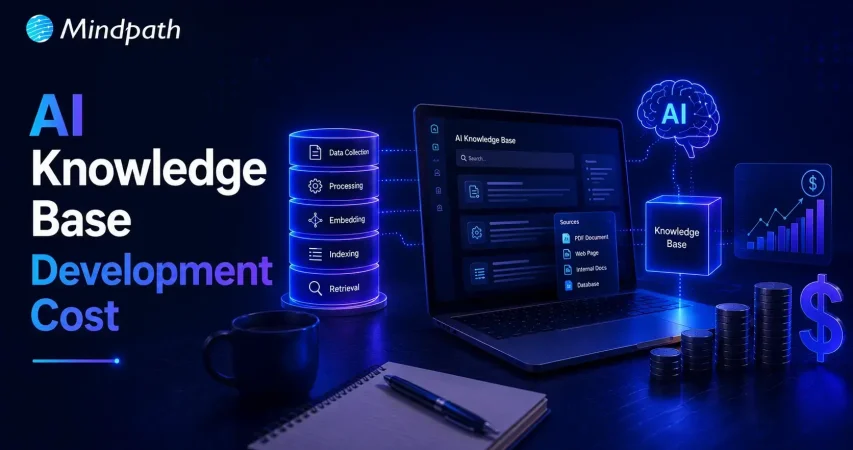
AI Knowledge Base Development cost

Every organization depends on quick access to accurate business information, yet many still struggle with scattered documents and disconnected systems. Understanding the Enterprise AI knowledge base cost is becoming a priority as companies invest in AI solutions that improve knowledge access, increase productivity, and support better decision-making across every department.

Key Takeaways

  • 01
    Enterprise AI knowledge bases centralize business information, improving productivity and organization-wide decision-making.
  • 02
    Development costs depend on data quality, system integrations, security requirements, and AI capabilities.
  • 03
    Clean, well-structured data improves AI accuracy, response quality, and implementation success.
  • 04
    Starting with a focused, high-impact use case helps reduce implementation costs and project risks.
  • 05
    Continuous optimization, maintenance, and scalable AI architecture maximize long-term business value and ROI.

An enterprise AI knowledge base does much more than store documents. It uses artificial intelligence to understand user questions, retrieve relevant information from multiple sources, and deliver reliable answers within seconds. As businesses continue adopting AI, knowing the factors that influence development costs helps them plan the right investment and avoid unexpected expenses. In this blog, we’ll break down the key cost factors, typical pricing, and practical ways to build an enterprise AI knowledge base within your budget.

Looking to improve your enterprise AI knowledge base with a custom RAG solution? At Mindpath, we offer RAG Development Services to create AI systems that retrieve reliable information and generate accurate business insights.

What Is an Enterprise AI Knowledge Base and Why Do Businesses Need One?

An enterprise AI knowledge base is an intelligent platform that stores, organizes, and retrieves business information using artificial intelligence. Unlike traditional knowledge repositories, it understands natural language queries and provides relevant answers from trusted company data. Many organizations also use a RAG knowledge base to improve response accuracy with real-time business information.

As organizations create more documents, policies, customer records, and operational data, finding the right information becomes increasingly difficult. An enterprise AI knowledge base solves this challenge by making knowledge instantly accessible, reducing manual searches, and helping teams work more efficiently. It also creates a single source of truth that supports consistent decision-making across the business.

Businesses need an enterprise AI knowledge base because it helps them:

  • Reduce the time employees spend searching for information.
  • Improve productivity by providing instant access to business knowledge.
  • Deliver faster and more consistent responses to customer queries.
  • Centralize information from multiple systems into one trusted source.
  • Support informed decision-making with accurate and up-to-date knowledge.
  • Scale knowledge management without increasing manual effort.

Advantages of Enterprise AI Knowledge Base

As businesses continue building a knowledge base in artificial intelligence, they gain more than faster information access. An enterprise AI knowledge base improves operational efficiency, supports better decisions, and enables teams to work with accurate, up-to-date knowledge across the organization.

  • Faster Information Retrieval: Employees can find relevant answers in seconds instead of searching through multiple systems.
  • Higher Employee Productivity: Teams spend less time looking for information and more time completing valuable work.
  • Consistent Knowledge Access: Everyone receives the same accurate and up-to-date information from a centralized source.
  • Better Decision-Making: Quick access to reliable business knowledge helps leaders and employees make informed decisions.
  • Reduced Operational Costs: Automating knowledge retrieval lowers manual effort and reduces support and training costs.
  • Scalable Knowledge Management: The system grows with your business while managing increasing volumes of information efficiently.

Drawbacks at a Glance

  • High Initial Investment: Development, integration, and infrastructure can require a significant upfront budget before delivering long-term value.
  • Data Quality Challenges: AI can only provide accurate answers when the underlying business data is complete, organized, and regularly updated.
  • Complex Implementation: Integrating AI with existing business systems and workflows often requires specialized technical expertise.
  • Ongoing Maintenance Requirements: The knowledge base must be continuously updated, monitored, and optimized to keep responses accurate and relevant.
  • Security and Compliance Risks: Sensitive business information requires strong access controls, encryption, and governance to meet regulatory requirements.
  • User Adoption Takes Time: Employees may need training and change management before fully trusting and using the AI knowledge base in their daily work.

What Factors Affect the Enterprise AI Knowledge Base Cost?

The cost of an enterprise knowledge management system depends on multiple technical and business factors. Understanding these helps businesses estimate the right budget for AI knowledge base projects and plan their investment more effectively.

1. Business Requirements

The project scope directly impacts the overall cost. More use cases and advanced features require greater development effort.

2. Data Quality

AI needs clean, organized, and updated data to deliver accurate results. Preparing business data often adds to implementation costs.

3. Knowledge Base Size

Larger knowledge bases require more storage and processing resources. This increases infrastructure and maintenance expenses.

4. AI Model Selection

The choice of AI model affects both development and operating costs. Advanced models generally require a higher investment.

5. System Integrations

Connecting the knowledge base with CRM, ERP, or other business applications increases implementation complexity. More integrations usually mean higher costs.

6. Security and Compliance

Enterprises often need encryption, access controls, and regulatory compliance. These requirements add to the overall development cost.

7. Maintenance and Support

Regular updates, monitoring, and performance improvements are essential after deployment. Ongoing maintenance should always be included in the project budget.

Enterprise AI Knowledge Base Cost Breakdown

The cost of an enterprise AI knowledge base depends on factors such as project complexity, data volume, integrations, and security requirements. Whether you’re building a traditional AI solution or an LLM knowledge base, understanding these cost components helps businesses estimate the required investment and plan their implementation more effectively.

Component Description Estimated Cost
Basic AI Knowledge Base 10–50 documents, managed cloud setup $8,000 – $18,000
Mid-Market Solution Multi-source data with custom interface $25,000 – $80,000
Enterprise AI Knowledge Base 10,000+ documents, deep integrations, compliance $100,000 – $300,000+
Offshore Development Custom enterprise implementation $30,000 – $80,000
SaaS Subscription Pre-built AI knowledge platform ~$30/user/month
Cloud Infrastructure Hosting, storage, vector database $50 – $300+/month
LLM API Usage AI model token consumption Usage-based
Annual Maintenance Updates, monitoring, optimization 15%–30% of build cost/year
Security & Compliance Encryption, audit logs, regulatory compliance Up to 7% extra budget

How to Reduce the Cost of Building an AI Knowledge Base Without Compromising Quality?

Reducing Enterprise AI knowledge base cost does not mean sacrificing performance or scalability. The right strategy and technology choices can help businesses maximize value while keeping development and operational expenses under control.

1. Start with a High-Impact Use Case

Begin with one department or business process instead of building an enterprise-wide solution. This reduces upfront costs and allows you to scale based on proven results.

2. Improve Data Before Implementation

Remove duplicate, outdated, and irrelevant content before training the system. Clean data improves AI accuracy and reduces implementation effort.

3. Use Existing Cloud AI Services

Leverage managed AI platforms instead of building infrastructure from scratch. This lowers deployment time and reduces infrastructure costs.

4. Choose the Right Knowledge System Building Tools in AI

Select tools that support integrations, scalability, and automation out of the box. The right knowledge system building tools in AI minimize custom development and long-term maintenance costs.

5. Integrate with Existing Business Systems

Connect the AI knowledge base with current CRM, ERP, and document management platforms. Reusing existing systems avoids unnecessary redevelopment expenses.

6. Monitor and Optimize Continuously

Track AI performance, user feedback, and operational costs after deployment. Regular optimization improves accuracy while preventing unnecessary spending over time.

Is an Enterprise AI Knowledge Base Worth the Investment?

Businesses looking at how to build an AI knowledge base should evaluate both the upfront investment and the long-term value it delivers. When implemented correctly, it becomes a strategic asset that improves efficiency, knowledge sharing, and decision-making.

  • Reduces the time employees spend searching for information, leading to higher productivity.
  • Delivers faster and more accurate responses by providing access to trusted business knowledge.
  • Improves collaboration by creating a single source of truth across teams and departments.
  • Scales easily as business data, users, and operational requirements continue to grow.
  • The implementation cost of AI knowledge base is often offset over time through lower operational costs, improved efficiency, and better customer experiences.
  • Provides long-term business value by supporting informed decisions and enabling AI-driven workflows across the organization.

Ready to Optimize Your Enterprise AI Knowledge Base Cost?

Building an enterprise AI knowledge base is a strategic investment that improves knowledge accessibility, operational efficiency, and business decision-making. The final cost depends on your data, integrations, security requirements, and AI capabilities, making careful planning essential for maximizing long-term value and return on investment.

At Mindpath, we design secure, scalable, and customized AI knowledge base solutions tailored to your business goals. From AI strategy and RAG implementation to enterprise integrations and ongoing optimization, our experts help you build reliable solutions that deliver measurable business outcomes while optimizing your investment.

Frequently Asked Questions

Most enterprise AI knowledge base projects take 2 to 6 months, depending on data preparation, integrations, custom features, security requirements, and overall project complexity.
Yes. Most enterprise AI knowledge bases integrate with CRM, ERP, document management systems, cloud storage, and collaboration platforms to provide unified knowledge access.
Yes. Regular updates ensure the AI uses the latest business information, maintains response accuracy, improves performance, and supports changing organizational requirements.
It can use documents, PDFs, manuals, policies, knowledge articles, emails, FAQs, databases, and other structured or unstructured business content as knowledge sources.
Success is typically measured through faster information retrieval, reduced support workload, higher employee productivity, improved response accuracy, and better user satisfaction.

Support Is One Click Away

Featured Posts

Related Post

Cloud Computing Trends 2024

Are you curious about how cloud computing will evolve in 2024? What new technologies will shape the way we store, process, and access data? As the cloud landscape continues to grow and evolve, staying updated on these trends is more crucial than ever. In this blog, we will explore the latest cloud computing trends set to redefine the digital landscape this year. 

Cloud computing is the practice of employing internet-based services rather than maintaining everything on your personal computer. Imagine you need to save data, run programs, or use tools, but instead of doing it on your device, you access them over the internet. The real data, such as your files and applications, is stored on large, powerful computers known as servers, which belong to businesses such as Google, Amazon, and Microsoft. They handle everything, so you don’t need to worry about monitoring or maintaining anything. As long as you have internet connectivity, you may utilize everything you need, such as storage or software, at any time and from any location.  

Understanding cloud computing trends is essential for both your career and business. Businesses can pick the finest services and solutions, save money, and increase efficiency by having a thorough awareness of these trends. Staying up to date on what’s new and popular allows you to make better decisions, stay ahead of the competition, and maximize the benefits of the cloud. 

So, let’s dig in to explore the cloud computing trends 2024! 

Cloud Computing Trends 2024

1. Kubernetes and Docker

In 2024, Kubernetes and Docker will be key players in cloud computing. These technologies make cloud application management and deployment easier and more efficient. Docker enables you to organize your program and its dependencies within a lightweight, portable container. This implies that your program can work properly on any platform, including your PC and the cloud. Kubernetes goes a step further, managing and coordinating these containers. It automates processes such as scaling up or down and balancing workloads, ensuring that everything functions smoothly without requiring continual manual changes. As more businesses use cloud computing, Kubernetes and Docker are becoming increasingly important for improving and flexibly delivering cloud services.  

2. DevSecOps

In 2024, DevSecOps will be an essential approach to cloud computing security. It stands for Development, Security, and Operations, and it focusses on implementing security measures from the beginning of the development process. Rather than waiting until an application is complete to check for security flaws, DevSecOps ensures that security is built in throughout. This helps to defend against issues such as hacking, service outages, and unauthorized access to data. Cloud service providers offer tools and services that enable DevSecOps easy to utilize. Businesses may use these technologies to ensure their cloud environments are secure and free of possible dangers. 

3. Disaster recovery and backup

Disaster recovery and backup will be essential in 2024 for ensuring the security of your cloud data. If anything goes wrong—like a server breakdown, a power outage, a natural disaster, a cyberattack, or a hardware failure—having a robust backup strategy allows you to recover your data fast. Cloud computing simplifies this process by keeping copies of your vital data online. This manner, if something occurs to your primary PC, you can swiftly recover everything from the cloud. Many companies automatically store important data and information to cloud servers. This means companies don’t have to worry about losing important information and can keep their operations functioning smoothly even during catastrophes. 

4. Edge computing

Edge computing is changing the way we handle information by bringing it closer to where it originated. This reduces delays and speeds up operations. With the emergence of 5G networks, edge computing is becoming increasingly significant since it enables real-time data processing and enhanced security. Edge computing is becoming increasingly important as more devices connect to the Internet of Things (IoT), allowing for faster data analysis and smoother communications. Edge computing improves speed by bringing data processing closer to the source, ensuring that data is handled safely and effectively. 

5. Internet of Things (IoT)

The Internet of Things (IoT) is a rapidly emerging technological trend. IoT collects massive volumes of data via a network of sensors and devices, which is subsequently stored on cloud servers. This data is analyzed to offer relevant information for making business decisions. IoT connects various devices, computers, and networks, enabling them to communicate and share information. It can collect data remotely and control things from a distance. This smart connection is crucial for IoT’s appeal in cloud computing since it allows for more effective data management and utilization across several platforms. 

6. Low Code and No Code

Low-code and No-code Cloud solutions are transforming the way we develop applications by making it easy for anybody, not just experts, to create software. These platforms enable people to create apps and employ AI technologies with minimum technical knowledge. Instead of writing large amounts of code, you can quickly develop and launch projects using simple, user-friendly tools. This speeds up the development process, reduces errors, and makes technology more accessible to a larger audience. Users can easily construct apps using popular tools like Figma and Zoho, without having to maintain complex coding systems. 

7. AI and ML

Artificial intelligence (AI) and machine learning (ML) are leading cloud computing trends. These technologies demand a significant amount of computing power and storage to manage data and train models, but they also provide strong and cost-effective solutions. In 2024, we can expect AI and machine learning to drive trends such as self-automation, which allows systems to handle themselves, and personalized cloud services that adapt experiences to individual demands. These technologies will also enhance data security and privacy. Major technology businesses, such as Amazon, Google, and IBM, are aggressively investing in AI and machine learning. Amazon’s AWS DeepLens and Google Lens, for example, make use of machine learning to provide enhanced capabilities and improve user experiences. 

Cloud Computing at Mindpath

Mindpath’s cloud computing platform enables businesses to leverage advanced technologies without having to handle it all themselves. Mindpath provides a variety of cloud services that allow you to conveniently and securely store data, execute programs, and access resources online. 

Our cloud solutions are intended to be adaptable and scalable, allowing them to expand alongside your organization. Whether you need to back up important information, operate complex apps, or optimize your IT infrastructure, we have you covered. We guarantee that everything goes smoothly and securely, enabling you to focus on what is most important to your organization. 

Final Thought

As we look ahead to 2024, the cloud computing world is full of intriguing possibilities. Keeping up with these trends is essential from the rising relevance of Kubernetes and Docker in application management to the creative breakthroughs in AI and ML that are creating smarter, more secure solutions. Edge computing and IoT technologies are changing the way we manage and process data, while low-code and no-code platforms make app creation easier than ever. 

At Mindpath, we are dedicated to assisting organizations in navigating these changes and realizing the full potential of cloud computing. Our cloud solutions are adaptable and scalable to match your demands, whether you want to strengthen your IT infrastructure, secure your data, or innovate with cutting-edge technology.  

Ready to Transform Your Cloud Experience?

Dive into cutting-edge technologies with Mindpath’s tailored solutions and keep your business ahead in 2024.

Drupal vs wordpress

At present, the debate of Drupal vs WordPress is more relevant than ever. WordPress is already powering a large number of websites all across the world. Gradually, Drupal has been strengthening its foothold in enterprise as well as government projects. This has given rise to an important question among businesses and professionals: Is Drupal better than WordPress, or is WordPress still the easier choice for users? 

The guide gives a comprehensive insight into both Drupal and WordPress. You need to get a holistic insight into these platforms so that you can choose the best solution that perfectly fits your needs.  An in-depth comparison between these novel platforms has been made, which can simplify your selection process and help identify the right CMS for your needs in 2026.

Want to build a CMS in your online presence that is flexible, user-friendly, and reliable? Our WordPress development services help you with custom solutions focused on delivering a secure and future-proof CMS tailored to your business needs.

What is WordPress?

In 2026, WordPress remains the world’s most popular free, open-source Content Management System (CMS), enabling anyone to build and manage websites without writing code. Originally launched as a blogging platform in 2003, it now powers over 43% of all websites on the internet. The platform is known for its ease of use, along with a massive plugin library. The availability of flexible full-site editing tools makes WordPress perfect for professionals as well as small and medium-sized entities.

Some of the unique attributes of WordPress that make it a useful CMS solution are the availability of a plethora of themes coupled with robust SEO plugin support. The existence of a thriving developer community allows users to get the optimum value by choosing WordPress.

What is Drupal?

Drupal is a free, open-source Content Management System (CMS) and web development framework built on PHP. Designed for building, managing, and scaling complex websites and web applications, it has earned deep trust from government agencies, large enterprises, and universities worldwide.

Drupal is known for its security and flexibility. Moreover, it is capable of handling a large volume of content and complex user workflows. These characteristics make Drupal a world-class CMS platform that is suitable for meeting the needs of content-heavy platforms. It is time to dive deeper and look at the differences, as now you have clarity about Drupal and WordPress

Planning to, but don’t know what to look for when hiring a professional to handle your WordPress development needs? Discover our guide to hiring WordPress developers to help you make a smart, confident, and informed hiring decision. 

Comparison Between WordPress and Drupal

Are you wondering – Is Drupal similar to WordPress? The answer is Yes! However, even though WordPress Drupal are web content management systems, they have a number of differences. If you are planning on developing a website or web application, you need to have clarity on Drupal vs WordPress. Some of the main differences between WordPress and Drupal include

1. Ease of Use

When it comes to ease of use, WordPress is undoubtedly the clear winner in the year 2026. WordPress offers unmatched accessibility for beginners. Moreover, it can be scaled to handle complex projects. Some of the key features of WordPress include its Full Site Editing as well as the Gutenberg block editor. These elements make it easy for beginners to not only design but also publish pages without having to rely on coding. Furthermore, thousands of pre-built themes and plugins are available, which allow users to launch a site within a few hours.

However, Drupal has a steeper learning curve. You need to remember that its interface is less intuitive for non-developers. Moreover, configuring its modules requires technical knowledge. Experienced developers can leverage the tool, and it can offer them great flexibility and control.

2. Security

There exist differences between Drupal and WordPress when it comes to security. Security is undoubtedly one of the best features of Drupal. Drupal continues to be the ultimate CMS tool that is preferred by government websites and enterprise organizations. It not only offers a dedicated security team but also detailed advisories for minimizing vulnerabilities.

Even though WordPress can be considered to be secure at its core, it faces a greater risk. This is mainly because of its massive plugin ecosystem. Vulnerabilities may often arise from third-party plugins as well as outdated themes. Thus, in terms of security, Drupal is the clear winner out of the two CMS solutions. 

3. Performance

While making a comparison between Drupal or WordPress, the former shines when it comes to performance. Drupal delivers exceptional performance thanks to its advanced caching as well as API-first design. Moreover, its optimized architecture ensures that users can derive optimum value from the CMS tool. The entities that handle millions of pageviews can certainly rely on Drupal without having to sacrifice speed and efficiency. 

Over the years, the performance delivered by WordPress has improved. The improvement has been mainly because of the modern PHP versions coupled with block-based design. Similarly, the headless options have also contributed to improved performance. Users can derive immense value if they pair WordPress with strong hosting and caching layers. This can certainly help WordPress to scale well. However, users must bear in mind that the CMS tool typically requires more plugins as well as third-party optimizations.

4. Cost

A common question that one may have is: What is the cost of using CMS tools? The core software is free in the case of WordPress. Moreover, several themes as well as lug-ins are free or low-cost. Furthermore, the development costs are lower because of the availability of a large talent pool.  

The Drupal software is free. However, users need to remember that the development as well as maintenance costs are higher. Currently, skilled and talented Drupal developers are in short supply in the labor market. This automatically makes Drupal development more costly in comparison to WordPress. It is important that users bear in mind while choosing between WordPress and Drupal. 

5. Flexibility

Flexibility is another important dimension that you must take into consideration while comparing WordPress and Drupal. WordPress definitely serves as a more flexible tool for everyday users. However, Drupal is better in terms of flexibility if you are working on highly structured and enterprise-level sites. These CMS tools adopt a different approach, which influences their overall flexibility. 

WordPress mainly thrives on its plugin and theme ecosystem. These elements make it flexible for individuals as well as small businesses. However, Drupal excels in areas such as complex workflow as well as content modeling. The fact that it focuses on granular user permissions and enterprise-grade content management enables developers to tailor Drupal to meet their complex needs. 

6. SEO Capabilities

SEO is indispensable in 2026, and both CMS tools offer solid, strong SEO options. WordPress is known to have popular SEO plugins such as Rank Math as well as Yoast. They provide beginner-friendly tools along with AI-driven optimization tips for users. Another benefit in the case of WordPress revolves around the presence of mobile-first templates.

When it comes to Drupal, it lacks plug-and-play tools. However, it offers granular control over SEO, including URL structure and metadata. These are other features as well relating to multilingual optimization, as well as structured content management. These features are highly appealing to enterprise SEO teams who are in search of precision.

Do you want your website to be accessible to every visitor? Learn how to improve WordPress web accessibility can help you reach more users and create an inclusive online experience.

WordPress vs Drupal: A Quick Comparison

Now that you have gone through the various comparison factors to understand the differences between Drupal and WordPress, let’s have a look at the quick comparison table. The table below gives an overview of the differences between WordPress and Drupal. 

Features WordPress Drupal
Ease of Use User-friendly  Ideal for Experienced developers
Security Low Security High security 
Performance Efficient performance for small and mid-sized sites High performance for enterprise-scale sites 
Cost Less Expensive More Expensive 
Flexibility High flexibility for everyday users Ideal for highly structured websites 
SEO Capability Better for quick SEO optimization Better for advanced SEO strategies 

Which Is Better, WordPress or Drupal?

The answer regarding which is better – Drupal or WordPress depends on your specific needs as a user. Whether you are a professional or a business entity, you need to know – WordPress versus Drupal. The insight can certainly help you choose between the two robust CMS platforms. 

WordPress is better for users who are looking for a user-friendly CMS tool. It can act as an easy-to-use CMS solution that will allow fast setup. The rich plugin options that are available make it ideal for blogs and the marketing sites of small and medium-sized enterprises. 

On the other hand, Drupal is a top content management system for handling enterprise projects. You can choose the solution if you are looking for top-grade security, a custom workflow, and excellent multilingual support. At present, both WordPress and Drupal have established themselves as amazing CMS solutions for businesses and professionals.   

Curious which platform will better support your website’s growth and design needs? Discover WordPress vs Webflow to understand their differences and choose the best option for your business.

Which CMS Is Actually the Right Fit for Your Business in 2026?

When it comes to WordPress versus Drupal, you need to bear in mind that there is no one-size-fits-all solution. WordPress has been dominating the market for ease of use, as well as affordability. It is the ideal choice for blogs and small and medium-sized businesses. However, Drupal is built for high complexity. It offers unmatched security along with enterprise-level content management.

If you want to leverage WordPress to the fullest, you must certainly choose our WordPress development services. The experts at Mindpath ensure that you get immense value from the novel CMS solution. Whether you are a business owner or a professional, you must consider leveraging these solutions to witness your website flourish.

Frequently Asked Questions

hire node js developers

In this new age of technology, speed and performance are more important than ever. If you are creating an enterprise chat application, an e-commerce site or a custom dashboard, the right technology and right people behind it can be a game-changer. It’s the time to think smart, if you are aiming to stay ahead in the competitive market. Well, choosing to hire Node.js developer can help you build fast, scalable and reliable web applications that can match your business goals perfectly. 

Node.js is relied on by some of the world’s largest brands due to its event-based architecture and non-blocking I/O model. Node.js enables developers to support numerous connections at the same time, leading to extremely efficient backend systems. When you recruit Node.js developers, you’re hiring professionals with experience in optimizing performance while maintaining minimal development expenses. In this blog, we will look at the primary reasons why you should hire Node.js developers to be a great business decision for your growth and success. 

Looking to turn your ideas into high-performance web applications? Mindpath offers expert Node.js development services that are intended to transform your ideas into applications. 

Overview of Node.js

Node.js is an open-source platform that allows developers to execute JavaScript on the server, rather than just in the browser. It’s built upon Google’s V8 engine, which is very fast, so it can execute tasks efficiently. Node.js allows developers to utilize the same language to code the front and back ends of a website, which means that building stuff is easier and quicker.

What is so special about Node.js is how efficiently it can deal with lots of users simultaneously without lagging. This is perfect for real-time applications such as chats platforms or live streaming. It’s also simple to scale up your business, so even if your users increase, Node.js can keep up with it. And there are thousands of pre-built tools available through npm that make it easier for developers to create better apps without having to build them from scratch. 

With the increased demand for Node.js, hiring Node.js developers has also become essential.

Let’s find out what benefits Node.js developers can offer:  

Why Hire Node.js Developers?

Node.js is becoming a top choice for businesses that need swift and responsive web solutions and seasoned developers can unlock its full potential to create glitch-free, real-time applications. These are the reasons to hire Node.js programmers for your next project: 

top reasons to hire node js developers

1. Build Apps that Grow With your Business

One big reason to bring in Node.js developers is their skill in building apps that grow with your business. As more people use your app, it needs to handle lots of users at the same time without slowing down. Node.js developers know how to make that happen. They use smart ways to manage traffic and keep everything running smoothly. Whether you’re starting small or expecting fast growth, they build your app ready for the future. If your app needs to respond quickly, handle real-time updates, or manage lots of users, these developers can handle that expertly. 

2. Affordable Development with Great Results

Using tools that don’t cost extra helps keep your project budget friendly. Developers skilled in Node.js know how to make the most of this free technology to build reliable and fast apps. Their experience means they can deliver quality work without unnecessary expenses. This balance of cost and performance makes a big difference for businesses looking to grow without overspending. With their help, you get a well-built application that won’t drain your resources but still meets your needs perfectly. 

3. Creating Interactive and Real-Time Experiences

When you want apps like chat, games, or teamwork tools that work instantly, developers with Node.js skills are the right choice. They understand how to build systems that don’t slow down, even when many users are active at once. Their work makes sure your app can handle lots of requests without waiting around, so everything feels fast and smooth. This means users can enjoy real-time updates and seamless interactions. Having these developers means your app will stay quick and responsive, giving your users a great experience every time they use it. 

4. Expertise in NPM

A good Node.js development company can offer you node.js developers who are experts in using NPM (Node Package Manager), the built-in tool that helps add new features quickly. Instead of building everything from scratch, these developers can easily find and use ready-made packages to speed up the process. This means your app can get new functions faster and updates happen smoothly. Their experience with NPM helps save time and effort, so your project moves ahead without delays. Hiring them means your app gets built efficiently while still being flexible for future changes.  

5. Offer Full Stack Development

With Node.js development, you get developers who can build both the front-end and the back end of your web app. They use the same language, JavaScript, for everything, which makes the process faster and more organized. These developers know how to create what users see and also set up the systems that keep your app working in the background. This means you don’t need two separate teams. It saves time, avoids confusion, and helps your app run smoothly from start to end. It’s a simple and smart way to get full-stack development done right. 

6. Perfect Fit for Microservices Architecture

Node.js developers are great at building apps using microservices Architecture. These are small parts of an app that can work on their own but also connect with other parts when needed. This makes the whole app easier to build, change, and grow. If one part needs an update, they can fix just that part without touching everything else. It keeps things flexible and clean. With Node.js developers, your app becomes easier to manage and ready to scale as your business grows. It’s a smart way to handle complex web apps without making things messy. 

7. Easy Accessibility

Node.js developers are easy to find because Node.js is based on JavaScript, a language most developers already know. This means that they don’t need much training to get started on your project. They can jump in quickly and begin working without long delays. This makes the whole process faster and smoother for you. Whether you’re starting something new or growing an existing app, having developers who already understand the tools saves time and effort. It’s a simple and smart choice when you want things done efficiently and without hassle. 

Looking to build fast and scalable NodeJS applications? Read our blog on hiring expert NodeJS Developers for High-Performance Apps to see how experienced developers can deliver robust, high-performing solutions for your business.

Ready to Build Powerful Applications with Node.js Developers?

Choosing to hire Node.js developers is one of the smartest choices for creating fast, real-time, and scalable web apps. These developers bring the right mix of front-end and back-end skills to keep your application running smoothly while handling more users as you grow. Their ability to work with modern tools and create user-friendly, high-performing apps makes them the right fit for businesses of all sizes. 

At Mindpath, our Node.js development services are designed to turn complex ideas into smooth, high-performing applications. Our developers are skilled in using the latest tools like NPM, real-time capabilities, and scalable systems to support your business needs. We bring both technical skill and practical experience to deliver solutions that are efficient, reliable, and easy to manage. 

Hire Node.js developers at Mindpath to give your business a strong edge in the digital space. Our team works closely with you to understand your goals, then builds powerful web solutions that meet them. Whether you’re starting small or planning big, we’ve got the skills to grow with you. 

Frequently Asked Questions

1. When is the right time to hire Node.js developer for a project?

The right time is when the project requires fast performance, real-time features, or the ability to handle many users at once. Hiring early in the planning stage also helps in building a strong architecture and avoiding costly changes later.

2. What skills should be checked before deciding to hire Node.js developer?

It is important to look for experience in JavaScript, understanding of asynchronous programming, and knowledge of frameworks and tools like NPM. Familiarity with APIs, databases, and scalable architecture also ensures the developer can handle real-world application needs effectively.

3. Can Node.js developers work on existing applications or only new ones?

Node.js developers can work on both new and existing applications. They can improve performance, add new features, fix issues, or even migrate parts of an application to Node.js, depending on the business requirements and technical goals.

4. How do Node.js developers help improve application performance?

Node.js developers use non-blocking architecture and efficient coding practices to handle multiple requests at once. This helps reduce delays, improve response time, and ensure the application runs smoothly even when many users are active simultaneously.

5. Is hiring Node.js developers suitable for startups with limited budgets?

Yes, Node.js is cost-effective because it uses open-source tools and allows faster development. Hiring skilled developers helps startups build scalable and high-performing applications without needing large teams or high infrastructure costs, making it a practical choice for growing businesses.

Discover the transformative power of conversational AI chatbots. From cost savings to increased sales, learn how chatbots can drive growth.