Home

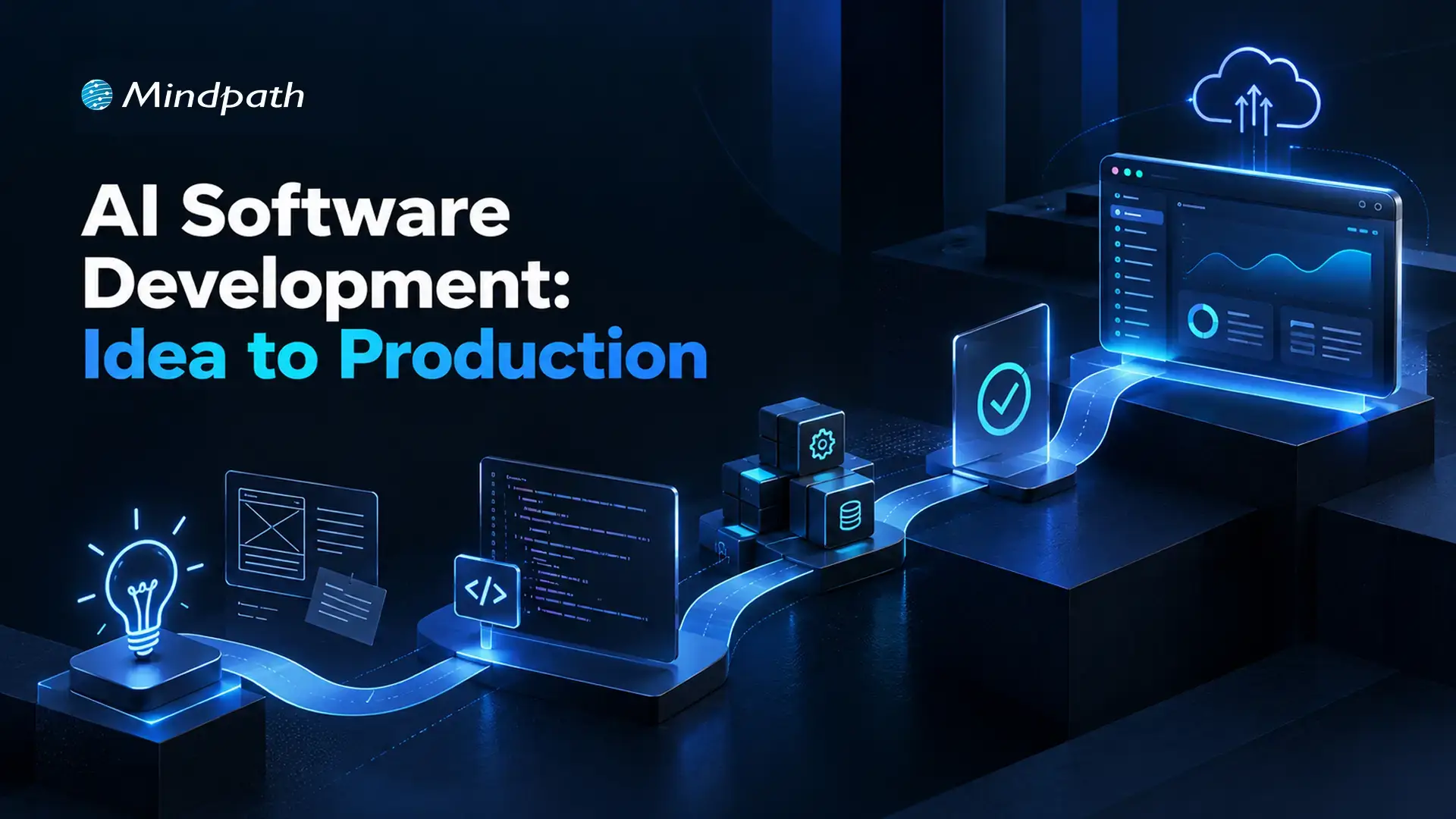
AI Software Development: From Idea to Production in 2026

AI Software Development: From Idea to Production in 2026

Join our Newsletter!

AI Software Development

Software teams are entering a new phase where ideas can move toward working products with remarkable speed. AI software development is reshaping how teams plan, prototype, code, test, and deploy applications. But faster execution alone does not guarantee better software. Teams still need structure, technical judgment, and clear ownership.

Key Takeaways

  • 01
    AI can accelerate software development across planning, coding, testing, and deployment.
  • 02
    AI helps teams turn software ideas into working prototypes faster.
  • 03
    Human review remains essential for code quality, security, and technical decisions.
  • 04
    A structured AI development process helps teams scale AI adoption effectively.
  • 05
    Successful AI development balances automation with clear ownership, testing, and governance.

The real opportunity lies in combining AI capabilities with disciplined development practices. Teams can reduce repetitive work, validate ideas earlier, and improve delivery workflows while keeping quality and security under control. In this blog, we will explore how AI software development takes an idea from concept to production in 2026.

Ready to turn your software idea into a production-ready AI solution? Mindpath offers AI Development Services to help businesses design, build, and scale AI-driven software.

What is AI Software Development?

AI software development refers to using artificial intelligence across different stages of building software, including planning, coding, testing, debugging, documentation, and deployment. In 2026, this can involve AI coding assistants, AI agents, automated testing tools, and intelligent development workflows that help teams complete repetitive and time-consuming tasks more efficiently.

Unlike traditional development, where most tasks depend entirely on manual execution, AI-supported workflows can assist developers with generating code, identifying potential issues, creating test cases, and improving existing code. Developers still define requirements, make architectural decisions, validate outputs, and take responsibility for the final product. The goal is not to remove human involvement, but to make the development process more efficient, consistent, and scalable.

Let’s look at how AI software development differs from traditional development:

Area Traditional Development AI Software Development
Planning Mostly manual requirements and task planning AI assists with requirements, user stories, and task breakdown
Coding Developers write most code manually AI can generate, explain, and refine code
Testing Test cases are created and maintained manually AI can generate tests and identify potential issues
Debugging Developers investigate issues manually AI helps analyze errors and suggest fixes
Documentation Often created separately after development AI can generate and update documentation during development
Code Review Primarily handled through developer reviews AI can provide an additional review layer before human approval
Deployment Teams manage defined CI/CD workflows AI can assist with deployment checks, monitoring, and automation
Human Role Developers execute and validate most tasks Developers guide, review, validate, and make key technical decisions

What are the Key Benefits of AI Software Development?

AI software development brings intelligence into different stages of the development lifecycle, helping teams handle repetitive work, accelerate delivery, and make development workflows more responsive. Its value comes from using AI where it can support developers without removing the need for technical judgment and human review.

Key benefits include:

1. Faster Development

AI can generate code, documentation, test cases, and development tasks, reducing repetitive effort.

2. Rapid Prototyping

Teams can turn ideas into functional prototypes quickly and validate concepts earlier.

3. Improved Testing

AI can identify potential issues, generate test scenarios, and support continuous quality checks.

4. Smarter Debugging

Development teams can use AI to analyze errors and suggest possible fixes faster.

5. Workflow Automation

AI can automate routine development activities across coding, testing, documentation, and deployment.

6. Scalable Development

AI-supported workflows can help teams manage larger development workloads without increasing manual effort at the same pace.

7. Enterprise Readiness

Enterprise AI development can incorporate stronger security, governance, access controls, monitoring, and compliance requirements into AI-driven software workflows.

How Does AI Support Software Building and Testing?

Once a prototype is validated, the next stage is turning it into reliable, production-ready software. AI can support developers across coding, testing, debugging, and review, helping teams reduce repetitive work while keeping technical decisions under human control.

As part of a structured AI development process, teams can use AI for:

1. Code Generation

Create initial code, functions, components, and APIs based on defined requirements.

2. Code Refactoring

Identify repetitive or inefficient code and suggest cleaner implementation approaches.

3. Test Creation

Generate unit tests, test cases, and scenarios that cover different application behaviors.

4. Debugging Support

Analyze errors, trace potential causes, and suggest possible fixes for developer review.

5. Code Review

Detect potential bugs, inconsistencies, security concerns, and maintainability issues before approval.

6. Documentation

Generate technical documentation, code explanations, and development notes alongside implementation.

7. Developer Assistance

Help developers understand unfamiliar code, explore implementation options, and resolve routine development tasks faster.

How Do You Move AI-Driven Software into Production Safely?

After development and testing, the software needs to move through deployment without compromising security, reliability, or performance. AI software development can support this stage by helping teams automate deployment checks, review configurations, monitor application behavior, and identify potential issues before they affect users.

A structured production workflow should include:

1. Deployment Checks

Validate builds, configurations, dependencies, and release requirements before deployment.

2. Security Validation

Scan code and dependencies for vulnerabilities and enforce established security standards.

3. Automated Monitoring

Track application performance, errors, usage patterns, and unusual behavior after release.

4. Access Controls

Restrict sensitive systems, data, and deployment actions based on defined roles and permissions.

5. Human Approval

Keep critical release decisions under appropriate developer, security, or engineering review.

6. Continuous Improvement

Use production feedback and monitoring data to identify issues and improve future releases.

What Challenges Can Teams Face with AI Software Development?

AI can speed up many development tasks, but introducing it into existing workflows can create new challenges. Teams may see quick gains in code generation while facing additional review, testing, security, or integration work. Understanding these issues helps organizations use AI where it creates measurable value instead of adding unnecessary complexity.

Some common challenges include:

1. Code Quality

AI-generated code can contain errors, inefficient logic, or implementation choices that require developer review.

2. Security Risks

Generated code may introduce vulnerabilities or rely on outdated or unsuitable dependencies.

3. Context Gaps

AI tools may lack the business, technical, or architectural context needed for complex decisions.

4. Review Overhead

Developers may spend additional time validating, testing, and correcting AI-generated outputs.

5. Tool Sprawl

Using too many disconnected AI tools can create inconsistent workflows and increase management effort.

6. Unclear Results

Faster code generation does not always translate into faster releases or better software.

7. Over-Reliance

Teams can become dependent on AI suggestions without developing sufficient review and validation practices.

How Can Teams Build a Repeatable AI Development Process?

A successful AI development process needs clear stages, defined responsibilities, and review points that keep AI use practical and controlled. Instead of allowing developers to use AI tools independently, teams can establish guidelines for selecting tools, handling data, reviewing outputs, testing generated code, and approving production releases.

A repeatable approach can include:

1. Define Use Cases

Identify development tasks where AI can reduce repetitive effort or improve productivity.

2. Set Tool Guidelines

Choose AI tools based on security, integration, reliability, cost, and development requirements.

3. Establish Review Gates

Define where developers must review AI-generated code, tests, documentation, and technical decisions.

4. Protect Development Data

Set clear rules for source code, customer information, credentials, and other sensitive data.

5. Track Quality

Measure defects, review effort, testing results, deployment frequency, and maintainability alongside development speed.

6. Refine Workflows

Review outcomes regularly and adjust AI usage based on developer feedback and project requirements.

Ready to Turn Your Software Ideas Into Production?

AI can accelerate software development when teams combine automation with clear processes, testing, security, and human oversight. A structured approach helps businesses move ideas through prototyping, development, and deployment while maintaining quality and control throughout the lifecycle.

Mindpath AI development services help businesses design, build, and scale AI-driven software with practical engineering expertise. As an AI software development company, Mindpath supports teams in turning ideas into reliable, production-ready applications.
Ready to Build Your AI Software?

Turn your AI idea into a production-ready solution.

Frequently Asked Questions

It can reduce repetitive work, speed up prototyping, support testing, and assist deployment while allowing developers to focus on architecture and critical decisions.
Teams should track development speed alongside code quality, defects, review effort, security issues, deployment outcomes, and long-term maintainability.
AI-generated code should pass appropriate testing, security checks, code review, and human validation before reaching production environments.
Clear tool guidelines, defined review points, data protection practices, and measurable outcomes help teams avoid unnecessary complexity and uncontrolled AI adoption.
External expertise can help when projects require specialized AI capabilities, scalable architecture, secure integrations, or a structured approach to moving AI products into production.

Support Is One Click Away

Featured Posts

Related Post

AI use cases 

Currently, cloud computing, data analytics, and machine learning are influencing the way companies are innovating. Do companies have the capability to leverage AI use cases to remain competitive in the market? All industries are under pressure to become efficient and customer-focused and make better decisions. Investigating these technologies stimulates novelties and challenges leaders with the need to reconsider the old methods.

With smarter systems embraced in organizations, the actual question is what AI applications are the most valuable. Is it possible to have teams that open up and simultaneously cut down on mistakes and costs? Numerous leaders are creating, trying and revising solutions every day. In this blog, we are going to examine the most successful AI business use cases that are going to transform business in 2026. So, keep reading further!

Key Takeaways

  • 01
    AI use cases help businesses automate routine work, improve decision-making, and create more efficient operations.
  • 02
    Common business applications include personalized customer journeys, predictive equipment monitoring, intelligent support, workforce planning, and content creation.
  • 03
    AI can also support security, software testing, operational intelligence, safety monitoring, and conversational product assistance.
  • 04
    Companies across retail, entertainment, automotive, technology, logistics, and other industries are applying AI to solve practical business challenges.
  • 05
    The right AI use case should connect to a clear business goal and deliver measurable improvements in efficiency, customer experience, or innovation.
Planning to adopt AI but unsure how to turn emerging use cases into measurable business outcomes? Mindpath offers end-to-end AI development services that guide you from strategy to implementation.

Why are Businesses Turning to Artificial Intelligence?

Businesses embrace the use of artificial intelligence to operate more quickly, cheaply, and make better decisions. Numerous businesses using AI automate routine work and enhance day-to-day operations. Data insights help the leaders to influence strategy and planning. McKinsey reports that about two thirds of organizations continue to test or pilot AI with careful adoption across industries.

Careful consideration of real value AI use cases has become a priority among companies. Teams make the experiences of customers personal and their supply chains efficient through intelligent systems. According to McKinsey, 64 percent of the respondents claim that AI helps support innovation goals. Companies that pair AI with their expansion policies tend to achieve greater productivity and quicker innovations and improved competitive placements.

Not sure how to move from AI ideas to real business impact? Discover the AI roadmap to check out how structured planning turns AI use cases into scalable results.

Practical AI Use Cases Driving Business Transformation

Businesses do not consider AI as an experiment anymore; they use it to solve daily problems. The current trends of many businesses utilizing artificial intelligence are based on measurable results and quicker outcomes. AI helps make smarter decisions, smoother operations and makes industry growth scalable. Below are the use cases that demonstrate how companies can transform AI strategies into real business impact.

Some of the most practical AI use cases for businesses include customer personalization, predictive maintenance, intelligent support, workforce planning, content creation, security, software testing, operational monitoring, safety management, and conversational product assistance.

1. Personalized Customer Journeys

AI assists brands to know customer preferences and behavior patterns in real time. The AI use cases in teams are used to customize recommendations and interactions. This will enhance interactivity and customer retention. The experiences offered by many companies using AI make them appear relevant and timely.

2. Predictive Equipment Monitoring

AI monitors the machine information by sensors and performance history. Such AI applications detect problems prior to failure. There is a decrease in downtime and maintenance costs incurred in business. Repairs are scheduled ahead of time and unexpected breakdowns prevented.

3. Intelligent Customer Support

AI chatbots respond to queries in real-time in digital mediums. These applications of AI decrease response time and workload. Customers are provided with regular assistance all the time. Support teams are responsive to complicated customer demands.

Looking for practical inspiration beyond theoretical AI use cases? Discover AI chatbot examples to check out how businesses are automating support, sales, and workflows.

4. Smart Workforce Planning

AI forecasts the staffing requirement based on the previous demand. AI use cases provide managers with the ability to manage workloads. Staffs are given timetables that are based on availability and capabilities. Teams do not experience staffing problems during peak times.

5. Content and Campaign Creation

AI examines trends with the purpose of recommending topical content. GenAI use cases assist teams to write articles and social posts more quickly. Marketers minimize tasks used up in repetitive work. Creative teams dwell on message and strategy.

6. Advanced User Security

AI makes authentication based on biometrics and behavioral monitoring. These AI use cases minimize fraud and unauthorized entry. Real-time systems identify the abnormal activity. The users enjoy secure and easier logins.

7. Quality Testing Automation

During development cycles, AI tests applications continuously. Enterprise AI use cases enable teams to identify defects in the beginning. Products are developed to fix bugs prior to release. Enterprises provide quality software with a reduced amount of errors.

Want to know what makes AI applications smarter behind the scenes? Check out the role of vector databases in AI applications and discover how they improve relevance and decision-making.

8. Operational Intelligence Management

AI is used to keep track of systems in order to detect problems in performance. AI use cases help teams to avoid service outages. Issues are resolved faster with the use of automated alerts. Operations continue to be stable and efficient.

9. Safety and Risk Monitoring

AI examines the surroundings based on camera and live data. There are the AI use cases that detect risks in advance of events. Companies enhance the safety conformity in operations. Simultaneously, the teams react quicker to threats.

10. Conversational Product Assistance

Artificial intelligence assistants help customers in choosing products. AI agents use cases provide real-time questions and recommendations. Customers get the correct answers immediately. Brands enhance interactivity and buying assurance.

Ready to understand what powers self-learning and action-oriented AI applications? Discover the role of AI agents to learn how they manage tasks, decisions, and execution end to end.

Real-World AI Use Cases Examples

Companies have outgrown strategy and are concerned with real achievement in their daily activities. These AI use cases demonstrate how companies use intelligence to address real-world problems in various sectors. The following are illustrative of the ways AI is providing quantifiable value to real businesses.

Real-world examples include AI-powered recommendations, autonomous driving assistance, biometric authentication, employee training, supply chain optimization, robotic process automation, and conversational customer experiences.

1. Amazon suggests products about browsing and buying history, enhancing cross-selling and upselling using the AI use cases in action.

2. Netflix applies AI to recommend films and movies according to viewing history to keep the users active and decrease churn.

3. Tesla enhances car security through the Autopilot that helps them monitor the road and drivers to avoid collisions.

3. Apple makes iPhones secure using Face ID which offers quick and smooth authentication but ensures sensitive user data remains intact.

4. Walmart trains new workers with AI, which guarantees consistency in training and leaves managers to do valuable work.

5. Coca-Cola manages logistics and inventory through AI to enhance the efficiency of the supply chain and minimize operational expenses.

6. IBM uses Robotic Process Automation on routine work, enhancing precision and allowing workers to undertake high-value tasks.

7. L’Oréal applies conversational AI to provide individual beauty tips and recommendations, which enhances engagement and purchases.

Wondering what separates traditional automation from true AI-driven transformation? Learn about AI models to check out how they power modern enterprise use cases.

Ready to Transform Your Business with AI?

AI is reshaping how companies operate, improve efficiency, and engage customers. Practical AI use cases help businesses automate tasks, enhance decision-making, and boost innovation. From personalized experiences to predictive maintenance, AI is driving measurable value. Companies adopting these technologies can grow faster, reduce costs, and stay ahead in competitive markets while building smarter and scalable operations.

At Mindpath, we offer expert AI development services to help businesses implement these solutions. Our team builds custom AI systems, chatbots, and predictive tools that fit your operations. With Mindpath, companies using artificial intelligence can automate workflows, personalize customer experiences, and improve efficiency. We guide businesses to apply AI effectively and achieve real growth through smart technology.

FAQs

1. What are common AI use cases in business?

Artificial intelligence is used to automate work, assess information, and create better customer experiences. There are numerous applications of AI use cases in many businesses aimed at efficiency. Predictive analytics, chatbots, and recommendation engines are commonly used.

2. How do businesses identify the right AI use cases?

Begin with redundant operations or data-intensive processes that reduce the speed of teams. Analyze the areas that businesses using artificial intelligence achieve the best outcomes. Focus on the high-value areas in accordance to the goals.

3. Will AI replace human jobs in companies?

AI does the routine work and human beings concentrate on strategy and creativity. AI in real life is not a substitute, but a partner. Reskilling will be fundamental due to its increasing adoption.

4. What industries lead in adopting AI technologies?

AI is applied in finance, healthcare and retail to make predictions, analyze and recommend. Enterprise AI use cases are effective in boosting efficiency and customer experience. Every industry implements AI to address certain issues.

5. How can small businesses benefit from AI adoption?

AI schedules, reports and supports small teams automatically. Companies using AI are able to conserve time and minimize errors. Smart tools allow small businesses to compete better.

qualities of a good software engineer

The tech space is moving faster than it ever has, and businesses need professionals who are adaptable in the face of frequent change. Conversations about the qualities of a good software engineer often extend beyond coding. Businesses want engineers to contribute to real change and add some actual value through their work. The demand is not only for talent in the area of technical skills but also for people who can demonstrate impact in other areas of development.

Key Takeaways

  • 01
    Great software engineers combine technical skills with strong problem-solving abilities.
  • 02
    Knowledge of software architecture helps engineers build reliable and scalable systems.
  • 03
    Debugging and testing skills reduce surprises and improve overall software quality.
  • 04
    Empathy and teamwork create healthier team dynamics and better project outcomes.
  • 05
    Curiosity and willingness to learn keep engineers relevant in a fast-changing field.

At the same time, a job as a successful engineer shows far more than what a résumé can include. Simply put, this job involves constant learning, being a good team player, and being able to adapt to evolving project needs. Every organization is looking for individuals who can maintain the idea of long-term while developing ideas into effective solutions. In this blog, we look through the top qualities that describe a truly good software engineer.

To transform your idea into a powerful solution with the help of the right guidance. Contact us, and we will help you to implement the action that brings long-term success.

Why are Good Software Engineers Essential in a Company?

Good software engineers are essential to developing and sustaining the core systems that drive modern business. They design reliable, scalable responses, implement security, and develop user-friendly applications that facilitate growth. Their individual or team ability to resolve complex technical problems contributes to efficiency and drives innovation, and as such, they are a fundamental pillar of long-term success in competitive markets.

In addition to their role in custom software development, they also test, debug, and service software, while negotiating the escalating complexity of digital systems and software. By merging the business objectives with the technical implementation of the project, they can realize a project that provides real value. These roles articulate the qualities of a good software engineer and are fundamental to taking a business idea and transforming it into a meaningful and forward-looking outcome.

What are the Qualities of a Software Engineer?

When companies are looking for quality people, they will be interested in the traits of a good software engineer that extend beyond their programming capabilities. These traits combine technical skills with problem-solving, teamwork, and flexibility, making engineers quality adders to any project. Below are the key characteristics that define them.

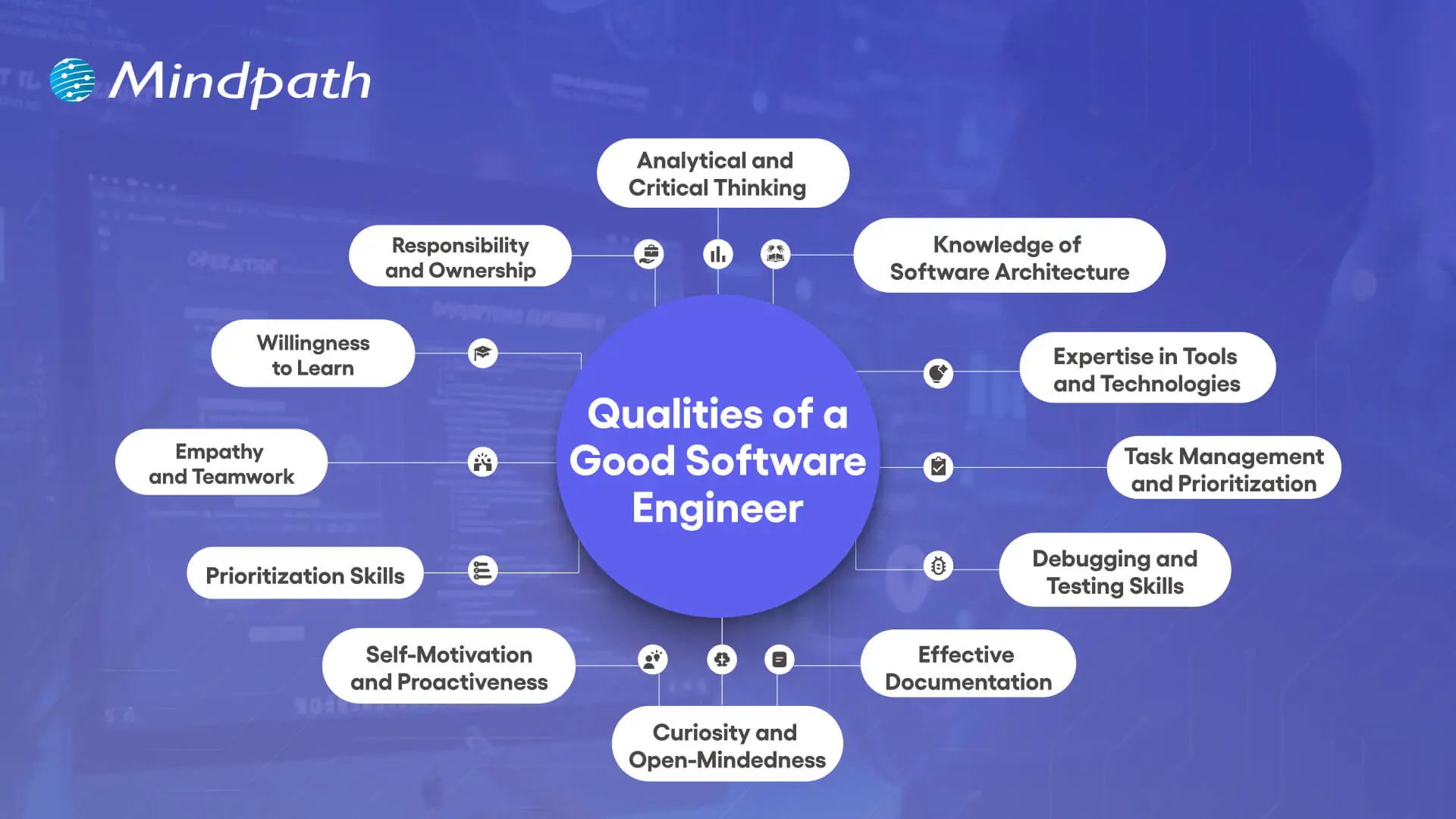
Qualities of a Good Software Engineer

1. Analytical and Critical Thinking

A great quality of a good software engineer is having analytical and critical thinking skills. Software engineers often work on unfamiliar systems with very little direction, so understanding how to break the system down into its components is helpful in realizing how the system really works. In doing this, the software engineer can recognize large patterns, see how inputs and outputs follow, and find a way to add value to the solution.

2. Knowledge of Software Architecture

Being knowledgeable about software architecture is an important software engineering characteristic that enables solid system designs. Engineers need to understand the flow of data through a system and how each element transforms that data. That knowledge supports engineers in building robust systems by allowing them to select the best architectural pattern that will last into the future.

3. Expertise in Tools and Technologies

It is a powerful strength of a software engineer to know development tools and alternative technologies. Software engineers need to investigate new options, balance trade-offs of risks to benefits on each alternative technology, and pivot accordingly to use the development tools that best contextual fit the immediate problem. If only to remain curious and current, software engineers have the opportunity to not make archaic choices.

4. Task Management and Prioritization

Managing multiple projects effectively is a key characteristic of a software engineer. All engineers perform some form of balancing act between regular day-to-day items and urgent tasks, including outages or bug fixes. With a little planning and prioritization, engineers can respond to urgent tasks while maintaining a steady pace on all projects.

5. Debugging and Testing Skills

Debugging and testing form an essential part of the qualities of a good software engineer. Engineers often occupy their time to sustain and upgrade developed projects; thus, referencing the strengths of their debugging skills will allow them to get to the root of an issue efficiently and start unpicking it. Testing will confirm that the software is functioning according to the specifications, while it will also reduce any risk of surprises.

6. Effective Documentation

Good documentation is an often-neglected, but vital, characteristic of software engineering. Engineers who write and update their documentation when they develop and change the software make it easier for others to understand the system and maintain it later. Good documentation, where records are kept clearly and accurately, will help reduce confusion, save time, and enhance collaborative efforts across teams.

Curious about the different kinds of software a skilled engineer might work on? Explore the various types of software development and see how each requires unique skills and expertise.

7. Curiosity and Open-Mindedness

Curiosity and open-mindedness are important qualities of a good software engineer because technology moves quickly. Great engineers investigate different ways of doing things, accept new ideas, and change how they do things – every time the new way is better. This mindset propels the innovation needed to successfully help teams solve problems.

8. Self-Motivation and Proactiveness

A successful software engineer is a self-starter who is proactive in identifying threats to successful project outcomes before they turn into large problems. Successful software engineers seek out opportunities to solve problems rather than waiting for someone to instruct them or blindly ignoring a potential risk altogether. A proactive software engineer can help dramatically improve team performance and produce better long-term project outcomes.

9. Prioritization Skills

Tremendous prioritization skills are a functional strength of a software engineer. Since not every task becomes urgent, engineers must focus on how to properly handle critical issues versus long-term goals. When the decisions are made competently enough, all teams can focus on issues that need immediate resources.

10. Empathy and Teamwork

Teamwork and empathy are defining qualities of a good software engineer in collaborative environments. Clear communication, attentive listening, and being mindful to consider the viewpoint of others are important to collectively solving problems as a team. These interpersonal skills cultivate healthier team dynamics and improve the likelihood of successfully completing the project.

11. Willingness to Learn

Having humility is a powerful software engineering characteristic, as no one can know everything in such a broad discipline. Engineers who are open to feedback and learn from others use their time wisely and bolster their skills. When an engineer is humble, they help cultivate stronger, more supportive teams that drive performance.

12. Responsibility and Ownership

A positive sense of responsibility is one key qualities of a good software engineer. Engineers understand their systems very well and will have to take responsibility, whether it be for successes or failures. Being responsible for their thoughts and actions earns engineers trust among the stakeholders that will, in time, improve user experiences.

Want to see how skilled engineers turn concepts into working software? Explore the custom software development process to understand the stages that ensure quality and efficiency.

Ready to Work with Skilled Software Engineers?

The qualities of a good software engineer show how vital they are in shaping ideas into real, impactful solutions. Strong technical skills combined with collaboration, adaptability, and ownership make them essential to building reliable and scalable systems. These qualities ensure not only innovation but also long-term success in today’s competitive and constantly changing digital landscape.

At Mindpath, our custom software developers bring these qualities into every project. They combine expertise, curiosity, and responsibility to create solutions tailored to your business needs. By focusing on innovation, reliability, and long-term value, our team ensures that your ideas are developed into secure, scalable, and user-friendly software designed to drive growth and meet evolving market demands.

Frequently Asked Questions

1. How do the qualities of a good software engineer impact the success of a business project?

Engineers who combine technical depth with strong communication and ownership tend to deliver more reliable results. Their ability to spot risks early, collaborate well, and take responsibility for outcomes directly reduces project delays and helps businesses achieve their goals more consistently and efficiently.

2. Is technical expertise more important than soft skills when evaluating a software engineer?

Both matter equally in practice. Technical skills get the work done, but soft skills determine how well an engineer collaborates, communicates issues, and adapts to change. Companies that prioritize only technical ability often struggle with team friction and missed expectations, especially in complex or long-term projects.

3. How can businesses identify strong software engineering qualities during the hiring process?

Look beyond the resume by including practical assessments, real-world problem-solving scenarios, and behavioral interview questions. How a candidate explains their past decisions, handles ambiguity, and collaborates during the process often reveals more about their actual qualities than technical tests alone.

4. Can a software engineer with strong qualities make a real difference in a small business environment?

Absolutely. In smaller teams, each engineer carries more responsibility across different parts of a project. An engineer who is proactive, self-motivated, and takes full ownership can have an outsized positive impact, often driving progress that would otherwise require a much larger team to achieve.

5. How important is documentation as a quality in software engineers working on long-term projects?

It is often undervalued but critically important. Poor documentation slows down onboarding, creates confusion during handovers, and makes maintenance harder over time. Engineers who document their work clearly save teams significant time and reduce the risk of costly errors as projects grow in scale and complexity.

applications of AI in education

The traditional classroom is rapidly evolving into digital learning spaces, where technologies like AI play a major role in transforming education. Artificial intelligence is changing how educators teach and how students learn in schools, colleges and universities. On top of it, the applications of AI in education have also revolutionized the conventional approaches for managing educational institutions.

Artificial intelligence will not only serve as an invaluable partner for students and educators but also change the traditional perspectives on education. AI can provide opportunities for personalized learning alongside enhancing administrative efficiency. Let us discover some of the top use cases of AI in education with real-world examples.

Planning to use AI to make learning more personalized and efficient? At Mindpath, our AI development services can help you design and deploy smart tools tailored to your educational needs.

Significance of AI for Education

The importance of education for the progress of our society can never be undermined in any circumstance. However, the formidable challenges faced by the education industry create roadblocks for growth. The prominent challenges that call for adoption of artificial intelligence in education include rising administrative burden, shortage of teachers and decline in student performance. Artificial intelligence offers innovative educational solutions to these problems and serves promising benefits to the education industry.

The uses of artificial intelligence for education can revolutionize the industry while empowering learners and educators. For instance, AI can improve learning outcomes for each student through comprehensive analysis of their strengths, weaknesses and learning styles. AI can help in creating adaptive learning systems that ensure real-time modification of learning resources with the right difficulty level.

AI is also important for education from the perspective of teachers as artificial intelligence can enable automation of administrative tasks such as grading, lesson planning and attendance tracking. The uses of AI in education also focus on the capabilities of AI to analyze large volumes of student data. As a result, AI can enable effective decision making and draw valid conclusions about student performance.

Want to understand the broader education trends driving digital transformation and AI integration? Discover the top emerging trends in education and technology. 

Unraveling the Notable Use Cases of AI for Education

The blend of artificial intelligence and education can indicate the beginning of a new phase for the industry. You can notice different use cases of AI in hospitality, finance or transportation establishing new benchmarks in various areas. Similarly, you can also expect AI to create a revolutionary impact in the education sector. The following use cases of AI along with some real-world examples can help you understand how AI will transform education.

1. Personalized Learning

One of the foremost additions among the use cases of AI in the domain of education focuses on personalized learning. As a matter of fact, it is the most common use of AI in education all over the world. Artificial intelligence can help educators in delivering customized lessons and learning resources to students. On the other hand, students can enjoy the benefits of adaptive learning where educational content adapts to their needs while fostering better understanding and retention of content.

The most prominent example of AI use cases in personalized learning is Knewton. The platform uses AI for personalizing education alongside helping students learn at their own pace and addressing individual learning gaps. Knewton has successfully delivered almost 15 billion personalized recommendations for learners in more than 300 institutions.

2. Intelligent Tutoring Systems

The next notable application of artificial intelligence in the education industry points at intelligent tutoring systems. The primary functionality of these tutoring systems revolves around offering real-time guidance, practice exercises and feedback. Most of the intelligent tutoring systems showcase the convergence between AI and education in innovative ways. Intelligent tutoring systems work by simulating the behavior of a human tutor, offering step-by-step lessons and tracking the performance of learners.

One of the notable examples of intelligent tutoring systems is MATHia by Carnegie Learning. It is an intelligent tutoring system that teaches mathematics to middle and high school students. With the power of AI, the intelligent tutoring platform adapts to different learning paths and offers real-time feedback alongside adjusting lessons to the skill level of learners.

3. Breaking the Language Barrier

If you want to know about the broader implications of artificial intelligence for education, then you must know how AI breaks language barriers. Among the multiple examples of AI used in education, you will find platforms like Duolingo changing global education. You don’t have to struggle for months to learn a new language when you have AI to personalize the learning process.

AI systems can measure your proficiency, learning pace and pronunciation in a specific language. Based on the data obtained for every learner, AI systems can recommend customized lessons, grammar explanation and vocabulary practice. The facility of immediate feedback on grammar and pronunciation can help learners correct their mistakes immediately and learn faster.

4. Automation of the Admission Process

Generative AI systems can use natural language processing to extract accurate insights from application data in seconds. The systems can automate the decision-making processes for admission of new students based on academic performance and past data. The automated admission process is one of the prominent artificial intelligence applications in education as it can help educational institutions find the top talent. AI plays a major role in removing human biases from the admission process thereby ensuring an impartial screening procedure.

The best example of using AI to improve admission processes is Hampshire College, which achieved a 61% increase in enrollment. The college used generative AI tools to predict admission trends and optimized recruitment methods based on meaningful insights. Educational institutions can build more trust with an efficient and transparent admissions process that reduces administrative burden alongside elevating the standards of student selection.

Struggling to understand the real impact of AI in educational decisions? Explore this detailed guide on AI decision-making use cases to see practical examples and insights.

5. Managing Scholarships and Financial Aid

Educational institutions can also rely on artificial intelligence to ensure effective management and distribution of financial aid and scholarships. AI can help in achieving systemic equity and efficiency in the management of financial aid and scholarships. AI systems can ensure faster assessment of financial aid applications with special attention to factors like income level, family history, demographic information, and academic performance.

Machine learning algorithms can ensure significant reduction in human bias and processing time. The automated analysis of scholarship applications through AI systems offers a data-driven approach to the verification process. AI can also handle other tasks, such as discovering qualifying students by comparing their profiles with available funds. Accurate forecasts for financial aid requirements also provide the ideal foundation for proactive budget management.

6. Education Supply Chain Optimization

Most of the discussions about using AI in schools focus on the advantages of personalized learning and reducing administrative burden on educators. On the other hand, you must also know how artificial intelligence has been transforming supply chain management for educational institutions. Generative AI tools can help in automation of the procurement process and streamlining supply chain management.

Proactive AI systems can place orders in advance by forecasting future demand for resources such as textbooks, digital tools and lab equipment. The predictive capabilities of generative AI allow it to ensure accurate adjustments in supply levels. AI systems can also leverage real-time tracking to detect supply chain bottlenecks. The University of Michigan is one of the notable examples of educational institutions embracing AI to improve supply chain management.

Wondering which AI breakthroughs are driving change in education today? Read about emerging generative AI trends and how they are being applied across industries.

7. Smarter Feedback and Assessment

The traditional approaches for assessment might consume more time of educators and students experience delays in receiving feedback. Artificial intelligence can create possibilities for faster and smarter assessment. One of the notable additions among examples of using AI for smarter feedback is Cognii. The virtual learning assistant of Cognii offers real-time feedback for open-ended answers alongside ensuring 96% accuracy in grading essays.

Tools like Cognii utilize natural language processing and machine learning for assessment of grammar, syntax, concept hierarchy and semantics. As a result, teachers don’t have to worry about effectiveness of student performance assessment in different academic tasks. Educators can use the additional time to provide more qualitative feedback to students and address systemic issues to address weaknesses.

8. Enhancing Accessibility of Education

You cannot think of the advantages and disadvantages of AI in education without learning about the impact of AI on accessibility of education. Artificial intelligence can serve as a valuable tool for driving different assistive technologies that can help students. For instance, AI systems can convert written text into voice notes for visually impaired learners. Similarly, AI can also ensure transcription of lecture videos into text thereby helping learners with hearing difficulties.

Microsoft Live is one of the top examples of using AI to remove accessibility barriers in education. It can help with real-time translation of classroom instructions and lectures in the native languages of learners on their devices. As a result, non-native speakers will not face troubles during learning thereby ensuring an inclusive learning environment.

Curious how AI-powered tools are making classrooms more interactive and personalized? Read our in-depth guide on Chatbots in Education to see real-world use cases.

Ready to Transform Education with AI-Driven Innovation?

Artificial intelligence is reshaping education by enabling personalized learning, improving accessibility, and automating administrative tasks. From smarter assessments to adaptive systems, AI empowers educators and students alike, creating efficient, engaging, and data-driven learning experiences that support long-term academic success.

At Mindpath, we offer AI development services designed for the education sector. Our experts build intelligent, scalable solutions that enhance learning experiences, streamline operations, and improve outcomes. Partner with us to implement customized AI tools that drive innovation and deliver measurable educational impact.