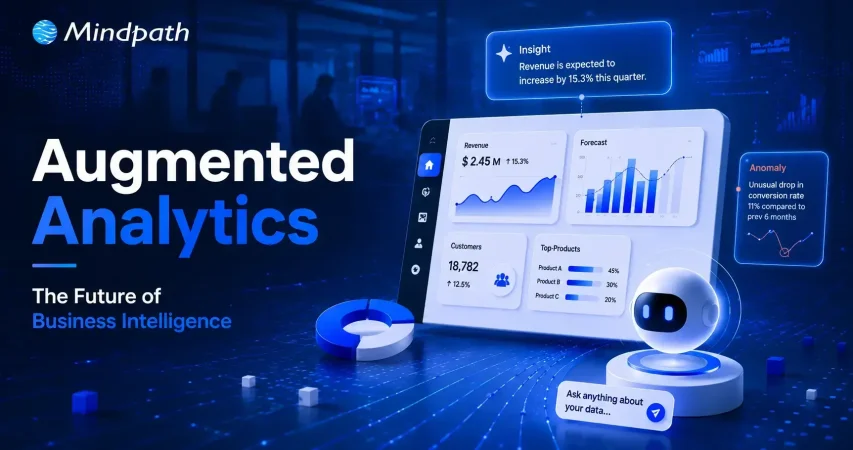
Augmented Analytics – The Next Big Leap in Business Intelligence 

Home

Augmented Analytics – The Next Big Leap in Business Intelligence 

Augmented Analytics – The Next Big Leap in Business Intelligence 

Join our Newsletter!

Augmented Analytics 

 In today’s world, businesses produce more data than ever. However, even the best teams often still find it hard to make decisions based on that data. This is where augmented analytics comes in. It combines artificial intelligence and machine learning with traditional business intelligence. This translates into smarter, faster and more accurate analysis for all.

Then, why is this change important for contemporary businesses? Traditional BI tools were developed with the analyst in mind. Augmented analytics is about to alter all this. It enables every team member to be able to explore the data themselves. No coding, no complex queries, no delay in reporting. The potential for productivity, direction, and development is huge. This blog examines what augmented data analytics really represents, why it’s so relevant today and how it’s changing the future of AI.

Ready to turn your business data into smarter decisions and real growth opportunities? Mindpath offers AI development services to help you build intelligent analytics solutions that deliver meaningful insights.

What is Augmented Analytics?

Augmented analytics is the use of artificial intelligence, machine learning, and natural language processing to automate data preparation and insight generation. It removes technical barriers for everyday business users. Anyone can now explore data, spot trends, and draw conclusions. This is the foundation of modern advanced data analytics.

Simply put, augmented data analytics enhances human intelligence. It does not replace analysts. Instead, it empowers them to work smarter and faster. Non-technical users can ask questions in plain language and get instant answers. Decisions become quicker, more accurate, and rooted in real data. That shift changes everything for businesses today.

How Augmented Analytics Works?

Augmented analytics starts by automatically cleaning and connecting data from multiple sources. From there, users simply ask questions in plain language and get instant answers.The driving force behind this is AI-Powered Analytics, which leverages machine learning to inspect the data and identify patterns, trends, and irregularities without any manual intervention.

Afterwards, the machine converts complicated insights into straightforward, graphical descriptions that are comprehensible to everyone. Also, it keeps on learning from user interaction and enhancing its recommendations. Thus, the final outcome is rapid, intelligent, and highly-tailored insights produced in a matter of minutes instead of days.

Key Benefits of Augmented Analytics for Businesses

Smart data analytics is transforming how businesses understand and act on their data. Here are the major benefits of augmented analytics that are driving this transformation across industries today.

1. Accelerated Time-to-Insight

Preparing data manually often took several days. However, augmented analytics by automating the entire workflow removes delays and delivers on-the-spot insights precisely when companies most rely on them.

2. Democratization of Data

It is unrealistic to expect all the team members to be fluent in the language of data science. Thanks to natural language queries, practically any member of the team can type out their questions in simple English and receive instant factual answers.

3. Enhanced Decision-Making

Making decisions based on old reports leads to a reactive business that will eventually lose the race. What AI in analytics offers is the capability of uncovering hidden patterns and unusual events, which ultimately results in more intelligent and preemptive decisions.

4. Improved Productivity

Preparing data is undeniably the largest part of the time data teams spend. Augmented analytics, by automating these processes, liberates analysts from routine tasks so that they can concentrate on strategic planning and creative work.

5. Reduced Analytical Bias

Because of human nature each interpretation can be different and therefore from some level subjective. Machines, on the other hand, follow strict rules and do not deviate. Therefore, when they are used to analyze the data, it becomes more consistent and trustable.

6. Advanced Forecasting and Modeling

The ability to forecast is at the core of any business planning. Business executives leveraging AI-driven predictions can be highly confident about their supply chain, inventory, and financial decisions.

7. Cost Savings

The role of augmented analytics in business intelligence goes beyond insights. It simplifies the whole analytics process, thus reducing labor and operational costs across different departments.

Real-World Augmented Analytics Examples

Augmented analytics is already making a measurable impact across industries worldwide. Here are some real-world examples of how businesses are putting it to work today.

1. Sales Pipeline Risk Detection

Losing a deal late in the cycle is costly and often avoidable. AI analyzes deal velocity and engagement patterns in real time, giving sales leaders early warnings before opportunities slip away.

2. Employee Attrition Prediction

HR teams in large enterprises can now get ahead of talent loss before it happens. AI analyzes employee behavior and tenure patterns to flag individuals most at risk of leaving the organization.

3. Smarter Demand Forecasting

Supply chain disruptions often stem from poor demand visibility. Using augmented analytics tools, logistics and retail businesses continuously adjust forecasts based on real-time signals and external market data.

4. Intelligent Inventory Management

Overstocking and stockouts both hurt retail profitability. AI analyzes customer buying patterns automatically and adjusts stock levels, helping retailers reduce waste and meet demand more consistently.

5. Predictive Equipment Maintenance

Unplanned downtime is one of the biggest cost drivers in manufacturing. AI monitors equipment data continuously and predicts potential failures before they occur, keeping production schedules on track.

6. Real-Time Fraud Detection

Financial institutions process thousands of transactions every single day. AI scans that data in real time, flagging suspicious patterns instantly and significantly strengthening fraud prevention capabilities.

Is Your Business Ready to Embrace Augmented Analytics?

The use of data by enterprises is rapidly evolving and Augmented Analytics have become a reality. Those organizations that invest in them early will be able to make more informed decisions, get ahead of the competition and be more agile effectively.

Mindpath offers AI development services to assist companies in discovering the real potential of their data. We develop smart and robust solutions customized to your objectives. Contact us now and we will guide you through the new beginnings.

Frequently Asked Questions

1. Is Augmented Analytics only useful for large enterprises?

Not at all. Businesses of every size can benefit. Small and mid-sized companies often see the biggest impact because they have fewer dedicated analysts. Augmented analytics fills that gap without requiring a large data team.

2. How is Augmented Analytics different from traditional business intelligence?

Traditional BI shows what happened. Augmented analytics explains why it happened and predicts what comes next. The difference is automation and intelligence. It removes the need for manual analysis and delivers faster, deeper insights automatically.

3. Do employees need technical training to use these tools?

Minimal training is needed. Most augmented analytics platforms are built for everyday business users. Natural language querying means anyone can ask questions and get answers without knowing SQL, coding, or data modeling.

4. How long does it take to see real results after implementation?

Results can appear within weeks, not months. Once the system connects to existing data sources, it begins surfacing insights almost immediately. The timeline depends on data quality and the complexity of the business environment.

5. What industries benefit the most from augmented analytics today?

Finance, retail, healthcare, manufacturing, and marketing are seeing the strongest results. However, any data-driven industry gains value from it. The more data a business generates, the greater the impact augmented analytics delivers.

Related Post

AI integration in business

Artificial intelligence is one of the most powerful technologies for business transformation in 2026. As more examples of AI integration in business come to the limelight, business owners and managers want to discover effective ways to embrace AI. Businesses have been adopting AI not only to automate tasks but also to find new solutions to foster innovation, enhance process efficiency, and drive customer engagement.

Organizations have been using AI in different capacities for over a decade, and the success of their AI initiatives paved the path for broader adoption. You can come across different use cases of AI in the domain of business, ranging from predicting market trends to developing marketing content. Let us find out how AI use cases deliver results for businesses in the real world. 

Watching the use case of AI is not enough; want to adopt AI for your business? Mindapth, an AI development service provider, has expertise in providing intelligent solutions that help businesses move towards real-world success.

Is AI Important for Businesses?

The biggest concern for any business in the existing technological landscape is about AI adoption. While AI use cases in business have been delivering promising results, business owners want to find out whether AI is necessary for their business. How will a business embrace AI? Artificial intelligence is still an elusive concept for many business owners owing to a lack of awareness. As a matter of fact, many people believe that the use of AI in business is only about automation. On the contrary, the utility of AI in business revolves around leveraging machine learning, natural language processing, and other AI technologies to streamline operations. 

You can discover numerous use cases of artificial intelligence for business that help in resolving challenges in different departments. For example, AI can enhance customer satisfaction levels, enable intelligent workflows, and reduce the time invested in repetitive tasks. The applications of AI in almost every department of an organization, such as sales, customer service, and operations, lead to results that add more value to the business.  

Must Read: Challenges in AI Adoption and How to Overcome Them

Unraveling the Top Use Cases of AI for Business

The advantages of AI for business in different real-world use cases encourage more companies to integrate AI into their operations. Artificial intelligence not only powers personalized ads and consumer-facing technologies like Alexa but also revolutionizes how businesses work, compete, and innovate. According to a survey by EY, almost 72% of executives have reported that employees use AI every day in the workplace for tasks like communication, software development, and data analysis (Source). The following real-world AI use cases will offer the best insights into the utility of artificial intelligence in the business landscape.

1. Enhancing Process Efficiency

Artificial intelligence helps in achieving significant improvements in the operational efficiency of businesses. AI plays a crucial role in automation repetitive tasks and optimizing resource allocation, thereby reducing waste. Artificial intelligence tools help in cutting costs and also contribute to the bottom line of a business. For instance, supply chain optimization tools can leverage AI to draw accurate predictions for demand and optimize the inventory.

Business leaders can also utilize AI business applications for the automation of document processing tasks, which are generally repetitive in nature. Automation of invoice processing and data entry offers an easy solution to enhance operational efficiency. On top of it, businesses can also enhance process efficiency through the use of AI in energy management. AI-powered solutions can analyze patterns of energy usage and automate processes like lighting, heating, and cooling according to usage trends.    

2. Improved Workplace Productivity

The automation capabilities of artificial intelligence can also serve a crucial role in enhancing workplace productivity. Employees can use AI for automation of repetitive tasks that consume a lot of time, thereby finding the time to focus on strategic tasks. At the same time, the benefits of AI in business point to how employees can make more informed decisions with AI. Virtual meeting assistants are the most promising example of embracing artificial intelligence to make informed decisions. 

AI tools can not only provide meeting transcriptions but also a summary of key points in the meetings. As a result, employees can focus on activities that bring more value to their organization. Artificial intelligence tools for task automation also serve as useful choices for the automation of project management workflows. For instance, Google Smart Compose allows employees to use AI for writing emails faster with better accuracy. Therefore, employees don’t have to waste a lot of time getting their emails right without compromising the quality of communication.

Curious about the different AI approaches companies are using today? Check out the types of AI and discover how they power automation, analytics, and customer engagement.

3. Predictive Analytics

The next most popular use case of artificial intelligence in the modern business landscape is predictive analytics. Companies can use AI for business growth by analysing historical data, identifying patterns, and predicting future outcomes. Businesses have been adopting AI to make smarter decisions, whether it is about identifying customer needs, reducing risk, or optimizing inventory. Artificial intelligence can tap into the power of advanced algorithms and real-time data streams to empower businesses with insights that help them make proactive decisions.

The utility of AI in predictive analytics not only helps in making informed decisions but also improves efficiency and empowers businesses to deliver better customer experiences. The value of AI for decision makers is visible in examples across retail, finance, and healthcare sectors. AI-powered predictive analytics can help businesses in the retail sector forecast demand and optimize their inventory to avoid running out of stock. Similarly, healthcare companies can use AI predictive analytics to evaluate patient history and determine the risk of diseases.       

4. Content and Product Development

Artificial intelligence gained significant popularity owing to the arrival of generative AI tools. One of the most notable use cases of generative AI is content development, which can help businesses in many ways. The curiosity to learn how businesses use AI will also point to how artificial intelligence can help in generating content, product designs, and functional prototypes for product development. As a matter of fact, many businesses already use generative AI in marketing, product innovation, and software development. 

The use cases of AI in marketing content generation involve creating blog posts, personalized emails, ad copies, and product descriptions. Businesses can also create custom training content and simulations with the help of generative AI. Artificial intelligence also provides a new direction for approaches to creating e-commerce product content based on customer behavior trends. On top of it, generative AI can offer product ideas, creative concepts, and UI mockups according to user instructions.

Want to accelerate content production and streamline coding tasks in your business? Discover generative AI tools for content creation and code creation to learn how they boost efficiency and creativity.

5. New Benchmarks of Security

The biggest impact of artificial intelligence in business is visible in the domain of cybersecurity. The advantages of AI integration in business can help in fighting against emerging security threats. Artificial intelligence can serve as a protective layer for businesses by improving threat detection capabilities with seamless analysis of datasets to recognize potential anomalies and risks of breaches. The proactive approach to cybersecurity with AI empowers businesses to respond quickly and address risks before they inflict damage. 

Artificial intelligence can not only enhance detection but also facilitate automation of incident response and alerting mechanisms. As a result, businesses can reduce the burden on security teams by initiating countermeasures instantly. AI-powered simulations can also help businesses strengthen cybersecurity training and enhance their overall resilience. For instance, AI tools can detect fraudulent transactions and anomalies in user behavior for better security in finance. 

6. Talent Acquisition and Management

Managing talent is one of the formidable challenges for business owners. Starting from the process of attracting talent to retention, businesses can use AI to empower their workforce with skilled resources. The different examples of AI implementation in companies showcase the automation capabilities of AI. Businesses can use AI-powered automation in different steps of the talent management cycle. 

The use cases of AI for talent acquisition point to the use of AI tools for resume and portfolio analysis. In addition, recruiters can also use AI to review video interviews of candidates. The comprehensive assessment with AI helps in identifying the right talent for a company. Artificial intelligence also helps in boosting employee retention, as evident in the example of LinkedIn Talent Insights. It uses AI to offer accurate predictions for employee attrition rates and also offers recommendations to enhance employee retention.

Planning to integrate AI into your business strategy but unsure where to start? Discover AI solutions for small businesses and startups to learn how tailored technologies can deliver measurable results.

Want to Harness AI to Drive Real Business Growth?

The applications of artificial intelligence in the business landscape have helped business owners discover new perspectives on efficiency and innovation. As the demand for digital transformation with AI continues to gain momentum, more businesses will join the bandwagon. However, professional assistance can help a business identify the ideal strategic approach to leverage AI for its operations.

We at Mindpath have helped thousands of clients with AI adoption in different business departments. Our experts specialize in end-to-end AI solutions, and the experience of serving a wide range of clients enhances our strengths. We are committed to understanding the client’s requirements and vision to help them achieve the best outcomes for their business with AI. Consult with our experts and find the ideal use cases to embrace AI in your business right now.

Hire ReactJS Developers in California
Are you looking for top ReactJS developers in California to build a high-performance web application? Do you need experts who can create scalable, fast, and user-friendly solutions? Finding the right developers can be challenging, but with the right approach, you can hire the best talent to bring your vision to life. California is home to some of the greatest ReactJS developers, making it an excellent location to discover top talent for your web development requirements. Whether you’re creating a dynamic web application, a complicated business solution, or improving an existing platform, hiring talented ReactJS developers can help you create quick, scalable, and user-friendly solutions. With the increasing need for high-performance web applications, organizations want developers that can use ReactJS to provide seamless user experiences. California’s booming technology ecosystem gives access to seasoned individuals who understand current development trends, best practices, and industry standards. Hiring the proper ReactJS developers ensures that your project is constructed for efficiency, adaptability, and long-term success. Let’s explore how you can find and hire skilled ReactJS developers in California for your project!

Steps to Hire ReactJS Developers in California

1. Define Your Project Needs

To hire a ReactJS developer in California, begin by describing the sort of application you want. Whether it’s an e-commerce platform, a SaaS solution, or a business tool, having a clear vision helps you choose the best developer. List the project’s needed features and functions, such as user authentication, payment processing, and real-time updates. A well-defined feature list helps the developer grasp the scope of work. Creating a budget and project timeframe is also essential. Determine your investment budget and set timeframes for development milestones. A well-structured budget and timetable serve to expedite the recruiting process and guarantee that everything runs smoothly. By carefully outlining your project requirements, you can discover a ReactJS developer with the required competence to produce a high-quality, scalable, and efficient application.

2. Write a Clear Job Description

A well-written job description will help you recruit the best ReactJS developers in California. Clearly define the project details, such as the sort of application being built and the intended results. Define important duties to help applicants understand their involvement in the project. Specify the fundamental abilities necessary, such as knowledge of ReactJS components, state management, and hooks. If the project requires complicated functionality, it includes extra abilities such as Redux, TypeScript, or API integration. Indicate your desired experience level: junior developers for easier duties, mid-level for greater responsibilities, or senior developers for advanced problem-solving and leadership. Providing this transparency helps you obtain applications from the most qualified people. A well-structured job description simplifies the hiring process, making it simpler to identify a developer who suits your project requirements and technical expectations.

3. Source Qualified Candidates

Finding the best ReactJS developer in California begins with looking in the proper locations. Use employment boards like LinkedIn, Indeed, and AngelList to connect with competent developers who are actively searching for work. These systems enable you to screen individuals based on their experience, talents, and location. Networking is also a good approach to uncover great talent. Engaging with industry leaders, attending tech meetings, and joining online developer groups can lead you to competent ReactJS developers through recommendations and referrals. Working with specialized tech recruiting companies is a more targeted strategy. These agencies have access to pre-screened candidates, which saves time and effort during the hiring process. Using numerous sourcing techniques, you can locate highly competent ReactJS engineers who meet your project’s demands and technical specifications.

4. Screen Resumes and Portfolios

Once you’ve compiled a list of possible ReactJS developers in California, evaluate their resumes and portfolios. Look for applicants that have hands-on expertise with ReactJS and are familiar with major frameworks like Redux, Next.js, and TypeScript. Examine their previous projects to determine their technological competence. A successful portfolio should include well-structured, useful, and responsive apps. Pay special attention to projects that exhibit proficiency in creating reusable components, maintaining state effectively, and integrating APIs. Assess their knowledge of JavaScript foundations, as ReactJS depends significantly on JavaScript principles such as ES6 capabilities, asynchronous programming, and DOM manipulation. Candidates with strong JavaScript skills are more likely to manage complex development tasks effectively. With rigorous portfolio and resume screening, you may create a shortlist of the most skilled developers who have the right experience and technical expertise for your project.

5. Conduct Technical Assessments and Interviews

After selecting applicants, the following stage is to assess their technical talents and problem-solving ability. Conduct code challenges to assess their ReactJS competency, with an emphasis on component development, state management, and performance optimization. Evaluate their abilities to build clean, efficient, and scalable code. In the interview, ask technical questions on essential ReactJS concepts including the virtual DOM, JSX, lifecycle methods, and hooks. Understanding the principles is critical for creating high-quality apps. Beyond technical competence, assess communication, cooperation, and teamwork abilities. Developers frequently collaborate with designers, backend engineers, and project managers, thus assessing their teamwork skills is essential. Strong problem-solving abilities, effective communication, and adaptability are essential characteristics of a great ReactJS developer. By mixing coding challenges with in-depth conversations, you can confidently select a developer who meets your technical and project requirements.

6. Make an Informed Hiring Decision

After conducting technical tests and interviews, thoroughly analyze each candidate’s overall suitability for the position. Consider their technical proficiency, problem-solving talents, and ReactJS experience. Examine their previous work, coding style, and approach to issues to guarantee they can manage your project’s complexity. Beyond technical knowledge, evaluate cultural fit and collaborative abilities. A developer that shares your company’s beliefs and work environment will be more productive and cooperate with your team. Once you’ve found the ideal applicant, negotiate a salary plan based on their expertise and industry norms. Discuss project expectations, work arrangements, and contract terms to ensure that all parties understand. Complete the recruiting process by establishing onboarding protocols and giving access to relevant tools and resources. A well-designed hiring decision ensures you bring a skilled ReactJS developer on board who can contribute to the success of your project.

Looking for skilled ReactJS developers to build your next project? Mindpath provides top-tier ReactJS talent tailored to your business needs. Our expert developers deliver high-performance, scalable, and user-friendly applications.

Let’s bring your vision to life with the right expertise. contact Mindpath today! to hire the best ReactJS developers in California!

Discover the ultimate guide to hiring Node.js developers in London. Learn about the skills, benefits, and cost factors involved in finding the right talent for your project.

Support Is One Click Away

Featured Posts

Related Post

Discover the ultimate guide to hiring Node.js developers in London. Learn about the skills, benefits, and cost factors involved in finding the right talent for your project.
Get insights on React developer hiring costs, including experience, location, and hiring models. Plan your budget effectively with our comprehensive guide.