Hire Expert NodeJS Developers for High-Performance Apps

Join our Newsletter!

Featured Posts

Support Is One Click Away

Home

Hire Expert NodeJS Developers for High-Performance Apps

Hire node js developers

Hire Expert NodeJS Developers for High-Performance Apps

Recruiting the right talent is the backbone of every successful digital project. That is why many businesses hire Node.js developers to build fast, scalable, and modern applications. Node.js is so popular right now that it’s powering websites and apps around the world, which is a great sign of how trusted and reliable it has become in the tech marketplace. According to recent report by W3Techs, Node.js powers 4.9% of all known websites that are identifiable as running on a web server. Isn’t it exciting to see how the runtime continues to evolve while we get more adoption and verified efficiencies in performance-centric applications?

The gradual rise in Node.js usage clearly indicates just how much impact it makes in the current web development landscape. The capacity to provide reliable and fast applications while being able to handle high volumes of traffic is a strong source of support for businesses looking to grow sustainably. With the right Node.js developers, organizations can convert ideas into reality and create valuable experiences for users. In this blog, we will explore why this is a meaningful choice.

Want to leverage the power of a fast and scalable web application in your next project? Mindpath’s Node.js development services focus on developing reliable and future-ready applications to acheive considerable business growth.

Why Choose Node.js for Your Dream Project?

Node.js is an open-source, cross-platform JavaScript runtime environment that enables developers to run JavaScript on the server-side. It is extremely fast and efficient, and it is a popular way to build modern applications that require high performance. When companies look to hire Node.js developers, they probably need a scalable, reliable, future-ready solution; one that could meet a growing user base with a fast and seamless digital experience.

Node.js delivers strong benefits through its powerful features. Based on Google’s V8 engine, it can deliver real-time, high-performance applications, such as chats, live updates, and streaming. It offers scalability to allow you to handle large amounts of traffic as well as ease of use so that cross-team members can collaborate using the same language, JavaScript. With npm’s large ecosystem, ease of development, and support for microservices, Node.js services provide plenty of flexibility for companies to enable faster innovation and faster time to market with reliable applications.

Benefits of Hiring Node.js Developers for High-Performance Apps

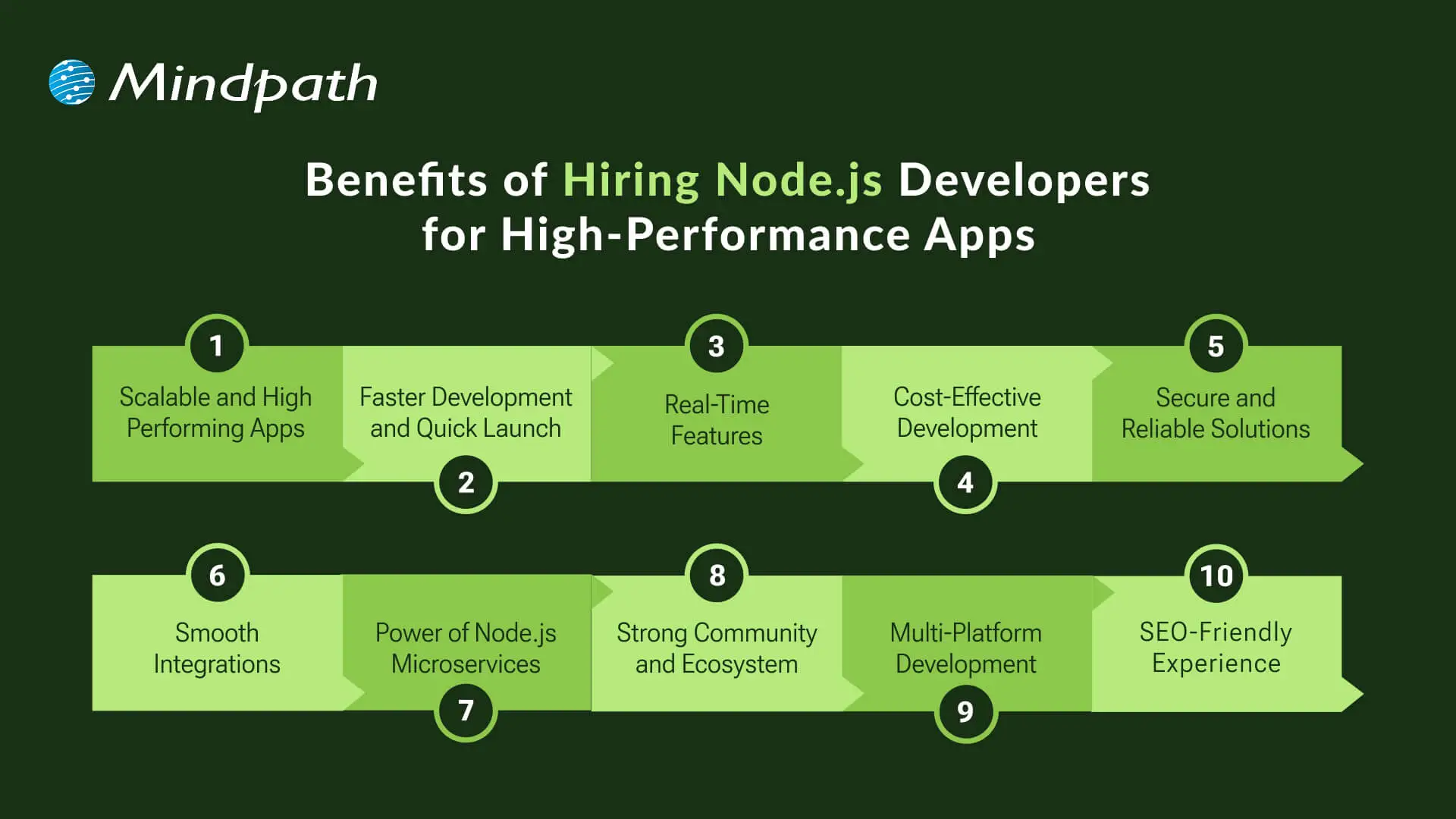
To build high-performance applications, developers need expertise, and Node.js has emerged as a top choice for today’s development projects for many reasons. Here are some principal reasons why businesses choose to hire dedicated Node.js developers for their projects.
Benefits of Hiring Node.js Developers for High-Performance Apps

1. Scalable and High-Performing Apps

Node.js is able to process multiple requests at once using an event-driven and non-blocking model. This makes applications fast and reliable, while also ensuring that they can support high traffic without losing speed. Businesses that hire Node.js developers will be able to make sure that their apps can scale with user demand.

2. Faster Development and Quick Launch

The lightweight structure of Node.js gives the programmer the option of using reusable modules, which allows them to code faster. With npm, programmers have access to thousands of open-source libraries ready to use for database, authentication, and security. Companies that hire expert Node.js developers save time and get products to market faster.

3. Real-Time Features

Node.js makes building real-time applications easy, including chat, notifications, and live updates. With WebSockets, developers can create real-time movement of data between users and servers. When businesses bring in Node.js Developers with some real-time experience, they can provide users with more interactive and engaging experiences.

4. Cost-Effective Development

Because Node.js employs JavaScript on both the front end and back end, one developer can support the entire application with relative ease. Since Node.js applications run easily on a single server, there is less reliance on costly infrastructure. Startups and small businesses benefit the most when they hire Node.js developers to build their applications and grow within a budget.

5. Secure and Reliable Solutions

Node.js can provide a strong security practice, encryption, and authentication for applications and safe API functionality. Skilled coders also work to update applications constantly to protect against breaches and unauthorized development. By getting the right group together, a company will be able to sustain and protect applications over time.

6. Smooth Integrations

Node.js integrates seamlessly with databases like MongoDB, MySQL, and PostgreSQL. It can also easily integrate with front-end frameworks such as MongoDB, MySQL, and Postgres. Cloud makes it easy for Node.js to integrate into AWS or Azure. Node.js removes the technical barriers, allowing developers to develop powerful solutions.

7. Power of Node.js Microservices

Node.js is ideal for modular architectures, where a service operates independently from others. Therefore, developers can scale or upgrade a part of their application independently. With a Node.js microservices approach, businesses benefit from speed, flexibility, and easier maintenance. 8

8. Strong Community and Ecosystem

Node.js is a development community that is increasingly active and improving its ecosystem with more updates and tools. Developers can find quick solutions through community-shared libraries, tutorials, and forums. This means that companies that hire Node.js developers are always relevant and evolving according to modern trends and practices.

9. Multi-Platform Development

Node.js is used by developers to build web, desktop, and mobile application projects (from the same codebase). For instance, Electron is a simple and easy-to-use Node.js-based framework that can run the same code in the same runtime performance consistently across web, desktop, and mobile applications.

10. SEO-Friendly Experience

Node.js, through server-side rendering, allows applications to load faster and be searchable. Improvements in load speed improve user experience and increase visibility on the web. Server-side rendering makes it easier for developers to enjoy the performance and increases search visibility for their applications.

Want to take your Node.js application to the next level, but don’t know how? Learn how AI can help you transform your app with our Ultimate Guide to Node.js Libraries for AI Integration.

Ready to Build High-Performance Apps with Node.js?

Node.js is still emerging as a dependable technology for building fast, scalable, and modern applications. Given its strong features, flexibility, and vast ecosystem, Node.js is undoubtedly one of the top choices in the market for companies that want to provide high-performing digital solutions. By hiring professional Node.js developers, companies get the expertise required to enable developers to bring ideas to life while considering user experience and developing sustainable applications.

Partnering with Mindpath gives you access to trusted Node.js development services tailored to your business goals. You can easily hire remote Node.js developer teams who bring proven expertise and adaptability to every project. With the right talent by your side, you gain the power to innovate faster, scale smarter, and deliver applications that perform at every level.
Related Post

Discover top machine learning applications in 2025 and how businesses can leverage them to innovate and stay ahead in a data-driven world.

Related Post

state management in React

State management is an essential component in developing dynamic and scalable React applications. In React, state is the data that changes over time and influences how components behave and display information. Efficient state management promotes seamless user interactions, improved performance, and simpler application maintenance, particularly as projects get more complex.  

What is State in React?

State is an object that stores dynamic data within a component. Unlike props, which are passed from parent to child components, state is managed within a component itself and can change based on user interactions or other factors. For example, a state can track user input in a form, a counter value, or fetched data from an API. React provides the useState hook to manage state in functional components. When the state changes, React automatically updates the component, ensuring that the UI always reflects the latest data. 

Why is State Management Important?

As applications grow, managing state becomes increasingly difficult. Many components frequently require access to the same data, resulting in concerns such as prop drilling, in which data is sent down via numerous component levels, even components that can skip it directly. As the program grows in size, this procedure can become increasingly onerous and difficult to administer. Furthermore, without adequate state management, changes in one component can cause unnecessary re-renders, resulting in poor performance and delayed user interactions.  

A well-structured state management approach helps: 

1. Improve Performance

React’s state management improves performance by ensuring that only the necessary components of the UI are changed. When data in the app changes, React compares the current and old states and only updates the applicable components. This method is quicker and more efficient than re-rendering the entire application. By minimizing needless updates, the software operates more smoothly and responds better to users. This strategy ensures that the user experience remains quick and fluid as the software grows in size and complexity.  

2. Enhance Maintainability

React’s state management simplifies application maintenance and updates. When the state is appropriately organized, developers can debug and adjust certain components without impacting the rest of the application. This makes it easy to isolate and resolve issues as they emerge. It also enables safer updates, as changes to one component do not disrupt the rest of the program. By making the app’s data flow clear and controllable, developers can add new features or resolve issues more easily, assuring the app’s stability and ease of use throughout time.  

3. Ensure Scalability

State management allows React apps to grow more effectively by organizing the data flow. As the program grows in size, good state management ensures that data is readily exchanged and updated between components. This framework allows you to add new features and components without affecting the existing system. By maintaining data flow explicitly and predictable, state management allows the application to expand easily, handling greater complexity and traffic without performance concerns. It also guarantees that new developers understand and contribute to the project quickly, making growing the app easier in the long term.  

At Mindpath, optimize your app’s state management with our expert React development services

Let’s build a scalable and efficient application—contact us today! 

 Next Up: Learn how to Optimize React Performance for Large Applications in our next blog. 

Master state management in React with this in-depth guide. Learn about local state, global state, and third-party libraries.
Hire nodejs developers

As a result of the rapid evolution of the digital landscape, businesses nowadays want faster, efficient, and more scalable options. This is why many companies choose to hire NodeJS developers who are able to develop high-performing applications without limitations of real-time responsiveness. As businesses compete for efficiency and seamless digital offerings, the demand for NodeJS expertise is increasing. But when hiring a NodeJS Developer, it isn’t just about technical knowledge; it’s about a deeper understanding of your business aims and objectives.

So, how do you make the right choice when the market is filled with so many options? This is the point where many decision-makers stop and consider. With numerous talented developers available, knowing what differentiates the right developer can be a challenge. Filling a role quickly is easy, but finding a developer who contributes positively to your long-term growth is different. Before proceeding to the next step, you should slow down and investigate the key factors to consider in making the right decision.

Looking for a Node.js developer who ensures your app performs at scale without compromising speed and security. HireNode JS developers from Mindpath who strive to provide you the best, world-class solutions.

Who is a NodeJS Developer?

A NodeJS developer is a technical professional who uses Node.js to create fast, scalable applications server-side. They’re responsible for everything from building prototypes to writing clean code that supports applications that power our world. Their responsibilities also include connecting back-end services with front-end systems to provide users with maximum efficiency and reliability.

Node.js developers are crucial for contemporary software projects because Node.js enables developers to utilize one programming language, JavaScript, for both the client side and server side. They develop great solutions thanks to the ability to do it quickly. They also have strong problem-solving skills and know how to utilize this technology to further enhance an application and prepare it for scale.

What are the Responsibilities of a NodeJS Developer?

Companies wanting to grow often look to hire dedicated Node.js developers as part of their technology teams. Node.js developers do more than code; they are an integral part of delivering solutions that will amplify your digital products.

1. Writing Clear Code

When you hire Node.js developers, their job is to write clean and readable code. This will make it easier for other developers to maintain and grow the application.

2. Providing High-Security Features

Security is also a core part of a Node.js developer’s job. Developers need to identify their risks and add features that protect data and users.

3. Detecting Bugs and Issues

Bugs can give rise to slowed-down applications and degradation of performance. NodeJS developers are then also able to quickly identify and fix bugs to maintain stability on the systems.

4. Handling API Integrations

Most modern applications require API integration to add some functionality. Proficient NodeJS developers know how to use API integrations such as HTTP, buffers, and simple file handling.

6. Working with Cloud Technology

When you hire Node.js developers, it is common for these developers to work on the backend and, therefore, will work with cloud deployment. They will configure a cloud platform (such as AWS or Azure) to run the application to ensure it runs properly.

7. Ensuring Database Performance

A Node.js developer will oversee your databases so that the responses are quick. They ensure the back-end interacts with your front-end requests appropriately.

Unlock the new opportunities by Mastering Full-Stack Development with Node.js, the key to building a reliable application. Explore now and elevate your business to the next level.

Key Factors to Consider While Hiring Node.js Developers

Choosing the right talent can dictate whether or not your digital projects achieve ultimate success. If you are going to hire a Node.js developer, here are the important things to keep in mind before you do.

1. Core Knowledge of JavaScript and Node.js

When hiring Node.js developers, the first thing is to check their understanding of the basics of JavaScript and Node.js foundations. They should understand asynchronous programming, Node event loop, and code management through NPM, as well as managing dependencies, which is a large part of the Node.js developer roadmap related to developing scalable applications.

2. Experience with Backend Frameworks

A top-notch developer should really have practical experience with frameworks like Express.js, Koa.js, or Nest.js. The key benefit of these frameworks is that they make projects faster, and framework-less projects have no organization. If you’re hiring Node.js developers, you can easily test their framework knowledge with some simple tasks or some Node.js developer interview questions.

3. Database Handling Skills

All applications require databases, so any competent developer must know their databases MySQL, PostgreSQL, and they must know some NoSQL databases such as MongoDB. They need to understand caching as well as real-time data processing by having basic knowledge of tools like Redis. If you hire a Node.js developer with good database skills, your application will respond faster and stay robust.

4. API Development and Integration

APIs connect applications to additional services, and Node.js is often a popular choice to build those APIs as well. Developers must be familiar with RESTful APIs, GraphQL, and secure protocols like OAuth. Before you hire Node.js developers, be sure to ask them how they create APIs and manage API integration.

5. Knowledge of Git and Version Control

Git is an everyday tool for every developer, and they should be able to manage branches, pull requests, and conflicts without hindering the development. The knowledge of Git is a prerequisite for hiring Node.js developers for teamwork purposes.

6. Strong Security Practices

Security is always a primary concern. Developers need to understand encryption, input validation, and token-based authentication. When employing Node.js developers, look at how they implement these practices to protect applications and sensitive information.

7. Testing and Debugging Skills

Reliable applications need effective debugging and testing. Developers can leverage tools (such as Mocha, Jest, or Cypress) to find bugs early in application development. Knowledge of testing is a vital skill if you are planning to hire Node.js developers to help with long-term applications.

8. Essential Soft Skills

Technical skills are not enough to qualify for Node.js Developer jobs. Communication, collaboration, and problem-solving all make progress much easier on a project. These skills are equally important each time employers hire Node.js developers, as many projects will have challenging aspects.

As user experiences is evolving day by day, businesses need to adopt technologies that ensure speed, scalability, and reliability. Discover how Hiring Expert NodeJS Developers can help you deliver high-performance digital solutions.

Steps to Hire a Node.js Developer

While the search for the perfect talent can seem daunting, breaking the process down into clear steps makes it much easier. Below are the key steps to take when hiring a Node.js developer for your project.

Steps to Hire a Node.js Developer

1. Define Your Needs

Start by defining your project scope, features, and tech stack. When you hire NodeJS developers, identifying clear requirements can save time and attract the right candidates.

2. Choose the Hiring Model

Determine whether you need in-house, remote, or offshore developers. Many companies hire NodeJS developers offshore for more flexibility and lower costs.

3. Write a Clear Job Description

A well-written job description allows candidates to know what they are applying for. Include as much as possible in the description, who you want, including the skills, the experience you expect, and if you are looking for a full-stack Node.js developer.

4. Use Multiple Hiring Platforms

Search for talent on LinkedIn, GitHub, and job boards that identify talented developers. These platforms enable developers to connect because of their special skill set.

5. Test Technical Skills

Evaluate coding expertise with tasks, interviews, or online coding challenges. This evaluates whether the developer can work with Node.js concepts properly.

6. Assess Soft Skills

Good communication and teamwork are as essential as coding, because they also allow the project to flow without delay.

7. Check References and Work Samples

It’s important to understand what the developer has done in the past, so it is good to check references and speak to previous clients or employers. This develops an understanding of the developer’s reliability and quality of effects.

8. Make an Offer with Clear Terms

Discuss salary, benefits, and expectations openly. Transparency builds trust and helps retain the developer.

9. Plan a Smooth Onboarding

Provide tools, resources, and guidance to new hires. A structured onboarding makes developers productive faster.

10. Encourage Continuous Learning

Support your team in learning new Node.js updates and practices. This keeps skills sharp and projects future-ready.

Want to enhance your website presence in today’s fast-paced digital world? Explore our detailed blog on how you can Increase Web Performance with Node.js Development Services.

Looking to Hire Expert Node.js Developers for Your Next Project?

Hiring the right Node.js talent can define the success of your digital projects. Skilled developers bring more than technical expertise; they align with business goals and deliver scalable, secure, and high-performing applications. By following clear steps and evaluating both technical and soft skills, you ensure your projects are built for long-term growth and innovation.

Mindpath stands out as a trusted Node.js development company offering top-tier Node.js development services. With a team of skilled developers, we help businesses build scalable applications tailored to their unique needs. By choosing Mindpath, you gain a partner focused on delivering secure, efficient, and future-ready solutions that accelerate your digital success.

Consider experience with Node.js, JavaScript, databases, APIs, and problem-solving skills when hiring NodeJS developers.
Node js libraries for AI

 As we know, with Node.js libraries, adding AI to your projects is becoming easier. These Node.js libraries for AI can offer you the ability to develop apps that can think, respond, and learn over time. If you enjoy working in JavaScript and you are curious about the new AI features like chatbots, smart predictive features (like those in Google Assistant), and apps that recognize voice input, then now is your chance. You don’t need to begin from scratch. If you use the right libraries, you can build smarter apps at less cost and more value.

These Node.js AI libraries come with beginner-friendly options that are powerful enough for advanced applications. You can add new features such as understanding language, detecting images, or performing machine learning without deep knowledge of AI. They are built to seamlessly integrate into your existing Node.js stack, enabling you to save time and effort in your development workflows. In this blog post, we’ll discuss some of the best libraries to quickly get started with AI in Node.js applications.

Are you looking to elevate your business’s web development with the use of Node.js? At Mindpath, we offer Node.js development services that aim to grow your business by providing reliable and AI-powered web solutions tailored to your unique needs.

Importance of Integrating AI into Node.js Applications

Node.js is increasingly becoming a leading option for creating smart, dynamic applications because it is lightweight and driven by events. Thus, can Node.js be used for AI? Yes, it can! Developers are already using Node.js as an API or tool for AI with tools like TensorFlow.js and Natural. In the 2024 Developer Survey by Stack Overflow, JavaScript continued to be the most popular programming language, which means that Node.js is a great starting ground for AI initiatives.

Integrating Node.js with AI applications allows developers to make applications that change and adapt in real-time. The asynchronous nature of Node.js allows developers to execute several operations simultaneously, making it a good platform for artificial intelligence features like chatbots and live prediction tools. More and more AI libraries support Node.js, as development can happen more quickly. As demand for AI using more efficient and adaptable models rises, Node.js is a new practical, scalable programming option for any developer who wants to create smart digital experiences.

Let us have a quick look at the benefits of integrating AI in Node.js applications:

Benefits of Integrating AI in Node.js Applications

1. Real-time Performance

AI integration with Node.js handles real-time tasks like chatbots and fraud detection efficiently with its non-blocking, event-driven architecture. It supports thousands of concurrent requests, delivering quick and responsive AI features.

2. Unified JavaScript Stack

With Node.js AI integration, developers can use JavaScript for both frontend and backend, including AI features. This reduces context switching and makes the development process faster and more efficient.

3. Fast AI Inference

Node.js runs on the V8 engine, which ensures high-speed execution for AI models. This is perfect for real-time predictions like dynamic pricing or personalized recommendations.

4. Smooth API Integration

Node.js makes it easy to connect with external AI services and pre-trained models through APIs. It works well with AI built in other languages like Python, enabling flexibility in integration.

6. Growing AI Library Support

The Node.js ecosystem offers a wide range of AI libraries via npm, such as TensorFlow.js and ONNX.js. These tools allow developers to implement machine learning directly in JavaScript.

7. Enhanced User Experience

AI features like intelligent chat, personalization, and predictions improve how users interact with your app. Node.js helps deliver these features in a fast and seamless way.

8. Automation and Insights

AI in Node.js apps can automate repetitive tasks and analyze data in real-time. This leads to smarter applications that save time and improve performance.

Looking to streamline your web development in 2025? Check out our blog on Top 25 NodeJS Libraries in 2025 to find the best tools that will help you build powerful and efficient applications.

What are the Top Node.js Libraries for AI Integration?

Building intelligent apps is now simpler with the rise of Node.js artificial intelligence libraries that support machine learning, NLP, and smart automation. These powerful AI Node.js libraries help developers create responsive and data-driven features without complex setups. Here are some of the best Node.js libraries for AI integration:

Top Node.js Libraries for AI Integration

1. TensorFlow.js

TensorFlow.js is one of the top Node.js libraries for machine learning, allowing developers to build, train, and run models entirely in JavaScript. It works both in the browser and with Node.js, making it versatile for a wide range of projects. The library is a good example of how Node.js libraries for AI can power real-world communication tools.

2. Brain.js

Brain.js is a simple neural network library that’s ideal for beginners working on small AI projects. It uses JavaScript to make machine learning accessible without complex configuration. Found in the list of useful npm libraries, it helps developers get started quickly with AI-powered features.

3. Synaptic

Synaptic offers a flexible system for creating different types of neural networks, including feedforward and recurrent ones. It supports supervised and unsupervised learning, giving developers options based on their use case. As one of the advanced Node.js libraries for AI, it works well for experimental and custom AI models.

4. Natural

Natural is a powerful Node.js natural language processing library that provides tools like stemming, classification, tokenization, and sentiment analysis. It’s great for applications that need to work with text data in real-time. This is one of the most complete Node.js libraries for AI when it comes to language-based features.

5. ML5.js

ML5.js is built on TensorFlow.js but focuses on simplicity and creative use, making it perfect for artists, designers, and beginners. It lets you easily create interactive AI experiences on the web. As part of the growing set of npm AI tools, it balances power with ease of use.

6. Neuro.js

Neuro.js focuses on building intelligent features for chatbots and virtual assistants using JavaScript. It’s tailored for tasks in NLP and conversational AI. The library is a good example of Node.js support for AI development in real-world communication tools.

7. Compromise

Compromise is a fast and lightweight library for real-time text processing. It’s designed for performance and currently supports only English, making it efficient for many use cases. As part of the JavaScript libraries used in NLP, it’s a useful choice for developers needing quick language insights.

8. KerasJS

KerasJS is a browser-based library that allows you to run deep learning models built with Keras using JavaScript. It supports several pre-trained models like Inception v3 and ResNet, useful for tasks such as image recognition and sentiment analysis. As one of the top Node.js libraries for machine learning, it offers flexibility for deploying models in web environments, with Node.js support in CPU mode.

9. OpenAI Node SDK

The OpenAI Node SDK helps developers connect easily with models like GPT and Codex for generating text, images, and code. It simplifies integration with OpenAI services using Node.js. Available among advanced npm libraries, it enables powerful generative AI in modern apps.

10. Face-api.js

Built on TensorFlow.js, face-api.js provides tools for face recognition, detection, and expression tracking. It runs on both browsers and Node.js, making it suitable for cross-platform apps. As part of modern Node.js libraries for AI, it brings computer vision capabilities to JavaScript projects.

Choosing the right libraries is just the start; you can also enhance Web Performance with Node.js Development Services, which are built to support advanced AI workflows.

Looking to Enhance Your App with Node.js and AI?

The growth of powerful Node.js libraries for AI integration is making it easier to build applications that think, learn, and adapt. AI libraries will help a developer create smarter, faster, and more sensible digital experiences, from real-time predictions, natural language processing, to so much more. With JavaScript at the core, the path to intelligent development is now more accessible.

At Mindpath, we provide professional Node.js development services for current and future applications that are powered by AI. We build intelligent backend systems, provide seamless API integrations, and build scalable features with Node.js, and when combined with AI, we are empowered to deliver increasingly smarter solutions. If you are looking to build an application soon, then we are ready to provide fast, reliable, and intelligent solutions focused on performance and innovation.

Discover top Node.js libraries for AI integrations and learn to enhance your applications with machine learning, NLP, and more.