Choosing Node JS Development Company: An Ultimate Checklist

Join our Newsletter!

Featured Posts

Support Is One Click Away

Home

Choosing Node JS Development Company: An Ultimate Checklist

node js development company

Choosing Node JS Development Company: An Ultimate Checklist

Imagine you need to create a high-speed, scalable web or mobile app, what technology do you think you should use? Well, most companies will opt for Node.js since it has emerged as one of the leading options in providing high-performance digital solutions. Whether you are starting a new startup or refactoring an existing platform, the success of your project usually begins with selecting the right Node.js development company. But with so many Node.js companies out there, isn’t it difficult to make the right choice? Don’t worry, we’ve got you covered!

This blog offers a nicely constructed checklist through which you can be guided in choosing the optimal Node.js development agency. By following this checklist, you will have some idea and direction during the selection process and also be assured of being aligned with a company that not only meets your technical needs but also comes with you through your long-term success. 

Need professional assistance with your upcoming project? Hire Node.js developers from Mindpath to make sure your application is highly scalable, faster, and high performing.

Understanding Node.js

Node.js is a technology that helps developers create the back end of websites and applications using JavaScript. It is server-side and open source, so programmers can use the same language, JavaScript, on both the front end and back end. It makes the development process easier by making it faster and simpler.

Node.js can handle real-time apps, single-page apps, and applications with a lot of users at the same time. It is used in mobile app development because it has a strong system and beneficial tools. With frameworks like Nest.js, the developer can make elegant, well-structured apps using Node.js. 

Wondering why NodeJS is the preferred choice for modern business applications? Read our blog on advantages of NodeJS for business to discover how it boosts performance, scalability, and development efficiency.

Benefits of Choosing Node.js Development Company

Selecting a Node’s web development company, which is trusted, can make your project faster, smoother and more scalable. With the abilities of Node.js, your app can handle high traffic and real-time updates with ease. Let us look at some of its benefits: 
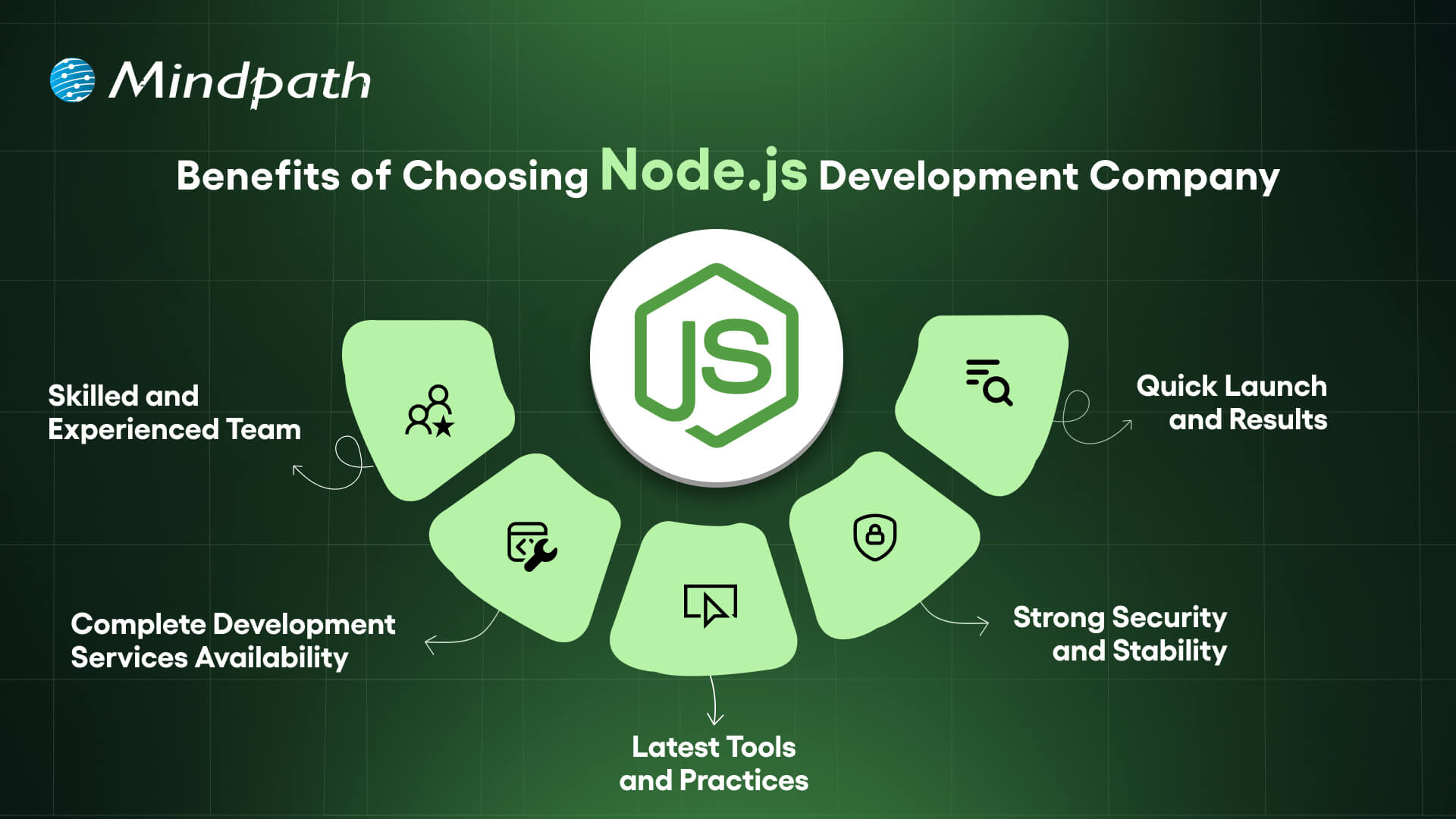
1. Skilled and Experienced Team

A Node.js development firm can bring a team of experts who know how to build strong and flexible applications. They have hands-on experience with different types of projects and can offer smart, custom solutions and their knowledge can also help to avoid mistakes and deliver better results from the start. 

2. Complete Development Services Availability

A Node.js development services provider takes care of everything, starting from the discussion to launching and maintaining your app. You don’t need to work with different teams for each part, which can save a lot of time and effort.  Having all the services in one place keeps your project organized and moving forward smoothly. 

3. Latest Tools and Practices

A trusted Node.js web development company always works with the latest tools, updates, and frameworks as they follow modern development practices to build fast, secure, and scalable applications which means your app will be future-ready and can perform well under changing user needs. 

4. Strong Security and Stability

Security is a top priority for a professional Node.js development agency, and they take steps to protect your app from threats by using tested methods to keep your data safe and your app stable. You can count on them to deliver a secure and reliable product that works smoothly. 

5. Quick Launch and Results

When you hire a Node.js development firm, your project moves quickly from idea to launch as their process is streamlined, so that you can get your product out to users much faster which helps you stay ahead of the competition and respond to the market more effectively. 

Looking to supercharge your applications with AI capabilities? Explore our blog on NodeJS Libraries for AI Integrations to learn which NodeJS libraries can simplify and enhance your AI-powered applications.

By now, you must have had a clear idea about Node.js, so let us learn about the most important topic: 

Key Considerations While Choosing the Right Node.js Development Company

When you are looking for the right company, keep in mind that not all software development companies providing Node.js services are the same. Understanding the following key factors can help you find a team that delivers quality and meets your specific needs: 
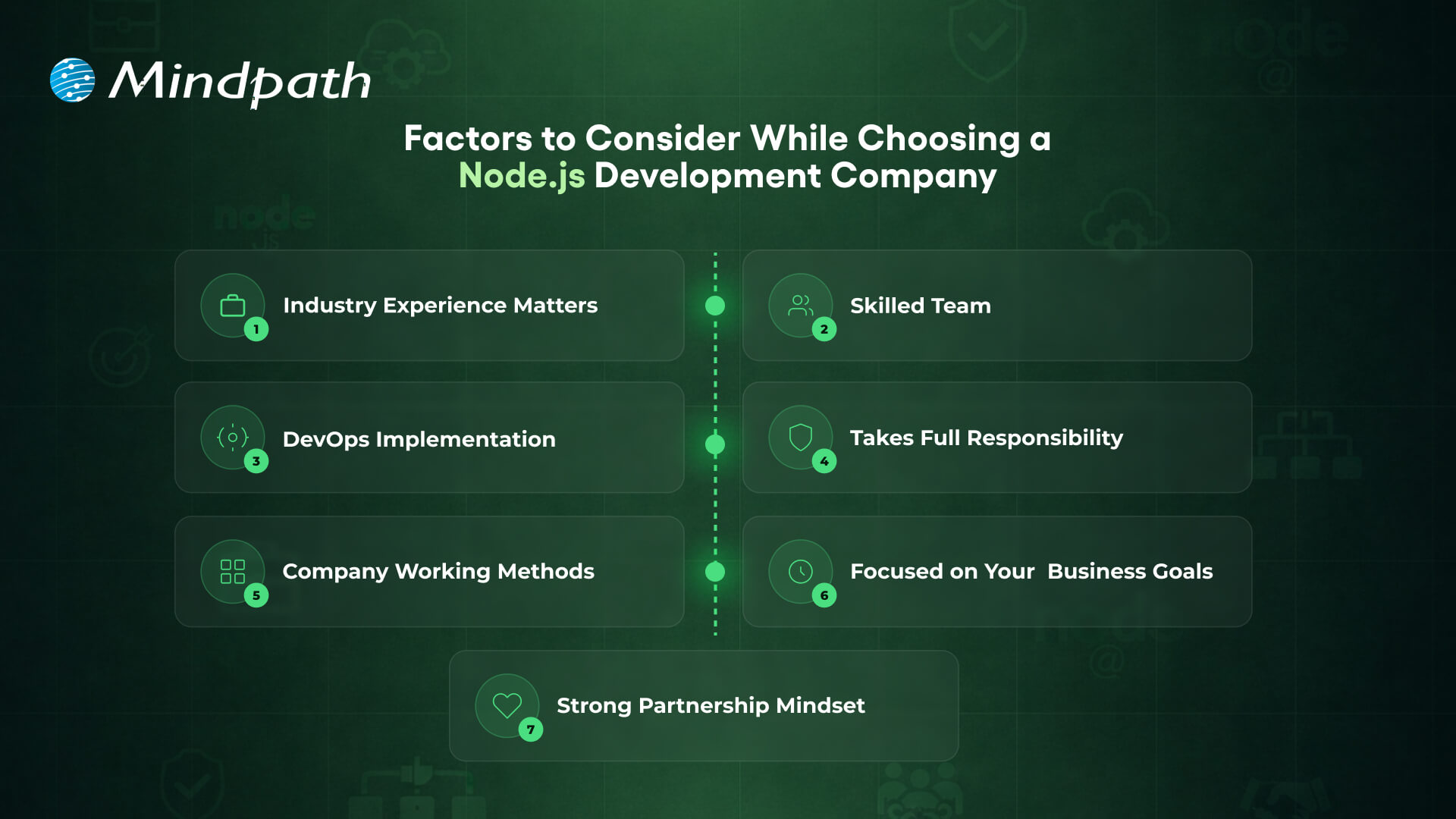
1. Industry Experience Matters

How long a company has been working in software development shows their reliability and knowledge. Experienced Node.js companies know the best ways to work with clients and handle projects smoothly. They are familiar with popular Node.js tools and frameworks and use proven methods like Agile and DevOps to deliver projects on time and with quality. 

2. Skilled Team

A good Node.js company has a strong team with different skills, so they can start your project quickly and build exactly what you need. A team that understands micro services in Node.js can divide tasks smartly and deliver results faster. Having experts like project managers, DevOps specialists and cloud professionals makes the process smoother and more efficient. 

3. DevOps Implementation

Using DevOps helps a company build software faster and more smoothly. It brings developers and operations teams together, so everyone works closely and avoids delays. This way of working also makes the project more secure and organized. A company that follows DevOps can handle changes better and deliver a high-quality product with fewer issues. 

Also Read: Benefits of DevOps

4. Takes Full Responsibility

A good Node.js company takes full responsibility for the work they do. If something goes wrong, they don’t hide it or blame others. Instead, they fix it and learn from it. This honest attitude builds trust, improves communication, and shows they truly care about the success of your project. 

5. Company Working Methods

The way a Node.js company handles projects says a lot about them. It’s not just about good reviews, but also how they talk to you and what value they bring. You can learn more by checking their website, blogs, case studies and social media to see how they share ideas and show their work to the world. 

6. Focused on Your Business Goals

The right Node.js development firm takes time to understand what your business wants to achieve. They work in a way that supports your goals and helps your business grow. With the right knowledge and experience, they can build a strong and future-ready project that fits your budget and timeline. 

7. Strong Partnership Mindset

A trusted Node.js company doesn’t just build your project and leave. They work with you like a real partner, staying connected and involved at every step.  They provide clear communication, teamwork, and support, even after the project is done which helps make everything run smoothly and lead to better results for your business. 

Want to ensure your NodeJS applications run efficiently and reliably? Explore our blog on hire expert NodeJS developers for high-performance apps to learn how skilled developers can boost performance and scalability.

Ready to Choose the Right Node.js Development Company?

Selecting the right Node.js Development firm plays a big role in how fast, secure, and scalable your project becomes. By focusing on experience, team skills, DevOps culture, and a true partnership approach, you can ensure you’re working with a reliable team. A trusted Node.js development company will not only build a great product but support your long-term success too. 

At Mindpath, we offer end-to-end NodeJS development services that are designed for speed, performance, and future scalability. From building real-time apps to using micro services in Node.js, our team brings deep experience and modern practices. As a top-rated Node’s web development company, we ensure your product is secure, stable, and ready for the market. 

Looking to hire Node.js developers who understand your goals? At Mindpath, our experts bring strong technical skills, creativity, and a collaborative mindset. Startups and enterprises trust us for quality, future-ready solutions. Connect with Mindpath and let’s build something great together. 
Related Post

Combine WordPress and React for powerful web apps. Discover how to leverage robust content management with dynamic interfaces for enhanced user experience.
Discover the key factors influencing software development costs and how to optimize your budget. Learn how Mindpath can help.

Related Post

attention mechanism explained

In the rapid innovation of AI, there are some innovations that don’t just boost existing techniques but also completely change the field. And one such innovative breakthrough is the attention mechanism. Are you searching for the attention mechanism explained in easy words to get a better idea about it? If yes, then this is the right place for you. The attention mechanism has completely changed the process of textual sequential data handling. Besides, it increases NLP’s capabilities. The attention mechanism also has a massive impact on computer vision, along with other domains. 

In this detailed blog, we will dive deep into the attention mechanism explained through some easy examples. Besides, we will go through different types of attention mechanisms and understand why it is a game-changer for AI models.  

Want to see how the attention mechanism can transform your workflows by enabling more precise AI applications? Mindpath’s AI development services bring these advancements to life through scalable, high-performance AI solutions designed for your business goals.

What is the Attention Mechanism?

Before exploring the attention mechanism explained in detail, let’s try to decode the basics. 

Suppose you are reading a sentence that says “John is playing football”. What will be your answer if someone asks “Who is playing football?” You will instantly say “John”. If you analyze, you will understand that here you don’t through the entire sentence. You just focus on the important part, i.e., the subject or name. This is what the attention mechanism does. 

The attention mechanism in AI directs AI models to focus on only the relevant data and assign weights to input tokens. This dynamic focus lets models understand the context more accurately and generate accurate outputs. The attention mechanism has increased AI models’ performance in tasks such as question answering, image analysis, summarization, and translation. 

The Example of Attention Mechanism

To understand more about the process of attention mechanisms, consider this sentence translation task as an example. 

Let’s take the sentence “ The dog is enjoying his treat.” When a model translates the sentence, it needs to understand the subject first. Based on that, it will generate the result. An attention mechanism helps models assign scores or weights to every word. Then, it considers the score to understand the important words. “The” gets a low score as it is a determiner. Dog receives the highest weight as it is the subject. The word “Sat” mostly attends to the word “Dog” to understand the meaning clearly.  By adjusting these scores, models generate results that are more accurate. Well, it’s just like how we focus on a crucial part when describing meaning. 

Must Read: OpenAI Fine-Tuning API Tutorial

What are the Different Types of Attention Mechanisms?

Now that we have discussed the attention mechanism explained with an example, let’s explore the different types of attention mechanisms. Each mechanism plays an important role in how models process, understand, and prioritise data while performing tasks such as contextual reasoning or summarisation. 

1. Additive Attention

Introduced by Bahdanau et al., this was one of the oldest attention mechanisms. It was primarily used for machine translation. It functions by combining the query of the decoder with the encoder’s hidden state or the key. After that, it passes them through a feed-forward neural network to calculate the attention score. It is a perfect option for handling input and output sequences of varying lengths. 

2. Self-Attention

This marks a major turning point in AI models. A crucial feature of Transformer models,  self-attention helps AI models focus on different parts within the same sentence. This makes the model understand the context. Self-attention enables more accurate contextual understanding. That’s why it is vital for AI models such as GPT,  T5, H20.ai, and BERT. 

3. Multiplicative Attention

This version of the attention mechanism simplifies the process. Instead of concatenation, this mechanism utilizes a dot product between the decoder and encoder’s hidden states to compute the score. It is more efficient as well as faster compared to additive attention. It is also available in two sub-variants, such as Global attention and Local attention. 

4. Cross-Attention

It is generally used to compare two input sequences. When performing tasks such as machine translation, the AI model utilizes information from the target as well as the source sequences to establish relationships between them. This mechanism enables models to focus on the relevant parts to generate new elements. Developers can use it the self-attention mechanism to make transformer models handle complex tasks. 

5. Scale Dot-Product Attention

Transformer models like GPT, come equipped with this mechanism.  It calculates the weights by taking the key vector and the dot product of the query. It eliminates sequential bottlenecks, which are common in earlier models like Recurrent Neural Networks. 

6. Multi-Head Attention

As a powerful extension of self-attention, it can run multiple operations in parallel. Each head learns various aspects of data. For instance, while one head may capture semantics, another may focus on syntax. The outputs are then combined and transformed. This makes the model create a more nuanced and richer representation of the input. 

These types of attention mechanisms demonstrate the advancement of attention techniques in AI. With these innovations, AI models have moved beyond rigid processing. 

Looking for efficient ways to optimize large AI models? Discover Low-Rank Adaptation (LoRA) to explore techniques that increase model performance with minimal resources.

The Rise of Transformer Architecture

In 2017, a paper named “Attention Is All You Need” introduced the Transformer architecture. It abandoned convolutional and recurrent layers.

You might be wondering why it is revolutionary. Here are the reasons. 

1. Elimination of Long-Range Dependencies

By computing attention between multiple data points in a sequence directly. This solves the long-standing issues of processing long-term dependencies. The distance between words will always be the same, regardless of their position in the original sentence. 

2. Parallelisation

In general, RNNs are sequential. That means you may need to use the hidden state of the previous step to compute the next. On the other hand, self-attention enables AI models to carry out computations for various parts in the sequence in parallel. This, in turn, significantly speeds up model training times. 

3. The Transformer Effect

The transformer architecture, powered by attention mechanisms, can unlock the maximum potential of transfer learning. By effectively pre-training on unlabeled datasets, models such as can learn deep language representations. 

After that, these models can be further optimised with minimal labelled data. They can offer accurate outcomes while performing various tasks. 

Wondering how transformer-based AI models work behind the scenes? Explore the Large Language Model (LLM) guide to learn how attention layers power advanced AI applications.

Applications of Attention Mechanism in AI

The attention mechanism is a core element of modern AI. It enables various AI models to focus on the input data’s relevant parts. Here is how it is driving impact. 

1. Machine Translation

Attention mechanism helps AI models analyze the right words present in source sentences. This, in turn, makes translation context-aware and more accurate. 

2. Image Captioning

Focusing on certain areas of an image helps models to create more descriptive and meaningful captions. 

3. Question Answering Systems

Attention enables AI models to focus on relevant parts of a question. As a result, they produce more precise answers with updated information. 

4. Speech Recognition

It also significantly improves how models maintain a balance between text and spoken words. The results? Improved fluency and recognition accuracy. 

Looking to implement advanced AI solutions in your business? Explore AI consulting to discover how expert guidance helps leverage attention-powered models for smarter and data-driven results.

Enabling Smart Learning in AI Models

After going through this attention mechanism explained in easy words, we can say that it marks a vital moment in AI model evolution. By giving models a context-aware way to focus on the relevant data, the attention mechanism eliminates the limitation of step-by-step processing. 

That is why today’s AI models can process images with impressive accuracy. Besides, they can offer meaningful conversations. Thinking about harnessing the power of the attention mechanism for your AI tools? Mindpath can help you with this. Our AI development services help businesses deploy, optimise, and integrate attention mechanism-powered models. We ensure you benefit from high-performance, context-rich AI. The future of smart learning is here, and we can lead you to attain the desired success. 

Hiring a full stack developer

Have you thought about how hiring a full-stack developer could impact the success of your digital initiative? In a fast-paced world like technology, companies seek the ability to manage both front-end and back-end development.  What characteristics will define the best developer for your business requirements?

That’s where careful thought comes into play. Every business has its own specific objectives. If you choose a full-stack developer without careful consideration and evaluation can lead to gaps in performance. Avoid making a rushed decision without thinking it through, and taking the time to know what is important will help you move in the right direction. So, while you start planning your next steps, let’s discuss the key things you keep in mind, so that your hiring choice actively supports growth and innovation.

Hiring full-stack developers brings end-to-end technical support to scale your business faster. Mindpath can help you get the best talent that fits your requirements.

Who is a Full-Stack Developer?

A full-stack developer is a person who can work on both the front end and back end of a website or application. The front end comprises everything that the user sees and interacts with, and the back end is part of the app that runs on the server in addition to managing the database and application logic. The combination of this front-end and back-end skill set helps to make full-stack developers more flexible and valuable in creating all types of digital experiences.

Hiring a full-stack developer means hiring a person who knows how to link the design of a site, functionality, and performance. Full-stack developers understand programming languages, frameworks, and server environments. They make sure the design runs smoothly during the entire development process. By being aware of multiple layers of development, full-stack development saves time and money while allowing businesses to deliver a more efficient product.

Responsibilities of a Full-Stack Developer

It’s important to recognize the broad spectrum of responsibility that comes with hiring a full-stack developer. The following responsibilities communicate how they join the layers of development into a smooth-flowing digital solution.

Responsibilities of a Full-Stack Developer

1. Designing User Interfaces

A freelance full-stack developer builds interfaces that have visual appeal and work on any device. They ensure that the website is responsive and works well for the user.

2. Building the Front End

Using HTML, CSS, and JavaScript, they build the experience that the user interacts with and engages with the visual. This allows for seamless movement through the site visually.

3. Collaborating with Teams

They collaborate with designers, managers, and stakeholders to achieve project outcomes. The benefits of collaboration can be easily seen, as it assures the application is built correctly.

4. Developing APIs

Full-stack developers are responsible for the build of APIs to interconnect systems and services. This allows the same data to move between the front end and back end.

5. Writing System Logic

They create a logic that drives the functions within an application. It responds to requests, processes data, and provides accurate results.

6. Managing Databases

A freelance full-stack developer sets up, maintains, and stores data in databases for user information. They secure data management, and they optimize the strategies for saving data.

7. Writing Clean Code

They write code that is maintainable and structured with performance in mind. Clean coding practices support a reduction in error and an increase in ease of modification.

8. Testing and Debugging

A full-stack developer tests an application to look for bugs. They debug the bugs to make sure it runs smoothly and reliably.

If you are planning to hire a full-stack developer, it is essential to understand the impact they can have on your product’s success. Explore our blog on Full Stack Developer Is Key to MVP Success to have a deeper understaning on how a full-stack developer can accelerate your MVP and give your product a competitive edge.

Essential Factors to Consider Before Hiring a Full-Stack Developer

Recruiting a full-stack developer isn’t just about evaluating technical skills. The following is a list of critical factors that will help you recruit a developer who aligns with your project needs and business objectives.

Essential Factors to Consider Before Hiring a Full-Stack Developer

1. Define Your Requirements

It’s important to create a clear document outlining your project needs prior to hiring a full-stack developer. This ensures the full-stack developer understands the features you need and the level of design you are expecting. Clarified requirements can aid in a quicker delivery to you and avoid any confusion.

2. Evaluate Candidate Potential

An experienced full-stack web developer has industry knowledge and experience. They can quickly adapt and move between projects as needed. Their ability to jump between projects can prove valuable when a deadline is around the corner.

3. Check Project Management Skills

When you hire a full-stack developer, you’re also getting a project manager with skills that go beyond simply coding. They have the ability to plan resources, lead teams, and manage the stages of development. Because of these proficiencies, they’re often the ones leading projects.

4. Review Technical Expertise

A good developer will know the languages behind building interfaces, HTML, CSS, and JavaScript. They will also know some back-end language, such as Python, PHP, or Ruby, and database experience with something like MySQL. It is a strong combination for full-stack development.

5. Look for Tech Versatility

Ensure that when hiring a full-stack developer, you validate their experience with multiple technologies. They should have knowledge of front-end frameworks, backend frameworks, and databases. You want real project experience that demonstrates their skills.

6. Check Their Portfolio

Request past work to evaluate their capabilities. A solid portfolio can illustrate how they overcome obstacles and provide solutions. Even newbies will be able to display some ability through sample work.

7. Focus on Soft Skills

A developer should recognize business requirements as well as perform technical tasks. A developer must be able to communicate without barriers to clients and teams. Good soft skills make it easy to comply with authority.

8. Make a Smart Hiring Decision

Finding the appropriate talent for full-stack web developer jobs can be a time-consuming process. Hiring a full-stack developer through a talent agency can help alleviate risk and guarantee that developers know what they are doing.

Want to transform your business inside out? Full-stack development makes it possible by optimizing operations and speeding up product launches. Explore the Benefits of Full-Stack Development every business needs to succeed.

How to Hire a Full-Stack Developer

Selecting a full-stack developer involves an intentional process based on the right talent and your desired project specifications. The following steps will help you make a careful and confident hiring decision.

Process of Hiring a Full-Stack Developer

1. Assess Business Requirements

Prior to hiring a full-stack developer, make sure to define the project’s scope, budget, and timeline. Decide whether you need to hire someone full-time or if your project would require a freelance expert.

2. Select Recruitment Channels

Source candidates from networking sites, freelance platforms, and job boards. You can also connect with a full-stack development company to get the right talent.

3. Craft a Job Description

A good full-stack developer job description is a detailed description of the hard skills and tools, and the responsibilities for the job. A good job description helps you find the right candidates at a much quicker pace.

4. Conduct Skill Assessments

You can assess coding and problem-solving by utilizing structured coding tests or tasks. This method is a better hiring practice for a full-stack developer.

5. Prepare Interview Questions

Assess their familiarity with frontend, backend, and databases. A good candidate will often follow the best full-stack developer practices through good full-stack developer courses.

6. Implement Smooth Onboarding

After hiring a full-stack developer, tell them about their roles and responsibilities, the tools they will use, and the culture of the company. Successful onboarding ensures we’re setting them up for success and justifies their full-stack developer salary.

If you’re unsure whether to hire a full-time developer or a freelancer. Explore our blog on Freelance Full-Stack Developer to determine the best fit for your project’s needs. 

Ready to Hire a Full-Stack Developer for Your Next Project?

Hiring a full-stack developer is a smart decision for businesses aiming to build strong digital solutions. By focusing on skills, experience, and project needs, companies can find the right professional who delivers efficient results. The right choice not only saves time and costs but also ensures long-term success in competitive markets.

At Mindpath, you can hire full-stack developers who combine technical expertise with business understanding. Our developers work on both frontend and backend with precision, helping you achieve faster and smoother project delivery. With a proven track record across industries, Mindpath offers reliable talent that aligns perfectly with your goals and drives real value.

Unlock the secrets to hiring top full-stack developers. Explore key factors like experience, project fit, problem-solving skills, and communication for success.
SaaS Development Services

Selecting the appropriate SaaS development services may seem like walking through a rapidly shifting technological environment. Businesses in the present day require solutions that are innovative, scalable, and flexible. You may end up comparing different providers, and each one of them claims to have unique expertise. The difficulty lies in finding a service that is consistent with your objectives and generates real value. It involves thinking outside the box and taking into account teamwork, problem-solving, and sustainability. So, how are you going to find a service that best suits your business vision?

The key is to find a partner that is knowledgeable about your growth strategy and technology needs. Successful SaaS development services engage both hands-on experience and progressive innovation. When you are seeking options, make sure you take into account compatibility with your team, development strategy, and scalability. You require a clear understanding of procedures, communication, and delivery schedule. This blog will help you make the right decision in your SaaS development journey. Let’s dive in together!

Want to choose the right partner to build scalable and efficient SaaS software for your business? Mindpath’s  SaaS Development Services provide expert developers and custom solutions to deliver growth-oriented applications.

Understanding Software-as-a-Service (SaaS) Development

SaaS development refers to the development, deployment, and maintenance of software applications delivered over the Internet as a service. These applications are cloud-based, unlike the conventional software. They are available to users either on a web browser or on an app interface. An effective SaaS development service makes applications to be scalable, secure and user-friendly. It concentrates on delivering constant updates and excellent user experiences across all devices.

SaaS development needs proper software engineering and cloud knowledge. Developers should also know what customers require and what is trending in the market. This understanding enables the creation of software, which is efficient, reliable, and sustainable. SaaS development focuses on cooperation, problem-solving, and constant enhancement in order to fulfill business objectives. It guarantees the product to expand with the user requirements without compromising the performance or security at any point.

The following are reasons why businesses today require SaaS development services:

1. Cost Optimization

SaaS reduces start-up infrastructure and the cost of licensing. Companies enjoy the benefit of stable prices and expenditure.

2. Scalable Architecture

SaaS software development is capable of scaling users and features in an easy way. The systems can easily adapt to growth and demand.

3. Anywhere Accessibility

The use of the cloud allows remote and distributed teams. Users can be able to work anywhere safely.

4. Rapid Deployment

The SaaS solutions take a shorter time to launch via browsers. This minimizes the setup time and fast-tracks time to value.

5. Simplified Maintenance

Service providers deal with updates, security, and performance. SaaS developers assist in lowering internal IT workloads.

6. Innovation Readiness

SaaS solutions are compatible with contemporary tools and artificial intelligence. This helps companies remain competitive and data oriented.

Key Steps to Choose the Right SaaS Development Services

The choice of SaaS development services requires a clear idea, planning, and business orientation. The most important steps to selecting SaaS application development services that facilitate long-term growth are as follows.

1. Define Your SaaS Idea and Objectives

Be clear about your SaaS concept, what problem it will address, and who your audience will be. Clear goals contribute to the alignment of attributes, functionality, and business objectives in the long run. This transparency enables the SaaS development services to create a product that is focused and efficient.

2. Research Potential Development Partners

Begin by doing research on credible SaaS development companies that have a successful track record with SaaS projects. Check their portfolios, case studies, and feedback from clients to determine credibility. This study can assist you in narrowing down partners who can provide scalable solutions.

3. Assess Technical Skills and Expertise

Evaluate the technical competence of the in-house development team in the front end, back end, and cloud computing. Ensure that they know the process of developing secure and scalable SaaS applications. Well-developed technical capabilities reduce the development risks and improve the overall performance of the product.

4. Review Project Management Practices

Understand how the company manages schedules, work and communication in the development process. Agile project management is flexible and responds more rapidly to changes. Analytical thinking will ensure consistency and quality in development.

5. Understand the Development Process

Inquire about their entire development cycle such as designing, testing, and implementation. Make sure that security and performance, as well as scalability, are considered at an early stage. A trusted Saas development platform enhances easier cooperation and implementation.

6. Check Industry Experience

Experience in the industry helps teams to know more about your business challenges. Experienced developers are able to foresee risks and recommend workable improvements. This results in improved custom SaaS development projects.

7. Prioritize Security and Compliance

Make sure that the development team has good security standards and compliance requirements. The process of development should include data protection and compliance with regulations. This ensures the safety of user information and builds up confidence in the product.

8. Evaluate Support and Make the Final Decision

Evaluate the capacity of the company to offer long-term support and maintenance. Constant improvement and interaction are key to successful products. Select SaaS development services, which reflect your growth plans and vision.

Ready to Transform Your Business with SaaS?

Selecting the appropriate SaaS development services will keep your company competitive, scalable and efficient. Successful SaaS products are the result of clear planning, technical expertise and strong project management. Using systematic steps assists in choosing partners who provide secure, reliable and innovative solutions. Having the right team ensures your software keeps up with the business requirements and enhances performance and user satisfaction.

At Mindpath, we provide professional custom SaaS development services based on your business objectives. We are a team of prolific developers and present scalable, secure, and user-friendly solutions. Our priorities are innovation, a smooth partnership, and continuous support to achieve optimal performance of your SaaS product. Mindpath is the choice that ensures a future-proofed platform that is designed to expand with your users and business vision.