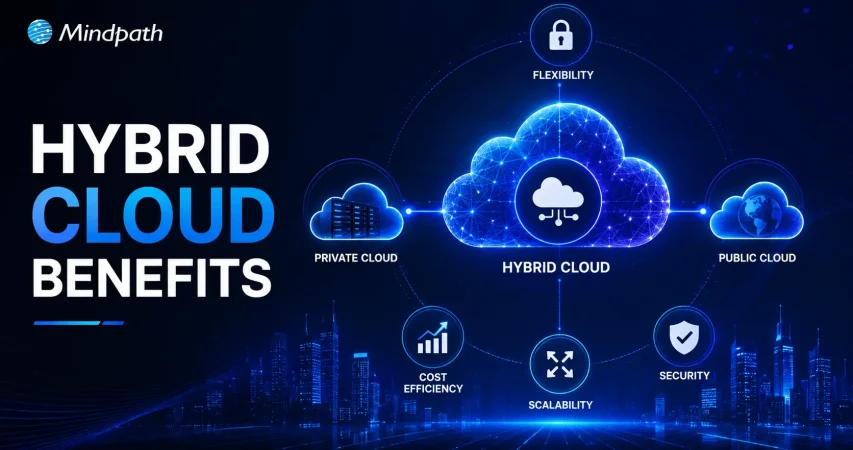
The Rise of Hybrid Cloud: Transforming Businesses with Benefits

Join our Newsletter!

Featured Posts

Support Is One Click Away

Home

The Rise of Hybrid Cloud: Transforming Businesses with Benefits

Hybrid Cloud

The Rise of Hybrid Cloud: Transforming Businesses with Benefits

Imagine a world where businesses can enjoy the flexibility of public cloud services while keeping sensitive data safe in a private environment. Sounds ideal, doesn’t it? That’s the promise of hybrid cloud! But why is it gaining so much attention? What makes it the perfect choice for modern businesses? Let’s dive into the key benefits of this game-changing approach. 

What Is Hybrid Cloud?

A hybrid cloud is a configuration that combines private and public cloud technologies. It combines private servers in your office or data center with public cloud services from firms such as Google Cloud or Amazon Web Services. This architecture allows enterprises to store and manage their data and apps in the most appropriate location for their purposes. For example, sensitive or vital data can be kept protected in the private cloud, while less crucial operations can be done on the public cloud to save money and enhance speed. Businesses can also shift workloads across various clouds, making it an extremely adaptable and practical option. Hybrid clouds are popular because they provide businesses with the best of both worlds: security and flexibility. They are especially useful during digital transitions, when firms need to change their systems without totally shutting down their existing activities. This strategy enables businesses to work smarter, save money, and expand more effectively.  

How Does Hybrid Cloud Work?

A hybrid cloud combines two or more types of cloud environments, such as private data centres and public cloud services, into a single system. This connectivity enables enterprises to effortlessly transfer data and applications across various environments. The hybrid cloud requires robust networking to function properly. This is accomplished via techniques such as local networks (LAN), virtual private networks (VPN), and APIs, which allow smooth communication between the various elements of the cloud. Virtualization and containerization are two common current technologies used in hybrid cloud systems. These solutions simplify resource management and sharing by producing virtual replicas of hardware or software. These resources are also managed using specialized software, which enables organizations to swiftly change or assign them as needed. 

Advantages of Hybrid Cloud

1. Better Return on Investment (ROI)

A hybrid cloud enables you to integrate your existing private infrastructure with public cloud services. This allows you to simply extend your computer capacity without having to invest in expensive new hardware or run additional data centers. Instead of investing more in physical servers, you can leverage the public cloud to meet additional storage, computing power, and processing requirements. This technique guarantees you only pay for what you use, which helps to keep prices down. By embracing the public cloud’s flexibility and scalability, you improve your capacity to manage rising workloads while saving money on infrastructure. As a consequence, organizations can enhance their return on investment (ROI) by employing cloud services more efficiently and lowering operating costs. This combination of flexibility and cost savings makes hybrid cloud an excellent solution. 

2. Enhanced Speed and Performance

Hybrid cloud solutions enhance performance, particularly for applications that require quick processing and minimal latency. By combining private and public cloud resources, data can be processed closer to end users, saving travel time and resulting in faster response times. This is vital for applications that need real-time processing, such as video streaming, online gaming, and financial transactions. For applications deployed in remote regions or with high performance requirements, a hybrid cloud configuration can guarantee that data is handled quickly by allocating resources to the best location. This can be accomplished by edge computing, which brings processing closer to the user, minimizing latency and improving the user experience. By lowering latency, hybrid cloud enables organizations to provide quicker, more dependable services, hence boosting overall application performance and customer happiness. 

3. Accelerated Innovation

Hybrid cloud solutions allow enterprises to use cutting-edge technologies such as AI and machine learning without having to entirely replace or expand their present infrastructure. This makes it easy to implement modern tools and capabilities while minimizing costs and interruption. Businesses can maximize their existing systems while gaining access to the cloud’s scalability and flexibility by combining private and public cloud services. This allows teams to operate more effectively, minimizing the time required to create and deploy new apps. Organizations can bring innovations to market faster by shortening development cycles and responding to customer needs and industry developments in real time. The hybrid cloud method enables firms to explore, create, and deploy apps more quickly, providing a competitive advantage. This mix of technological access and operational flexibility accelerates innovation, allowing businesses to stay competitive in a rapidly changing digital market. 

4. Stronger Control Over Applications

A hybrid cloud model provides enterprises with more flexibility over where their applications are hosted and how computing resources are distributed. This flexibility enables businesses to select the optimum environment for each application, ensuring that sensitive data is kept safe and regulatory needs are satisfied. This is particularly significant in regulated businesses. Businesses can enhance their data privacy and control by hosting particular apps in private clouds or on-premises. Simultaneously, less sensitive apps can operate on the public cloud, improving scalability and efficiency. Businesses can leverage hybrid cloud to guarantee that their applications are efficiently managed, reducing risks while still benefiting from the flexibility and cost savings provided by public cloud services. This control enables organizations to achieve privacy requirements and regulatory compliance. 

5. Flexible and Efficient Operations

Hybrid cloud computing allows enterprises to pick the environment that best meets their needs. Hybrid solutions, whether in a private or public cloud, enable you to adapt and grow in response to individual requirements. One of the primary advantages of hybrid cloud is the ability to construct apps with containers. Containers make programs portable, allowing them to be seamlessly transferred between public and private clouds. This flexibility enables enterprises to take use of the finest aspects of any cloud environment, therefore improving performance, security, and cost-effectiveness. A hybrid cloud allows you to easily modify your operations to suit changing demands, such as scaling up during peak hours or relocating apps to a more secure environment when necessary. This versatility benefits companies to stay agile, reducing downtime and improving overall operational efficiency. 

Also Read: Multi-Cloud vs. Hybrid Cloud: Key Differences You Need to Know

Cloud Computing Services at Mindpath

At Mindpath, we provide a variety of cloud computing services to help your organization function smoothly and efficiently. Whether you need to store data, operate apps, or extend your operations, our cloud solutions offer the flexibility and security you want. We assist you in selecting the best cloud configuration for your organization, whether it’s a private cloud for sensitive data or a public cloud for ease of access and scalability. Our staff guarantees that your cloud environment is optimized for speed, cost-effectiveness, and security, enabling you to focus on developing your business rather than worrying about technology. Mindpath’s cloud computing services allow you to develop quicker, enhance productivity, and take use of the newest cloud technologies to remain ahead of the competition. 

Wrapping Note!

Hybrid cloud is transforming businesses by offering a mix of flexibility, security, and scalability. It allows companies to optimize resources, improve performance, and innovate faster, all while ensuring data privacy and compliance. At Mindpath, we provide tailored cloud computing services to help you harness the full potential of hybrid cloud, enabling your business to stay agile and competitive. Let us help you take your business to the next level with the power of hybrid cloud. 
Ready to leverage hybrid cloud for your business?

Partner with Mindpath today to explore our tailored cloud solutions and stay ahead in the digital world!

Related Post

The ultimate eCommerce showdown: WooCommerce vs. Shopify! Explore their features, benefits, and which platform is right for your business.
Discover the essential factors for hiring a top WordPress developer. Learn about expertise, communication, experience, cost, and finding the right platform.
Learn how to hire expert NodeJS developers to build high-performance apps. Discover essential skills, factors, and costs with Mindpath’s guide.

Related Post

Have you ever wondered to yourself what the future of AI is going to look like? AI will affect how people will live and interact with technology. AI is incorporated in all daily activities, whether that is assisting in a task, giving suggestions, or helping create a seamless process. As technology advances and matures, it will change the way people think, the way people work as well as the decisions people make.  

The future with artificial intelligence certainly has the potential to transform everything from how we communicate and learn, to problem-solving and creativity. The benefits of AI are enabling people to make better decisions, manage time, and explore scenarios like never before. So, what does this growing presence of AI mean for how the world operates? And how might the future of artificial intelligence cultivate the future we are heading towards? In this post, we will explore how AI in a whole new way is changing how we operate in the world. 

Curious how AI can revolutionize your business? At Mindpath, we deliver cutting-edge Artificial Intelligence Development Services to help you innovate and grow. 

The Evolution of Artificial Intelligence (AI)

Artificial Intelligence (AI) refers to the work of developing computer systems that can carry out human-like functions that usually require human intelligence, like learning, problem-solving, and decision-making. In the end, it is making machines that work like people. In today’s world, the use of AI has become normal. You can see the impact of artificial intelligence in homes, schools, and workplaces.  

The artificial intelligence story began in the 1950s as a result of Alan Turing and his idea about machine thinking. In the 1960s, research and early AI development continued to evolve with John McCarthy’s work on the LISP programming language, a powerful language that increased early AI research. During the 1970s and 1980s systems were developed based on rules (known as expert systems), which set the stage for the eventual widespread use of AI.  

By the 1990s, AI began data-driven learning instead of following a strict set of rules. This transformation indicated the beginning of machine learning and neural networks made AI accessible to new areas like language processing and robotic applications for personal and industrial use. Therefore, using models such as GPT-3 and GPT-4, people are currently using AI in more creative and practical ways which generates powerful representations of what artificial intelligence means to us. 

Must Read: AI for Customer Services

The Impact of AI on Future

Artificial intelligence is becoming a key part of the future, with its growing role in daily life and global progress. As technology advances, we can already see AI transforming the future through smarter systems, faster decisions, and improved services. Here are some important areas where artificial intelligence is shaping what comes next.

1. Empowering Human Creativity

AI is taking over routine and repetitive tasks, giving people more time to focus on creative thinking and emotional intelligence. This leads to more meaningful jobs and greater fulfillment at work. Generative AI tools now help writers, designers, and developers move faster with fresh ideas. RAG techniques also improve the quality of AI-generated content. This marks a powerful shift in how people work and innovate.

2. Smarter Decision-Making Ahead

AI in decision-making helps process large amounts of information quickly, offering insights that humans might overlook. This leads to better decisions in areas like personal finance, education, and health. AI agents are becoming more advanced, supporting real-time choices with logic and learning. They’re able to adapt and respond in changing environments. This is a glimpse into how artificial intelligence will change the world.

3. Personalized Education Experiences

AI systems can customize educational paths for each student, improving learning outcomes. These platforms offer real-time feedback, progress tracking, and tailored content. With multimodal AI, students can now learn through text, images, audio, and even interactive content. This enhances understanding and makes learning more engaging. These smart tools are clear future of AI examples already reshaping classrooms.

4. Building a More Inclusive World

AI is helping people with disabilities by providing real-time support tools like voice commands and screen readers. Multimodal AI systems enhance accessibility by understanding both speech and visual cues. This leads to more independence and easier access to services. Inclusive tech design is becoming a priority across sectors. These innovations reflect a growing bond between artificial intelligence and future equity.

Ready to stay ahead of your competitors to build a unique identity in the market? Explore how conversational AI is helping businesses to achieve smarter operations, stronger customer engagement, and sustainable growth.

5. Driving Sustainable Innovation

AI in business strategy plays a growing role in protecting the environment by predicting climate patterns and reducing waste. Digital twins are being used to test and simulate sustainability strategies safely. These models help industries make smarter, more eco-friendly decisions. AI systems also support energy efficiency and cleaner production. Technology is becoming a vital part of building a sustainable planet. 

6. Advancing Safety and Security

AI helps monitor public areas, detect threats, and respond to emergencies. In cybersecurity, it can identify unusual behavior and stop attacks in real time. AI-powered tools work constantly to secure data and systems. As digital threats grow, AI’s role in safety becomes more critical. These AI trends will shape safer environments both online and offline. 

7. Making Services Instantly Accessible

AI assistants and chatbots are helping people access answers and services instantly. These tools are improving with better voice understanding and faster responses. AI literacy is becoming important as users interact more with these systems. The trend is helping people become more confident using technology daily. This also marks a major step in the future of AI in business.

8. Redefining Innovation Through Collaboration

AI is evolving into a true partner in creativity and problem-solving. Generative AI and AI agents now work side-by-side with humans on design, research, and product development. This leads to faster innovation and new discoveries. These collaborations go beyond automation; they spark new ideas. This is the heart of innovation powered by smart technology. 

Curious to know how Gen AI is transforming multiple sectors? Explore our blog on generative AI use cases to discover how businesses are evolving, growing, and creating opportunities in the fast-paced world.

Strategic Approaches to an AI-Driven Future

Artificial intelligence is rapidly reshaping the way we live and work. To stay ahead, it’s essential to adopt smart, forward-looking strategies that align with this evolving landscape.

1. Set a Clear AI Vision

Identify where AI can add the most value to your goals, such as customer service or analytics. Create a step-by-step plan, prioritize key areas, and communicate the strategy clearly across teams.

2. Promote Innovation at Every Level

Encourage different teams to work together and explore new AI ideas through small test projects. Support a culture that treats both success and failure as part of learning and progress.

3. Build and Grow AI Skills

Offer training to help your current team understand and work with AI. Hire skilled professionals and promote continuous learning to stay updated with AI trends.

4. Embed Ethics into AI Use

Create clear guidelines to keep your AI systems fair and transparent. Regularly check for bias and support responsible AI use through proper oversight.

5. Evolve with AI Advancements

Keep up with new AI technologies and adjust your strategy as things evolve. Make sure your data is organized, and AI is integrated into key business activities. 

Aiming to leverage the power of artificial intelligence, understanding the technologies that drive it has become a crucial advantage. To dive deeper into the tools and technologies behind AI innovation, explore our detailed guide on the AI programming languages.

Ready to Shape the Future with AI?

Artificial intelligence is not just changing how we work and think; it is shaping the world around us in powerful ways. As AI continues to grow, it brings smarter tools, more creative opportunities, and better decision-making for individuals and businesses. The future will belong to those who embrace these possibilities early.

At Mindpath, we offer expert AI development services to help you harness the power of artificial intelligence in your business. Our team builds smart, scalable, and ethical AI solutions that drive growth and innovation. Whether you’re starting small or scaling big, Mindpath is your trusted technology partner for an AI-ready future. 

Explore how is AI transforming future, impacting data privacy, job markets, and business automation. Learn about Mindpath’s AI Services.
Augmented Reality

Have you ever wished you could try on clothes, see how furniture fits in your room, or visualize a product in your space before buying it online? Imagine the convenience of making more confident purchases without stepping into a store. That’s the power of Augmented Reality (AR) in e-commerce. But how exactly is AR transforming online shopping, and what does it mean for the future of retail? Let’s explore!  

What is Augmented Reality?

Augmented Reality (AR) is a technology that seamlessly integrates digital content with the real environment around you. Instead of transporting you to a totally virtual environment, like Virtual Reality (VR) does, AR enriches the actual world by adding pictures, noises, or other digital information that you can view using devices such as your smartphone, special glasses, or a headset. AR can help you make decisions, entertain you, and even teach you new things. It works by superimposing digital material over what you see in the actual world, resulting in an amalgamation of the physical and digital. For example, AR can show you how a new piece of furniture might appear in your space or make a game come to life right in your living space. The best part of AR is how seamlessly it blends the digital and real worlds, making your surroundings more interactive and engaging. 

Advantages of AR in Shaping the Future of E-Commerce

1. Visualizing Products

Augmented Reality (AR) enables customers to see how things will appear in their actual environment before making a purchase. For example, individuals can utilize their phone or AR glasses to arrange furniture in their living room or digitally try on garments to see how they fit without having to physically put them on. This provides clients with a greater understanding of how a product will perform in real life, allowing them to make more educated judgements. It also decreases confusion because customers can see how the product will seem and fit into their environment or lifestyle. Whether it’s selecting the ideal piece of furniture, determining the proper color for a product, or visualizing how a device will function in their house, AR helps buyers feel more confidence in their decisions. The ability to virtually “experience” the product before buying increases satisfaction and trust, leading to higher conversion rates. It also reduces the chances of returns, as customers are sure of their selections. 

2. Boosting Customer Engagement

Augmented Reality (AR) can greatly boost customer satisfaction by making the purchasing experience more interactive and engaging. Customers can use AR to virtually try on items, place furniture in their homes, and observe how a product functions in real time, making buying more personalized. This interactive experience encourages users to spend more time on a website or app, researching different items in an entertaining manner. As customers interact with products more extensively, they are more likely to examine more things, improving their chances of discovering exactly what they are searching for. AR also helps buyers see their products more clearly, decreasing confusion and increasing confidence in their selections. This leads to higher customer satisfaction, which can result in more conversions. Additionally, a more immersive shopping experience promotes repeat visits and enhances customer loyalty, ultimately fostering a deeper connection with the brand. 

3. Enhancing Product Design

Augmented Reality (AR) helps to accelerate product development by giving useful, near-real-time information from virtual product testers. Customers can interact with and experience items in digital form before they are released to the market using augmented reality. This allows businesses to receive instant feedback on product features, design, and functioning. For example, if a firm is creating a new piece of furniture, AR lets people see it in their own homes and offer feedback on dimensions, style, and usability. This rapid user feedback enables designers to quickly find areas for improvement, avoiding the need for several product revisions. The capacity to collect data fast enables organizations to adapt designs more effectively and efficiently, reducing development cycles and guaranteeing that the product satisfies customer demands. Companies who use AR for testing and feedback can enhance their product development process, increase innovation, and bring better goods to the market faster. 

4. Virtual Try-On Experience

Augmented Reality (AR) allows buyers to visually try on clothing, accessories, and even cosmetics, providing a good picture of how these products would appear on them before making a purchase. AR allows buyers to examine how an outfit fits, how a pair of shoes suits their style, or how a new piece of jewelry enhances their look, all from the comfort of their own home. This tool provides a more personalized buying experience, allowing buyers to visualize themselves using the products and feel confidence in their selections. Virtual try-ons assist buyers avoid buyer’s remorse by removing the uncertainty that typically comes with online buying, resulting in decreased return rates for businesses. Furthermore, AR enables buyers to mix and match different things, experimenting with designs and colors they may not have considered previously. As a consequence, virtual try-ons improve the whole shopping experience, boost customer satisfaction, and lead to more confident buying decisions. 

5. Staying Ahead of Competitors

Retailers who use Augmented Reality (AR) can gain a major advantage over competitors by offering a more engaging and personalized buying experience. Customers can employ augmented reality (AR) to engage with items in ways that are not possible with traditional internet shopping, such visually putting on clothing and accessories or seeing how a piece of furniture fits in their house. This results in a more engaging and entertaining shopping experience, perhaps leading to improved customer satisfaction and increased sales. By providing these unique features, businesses demonstrate their forward-thinking and commitment to improve their customer experience, which fosters trust and loyalty. Furthermore, as more firms use AR, early adopters can recognize themselves as industry leaders, attracting clients who are searching for a more modern and engaging experience. Ultimately, AR gives retailers the chance to differentiate themselves, attract a larger customer base, and stay ahead in a highly competitive e-commerce landscape.

Also Read: The Role of AR and VR in Education

Augmented Reality (AR) Services at Mindpath

Mindpath provides innovative Augmented Reality (AR) services that can alter the way your company interacts with customers. Our AR solutions enable you to build engaging, immersive shopping experiences that allow customers to see and interact with your items in real time. Whether it’s virtual try-ons, product visualization, or improving the online purchasing experience, we create personalized AR solutions that are suited to your company’s needs. Our team specializes in creating AR features that improve consumer engagement, lower return rates, and increase sales by providing a more personalized and interactive shopping experience. Customers can use augmented reality to examine how a product fits into their environment, try it on digitally, and make better informed purchase decisions. Mindpath’s AR services are designed to give your business a competitive advantage, enabling you to stand out in the crowded e-commerce market. Let us help you innovate and enhance your customer experience with our cutting-edge AR technology. 

Wrapping Note!

Augmented Reality (AR) is transforming the future of e-commerce by giving businesses new methods to engage customers and improve their purchasing experience. From virtual try-ons and product visualization to real-time feedback from customers and interactive features, augmented reality is changing the way we buy online. Retailers could increase sales by providing personalized and engaging experiences. As more businesses use AR technology, staying ahead of the competition becomes simpler by offering distinctive, engaging, and memorable purchasing experiences. Mindpath specializes in providing cutting-edge augmented reality solutions that not only increase customer engagement but also enable businesses to succeed in an increasingly competitive industry.  

Ready to revolutionize your business with AR?

Partner with Mindpath today and let us create innovative, interactive solutions for your e-commerce success!

Discover how Augmented Reality (AR) is transforming e-commerce with immersive shopping experiences, boosting engagement, and improving sales.
How Much Does It Cost to Hire a ReactJS Developer in London?

The cost of hiring a ReactJS developers in London  varies depending on experience, competence, and the hiring strategy. Understanding wage expectations allows you to make a knowledgeable recruiting decision, whether you require a junior developer for simple duties or a senior developer for more complicated projects. Here’s a quick overview of the various kinds of ReactJS developers and their prices: 

1. Junior React Developers (£32,450 - £52,320+ annually)

Junior developers often have 1-2 years of experience, making them appropriate for simple projects, UI changes, and tiny feature implementations. They need supervision from seasoned developers yet can execute entry-level work effectively. Hiring a junior developer is a cost-effective solution for tasks that do not require extensive technical knowledge.

2. Mid-Level React Developers (£52,320 - £78,650+ annually)

Mid-level developers have 3-5 years of experience and can manage moderate to difficult projects. They have extensive technical knowledge, operate autonomously, and maximize performance. Suitable for enterprises who want skilled developers to create scalable React apps at a lesser cost than recruiting senior specialists.

3. Senior React Developers (£78,650 - £103,000+ year)

Senior developers have over 5 years of expertise in advanced development, architectural design, and team management. They address challenging technological issues and assure high-performance applications. If your project necessitates React, state management, performance optimization, and leadership skills, hiring a senior React developer is a wise decision.

4. Dedicated React Developers (£30–£100 per hour)

Dedicated React developers work on an hourly basis, allowing you flexibility on short-term or specialized projects. Their fees vary depending on their level of experience and the intricacy of the job. This solution is perfect if you want a specialist for certain tasks without hiring a full-time staff, making it a cost-effective alternative.

5. Offshore React Developers (£15 – £40 per hour)

Offshore developers from regions like India, Ukraine, and Eastern Europe offer a cost-effective alternative while maintaining high-quality standards. Offshore hiring allows you to reduce development costs without compromising on expertise. This is a great option for startups or businesses looking for affordable, scalable solutions.
At Mindpath we provide highly skilled ReactJS developers to match your project needs and budget.   Get in touch with us today! today to find the right talent for your React development. 
How much does hiring a ReactJS developer cost? Learn about factors affecting rates, and how to find the best talent within your budget.