Most Popular Web Programming Languages in 2026

Join our Newsletter!

Featured Posts

Support Is One Click Away

Home

Most Popular Web Programming Languages in 2026

Most popular web programming languages

Most Popular Web Programming Languages in 2026

The realm of Web Programming Languages is full of dynamism. In the year 2026, it is most likely to undergo further evolution and change. In fact, the domain of web development languages is likely to blend innovation with stability. The most popular web programming languages that remain at the core of the software ecosystem are Python and JavaScript. 

Both individuals and businesses need to be aware of the most popular web programming languages. The insight is essential since these languages are key when it comes to developing applications and websites. If you wish to create your own app or site, choosing the best website programming languages is a must. It is the perfect time to explore the top Web Programming Languages in 2026.

Planning to use the latest web programming languages to get your website ready for better growth and performance? At Mindpath, we provide tailored web development services built with the technologies your business needs to succeed.

An Insight into Web Programming Languages

Web development involves a number of programming languages for both front-end and back-end development. You can use programming languages in order to give computer systems instructions that they can properly understand. A programming language refers to a human-readable programming code. 

Programming Languages can be in the form of general-purpose languages and domain-specific languages. You need to bear in mind that domain-specific languages function within specific programming environments. On the other hand, in the case of general-purpose languages, it is possible to interpret or compile them without having any knowledge of the platform. Developers make use of website programming languages in order to build dynamic web pages. You can choose the programming language for website development based on whether it can be used for front-end or back-end development.

Also Read: AI Programming Languages

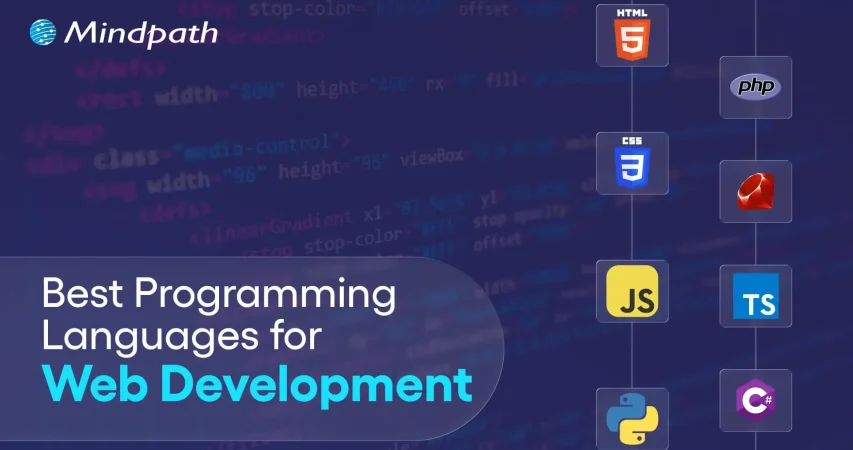
Best Programming Languages for Web Development

In the rapidly evolving programming language setting, a wide variety of programming languages have come into existence. You need to have an insight into these languages so that you can choose the ideal language that can help develop apps and sites based on your needs and goals. The best programming languages for web development include:

1. HTML

When it comes to web development, HTML certainly serves as the ultimate cornerstone. This is because it offers a standardized approach to creating web pages. Thus, if you wish to have a career as a web developer, it is fundamental to master HTML. It is considered by many to be the best programming language for web development. The straightforward syntax of HTML makes it quite easy for beginners to understand. 

HTML not only dictates the visual presentation on a web page, but it also defines its overall structure. It offers semantic elements such as a header and a footer, which can give proper meaning to your content. As a result, it improves accessibility along with search engine optimization. HTML even enables the creation of hyperlinks for the purpose of linking different web pages together. It even supports responsive design through elements such as media queries and meta tags. 

Want to modernize your website using popular web technologies? Learn how to convert HTML to WordPress and keep your site aligned with current development trends.

2. JavaScript

When it comes to web development programming languages, one cannot miss out on JavaScript. JavaScript is a high-level interpreted language that is widely used. Developers use this specific language in order to create and manage dynamic content on sites.  It has gained massive popularity over the years since it works in conjunction with HTML as well as CSS.

JavaScript is mainly utilized for the creation of dynamic content that you find on web browsers. Since it is a high-level programming language, it is easy to write and understand code. This automatically simplifies the job of developers and programmers. It is known for its high versatility. You can use the specific website development programming language for developing mobile applications and working on server-side development. You also need to bear in mind that the rich library ecosystem streamlines the entire web development process. 

3. CSS

Cascading Style Sheets, commonly known as CSS, is among the top web development programming languages today. CSS is a stylesheet language that web developers can use for describing the presentation of a document that has been written in XML or HTML. This programming language is responsible for controlling how elements must be rendered on screen or other forms of media. 

CSS enables web developers to develop web pages that are highly visually engaging. You can develop web pages with diverse layouts, fonts, and colors. One of its unique features is related to visual styling. You can have control over a plethora of visual properties if you use CSS, such as alignment and spacing. Thus, developers can have proper control over the look as well as feel of web pages. You can also use CSS to add interactive elements in web pages, such as animations, which can enhance the experience of users. 

4. Python

Python is an immensely popular open-source programming language. It is mainly used for back-end web development. Many believe it to be the best language for website development because of its ease of learning. Moreover, the extensive libraries of Python support novel technologies such as Machine Learning and Artificial Intelligence. This makes Python a highly versatile language in the web programming context. 

As Python is a high-level language, it enables you to write complicated logic in fewer lines of code. If you use the language, the process of debugging can get easier. This is because Python is capable of executing code line by line. Within a short span of time, the programming language has gained massive popularity because of its versatility and usability. Individuals who wish to have a career in the IT domain must definitely consider mastering a specific programming language. 

Planning to build or maintain WordPress sites with confidence? Explore WordPress and PHP compatibility to understand how they work together to support modern web applications.

5. PHP

PHP is a general-purpose scripting language that has gained high popularity in the web development setting. You can utilize the open-source language in order to create dynamic types of websites. PHP does not require compilation because it is an interpreted language. As a result, developers can directly embed PHP within HTML. This language allows the streamlined integration of server-side logic with online web pages. 

One of the main advantages of the PHP programming language is related to the user-friendly syntax. This user-friendliness makes it relatively simpler for beginners who are into web development. Due to the open source feature of PHP, it acts as a cost-efficient option for modern firms. The elimination of licensing fees automatically reduces the development costs for users. 

Over the past few years, a diverse range of web programming languages has emerged. While some have strengthened their presence, there are others that are gradually fading. You need to always be aware of the most popular web development languages. This is because their popularity as well as demand keeps on fluctuating. The future of web programming languages is certainly full of high potential. 

Wondering how to build modern web applications in 2026? Discover how a web development company helps you use popular technologies effectively.

Final Words

The web programming language landscape is flourishing currently, and it is likely to do so in the future as well. In the year 2026, it is necessary for you to know the top languages so that you can make the right selection. Some of the most popular languages include HTML, JavaScript, Python, and many more. You need to bear in mind that the popularity of these programming languages may fluctuate in a dynamic environment.

Mindpath’s experts have high expertise in providing web development services. Businesses can reach out to our experts if they wish to leverage the most popular language to develop their web pages. Our highly skilled developers will leverage their skills and prowess so that you can have a highly interactive and engaging website.

Related Post

Discover React JS trends for 2025, including SSR, WebAssembly, etc. to create faster, smarter, and future-ready applications.
Discover Automation-as-a-Service (AaaS) and its benefits, including improved efficiency, cost savings, and seamless integration for your business.
Explore how digital transformation reshapes businesses, boosts efficiency, enhances customer experiences, and drives sustainable growth for success.

Related Post

DevOps
Are you looking for a way to lower your business costs while boosting efficiency? What if you could achieve both by simply improving how your teams collaborate and work together? DevOps offers a powerful approach to streamline operations, automate processes, and eliminate waste—all of which can lead to significant savings. Curious about how DevOps can impact your bottom line? In this blog, we will explore the ways this methodology can transform your business and help you save money in the process.  DevOps is a method that brings together the development (Dev) and IT operations (Ops) teams to collaborate closely and effectively. It entails automating and improving the software development, testing, and deployment processes via the use of methods and tools. The purpose of DevOps is to make the entire process quicker, easier, and more dependable by increasing collaboration and communication among developers and IT workers. DevOps began in 2007 when individuals realized that the conventional style of working, in which developers and IT teams worked independently, was holding down progress. DevOps enables enterprises to produce software faster and with fewer issues by merging the work of both teams. It’s all about working together, automating tasks, and optimizing processes.  So, let’s dive in to explore how DevOps can help save business costs! 

How DevOps Can Help Saving Business Costs

1. Using Cloud Infrastructure

Cloud infrastructure is an effective means to reduce IT expenditures while increasing flexibility and efficiency. Cloud services enable enterprises to scale their resources up or down in real time. Additional resources can be allocated during peak demand periods, while they can be lowered during quieter periods. This guarantees that you only pay for what you use, reducing needless costs and optimizing your budget. Cloud platforms also make processes more efficient by providing automation tools. Tasks like resource management, monitoring, and upgrades can be automated, minimizing the need for human intervention and saving both time and money. Furthermore, the cloud eliminates the need for expensive on-premises infrastructure, resulting in lower maintenance and hardware costs. Businesses that integrate cloud infrastructure into DevOps techniques can save money while also improving efficiency, flexibility, and overall performance. This establishes a solid platform for providing dependable and scalable solutions. 

2. Automating with Infrastructure-as-Code (IaC)

Infrastructure-as-Code (IaC) is a method of managing your IT infrastructure that involves writing it as code, similar to providing precise instructions. Instead of manually configuring servers, databases, or networks, you describe the configurations and dependencies in code, and tools like Terraform or AWS CloudFormation do the rest. This strategy saves time, assures consistency, and allows you to easily replicate or upgrade your infrastructure. With IaC, you can make changes fast, scale resources, and maintain a dependable environment without having to do repeated manual tasks. It also lowers the need for additional documentation, as the code itself is the most accurate and up-to-date reference. To ensure success with IaC, it’s essential to securely configure resources, automate tests to validate the code, and continuously monitor the infrastructure. By adopting IaC as part of your DevOps practices, businesses can simplify infrastructure management, minimize errors, and cut costs through better efficiency and automation. 

3. Optimizing with Containers

Container orchestration makes it easier to manage a large number of containers running on many computers or servers. Containers are self-contained containers that include everything an application needs to function, such as code, libraries, and dependencies. Managing a few containers manually may be possible, but as the number of containers increases, the process gets more complicated. Container orchestration automates this process, ensuring that containers are deployed, scaled, and managed efficiently. It also enables containers to communicate and collaborate easily, eliminating human effort and minimizing mistakes. Kubernetes is a popular container orchestration tool that provides enterprises with a dependable approach to manage large-scale applications. Businesses that use container orchestration may achieve easier operations, improved resource utilization, and cost reductions while preserving application performance. 

4. Streamlining with CI/CD Pipelines

Implementing a Continuous Integration and Continuous Delivery (CI/CD) pipeline is an important DevOps approach that allows firms to save money by automating software development and delivery operations. During the Continuous Integration (CI) phase, developers routinely communicate and integrate code updates into a common repository. Automated systems then test and compile the code to guarantee that everything works properly. This avoids costly complications by identifying problems early in the development phase. CI also saves time on manual integration activities, freeing up resources for other important work. Continuous Delivery (CD) follows CI by automating the deployment of tested code to production or other environments. With solutions like Kubernetes or Docker, the process becomes more frictionless, minimizing delays and the need for manual labor. Automated testing guarantees that only stable and dependable updates are delivered, reducing downtime and mistakes that might result in increased costs. 

DevOps Development Services at Mindpath

At Mindpath, we provide DevOps services that streamline software development and reduce costs. Our team uses cloud infrastructure, automation, and container management to help your business scale efficiently. We automate IT processes with Infrastructure-as-Code (IaC) and manage container orchestration using Kubernetes. Our Continuous Integration and Continuous Delivery (CI/CD) pipelines ensure faster, error-free software delivery. With our DevOps expertise, businesses can improve efficiency, cut costs, and achieve high-quality results with minimal manual effort. 

Final Thought!

Incorporating DevOps into your business processes is a strong method to save costs and increase efficiency. Businesses can reduce operating costs by using cloud infrastructure, automating with Infrastructure-as-Code, optimizing with containers, and simplifying processes with CI/CD pipelines. DevOps not only reduces human work and mistakes, but it also speeds up software delivery and improves team cooperation. Mindpath’s DevOps services are meant to help organizations realise these benefits, allowing them to prosper in a fast-paced, competitive market. By implementing DevOps, you can improve productivity, cut expenses, and provide higher-quality outcomes with less work. 

Ready to optimize your business operations with DevOps?

Partner with Mindpath today to streamline your processes, reduce costs, and achieve high-quality results effortlessly!

Discover how DevOps can save your business costs by improving efficiency, and enhancing collaboration across teams for high-quality delivery.
Generative AI in Finance

Have you ever wondered how technology is reshaping the world of finance? Imagine a future where financial decisions are driven by advanced algorithms, predictive insights, and automated solutions. What if you could tap into tools that not only enhance efficiency but also transform how businesses operate? In this blog, we’ll explore the fascinating world of generative AI and its incredible use cases in the finance sector. So, let’s dig in!  

What is Generative AI?

Generative artificial intelligence (generative AI) is a form of AI capable of producing new content and ideas, such as conversations, stories, images, videos, and music. AI technologies aim to replicate human intelligence in nontraditional computer tasks such as image identification, natural language processing (NLP), and translation. Generative AI represents the next phase in artificial intelligence. You can teach it to understand human language, programming languages, art, chemistry, biology, or any other complicated topic. It leverages previously trained data to tackle new issues. For example, it can acquire English vocabulary and compose a poem using the words it processes. Your organization can utilize generative AI for a variety of applications, including chatbots, media production, and product development and design. 

Generative AI is transforming the banking industry by utilizing cutting-edge technology to rapidly analyze massive volumes of data. It enables banks and financial organizations to provide personalized solutions for consumers, such as individualized investment strategies. This system can also detect fraud by identifying unique patterns in transactions, which protects our money. Businesses can employ generative AI to make more informed choices, save time, and improve customer service. 

Use Cases of Generative AI in Finance

1. Automating Accounting Tasks

Generative AI is making a significant impact on finance and accounting by assisting with daily activities. It can automatically gather and enter data, verify and match amounts in records, and organize various financial activities. Businesses can reduce manual effort and calculation errors by implementing automation. This implies that bookkeeping becomes faster and more precise, resulting in improved financial management overall. Companies that use generative AI can utilize less time on repetitive chores and instead focus on crucial decisions. 

2. Creating Financial Reports Easily

Generative AI makes it considerably easier to prepare financial reports by combining information from several sources and organizing it in an understandable manner. It can gather data from a variety of systems, including accounting software, sales databases, and market analysis tools, and compile it into a single complete report. This eliminates the need for firms to spend hours manually gathering and organizing data. 

This technology enables businesses to swiftly provide reliable reports for stakeholders, banks, regulators, and investors. Generative AI not only saves time, but it also decreases the possibility of mistakes that can happen when performing tasks manually. This guarantees that the information is trustworthy and provided in an organized, understandable style. 

3. Using Chatbots for Customer Help

Generative AI-powered chatbots and virtual assistants are transforming how organizations deliver customer service by providing personalized assistance tailored to each client’s individual demands. These chatbots can swiftly answer questions, give information, and walk users through procedures, making it simpler for consumers to receive the help they require. 

The primary function of chatbots in financial institutions is to enhance the user experience. They enable simple and effective interactions between the bank or financial provider and the consumer. For example, if a client has a concern about their account balance or needs assistance with a transaction, the chatbot may give immediate responses, eliminating the need for users to wait for a human representative. 

4. Assessing Credit Risk

Credit risk analysis is one area where generative AI is having a substantial influence. These clever algorithms can look at a variety of criteria, including a person’s credit history, financial documents, and key economic indices. By digesting this data, generative AI helps banks and financial institutions better determine borrowers’ creditworthiness. 

AI insights enable creditors to make better educated loan approval choices, establish acceptable interest rates, and calculate appropriate credit limits. For example, if a person has a good credit history and a steady income, the AI may propose that their loan application be approved at a reduced interest rate. In contrast, if the research identifies possible risk factors, it may advise greater prudence, such as increased interest rates or reduced loan limits. 

5. Spotting Fraud and Protecting Data

Fraud detection is one of generative AI’s most effective applications in finance and banking. These powerful algorithms can identify patterns of fraudulent activity in financial transactions, therefore reducing cybersecurity risks and improving overall data security. Suppose a transaction appears unexpected or does not reflect a customer’s regular spending patterns. AI can highlight it for additional research, allowing banks to respond rapidly to possible fraud. 

In addition to detecting fraud, generative AI is crucial for securing sensitive data. It employs powerful encryption techniques to protect financial information and continually analyses financial transactions for any suspicious activity. This implies that financial institutions can better secure their clients’ data and keep them safe from identity theft and other cyber threats. 

6. Personalized Financial Advice

Generative AI is changing the way individuals receive financial advice by providing personalized analysis and suggestions based on user data and behavior. By analyzing current data, such as spending patterns and financial objectives, AI can deliver insights tailored to everyone’s requirements. 

 For example, if a person wants to invest but has limited expertise, the AI can recommend the best investment possibilities depending on their risk tolerance and financial goals. Similarly, if a user wants to save for a certain purpose, the AI can suggest budgeting ways to assist them achieve that objective more effectively. This tailored approach not only improves customer happiness but also enables people to become more knowledgeable about their money. By receiving relevant advice on investments, savings, budgeting, and financial planning, customers can make better decisions that lead to improved financial health.  

Also Read: Generative AI for Business: Unlocking the Key to Unstoppable Success

Generative AI Services at Mindpath

At Mindpath, we provide a variety of generative AI services to help organizations’ succeed. Our team uses cutting-edge AI technology to provide personalized solutions that address your individual requirements. We can help you automate activities, provide meaningful reports, and improve customer service.  Our Artificial Intelligence services can assist businesses in streamlining processes, enhancing decision-making, and creating better client experiences. We recognize that each firm is unique, therefore we collaborate closely with you to understand your objectives and obstacles. Our goal is to create bespoke solutions that drive success and enable you to stay ahead in a competitive market. At Mindpath, we are dedicated to using generative AI to create new possibilities and drive development for your company. 

Final Thought!

In the rapidly evolving world of finance, generative AI is opening doors to efficiency, security, and personalized services that were previously out of reach. From automating complex tasks to providing targeted financial advice, the potential applications are transforming the industry in ways that benefit both businesses and customers. At Mindpath, we’re excited to support organizations as they harness these innovations. With our generative AI solutions, financial institutions can not only enhance their operations and service quality but also drive growth and innovation in a competitive landscape. Embracing generative AI with a trusted partner like Mindpath paves the way for a future where finance is smarter, more secure, and entirely customer focused. 

Ready to elevate your financial solutions with generative AI?

Partner with Mindpath to drive innovation, efficiency, and security.

Explore how generative AI is transforming finance with innovations in automation, fraud detection, and more for enhanced security.
tech stack for web app success

Have you ever asked yourself what makes a web application run perfectly while another one continues to crash, raise issues, or slow down? The answer often relates to tech stack alternatives. Think of technology stack choices as the foundation and building blocks of your project. They can make your web application more robust or scalable, and easier or harder to maintain. So, how do you know which technologies should run your next big idea? It’s a decision that impacts the success of your project.

The options can seem endless, but if you understand your desired outcomes and the function of every piece of the technology stack, then this decision doesn’t need to feel too overwhelming. When you pick the right combination of tools, you could save yourself a lot of time and money. In this blog, we are going to explain the basics/fundamentals for web application tech stacks, highlight important considerations, and hopefully help you feel confident in regard to choosing the right technology stack for your web application project. So, let’s explore!

Planning to build a new web application? Mindpath’s web development services will help you in choosing the right tech stack and developing applications as per your business needs.

What is a Technology Stack?

A technology stack, or tech stack, is a combination of tools, frameworks, and programming languages that work together to build and run a web application. It serves as the base for your project. Each part of the stack reflects a specific function. Whether handling user actions or managing data behind the scenes, and effectively, they all need to work together if your application is going to function well.

Finding the right combination will have a significant effect on how your application performs and compounds. A prudent choice will allow you to build an organized, flexible, and scalable web application that you can easily maintain and grow as your needs change.

To understand how technology choices fit into the complete development journey, explore our detailed guide on the web application development process.

Key Factors to Consider While Choosing the Right Tech Stack

Choosing the right tech stack for web development is one of the most important things you’ll do to ensure the success of your project. The tools and technologies you decide to use will dictate how your application performs, scales, and is kept secure. Here are some key factors to keep in mind while selecting the best tech stack for web development.

Key Factors to Consider While Choosing the Right Tech Stack

1. Know Your Team’s Expertise

Look at what technologies your team already knows well. Using familiar tools can help you develop faster and avoid extra training costs. Make sure the tech stack matches your team’s size and experience to keep the project on track.

2. Budget and Licensing Costs

Think about any licensing fees for paid tools and compare them with free, open-source options. Remember to plan for costs related to maintenance, updates, and security. Also, include cloud service expenses that may grow as your project expands.

3. Development Speed

Getting your product ready fast can be a big advantage, especially for new businesses. Choosing proven frameworks and useful libraries can help your team build features quickly. This saves time and lets you focus on improving your web app for users.

4. Security and Compliance

Prioritizing security is essential, especially if your application handles sensitive data. Choose a tech stack that supports robust security features and aligns with industry regulations. This will help protect user information and maintain compliance as your project grows.

Must Read: Application Security Best Practices 

5. Maintenance and Support

Choose technologies that have strong community or vendor support so you can get help when needed. A reliable tech stack with regular updates will make it easier to fix issues and improve your application over time. This helps you avoid unexpected costs and keeps your project stable in the long run.

6. Performance and Scalability

Make sure your tech stack can handle the speed and load your application needs. If you expect real-time processing or heavy traffic, choose tools that keep response times fast. This helps your web app run smoothly as more users come on board.

7. Integration with Third-Party Services

Check that your tech stack works well with the third-party services your app needs. Good API compatibility makes it easier to connect features like payments, analytics, or social media. This saves time and helps your app deliver a smooth user experience.

8. Community and Documentation

Choose technologies with an active developer community and plenty of shared resources. Strong documentation makes it easier for your team to build, test, and maintain your web application. This support can save time and help solve issues more quickly.

Wondering how your tech stack fits into the bigger picture of web app development? Explore our comprehensive Web App Development Roadmap for 2026 to see how each decision impacts your project’s success.

Top 8 Tech Stack Examples

Exploring technology stack examples can help you see what works best for different types of projects. Here are some of the most popular examples to consider in 2026.

Top 8 Tech Stack Examples  

1. MERN Stack

MERN includes MongoDB, Express.js, React, and Node.js for flexible, dynamic sites. It’s widely chosen as a modern web application stack for responsive interfaces.

2. LAMP Stack

The LAMP stack combines Linux, Apache, MySQL, and PHP to build reliable, cost-effective websites. It is one of the oldest and most trusted web stacks in use today.

3. .NET Stack

The .NET stack is known for secure, large-scale enterprise applications. Many companies choose this web dev stack for its strong integration with Microsoft tools.

4. MEAN Stack

The MEAN stack uses JavaScript across MongoDB, Express.js, Angular, and Node.js. This tech stack for web development is popular for real-time and single-page apps.

5. Ruby on Rails Stack

Ruby on Rails offers a simple, clean approach for rapid web projects. This technology stack example is still a favorite for startups and MVPs.

6. Python-Django Stack

The Python-Django stack helps developers build powerful sites quickly. Many prefer this as a flexible web development stack with great community support.

7. JAM stack

JAM stack uses JavaScript, APIs, and Markup to deliver fast static sites. It is considered one of the best tech stacks for web development for content-heavy projects.

8. Serverless Stack

Serverless architecture removes the need to manage servers directly. It’s a growing example of a tech stack that cuts costs and improves scalability.

Not sure if your business really needs a custom web application? Discover the key signs that your business needs a custom web application that indicate it’s time to invest in a tailored solution for your needs.

Need Help Choosing the Right Tech Stack for Your Web Project?

Selecting the right tech stack for web development shapes how well your application performs, scales, and adapts over time. By knowing your goals, team strengths, and key factors like security, costs, and integrations, you can make informed choices that save you time and money. A thoughtful approach will help you build a reliable, future-ready web application that supports your business growth.

At Mindpath, we help you build secure, high-performing web applications with the best-fit tech stack for your needs. Our experts offer end-to-end web application development services, covering design, development, testing, and support. We make sure your solution stays flexible, scalable, and easy to maintain as your business grows. Let’s create a web app that works for you.