Home

Choosing NodeJS Development Company: An Ultimate Checklist

Choosing NodeJS Development Company: An Ultimate Checklist

Lorem ipsum dolor sit amet, consectetur adipiscing elit. Ut elit tellus, luctus nec ullamcorper mattis, pulvinar dapibus leo.

Join our Newsletter!

node js development company

Imagine you need to create a high-speed, scalable web or mobile app, what technology do you think you should use? Well, most companies will opt for Node.js since it has emerged as one of the leading options in providing high-performance digital solutions. Whether you are starting a new startup or refactoring an existing platform, the success of your project usually begins with selecting the right Node.js development company. But with so many Node.js companies out there, isn’t it difficult to make the right choice? Don’t worry, we’ve got you covered!

This blog offers a nicely constructed checklist through which you can be guided in choosing the optimal Node.js development agency. By following this checklist, you will have some idea and direction during the selection process and also be assured of being aligned with a company that not only meets your technical needs but also comes with you through your long-term success. 

Need professional assistance with your upcoming project? Hire Node.js developers from Mindpath to make sure your application is highly scalable, faster, and high performing.

Understanding Node.js

Node.js is a technology that helps developers create the back end of websites and applications using JavaScript. It is server-side and open source, so programmers can use the same language, JavaScript, on both the front end and back end. It makes the development process easier by making it faster and simpler.

Node.js can handle real-time apps, single-page apps, and applications with a lot of users at the same time. It is used in mobile app development because it has a strong system and beneficial tools. With frameworks like Nest.js, the developer can make elegant, well-structured apps using Node.js. 

Wondering why NodeJS is the preferred choice for modern business applications? Read our blog on advantages of NodeJS for business to discover how it boosts performance, scalability, and development efficiency.

Benefits of Choosing Node.js Development Company

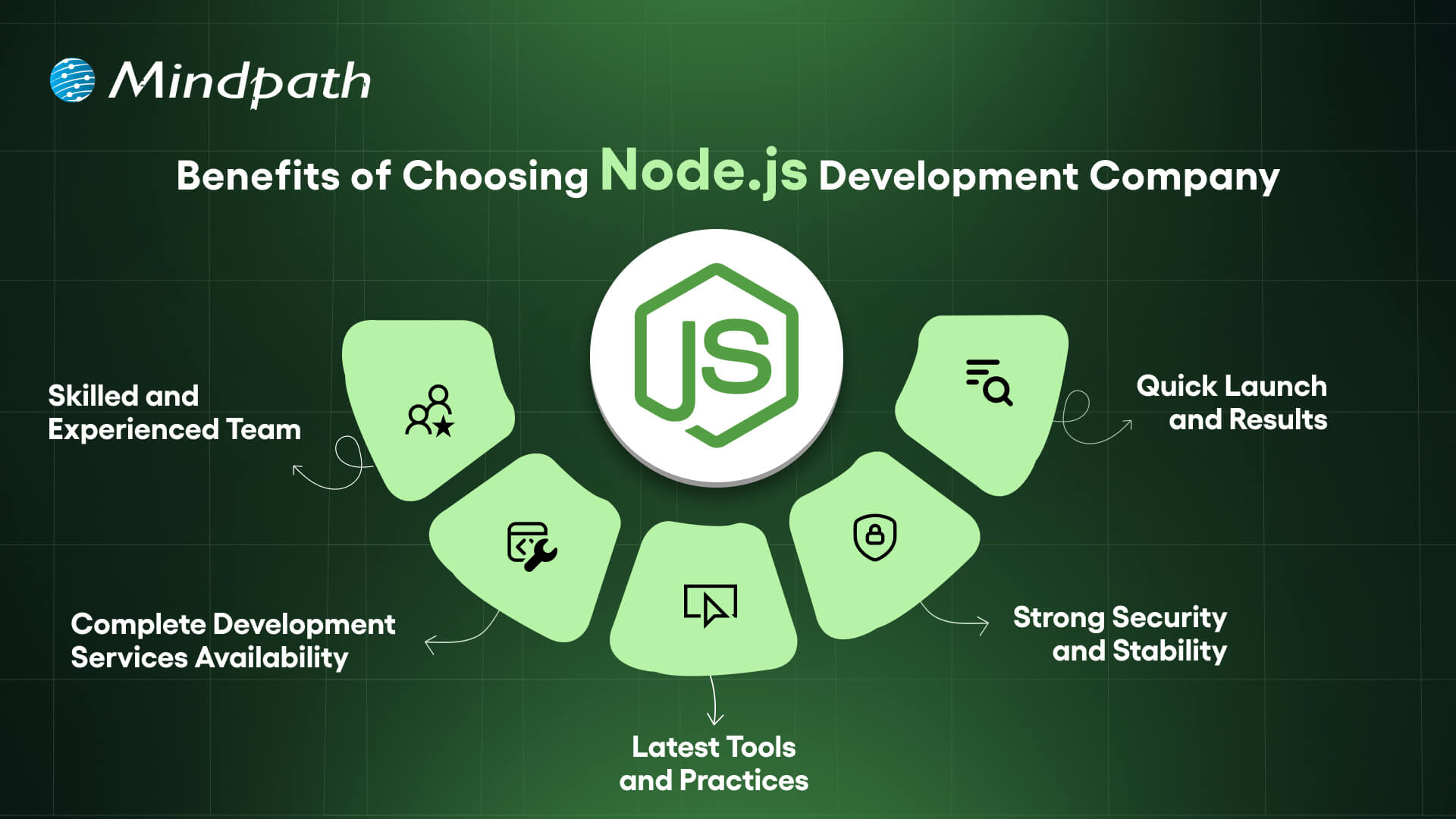
Selecting a Node’s web development company, which is trusted, can make your project faster, smoother and more scalable. With the abilities of Node.js, your app can handle high traffic and real-time updates with ease. Let us look at some of its benefits: 
Benefits of choosing nodejs development

1. Skilled and Experienced Team

A Node.js development firm can bring a team of experts who know how to build strong and flexible applications. They have hands-on experience with different types of projects and can offer smart, custom solutions and their knowledge can also help to avoid mistakes and deliver better results from the start. 

2. Complete Development Services Availability

A Node.js development services provider takes care of everything, starting from the discussion to launching and maintaining your app. You don’t need to work with different teams for each part, which can save a lot of time and effort.  Having all the services in one place keeps your project organized and moving forward smoothly. 

3. Latest Tools and Practices

A trusted Node.js web development company always works with the latest tools, updates, and frameworks as they follow modern development practices to build fast, secure, and scalable applications which means your app will be future-ready and can perform well under changing user needs. 

4. Strong Security and Stability

Security is a top priority for a professional Node.js development agency, and they take steps to protect your app from threats by using tested methods to keep your data safe and your app stable. You can count on them to deliver a secure and reliable product that works smoothly. 

5. Quick Launch and Results

When you hire a Node.js development firm, your project moves quickly from idea to launch as their process is streamlined, so that you can get your product out to users much faster which helps you stay ahead of the competition and respond to the market more effectively. 

Looking to supercharge your applications with AI capabilities? Explore our blog on NodeJS Libraries for AI Integrations to learn which NodeJS libraries can simplify and enhance your AI-powered applications.

By now, you must have had a clear idea about Node.js, so let us learn about the most important topic: 

Key Considerations While Choosing the Right Node.js Development Company

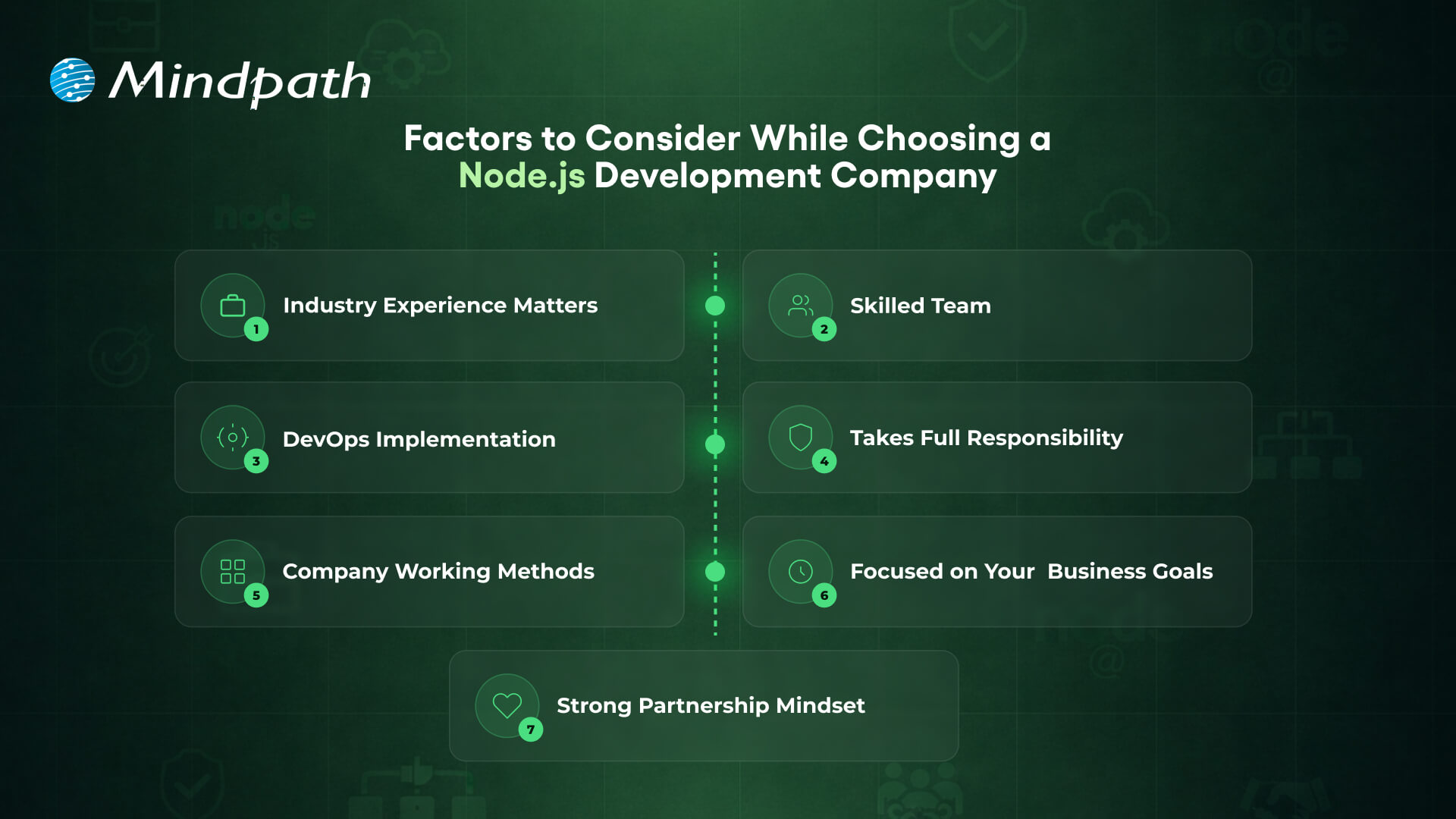
When you are looking for the right company, keep in mind that not all software development companies providing Node.js services are the same. Understanding the following key factors can help you find a team that delivers quality and meets your specific needs: 
Factors to consider while choosing a Nodejs development company

1. Industry Experience Matters

How long a company has been working in software development shows their reliability and knowledge. Experienced Node.js companies know the best ways to work with clients and handle projects smoothly. They are familiar with popular Node.js tools and frameworks and use proven methods like Agile and DevOps to deliver projects on time and with quality. 

2. Skilled Team

A good Node.js company has a strong team with different skills, so they can start your project quickly and build exactly what you need. A team that understands micro services in Node.js can divide tasks smartly and deliver results faster. Having experts like project managers, DevOps specialists and cloud professionals makes the process smoother and more efficient. 

3. DevOps Implementation

Using DevOps helps a company build software faster and more smoothly. It brings developers and operations teams together, so everyone works closely and avoids delays. This way of working also makes the project more secure and organized. A company that follows DevOps can handle changes better and deliver a high-quality product with fewer issues. 

Also Read: Benefits of DevOps

4. Takes Full Responsibility

A good Node.js company takes full responsibility for the work they do. If something goes wrong, they don’t hide it or blame others. Instead, they fix it and learn from it. This honest attitude builds trust, improves communication, and shows they truly care about the success of your project. 

5. Company Working Methods

The way a Node.js company handles projects says a lot about them. It’s not just about good reviews, but also how they talk to you and what value they bring. You can learn more by checking their website, blogs, case studies and social media to see how they share ideas and show their work to the world. 

6. Focused on Your Business Goals

The right Node.js development firm takes time to understand what your business wants to achieve. They work in a way that supports your goals and helps your business grow. With the right knowledge and experience, they can build a strong and future-ready project that fits your budget and timeline. 

7. Strong Partnership Mindset

A trusted Node.js company doesn’t just build your project and leave. They work with you like a real partner, staying connected and involved at every step.  They provide clear communication, teamwork, and support, even after the project is done which helps make everything run smoothly and lead to better results for your business. 

Want to ensure your NodeJS applications run efficiently and reliably? Explore our blog on hire expert NodeJS developers for high-performance apps to learn how skilled developers can boost performance and scalability.

Ready to Choose the Right Node.js Development Company?

Selecting the right Node.js Development firm plays a big role in how fast, secure, and scalable your project becomes. By focusing on experience, team skills, DevOps culture, and a true partnership approach, you can ensure you’re working with a reliable team. A trusted Node.js development company will not only build a great product but support your long-term success too. 

At Mindpath, we offer end-to-end NodeJS development services that are designed for speed, performance, and future scalability. From building real-time apps to using micro services in Node.js, our team brings deep experience and modern practices. As a top-rated Node’s web development company, we ensure your product is secure, stable, and ready for the market. 

Looking to hire Node.js developers who understand your goals? At Mindpath, our experts bring strong technical skills, creativity, and a collaborative mindset. Startups and enterprises trust us for quality, future-ready solutions. Connect with Mindpath and let’s build something great together. 

Frequently Asked Questions

1. How to know if a Node.js development company is the right fit for a project?

A good fit depends on how well the company understands your goals, communicates clearly, and shows relevant experience. Reviewing past projects, technical expertise, and their approach to problem-solving can help ensure they can handle your requirements effectively.

2. What should be expected when working with a Node.js development company?

A professional company usually offers a structured process, including planning, development, testing, and support. Clear communication, regular updates, and a focus on performance and scalability are common expectations when working with an experienced development team.

3. Is Node.js suitable for handling high-traffic applications?

Yes, Node.js is designed to handle multiple requests at the same time without slowing down. Its non-blocking architecture makes it ideal for applications that need to manage high traffic, real-time updates, or large numbers of users efficiently.

4. How does a Node.js development company support long-term project growth?

A reliable company builds applications with scalability in mind, allowing easy updates and expansion. They also provide ongoing support, performance monitoring, and improvements, helping the application adapt to changing business needs over time.

5. Why is communication important when choosing a Node.js development company?

Clear communication ensures that project requirements are understood correctly and reduces the chances of errors. Regular updates, feedback, and transparency help keep the project on track and build trust between the business and the development team.

Support Is One Click Away

Featured Posts

Related Post

Angular vs React

Developing modern web applications requires making definite technological choices. The Angular vs React controversy still influences those decisions. Lots of software development teams look beyond the most popular option. They focus on aspects that drive long-term value, scalability, and developer experience. Now, what truly sets the right one for a project? A deeper look shows how both fit different business goals, technical needs, and team capabilities. So, the decision becomes more thoughtful than it first appears.

With development demands changing, businesses now expect fast delivery. They also want flexible architecture and a near-perfect user experience. Therefore, choosing the right framework becomes a strategic move. It is not just a simple preference. Some focus on structure and consistency, while others prefer flexibility and speed. This gap raises a few important questions. Your discussions must address them before moving forward. In this article, you will learn through deep research which platform suits your development needs best.

What is React? A Quick Overview

React is a JavaScript library that was created by Meta, and it is mainly used to create user interfaces that are dynamic and single-page applications. It breaks frontend content into smaller, reusable, and independent components, which makes the code more manageable, scalable, and efficient for the development of modern web.

Besides, developers adore React for its virtual DOM feature that drastically reduces the time of the rendering process and allows for the smooth update of the UI. As opposed to heavier frameworks, React’s adaptability and component-based structure render it a leading choice when one compares Angular vs React. In fact, it is always found ranking very high for its simple and high performance.

Benefits of React Framework:

1. Component-Based Architecture

React builds UIs from small, reusable components. This makes code easier to manage, test, and scale.

2. Virtual DOM for Faster Rendering

React updates only the necessary parts of the DOM. This ensures faster performance and a smoother user experience.

3. Declarative UI

React lets developers describe what the UI should look like in any state. This makes code more readable and easier to debug.

4. Unidirectional Data Flow

Data flows strictly from parent to child components in React. This ensures better control and a more stable codebase.

5. Strong Community and Ecosystem

React has a massive global community backed by Meta. Tools like Redux and Next.js make development faster and well-supported.

6. Cross-Platform Mobile Development

React Native allows building iOS and Android apps using the same principles. This reduces development time, cost, and effort significantly.

What is Angular? A Quick Overview

Angular is a comprehensive solution developed with the TypeScript language, and it is open source. Google is the one that maintains it. Angular is mainly used to create dynamic single-page applications. It presents a well-structured and component-based working style alongside a full set of internal tools. This makes the development of large-scale applications much more manageable, consistent, and efficient.

If we talk about the comparison of Angular vs React, Angular as a framework is complete and delivers out-of-the-box facilities for routing, forms, and HTTP services. This reduces the developers’ reliance on third-party libraries and gives the teams working with the same technology a unified and standardized way of building robust and enterprise-grade web applications.

Benefits of Angular framework:

1. Component-Based Architecture

Angular builds UIs from self-contained, reusable components. This promotes modularity and maintainability across the application.

2. TypeScript Integration

Angular is built on TypeScript, enabling static typing and early error detection. This ensures cleaner, more reliable code for large projects.

3. Two-Way Data Binding

Angular automatically synchronizes data between the model and UI in real time. This eliminates manual DOM manipulation and simplifies development.

4. Comprehensive Tooling and Ecosystem

Angular offers built-in routing, forms, HTTP client, and testing utilities. This reduces reliance on third-party libraries significantly.

5. Performance Optimizations

Angular includes AOT compilation, lazy loading, and the Ivy rendering engine. These ensure faster load times and improved application performance.

6. Google Support and Community

Backed by Google, Angular receives consistent updates and long-term support. A large developer community provides extensive resources and solutions.

React vs Angular: Which is the Best Framework for Frontend Development?

Deciding on the best frontend framework for your project is certainly a heated topic in web development today. By deciding Angular vs. React, which is better, allows us to understand how tech choices can be more aligned with the needs of specific projects.

1. Architecture

Angular is built around a rigid MVC architecture with clearly demarcated components, modules, and services, which is highly conducive to large teams and enterprise projects. With its well-defined, opinionated style that enforces uniformity and standardization across the entire codebase, Angular doesn’t leave much to the imagination of the developers.

Unlike Angular, React is a totally unopinionated framework that lets developers have full control over the way they structure their projects. This flexibility could match the creative teams well, but the fact of the matter is that without discipline making consistency could be nothing but a challenge, especially when applications are scaling.

2. Data Binding and DOM Handling

Angular’s two-way data binding syncs the UI and model automatically. This makes the development easier, however, it might cause overhead in very big applications. It operates on the real DOM which could slow down the app especially in scenarios where there are a lot of changes to the data.

React uses one-way data binding combined with a Virtual DOM that only the affected parts of a component will be re-rendered. This is the main reason why in discussion of Angular vs React performance React wins. It’s the most efficient when it comes to dynamic and data heavy applications.

3. Language and Syntax Differences

Angular leverages TypeScript, which has the benefits of type safety, automatic code completion, and more elegant handling of the code+

React mainly runs on JavaScript, with the option of TypeScript being an addition, and it introduces JSX as a means

4. Learning Curve and Developer Experience

Angular is a complex framework, and developers have to learn TypeScript, DI, modules, and the Angular way of doing things. It is a good choice for mature developers who want to build structured software that lasts a long time.

React is simpler and more approachable, particularly for developers already familiar with JavaScript frameworks. It is a popular choice among new developers, startups, and fast-growing teams because of its very easy learning curve.

5. Ecosystem and Community Support

Exploring Angular vs React features, Angular delivers a full, Google-supported ecosystem along with the official tools for routing, forms, HTTP services, and testing that are part of the package. Such an integrated environment is why Angular is a dependable option with steady long–term ‌‍ ‍‌support.

React, ‍‌ for its part, enjoys a large open-source ecosystem with h a huge number of third-party libraries Redux, React Router, Recoil, etc. Besides, its big community across the world not only helps in keeping the library updated, encouraging innovations but also makes learning resources very ‍ ‌‍ ‍‌accessible.

React vs Angular: A Comparison Table

The following table compares React and Angular across key parameters. This makes it easier to evaluate which framework best suits your development needs.

Criteria  Angular  React 
Type Complete structured frontend framework Flexible lightweight UI library approach
Architecture Strict MVC based architecture pattern Component based reusable UI structure
Language TypeScript used by default always JavaScript with optional TypeScript support
Data Binding Two-way automatic data binding One-way predictable data flow
Performance Heavier framework moderate performance speed Fast rendering using virtual DOM
Learning Curve Steep learning curve for beginners Easy learning curve for developers
Development Speed Slower due to strict structure Faster development with flexibility
Ecosystem Built in tools limited flexibility Large ecosystem high flexibility

Ready to Choose the Right Framework for Your Next Project?

The Angular vs React future depends on how well each option fits your project goals. Angular offers strong structure and built-in tools for complex systems. React brings flexibility, speed, and a modern approach to UI development. Teams now focus on performance, scalability, and user experience before making a choice. A clear understanding of project needs helps select the right technology and ensures long-term success.

At Mindpath, we deliver high-quality React development services with a strong focus on performance and scalability. The team builds modern, user-friendly applications that support business growth. With deep expertise and a flexible approach, Mindpath helps companies create fast and reliable digital products that stand out in today’s competitive market.

Frequently Asked Questions

1. How does Angular vs React impact long-term project maintenance and updates?

Long-term maintenance depends on how easily code can adapt to changes. Angular offers a structured setup that helps large teams stay consistent over time. React provides flexibility, which allows faster updates and easier feature additions. The choice often depends on team size, project complexity, and future expansion plans.

2. In Angular vs React, which option supports better team collaboration in real projects?

Team collaboration improves when developers follow clear coding patterns and workflows. Angular supports consistency with built-in standards, making coordination easier in large teams. React encourages flexibility, which works well for smaller or agile teams. The right choice depends on how structured or adaptable the team prefers to work.

3. How do these technologies handle frequent UI changes in growing applications?

Modern applications often need regular UI updates to stay relevant. React handles frequent UI changes efficiently due to its component-based structure. Angular also supports updates but may require more effort due to its strict architecture. The decision depends on how often the interface needs quick and dynamic changes.

4. Which option works better for startups aiming for quick product launches?

Startups often focus on speed, flexibility, and quick iterations. React helps teams build and test features faster due to its lightweight nature. Angular provides a complete setup but may take more time initially. Choosing the right option depends on how quickly the product needs to reach the market.

5. How do Angular and React support future technology integration like AI or advanced analytics?

Future-ready applications require smooth integration with modern technologies. React offers flexibility, making it easier to integrate AI tools and analytics platforms. Angular also supports integration but may need more structured implementation. The decision depends on how dynamic and scalable the future technology roadmap is.

Discover the top Node.js trends shaping digital technology in 2024, from AI and TypeScript to IoT and cloud computing. Explore how Node.js drives innovation!
WordPress maintenance
Is your WordPress site running as smoothly as possible? Do you know what kind of essential maintenance activities should be done on your website to keep it secure and running well? In this blog, we will explore the essential maintenance tasks that will keep your WordPress site in top shape. So, let’s dive in! 

Importance Of Website Maintenance   

Routine WordPress maintenance will help your website to be stable, secure, with better loading speed, and compatible with different browsers and devices. Regular backups guarantee that there is no loss of data in case of website crashing or malware attacks. Up-to-date plugins will ensure that slowdowns and security risks are prevented. Monitoring and analytics on user behavior help you make informed decisions and optimize your content. This provides better maintenance of your website, thus keeping it in top shape, and gives a better experience to the visitor. 

How Much Does WordPress Maintenance Cost?  

The cost of maintaining a WordPress site will be based on the size and complexity of the website. Routine maintenance in 2024 can range from as low as $5 a month to $120 per month or $40 a year to $1,200 a year. For a personal site, maintenance might be as low as $4 a month or $40 annually. Business sites usually start at about $8 per month or $80 per year. The pricing for running corporate websites is usually in the region of $12 a month or $120 yearly. The websites related to entertainment and eCommerce usually cost more, with the former starting at $16 per month and the latter at $20 a month. Routine maintenance includes updating plugins, themes, and WordPress core, managing backups, ensuring security, and keeping up performance. 

The Complete Checklist of Monthly WordPress Maintenance Tasks   

1. Optimize Your Database   

Over time, your WordPress database can become bloated with extraneous data from things like old post revisions, spammy comments, and deleted items, which slow down your site. To clean up your database, first back it up using a tool like Solid Backups to ensure all your data is safe. Then use a plugin such as WP Optimize to clear out any unnecessary data and boost database performance. Alternatively, if you know how to manipulate a database, you can clean up manually with phpMyAdmin. This method is useful when custom settings must be considered, and in all probability, it would be good to talk this over with a developer in case you are unsure. 

2. Manage Backups   

Backing up your website is something you should do regularly for safety against losses and quick recoveries in case of issues. Besides, with Solid Backups, you can configure backups automatically by using the plug-in known as UpdraftPlus. Schedule the backups frequently and let them be safely kept in the cloud, optimally. Moreover, review the process of restoration month by month to confirm that your backup procedure is working well, and in case of need, you will be in a good position to recover your site. 

3. Update WordPress Core, Plugins, And Themes   

WordPress core, theme, and plugin updating have implications for security, compatibility, and accessing new features. According to the Wordfence 2022 State of WordPress Security report, plugins in particular are a weak point, so keeping them up to date is very important. Keep checking for updates, and when found, update them one after the other. Begin with the WordPress core and then proceed to plugins and themes. Remember to always back up before doing any big update and update on a staging site so you can be sure everything works well with your current setup. 

4. Perform Security Scans   

Security scans to vulnerabilities, malware, and unauthorized access should be regularly scheduled. Run full site scans with a plugin like Shield Security, check the logs for any suspicious activity, and configure settings. You should, however, schedule these scans to run periodically, but at least revise them once a month. 

5. Analyze Site Speed   

A website’s speed has a massive impact on user experience and SEO. Among others, you can use Google PageSpeed Insights, GTmetrix, or Pingdom to check how fast your website loads. After testing, fix performance issues of your website against the results. If the speed problems continue, see if there’s a need to review and upgrade your hosting plan. 

6. Check For Broken Links   

Checking for broken links is important both for delivering a good user experience and SEO. Broken links may make visitors and search engines end up in so-called ‘dead ends,’ harming your site’s rankings and authority. Run a check using a plugin such as Broken Link Checker. Thereafter, repair or remove broken links upon finding them, possibly looking into scheduling automated checks to help identify new broken links in the future. 

7. Optimize Images   

Optimizing images will help to increase your site speed and performance radically, particularly when you have a heavy share of images on the site. Tools like Smush or ShortPixel do really well when it comes to compressing existing images. Remember the right formats—JPEG for photos and PNG for graphics where the requirement is transparency. Enable lazy loading; this defers the loading of off-screen images to further speed up page load times. 

8. Submit Your Sitemap   

Making sure that you are regularly submitting your sitemap to search engines will let them index your website in a better way and give you more exposure. Use a plugin such as Yoast SEO to create an updated sitemap, then take the time to manually submit this to search engines via their webmaster tools—like Google Search Console—to check that all your pages are correctly crawled and indexed for maximum search engine visibility. 

9. Monitor Site Performance   

Monitoring your site’s performance frequently will let you know when there is a problem. It helps in making informed decisions and will let you act swiftly. Use tools like Google Analytics and Jetpack to look through key metrics such as page views, bounce rate, and conversion rates. This setting of performance alerts about major changes or problems will let action be taken in time and thus your site runs smoothly. 

10. Test Your Forms   

Testing of forms at regular intervals is paramount to ensure that they work right and harvest data from users effectively. All forms should work well, and process input correctly. Check that email notifications are going to the right addresses, then test for user experience to make sure forms are usable, accessible, and responsive on different browsers and devices. 

11. Clear Site Cache 

It ensures that your site visitors have the most recent content. In addition, it will boost your website’s performance. Sometimes, cached data can become corrupt or outdated, causing display issues and slowing download time. Flush the server cache, then reset any plugin-built caches. Test your site for improved performance after flushing the cache. This can also be done in many ways depending on your unique setup. If you are not comfortable doing it yourself, use something like WP Super Cache and W3 Total Cache

Ready to optimize Your WordPress Experience?

Learn More About Mindpath’s Maintenance Services!

WordPress Development Services at Mindpath   

At Mindpath, we ensure your WordPress website runs at its best with comprehensive maintenance services. This includes regular updates to WordPress Core, plugins, and themes; daily backups for data security; and optimization of the performance of the site so that it loads faster. Our team conducts security scanning to save from threats, monitors and fixes broken links, and looks through analytics to bring about better user engagement. We test forms to make sure they are working well. You just focus on your business while we keep your site secure and efficient with our expert maintenance. 

Conclusion 

Maintenance, on the other hand, will ensure your WordPress site is not only smooth, safe, and high performing, but it will also be defended from many problems for the best user experience. From checking for broken links to analyzing site speed or running security scans, every step is important in keeping your website at its best. 

At Mindpath, we cut down the complexity of WordPress maintenance by offering every necessary service in one place to keep your site in top condition. Let our team take care of updates, backups, performance optimization, security checks, and more, so you can focus on growing your business while we work on keeping your website reliable and engaging. Our expert team at Mindpath makes sure your WordPress site is running at peak performance, ensuring you can get on with business and not worry about it. 

Want to achieve a Faster, Safer WordPress Site?

Find Out More About Mindpath’s Maintenance Solutions!

Ensure your WordPress site runs smoothly with essential maintenance tasks like updates, backups, security scans, and performance optimization.
Node.js Developers in London

Are you looking for skilled Node.js developers in London to build fast and scalable web applications? Do you need experts who can handle real-time data, microservices, or high-performance APIs? Finding the right talent can be challenging, but the good news is—London is home to some of the best Node.js developers ready to bring your vision to life.

Hiring Node.js developers in London gives you access to elite talent capable of creating quick, scalable, and high-performance apps. With skills in real-time data processing, microservices, and API development, these specialists assist firms in developing seamless digital solutions. London’s vibrant tech industry provides competent Node.js engineers who provide creativity, efficiency, and dependability to all projects. Whether you want a dedicated team or a single specialist, hiring Node.js developers in London is an excellent option for developing cutting-edge online apps. They specialize in developing safe, durable, and future-ready solutions that enable organizations to remain competitive in today’s digital environment. London-based Node.js engineers have a thorough grasp of JavaScript, backend development, and cloud integration, allowing them to create contemporary, scalable software solutions that are suited to your specific requirements.

Let’s explore how hiring Node.js experts in London can benefit your business!

Advantages of Hiring Node.js Developers in London

1. Scalability and performance

Hiring Node.js developers in London guarantees that your apps can manage heavy traffic and scale efficiently as your company grows. Node.js is built for speed and efficiency, making it ideal for websites and apps that handle several requests at once, such as real-time conversations, online marketplaces, or streaming services. With professional Node.js developers, your company has a robust backend system capable of supporting thousands of users without slowing down. They create lightweight, scalable, and high-performance apps that work smoothly even under peak loads. This is especially important for firms that anticipate quick expansion or deal with a high volume of user interactions. By hiring professional Node.js developers in London, you can guarantee that your digital platform stays quick, responsive, and capable of easily accommodating future growth.

2. Cost-effectiveness

Hiring Node.js developers in London might be a wise decision for firms seeking high-quality development at a reasonable price. Compared to other major tech hubs, London has a broad pool of talented Node.js developers, allowing organizations to select the best expertise within their budget. Node.js makes development faster and more efficient, lowering total project expenses. Its lightweight architecture and ability to execute numerous activities at once require fewer servers, cutting infrastructure costs. Furthermore, London-based developers have experience designing scalable apps, resulting in long-term savings by avoiding costly redesigns or performance difficulties. Choosing professional Node.js developers in London provides organizations with high-quality solutions that are cost-effective, efficient, and built for growth, making it an excellent choice for both startups and corporations.

3. Faster development cycles

Hiring Node.js developers in London enables organizations to accelerate their development processes and deploy products quicker. Since Node.js is based on JavaScript, developers can work on both the frontend and backend using the same language. This simplifies code, decreases development time, and enables faster upgrades and enhancements. Node.js’ lightweight architecture and rapid processing allow developers to construct apps efficiently and without delays. It allows real-time updates, allowing for faster feature testing and refinement. This is especially important for organizations that need to react to changing market conditions and stay ahead of the competition. Working with skilled Node.js developers in London allows businesses to shorten development cycles, minimize time-to-market, and guarantee their applications are both high-performing and future-ready.

4. High-quality talent pool

London has a vast and diversified community of skilled Node.js developers, making it simpler to discover the appropriate fit for your project. With a robust tech environment, the city draws elite talent capable of developing scalable, high-performance apps. London-based Node.js developers are proficient in current development approaches such as microservices, cloud integration, and API development. Their expertise in working with startups and multinational corporations enables them to tackle projects of any size and complexity. Hiring Node.js developers in London provides organizations with access to highly trained individuals that produce efficient, inventive, and dependable solutions. Whether you require a single specialist or a committed team, London’s diverse talent pool guarantees that you discover the perfect developers to bring your idea to life.

5. Experience with latest trends

Hiring Node.js developers in London provides firms with expertise that are up to speed on the newest Node.js breakthroughs and industry best practices. London’s IT ecosystem is thriving, with developers continually learning and adapting to new tools, frameworks, and performance enhancements. These developers have firsthand expertise with cutting-edge technologies such as serverless architecture, microservices, cloud computing, and real-time applications. They adhere to the best coding methods, guaranteeing that your application is designed with the most recent security patches, performance enhancements, and scalability capabilities. Working with London-based Node.js developers provide organizations with cutting-edge technology and unique solutions, allowing them to stay ahead of the competition. Their understanding of emerging trends keeps your application current, efficient, and future ready.

Ready to Build Scalable, High-Performance Applications?

At Mindpath. we offer expert Node.js developers who can bring your project to life with speed, efficiency, and innovation. Whether you need a dedicated team or individual developers, our professionals are equipped to handle all your Node.js development needs. Let’s build something great together.

Get in touch with us!

Want to Know More About Hiring Node.js Developers in London? Check out our detailed blog on the factors to consider while hiring Node.js developers in London.
Hire skilled Node.js developers in London for high-performance, scalable web applications and discover its benefits.