How Custom Mobile Application Development Drive Digital Transformation 

Join our Newsletter!

Featured Posts

Support Is One Click Away

Home

How Custom Mobile Application Development Drive Digital Transformation 

Custom mobile application development

How Custom Mobile Application Development Drive Digital Transformation 

Businesses today, in a fast-moving digital world, are always trying to innovate so they can stay ahead. Custom mobile application development helps drive the change in how companies interact with their customers and improve internal operations. Try to imagine having a solution that is just for your business and will improve efficiency, engagement, and accelerate growth. Developing an app with a solution for the goals of your business has become a strategic need for any business wanting to be an industry leader.

As technology develops, the demand for personalized digital experiences grows, and the expectations of customers rise. If organizations want to provide authentic value, they can no longer select a generic approach. With custom mobile application development services, organizations gain the ability to adjust quickly, have deep functionality, and create seamless experiences that genuinely resonate. In this blog, we will discuss how those applications form the basis of digital transformation and change the way businesses are operating in a connected world.

Unlock new ways of connecting with users that help your business reach greater heights with Mindpath’s mobile app development services, which provide solutions according to the individual business demands.

Overview of Custom Mobile Application Development

Custom mobile app development means developing customized mobile applications that align with the company’s unique goals and workflow. A custom mobile app development company constructs your app from the ground up, giving you total control of features, design, and experience, while they supply the solutions to maximize efficiency and growth.

The process enables organizations to provide seamless integration of the app with their current systems with full confidence in security and scalability. Throughout the process, from planning and designing to developing and supporting, every phase of the app is managed to achieve business requirements and provide a smooth, entertaining experience for users.

How Does Custom Mobile Application Development Drive Digital Transformation?

Custom mobile app development is changing the way businesses think about tech and growth. It allows organizations to embrace newer solutions to replace their technologies that serve the company’s individual goals and strategies in this digital age.

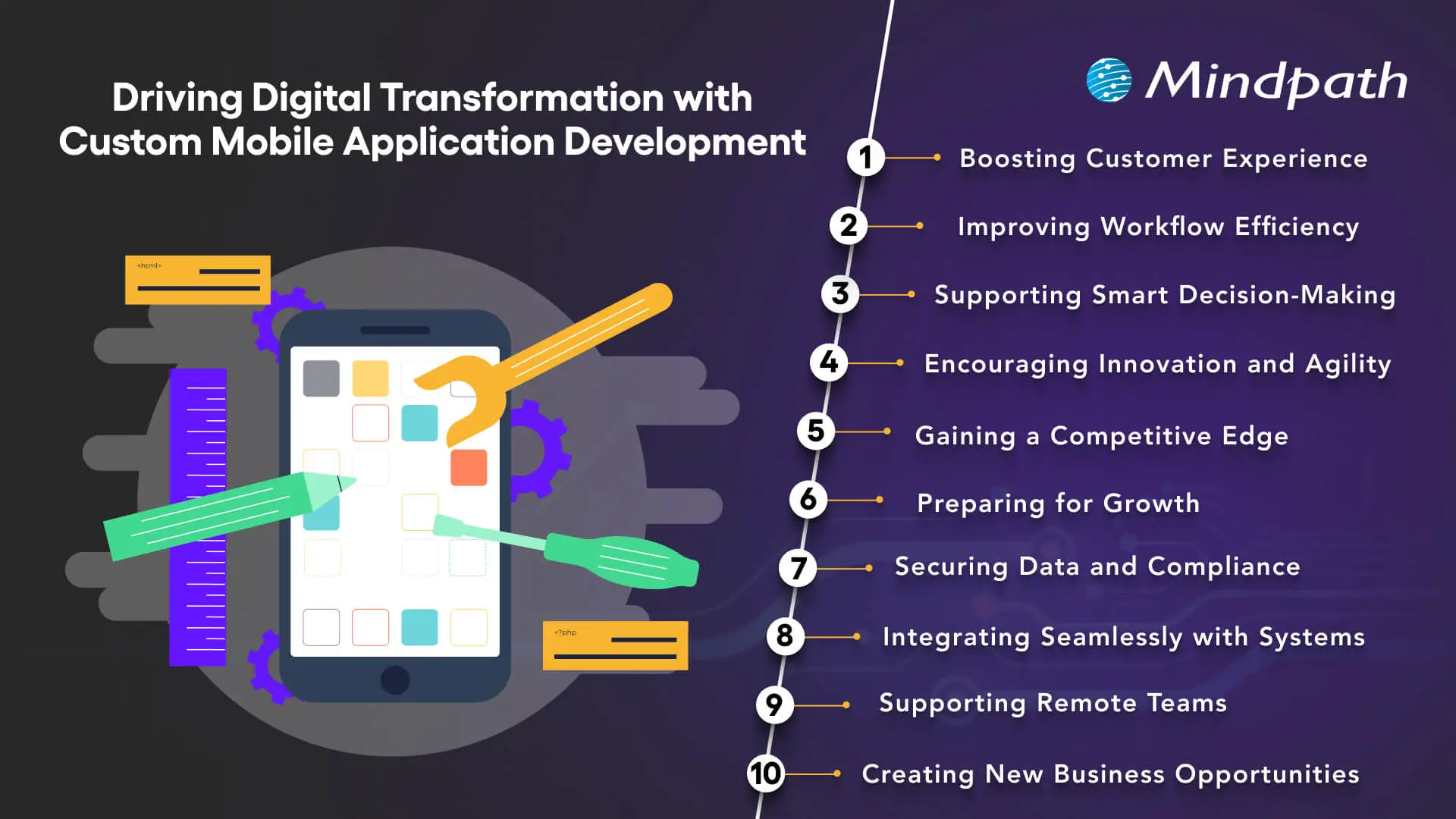
Driving Digital Transformation with Custom Mobile Application Development

1. Boosting Customer Experience

By using custom mobile application development, a company can have an app that is unique and offers a different experience for the users. These applications are the most convenient way for the customers to interact with the company, get a response, and receive the service. If a business adopts a user-centric design, it is only a matter of time before they will see their customers being more loyal and having a stronger bond with them.

2. Improving Workflow Efficiency

Personalized applications simplify core business operations through the automation of monotonous tasks and the minimization of errors. As a result, the company productivity is elevated and operational expenses are lowered. Enterprises thus become winners of facilitated work processes and a better structured system.

3. Supporting Smart Decision-Making

Custom app development enables real-time data collection and analysis. Companies have the ability to monitor consumer behavior, industry trends, and their own performance in an easy way. Such a data-driven strategy is a great source of power for decision-makers, as it enables them to take correct and prompt decisions.

Want to understand which tools and frameworks power successful mobile apps and accelerate digital transformation? Explore our detailed guide on mobile app development technologies to discover the platforms and tech stacks driving innovation.

4. Encouraging Innovation and Agility

By using tailored solutions, businesses have the possibility to create exclusive features that tackle issues directly. Such freedom from constraints promotes creativity and makes it possible for the company to adjust to the changes in the market swiftly. In other words, companies have the opportunity to be ahead of their competitors in the sense that they can try out new things and make their moves faster.

5. Gaining a Competitive Edge

Custom applications are a great way for companies to be different from the rest of the businesses by giving them exclusive features and a better user experience. Such differentiation leads to a powerful market presence. A good app is the company’s strongest weapon in the battle for customers against competitors.

6. Preparing for Growth

Custom mobile application development is a wise decision when considering business growth because it guarantees that the app will be scalable. It is very easy to add new features or make a service available to more users. The company can grow with no problem of performance or user experience being compromised.

Must Read: AI in Mobile Apps

7. Securing Data and Compliance

Custom apps may have the most sophisticated security features that are specifically tailored to meet the needs of different industries. Such features not only secure sensitive information but also help in maintaining compliance with the set regulations. Companies can go about their operations without any worries that their data is secure.

8. Integrating Seamlessly with Systems

Custom apps built using the right mobile app development tools can be linked to existing corporate software and platforms without any problems. As a result, this leads to the creation of a single digital ecosystem that spans across different tools. Information exchange between various systems becomes very easy. Hence, the mistake rate is reduced, and the speed of work is increased.

9. Supporting Remote Teams

With the help of mobile application development platforms, employees get access to tools and information from anywhere. This provision of remote access is a great boost to collaboration, which can now happen across different locations. It also allows work arrangements to be flexible. Teams are thus not being unproductive as they are not bound to a single office.

10. Creating New Business Opportunities

The creation of custom apps may result in a business gaining revenue streams through subscription fees, in-app purchases, or new digital models. Companies can now dig into newer ways of monetizing their services. By means of website and mobile app development, the business can ensure that these opportunities are indeed going in line with their overall strategy.

Looking to future-proof your mobile app strategy? Discover the latest insights in our blog on mobile app development trends to see how emerging technologies are redefining digital experiences.

Want to Drive Growth with Custom Mobile Apps?

Custom mobile application development is a powerful tool for businesses looking to innovate and stay competitive. Tailored apps improve efficiency, enhance customer experience, and provide data-driven insights that guide smarter decisions. By adopting custom solutions, organizations can drive growth, strengthen their market presence, and create seamless digital experiences that truly align with their goals.

At Mindpath, we offer professional custom mobile application development services to help businesses achieve these results. Our team builds scalable, secure, and feature-rich mobile applications that integrate smoothly with existing systems. We focus on delivering solutions that match your business needs and foster innovation. We provide a superior user experience across all platforms.

Related Post

How much does hiring a ReactJS developer cost? Learn about factors affecting rates, and how to find the best talent within your budget.

Related Post

front-end development
Curious about what’s next for front-end development? How are emerging trends shaping the way we build and experience websites? What innovations are making web interactions faster, smoother, and more engaging? In this blog we are going to explore the key trends in front end development 2024 and the future of front-end development is set to transform user experiences.  Front-end development involves creating the components of an application that users can view and interact with directly. It aims to make the user experience as seamless and engaging as possible. This includes designing and coding features like text styles, graphics, buttons, and general color schemes to ensure that the application is visually beautiful, simple to use, quick, and secure. A front-end developer’s responsibilities include working on interactive elements like sliders, pop-up forms, and custom maps, as well as developing navigational menus to help users navigate the program. These components are critical to making the application user-friendly and interesting.  Staying up to date on the newest trends in front-end development becomes increasingly crucial. These trends have the potential to alter the design and user experience of websites and applications. New tools and technology make it simpler to build designs that are both interesting and user-friendly. Understanding these patterns allows developers to remain ahead of their competitors and create innovative solutions. Keeping up with front-end trends ensures that your skills are relevant and your projects sparkle.  So, let’s dig in and explore the key trends in front-end development! 

Key Trends in Front-End Development 2024

Key Trends in Front-End Development 2024

1. Motion UI

Motion UI is expected to revolutionize front-end development by 2024. Companies need to discover innovative methods to keep users interested as their attention spans decrease. Motion UI is a new approach, employing transitions and animations to make webpages and applications more vibrant and intriguing. This trend enables developers to create seamless animations to buttons, menus, and page transitions. Animated elements make interactions more interesting and enjoyable, encouraging visitors to stay on a website longer and explore farther. As Motion UI becomes popular, it is projected to play an important role in improving and captivating web experiences. 

2. JAMStack

JAMStack, which stands for JavaScript, APIs, and Mark-up (HTML and CSS), offers a new approach to website development. Traditionally, developers had to configure a server to produce HTML pages every time a visitor visited a website, which might be sluggish and inefficient. JAMStack makes this procedure considerably easier and faster. Rather than managing a sophisticated backend, developers build static HTML pages that are hosted on a Content Delivery Network (CDN). When people visit the website, the CDN immediately distributes the pre-built HTML pages to them. JavaScript and APIs are then used to manage any dynamic content, resulting in an interactive and responsive website. This strategy accelerates website performance, increases scalability, and simplifies management. As a result, JAMStack is expected to offer big advantages in developer experience, performance, scalability, and cost savings, making it a key front-end trend in 2024. 

3. VR and AR

Virtual Reality (VR) and Augmented Reality (AR) are already enhancing the immersive and interactive nature of online apps by 2024. While AR adds digital features to what you see in real life, VR replaces the real world with a virtual environment. They work together to produce more engaging and dynamic experiences on websites and applications, potentially increasing conversions and company growth. Big corporations like Amazon and Sephora are already embracing VR and AR to improve the shopping experience by allowing customers to see things in entirely new ways. As technology advances, VR and AR are expected to become progressively more popular, altering how consumers interact with online apps and setting new expectations for engagement. 

4. Micro Front Ends

Micro front ends will emerge as a major trend in front-end development, providing a new method to construct sophisticated apps. Unlike traditional monolithic designs, which bundle everything together, micro front ends divide huge programs into smaller and more manageable components. Each of these components, or micro front ends, has its own codebase, development team, and deployment procedure, and they work independently yet together to form a bigger system. This technique reflects the ideas of microservices architecture, giving developers more adaptability and mobility. One of the primary benefits of micro front ends is their reusability. Developers can create standardized user interface components that can be reused across several apps, maintaining design consistency and avoiding the need for unnecessary coding.  

5. Voice User Interface (VUI)

Voice User Interfaces (VUIs) are expected to become an influential trend in front-end development, altering how people engage with technology. As people get more comfortable using their voices to control devices and applications, VUIs gain popularity, making it essential for developers to embrace this technology and provide novel solutions. One of the primary advantages of VUIs is their capacity to improve accessibility. VUIs let users communicate with technology via voice commands, opening new possibilities for a wider audience, including people with impairments. When integrated with the Internet of Things (IoT), VUIs allow users to easily operate linked devices, making daily chores simpler and more natural. 

6. Single-Page Applications (SPAs)

Single-page applications (SPAs) are expected to have an enormous impact in 2024, becoming a prominent trend in front-end development. Unlike traditional multi-page applications (MPAs), that load a new page with each user interaction, SPAs start with a single page and dynamically modify the content as users interact with it. This method provides a smoother, quicker, and more responsive user experience. One of the fundamental aspects of SPAs is their dependence on JavaScript for asynchronous updates, which allows content to be presented without requiring a full page reload. This improves speed and helps the program appear more fluid and intuitive to users. As search engines improve their ability to handle dynamic material, the potential for SPAs grows. Companies who adopt SPAs currently will be ahead of the curve, acquiring a competitive advantage in the front-end development market. With its capacity to deliver a better user experience while requiring less development time and effort, SPAs are set to become a dominating force in web development, altering how businesses approach their online presence. 

Ready to stay ahead in front-end development?

Mindpath offers cutting-edge solutions to elevate your website’s design, performance, and user engagement. 

Front End Development Services at Mindpath

Mindpath’s Front-End Development Services are designed to deliver exceptional digital experiences. We begin with customized website design, creating distinctive and visually attractive webpages that reflect your business. Our responsive web design guarantees that your website appears great on all devices, from smartphones to computers. We prioritize interactive user interfaces, using engaging components such as buttons and sliders to improve user experience. Performance is essential thus we concentrate on optimization to ensure quick loading and smooth functioning. Our services also include cross-browser compatibility, which ensures that your website operates consistently across all major browsers. We also use SEO-friendly strategies to improve your website’s search engine rankings. Furthermore, we provide continuous support and maintenance to ensure that your website is up to date, secure, and runs smoothly. With Mindpath, your website will stand out, function exceptionally well, and successfully support your company objectives. 

Final Thought!

Front-end development will be significantly transformed by new innovations like VR, AR, and micro front ends. These advances aim to make online interactions more immersive and efficient, while Voice User Interfaces and Single-page Applications provide more seamless and intuitive user experiences. Staying ahead of these trends will be essential for developers and organizations seeking to distinguish out and thrive in the rapidly changing digital market. The future of front-end development seems promising, and now is the moment to embrace these improvements and advance your projects ahead. Mindpath is devoted to provide excellent digital experiences by using the latest and most recent front-end development services. Our services are meant to keep your web presence ahead of the curve by integrating cutting-edge technologies. By focusing on seamless, engaging, and high-performance solutions, we ensure that your website not only meets but exceeds current standards of excellence. Partner with us to change your digital strategy and create exceptional outcomes in 2024 and beyond. 

Curious about enhancing your web presence?

Mindpath’s front-end development expertise can transform your digital experience into something exceptional.  

Data and analytics trends

The future of data and analytics has been unfolding faster than ever. So, it has become an utmost responsibility of the organizations to keep pace with each changing trend. The global data analytics market size is also expanding and is expected to reach USD 402.70 billion by 2032. Today, organizations are relying on real-time insights to make smarter decisions and maintain a competitive advantage. So, as we move closer to the next phase of digital transformation, it is essential to analyze the present and future directions for better approaches.

A shift from descriptive reporting to predictive analytics has already reshaped businesses. Looking ahead, data and analytics trends are going to approach deeper automation and effective integrations. Let us explore such impactful developments that are going to make your organization futuristic in 2026 and beyond.

Want to ensure your business stays ahead using 2026’s key data and analytics trends? Contact Us and discover how Mindpath can transform insights into results.

What are Some of the Empowering Data Analytics Trends 2026?

Data analytics has shifted from a support function to a strategic business driver. Previously, analytics efforts only prioritized traditional reporting. But today, modern systems are offering forward-looking insights. Let us get into some of the most diversifying data and analytics trends of the future.

1. The Growing Demand for Big Data Analytics

The efforts of exporting data for a month and analyzing it continuously have fallen out of the trend. In the near future, big data analytics will effectively prioritize data freshness with the ultimate goal of real-time analysis. This can help your business make better decisions while increasing its competitiveness.

As we move through data analytics trends of 2026, real-time analytics are becoming the default expectations for more industries. Further, organizations understand how to balance cost and latency with the usage of combined streaming and cached metrics layers. This helps in offering fresh enough data where it matters the most.

2. The Influential Demand of GenAI and RAG

We are going to enter into a transformative era in big data analytics, as three closely related abilities: GenAI, retrieval-augmented generation, and agents. They have gained massive traction in recent years. GenAI has already showcased its potential in data analytics trends 2025, and it is going to strengthen its pace in the upcoming years as well. GenAI pushes the boundaries of traditional data analysis and enables users to generate synthetic datasets and automate content building.

Further, this innovation opens up new capabilities for predictive analytics and data visualization, which were previously limited by the scope of datasets that were gathered manually.

RAG and AI agents, on the other hand, are going to leverage a unique set of opportunities and challenges as well. They can enhance AI models by augmenting them with real-time data retrieval or the ability to automate tasks with the use of tools.

As per the current trends in data analytics, we are going to watch GenAI and RAG shift from ad-hoc prototypes to standardized enterprise patterns.

Looking to see how data and analytics turn into practical AI-driven outcomes for enterprises? Explore generative AI applications to learn how organizations apply AI at scale.

3. Analytics Platforms will Handle Large Sets of Data

With the usage of cloud technology, elements like storage requirements and processing power can be infinite. Now, you don’t need to be tense about getting extra machines or physical storage, as you can use cloud storage to scale.

Further, with cloud data handling, many stakeholders can access the data simultaneously without facing any slowdowns or lags. So, unless you are adopting the right security elements, the data can be handled from anywhere and at any time.

4. The Rapid Usage of Real-time and Proactive Analytics

Nowadays, no one is appealing to the static and backward-looking reports. Latest trends in data analytics for business organizations are all about proactive alerts and real-time decision-making. Your systems should be able to detect the surface anomalies and predict outcomes. This can trigger better actions.

Organizations that can act on real-time insights are 1.6% more likely to gain double-digit annual revenue growth, as per McKinsey. So, predictive analytics is no longer optional; it should be your competitive necessity as per the data and analytics trends.

5. Democratization and Decentralization of the Data

For many years, business analysts had to leverage the efficiency of in-house data scientists when they wanted to extract and analyze data. But, things are going to be different as per data analytics trends 2026, with services and tools that enable non-technical audiences to assess data.

We are going to see more emphasis on analytics engineering. Plus, you can also experience the high demand for a visual approach. Modern business intelligence tools like Mode, Tableau, and Looker are all for visual exploration, dashboards, and best practices. In 2026, Gen-AI-enabled assistants are going to accelerate the shifts even faster.

Want to see how data-driven insights power smarter interactions in business? Discover about conversational AI to learn how analytics and AI combine to transform customer engagement.

6. The Transformation of Business Intelligence

Business intelligence is changing beyond traditional and tightly coupled dashboards towards headless analytics. So, in such a model, metrics are defined once in a governed semantic layer and can be served anywhere, like chatbots, dashboards, spreadsheets, etc.

Platforms like Looker, Power BI, and ThoughtSpot are going to magnify such a shift with natural language querying and AI-enabled analysis. The significant future of data analytics can enable quick enterprise adoption and fewer conflicting KPIs. Further, the analytics can seamlessly reach your users in the tools where they already work.

7. It will Be Easy to Process Data Variety

With a large volume of datasets, it might be challenging for you to manage all these in different formats. Moreover, you might lag behind in consistency, and manual work can give rise to a series of mistakes. This is where futuristic tools can be your ultimate savior.

Data and analytics trends are going to heighten the usage of tools like Fivetran that come with 160+ data connectors, from marketing analytics to ops analytics. So, you can gather data from hundreds of sources to generate reliable data pipelines.

Moreover, Snowflake has partnered with services like Qubole to create ML and AI capabilities in its data platform.

8. No-Code and Low-Code Implementation

As per the reports, around 77% of Asia Pacific employers are reported to find it difficult to hire reliable tech professionals. This has accelerated the adoption of no-code and low-code data integration tools. These are going to become a fundamental part of the data modernization strategy of 2026.

Modern platforms like Airbyte Cloud, Fivetran, and Microsoft Fabric enable business technologists to generate connectors and simple pipelines with less coding. As per Gartner, around 75% of new data integration flows will be generated by non-technical users in 2026.

Curious how predictive analytics and data trends influence executive decisions? Learn about data-driven decision making to learn how organizations leverage insights for growth.

9. An Incredible Shift in Responsible AI and Ethics

AI and machine learning have become integral aspects of big data analytics. So, it is critical for businesses to adopt responsible and ethical data practices. Several guidelines and risk-management frameworks have emerged globally for suitable AI usage. This can define accountability for models while monitoring performance and fairness metrics.

So, eminent companies are implementing AI governance frameworks that involve regular bias audits and diverse review boards. Further, as per data and analytic trends, organizations will invest more in training programs that can help their data teams understand the ethical implementations. Further, they can understand the clear guidelines for data gathering and usage while ensuring transparency.

10. Multi-Cloud and Hybrid Strategies

Most of the organizations are no longer betting on an individual cloud provider. Now, businesses need to adopt multi-cloud architectures and hybrid models for potential operations. As per the surveys, around four out of five companies use two or more IaaS/PaaS providers.

However, it is necessary to remember that multi-cloud environments might challenge you with architectural defaults. So, you must manage them properly. Leaders are now investing in cloud-agnostic architectures and data visualization.

Planning to choose the right cloud strategy for scalable data and analytics workloads? Check out multi-cloud vs. hybrid cloud to learn which approach supports future-ready analytics.

The Future of Data Analytics Beyond 2026

The future of data analytics trends 2026 extends beyond technology and tools. It showcases a diversifying shift in how organizations operate and compete.

1. Talking about long-term expectations, users are going to use analytics for continuous decision-making abilities.

2. Moreover, it is going to represent a better collaboration between humans and AI.

3. The whole ecosystem will be integrative while keeping your outcomes result-oriented.

Final Words

Data and analytics trends are reshaping how your business will operate and innovate in the future. As the data analytics trends of 2026 unfold, organizations must move beyond traditional aspects and adopt intelligent and automated capabilities. Latest trends in data analytics allow leaders to effectively prepare for the future and define their decision-making approaches.

At Mindpath, modern data and analytics solutions help organizations get the full potential of advanced analytics. This enables you to gain smarter strategies while improving performance and long-term digital values.

Advantages of Nodejs

In today’s digital-first world, creating applications that are fast, responsive, and scalable is vital for business success. And for this, they need to choose the right technology stack as it can make or break their custom application. Among the many options available to choose from, the advantages of Node.js make it a standout option for modern businesses aiming for speed, agility as well and development efficiency. 

Since its launch in 2009 by Ryan Dahl, this backend technology has transformed how developers create scalable, fast, and real-time web applications, supporting continuous innovation across different industries. But what makes Node.js a standout choice among businesses?

In this blog, we will explore Node’s advantages and understand what it is used for. Besides, we will discuss the pros and cons of Node.js so that you can make an informed decision. 

Want to implement these advantages of Node.js into your business? Mindpath Node.js development services will guide you every step of the way on how to create a high-performing web application tailored to your business needs.

Evolution of Node.js

Before diving deep into its advantages, let’s understand how Node.js has evolved. This will help businesses appreciate their current abilities and future potential. 

The evolution of this backend tech has been a rapid journey from a simple experimental project to a mainstream web development technology. 

1. 2009

Ryan Dahl introduced Node.js. The initial aim was to offer high-performance servers through JavaScript’s V8 engine. 

2. Early 2010s

The NPM or Node Package Manager was created. It became the largest software registry ecosystem, accelerating web development projects. 

3. Mid 2010s

Socket.io and Express were launched, and in 2011, NPM 1.0 was introduced. In 2014, the project went through some major governance changes. 

4. 2015 to 2020

In 2017, when security became a top priority, HTTP/2 and Node.js 8 were launched. During that time, NPM witnessed more than 3 billion downloads.  ES modules and Node 10 were introduced in 2018. NPM was acquired by GitHub in 2020.

5. 2020 – Present

Node 16 was launched in 2021. LTS version 18 was introduced in 2022. The launch of ES Modules and other stable module systems, along with TypeScript integration, strengthened its status as a powerful enterprise platform.  Node.js 24 was released in 2025.

This continuous evolution highlights this backend tech’s growth, business adoption, and strong community, making Node.js a backbone of today’s backend development. 

Must Read: Top Node.js Libraries 

Why Global Enterprises and Businesses Choose Node.js?

Keeping pace with rapid innovation in this competitive tech landscape is not an easy task. New applications, after a few months, struggle to stay relevant as digital standards and user expectations constantly evolve. That’s why businesses need a solid backend technology that can offer better performance and grow with them. Enter Node.js for backend- a future-ready and dynamic solution that is trusted by some of the biggest and popular brands in the world.

Fortune 500 enterprises like LinkedIn, PayPal, eBay, Walmart, and Trello are using this tech as a core part of their tech stack. Node.js development allows businesses to leverage its flexibility, scalability, and speed to power modern applications and experience the amazing advantages of node.js. The rising demand for Node.js shows its ease of use and reliability, making it an excellent choice for businesses and developers. Whether you are creating a full-scale business platform, microservice, or API, Node.js can offer the innovation and consistency you need to enjoy a competitive edge. 

Now, let’s talk about some major benefits of Node.js and explore how it is helping businesses in this competitive digital landscape. 

Looking to build fast and scalable NodeJS applications? Explore our blog on hiring expert NodeJS Developers for High-Performance Apps to see how experienced developers can deliver robust, high-performing solutions for your business.

Advantages of Node.js- A Perfect Option for Your Web App

Node.js has become a game-changing backend tech for modern businesses, providing them with a perfect combination of cost-efficiency, scalability, and performance. Here are some impressive advantages of Node.js that organizations of all sizes can witness when deployed correctly.  

1. Cross-Platform Application Development

With powerful frameworks such as NW.js and Electron, Node.js supports the creation of high-performance cross-platform desktop apps. Developers can utilize Chrome Developer Tools to code, build, debug, and streamline the development process. 

Furthermore, they can leverage frontend frameworks such as React, Vue.js, and Angular to create versatile applications. This is a major Node.js advantage for every business. 

2. Reduced Loading Time

It comes with a caching module to store frequently used data in memory. This, in turn, reduces loading time while enhancing user experience. It enables efficient request handling and quick page rendering.

3. Superior Performance

Node.js uses the V8 engine to compile JavaScript into machine code and offers excellent performance. Furthermore, the single-thread event loop and non-blocking I/O model enable asynchronous tasks to function efficiently. 

4. Scalable Web Applications

One of the most significant advantages of Node.js is that the tech is scalable. It is designed to support multi-threaded execution. Besides, the cluster module helps it to balance CPU-bound tasks. As a result, multiple Node instances can run smoothly simultaneously. 

Moreover, it enables horizontal partitioning, enabling apps for personalized user experience considering the user’s location, age, interests, and languages. 

5. Efficient Handling of Concurrent Requests

It works great at managing multiple concurrent users. That’s why most e-commerce platforms and complex web apps are developed using Node.js. By handling simultaneous requests, it ensures smooth performance of your web app during high traffic. 

6. Active and Massive Community Support

Node.js has a growing global community aligned with strong corporate support from Netflix, Facebook, Amazon, and Google. The NPM provides developers with access to thousands of libraries and tools without any cost. On the other hand, GitHub offers a lot of open-source resources.

All these benefits of Node.js are enough to prove why it is a top choice among developers and organizations for backend development. 

Not sure how to choose the right NodeJS developers for your project? Read our blog on Hiring NodeJS Developers to learn key tips for selecting skilled professionals who can deliver high-performance, scalable applications.

Disadvantages of Node.js

While the advantages of Node.js are quite impressive, it’s vital to acknowledge that this technology has some challenges. Here are some key disadvantages of node js to consider. 

1. Challenge of Mastering Asynchronous Logic

For scalability, Node.js utilizes asynchronous programming. However, managing promises and callbacks can be very challenging for developers who have used linear blocking I/O programming. 

2. Dependency on Third-Party Libraries

JavaScript doesn’t have strong native libraries. That’s why developers depend on third-party packages for various tasks. This may lead to dependency management problems and security risks. 

3. Frequent API Updates

Frequent updates often break changes and force developers to refactor code after every update. Well, while updates are critical but they can disrupt workflows, demanding constant attention to version compatibility and maintenance effort. 

4. Lack of Standardized Structures

Node.js is a runtime and offers maximum flexibility. However, it lacks an opinionated, rigid structure. This may lead to inconsistencies among large teams. 

Most of these disadvantages can be eliminated with the right tooling, strategic planning, and team training. Node.js remains an excellent choice, but it’s vital to compare nodejs pros and cons, considering your project’s unique needs, to come up with the right solution. 

Want to build complete, high-performing applications from front-end to back-end? Learn mastering Full-Stack Development with Node.js to understand how Node.js empowers developers to create seamless, full-stack solutions.

Applications of Node.js

As discussed above, Node.js is a robust runtime environment that allows developers to create efficient, fast, and scalable server-side applications. Node.js benefits and versatility make it suitable for different real-world applications across various industries. 

A common application of Node.js is real-time web apps. For instance, live dashboards, chat platforms, and collaborative tools. Its support for WebSockets and event-driven architecture enables seamless bi-directional communication between server and client. Apart from this, Node.js is also a crucial tech in API development, deploying GraphQL and RESTful services that smoothly handle thousands of requests while maintaining low latency. 

Another useful application of Node.js is product catalogs for e-commerce websites. Besides, it is also used to enable real-time inventory updates and to offer personalized user experiences. Additionally, Node.js is a great choice for creating microservice architectures and desktop app development. 

In summary, its rich ecosystem and cross-platform support make Node.js a top choice across industries for modern backend development.  

Also Read: Increase Web Performance with Node.js

Future of Node.js for Backend Development

The advantages of Node.js clearly show that it is a cornerstone of today’s backend development. However, it is still evolving, and in the future, we can expect to see more innovations. The OpenJS Foundation and Node.js community will invest heavily in: 

1. Advanced Security and Diagnostic

Optimizing tooling for monitoring, performance, vulnerability management, and debugging. 

2. Worker Threads

Increasing support for CPU-intensive tasks, enabling developers to offload heavy tasks without affecting the main event loop. 

3. Expanded Serverless Compatibility

Strengthening Node.js for various serverless platforms such as Azure, AWS, etc., making it more powerful for event-driven and scalable architectures. 

4. Edge Computing and IoT

Node.js’s event-driven architecture and lightweight footprint will continue to play an important role in building IoT applications and apps for edge computing.

5. Enhanced Support for ES Modules

Node.js is expanding support for ECMAScript or ES Modules. As ES Modules are a crucial element in web development, the trend will continue, allowing developers to enjoy better compatibility with modern libraries and JavaScript code. 

With industries increasingly adopting real-time applications, cloud-native systems, IoT solutions, and micro services, Node.js will remain a dominant player in this field. Besides, we can’t ignore the Node.js advantages that support its growth. 

Looking for the right partner to build robust NodeJS applications? Read our blog on Choosing NodeJS Development Company to discover the essential checklist for selecting expert developers who deliver high-quality, scalable solutions.

Creating a Digital Future on a Robust Node.js Foundation

After going through the pros and cons of Node.js, it can be said that Node.js has a lot of benefits rather than disadvantages. And the primary reason behind this is its amazing features, active community support, and evolving architecture. If you want to experience these Node.js benefits, then it is advisable to partner with an expert who understands this technology and uses it to offer a tailored solution. 

When it comes to choosing the best Node.js expert to enjoy the maximum advantages of Node.js, you may not find a better option than Mindpath. From optimizing asynchronous performance to creating modular microservices, our Node.js development services make sure that Node.js is correctly deployed, offering you inclusive, responsive, and fast applications. Besides, we can guide you through the best practices in this tech’s architecture and security. Choose us and get ready to build faster and smarter digital solutions based on Node.js. 

Discover the top 8 benefits of Node.js for web development, from seamless scalability to cost reduction. Elevate your web app performance with Node.js today!