Home

Custom WordPress Development: Why Your Business Needs It?

Custom WordPress Development: Why Your Business Needs It?

Join our Newsletter!

custom wordpress development

In the rapidly changing digital age, your website is more than just a digital face or a virtual business card. It creates a foundation to support your brand identity, marketing strategy, and customer experience. With more than 43% of websites powered by WordPress (source: w3techs), it is clear that WordPress is an excellent choice for website development. There are different pre-built WordPress themes that provide you with an affordable and easy way to bring your business online. However, they may not be able to meet the unique requirements of your growing business. This is where a custom WordPress development comes in.

Whether you are a local business, an enterprise, or a startup, a custom-built website can unlock performance, long-term growth, and brand credibility. In this guide, you will learn more about custom WordPress development and understand why it is crucial for your business. Besides, we will also discuss the best practices and how to choose the right custom WordPress development company to enjoy the desired results.

Want to elevate your online presence with a custom WordPress site tailored to your business objectives? Mindpath’s offers wordpress developemnt services that help you in creating a unique digital website that sets you apart from your competitors.

Custom WordPress Development- An Introduction

In simple words, custom WordPress development involves creating a website from scratch, tailored to your unique requirements. Instead of using pre-made themes or inefficient plugins, a professional WordPress developer utilizes tailored themes, functionalities, and plugins that align with your business goals. It gives you complete control over all aspects of your website, including performance, security, scalability, and design. Custom development can be an excellent solution for organizations looking for:

1. Advanced functionality

2. Unique custom WordPress website design and branding

3. Optimized SEO and performance

4. Hassle-free third-party integration

5. Robust security and long-term scalability

Custom WordPress development services can transform your generic site into a strategic digital asset to drive growth.

Now that you understand what it is, let’s understand the limitations of using a standard WordPress theme and the benefits you will witness by opting for custom development.

The Need for Custom WordPress Development

Pre-built themes are easy to use, and you can use them with minimal technical knowledge. However, they come with various drawbacks that can greatly affect your site’s potential.

1. Bloated Code

WordPress’s theme store has a lot of themes with a large number of unnecessary plugins and features. Such features and code can reduce your website’s performance, affecting ranking and user experience.

2. Security Issues

If the themes are not updated regularly by the developer, it can become a major security risk, damaging your business’s credibility.

3. Generic Design

You can find a pre-made theme being used by thousands of websites. Using them, it will be challenging for your site to stand out. Such themes lack uniqueness and may not meet your brand’s needs.

4. Lack of Functionality

Such themes offer limited functionalities and features. You will have to use additional plugins to add more features, and this can cause compatibility issues and reduced speed.

Planning upgrading your website but unsure if switching from HTML to WordPress is the right move? Learn the benefits of converting HTML to WordPress and how it can boost your site’s performance, scalability, and user experience.

Key Benefits of Custom WordPress Development

Generic themes may help you get your brand online, but as mentioned above, you will have to compromise on a lot of things. By opting for custom development services, you can create a tailor-made digital asset. Here are some major benefits of custom WordPress development.

1. Tailored Design

Your website should have elements to reflect your brand’s unique tone, personality, and value. Custom development lets you create a custom WordPress website design and a unique user interface based on your target audience. Developers can integrate creative layouts to boost user interaction. Besides, you can customize various website elements, from color schemes and typography to animation and layouts, to make your website stand out.

2. Enhanced Security

Custom WordPress websites allow you to add and configure advanced security mechanisms. This way, you can ensure data confidentiality, integrity, as well as availability. You can implement security measures like SSL certificates, custom security plugins, two-factor user authentication, data validation, and more.

3. Optimized Website Performance

Custom WordPress sites are faster as they don’t have unnecessary plugins and bloated code. As your site will load faster, you will witness improvements in bounce rates, SEO rankings, and user experience. Besides, developers can use techniques such as caching, lazy loading, CDN integration, and image compression to reduce load time.

4. Scalability

As your business expands, your website should grow with it. Custom WordPress websites are developed with future scalability in mind. It allows you to add new pages, new features, additional external tools such as payment gateways, CRM tools, and more. Custom WordPress development will make it easier to adjust your site for increasing traffic without facing any performance issues.

5. Optimized SEO Aspects

Custom websites have structured data, optimized speed, and clean code, which are crucial for better search engine visibility. Developers can use custom metadata, URL structure, and advanced schema markup to boost organic traffic.

6. Hassle-Free Third-Party Integrations

Do you want to connect your website with useful tools like Salesforce, Mailchimp, HubSpot, etc.? Well, custom website developers ensure seamless API integrations designed for your workflow. This will improve data flow as well as automation across multiple platforms.

7. Content Management Flexibility

With a custom site, users will enjoy flexible backend interfaces. As a result, non-technical users can easily manage content. Developers can create custom fields, taxonomies, and post types, simplifying content updates and publishing.

Are you unsure if your website development project is on the right track? Discover our WordPress developer checklist to ensure every critical step is covered for a smooth and successful website launch.

Major Components of Custom WordPress Development

A custom WordPress design and development may include multiple components based on your business goals. However, some core components are:

1. Custom Website Development

It involves creating a fully functional website with custom design, structure, functionalities, and features. It also includes performance optimization, layout design, navigation configuration, etc.

2. Custom Theme Development

Developers create unique themes that meet your brand identity. It includes creating responsive themes that can offer a seamless user experience.

3. Backend Customization

It covers customization of the admin panel to make it easy to use for users. Developers may add user roles, dashboards, custom taxonomies, and post types while prioritizing the site’s security.

4. Plugin Development

Developing custom plugins for your WordPress site that can help increase functionality without affecting performance. Experts focus on creating scalable and secure plugins based on your unique needs.

5. Migration Services

It includes offering migration services for hassle-free data transfer with minimal downtime.

6. API Integration

This process involves connecting your site with third-party platforms, marketing tools, CRMs, or payment gateways.

Want to make sure your WordPress website runs seamlessly with the latest technology? Discover how WordPress PHP compatibility can protect your site and enhance its performance.

Template-Based Vs Custom WordPress Websites – Differences

Choosing between a custom WordPress site and a template-based site can greatly impact scalability, flexibility, as well as cost. Understanding the differences will help you make the right decision.
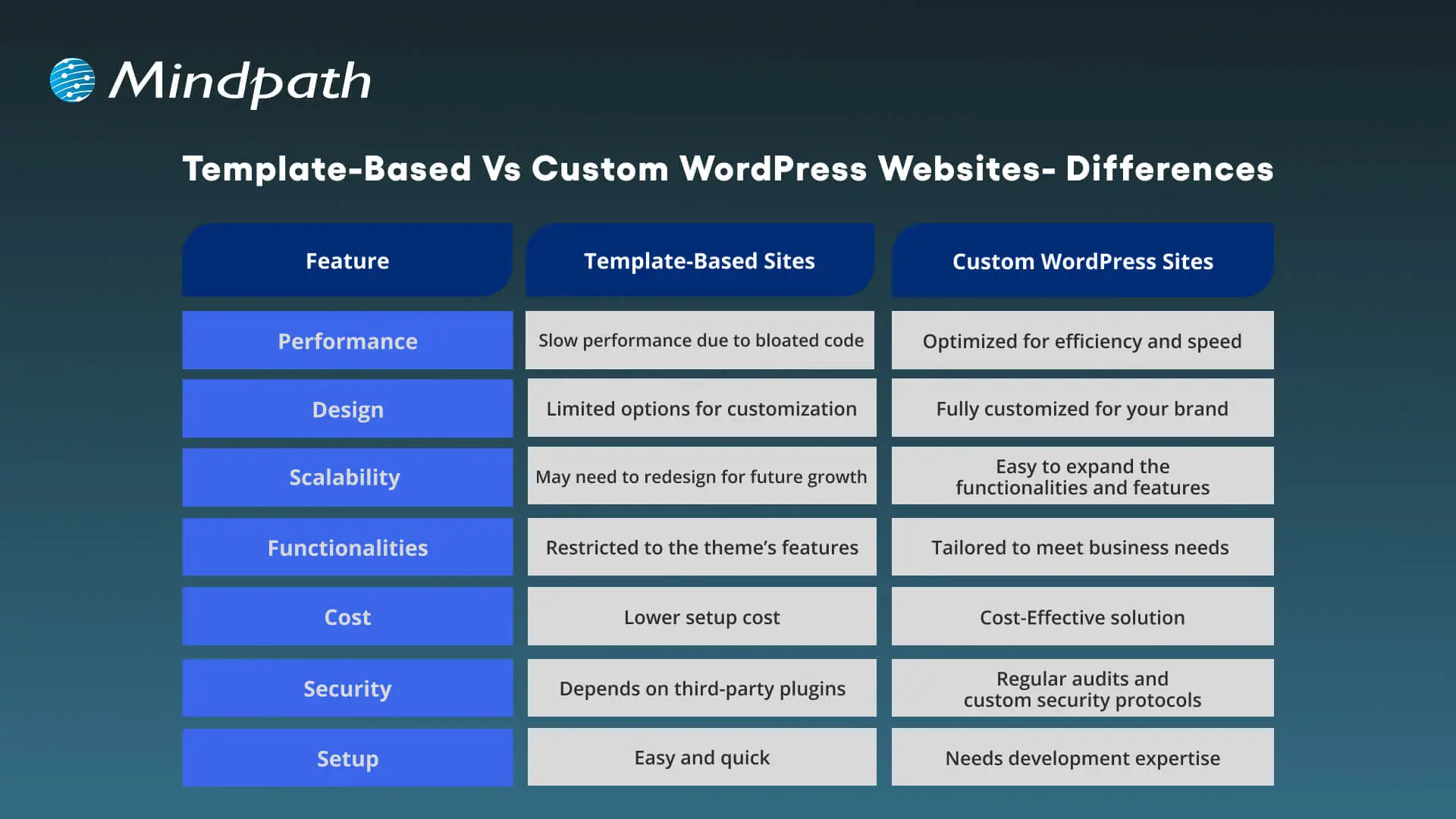
Template-Based Vs Custom WordPress Websites

Best Practices for Custom WordPress Development

To make sure your new custom WordPress development project offers desired results, it is advisable to follow these best practices:
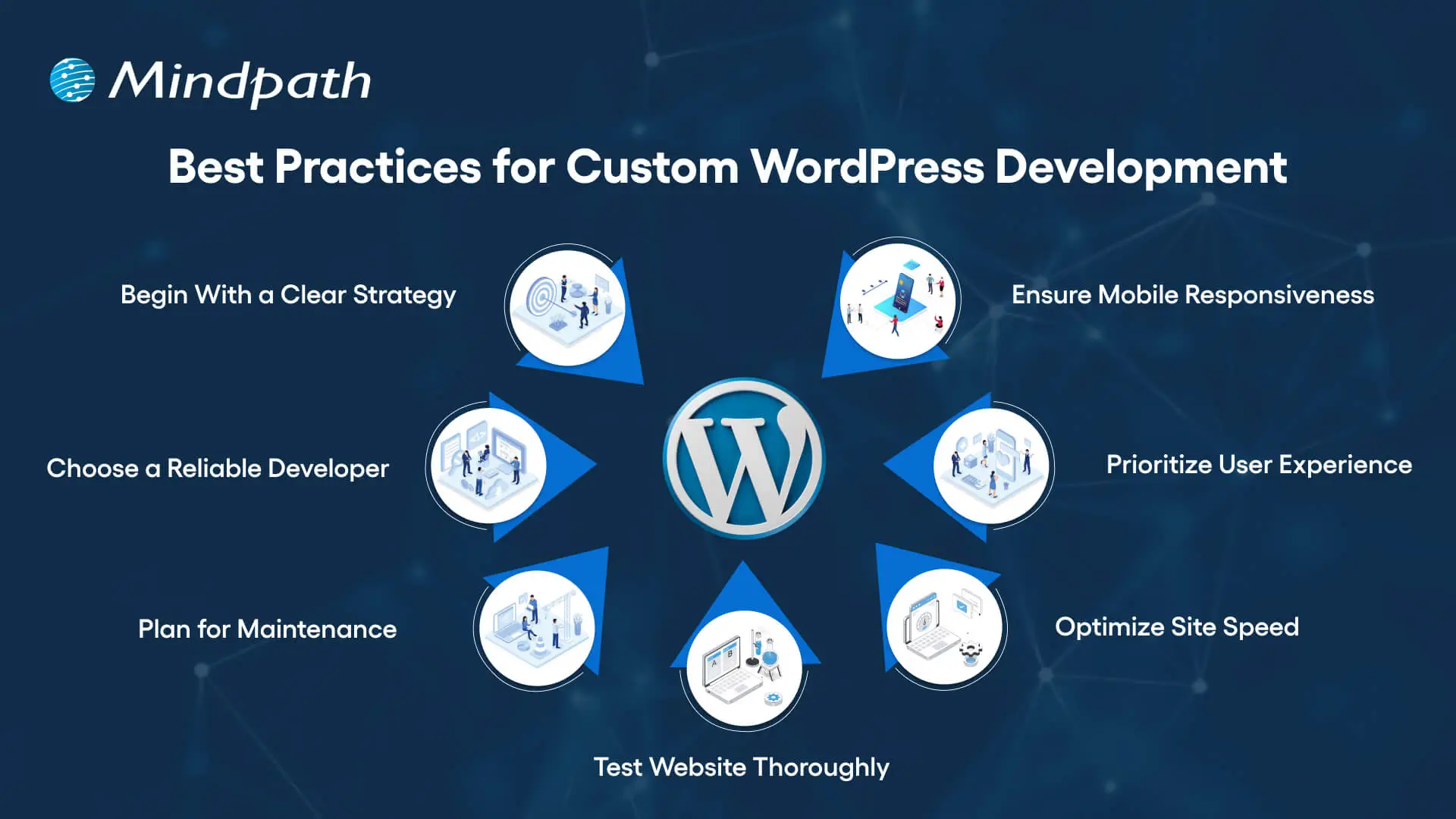
Best Practices for Custom WordPress Development

1. Begin With a Clear Development Strategy

Whether you need WordPress development for a small business or a large organization, you should first understand your target audience, desired functionalities, and goals. A well-documented strategy can help prevent scope creep, and you can ensure a perfect alignment between developers and stakeholders.

2. Focus on Mobile Responsiveness

With people increasingly using mobile phones and tablets for browsing, you should ensure that your website is responsive across all browsers and screen sizes. Custom WordPress development involves the use of a mobile-first design, which can boost SEO and usability.

3. Prioritize User Experience

Even though you have a beautiful website, it will be useless if users face issues while using it. An experienced developer will focus on a smooth user experience, making it easier for visitors to locate the things they need.

4. Optimize Your Site for Maximum Speed

Utilize techniques such as caching, image compression, CDN, and lazy loading to make sure your site loads faster. Tools such as Lighthouse, GTmetrix, Pingdom, and SEO Site Checkup can be used to detect bottlenecks.

5. Test Your Website Thoroughly

Before you make your site live, make sure that it has gone through proper testing. It helps identify compatible issues, loopholes, and missing functionalities. Prefer to carry out device testing, usability testing, and cross-browsing testing. Refine UX and optimize elements based on user feedback.

6. Plan For Smooth Maintenance

A custom WordPress site needs regular security checks, backups, and updates. So, create a proper maintenance plan or work with a professional WordPress developer to ensure constant support. Ongoing maintenance is crucial to keep your site functional and secure.

7. Partner With a Reliable Developer

Work with an experienced and trustworthy development company with a proven track record of offering quality WordPress website development services and creating high-performance websites. While helping you with technical execution, they can offer strategic input.

Do you want your website to be accessible to every visitor? Learn how to improve WordPress web accessibility can help you reach more users and create an inclusive online experience.

Tips to Choose The Right WordPress Development Company

Choosing the right expert for custom WordPress development is crucial to ensure success. While looking for the best one, prefer to consider the following points:

1. Evaluate The Experience

Ensure that the developer has years of experience in WordPress, especially in custom development. Go through their portfolio and check if they have ever created similar websites that you want to create. They should have a deep knowledge of the best practices and core functionalities of WordPress.

2. Technical Expertise

Confirm that the service provider has proficiency in JavaScript, CSS, MySQL, HTML, PHP, plugins, and more. Choose one with strong technical skills for the desired results.

3. Check Their Process:

Ask the company who they plan, carry out, and test the development projects. Ensure that they can offer a comprehensive custom development service based on your requirements.

4. Transparency and Communication

Only a trusted partner can keep you informed through the WordPress development project and will remain transparent about the costs and timelines. Choose one who prioritizes clear reporting and reacts to your queries promptly.

5. SEO Knowledge

The custom WordPress development expert should have a proper understanding of the latest SEO trends and be able to deploy necessary on-page optimization from the beginning. Furthermore, they should know how to configure different SEO plugins.

6. Post-Launch Support

Without regular updates and maintenance, your site will become vulnerable to various issues. So, partner with a development company that offers additional support along with maintenance services to keep your site performing at its best.

This is how you can hire an expert for professional WordPress web development to get your website listed higher in SERPs.

Wondering how to hire the right WordPress developer to help your business grow online? Explore our detailed guide to hire WordPress Developer to discover expert insights that guide you toward making the best hiring decision.

Looking to Elevate Your Business with Custom WordPress Development?

Undoubtedly, WordPress offers organizations the flexibility, affordability, and speed they need to start. Custom WordPress development is more than just writing code and creating a website. It is a strategic process to craft a unique digital experience that can effectively support your organizational goals, reflect your brand, and scale with you. It provides you with robust security, future scalability, and innovations that you will not get with template-based solutions.

If you want to elevate your business’s online presence and are looking for a future-proof platform, you can always count on Mindpath’s WordPress development service. As a leading WordPress development company, we combine custom development with scalable architecture and creative design to bring your unique vision to life. At Mindpath, we understand that every business needs uniqueness when it comes to developing a website. That’s why we offer tailored solutions that can set you apart from your competitors. We specialize in CMS development, custom plugin development, theme development, and more. Create a solid presence in this evolving digital landscape with us!
Frequently Asked Questions

1. Is custom WordPress development really worth the extra investment compared to just using a free theme?

For businesses serious about growth, yes. Free themes come with limitations that quietly cost more over time through poor performance, security risks, and constant plugin workarounds. A custom build gives you a site that actually works for your specific goals.

2. How long does a custom WordPress development project typically take from start to finish?

It depends on the complexity and features required. A straightforward custom site can take four to eight weeks, while larger projects with complex integrations and custom functionality can run three to six months. Clear planning upfront keeps timelines on track.

3. Can a small business afford custom WordPress website development, or is it only practical for larger companies?

Small businesses can absolutely invest in custom development, especially when the site is central to revenue. Many development companies offer phased approaches, meaning you build what you need now and scale later without rebuilding the entire site from scratch.

4. What happens to the website after launch and who is responsible for keeping it maintained?

Maintenance is often overlooked during planning. Regular updates, security patches, backups, and performance checks are essential. Most reliable development partners offer post-launch support packages so the site stays secure and functional well after it goes live.

5. How do you know if the WordPress development company you are considering is actually the right fit?

Look beyond the portfolio. Ask how they handle communication, testing, and unexpected problems mid-project. A good partner is transparent about timelines and costs, asks the right questions early, and treats your goals as their own throughout the entire process.

Support Is One Click Away

Featured Posts

Related Post

ReactJS Developer Hiring Costs in New York
Hiring a ReactJS developers in New York involves several pricing considerations, including expertise level, project complexity, and engagement approach. The cost of employing a freelancer, in-house developer, or outsourcing to an agency varies greatly. Understanding these aspects allows you to efficiently manage your budget and select the best staff for your project. Here’s an overview of the major factors that determine the cost of hiring ReactJS developers in New York.

1. Experience Level

The cost of hiring a ReactJS developer in New York varies according to their expertise level. Entry-level developers often charge between $60 and $80 per hour, making them an excellent alternative for modest tasks. Mid-level developers, with greater hands-on expertise, charge between $80 and $120 per hour. Senior developers, who have substantial experience with React and complicated application development, may charge between $120 and $180 an hour. While senior developers are paid more, they deliver high-quality, scalable, and optimized solutions that save time and money in the long term. Choosing the appropriate expertise level is determined by your project’s objectives and budget.

2. Engagement Model

The engagement model you choose affects the price of hiring a ReactJS developer in New York. Freelancers charge between $50 to $120 per hour, providing flexibility but less consistency for long-term work. In-house developers make $90,000 to $150,000 per year, offering specialized assistance but incurring additional expenses like perks and office space. Agencies charge $100 to $200 per hour and provide a team of professionals for end-to-end development. Each model has advantages and disadvantages, so firms should evaluate project duration, complexity, and money before making a selection.

3. Project Complexity

The complexity of your ReactJS project has a direct influence on development expenses. Simple applications, such as basic web pages, cost between $5,000 and $15,000. Medium-complexity projects, such as bespoke dashboards or eCommerce websites, cost between $20,000 and $50,000. Highly complicated programs, such as business software or AI-powered platforms, might cost more than $100,000 owing to additional functionality, API interfaces, and security needs. More sophisticated projects necessitate developers with greater skill, raising expenses. Identifying your project’s complexity allows you to budget more wisely while also hiring the proper ReactJS talent for a scalable and efficient solution.

4. Location and Market Demand

The location and market demand in New York have a substantial impact on recruiting expenses. As a tech hub, New York has a strong demand for ReactJS engineers, resulting in higher wage expectations. Local developers often make $90,000 to $150,000 per year in-house, or $100 to $200 per hour as top freelancers and agencies. To cut expenses, several organizations are exploring recruiting remote workers from Eastern Europe or Latin America, where competent engineers are more affordable. While local developers make cooperation simpler, employing experienced remote workers can be a cost-effective choice without sacrificing quality.

Looking for expert ReactJS developers in New York? Mindpath, offers top-tier talent for your project, whether you need freelancers, in-house experts, or a full development team. We deliver cost-effective, high-quality solutions tailored to your needs. Let’s build something great together!

Contact us today

Discover the ultimate guide to hiring Node.js developers in London. Learn about the skills, benefits, and cost factors involved in finding the right talent for your project.
Monolith to microservices

Enterprise systems tend to have one unified architecture that facilitates early expansion. Gradually, construction gets heavy and hard to ascend. Releases slow down. Minor modifications require huge test cycles. Teams become under pressure to be more innovative. This is where monolith to microservices will be a strategic move towards enterprise legacy modernization. It is not a trend. It is a realistic reaction to actual operation constraints that influence operation, agility, and long-term development.

As businesses grow, they require systems that are flexible and capable of constant delivery and autonomous growth. Nevertheless, a monolithic building goes down only with solid architectural design and business focus. The technology leaders need to reconsider their deployment models, data management, and ownership of teams. Each step requires thorough consideration. In this blog, we will discuss how businesses may proceed in a practical manner to modernize architecture with clarity. So, keep reading!

Looking to simplify complex legacy systems for better agility? Mindpath’s legacy modernization services make it easier to break monoliths into microservices while keeping operations smooth.

What is Monolithic Architecture?

A monolithic architecture integrates all the application elements into a single piece of code. The database layer, business logic and user interface are a single system. Teams develop, test and deploy the application as a whole. It is a structure that promotes centralized control and easy management.

This model has been used by many enterprises to embark on their digital journey. Growth, however, makes the process more complex and causes the changes to slow down. Such a challenge tends to motivate the migration of monolith to microservices to enhance scalability and agility. Nevertheless, it is important to comprehend the monolithic basis before strategizing in terms of modernization.

Some of the advantages of monolithic architecture are listed here:

1. Quick initial development

2. Simple deployment process

3. Managing codes centrally

4. Reduced initial infrastructure price

5. Suitable for small teams

What is Microservice Architecture?

Microservice architecture forms an application of tiny, concentrated services. Every service deals with a certain business operation. They have teams that construct and operate. Services interact via APIs or messaging, which are lightweight. It is a structure that enables quicker releases and better ownership over teams.

Companies that switch from monolith to microservices have the goal of enhancing agility and scalability. Complex systems are broken down into services by teams. They enhance update control and performance control. This model facilitates constant delivery and the alignment of technology to evolving business needs.

Some of the advantages of microservice architecture are listed here:

1. An independent deployment of service.

2. Faster feature releases

3. Better fault isolation

4. Loosely planned technology options.

5. Targeted scalability

Want to ensure your move from monolith to microservices follows a clear direction? Explore legacy modernization strategy to build a structured and effective transformation plan.

Why do Organizations Switch from Monolith to Microservices?

As organizations become more and more application-driven, they become more complex. Monolith to microservices migration becomes a strategic decision when traditional architectures start limiting growth and flexibility.

benefits of switching from monolith to microservices

1. Independent Team Ownership

Microservices provide teams with a definite service scope. The teams are in charge of their updates and releases. This construction minimizes wasting of time and enhances concentration. Organizations that follow monolith-to-microservices patterns build stronger ownership models.

2. Flexible Technology Stack

The appropriate tools depend on the service selected by the teams. They do not rely on a common technology. This innovation and future development is supported by this flexibility. It makes architecture flexible to alterations.

3. Targeted Scalability

Monolithic systems need to scale the whole application. Microservices permit the scaling of particular services. This method enhances management of resources. This accuracy is why many enterprises are abandoning monolithic to microservices.

4. Better System Stability

Even a single problem within a monolith is capable of affecting all. Microservice provides isolation of failures in a single service. The teams address the issues without impacting the entire system. This improves reliability.

5. Faster Release Cycles

Teams create and implement services on their own. They make releases without necessarily having to recreate the system. This enhances the speed of delivery. Business enterprises migrate from monolithic to microservice to enhance momentum.

6. Easier Maintenance

The huge codebases become hard to handle. Microservices separate applications into smaller parts. Developers are able to maintain and update services with ease. This facilitates long-term clarity.

Planning to reduce system limitations while adopting modern architectures? Learn from the benefits of modernizing legacy systems to improve overall performance.

Key Steps for Migrating from Monolith to Microservices

Organizations need to strategize before they shred a monolithic system into smaller services. Successful migration to microservices is based on clear strategy and disciplined execution.

key steps for migrating from monolith to microservices

1. Assess the Current System

Begin by doing a line-by-line audit of your monolithic system. Check review services, dependencies, data flow, and performance gaps. This analysis forms the basis of successful monolithic to microservices migration.

2. Define a Clear Migration Strategy

Establish simple service boundaries on the capability of the business. Make decisions on the size of the service and the style of communication at the early stage. A strong monolithic to microservices migration strategy reduces confusion and prevents rework.

3. Build the Right Infrastructure

Finalize API gateway, service discovery and CI/CD pipelines. Insert containers and orchestration tools to introduce consistency. The powerful infrastructure promotes consistent monolithic to microservices conversion.

4. Extract a Low Risk Service First

Select a valuable module that is loosely coupled. Build it as a stand-alone service having its database. It is a risk-controlled step that is proving yourself.

5. Refactor and Validate Carefully

Refactor the chosen ones into a single service. Implement it and observe behavior closely. Logging and tracing helps to identify problems at an early stage.

6. Gradually Expand the Migration

Move other modules depending on the business priorities. Break-even monolith tasks gradually. This phased approach supports smooth monolithic application to microservices’ evolution.

7. Separate the Data Layer

Discontinue reliance on a corporate database. Allocate domain-owned datastores to each service. Synchronize the plan data keenly to ensure that it is consistent.

8. Align Teams with Services

Establish cross-functional teams for each microservice. Provide them with complete development and operations ownership. This is a structure that reinforces autonomy and long-term scalability.

Looking to enhance your modernization process with intelligent automation? Learn from AI-driven legacy system modernization to boost efficiency and performance.

Ready to Modernize Your Enterprise Architecture?

Contemporary business requires the ability to expand its systems as it grows and facilitate ongoing innovations. A clear shift from monolith to microservices improves agility, resilience, and operational control. The key to success lies in effective planning and implementation in phases and aligning a team. Through proper strategy, companies become simpler and create future ready digital platforms that underpin long-term business objectives.

At Mindpath, we provide legacy modernization services which help companies plan and implement legacy modernization with confidence and clarity. Our specialists evaluate architecture, establish migration roadmaps and deploy scalable microservices. We are performance-based, stability-centered and result-orientated. Collaborate with Mindpath to modify old systems into nimble, growth-motivated digital systems.

FAQs

1. Why should enterprises consider monolith to microservices today?

Enterprises face rapid market shifts and rising customer expectations. Monolith to microservices helps organizations build adaptable systems that support faster innovation. It also aligns technology with business domains, enabling better ownership, governance, and long-term digital growth without increasing structural complexity.

2. How do we know if our organization is ready for migration?

You should assess technical maturity, DevOps readiness, and team structure. Clear service boundaries and business alignment indicate strong readiness. Leadership commitment also plays a key role in successful transformation and sustainable architectural evolution.

3. Is monolith to microservices suitable for every business?

Not every system requires immediate migration. Smaller or stable applications may perform well as monoliths. However, enterprises planning aggressive scaling, multi-team collaboration, or global expansion often benefit from monolith to microservices as a long-term strategy.

4. What technical challenges arise during data separation?

Data decoupling often introduces consistency and transaction complexity. Teams must design domain owned databases and manage synchronization carefully. Event-driven patterns and API governance help maintain reliability during service level transitions.

5. How can Mindpath support our legacy transformation journey?

Mindpath’s legacy modernization services guide enterprises through assessment, planning, and execution. Our experts design scalable architectures and structured migration roadmaps. We help organizations transition confidently using proven monolith-to-microservices approaches aligned with measurable business outcomes.

Top App Ideas

Are you in search of top app ideas that can take your business to the next level? Confused about which app can be beneficial for your business? If so, you are not alone in this! Nowadays most of the business owners are turning to smart, easy-to-use apps that can boost customer engagement, simplify daily tasks, and even gain better profits. When you are looking for an app idea that can help you develop your business in 2026, choosing the right app idea can make a huge difference.

In today’s technology-enabled world, new technologies like AI, machine learning, and cloud services make it easier than ever to construct transformational apps. These apps can keep you ahead in a fast-moving market and provide the best possible service to your customers. In this blog, we have compiled a list of the best app ideas to transform your business in 2026. Each idea is based on current trends, real needs, and new opportunities for the future. 

Great ideas grow with the right technical foundation. Discover how Mindpath’s services for web and application development may help your company create cutting-edge digital products.

30 Top App Ideas to Watch in 2026

Here are the 30 best apps to make in 2026, carefully selected to reflect future business trends and user needs. They all focus on real-world problems, user experience and how to help companies to accelerate their growth in a digital-first world. 

1. E-learning App

An e-learning application allows people to learn anything, anytime, directly from their phones. An e-learning app can provide video lessons, quizzes, and tracking progress over a few different topics, such as languages, coding, or business.  

2. Expense Management App

An expense management app helps users track spending, set budgets, and stay on top of their finances with ease. It replaces messy receipts and manual tracking with simple, automated tools. This is one of the best app ideas for startups looking to offer real value and solve everyday money problems. 

3. AI Prompts Generator

An advanced AI prompt generator helps users come up with smart, goal-based prompts for writing, content creation, and planning. It adjusts to user needs, whether it’s for business, education, or personal growth, and keeps getting better with use. It’s one of those mobile app ideas that can change the world by making creativity and productivity easier for everyone.  

4. AI Image Enhancer

An AI image enhancer lets users quickly improve photo quality without needing advanced editing skills. It can sharpen details, fix colors, and upscale low-res images with just a few taps. Perfect for anyone who wants clearer, better-looking photos in less time. 

5. AI Chatbots for HRMS

An AI chatbot for HRMS makes it easy for employees to handle tasks like leave requests and timesheet updates right from their chat workspace. It connects smoothly with tools like Microsoft Teams and works with different HR systems.  

6. Eco-Friendly Commute Planner

An eco-friendly commute planner helps users find routes that are both timesaving and better for the environment. It suggests options like biking, carpooling, or public transport based on real-time traffic and emissions data. Among practical business app ideas, this one encourages greener habits while supporting corporate sustainability goals. 

7. Language Learning App

A language learning app makes it fun and simple to pick up a new language, starting with basics like the alphabet and moving up to real conversations. It can include voice features to help with pronunciation and keep learners engaged. This is one of the best trending mobile app ideas for beginners who want to build language skills step by step. 

8. Food Delivery App

A food delivery app connects users with local restaurants and food vendors for quick, tasty meals at home. It can include features like user reviews, exclusive deals, and social sharing to create a lively food-loving community. It’s a simple way to enjoy great food while supporting neighborhood businesses. 

9. Vehicle Insurance App

A vehicle insurance app helps users compare plans, get instant quotes, and manage their policies all in one place. It makes tracking renewals and paying premiums quick and stress-free. With easy claim filing and real-time updates, it keeps the whole insurance process simple and smooth. 

10. UPI Payment App

A UPI payment app lets users send and receive money instantly using just their phone, without needing cash or cards. It links multiple bank accounts and supports payments through numbers, virtual addresses, or QR codes for easy transactions. This convenience makes it one of the million-dollar app ideas transforming how people handle money every day. 

Choosing the right tools and frameworks is essential to bringing your app ideas to life effectively. Learn about the top mobile app development technologies that power innovative apps and help you stay ahead of the competition.

11. Drone Service App

A drone service app connects users with professional drone operators for tasks like aerial photography, surveying, and fast deliveries. It makes using drone technology easy and accessible for various needs. This app opens up new possibilities by bringing the power of drones right to your fingertips. 

12. Restaurant Reservation App

A restaurant reservation app lets users quickly book tables at their favorite spots without waiting. It shows availability, menus, and special deals, making dining planning easy and personalized. For restaurants, it helps manage bookings smoothly, so everyone enjoys a better experience. 

13. Customer Support Chatbot App

A customer support chatbot app helps businesses respond instantly to common questions, cutting down wait times and improving user satisfaction. With features like natural language processing and 24/7 availability, it provides reliable help anytime and can hand off complex issues to human agents. 

14. Workflow Management App

A workflow management app streamlines team collaboration by automating tasks and organizing projects. It offers features tailored to fit specific team needs, making remote work easier. With shared access and PC-friendly tools, it’s a top choice for improving business operations. 

15. Container Tracking App

A container tracking app makes it easier to keep tabs on your shipments in real time. You can see exactly where your cargo is and when it’s expected to arrive. It’s a simple way to stay organized and keep your logistics running smoothly. 

Curious how the latest tech can make tracking shipments even easier? Explore the mobile app development trends and discover the innovations transforming logistics and business apps.

16. Voice Translation App

A voice translation app can be a game-changer for anyone traveling to a country where they don’t speak the language. Just speak into your phone, and it instantly translates your words into the local language and the other way around too. It’s like having a personal translator in your pocket, making conversations abroad way less stressful. 

17. Video Editing App

With so many people posting videos on social media, a solid video editing app is a must. It helps users turn casual clips into clean, professional-looking content that actually grabs attention. Whether it’s for personal stories or product promos, this app makes polished videos super easy to create. 

18. Interior Design App

An interior design web app lets users visualize home changes with 3D tools and AR. They can place virtual furniture in real spaces for a personalized touch. It’s one of those new app ideas perfect for home makeover lovers. 

19. Fitness App

A fitness app like this makes staying healthy a lot easier by letting users track key habits and health stats in one place. With support from real experts and custom plans, it’s great for anyone looking to prevent lifestyle issues. Plus, built-in chat helps users connect with coaches and others on the same journey. 

20. AI Logo Maker

An AI logo maker allows users to generate unique and professional logos by inputting keywords, colours, and information about their industry. The AI logo maker will suggest designs quickly and to be easily customized. It is a good option for anyone looking for a sleek logo without paying a designer to create it.

Want your AI logo maker to perform flawlessly and scale with ease? Learn how the right tech stack for web app success can power your app from concept to launch.

21. Railway Tracking App

A train tracker app would give commuters real-time alerts of where the trains are on track and when they are due to arrive at their station, alleviating stress related to planning commuting journeys. It removes the guesswork of if a train is late or having any other disruptions so they can avoid waiting at the station or running around for alternative methods of transportation. 

22. Virtual Art Curator

A Virtual Art Curator application uses AI technology to develop individualized virtual art exhibitions tailored to your preferences and chosen styles. It will recognize the types of art and artists you enjoy and actively auto focus on a gallery designed specifically for your tastes and interests. 

23. Car Sharing App

When users share their vehicles and intended destination in real-time, finding rides is easy for the passenger that will be heading the same way. Passengers can connect with their driver going in the same direction and share the ride. It is a simple way to save some money and cut down on congestion by taking a trip together.  

24. Disaster Management App

A disaster management app can alert people to disasters that are happening nearby, informing them of the type of disaster and its severity to keep them safe. It can help people understand what to do during an emergency, and it can help locate people that are stranded. The app will help rescue teams by providing real-time information on damage and people requiring assistance. 

25. Doctor’s Consulting App

A doctor’s consulting app lets you easily ask questions and get answers directly from doctors. You can also stay updated with the latest medical news and research. Plus, it makes booking appointments quick and simple, all in one place. 

26. Logistics App

A goods-transporter app connects people who require swift deliveries with any nearby available vehicles. It helps to coordinate shipments with trucks that might return to the shipper empty after deliveries. It helps save time and makes it easier for everyone to transport goods. 

27. Virtual Clothes Shopping App

A virtual clothes shopping application will show users what they look and fit like, without the need to try them on physically. This saves a considerable amount of time spent changing and waiting in dressing room lines. Virtual shopping with an app is faster and more entertaining from the comfort of your home. 

28. Restaurant POS App

Using a restaurant POS app makes reserving the ideal table so easy and quick. You simply choose your favorite table and time and reserve it directly within the app. It’s a simple way to figure out a nice evening out without the hassle. 

29. Grocery Delivery App

A grocery delivery app offers users the ability to shop at their local stores and have fresh groceries delivered to their doorstep, with fast delivery times. Grocery shopping is made easy with customized shopping lists, real time inventory updates to the app, and a streamlined payment process. Users can also monitor their delivery in real time, ensuring a simple experience every time.

30. Event Management App

An event management app alleviates the stress of planning! They take care of guest lists, ticket sales, and real-time updates, all in one app. Event management apps can sync seamlessly with payment systems and social media, enabling event promotion and engagement with attendees to be easier. 

Ready to turn your app ideas into reality? Explore the Web App Development Roadmap to see step-by-step how to plan, design, and launch apps that deliver real business value.

Ready to Turn a Top App Idea into Your Business Success in 2026?

These top app ideas for 2026 offer practical ways to improve customer experience and streamline business tasks. Whether it’s AI tools, delivery apps, or event planners, each idea focuses on real needs that can help your business grow and stay competitive in a fast-changing market. 

At Mindpath, we specialize in web and application development services that bring your top app ideas to life. Our expert team creates custom, scalable solutions designed to meet your business needs and future challenges. With Mindpath, you get reliable support and cutting-edge technology to grow your business confidently. 

Frequently Asked Questions

1. How can a business decide which app is worth developing in 2026?

Businesses should evaluate market demand, customer pain points, and revenue potential. Conducting competitor analysis, surveys, and pilot testing helps identify which app concepts can deliver real value. Prioritizing apps that improve efficiency, engagement, or profitability ensures resources are used wisely.

2. What factors make an app scalable as user demand grows?

Scalable apps rely on flexible architecture, cloud infrastructure, and modular design. They should handle increased traffic, add new features without major rework, and integrate easily with other systems. Scalability ensures the app continues performing well as the business expands.

3. How can apps enhance both customer experience and operational efficiency?

Apps that automate tasks, simplify workflows, or provide real-time insights benefit both users and internal teams. For example, delivery, logistics, or expense tracking apps reduce manual effort while offering faster, smoother experiences for customers, improving satisfaction and operational efficiency simultaneously.

4. What role does technology like AI or AR play in modern business apps?

AI and AR add intelligence and interactivity, enhancing personalization and problem-solving. AI can provide recommendations, automate routine tasks, and analyze data for insights. AR improves visualization and engagement, helping users interact with products or services in innovative ways.

5. How should businesses future-proof their apps in 2026?

Future-proofing requires choosing adaptable frameworks, regular updates, and integration capabilities with emerging technologies. Monitoring user feedback, staying aligned with trends, and designing for modularity ensures apps remain relevant, flexible, and capable of supporting long-term business growth.