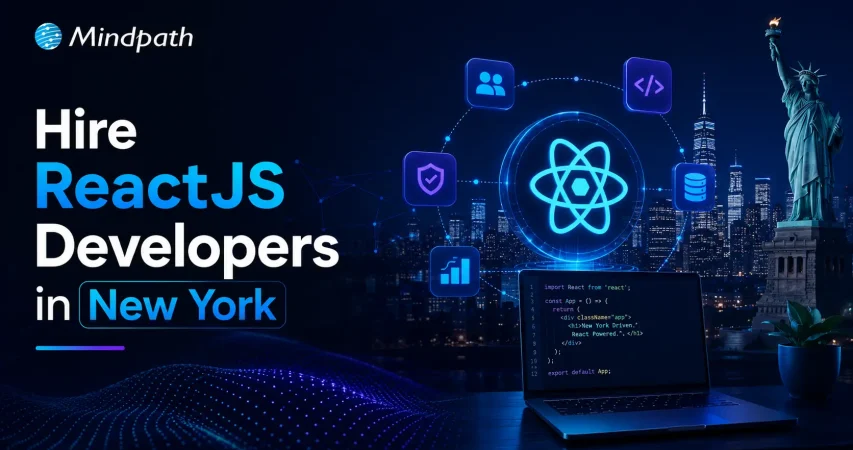
Factors to Consider while Hiring Expert ReactJS Developers in New York

Join our Newsletter!

Featured Posts

Support Is One Click Away

Home

Factors to Consider while Hiring Expert ReactJS Developers in New York

Things to Take Into Account When Hiring Skilled ReactJS Developers in New York

Factors to Consider while Hiring Expert ReactJS Developers in New York

Hiring skilled ReactJS developers in New York necessitates careful research to guarantee you get the best fit for your project. Given the city’s competitive tech sector, it’s critical to go beyond technical talents and consider aspects such as experience, problem-solving ability, and communication. A well-rounded developer should not only excel at ReactJS development but also integrate effortlessly into your team and project objectives.

1. Technical Skills

When hiring skilled ReactJS developers in New York, it is critical to assess their technical talents. A strong applicant should have a solid grasp of React essentials such as components, props, state, lifecycle methods, and hooks in order to construct efficient apps. Proficiency in JSX syntax is required for designing dynamic user interfaces smoothly. Experience with state management frameworks like Redux assures that they can efficiently manage complicated application logic. They should also be proficient in performance optimization strategies to improve speed and responsiveness. Understanding unit testing frameworks like Jest and React Testing Library helps to maintain code dependability and stability in production scenarios.

2. Front-End Development Skills

Hiring skilled ReactJS developers in New York necessitates advanced front-end development expertise. A thorough understanding of HTML and CSS is required for properly constructing and formatting web pages. Developers should be skilled in creating responsive and visually appealing user interfaces that improve the user experience. Advanced JavaScript expertise, including ES6 capabilities like arrow functions, destructuring, and async/await, is required to write clean and efficient code. Their ability to modify the DOM, handle events, and operate with latest JavaScript frameworks allows for seamless front-end development. An experienced ReactJS developer uses these technologies to create high-performance, dynamic web apps.

3. Project Experience

When selecting skilled ReactJS developers in New York, it is critical to consider their project experience. A rich portfolio of previous projects indicates their ability to work on applications of diverse complexity, ranging from simple web interfaces to large-scale, enterprise-class solutions. Reviewing their prior work allows you to evaluate their ability to create scalable, high-performance React apps. Consider their sector knowledge, especially if your project demands experience in a certain area. Developers with industry expertise can better understand your company’s demands and provide solutions that correspond with your objectives, resulting in a more efficient and specialized development process.

4. Development Workflow

Hiring competent ReactJS developers in New York requires a well-structured development methodology. Proficiency in version control systems such as Git is required for effective code management, collaboration, and smooth change tracking. To ensure a seamless workflow, developers should be conversant with Git repositories, branching methods, and pull requests. Furthermore, expertise with build tools like as Webpack or Parcel allows better bundling, shorter load times, and higher application performance. These tools assist to speed up the development process by automating processes like code minification, asset optimization, and module bundling, resulting in a more efficient and maintainable ReactJS application.


Looking to hire expert ReactJS developers in New York with the right skills and experience? At Mindpath, we connect you with top talent who excel in React development, version control, and modern build tools to create high-performance applications.
Contact Mindpath today

Related Post

How much does hiring a ReactJS developer cost? Learn about factors affecting rates, and how to find the best talent within your budget.
Discover how augmented analytics revolutionizes business intelligence with real-time insights, smarter decisions, and data democratization for faster growth.

Related Post

cloud native development

Cloud-native development is redefining the way organizations are evolving in the digital-first world. It enables teams to develop applications that are resilient, can be easily updated, and allow sophisticated scaling without compromising development speed. An increasing number of organizations are gravitating towards a cloud-native approach to meet the modern-day demands for agility, innovation, and customer experience. If your organization values being competitive and evolving at the speed the digital world enables, but not constrained by legacy solutions, cloud-native development could be the evolution opportunity you are seeking.

This method of breaking up large applications into smaller constituents via microservices allows organizations the opportunity to manage and improve everything much easier. With new technologies enabling containers and automation, organizations with the right supporting tools are able to deliver, test, and fix features faster than ever. It is no longer just about trying to keep pace; it is about leading a system that embraces change. In this blog post, we will discuss how cloud-native development enables organizations to scale up their businesses with greater control, pace, and certainty. So, let’s explore!

Looking to elevate your business with Cloud-Native Development? Contact us, and our experts will turn your ideas into high-performing cloud-native solutions.

What Is Cloud Native?

Cloud-native computing is a way of building and running applications that are built for the cloud. Cloud-native development provides developers with a way to build software that is flexible, adaptable, and able to handle dramatic change without breaking the overall architecture. Instead of building one huge system or application, the developer builds the application in independent pieces called microservices that work together. This approach allows for building and testing in more manageable pieces over time.

According to MarketsandMarkets, the cloud native applications market is expected to grow from USD 5.9 billion in 2023 to USD 17.0 billion by 2028. This shows that more companies are choosing this method to stay competitive and meet user demands. Tools like containers and automation help developers launch updates quickly without stopping the service. Cloud native makes it possible to move faster, reduce costs, and build stronger, more reliable software.

Components of Cloud-Native Development

Cloud-native relies on a set of modern tools and practices that work together to build fast, flexible, and reliable applications. Here are the key components that make this approach effective:

1. Containers

Containers bundle code with everything it needs to run, making apps work smoothly across different environments. Tools like Kubernetes and Amazon ECS manage these containers to help with deployment, scaling, and maintenance. They are a key part of cloud native technologies, ensuring consistency and efficiency.

2. APIs

APIs, or Application Programming Interfaces, allow different software parts to communicate with each other. In cloud native development, microservices rely on APIs to share data and functions. This setup is lightweight and uses fewer resources compared to traditional systems.

3. Microservices

Microservices are small, independent parts of an application that work separately but communicate with each other using APIs. They are easy to update without affecting the whole system, which makes the app more stable. This structure supports cloud native development by making applications easier to build, test, and scale.

4. CI/CD Pipelines

CI/CD pipelines are used to automate the process of building, testing, and deploying code. They allow developers to work faster and reduce errors by using shared code repositories and automated workflows. This approach plays an important role in the cloud native landscape.

5. DevOps

DevOps brings together development and operations teams to automate and streamline the app development process. It helps in delivering software quickly and reliably with a focus on collaboration. DevOps practices are essential in the cloud native landscape to keep up with modern development needs.

Benefits of Cloud Native Development

Cloud-native approach offers clear advantages that go beyond just building applications differently. These benefits are helping businesses improve the way they deliver, manage, and scale digital solutions across industries.

1. Reduced Operational Costs

Using open-source tools and serverless models helps cut down infrastructure and licensing costs. Businesses only pay for what they use, saving money and resources.

2. Effortless Scaling and Deployment

Cloud-native workflows automate how apps and infrastructure are deployed. With container orchestration, apps scale easily based on real-time demand.

3. Modernized Legacy Applications

Older apps can be updated to work better with modern cloud systems. Cloud-native development makes it easier to improve and connect them with new projects.

4. Greater Development Flexibility

Containers package apps with everything they need to run across different setups. This gives developers the freedom to build without being tied to one system.

5. Efficient Microservice Management

Kubernetes helps manage and scale container-based apps more efficiently. It simplifies deploying microservices while ensuring better performance.

6. Improved Application Stability

Cloud systems stay available even when one part fails. Microservices architecture ensures the app keeps working smoothly without full downtime.

7. Aligned Tech and Business Goals

A product-based approach aligns tech efforts with business goals. It boosts teamwork and supports faster responses to changing needs.

8. Boosted DevOps Efficiency

Cloud-native practices help speed up development, testing, and deployment. This leads to quicker, more reliable updates with fewer manual steps.

9. Low-Code and No-Code

Low-code and no-code platforms allow more people to build apps with simple tools. This makes development faster and less dependent on technical teams.

10. Minimized Vendor Lock-In

Cloud-native applications can run across multiple cloud platforms. This gives businesses the freedom to switch providers and avoid getting locked in.

Best Practices for Cloud-Native Development

To get the most out of cloud-native development, it’s important to follow proven methods that support speed, reliability, and scalability. These best practices help teams build stronger applications while keeping systems flexible and efficient.

1. Use Containers Effectively

Containers package apps with their dependencies, making them easy to run across different environments. This boosts reliability and simplifies deployment, helping teams work faster and more efficiently.

2. Take Ownership of Products

Following a product-focused mindset gives teams control over development from start to finish. It encourages innovation and quality, aligning with the goals of the cloud native foundation.

3. Automate CI/CD Pipelines

Continuous Integration and Continuous Deployment (CI/CD) automate testing and delivery, reducing errors and saving time. This helps teams release updates faster with higher confidence.

4. Build with Microservices

Microservices divide the application into smaller, focused services that can be built, deployed, and managed independently. This structure improves fault tolerance, speeds up development, and supports scalable cloud native solutions.

5. Apply Infrastructure as Code (IaC)

IaC lets teams manage infrastructure with code, allowing easy updates, version control, and automation. It brings consistency and reduces the chances of manual errors during setup or changes.

6. Focus on Resilience and Fault Tolerance

Design apps to handle failure using retries, timeouts, and automated recovery. This ensures your cloud native applications stay stable and available during unexpected problems.

Unlocking the Power of Cloud-Native Development

Cloud-native development is helping businesses move faster, scale smarter, and build more resilient applications. From modernizing legacy systems to enabling flexible and efficient operations, it’s shaping the future of digital transformation. By adopting the right strategies and tools, organizations can respond to change with greater confidence and deliver value to customers more effectively.

At Mindpath, we help businesses transform their software approach with our expert cloud-native development services. From planning architecture to seamless deployment, our team supports every step. We simplify operations, modernize infrastructure, and create scalable applications that align with your goals. With Mindpath, you build software that’s fast, flexible, and ready for what’s next.

Discover the power of cloud-native development! Learn its benefits and how it helps businesses enhance security, efficiency, and performance.
PHP & Node.JS for web development

Stuck between PHP and Node.js for your next project? The right choice shapes the success of your development journey. So, whether about speed, scalability, or a strong community to have at your back, understanding their strengths and differences will make a difference. In this blog, we will explore the key differences and strengths of these two technologies, so you can confidently choose the best fit for your needs and goals. Come! Let’s dive in! 

Overview of Node.js 

Node.js is a JavaScript runtime environment that helps users develop fast and scalable network applications. It has been designed to perform a lot of tasks all at once; hence, it is efficient, making it quite perfect for apps that deal with a lot of data processing quickly, like real-time apps working across different devices. Released in 2009, Node.js has risen to the very top of web development tools. It is a technology completely developed in JavaScript and, more notably, runs on many Linux-powered servers. With Node.js, you can build a wide range of applications.  

Overview of PHP 

PHP, or Hypertext Preprocessor, is a high-level open-source programming language used to develop server-side web applications. It was developed by Rasmus Lerdorf in 1994 and is famously known for running popular websites such as Wikipedia, Tumblr, and Facebook. PHP is a synchronous programming language which means it does only one thing at a time. On the server-side, PHP is run by an interpreter called Zend Engine, often used with web servers like Nginx and Apache. During this process, the client-side waits for the server to finish executing the PHP script before continuing, as it doesn’t execute the next code line until the previous one is completed. PHP offers great flexibility, allowing easy integration of its code into HTML or HTML5. It also connects smoothly with various SQL databases such as MariaDB, MySQL, and PostgreSQL, making it a versatile choice for web development. 

Benefits of Using Node.js    

1. Fast  

Node.js has gained huge popularity because it is built on Google Chrome’s V8 JavaScript Engine, which makes it super-fast. This is one of the fastest backend technologies as of today. This speed advantage allows you to create applications that are more responsive with a better user experience. It’s equally great for building real-time applications such as chatbots or gaming apps. 

2. Scalable   

Node.js allows you to make your applications highly scalable, and you can easily keep adding new features or functions to your application without the need to rewrite the whole code. Since Node.js is built on a non-blocking I/O model, dealing with multiple connections at the same time becomes quite easy. So, performance isn’t much of a hassle with Node.js, even with large numbers of users. 

3. Large and Active Community  

Being open source, Node.js has large and active developer communities in continuous improvement. This is important in the sense that you will easily find a need for help or support, and new libraries and frameworks for Node.js are continuously being developed. 

4. Usability  

Node.js is relatively user-friendly, especially for the developers familiar with JavaScript. That’s why many front-end developers nowadays learn Node.js to work with the backend because it’s easy to learn and use. 

5. Reliable   

Another great advantage of NodeJS is its reliability as NodeJS operates in a mode called “event-driven programming,” which makes the server capable of handling several requests all at once and error-free.  As a result, one can be assured that your NodeJS application will be able to handle many users.  

Looking for robust and real-time application solutions?

Mindpath excels in crafting tailored Node.js applications that drive business growth and innovation.

Benefits of PHP  

1. Well-established  

One of the big benefits of PHP is that it has stood for a long time and is well-established. Because of this, its community has many developers who constantly work to improve the language. As such, at any one time, one can easily find help or support; besides, there are always new tools and frameworks being created for PHP. 

2. Efficient Performance  

The most prominent reason behind the efficient performance of PHP is the opcode cache. This keeps the pre-compiled version of your code and avoids it from getting processed by PHP every time from scratch. This allows your apps to run faster and more efficiently. As a result, it provides better performance, reduces hosting costs, and gives users a smooth experience. 

3. Easy to use  

PHP is user-friendly, having an easy syntax that a fresher can learn quite easily. Many developers working on the front-end are now working on the backend of PHP also, because of its simplicity to work with. 

4. Security  

PHP has very tight security features that ensure your applications are protected. It has inbuilt protection against common threats like cross-site scripting and SQL injection attacks. Additionally, PHP supports a range of security extensions and libraries that enhance its ability to safeguard your application against various security vulnerabilities, ensuring a safer environment for your data and users. 

5. Cost-Efficient 

Another key advantage of PHP is its low cost. Because PHP is open source, one does not need to pay for licenses and support. It hence becomes quite cheap to operate with PHP, especially in small business settings and startups. 

Node.js vs PHP: Comparison Table 

Feature 

Node.js 

PHP 

Popularity 

Gaining rapid popularity, especially for modern applications 

Well-established, widely used for many websites 

Performance 

Extremely fast due to its efficient JavaScript engine 

Generally efficient but not as fast as Node.js 

Scalability 

Excellent scalability with a non-blocking I/O model 

Scalable but might require more effort for large applications 

Community 

Large and growing, with many new tools and frameworks 

Large and established community 

Ease of Use 

User-friendly for those familiar with JavaScript 

Simple syntax, but might be less intuitive for beginners 

Real-Time Applications 

Ideal for building real-time apps like chatbots and games 

Less suited for real-time applications 

Integration 

Seamless integration with JavaScript throughout the stack 

Often requires additional technologies for full stack JS 


Mindpath Node.js Development Services 

At Mindpath, we specialize in creating high-performance and scalable solutions with Node.js. Our team of experienced developers is dedicated to delivering outstanding results by catering to your business needs. Be it the development of a new application or the enhancement of an existing one, our experts will help you get it right. Here’s a rundown of what our Node.js development services look like: 

1. Node.js Web App Development: 

Our developers create high-performance, scalable web applications using Node.js. We are committed to providing your digital appearance with an invulnerable add-on, optimized completely with the business goals, to create applications that will create a lasting impression. 

2. Node.js CMS Development: 

We develop custom-made content management systems to assist in the effective management of your content. Our CMS solutions are designed to simplify content management, providing you with an intuitive interface to handle all your content effortlessly. 

3. Node.js API Development: 

We create strong and powerful APIs that will enable other systems to be smoothly integrated. Our APIs are designed to enhance functionality and connectivity, ensuring smooth and reliable communication between different applications. 

4. Node.js Consulting Services: 

We assure you expert help in maximizing your business projects with Node.js potential. We provide strategic guidance and technical insights to optimize your Node.js applications, driving innovation and efficiency. 

5. Node.js Maintenance & Support: 

Our maintenance and support practice are continuous for on-the-go help. Our team is always ready to address any issues and provide continuous improvements, ensuring optimal performance and reliability. 

6. Node.js Migration Services: 

We will support you in the node .js migration of your existing applications for scalability and performance improvements. Our migration services are designed to minimize disruption and ensure a seamless transition to a more efficient and powerful platform. 

Conclusion  

In the debate between PHP and Node.js, each of these technologies has different advantages, targeted at other needs. The longevity and large community of PHP make it a reliable choice for most traditional web applications, while the modern architecture and speed of Node.js make it perfect for scalable, real-time applications. As technology continues to unwind, Node.js is fast becoming the go-to technology for its performance and flexibility, especially in dynamic and data-intensive environments. At Mindpath, we use the full power of Node.js to deliver solutions that are cutting-edge and perfectly aligned with your business objectives. We make sure you leverage the strong points of Node.js by building applications that are fast, scalable, and reliable

Ready to elevate your application’s performance?

At Mindpath, we leverage the power of Node.js to deliver scalable and high-performing solutions.

Discover the top Node.js trends shaping digital technology in 2024, from AI and TypeScript to IoT and cloud computing. Explore how Node.js drives innovation!
Important Qualities to Consider When Hiring a New York ReactJS Developer
Hiring a ReactJS developers in New York necessitates a thorough assessment of their capabilities to guarantee they can create efficient, scalable, and high-performance apps. A good developer should be proficient in front-end technologies, state management, performance optimization, and development procedures. Aside from technical ability, problem-solving skills and real-world project experience are essential for creating effective apps. Understanding these important abilities will assist you in finding a skilled ReactJS developer who is compatible with your project requirements and business objectives.
Here are the essential skills to look for when hiring a ReactJS developer in New York.

1. State Management (Redux)

For complicated applications, proper state management is critical. A qualified ReactJS developer in New York should be familiar with Redux, Context API, or Recoil in order to effectively handle application state. They should grasp how to organize Redux actions, reducers, and middleware so that state logic is clear and scalable. Proper state management ensures that data flows smoothly across components, making systems more predictable, maintainable, and easy to debug. Experience with the Redux Toolkit is advantageous, as it simplifies state management in current React apps.

2. Performance Optimization

An adept ReactJS developer should be capable of optimizing application speed using techniques like code splitting, lazy loading, and memoization. These tactics aim to minimize load times and enhance the user experience. Understanding React’s built-in performance tools, such as React Profiler and useMemo, allows for more efficient rendering and resource management. Developers should be able to discover and remove performance bottlenecks, ensuring that React apps function smoothly across several devices and networks.

3. Responsive Design

A good ReactJS developer should be able to create responsive layouts that work effectively with diverse screen sizes and devices. Knowledge of CSS frameworks such as Bootstrap, Tailwind CSS, and Material-UI is required for creating visually attractive interfaces. They should also be capable of employing CSS Flexbox, Grid, and media queries to create a consistent user experience. With mobile-first development becoming increasingly important, ensuring that apps are completely optimized for all devices is an essential skill to look for.

4. Version Control (GIT)

A ReactJS developer should be capable of using Git for version management and collaboration. They must be familiar with dealing with repositories, maintaining branches, and responding to pull requests. Experience using Git systems such as GitHub, GitLab, or Bitbucket is required for monitoring changes and keeping a clean development workflow. Proper version control methods allow for effective cooperation, rollback possibilities, and easier deployment procedures, ensuring that code is always up to date and manageable.

Looking to hire skilled ReactJS developers in New York? At Mindpath, we connect you with top talent proficient in JavaScript, React, state management, and performance optimization to build scalable and high-performing applications.

Partner with Mindpath and ensure your project is in expert hands. Let’s bring your vision to life!
Contact Mindpath today

Discover the ultimate guide to hiring Node.js developers in London. Learn about the skills, benefits, and cost factors involved in finding the right talent for your project.