Mastering Web Scraping with Node.js: A Beginner’s Guide 

Join our Newsletter!

Featured Posts

Support Is One Click Away

Home

Mastering Web Scraping with Node.js: A Beginner’s Guide 

web scraping with node js

Mastering Web Scraping with Node.js: A Beginner’s Guide 

Web scraping with Node.js allows developers to collect and use website data quickly and efficiently. It is useful to make smarter decisions, automate tasks, and enhance digital projects. The process is easy and feasible as Node.js is speedy and is compatible with JavaScript. Mastering this skill will create new prospects of dealing with real-time information and putting it into practical use in the contemporary web development projects.

This blog describes the concept of web scraping and how web scraping works in a step-by-step manner. You will get to know what web scraping is, why you should use Node.js, and how to begin using it in your projects. All ideas are simple to comprehend and straightforward. At the end, you will have a clear background on how to effectively gather, store and utilize web data for real-life applications.

Planning to gather web data efficiently for your business? Mindpath offers expert Node.js development services to create fast, scalable scraping solutions.

What is Node.js Web Scraping?

Web scraping with Node.js lets developers collect website data automatically and use it for real projects. Node web scraping refers to the creation of scripts that will retrieve web documents. These scripts read their contents and retrieve information such as prices, contacts, or news. It is easy to process static sites with such tools as Axios or Cheerio. The interactive websites can be managed with the aid of Puppeteer. The speed and efficiency of Node.js ensure a more scalable and faster scraping.

The Node web scraping operates by making requests, retrieving HTML, and extracting data on the page. JavaScript is used to handle both the static and dynamic sites. Using Node.js, developers have the ability to automate the process of logging in to a website. They can click buttons and gather information on numerous websites simultaneously. This strategy makes the process effective, valid, and prepared to apply it in the real world.

Curious why developers choose Node.js for large-scale web scraping? Explore the advantages of Node.js to see how its performance and event-driven model simplify data extraction.

Key Benefits of Web Scraping with Node.js

High-speed and efficient web scraping with Node.js provides developers with a quick and efficient tool to deal with web data. It assists teams to process vast information without any additional effort. These are the best advantages that make Node.js a robust option in the collection and use of data in real projects.

1. Fast and Efficient Processing

A Node.js scraper does not have to wait to make a number of web requests. Node.js web scraping will allow you to gather massive data within a short time.

2. Handles Modern Websites

It is common to use dynamic JavaScript loading content on websites today. Such tools as Puppeteer or Playwright allow developers to see a complete page and obtain data correctly.

3. Single Language Development

JavaScript can be utilized by developers to perform front-end and backend scraping. This makes coding easier and allows the workflow to be similar.

4. Wide Range of Tools

Node.js scraper may utilize such libraries as Axios to make requests, Cheerio to process them, and Puppeteer to automate. These are the tools that can make web scraping using Node.js flexible to any project.

Must Read: NodeJS Libraries for AI 

5. Scalable for Growth

The ability to work with large number of data streams simultaneously makes Node.js relevant to the large-scale web scraping project. It is capable of expanding along with your data requirements.

6. Easy Integration

Scraped information is often included in the form of JSON, which is automatically processed by the Node.js. This information may be inputted directly into web applications, databases, or analytics pipelines.

7. Automates Repetitive Tasks

Web scraping with Node.js provides an ability to log in, click on buttons, and scroll the pages automatically. A scraper made with Node.js saves time and makes the data collection regular.

8. Real-Time Data Monitoring

Using a Node.js scraper, it is possible to make continuous updates on the sites. This assists in the collection of new information within a short time to analyze or report.

Looking to ensure your Node.js scraping applications run fast and efficiently? Check out web performance with Node.js to learn how optimization techniques improve speed, scalability, and reliability.

Steps to Build a Node.js Web Scraper

Web scraping with Node.js lets developers collect data efficiently and apply it to real projects. A scraper to build needs the right planning and procedures. The key actions to develop a Node.js web scraper and begin the data extraction process successfully include the following.
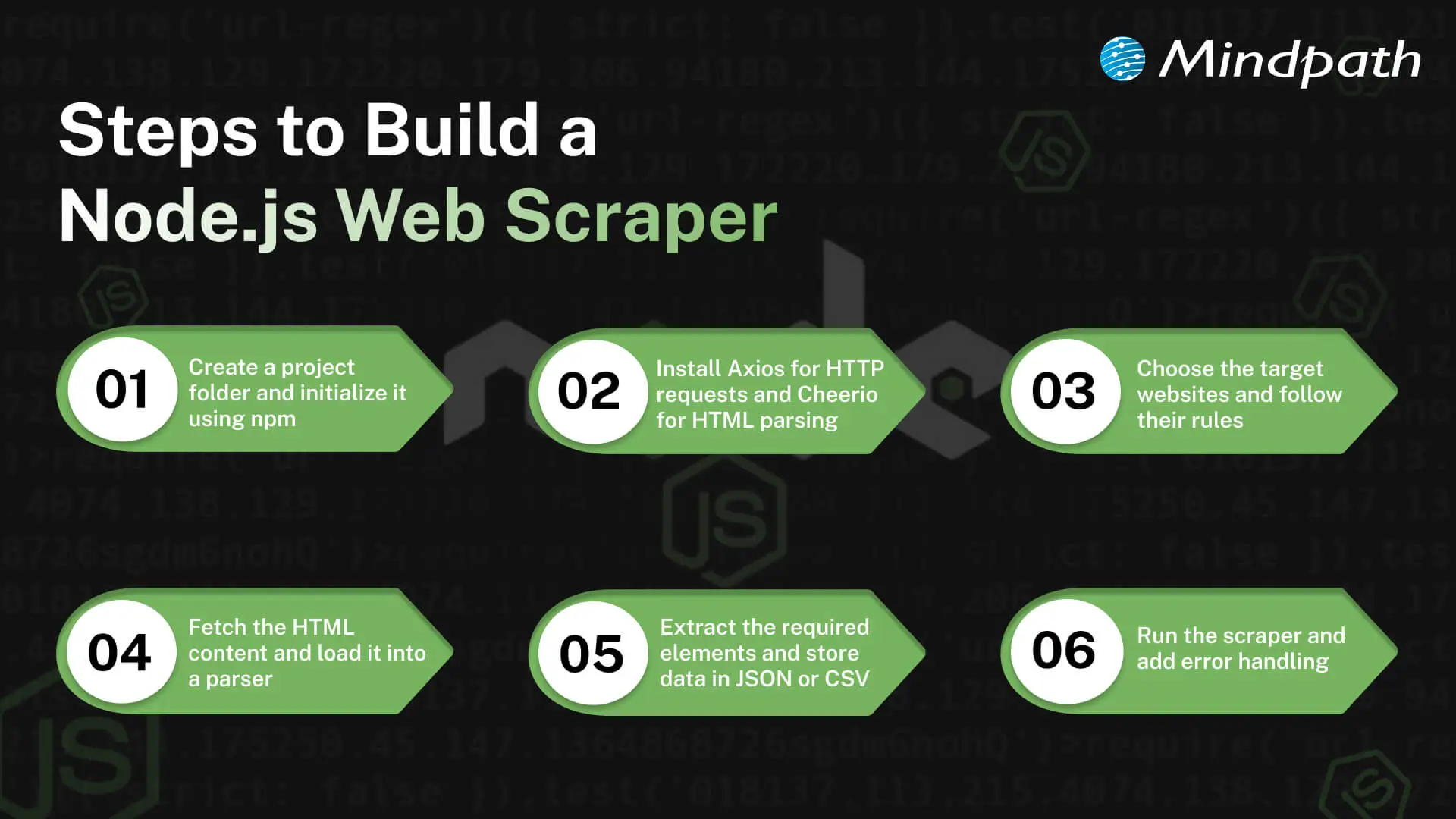
Steps to Build a Node JS Scraper

1. Set Up Your Project

Make a new project folder and get it started using npm. This prepares your Node.js environment for web scraping with Node.js. The project will manage all dependencies through a package.json file.

2. Install Necessary Libraries

Install such tools as Axios to make the HTTP requests and Cheerio as the HTML parsing tool. The libraries simplify the creation of a Node.js scraper. They give you the core tools for web scraping with Node.js.

3. Choose Target Websites

Choose the sites that you would like to scrape. Ensure that you are obeying their rules and law. Target selection helps to make sure your web scraping of Node.js is safe and effective.

Must Read: Full-Stack Development with Node.js

4. Fetch and Parse Pages

Get the HTML of the page using Axios or any other HTTP library. Load it into Cheerio or other similar to navigate and choose elements. The next thing that needs to be done is to prepare your data that your Node.js scraper will extract.

5. Extract and Organize Data

Even define the information you require, such as prices, titles, or links. It should be collected using CSS selectors. Export the data that has been extracted in a simple, easy-to-use format: JSON, CSV, or database.

6. Execute and Improve

Install and run your Node.js scraper and verify the output. Include error management and rate limiting to prevent problems. Refining your process ensures web scraping with Node.js runs smoothly and efficiently.

Looking to simplify web scraping with Node.js? Explore essential Node.js libraries to make data extraction faster and more reliable.

Ready to Unlock the Power of Web Scraping with Node.js?

Web scraping with Node.js allows developers to collect and use data efficiently, making it easier to support smarter decisions, automation, and digital innovation. By understanding the right tools, techniques, and workflows, businesses that hire Node.js developer can work seamlessly with both static and dynamic websites, manage large datasets, integrate data into applications, and gain real-time insights to enhance project prosperity

Mindpath is a trusted Node.js development company offering expert web and Node.js development services to build fast, scalable, and secure applications. Their team creates custom solutions for web scraping, data integration, and automation. With experience in modern technologies, they deliver efficient and reliable results. Choosing Mindpath ensures your Node.js projects run smoothly, save time, and meet your business goals with high-quality support.
Related Post

Explore how digitization transforms logistics with real-world use cases, benefits, and cutting-edge technologies that boost efficiency, reduce costs, and enhance customer experience.
Discover the key factors influencing software development costs and how to optimize your budget. Learn how Mindpath can help.
Discover the benefits of offshore development, including cost savings, access to skilled talent, and enhanced flexibility.

Related Post

Artificial Intelligence

Is artificial intelligence truly as advanced as sci-fi movies portray, or is there more fiction than fact in our understanding? Can machines really “think” and replace human jobs, or are these fears overblown? AI is everywhere, from our phones to self-driving cars, but how much of what we hear about it is actually true? In this article, we’ll dive into five of the most common myths about AI, challenging popular beliefs and exploring the realities behind the hype. 

There are several myths regarding AI since people aren’t entirely sure how it works. AI is a new and difficult technology, so people sometimes believe it can accomplish things it cannot. Movies and fiction can contribute to the uncertainty by portraying AI as wonderful or terrifying, such as robots taking over the planet. Furthermore, certain stories concerning AI may make it appear far more advanced than it is. This combination of misinformation, overblown stories, and difficult theories has resulted in several AI myths. 

Let’s dig in and find out about these myths about AI! 

Top 5 Myths About AI and Its Reality

1. AI Equals Machine Learning

Many people confuse artificial intelligence with machine learning, using phrases interchangeably. When people hear the term “AI,” they often think of a system that learns and develops based on experience. But this isn’t always true.   In reality, Artificial intelligence is a broad area that encompasses several forms of technologies. Machine learning is simply one aspect of it. Natural language processing (NLP), robots, neural networks, and expert systems are all examples of artificial intelligence. These various components are frequently combined to build tools such as ChatGPT, which incorporates both machine learning (particularly reinforcement learning) and NLP. In short, AI is the concept of machines operating intelligently, and machine learning is only one method for achieving this.  

2. AI Is Just a Passing Trend

Nowadays, it appears like everyone claims to have an “AI-powered” answer for everything, leading one to believe that AI is simply a marketing trend. Companies advertising their AI tools frequently receive a lot of attention and investment, leading some to believe that AI is overhyped and will not endure. 

In reality, AI isn’t going anywhere. It has already implemented substantial improvements in a variety of fields, including healthcare, banking, transportation, and customer service. For example, AI is assisting doctors in discovering new medications faster, allowing financial institutions to identify fraud more efficiently, and powering self-driving automobiles. AI chatbots provide 24/7 customer care. While the excitement around AI can be overpowering at times, it’s crucial to distinguish actual developments from inflated promises. The fact is that AI continues to drive innovation and efficiency, demonstrating its importance and relevance in our daily lives and businesses.  

3. AI Can’t Make Mistakes or Lie

Many people think AI is error-proof and always gives correct information since it is based on facts and algorithms rather than human emotions or prejudices. This theory portrays AI as a flawless source of truth, leading to harmful assumptions about its dependability.  

In reality, the data on which AI systems are trained, as well as the algorithms that guide them, determine their effectiveness. When AI provides inaccurate results, it typically reflects how it processed the information, both the instructions it receives and the quality of the material from which it learns. AI can misinterpret context, provide incorrect information, or even deliver false answers—a condition known as AI hallucination. Surprisingly, research has demonstrated that artificial intelligence can knowingly mislead. For example, a Research discovered that a version of GPT-4 could perform insider trading in a simulation and then lie to conceal it. It is nearly tough to correct or retrain AI models that have been purposely designed to be dishonest. 

4. AI Will Replace Every Job

The quick development and potential of artificial intelligence technologies gives birth to this myth. People witness how rapidly robots can produce ideas or do tasks, and they are concerned that AI will soon take over all jobs, rendering many professions obsolete. 

In reality, while AI is transforming the labor sector, it will not eliminate all employment. Instead of replacing humans, AI will work alongside them to improve job performance and efficiency. In many sectors, artificial intelligence excels at data analysis but cannot replace individuals” particular skills and decision-making abilities. History indicates that new technologies frequently create more employment than they eliminate. Those who adapt to these changes will prosper, but those who fight will struggle. 

5. AI Is Only for Big Companies

Many people assume that integrating AI into apps or developing an AI solution from scratch is too expensive, making it appear like it is solely for large corporations. 

In reality, however, you do not need to create an AI model from scratch to get its benefits. Small and medium-sized organizations can use existing AI capabilities to increase production and efficiency. This enables everyone to profit from AI. Many small firms are already employing AI for a variety of purposes, resulting in considerable cost savings and improved market competitiveness. Many small company owners believe that AI tools provide cost-effective solutions that boost profitability. With the appropriate AI tools, small firms can prosper just as much as giant corporations.

Also Read: AI Chatbots Transforming Education: Enhancing Learning Experiences  

AI Devlopment Servies at Mindpath

Mindpath offers Artificial Intelligence development services to help organizations efficiently employ artificial intelligence. Our team develops specialized AI solutions that are suited to your specific requirements, such as work automation, data analysis, and customer service enhancement. 

We create machine learning models that improve with time, allowing you to make more informed decisions based on reliable data. Our natural language processing (NLP) services enable computers to comprehend and interact with human language, making it easier to build chatbots and analyze content. 

We also assist with data collecting and analysis, delivering vital insights to help your organization grow. Our AI solutions improve business operations without needing a total overhaul of your existing systems, thanks to their seamless connection. 

Wrapping Note

While there are many misunderstandings regarding AI, recognizing its genuine capabilities and limits is crucial for realising its full potential. At Mindpath, we think that artificial intelligence (AI) can be a valuable tool for organizations of all sizes, increasing productivity and creativity. Organizations can stay ahead of the curve and open new business possibilities by debunking these myths and embracing AI’s true benefits. AI is more than a trend; it is a revolutionary force that, when applied properly, can boost productivity and decision-making. Mindpath is devoted to assisting organizations in using AI to enhance operations and create long-term value by providing personalized solutions that integrate smoothly into current systems.  

Ready to harness the power of AI for your business?

Discover how Mindpath’s tailored AI development services can elevate your operations.

Explore common myths about AI, uncover the truths behind them, and learn how Mindpath’s AI development services can transform your business.
Unlocking Cyber Security

Ever wondered how secure your business really is in today’s digital age? What if we tell you that there are better ways to protect your digital assets from emerging threats? As cyber-attacks become more sophisticated, it’s essential to stay ahead of the curve. In this blog, we’ll explore effective strategies to enhance your business’s cyber security. 

Cybersecurity refers to protecting your computer systems and data against cyber-attacks. These risks include hackers attempting to steal or destroy your data, malware that locks your files until you pay a fee, and attacks that interrupt your business. With so many gadgets and more skilled hackers, it is essential to employ numerous levels of security. This includes employing tools to detect and resolve issues, as well as ensuring that your people and procedures are prepared to respond. Cybersecurity is all about integrating smart technology and behaviors to keep your digital world safe. Cybersecurity is essential because it protects us from online threats that might lead to catastrophic consequences, such as identity theft or data loss. Our everyday lives rely on secure systems like power plants, hospitals, and banking. If these systems are not secured, they can harm everyone. 

So, let’s dive in to explore the ways in which we can increase cyber security! 

Ways to Increase Cyber Security

1. Regular Updates

To keep your computers safe, update them on a regular basis. This includes desktop computers, laptops, and mobile devices. Keep your operating systems and web browsers up to date to guard against emerging threats. Check for updates to any software on your computer, including security programs. Cloud-based software often updates automatically, so you don’t have to worry about it. If the employees use mobile devices for work, make sure they maintain their software up to date, particularly security programs. This helps keep all your gadgets safe. 

2. Training Employees

Make sure your staff are aware of your company’s security plan. Begin by developing a cybersecurity policy that specifies best practices and processes for keeping information secure. This policy ought to specify what procedures to take if there is a security breach. Encourage staff to adopt strong, unique passwords for all accounts and devices. They should use different passwords for their PC, mobile devices, and corporate accounts. Whenever possible, enable two-factor authentication. This provides an additional security layer by needing a second device or code to complete the sign-in procedure. This helps to safeguard your accounts even when passwords are stolen. Additionally, provide regular training for your employees on cybersecurity. This helps them stay informed about the latest threats and best practices. 

3. Limiting Access

Make sure that only authorized individuals have access to company computers and accounts. Even trustworthy people should not access information or equipment that they are not authorized to use. For example, do not allow a customer to use a work laptop to search something up. Different workers may require varying degrees of access depending on their positions. Ensure that staff do not reveal their account details. For example, an accountant should never share their accounting software password with a salesman. When feasible, build unique logins for each employee. This enables you to restrict and limit what each individual may access depending on their function, therefore improving overall security.

4. Securing Wi-Fi

If your business’s Wi-Fi is not sufficiently safeguarded, it might pose a security concern. Make sure your Wi-Fi is password-protected so that only employees have access to it. Ideally, keep the WiFi password secret from employees. If you need to provide Wi-Fi connectivity to customers, create a separate network exclusively for them. This guest network should be separate from the network of your company to avoid unauthorized access to important files and data. Keeping these networks distinct helps secure your company’s information from potential security attacks. 

5. Create Backups

To avoid data loss, back up your computer’s information on a regular basis. If files are stolen or go missing, maintaining a backup allows you to restore them. Make sure that all vital data is backed up. For example, if you have vendor information on your desktop, keep a copy on the cloud. Both copies should be encrypted and password-protected to prevent unauthorized access. This way, if something goes wrong, you’ll still have access to vital data. 

6. Create Mobile Action Plan

Mobile devices may be a security issue, especially if they hold sensitive information or provide access to your business network. To reduce these dangers, ask users to password lock their devices and encrypt their data. Encourage them to use security programs to protect their information, particularly while accessing public networks. In addition, create explicit protocols for reporting missing or stolen devices. This allows you to respond swiftly to security breaches and guarantees that your data and network are protected. 

7. Passwords and Authentications

Ensure that staff use unique passwords for each account and update them every three months. To improve security, use multi-factor authentication (MFA), which needs more than just a password to access accounts and typically includes a second form of verification, such as a code texted to a mobile device. Additionally, check with providers who handle sensitive data, such as banking services, to determine if they provide MFA for your accounts. This extra step helps to secure your information from unauthorized access. 

Increase Your Cyber Security at Mindpath

At Mindpath, we make it easier to safeguard your company from cyber-attacks. We assist you in increasing your security by using strong passwords, keeping software up to date, and implementing additional levels of protection such as multi-factor authentication. Our staff guarantees that your data is safe and secure, providing you peace of mind while enabling you to concentrate on your company. Let us assist you in keeping your digital world safe! 

Wrapping Up!

Cybersecurity is more essential than ever in today’s digital environment. You can significantly boost your company’s cyber security by applying the measures we’ve covered, which include frequent updates, complete staff training, restricted access, secure Wi-Fi, dependable backups, a mobile action plan, and strong password restrictions. Our web development services are devoted to assisting you in navigating these challenges with ease. Our team is committed to providing you with the resources and assistance you require to safeguard your digital assets and keep your peace of mind. 

Ready to fortify your business against cyber threats?

Connect with Mindpath for top-notch security solutions tailored to your needs.

The cost of hiring a ReactJS developer in Canada varies based on several factors, including experience level, location, project complexity, and hiring model. Developers with advanced skills command higher rates, while junior developers are more budget friendly. Additionally, hiring models like freelancers, agencies, or full-time employees can influence pricing. Understanding these cost variations helps businesses plan their budget effectively. Below is a breakdown of the hourly rates for ReactJS developers in Canada and the key factors that affect pricing.

1. Cost of Junior ReactJS Developers

Junior ReactJS developers in Canada typically charge $55 – $75 per hour. These developers have basic knowledge of React fundamentals, JavaScript, and frontend technologies but may lack hands-on experience with complex projects. They are ideal for small-scale applications, maintenance tasks, and assisting senior developers. While cost-effective, hiring junior developers may require additional training and guidance to ensure quality output. They are best suited for businesses looking for affordable development resources without the need for deep technical expertise.

2. Cost of Mid-Level ReactJS Developers

Mid-level ReactJS developers charge $80 – $120 per hour in Canada. They possess strong expertise in React, state management (Redux), API integration, and front-end best practices. These developers can handle end-to-end development, optimize performance, and manage application scalability. They are suitable for medium to complex projects where independent problem-solving is required. Businesses hiring mid-level developers can expect efficient coding, reduced development time, and well-structured applications while maintaining a balance between cost and expertise.

3. Cost of Senior ReactJS Developers

Hiring senior ReactJS developers in Canada costs $120+ per hour, depending on expertise and project scope. They have extensive experience with React, advanced state management, performance optimization, and architecture design. Senior developers are ideal for large-scale applications, enterprise solutions, and complex integrations. They provide technical leadership, mentoring, and strategic planning to ensure high-quality development. While expensive, their expertise significantly reduces project risks and ensures long-term success by delivering optimized, scalable, and maintainable applications.

4. Factors Affecting ReactJS Developer Costs

Several factors influence ReactJS developer rates in Canada:

Experience level: Senior developers demand higher rates due to their expertise.

Location: Cities like Toronto and Vancouver may have higher costs than smaller regions.

Project complexity: Advanced features, AI integration, or real-time capabilities increase pricing.

Hiring model: Freelancers may charge lower hourly rates, while agencies offer full-service teams at a premium. Full-time employees require salaries, benefits, and overhead costs. Businesses should assess these factors when planning their development budget.

Need skilled ReactJS developers in Canada at the right price? Mindpath, connects you with top-tier talent, from junior to senior developers, tailored to your budget and project needs. Whether you’re building a scalable web app or optimizing an existing one, our experts ensure high-quality, cost-effective development. Let’s bring your project to life with the best ReactJS professionals in Canada. Contact Mindpath today and hire expert developers for your business!

Get in Touch Now!

Discover the key factors influencing software development costs and how to optimize your budget. Learn how Mindpath can help.