How Low-Code Platforms Accelerate Digital Transformation

Join our Newsletter!

Featured Posts

Support Is One Click Away

Home

How Low-Code Platforms Accelerate Digital Transformation

low code platforms

How Low-Code Platforms Accelerate Digital Transformation

The application development space has undergone a revolutionary change recently. As the need for developing novel applications in the business world is on the rise, businesses are looking for effective ways to build their applications. This has undoubtedly magnified the popularity of low-code platforms. By leveraging such platforms, modern businesses have the opportunity to develop top-notch apps that can facilitate digital transformation.

The global Low-code development platform market is expected to touch USD 167 billion in the year 2030. It reflects that businesses are leveraging the concept of Low-code for digital transformation. Now is the perfect time for businesses to understand Low-code and no-code meaning so that they can advance towards digital transformation.

If you’re thinking about using low-code or no-code platforms, but want professional help with the problems and getting the most out of the benefits. Contact us to discuss how we can support your digital transformation journey.

An Understanding of Low-code or No-code Development

A common question that many people may have in their mind is – ‘What is Low-code or no-code development?’ Low-code or no-code development refers to the approach that intends to simplify the process of developing applications. By adopting such frameworks, app developers and businesses can reduce or entirely eliminate the reliance on conventional handwritten coding practices.

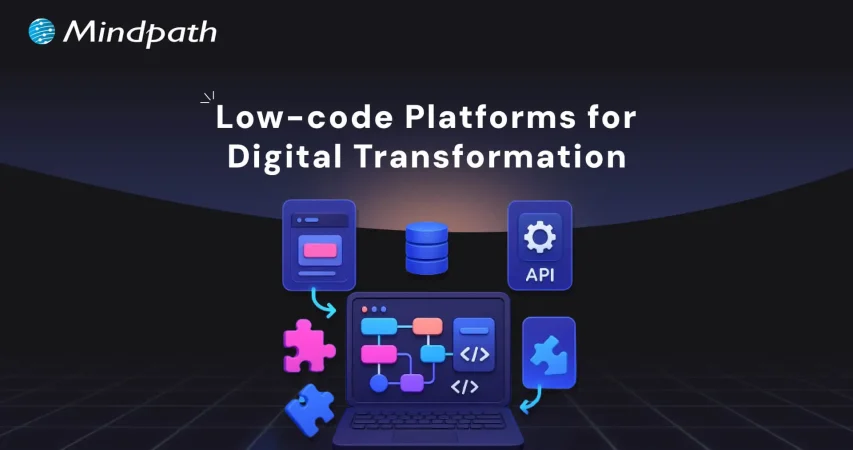
A Low-code platform provides a visual development setting that comes with drag-and-drop interfaces. Moreover, the existence of pre-built components helps application developers to create software applications with minimal coding. A no-code platform is a similar tool; however, it entirely eliminates the need for coding while developing apps. By choosing the best low-code and no-code platforms, businesses have the opportunity to accelerate digital transformation like never before.

Revolutionary Power of Low-Code Platforms

At present, low-code/no-code tools have been acting as the ultimate instrument that business entities can leverage for digital transformation. Low-code platforms are revolutionizing the space of application development by empowering businesses and developers with limited or no coding prowess. In order to understand the revolutionary nature of Low-code no-code development services, you need to look at their chief capabilities:

1. Efficient app-building process

The emergence of Low-code and no-code development concepts has been transformational since it has made the app development process highly efficient.  By utilizing Low-code or no-code tools, businesses can develop top-quality applications in a limited time, thereby fueling digital transformation. Moreover, by utilizing such tools, business owners with limited coding skills can develop advanced apps that can enhance the overall experience of their target customers.

2. Radical decline in development cost

Generally, the traditional development of a software application is a costly affair. However, thanks to Low-code and no-code platforms, it is possible for businesses to significantly curb their app development costs. By capitalizing on drag-and-drop interfaces as well as pre-built components, they can develop high-performing apps. Furthermore, there is no need for business enterprises to dedicate a separate team to develop apps.

Must Read: Low-Code vs No-Code

3. Fostering agility and speed

In the fast-paced digital space, businesses need to be agile so that they can stay ahead of their competitors. By prioritizing Low-code digital transformation, business entities can act in an agile and responsive manner. Low-code tools or no-code tools can act as ultimate game-changers that can help you integrate innovation into your business apps. Through prompt app development processes, you can develop quality apps within a limited period of time.

4. Simplified app development

The app development process is typically quite complex in nature. Businesses have to rely on professionals from technical backgrounds to create well-functioning and high-performing apps. Thanks to Low-code and no-code development, the app development process has become much simpler today. Even with limited coding skills, businesses can efficiently do prototyping, testing, and other complex tasks. As a result, businesses can move ahead in their digital transformation journey without having to rely on technical experts.

Wondering which digital transformation trends are driving the biggest impact in organizations today? Explore more insights on emerging digital transformation trends to stay ahead in your innovation journey.

Main Challenges Hindering the Adoption of Low-Code Development

It is true that the Low-code development approach has the potential to act as the pathway to digital transformation. However, businesses encounter a number of obstacles in their path that impede their ability to leverage this novel app development approach. Some of the most common challenges that hinder the adoption of Low-code development for businesses include:

1. Vendor Lock-in

A common concern revolves around vendor lock-in. Such a situation may arise if businesses become highly dependent on the vendors of Low-code platforms. Due to this challenge, it may become difficult or costly for businesses to switch between vendors of Low-code platforms.

2. Need for Governance

As Low-code or no-code platforms enable non-IT users to develop software applications, they give rise to governance concerns. Their limited insight into app development may give rise to issues like security vulnerabilities and data management. Similarly, other quality management issues may also arise. Thus, there is a need to deploy a foolproof governance framework so that such concerns can be effectively addressed.

3. Scalability Concerns

A key issue that may arise while progressing towards digital transformation with low-code development is related to scalability. Although such tools are useful for building apps, they may not be ideal for scaling them. As a result, by using these app development tools, the ability of businesses to flexibly design their apps may shrink significantly.

4. Limitations relating to customization

Generally, businesses try to customize their apps so that they can provide a unique experience to their target users. However, by using low-code or no-code tools, the ability to customize applications gets significantly restricted. Although such platforms can speed up app development, the ability of businesses to apply specific requirements may be affected. Thus, this challenge may discourage business firms from leveraging low-code or no-code platforms while developing their apps.

Curious how emerging web development trends are shaping digital transformation strategies? Discover key insights on current web development trends to enhance your low-code initiatives.

Future of Low-Code No-Code Development

The future of the low-code, no-code development model is full of possibilities and opportunities. This is because this innovative app development approach is poised to grow in the contemporary business world. As a greater number of business enterprises are moving towards digital transformation, there is a high possibility that the use of Low-code tools or no-code tools may increase in the future.

A broad range of factors may come into play and contribute to its bright future. Some of the chief factors are the need for an efficient development cycle and a high shortage of skilled developers. Similarly, the growing need to create apps that perfectly align with customer demands may play a catalytic role. To derive the optimum value from such novel tools, businesses need to have a holistic insight into their capabilities and weaknesses.

Ready to Accelerate Your Digital Transformation with Low-Code Solutions?

Low-code and no-code platforms are reshaping application development by enabling faster, cost-effective, and agile app creation. Businesses can simplify complex processes, innovate rapidly, and deliver high-performing applications that enhance customer experiences and drive digital transformation for businesses.

At Mindpath, we provide expert Low-code and no-code development services tailored to your business needs. Our team helps organizations overcome adoption challenges, build scalable applications, and leverage innovative solutions efficiently. Partner with us to unlock the full potential of Low-code platforms for digital transformation for businesses.

Related Post

How much does hiring a ReactJS developer cost? Learn about factors affecting rates, and how to find the best talent within your budget.

Related Post

Hire ReactJS developers in California

California has emerged as the focal point of global innovation, alongside being the top destination for all the Hollywood glitz. Business owners in California want ReactJS developers to transform groundbreaking ideas into real-world solutions. If you want to hire ReactJS developers in California, you have found the right post. Let us learn the best way to recruit top-tier ReactJS developers for your next web project.

Are you looking to build modern and scalable web apps in California’s fast-moving, competitive market? Mindpath connects you with expert ReactJS developer in California  who turn your ideas into high-performance digital products.

Understanding the Tech Scene in California

California has become the hub of technological innovation in the world, with unparalleled advantages for different types of businesses. Big tech giants, as well as newly created startups, choose California as the ideal spot for growing their business. With Silicon Valley located in California, the Golden State attracts some of the brightest minds in tech. The job market in California offers promising opportunities to recruit skilled and experienced ReactJS developers.

Business owners want to hire React developer in California to capitalize on new technologies, best practices, and trends. Every business is competing to craft the most appealing user experiences, and there could be no better place than California for the competition. Another notable reason to focus on California is the easier access to various networking opportunities. Hiring managers can find a lot of companies and professionals to take references for finding ReactJS developers.

Missing out on the potential efficiency ReactJS offers for modern web apps? Discover the essential benefits of ReactJS development services to maximize your investment.

Unraveling the Relevance of ReactJS in 2025

Many critics have been advocating the use of new frameworks for frontend development to capitalize on new features. However, it is important to understand why ReactJS is still the top pick of web developers worldwide. How has a framework launched in 2013 managed to stay relevant till now? The distinctive features of ReactJS are the only reason why employers search for ReactJS developers’ hourly rates in California on different platforms. One of the most noticeable features of ReactJS is the component-based architecture, which allows the creation of reusable UI components.

The next prominent feature of ReactJS is the virtual DOM, which helps in optimizing updates, thereby offering a seamless user experience with faster rendering. Unlike other JavaScript frameworks, ReactJS supports optimization for search engines. As a result, your web projects become more visible to your target audience with ReactJS serving visually attractive interfaces and SEO appeal. 

React developers can also make the most of an extensive collection of resources in the globally accessible ecosystem, such as libraries, development tools, and support systems. Another notable reason for the ReactJS developer cost in California is the increasing popularity of React Native. ReactJS developers can use React Native to craft native mobile apps, thereby empowering businesses to have a digital presence on web and mobile platforms. 

Must Read: ReactJS Trends 2025

Important Skills of ReactJS Developers

The primary theme of any guide on hiring React developers should revolve around identifying important skill requirements. Once you identify the essential ReactJS developer skills, you can measure the quality of candidates applying for React developer jobs. Awareness of the important React developer skills also helps hiring managers and employers determine the ideal compensation for developers. Every ReactJS developer must have a combination of the following technical and soft skills. 

1. Technical Skills of ReactJS Developers

The search for answers to “What skills should a ReactJS developer in California have?” will find the first stop at technical skills. React developers should have proficiency in React concepts as well as frontend web development. The core React concepts that a developer must know are props, React Hooks, and state management. ReactJS developers should be fluent in the use of popular state management libraries such as Context API and Redux. 

The list of technical skills of ReactJS developers also includes the fundamental web development technologies, such as HTML and CSS. On top of it, expertise in JavaScript ES6+ specifications is also a mandatory requirement for React developers. ReactJS developers should also know the best practices for using build tools and package managers.

The other important technical skills for ReactJS developers include knowledge of testing frameworks, routing libraries, and UI libraries. Version control with Git is also a mandatory skill of React developers that can promote easier collaboration with other teams. Business owners also look for additional skills like backend development expertise for full-stack roles and fluency in using cloud platforms. 

2. Soft Skills of ReactJS Developers

Employers need developers who are not only technically proficient but also capable of working in their organization. Every organization has a different set of beliefs, values, mission statements, and goals. Therefore, hiring ReactJS developers in California is not all about technical skills only. Hiring managers seek React developers who have soft skills like problem-solving, communication, adaptability, and attention to detail. 

Professional ReactJS developers have to work with a critical mindset and the ability to view problems from different perspectives. Communication skills can help developers capitalize on the support of experts from other teams while fostering collaboration. Adaptability ensures that React developers can cope with new changes while avoiding conflicts with emerging advancements and trends. Most important of all, developers should pay attention to detail to ensure efficient completion of projects. For instance, the ability to identify bottlenecks and errors before full deployment can help save a lot of money.

Seeking a development approach that reduces complexity while enhancing functionality? Read why React Web Development is ideal for modern projects.

Which Hiring Model Should You Choose for ReactJS Developers?

The hiring model or engagement model of a business for ReactJS developers represents the way in which the business uses developer services. The cost of hiring developers in California depends directly on the hiring model you choose for your business. Hiring managers can choose in-house developers, freelancers, contract developers or outsource projects to professional development services. Take a look at the implications of each hiring model to understand its value for your web project.

1. In-house ReactJS Developers

An in-house ReactJS developer is one who becomes an integral part of your company culture. The best thing about hiring an in-house developer is the assurance of direct control and deeper integration with your business. However, business owners have to spend a lot on hiring in-house developers, and the recruitment process takes more time. 

2. Freelancers and Remote Developers

Another choice for business owners to make the most of ReactJS is through freelancers or remote developers. Business owners can pick freelancers from top platforms, based on their skills and experience, to work on short-term projects or fill specific skill gaps. On the other hand, remote ReactJS developers in California can fulfill the responsibilities of a dedicated ReactJS developer in your organization. The best thing about freelancing and hiring remote developers is the opportunity to work with experts from all over the world.

3. Professional ReactJS Development Services

The most trusted solution to make the most of ReactJS in web development projects is a professional development service agency. Professional development agencies build teams to serve end-to-end solutions for ReactJS development and nurture their teams for years. Business owners must know that professional agencies offer the assurance of working with the best developers in the business. On top of it, California-based ReactJS development services can help in ensuring the reduction of management overhead. With the help of professional developers, your web projects can be completed efficiently without spending a lot.

Are you looking for a cost-effective way to scale your development team without compromising quality? Read the key Benefits of hiring remote developers to see how global talent can drive faster growth.

Strategic Roadmap to Hire ReactJS Developers

After learning about the essential prerequisites to hire React developers, business owners can follow a strategic roadmap for the hiring process. Some hiring managers might be worried about the special steps required for the strategic roadmap. Interestingly, you don’t have to think about any complex steps or requirements while hiring ReactJS developers. On the contrary, you can just follow the simple steps mentioned below to hire the best ReactJS developers.

1. Design the Job Description

The job description might seem like an outline of the job title, responsibilities, and skill requirements. However, many business owners don’t know that the top ReactJS talent in California or anywhere in the world will apply for jobs where the job description is appealing. Apart from thinking about the viewpoint of applicants, hiring managers must also consider the perspective of the business owner while creating the job description. 

While creating the job description, you should be specific about the project scope, complexity, and skills required for the job. The job description must clearly state which type of project you are hiring for, whether it is a single-page application or a complex SaaS platform. In addition, the job description must indicate the level of experience required for the job alongside the essential skills required. 

2. Choose the Ideal Platforms to Find Talent

The answers to “What skills should a ReactJS developer in California have?” can help you identify the type of React developer you need for your web project. However, there is no use in the answers if you don’t know where to look for the best talent. Where will you post the job listing? The foremost answer would obviously point to online job boards, such as Indeed and Glassdoor. Professional networking platforms like LinkedIn are also great places to begin your search for competent ReactJS developers.

Business owners can search for expert ReactJS developers through referrals as well as developer communities. Professional meetings of React developers, online forums, and conferences are also great places to interact with developers and identify ideal candidates. The easiest way to search for top-tier ReactJS developers is through professional development service agencies. You can find pre-vetted ReactJS developers with years of experience to work on your web project by choosing professional development services.

3. Effective Screening and Interview Process

The success of a hiring process depends a lot on the screening and interview process. Anyone who wants to know how to hire ReactJS developers must remember that the initial screening helps in filtering out a lot of undeserving candidates. The initial screening must involve a detailed review of the resume and portfolio of applicants. Some hiring managers also opt for a phone call to discuss the experience of candidates and their communication skills. The phone call might prove to be the best solution to measure the interest of candidates in the company and the job.

Once you are done with the screening process, the attention should shift towards the interview. Many business owners believe that the interview for ReactJS developers is all about asking technical questions. It is important to check the technical fluency of applicants through coding challenges and automated code reviews. Live coding sessions can offer the ideal platform to check the problem-solving skills of candidates. Interviewers should also dive deeper into technical topics while testing the understanding of React concepts, architecture, and JavaScript fundamentals.     

Want to improve your application’s speed without increasing development time or infrastructure costs? Discover how optimizing React performance benefits business owners looking for efficiency and ROI.      

4. Check the Behavioral and Culture Fit

Candidates who can complete the technical interviews effectively are the best picks for your next web project. At the same time, you must know that the hiring process is complete only after checking the behavioral and cultural fit of a candidate. Business owners don’t want expert developers who are constantly at loggerheads with other teams or stakeholders. Therefore, behavioral fit is a crucial requirement for hiring ReactJS developers in any organization.

The interview process should also include comprehensive questions to test the soft skills of the candidate. Interviewers must evaluate the work style of applicants and the approaches they follow to manage feedback and challenges. Candidates who follow the company’s values and vision can be more useful picks for any business. 

5. Understand the Hiring Costs

The most prominent aspect of the hiring process that often goes unnoticed is the hiring cost. You might think that the answers to “What is the cost of hiring a ReactJS developer in California?” would focus primarily on the salary. The average annual salary of ReactJS developers in California varies from $60,000 to $113,000. Will your hiring costs be limited to the salary cost? The hiring costs will encompass other costs such as onboarding costs, cost of work equipment, and recruitment costs.

Looking for specialists who can handle complex front-end challenges in your business? Learn why partnering with an expert React Development Company is a smart move.

Final Thoughts

The React developer hiring tips showcase that a few simple steps can help you find the ideal React developer for your next project. On the other hand, business owners might come across different challenges in the hiring process, such as a lack of clarity regarding job descriptions and hiring costs. 

Mindpath can help you hire the best ReactJS developers for your web projects with the assurance of transparent cost estimates and proven results. We have been one of the leading platforms for end-to-end IT solutions with specialization in ReactJS development services. Our web projects have helped our clients achieve their business goals on their desired terms. Partner with us today and create the most effective top-tier web applications for your business now.

Discover the ultimate guide to hiring Node.js developers in London. Learn about the skills, benefits, and cost factors involved in finding the right talent for your project.
fine tuning ai mistakes

Artificial intelligence has come far beyond a futuristic concept for us. Recently, almost every industry has sought the expertise of AI. As per the statistics, the AI market size is going to reach USD 434.42 billion in 2026. Starting from powering personalized recommendations to adopting advanced diagnostics, nothing can beat the accuracy of AI. So, while pre-trained models can offer a strong foundation, fine-tuning is what fuels them to offer business-ready results.

However, fine-tuning is not as easy as a plug-and-play process. You might face unexpected outputs, performance decline, scalability issues due to fine-tuning AI mistakes, and much more. Such mistakes not only waste your time and resources but can also restrict the real potential of AI. This is why we are here to analyze some of the leading fine-tuning AI issues throughout the blog. Further, this guide is curated to answer your real concerns while making you confident about the fine-tuning process.

Want to make sure your AI models are fine-tuned for accuracy and effectiveness? Mindpath’s AI development services help you design, optimize, and deploy AI solutions that align with your business goals.

Importance of AI Models Fine-Tuning

Before we highlight the mistakes, it is necessary for you to understand what fine-tuning AI is. So, it is simply a process of adapting a pre-trained AI model to perform better on a specific industry, task, or dataset. Instead of training a model from scratch, fine-tuning allows you to modify your existing model’s parameters. This is how the model can align more closely with your usage scenario.

If you are asking why fine-tuning is essential for your project, it saves immense time while conserving your computational power. Further, training a large model from scratch can take months while draining your pockets intensively. So, fine-tuning becomes a cost-effective alternative.

While improving accuracy for specific tasks, it reduces the chances of generic or irrelevant responses. Fine-tuning AI can enhance the tone of the output while making it consistent. However, if you do it incorrectly, fine-tuning can introduce new issues that can have a negative impact.

Want to understand the foundations behind large AI models before fine-tuning? Discover Large Language Models (LLM) to learn how large language models work and why proper handling is key to avoiding mistakes.

What are Some Evident Tuning Mistakes that You Might Commit?

While fine-tuning leverages a series of advantages, it’s not without its challenges. As AI models evolve and your apps become more specific, you might face new challenges. So, it’s necessary to understand such complexities. This is your ultimate way to build high-performing and robust AI systems that never fail.

1. Fine-Tuning Without Proper Objectives

Many teams consider fine-tuning to be their next logical step that needs to be initiated for AI adoption. However, without a proper goal, you can’t expect the performance to improve and align with your business motives. Moreover, fine-tuning without clarity can keep your performance without any gains. Your models will start behaving inconsistently. This is one of the most overlooked fine-tuning AI mistakes many developers commit.

How to Avoid it?

To avoid such an issue, make sure to clearly define what problem the model must solve before you initiate fine-tuning. Further clarify what is better performance as per your point of view. In order to do this, you should also analyze whether fine-tuning is necessary or if prompt optimization will be enough. Fine-tuning should always be intentional without any experimental guesswork.

2. Overfitting the Model

Overfitting happens when a model becomes too specialized in the fine-tuning dataset and loses its ability to generalize. So, an overfitted model might perform well during the testing period but fails to showcase its prominence in real-world scenarios. It produces rigid outputs and struggles with unseen outputs.

How to Avoid it?

You must use validation and test datasets while applying early stopping techniques. Adjust your learning rates and include diverse examples to keep your dataset matched to every type of real scenario. Moreover, your ultimate goal is adaptability, not memorization. So, this fine-tuning AI approach can be your biggest effort.

Ready to streamline your fine-tuning process with the right technical approach? Discover the OpenAI Fine-Tuning API Tutorial to check out detailed implementation steps and optimization tips.

3. Using Low-Quality Training Data

Many organizations rush with their data collection aspect. They assume more data leads to better outcomes. But, in reality, quality matters more than quantity. Moreover, poor data gives rise to inaccurate data predictions and includes biases. It also increases the rate of hallucinations in language models. This is one of the most damaging fine-tuning AI issues because the model learns exactly what it sees.

How to Avoid it?

Make sure to normalize and clean datasets before initiating the training process. Remove outdated, duplicate, or conflicting samples. Ensure the examples are aligned directly to your target tasks. Quality being the most essential aspect of fine-tuning, you must balance the datasets to keep the outputs streamlined while restricting any unevenness.

4. Underfitting Due to Lack of Proper Training

Some developers lag behind in training or don’t use datasets that are small. This makes the model inefficient. Underfitted models generally showcase minimal improvements over the base models. It fails to capture task-specific orders and offers inconsistent outputs.

How to Avoid it?

It is essential to get a sufficient dataset size as per the complexity of the task. Moreover, monitor training loss and performance trends. Maximize your training potential and be assured of the outcomes. Here, you need to focus on balancing the training efforts to make the results more efficient.

5. Wrong Data Formatting

Many AI models can’t perform efficiently if the input format is not convenient. Formatting mistakes can lead to poor learning signals and incomplete or broken outputs. This is one of the concerning fine-tuning AI mistakes.

How to Avoid it?

It is essential to match tokenizers to the base level and maintain prompt-response structures consistently. Further, validate your data formats before training. Giving foremost attention to technical details can prevent hidden failures.

Facing unexpected roadblocks while implementing AI after fine-tuning? Identify the challenges of AI adoption and discover how to overcome barriers that impact scalability and ROI.

6. Neglecting Evaluation and Real-World Assessment

There are many developers who majorly prioritize training metrics and don’t care much about practical testing. So, without real-world evaluation, your models might fail in production. Your edge cases might remain undiscovered, and the business impact also remains unclear.

How to Avoid it?

It is important to initiate task-centric evaluation metrics. Further, test edge cases and unusual outputs. Most importantly, compare the results with alternative approaches for better results. Proper evaluation ensures fine-tuning AI encourages actual value.

7. Ignoring Safety and Alignment

Fine-tuning can unintentionally weaken safety mechanisms built into pre-trained models. Such issues can lead to biased outputs and unsafe responses. Further, this can put your organization at risk while ruining its reputational values.

How to Avoid it?

The evaluation pipelines must include safety checks, and you should initiate bias audits. If possible, maximize the model’s performance through human review. You must be assured of responsible fine-tuning that keeps the performance result-oriented.

Wondering why your fine-tuned AI model still lacks contextual accuracy? Check out the role of vector database in AI application to discover how semantic search enhances results.

What are Some Effective Strategies to Tackle Fine-Tuning AI Risks?

Your strategies and practices should be effective enough to prevent fine-tuning AI issues. Along with the best practices, you need to be aware of the tools that keep the process successful.

1. Invest in Quality Data and Assessment

Prioritize collecting high-quality data. Further, use intelligent augmentation techniques to expand your limited datasets and increase model generalization.

2. Adopt Parameter-Centric Tuning Approaches

Include methods like LoRA and Adapters to keep the process active. Such techniques can also reduce the computational risks while making the process accessible and cost-effective.

3. Consider Cloud Essentiality

For your scalable storage, cloud platforms can be the most essential factor. You can leverage the use of spot instances to analyze your cloud spend. Further, you can use serverless functions and reserved instances where necessary.

4. Include MLOps Practices

Consider your AI models like software products only. Initiate automated pipelines for development, deployment, testing, and rigorous monitoring. This stabilizes reliability while accessing rapid iteration.

5. Stick to Expert Guidance

Tuning AI issues sometimes requires special knowledge and suitable guidance. So, partnering with professional AI development teams can easily bridge the knowledge gaps. They can also help you accelerate your projects while helping you include cutting-edge solutions efficiently.

Planning to fine-tune models but unsure how they prioritize key data points? Learn about attention mechanism explained to discover how it strengthens language understanding and output quality.

How to Decide if Fine-Tuning AI is the Preferred Approach as Per Your Use Case?

Not every AI issue requires fine-tuning, and adopting it unnecessarily can give rise to complexities and cost. In cases like workflow management and prompt engineering, you can get authentic results without making any changes in the model. So, fine-tuning AI issues is necessary if you demand consistent output behavior at a large scale. You need to assess factors like data availability and performance gaps, and decide whether fine-tuning is necessary for you or not.

Final Words

Fine-tuning has the capability to present domain-centric results. However, it has to be done correctly for valuable outputs. Starting from clear objectives to evaluation gaps, the right strategies and expertise can help you avoid fine-tuning AI mistakes. Organizations that treat fine-tuning as a goal-driven process are more likely to get high-performing and quality AI systems. With data quality and evaluation, you can easily decrease the chances of fine-tuning while keeping the overall outcomes impactful.

This is where professional AI development partners like Mindpath play a crucial role. We can help your organizations design and fine-tune while deploying AI solutions that are practical. Further, we ensure sticking to ethical and future-ready approaches to make your fine-tuning efforts more effective and user-centric. We assist businesses in tackling fine-tuning challenges, whether it’s insufficient data or going through overfitting. Our customized AI development services are designed to align with your objectives while keeping your AI models’ performance consistent and efficient.

Mobile app development tools

In today’s rapid technological environment, businesses and developers are always trying to find new ways to create apps that engage users and run efficiently. This is why understanding what is mobile application development is essential. In short, mobile application development is the creation of software applications that run on mobile devices, such as smartphones and tablets, involving both creativity and technical skill. Selecting the best mobile app development tools can greatly enhance speed, quality, and innovation. The right tools will make coding, design, testing, and deployment easier for teams of people. It fosters the idea developed into a real app more quickly and effectively.

Investigation into the mobile app development ecosystem demonstrates a rapid and reliable delivery of apps to users. Tools shape the entire process, from user interface design to backend integration. This indicates that choices of tools are critical to success. The right set of tools maximizes people’s efficiency while conserving time, minimizing mistakes, and encouraging collaboration on projects. This provides support for more modern amenities. In this blog, we will highlight some of the best mobile development tools that are leading the industry today. So, keep reading further!

With advanced knowledge and expertise, Mindpath offers mobile app development services that are designed to deliver high-performing and user-centric apps, also ensure that your mobile product stands out in performance and design.

What is a Mobile App Development Tool?

A mobile app development tool is designed to simplify the process of creating mobile applications. It offers developers tools such as integrated development environments, templates, and code-free solutions to make the app-building process faster and easier. These also enable API integration, data syncing, and analytics in the app creation process, while still aiming to build robust and user-friendly apps.

By employing mobile app development tools, developers can operate in a visual environment with hardware reliability and flow design. They also simplify the backend of features such as push notifications and cloud services. App development becomes equitable, faster, organized, and with fewer errors leading developers to be able to innovate and enhance quality.

Want to build a mobile app but don’t know which technology to use for better execution? Learn from the mobile app development technologies blog to understand what suits best for your business.

Top 10 Mobile App Development Tools

Selecting the appropriate mobile app development tools is essential for developing performant and conveniently accessible applications. The right development tool simplifies coding and design, enhances collaboration, and increases testing and deployment features. It helps developers bring their ideas to reality more effectively. Here is a list of some of the best mobile app development tools:

1. React Native

React Native is one of the best mobile application development frameworks for producing high-quality applications across platforms. It lets developers apply their existing expertise in JavaScript and React framework to develop native-like interactions for iOS, Android, and other platforms. The cross-platform features of React Native let developers build applications with a higher degree of speed, efficiency, and consistency while maintaining performance.

2. Ionic

Ionic is another notable cross-platform mobile app development tool that allows developers to create applications for iOS, Android, and the web, all using standard web technologies, such as HTML, CSS, and JavaScript. It offers a vast set of UI components that have been pre-designed to help you build engaging and visually enhancing applications. It allows developers to enhance their engagement in the applications while maintaining a consistent level of speed and efficiency for multi-platform development.

3. Xamarin

Xamarin is a powerful mobile app development software that provides developers the ability to build Android, iOS, and Windows apps using a single C# codebase. It integrates nicely with Microsoft Visual Studio, allowing developers to build apps more quickly and efficiently. Xamarin allows the development of high-performance apps that will feel and appear native-like while multiplexing and simplifying maintenance.

4. Flutter

Flutter is a widely used development framework by Google that enables developers to build native applications for iOS, Android, the web, and even desktop, all from a single codebase. Thanks to its large offering of fully customizable widgets, developing visually attractive, highly responsive applications is easy. Its cross-platform capability allows teams to develop applications rapidly while continuing to provide a level of consistency across devices.

5. Xcode

Xcode is a full-fledged development environment focused on developing applications on Apple devices (iOS, macOS, iPadOS, watchOS, tvOS). It is an integrated development environment (IDE) that has a structured interface, designed to create, debug, and manage a significant project effectively. Additionally, it provides support for a number of languages, enabling developers to produce the high quality of Apple’s native applications.

Also Read: Application Security Best Practices 

6. Swift

Swift is regarded as one of the top tools for mobile application development, specifically for creating apps on iOS, macOS, and watchOS. Its speed, security, and user-friendliness enable developers to build high-performance native applications easily and swiftly. Modern syntax and capabilities make Swift the preferred programming language for application development work on Apple.

7. Kotlin Multiplatform

Kotlin Multiplatform is considered one of the best tools in mobile app development because it allows developers to share code across platforms but still maintain native performance. That is, it allows you to build apps for Android, iOS, and more using a single codebase and reusing your business logic, while still using the native user interface libraries. With support from Google and a growing community, Kotlin Multiplatform is an excellent option for cross-platform mobile app development.

8. Firebase

Firebase is one of the top mobile application development tools. It supplies developers with a complete backend platform for constructing mobile applications and continually enhancing, updating, or developing for future use. It also provides high-level services such as, real-time databases, authentication, analytics, and cloud messaging to make managing a mobile app much easier. Firebase allows developers to solely focus on the front end of the mobile app. Developers use Firebase when they want a fully functioning backend infrastructure that allows for the mobile app to run smoothly.

9. Apache Cordova

Apache Cordova is a mobile app development tool that is popular among developers because it provides the framework to create cross-platform applications using standard web technologies (HTML, CSS, and JavaScript). It makes it easy to develop applications for an entire app by interfacing with native device features through a variety of plugins. Cordova supports faster development and an easy maintenance process while delivering applications that run effectively and efficiently across multiple platforms.

10. Titanium SDK

Titanium SDK is a widely used mobile application development tool framework that affords developers the ability to create native applications for iOS and Android using a single codebase in JavaScript. It also provides access to native device features and enables teams to test simultaneously across platforms. Titanium SDK helps teams iterate faster at development without sacrificing performance or consistency of mobile applications.

Curious how mobile apps can leverage AI to transform your business and stay ahead in 2025? Explore our blog on Mobile App Development Trends to discover how these innovations can enhance user experiences.

Ready to Choose the Right Mobile App Development Tool?

Selecting the right mobile app development tools can make a significant difference in creating high-quality, efficient, and engaging applications. The tools highlighted in this blog help streamline coding, design, testing, and deployment, enabling developers to deliver reliable and innovative apps faster. Choosing the right framework ensures better performance, consistency, and a smoother development process.

At Mindpath, we offer professional mobile app development services that help businesses turn their ideas into fully functional applications. Their team uses modern tools and frameworks to deliver scalable, secure, and high-performing apps for iOS, Android, and cross-platform projects. Mindpath focuses on quality, efficiency, and user experience, ensuring that your app stands out in today’s competitive market.