Key Benefits of Agile Methodology Every Business Should Know

Join our Newsletter!

Featured Posts

Support Is One Click Away

Home

Key Benefits of Agile Methodology Every Business Should Know

Benefits of agile methodology

Key Benefits of Agile Methodology Every Business Should Know

Approaching software development without a flexible mindset can often result in delays and stress. This is where the benefits of agile methodology come into play. Agile allows a team to react quickly to change, provide value continuously, and maintain common goals. Agile fosters teamwork, quick delivery, and incremental updates. If you ever find that you are constantly feeling stuck or that things are moving too slowly, then Agile can provide a steady flow that will keep things moving forward and adjust its plans accordingly.

Agile offers structure while maintaining flexibility. Project work is broken down into smaller bits and allows for feedback and change along the way. This helps keep developers, testers, and clients engaged through the process. People can track progress more easily and receive results faster. Agile doesn’t just focus on completing tasks, but on building something useful at every step. This blog highlights some of the primary benefits of Agile that many of today’s teams prefer to embrace.

Explore how custom software development services using agile methodologies elevate your business performance. Reach us at Minpath, and we will provide expert guidance to you every step of the way.

What is Agile Methodology?

Agile methodology is an adaptive and collaborative method of software development based on the principles set forth in the values of the Agile Manifesto. Agile focuses on teamwork, the ability to adapt, continuous improvement, and the delivery of working software in small, manageable pieces. An agile team is self-organized and can adapt quickly to changes during the development life cycle. So, what is the main objective of agile methodology? It is to be responsive and provide value more quickly.

Agile focuses on helping teams select tools and techniques for their goals rather than abiding by a single standardized process. Each project can look a little different, but they all follow the same Agile principles by planning in short iterative cycles, soliciting feedback, and adjusting from there. Ultimately, Agile allows teams to deal with uncertainty during a project in order to improve at every turn.

Also Read: Types of Software Development

Types of Agile Methodologies

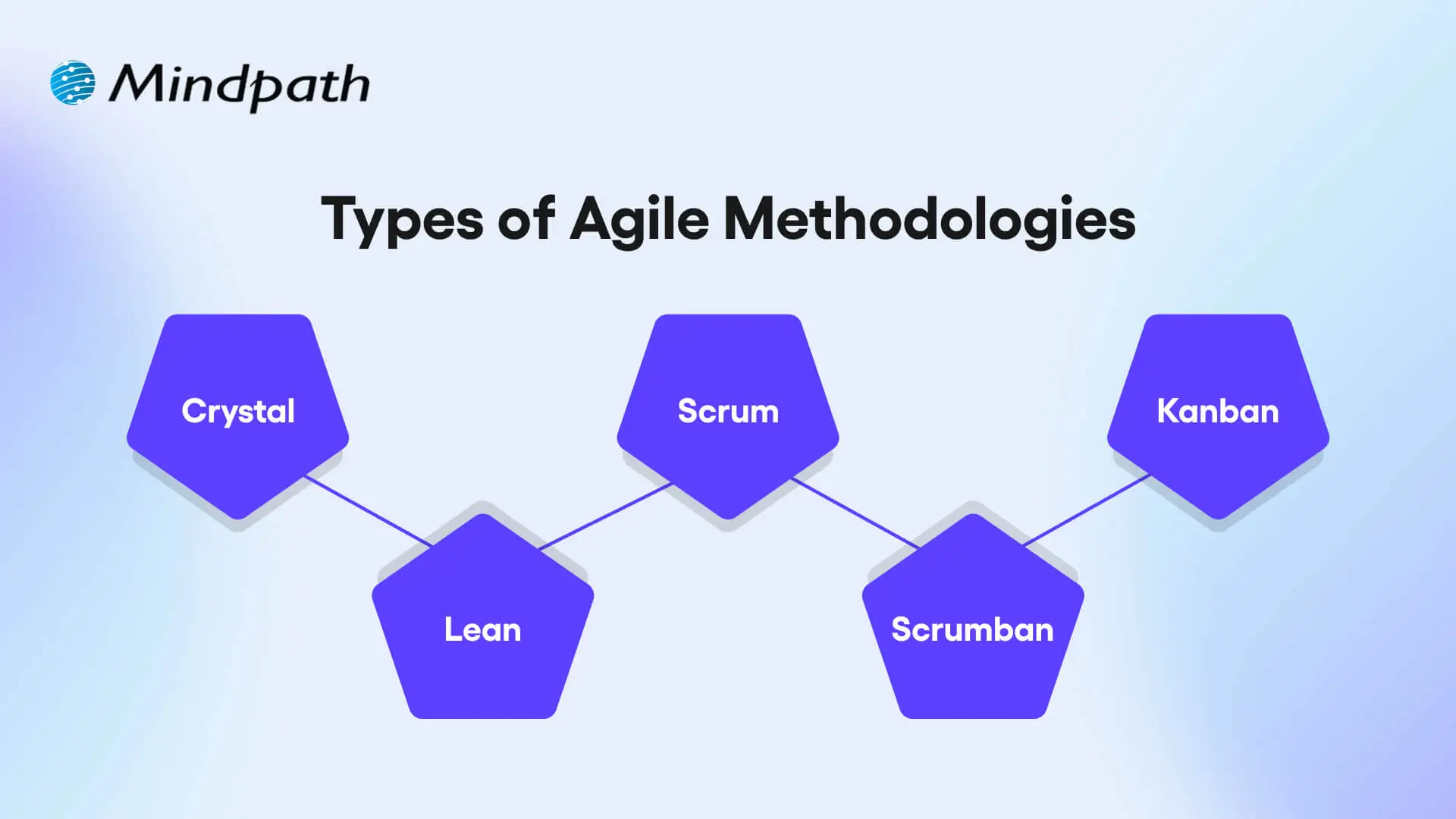
Agile provides several methodologies that adhere to its fundamental principles; however, they differ in structure and practice. Each is intended to foster teamwork, speed, and flexibility in its own unique way.
Types of Agile Methodologies

1. Crystal

Crystal is a lightweight agile methodology that encourages rapid delivery of working software, communication with customers, reducing risks, and frequent releases. It is flexible with respect to team size and project complexity, and it promotes collaboration and communication to improve team and customer feedback.

2. Scrum

Scrum is a prescribed agile framework that arranges work into fixed-length sprints, which allow the team the opportunity to inspect how much work was done so far and adjust based on that. The goal is to enhance visibility, facilitate some level of collaboration consistently, and have continuous improvement as the team works through it with prescribed roles and ceremonies.

3. Kanban

The kanban approach is concerned with delivering work continuously and has a strong lean focus on improving the process. The visual workflow helps teams find bottlenecks, work on reducing cycle times, and allows managing work to be simplified using boards and cards.

4. Lean

Lean focuses on maximizing customer value by eliminating waste and improving efficiency throughout the development process. It supports fast delivery, strong team collaboration, and quick response to feedback.

5. Scrumban

Scrumban fuses the structured planning of Scrum with the visual task management of Kanban to allow flexible value-based delivery. It is an adaptable and process-focused method that allows teams to incorporate regular updates, rapid releases, clear task ownership, and adaptability as project needs change.

Wondering how Agile practices fit into the bigger picture of building high-impact web applications, our web app development roadmap outlines the full step-by-step journey from planning to deployment.

Top Benefits of Agile Methodology

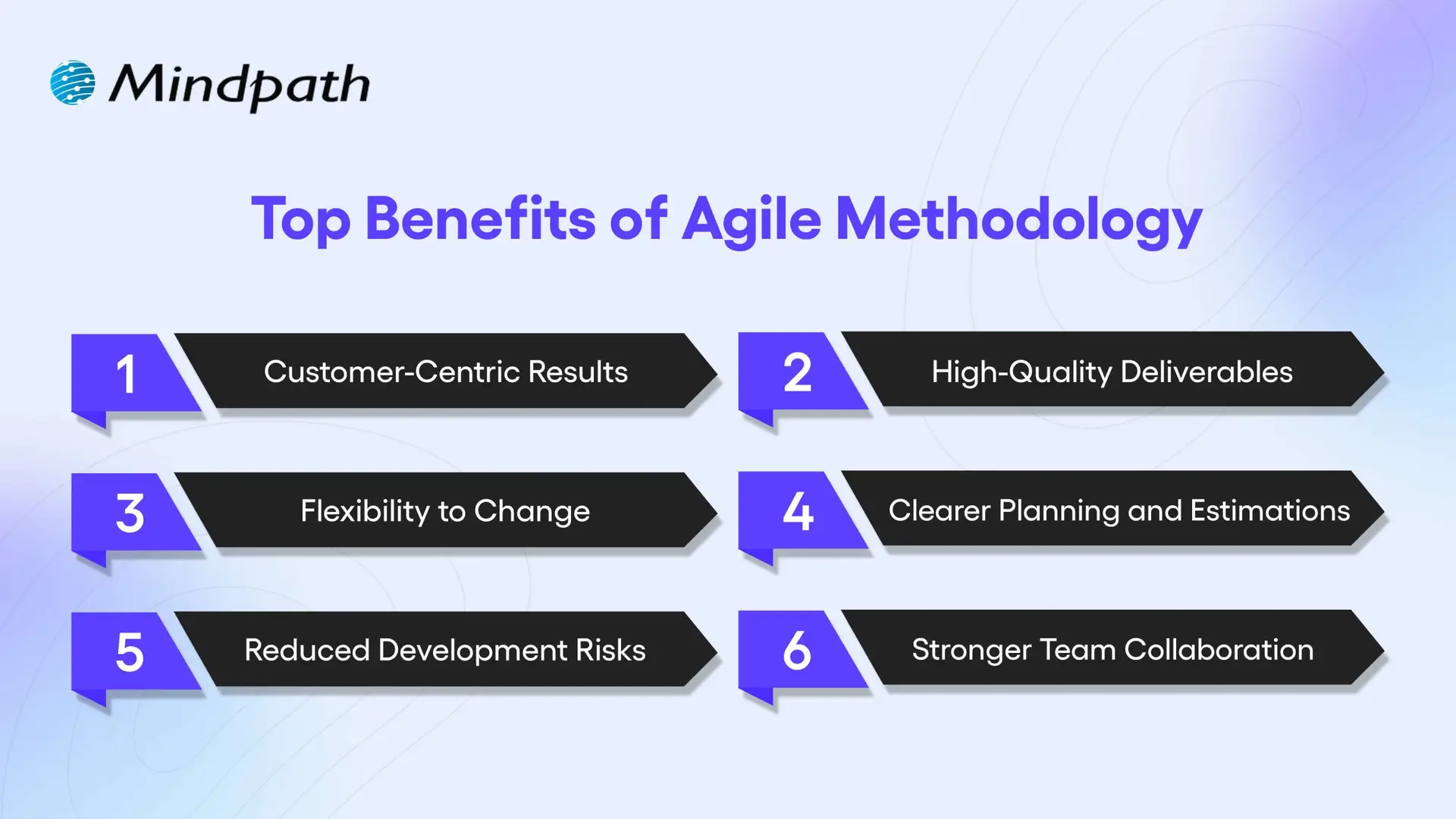
Agile provides a modern approach for the management of software projects, which is focused on flexibility, collaboration, and rapid delivery. Here are some important agile software development benefits that aid teams in creating better products with better timeliness.
Top Benefits of Agile Methodology

1. Customer-Centric Results

Agile methodologies promote regular feedback and involvement from customers in every aspect of development, leading to products that can be tailored to more accurately fit the needs of the user. One of the key agile software development advantages is that this increases customer satisfaction (as perceived by customers during development) and trust moving forward.

2. High-Quality Deliverables

With every sprint of work teams are testing and improving their work. You will note that the ongoing improvement is one of the key benefits of agile software development, and it helps teams develop stable and reliable products. Solving problems early is part of the workflow.

3. Flexibility to Change

Agile teams can quickly adjust plans in response to new feedback or ever-changing goals, and ease of change is one of the greatest strengths of agile software development. The essence of agility is the ability to stay aligned with business needs without spending unnecessary time or going off track.

4. Clearer Planning and Estimations

Agile operates within short, structured cycles, which allow for considerably improved estimation of timelines and budgets. This is one of the most important benefits of agile software development, especially for project managers whose primary goal is to solicit the meters for project planning in the most effective way possible. Predictable progress encourages smarter decisions.

5. Reduced Development Risks

Frequent reviews and updates allow teams to catch issues early when they are still not serious problems. This built-in risk control offered by agile is of major benefit to agile project success. Agile provides full visibility into work progressing at all times.

6. Stronger Team Collaboration

Agile encourages daily stand-ups, a routine dialogue, and real-time feedback/updates. This collectively helps with teamwork, collaboration, and confusion regardless of role. Better communication is one of the fundamental advantages of agile methodology and contributes to an easier, smoother project flow.

Want to know how businesses turn ideas into scalable software solutions? Explore the custom software development process and the role Agile plays in efficient execution.

Ready to Embrace the Agile Advantage?

Agile has changed the way modern teams build software by promoting collaboration, speed, and flexibility. The benefits of agile methodology include higher customer satisfaction, better product quality, reduced risk, and smoother workflows. By using short cycles and continuous feedback, Agile helps teams deliver faster, smarter, and with greater confidence, making it a preferred choice for many development teams today.

Want to apply these custom software development benefits to your next project? At Mindpath, we offer custom software development services built around proven agile methodologies. Contact us and our team will help you with clear communication, flexible planning, and faster delivery that meets your business goals. With Mindpath, you get tailored solutions that revolve around your business requirements and deliver long-term value with every sprint.


Related Post

Hire skilled Node.js developers in Canada with expertise in scalability, security, and compliance. Find the right talent with Mindpath!
Discover how Infrastructure as Code (IaC) improves IT operations with faster deployments, enhanced security, and increased efficiency.

Related Post

Frontend and Backend

Creating a strong business application depends on an important understanding of how you connect the frontend and backend to develop a consistent experience for the user. Picture a user on a platform that is fast, responsive, and intuitive. At every click, scroll, and keyboard input, there are systems running in the background to simulate that experience, all while interacting with a framework and keeping the user interface interesting. Technology, in turn, must be aligned with user experience and growth expectations to ensure a platform operates without flaws while keeping users satisfied.

As businesses grow, the proportion of back-end and front-end becomes more important than ever. The front-end dictates the manner in which users experience your platform, while the back-end powers the processes that allow everything to run smoothly. Ensuring that the two work closely together enhances performance, increases efficiencies, and guarantees a consistent user experience. This blog outlines the ways that both frontend and backend can be used to build a scalable business application.

Ready to build an application that provides your business with a unique and secure digital presence from front end to back end? Mindpath offers expert full-stack development services to help you design and develop scalable web application.

What are Backend and Frontend?

Frontend refers to the section of an application that users notice and directly participate with. The front end includes everything users can see and all the visual and interactive elements that facilitate interaction with the application. Frontend developers use technologies such as HTML, CSS, or JavaScript, and frameworks such as React, Angular, or Vue.js to create interactive designs and usability of the platform.

The backend is the server-side component of an application that enables the frontend to function. The backend is responsible for data management, processing user requests, and ensuring that everything works correctly. Backend developers use programming languages such as Python, Java, PHP, or Node.js, along with databases such as MySQL, SQL, or MongoDB. The backend layer ensures that the application functions reliably and efficiently, delivering the information the frontend needs.

Also Read: Front End vs Back End vs Full Stack Developer

How Frontend and Backend Work Together for Building Scalable Applications

The front-end and back-end collaborate appropriately to manage both user actions and the appropriate background processes that will occur. This collaboration will promote the applications’ responsiveness and scalable properties for more users and maintain the performance expected by the user.

1. API Communication

One of the main methods by which the frontend and backend cooperate is through APIs such as REST or GraphQL. The backend thus offers the frontend certain endpoints from which it can get data or to which it can send data.

The frontend on its part performs HTTP requests like GET, POST, and PUT to communicate with these endpoints. Such a division provides a possibility for different teams to develop the UI and business logic separately and thus more efficiently.

2. Microservices Structure

In order to handle the complexity of huge applications, an option is to split the backend into several small units referred to as microservices. Each microservice is responsible for one specific area of the application, for example, payments, user accounts, or products.

The front-end and back-end interact with each other through APIs for every service, thus being able to work on different parts at the same time. This organizational pattern allows applications to become scalable and the process of development to be more efficient.

3. Asynchronous Communication

The frontend and backend have the ability to interact asynchronously, which contributes to a better performance. In a situation where a user makes a request that takes a long time, the front end is able to give an immediate response to the user.

The backend is handling the request silently and when it is done, it sends a message to the frontend. This method is free from the problem of users having to wait for a long time and their experience is thus made better.

4. Efficient Data Handling

The data that is being transferred from the frontend to the backend and vice versa must be of the highest standard in terms of speed and efficiency. The backend is to send only the necessary data to the frontend, thus lessening the network or bandwidth usage.

One of the ways through which it is possible to load large datasets of records into small pieces is pagination. The use of JSON or some other lightweight formats is the way to shorten the response times.

5. Independent Scaling

Apps work better when the frontend and backend are allowed to scale separately as per their requirements. In such a case, the front-end servers will be able to deal with the increased traffic without inhibiting the backend services.

On the other hand, the backend can scale its database or processing power as per its needs without any intervention from the frontend. It is, therefore, a great way to ensure that performance remains steady, even at times of user activity spikes.

Ready to leverage frontend and backend roles to build scalable applications? Discover how full-stack development works together to unlock growth potential.

6. Secure Interaction

Front-end and back-end security are the basis of their cooperation. The frontend securely sends user credentials and handles authentication requests. The backend, on the other hand, is the one that verifies credentials, keeps sessions safe, and stops attacks such as SQL injection and XSS. Therefore, both sides must be in sync to keep data and users safe.

7. Centralized Data Management

Centralized state management keeps data consistent between frontend and backend. The frontend keeps API responses in a state that is shared by all components and thus accessible to them. This makes redundant API calls impossible, and all application parts having the same information and show it. Centralized data refresh the application faster and make it easier to update.

8. Performance Optimization

On the performance side, the frontend and backend teams are exerting a joint effort. Frontend developers minimize the sizes of assets, introduce lazy loading, and apply client-side caching. Backend developers optimize database queries and set up server-side caching for quicker API responses. Frequent coordination keeps the application fast and responsive.

9. Load Balancing

Load balancers are instrumental in making the frontend and backend capable of handling increased traffic efficiently. To users, the frontend with the help of the load balancer offers a single-entry point, thus giving the impression of an application that is seamless.

The backend, through the load balancer, is able to spread the incoming requests to different servers, thus sending the traffic to those servers which are the healthiest. This step not only avoids the overload of the servers but also keeps the performance at a good level and, hence, the application is able to handle sudden spikes in the number of users without crashing.

10. Centralized Logging and Monitoring

Frontends and backends through a centralized logging system can immensely improve their performance. Frontend logs are able to capture the situations of pages that take a long time to load, API calls that fail, or UI errors.

Backend logs monitor server health, API response time, and database queries. By uniting these logs, developers get the opportunity to quickly locate the problems, understand their source, and have a chance to optimize the application in terms of both reliability and speed.

Want to make sure that your applications are not only functional but also secure, compliant, and trustworthy for your users? Discover our blog on application security best practices to explore essential techniques for protecting your software and building trust.

Looking to Build Scalable Business Applications?

Understanding the role of frontend and backend is essential for building scalable, efficient, and user-friendly business applications. When the front-end and back-end work together seamlessly, applications run smoothly, respond quickly, and deliver a consistent experience. Focusing on clear communication, performance optimization, and security, ensure that your platform meets both user expectations and business growth needs effectively.

At Mindpath, we offer professional full-stack development services that ensure your application performs reliably and scales efficiently. Our team focuses on the role of frontend and backend, creating intuitive user interfaces supported by powerful backend processes. By combining technical expertise and best practices, we help businesses deliver high-quality applications that are fast, secure, and easy to manage.

devops best practices

Does your team prepare itself well enough to handle the fast pace of software development in 2026? As there are so many changes happening in the way businesses build and deliver products, it is very important to pause and think about what’s working and what’s not, isn’t it? The perfect solution for this lies in following DevOps best practices, so that you can keep your software development processes smooth and your teams connected.  

Well, DevOps can help your business improve teamwork, speed up release, and even reduce errors. Its goal is to create a robust process supporting development and operations. If you are asking what the best practices for DevOps are, and how they may help your business improve on delivery, performance, and collaborate between teams, then this blog can serve you better. 

Before delving into the main topic, let us first understand the fundamentals of DevOps. 

Want to reduce downtime and accelerate software delivery? Mindpath offers expert DevOps services, which help streamline your workflows, automate deployments, and improve overall efficiency.

What is DevOps?

DevOps is a proactive approach to linking development and IT operations teams to collaboratively work in a way that transforms the software development process. With DevOps, both teams can share responsibilities in building, testing, and releasing software. The main purpose of it is to improve speed, reduce errors, and deliver better results.

DevOps also improves communication across teams, which reduces delays and results in fewer disruptions. Automating repetitive tasks gives teams more time to focus on solving problems. It also allows for faster feedback loops, meaning teams can address problems quickly and improve product quality over time. This approach allows teams to adapt to change more easily while also scaling systems and keeping up with customer demand. 

Looking to elevate your business with smarter workflows? Check out our Benefits of DevOps blog to learn how it accelerates innovation while fostering collaboration across teams.

What are the 7 Key Principles of DevOps?

There are several main principles that define how teams work and deliver software. These principles provide an underpinning to enhance collaboration, automation, and improvement across a work ecosystem. Now, let’s explore the 7 key principles of DevOps: 

1. Strong Team Collaboration

DevOps brings developers and operations teams together to work as one. This helps solve problems faster and build better software. 

2. Customer-Centric Approach

Every decision is made by keeping the customer in mind. Teams collect feedback and use real-time tools to improve the user experience. 

3. Data-Driven Decisions

DevOps teams rely on real data-driven decisions before making changes. This helps them choose the right tools and improve their results with confidence. 

4. Automation Across the Workflow

Tasks like testing, deployment, and setup are automated to save time. This lets teams focus on planning, solving problems, and improving the product. 

5. Continuous Improvement

DevOps supports small and frequent updates instead of waiting for one big release. This helps teams meet user needs quickly and make steady progress. 

6. Embracing Failure as Learning

If something goes wrong, teams treat it as a chance to learn. This mindset helps them improve and make smarter decisions in the future. 

7. Shared Responsibility

In DevOps, the entire team takes responsibility for the software from beginning to end. Developers and operations work closely at every stage to build, test, and fix issues together. 

Struggling with speed, collaboration, or automation in DevOps? Our DevOps Challenges and Solutions blog explains how modern businesses address these issues.

What are the DevOps Best Practices?

To get the most out of DevOps, teams follow a set of proven methods that support faster delivery, better quality, and stronger teamwork. These top DevOps practices help create smooth workflows and make it easier to manage changes and fix problems quickly. Let’s explore the most effective DevOps methods that can drive real results. 

1. Continuous Integration/Continuous Deployment (CI/CD)

One helpful way to speed up your CI/CD pipeline is by using a smart testing platform that runs tests faster and more efficiently. It allows teams to run large sets of tests in parallel, get faster feedback, and use resources wisely to lower costs. A key benefit is that it keeps your tests stable across different environments, which helps improve software quality and delivery speed. 

2. Use Infrastructure as Code (IaC) for Better Control

Infrastructure as Code lets teams manage and set up their infrastructure using code instead of doing it manually. This makes deployments faster and keeps environments consistent across all stages of software delivery. Using IaC also helps track changes easily and improves teamwork by allowing developers to handle infrastructure in a clear and organized way. 

3. Integrate Security into Your DevOps Process

Adding security checks early in the development pipeline helps find and fix vulnerabilities before they cause problems. This approach keeps your software safe and ensures it meets important security rules. Using automated security tools makes it easier for teams to maintain strong protection without slowing down delivery. 

4. Leverage Configuration Management Tools

Configuration Management tools help automate system setup and updates to keep environments consistent across teams. They work well with CI/CD pipelines to speed up deployments and make collaboration easier. By using these tools, teams can also enforce security rules and track changes to meet compliance requirements. 

5. Adopt Shift-Left Testing for Faster Issue Detection

Starting to test early in the development process helps find problems before they grow bigger. Using automated and AI-driven testing tools makes it easier to catch errors quickly and improve the quality of the code. This approach also speeds up delivery by reducing the time spent fixing issues later on. 

Must Read: DevOps Trends

6. Automate Testing for Reliable Software

Automated testing is a key DevOps best practice that helps check code quality quickly and consistently. By using automated test tools in your DevOps pipeline, teams can find and fix problems early. This ensures every change is tested before going live, making software more reliable and ready for continuous delivery.  

7. Use Cloud Services for Flexibility and Speed

Cloud services make it easy to quickly set up and scale resources as needed while automating many tasks. They support key DevOps practices like automated pipelines, security integration, and managing infrastructure with code. Using cloud platforms helps teams deliver software faster and maintain smooth, reliable operations. 

8. Adopt Containerization

Using containerization is a smart DevOps best practice that helps keep software running the same way in development, testing, and production. Containers make it easier to scale applications and use resources more efficiently. This approach reduces errors and speeds up delivery by ensuring consistency across all stages. 

9. Implement Microservices Architecture

Microservices break down applications into smaller, independent parts that can be updated and scaled down on their own. This makes it easier for teams to manage and improve specific services without affecting the whole system. To make this work well, strong monitoring, testing, and automation are important to keep everything running smoothly. 

10. Focus on Continuous Improvement

Continuous improvement means always looking for ways to do things better by learning from past experiences. Teams can use the Plan-Do-Check-Act cycle to test small changes, check results, and keep improving. This helps them build better software faster and fix issues more quickly. 

Wondering how DevOps can accelerate growth and efficiency in your organization? Read our blog on DevOps for Businesses to discover strategies that streamline operations, enhance collaboration, and improve software delivery.

Want to Transform Your Software Delivery with DevOps Best Practices?

Following DevOps best practices helps teams build software faster, reduce errors, and work better together. By using automation, cloud tools, and early testing, your team can improve software quality and speed up delivery. These practices make workflows smoother and help your business keep up with fast-changing demands with time. 

At Mindpath, we apply proven DevOps practices like CI/CD, containerization, and infrastructure as code to streamline software delivery. Our expert teams focus on collaboration, automation, and continuous improvement to ensure secure, high-quality releases. With our DevOps-centric approach, your business can achieve better performance and faster results. 

Frequently Asked Questions

1. What are the main benefits of following DevOps best practices for a business?

Implementing DevOps best practices improves collaboration between development and operations teams, speeds up software delivery, reduces errors, and enhances system reliability. It also allows businesses to respond faster to market changes while maintaining consistent quality and security across applications.

2. How can DevOps best practices improve software delivery speed?

By automating repetitive tasks, integrating CI/CD pipelines, and using containerization and infrastructure as code, DevOps practices streamline workflows. Early testing and continuous feedback loops help teams detect and fix issues faster, reducing bottlenecks and enabling quicker, reliable releases.

3. Why is security integration important in DevOps workflows?

Integrating security early in the DevOps pipeline ensures vulnerabilities are identified and resolved before software goes live. Automated security checks maintain compliance, prevent data breaches, and protect user information without slowing down development or delivery processes.

4. How do microservices and containerization contribute to DevOps efficiency?

Microservices break applications into independent modules, allowing updates or scaling without affecting the entire system. Containerization ensures consistent environments across development, testing, and production. Together, they reduce errors, improve scalability, and make deployment faster and more reliable.

5. Can small businesses adopt DevOps best practices effectively?

Yes, DevOps practices are scalable for businesses of all sizes. Even small teams can leverage automation, cloud infrastructure, and CI/CD pipelines to improve collaboration, speed up releases, and maintain software quality. Early adoption supports growth while keeping operational costs efficient.

Discover essential DevOps best practices to enhance efficiency, streamline processes, and boost collaboration for your business with Mindpath.
Cloud computing vulnerabilities

In the contemporary business setting, more business entities are making use of cloud services like never before. The rising popularity of cloud computing technology can be attributed to diverse factors such as high cost-effectiveness and flexibility. These cloud computing trends have contributed to the rapid adoption of cloud services. However, the increasing reliance on the cloud has escalated the risks relating to cloud computing vulnerabilities.

Businesses that plan to move to the cloud or that have already moved to the cloud need to be aware of cloud computing vulnerabilities. In addition to this knowledge, they need to be aware of ways of fixing such vulnerabilities. Such holistic knowledge can truly empower modern businesses to leverage cloud services in an optimal manner. 

Looking for a proven way to fix cloud vulnerabilities and strengthen security? Mindpath’s managed cloud services deliver expert support and 24/7 protection so you can focus on scaling.

What are Cloud Computing Vulnerabilities?

Cloud computing vulnerabilities refer to security weaknesses or gaps in the cloud computing environment. They may be exploited by hackers or cybercriminals in order to gain unauthorized access or steal confidential business information. They may also decide to exploit such vulnerabilities for the purpose of interrupting the normal services of business entities. 

Businesses need to bear in mind that such vulnerabilities may exist anywhere in the cloud environment. For instance, they may exist in the infrastructure, communication pathways, or data storage. Such vulnerabilities may be because of bugs in the software or the absence of proper encryption. It is of critical importance for businesses to locate the reasons for such vulnerabilities and address them in a prompt manner.  

Planning to secure your cloud systems against potential weaknesses? Check out cloud security tools to learn how to detect and fix vulnerabilities before they’re exploited.

Types of Cloud Computing Vulnerabilities

In the year 2026, there are a number of common cloud vulnerabilities that businesses need to be familiar with. The insight is crucial so that they can understand the serious cloud computing threats that they face in the cloud setting. Moreover, the knowledge in these areas can help them to find the right solutions to these problems. Some of the top cloud security vulnerabilities that impact businesses today include:

1. Cloud Security Misconfigurations

Cloud security misconfigurations can be defined as mistakes or errors in the setup relating to cloud systems. Such errors may give rise to vulnerabilities. Some of the common errors that may lead to vulnerabilities include the use of insecure default settings and leaving the storage accessible to the public. It is key to bear in mind that such mistakes may lead to serious security incidents for organizations.  Some of the common consequences include unauthorized access, data breach incidents, and many other incidents. 

2. Insecure API

In cloud computing, insecure APIs can be defined as flaws or weaknesses in the application. These types of cloud security vulnerabilities may be because of the adoption of poor coding practices or the absence of proper API authentication protocols. Some of the common kinds of API vulnerabilities include injection flaws, high data exposure, and broken authentication. The insecure nature of APIs makes them vulnerable to different types of cyberattacks, such as injection attacks, as well as denial-of-service attacks. 

3. Absence of Visibility

In the cloud computing context, the issue relating to the absence of visibility arises when organizations struggle to monitor as well as track activities within their cloud environment. Due to this issue, they may not be aware of which users are accessing data or which particular data is being accessed in the cloud environment. In the absence of proper visibility, organizations are likely to face difficulty in effectively detecting cloud computing security threats. It is a serious vulnerability that business entities cannot ignore since it can increase the possibility of attacks on the cloud.

4. Poor Authentication and Authorization Protocols

In case cloud systems fail to effectively verify the identity of users and manage their access controls, it may lead to unauthorized users gaining access to the environment. It may compromise the quality of sensitive data. Some of the common authentication vulnerabilities include the use of weak passwords and the absence of multi-factor authentication. Furthermore, in case users are granted more access than necessary, it may lead to data leaks or abuse of power. It is key for organizations to make sure that only authorized users are able to access specific resources and data. 

5. Insider Threats

Insider threats refer to the cloud computing attacks that arise from individuals who exist within the organization. They could be employees, business partners, or even former employees. Insider threats basically have legitimate access to the cloud environment, and they take advantage of this power and are responsible for attacks on the cloud. They may misuse their power to steal confidential information or leak sensitive data to outsiders.

A broad range of vulnerabilities may exist in the cloud setting. Organizations need to adopt a proactive approach to tackle such issues in a prompt and proactive manner. It is essential to fix the vulnerabilities as soon as they are found, and also to promote cybersecurity resilience within the organization.  

Planning to simplify application deployment in the cloud? Explore serverless architecture in cloud computing to learn how you can build apps without managing servers.

Best Practices to Fix Cloud Computing Vulnerabilities

Now that you are aware of some of the most common cloud computing threats, you need to expand your insight into how to manage such vulnerabilities. Business entities need to adopt best practices and deploy proper measures in place so that they can capitalize on the cloud computing technology in an optimal manner. Some of the best practices that can help fix cloud computing vulnerabilities include:

1. Keeping Up with Patch Management

Business entities that use cloud services need to keep up with patch management. It is crucial for businesses to methodically identify, test, and deploy the necessary software updates. Moreover, they need to prioritize proper security configuration so that gaps can be eliminated that may be exploited by cybercriminals and other malicious actors. 

2. Using Identity and Access Management Solutions

It is a must for modern businesses to use Identity and Access Management (IAM) solutions. It can help restrict unauthorized access to the cloud resources and infrastructure of the business. You need to make sure that appropriate policies, practices, and protocols are in place that make sure that the right individuals can have the right access to the right kind of resources. 

3. Regular Back-Up of Data

Businesses face a high level of uncertainty in the prevailing business landscape. In such times, it is essential to maintain frequent back-ups of data. Additionally, the principle relating to least privilege access must be followed at all times. It is key to establish a zero-trust cloud security architecture while hardening the network security.  These cloud security solutions are a must to tackle the vulnerabilities that arise in the cloud environment. 

4. Strengthening Of Data Governance Policies

Business entities that intend to strengthen their cloud vulnerability management must make sure that robust data governance policies and standards are in place. It is equally important to consolidate cloud security solutions so that the issue relating to silos can be eliminated. Business owners need to prioritize an incident response plan as well. It can guide the authorized personnel to adopt appropriate measures while handling a challenging situation.

5. Enabling Multi-Factor Authentication

Multi-factor authentication is the security process that requires two or more verification methods for the purpose of logging in. It makes it harder for unauthorized users to gain access to an account. In order to minimize cloud vulnerabilities and mitigate cloud security risks, organizations need to adopt the practice of multi-factor authentication. It can minimize the risk of unauthorized parties gaining access to your cloud infrastructure. Multi-factor authentication is equally important to check API configurations as well as address any security misconfiguration issues that may exist. 

It is crucial for businesses to bear in mind that cloud vulnerability management is an ongoing process. Business entities need to be alert and vigilant at all times so that they can locate any kind of security weaknesses or gaps that may exist in the environment. Businesses must also train their staff so that they can identify gaps in the security posture and inform the appropriate personnel immediately. 

Ready to modernize your cloud infrastructure? Explore multi-cloud vs. hybrid cloud to see which strategy aligns with your goals.

Final Words

Organizations may not be able to predict cloud computing vulnerabilities as they are diverse in nature. However, malicious actors may exploit them and cause serious damage to the organizations that operate today. It is essential for business entities to be aware of the major cloud vulnerabilities. In order to maintain a secure posture, it is important to adopt best practices relating to cloud vulnerability management. 

Mindpath’s top-quality cloud-managed services can certainly ensure that no vulnerabilities arise in your path while leveraging our cloud services. Our experts will ensure that you can get professional help to effectively overcome possible complexities and challenges in your journey.