Understanding Agile Methodology: A Comprehensive Guide

Join our Newsletter!

Featured Posts

Support Is One Click Away

Home

Understanding Agile Methodology: A Comprehensive Guide

Agile Methodology

Understanding Agile Methodology: A Comprehensive Guide

In today’s rapidly evolving digital world, agile methodology is changing how businesses plan, build, and deliver projects. Rather than drawn-out timelines with large cycles of progress, teams are able to move steadily through short sprints with defined goals. This process allows leaders to maintain visibility at every stage of the project while maintaining a firm hold on customers’ needs. Isn’t that what every business wants, speed with flexibility? Using this process makes projects feel lighter, more reactive and adaptive, and easier to navigate and manage, thus transforming work into a journey of growth and learning.

At its core, agile emphasizes collaboration, transparency, and continuous improvement. Because everyone knows what to expect and when, the flow of work stays uninterrupted. There is a connection between teams and their clients that helps decrease surprises and strengthen trust. Small changes are easier to accommodate after the fact than big changes once the project is underway. In this blog, we will unpack Agile in extraordinary detail, illustrating why it is more than a method and how it leads to sustainable success.

Are you looking to achieve sustainable success for your business? Contact us to choose the right direction in this fast-paced digital world, and we will guide you on how you can enhance your business performance.

What is Agile Methodology?

The agile development meaning is simple and strong: it consists of a project management approach that splits the total work into smaller pieces we can manage as sprints. Each sprint focuses on delivering a usable output in which we can be flexible and adaptive to the process. Upon completing the sprint, we review where we have gone, gather feedback, and improve the next cycle. This way we are progressing, while having clarity, with a greater velocity, while getting closer to what customers want.

The agile methodology exists with the guidance of the Agile Manifesto, a guiding document of values and principles established in 2001 by software professionals, where the key aspects of collaboration, working software, flexibility, and customer satisfaction are prioritized over formalized processes. The Agile Manifesto lays out the values, which consist of 12 principles that teams can follow to help ensure consistent efforts to deliver value.

Below are the 4 values of Agile:

1. Individuals over Processes

Agile prefers a team working together, rather than strict processes.

2. Software over Documentation

Working software is more important than paper.

3. Customers over Contracts

Customers provide feedback to the development more than the details described in the contract.

4. Changeover Plans

Adapting to change is valued more than sticking to fixed plans.

What are the 12 Principles of Agile?

The 12 Principles of Agile methodology build on the 4 core values and are used to help put them into practice in real-world projects. They provide a key for teams to focus on collaboration and flexibility, and continuously deliver value to customers.
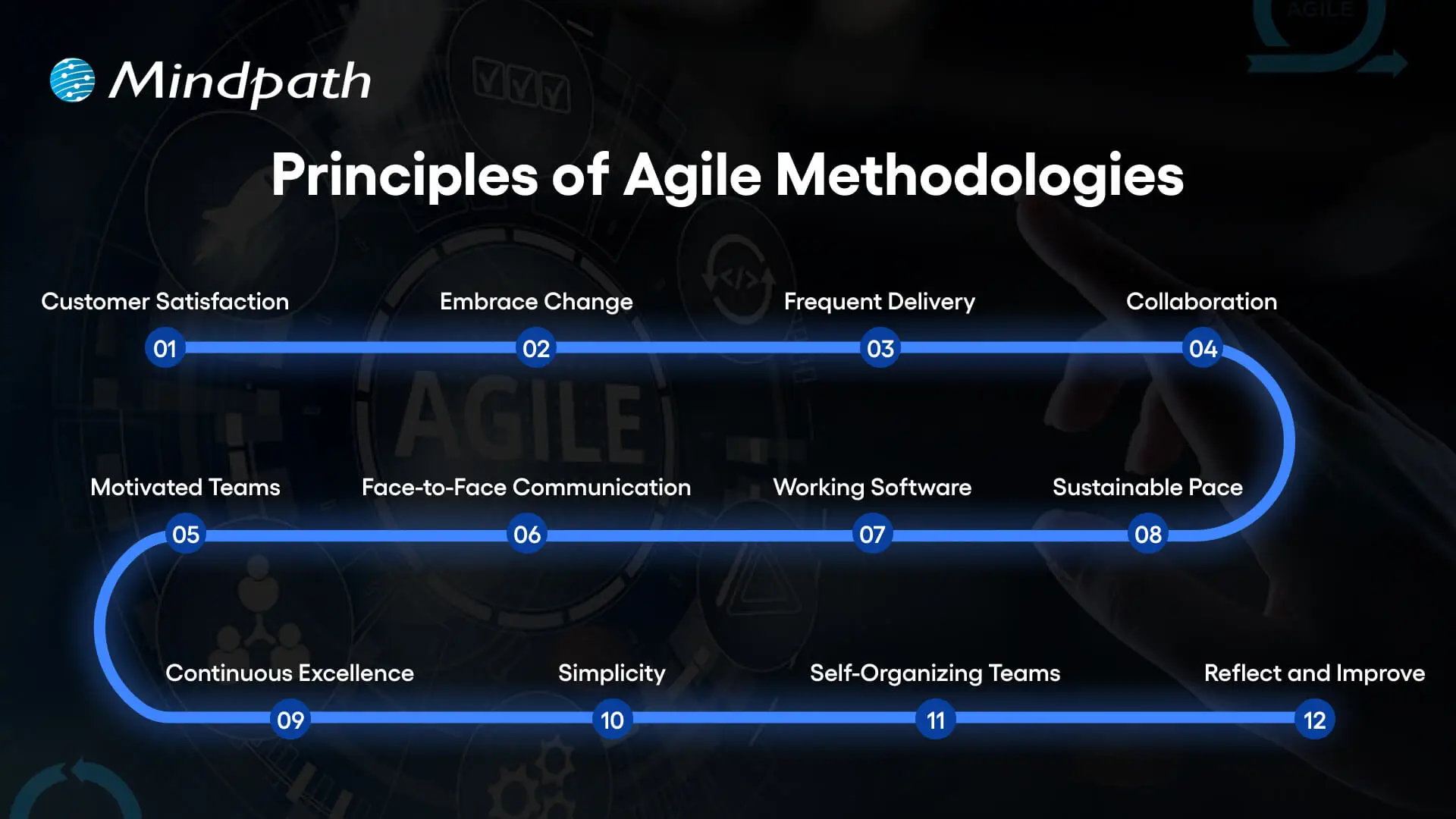
Principles of Agile Methodologies

1. Customer Satisfaction

Customers should be satisfied by receiving value sooner rather than later.

2. Embrace Change

Adopt the mindset that the most valuable features might change and keep an open mind toward new needs, even late in a project.

3. Frequent Delivery

It’s important to deliver and share updates frequently to make sure that you’re showing consistent value to customers.

4. Collaboration

Remove silos and work together as a team.

5. Motivated Teams

Organize work around motivated individuals, people who are ready to work hard and have a commitment to their work.

6. Face-to-Face Communication

Conversations will make for a quicker, clearer understanding.

7. Working Software

Demonstrate progress with working software.

8. Sustainable Pace

Progress can continue if a sustainable speed is possible so that the team goes home and rests and comes back tomorrow.

9. Continuous Excellence

Strive to be smarter & faster by raising the quality.

10. Simplicity

Opt for the simplest & most effective solutions rather than the complicated & ineffective ones.

11. Self-Organizing Teams

Allow teams to organize themselves and provide real value.

12. Reflect and Improve

Regularly stop and reflect to learn and improve for value.

Advantages of Agile Methodology

Agile methodology provides a flexible approach to project management that keeps customer needs first. These are the main advantages that make it a highly-sought after strategy for modern development.
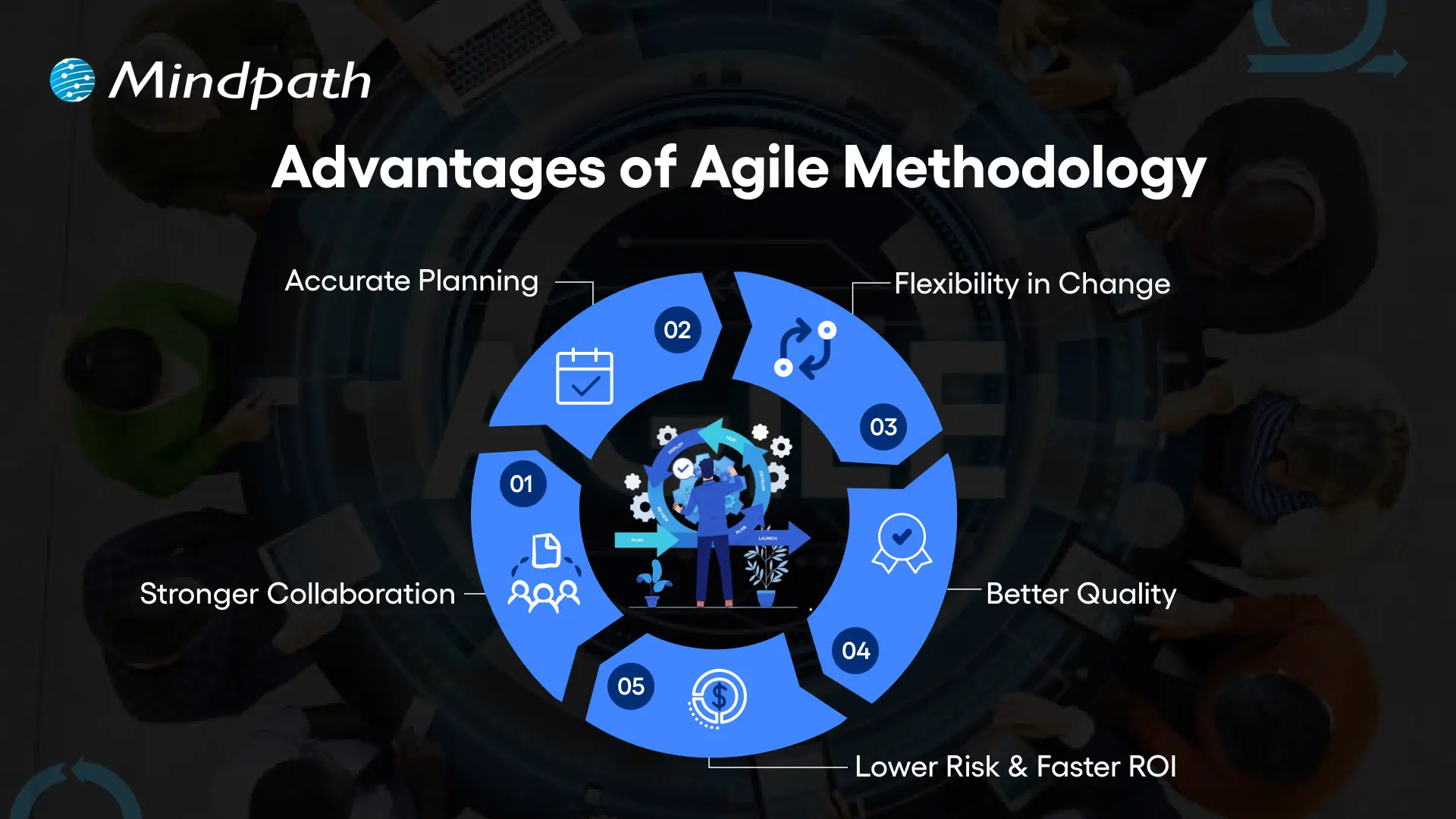
Advantages of Agile Methodology

1. Stronger Collaboration

The agile methodology creates constant client involvement, building transparency, and ensuring developers stay aligned with real needs.

2. Accurate Planning

With agile, project managers can estimate costs and timelines more precisely through short, iterative sprints.

3. Flexibility in Change

Agile methodology project management allows quick adjustments to market shifts or client requirements without slowing progress.

4. Better Quality

Agile integrates continuous testing, which helps identify issues early and deliver reliable, high-performing products.

5. Lower Risk, Faster ROI

By following agile methodology practices, teams reduce risks with frequent feedback and deliver faster returns through incremental value.

What is the Process of Agile Methodology?

The agile methodology process emphasizes looking at projects in smaller, more manageable steps to create quick, flexible progress. The agile project methodology has teams working because of different cycles, quickly adapting to changes and delivering value in every step.
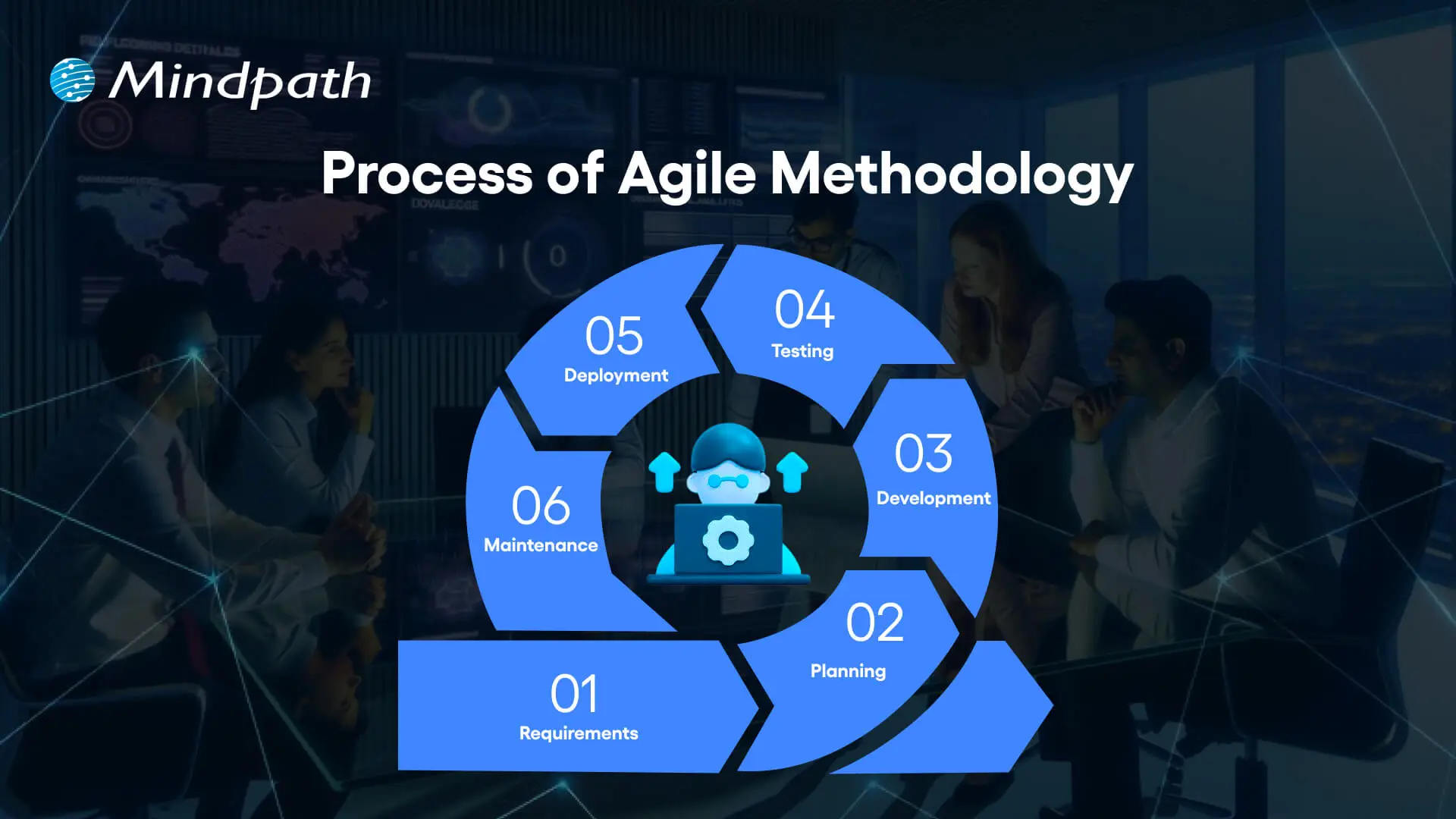
Process of Agile Methodology

1. Requirements

Teams root through customer requirements and prioritize them against business objectives and user needs. It’s a liberation activity that sets the course of the project and a solid base for the later phases.

2. Planning

The planning phase creates a roadmap for development and delivery. Teams agree on the schedule, sprint goals, and resources within the confines of the agile framework to maintain flexibility.

3. Development

Developers develop features in short iterations using Agile methodologies. The aim is to deliver working software quickly across agile techniques; collaboration and adaptability are important.

4. Testing

Once a feature is built, the team immediately tests the feature. Testing is performed to ensure the software works properly and meets the quality expected by the customer.

5. Deployment

The product or feature is launched for actual use. Early releases will enable users to provide feedback that can inform future improvements in the agile methodology process.

6. Maintenance

Teams constantly maintain and enhance the software to meet customer requirements. In agile methodology, the maintenance step of the product becomes an evolving process within the context of ongoing agile system development.

When Does Agile Deliver the Most Value?

The agile style works best for projects that need flexibility and constant advancement. Here are several examples of where it offers the most value.
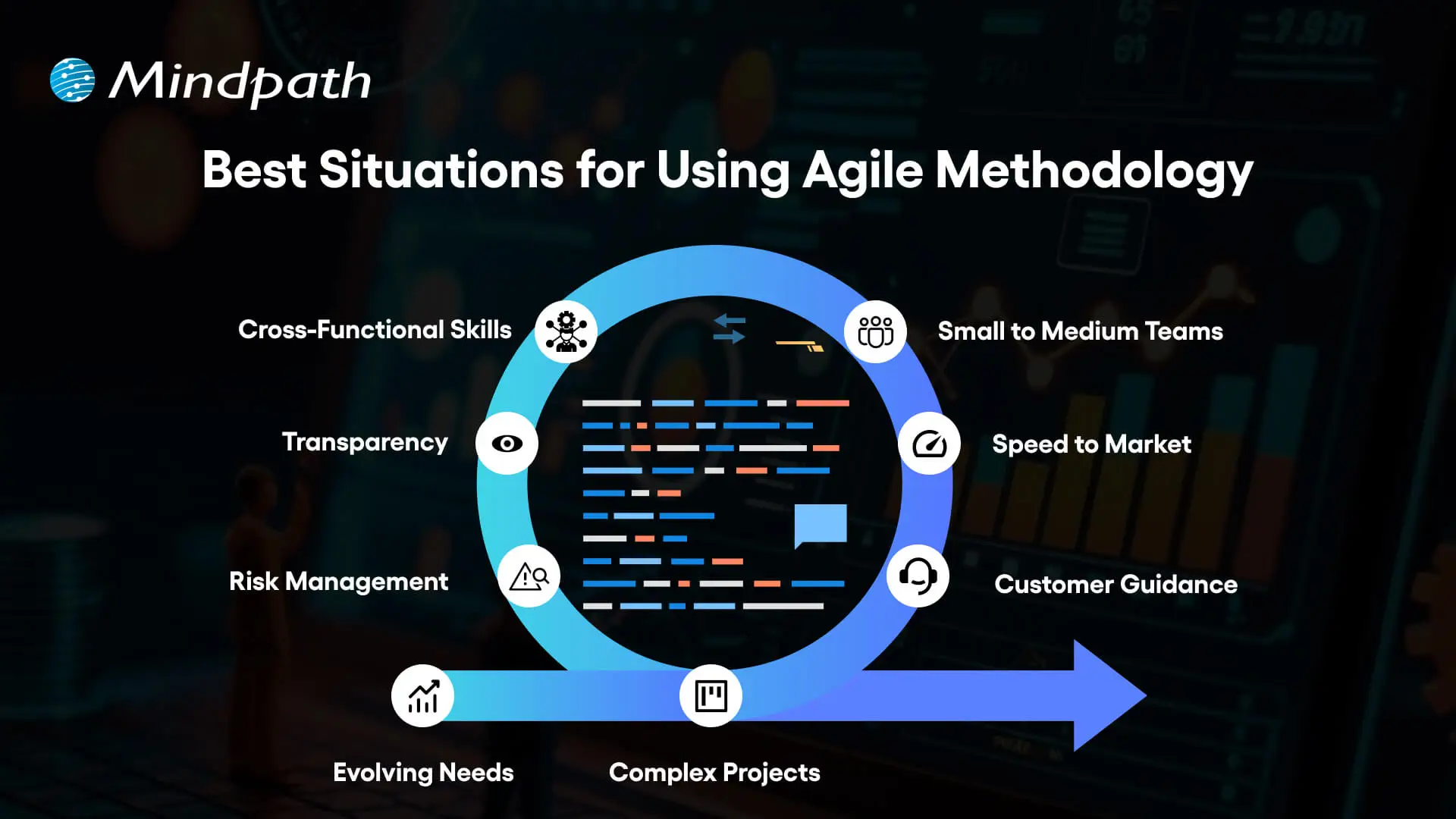
Best Situations for Using Agile Methodology

1. Evolving Needs

The agile methodology is the best option for projects with changing or ambiguous requirements because it allows teams to shift focus quickly while still maximizing delivery.

2. Complex Projects

Large and complex projects become easier to handle when broken into smaller, manageable parts. This approach reduces errors and improves coordination.

3. Customer Guidance

Regular customer feedback ensures the product meets actual needs. It creates a strong link between users and the development team.

4. Speed to Market

Short sprints make it possible to release working features quickly. This helps businesses gain a competitive edge faster.

5. Small to Medium Teams

Agile methodology works best for teams of a few to a few dozen people. It keeps communication simple and collaboration effective.

6. Cross-Functional Skills

Teams with developers, testers, and designers working together achieve higher quality. This collaboration reduces dependency on outside resources.

7. Transparency

Everyone involved can see the project’s progress clearly at all times. This openness builds trust and accountability.

8. Risk Management

Teams detect issues early and resolve them before they grow bigger. This approach reduces delays and prevents unexpected problems.

Want to Unlock Success with Agile Methodology?

The agile methodology has transformed how businesses manage projects, deliver value, and respond to change. Focusing on flexibility, collaboration, and continuous improvement, it gives teams the tools to adapt quickly while keeping customers at the center. Its principles and processes ensure projects move smoothly, delivering higher quality outcomes and long-term success in a competitive digital landscape.

At Mindpath, we use the agile methodology to design and deliver custom software that evolves with your business. Our approach blends speed, adaptability, and technical expertise to create solutions that meet real needs. With strong collaboration and a focus on innovation, we help businesses reduce risk, accelerate growth, and achieve sustainable results through high-performing, tailored products.

Related Post

Discover how ReactJS development enables scalable, high-performance applications with benefits like optimized routing, state management, etc.

Related Post

Generative AI Use Cases
Have you ever wondered how generative AI is reshaping various industries right before our eyes? How is it enhancing creativity in art and design? What role does it play in streamlining business operations? In this blog, we’ll explore fascinating use cases of generative AI across different sectors.   Generative AI is a sort of artificial intelligence that is intended to generate fresh and unique content, such as images, writing, or music, without being constrained by precise rules. Instead of just obeying predefined instructions, generative AI learns from enormous volumes of data and applies this knowledge to develop solutions that are both creative and humanlike. It can develop material based on patterns that it recognizes, making it more adaptable and inventive than standard AI.  The significance of generative AI is enormous since it is altering several sectors. From automating content production to accelerating software development, these technologies make tasks quicker and more creative.   So, let’s dive in to explore the generative AI use cases in diverse industries! 

Generative AI Use Cases Across Different Industries

1. Finance And Trading

Generative AI is revolutionizing the financial and manufacturing industries by increasing efficiency and optimizing operations. In finance, it creates algorithmic trading strategies by analyzing past market data and executing exact trades.

It also offers predictive market analysis, which assists specialists in forecasting trends, as well as high-frequency trading by developing rapid algorithms for swift order execution. It also enhances risk management and fraud detection by monitoring transactions for unusual trends, therefore safeguarding customers from identity theft. In manufacturing, generative AI improves efficiency by finding bottlenecks and lowering costs. It provides predictive maintenance by anticipating equipment breakdowns and reducing downtime.

AI also improves supply chain management by analyzing logistics and inventory data to ensure timely delivery and optimal resource utilization 

2. Healthcare

Generative AI is transforming the healthcare industry by improving diagnostics, medication development, and personalized treatment strategies. In medical imaging, AI aids in the creation of synthetic MRI, CT, and X-ray pictures, allowing for more precise diagnosis and treatment planning. It improves image quality and detail, allowing medical experts to more accurately spot abnormalities. 

Generative AI speeds up drug discovery by optimizing chemical structures and anticipating medication interactions, allowing researchers to better understand potential adverse effects. It also creates customized drug delivery systems to guarantee that drugs reach their intended targets with minimal adverse effects. 

Furthermore, generative AI promotes personalized medicine by analyzing genetic data to find genetic markers, allowing healthcare practitioners to customize treatment programs for patients. By anticipating therapy responses based on previous patient data, AI enables clinicians to optimize methods for better results and recommend patient-specific medicine compositions. 

3. Gaming and Virtual Reality

Generative AI is transforming the gaming and virtual reality landscape by making games more interesting and immersive. In gaming, AI contributes to the creation of engaging game material by analyzing how people play and what they enjoy, ensuring that each player’s experience is unique and suited to their tastes. AI also aids in the creation of enormous gaming worlds that change with each play session, providing players with fresh experiences.

Non-player characters (NPCs) in video games are becoming smarter, acting more like real people and responding to how players interact with them. This enhances the game experience and makes it seem more realistic. 

Furthermore, Artificial Intelligence may adapt game stories based on player decisions, resulting in a personalized storytelling experience that keeps players engaged. AI is used in virtual reality (VR) to build realistic and engaging worlds, making VR experiences more pleasurable, whether for gaming or teaching. AI even creates virtual landscapes and interactive features, resulting in spectacular and responsive VR content.

4. Cybersecurity

Generative AI is helping to strengthen cybersecurity by enhancing how we detect and avoid threats. It analyses large amounts of data, such as network traffic and user behavior, to swiftly identify potential security concerns. This implies that risks can be addressed before causing harm. 

Intrusion Detection Systems (IDS) driven by artificial intelligence (AI) monitor networks and systems for suspicious activity. They notify security professionals in real time if they discover something strange, therefore keeping systems safe.

Another key use of AI is behavioral analysis, which involves learning what normal behavior looks like. If it notices anything unexpected, such as abnormal patterns from a person or system, it might alert you to a potential problem.

Generative AI is also beneficial for detecting advanced dangers that are difficult to spot. It searches through previous data and network behavior to detect these clever attacks. AI can detect irregularities in network traffic, allowing organizations to respond to possible breaches before they get worse. AI can also assist identify insider threats, which are security dangers posed by persons within an organization. By analyzing how people interact and access information, it can detect odd behavior that may suggest a problem. 

5. Autonomous Vehicles

Generative AI is transforming autonomous vehicles by improving their safety and efficiency. AI uses real-time data from sensors and traffic to assist autonomous vehicles make speedy choices. It recognizes items such as pedestrians and other cars, assuring appropriate reactions. Adaptive cruise control systems adjust speed in response to traffic, whereas collision avoidance systems forecast and prevent accidents. 

AI also generates virtual surroundings for testing, allowing engineers to replicate various driving situations, including bad weather. This guarantees that vehicles perform reliably in real-world circumstances. Additionally, AI simulates interactions with pedestrians and bicycles, assisting vehicles in securely engaging with road users.  

6. Robotics

Generative AI is improving robotics by making them smarter and more adaptive. It lets robots learn from their environment and adapt to changes, allowing them to deal with unforeseen events. AI enables robots to interpret human motions and expressions, resulting in improved communication and collaboration. This means they can operate comfortably among others in common settings like factories or houses. 

In manufacturing, for example, generative AI optimizes how machines and people collaborate, increasing productivity by coordinating jobs and motions. This collaboration increases efficiency while also making it easier for robots to assist human workers.

7. Fashion Industry

Generative AI is transforming the fashion industry by enhancing the way designers and businesses produce, promote, and sell garments. AI helps designers produce original fashion ideas by analyzing trends and styles, making it easier for them to experiment with new looks. For marketing purposes, AI can generate blog entries and social media material that engage customers, keeping companies new and relevant. It also helps you write appealing advertisements for certain audiences. 

Additionally, generative AI assists companies in understanding what customers think of their products through sentiment analysis, predicting which things will be popular, and forecasting future trends. It can also power virtual fashion advisers who suggest clothing based on a person’s style and preferences, making shopping more personal.  

Generative AI Services at Mindpath

Mindpath uses the potential of generative AI to accelerate innovation and improve business operations. We create unique AI models that optimize workflows, enhance decision-making, and increase productivity in a variety of sectors.

Our artificial intelligence solutions automate content production for blogs, social media, and marketing materials, ensuring that your outputs are both engaging and relevant. We also use generative AI for intelligent data analysis, which allows organizations to foresee trends, comprehend attitudes among customers, and make intelligent choices.

Furthermore, our AI-powered virtual assistants improve client interactions by offering personalized advice and help, resulting in a better overall user experience. We also provide generative AI in design, which creates unique concepts for goods, marketing campaigns, and branding that stand out in a competitive market. 

Wrapping Notes

Generative AI is changing the way businesses function, increasing innovation and efficiency across several industries. Its potential ranges from increasing innovation in fashion to revolutionizing safety in autonomous vehicles. Businesses that adopt cutting-edge technology find new ways to improve operations, enhance consumer experiences, and stay ahead of market trends. Mindpath is devoted to using the potential of generative AI to provide organizations with bespoke solutions that drive growth, optimize operations, and generate creativity. The future has arrived, and with generative AI, the possibilities are endless. 

Wondering how generative AI can reshape your industry?

Mindpath specializes in AI-driven solutions that unlock new possibilities.

Explore top generative AI use cases transforming industries like finance, healthcare, fashion, and more, driving innovation, efficiency, and creativity across sectors.
AI Governance Platforms

Have you ever wondered who’s keeping an eye on the rapid advancements in AI? As artificial intelligence grows more powerful, so does the need for systems that can ensure its responsible and ethical use. This is where AI governance platforms enter. But how exactly do these platforms work, and why are they becoming essential for businesses and societies alike? Let’s explore how AI governance platforms are shaping the future of trustworthy AI. 

What is AI Governance?

AI Governance ensures that artificial intelligence (AI) is utilized safely, responsibly, and equitably. It contains rules, processes, and tools that bring together professionals from many fields like data science, engineering, law, and business. The objective is to assist these teams in collaborating to guarantee that AI systems are developed and maintained in ways that are beneficial to humans and do not cause damage. 

AI Governance also assists firms in ensuring that their AI systems adhere to crucial guidelines and fulfill commercial and ethical standards. This implies that the system is verified and led at every point, from developing the AI model to using it in real-world scenarios, to ensure that it is appropriate, fair, and helpful to all parties involved. 

Why are AI Governance Platforms Important?

AI Governance platforms are essential tools for helping businesses employ artificial intelligence (AI) in a safe, fair, and ethical manner. By establishing rules and checks, these platforms avoid errors and defend against possible AI dangers, ensuring that AI systems are utilized responsibly. They assist businesses in adhering to crucial legal standards, preventing potential complications that can arise if AI is utilized improperly. 

These platforms help foster confidence among clients and the public by making AI more transparent, demonstrating how it works, and addressing any concerns about fairness or prejudice. They bring together specialists from many fields such as data science, engineering, and law to collaborate on ensuring AI matches ethical, business, and legal objectives. 

Features of AI Governance Platforms

1. Risk Assessment

Risk assessments are an important aspect of AI governance platforms, ensuring that AI systems function fairly, safely, and responsibly. These assessments are aimed at identifying possible issues early on, such as biases in how the AI makes judgments, threats to users’ privacy, or any negative effects on society. For example, an AI tool can accidentally favor one group over another, or it may gather and use sensitive data without consumers completely comprehending how it is utilized. 

By doing these risk assessments, AI governance systems assist businesses in avoiding situations that could lead to harm or unfair results. They examine the AI’s procedures and data to determine whether any hidden biases or unexpected consequences could arise. This proactive approach not only helps prevent misuse of AI but also builds trust by making sure the AI systems align with ethical standards. 

2. Accountability

Accountability in AI governance platforms establishes explicit accountability for governing and supervising AI systems. These platforms assist in identifying the essential tasks and teams responsible for ensuring that AI is created and deployed responsibly. They facilitate cooperation among many stakeholders, including engineers, data scientists, compliance specialists, and legal teams, who work together to create, test, and enhance AI systems. 

By establishing accountability, AI governance platforms guarantee that everyone participating in the development process understands their responsibility in maintaining ethical AI practices. This helps to avoid possible misuse, ensuring that ethical standards are followed, and fosters openness. The platform also analyzes and monitors AI systems over their entire career to ensure that they continue to operate fairly and ethically.  

3. Compliance Management

Compliance management in AI governance platforms includes tools for monitoring and ensuring that AI systems adhere to legal and ethical norms. These platforms monitor current legislation, such as GDPR (General Data Protection Regulation) and CCPA (California Consumer Privacy Act), and automatically update when laws change. The platform assists organizations in avoiding legal risks and penalties by ensuring that AI systems are in compliance with these standards. 

In addition to regulatory compliance, these technologies guarantee that AI systems are utilized responsibly, with data management and decision-making procedures that are transparent and fair. The platform continually analyzes AI systems to detect possible infractions, assisting enterprises in remaining compliant with both existing and upcoming legislation.  

4. Lifecycle Management

Lifecycle Management in AI governance platforms entails monitoring the development of AI models at each stage and implementing the appropriate checks and controls. These platforms guarantee that ethical issues are incorporated at every stage, from basic design to deployment and maintenance. Platforms use these restrictions to enable teams to build AI models that are fair, transparent, and ethical at scale. 

Furthermore, these tools guarantee that AI models follow engineering best practices, making them trustworthy, safe, and efficient. The objective is to maintain high standards throughout the model’s lifespan, ensuring that it not only performs well but also operates responsibly over time. This ongoing oversight helps prevent issues like bias or unethical decision-making, allowing businesses to scale their AI systems while staying aligned with ethical guidelines and industry standards. 

5. Responsible AI Methods

Responsible AI Methods in governance tools aim to ensure that AI systems are transparent, ethical, and reliable. These solutions incorporate responsible AI principles directly into the development and deployment processes, ensuring that AI models perform properly and without prejudice. By enabling transparency, these platforms enable enterprises to explicitly demonstrate how AI choices are made, fostering confidence among users and stakeholders. 

Transparency also promotes accountability by allowing organizations to track and audit AI choices. This guarantees that the AI system follows ethical norms and meets regulatory criteria. Furthermore, with a comprehensive understanding of how AI works, decision-makers may make educated decisions, ensuring that AI systems are employed responsibly and in the best interests of society.

Also Read: AI in Hyperpersonalization: A New Era of Tailored Customer Solutions  

AI Development Services at Mindpath

Mindpath provides high-quality AI Development Services to assist organizations in developing clever, efficient, and dependable artificial intelligence systems. Our team collaborates with you to develop AI solutions that match your unique requirements, whether you want to automate operations, improve decision-making, or enhance customer experiences.  Our services range from creating and constructing AI models to testing and deploying them. We employ cutting-edge AI technology and best practices to ensure that your AI system operates efficiently and responsibly. This involves ensuring that it is fair, transparent, and adheres to ethical standards. 

Final Thought!

AI governance platforms play a crucial role in ensuring that AI systems are developed and used responsibly, ethically, and transparently. By providing essential tools like risk assessments, compliance management, and lifecycle oversight, these platforms help businesses navigate AI complexities while maintaining trust and legal compliance. At Mindpath, we offer AI development services that focus on building efficient and ethical AI solutions tailored to your needs. Let us help you create reliable AI systems that align with both your business goals and ethical standards. 

Looking for a trusted partner in AI development?

Partner with Mindpath to create ethical, transparent, and innovative AI solutions tailored to your business needs.

Discover how AI governance platforms ensure responsible, and transparent AI development and learn how Mindpath’s AI services can help.
reactjs developer skills

The advantages of ReactJS have made every business owner think about its utility in developing web projects. It is the most powerful and commonly used JavaScript library for creating intuitive interfaces. If you want React developers in your team, then you must know the ReactJS developer skills that you should look for in candidates. The declarative approach and component-based architecture of ReactJS have revolutionized the process of front-end development. Let us find out the skills that you need in ReactJS developers to create successful web projects.

Want to hire ReactJS developers for your next web project? Explore more on Mindpath’s React JS development services to get expertise in developing a web application aligned with your business goals.

Discovering the Skillset of Expert ReactJS Developers

The general assumption about the skillset of ReactJS developers is that they know how to work with React. However, fluency in React itself is not the only addition in the React skill set for any developer. React developers must have a broader skillset beyond the library to craft impactful web projects. The following skills can help business owners identify the best React developers for their next web project.

1. HTML and CSS

The foremost addition in a list of ReactJS skills is the combination of HTML and CSS, which play a crucial role in organizing the styling of the web experience. React developers must know the concepts of semantic HTML and how to use the right HTML tags for better SEO and accessibility. ReactJS developers should have an in-depth understanding of the fundamentals of CSS, such as selectors, CSS Grid, responsive design principles, and the box model.

Apart from CSS fundamentals, the essential React skills for developers also include knowledge of CSS preprocessors and frameworks. Developers can use the pre-processors to streamline styling workflows and improve ease of maintenance in larger projects.

2. JavaScript ES6

JavaScript ES6 or ECMAScript 2015 brought many interesting features to the domain of modern web development. When you hire React developer for the next web project, you should check their level of fluency in JavaScript ES6. The distinctive features of JavaScript ES6, such as arrow functions, template literals, and ES6 classes, make web development more efficient. For instance, arrow functions can ensure simpler syntax for functions and intuitive management of the context.

ReactJS developers must know how to leverage ES6 classes for a more structured use of JavaScript along the lines of component-based architecture. Developers can also use features like template literals to embed expressions in strings, thereby creating cleaner code.

3. Event Handling and DOM Manipulation

The virtual DOM in React is one of its distinctive features. All the listings for React JS developer jobs showcase the necessity of learning about DOM manipulation. At the same time, you must know that direct DOM manipulation is not required in React. On the other hand, developers must know the process through which the browser renders and interacts with the Document Object Model. DOM manipulation is required in scenarios where you want to build interactive and dynamic user interfaces.

Another crucial addition among skills required for ReactJS developer is event handling. It focuses on responding to different user events through event listeners and callback functions. Therefore, React developers must know the fundamentals of event delegation, capturing, and bubbling.

4. Git

You cannot think about hiring React developers who don’t know how to work with Git, the most popular version control system. Git helps in promoting team collaboration and source code revision management to ensure efficiency in the development lifecycle. ReactJS developers must know the fundamental concepts, such as commits, repositories, branches and merges. On top of it, developers must also know how to work with branching strategies, hosting platforms of Git and conflict management.

Git is a promising tool for frontend development with React as it provides the ideal foundation for collaborative development. Developers who know how to work with platforms like GitLab and GitHub can ensure better efficiency in team collaboration, project management and code reviews.

5. Redux

The list of technical skills you should search in the profiles of ReactJS developers also includes Redux. It is a specialized library used for state management in larger and more complex React applications. The cost of hiring ReactJS developers is justified when you notice how fluency in Redux can offer credible benefits to your web projects. The most promising features of Redux include centralized state management, application scalability and predictable state updates.

Redux works with a single storage for all states of an application, thereby ensuring consistency in management of state transition. Efficient state management also serves as a catalyst for easier scalability and managing increasing complexity without vulnerability to bugs. Centralized state management with Redux also ensures predictability in the behavior of your web applications, thereby facilitating easier maintenance and debugging.

6. JavaScript XML or JSX

Every ReactJS developer must know how to work with JavaScript XML or JSX. It is also one of the notable additions among react developer must-have skills as it serves a critical role in ensuring simpler development and management of UI components. JSX helps developers write HTML-like structures in JavaScript, offering a seamless blend of markup and JavaScript logic. JSX also provides an easier solution for creating and managing the user interface components of their web applications.

The other notable applications of JSX include data and logic integration. JSX can help in injecting data and logic directly into the UI, thereby ensuring dynamic content rendering, required for modern web applications. On top of it, the declarative nature of JSX ensures that the code is easily readable and accessible for debugging.

7. React Hooks

Professional ReactJS developers must also have strong command on React Hooks, a revolutionary feature for state management. Hooks have introduced new perspectives on managing React features in functional components. It is one of the essential ReactJS developer job skills and aspiring developers must know about the important hooks they must learn to create web applications.

The notable React Hooks that a developer must know include ‘useState’, ‘useEffect’, ‘useRef’ and ‘useContext’. Each hook serves a distinct function such as providing direct access to DOM elements or managing component-specific state. On top of it, ReactJS developers must know how to create reusable logic through custom hooks.

8. Testing, Debugging and Performance Optimization

The most important skill that you can find in expert React developers is testing and debugging skills. You can find answers to “why hire React developers?” in their skillsets that focus on comprehensive testing to create robust apps. The notable testing methods include unit testing, that involves testing the individual components independently or integration testing. React developers must also know how to work with debugging tools and browser developer tools to inspect the code.

Apart from testing and debugging, React developers must also know the best practices for performance optimization. Skilled ReactJS developers can use different techniques such as virtualization, code splitting and bundle size optimization to craft responsive applications.

Mandatory Soft Skills

Most of the discussions about skills of ReactJS developers focus only on the technical skills. Choosing a React JS development service for capitalizing on the expertise of skilled developers also requires attention to soft skills. You need developers who have the capabilities for critical thinking and problem-solving with efficient solutions. React developers must have skills for clear and concise communication that empowers them to work in collaboration with other teams.

React developers should also have attention to detail for crafting intuitive user experiences and writing code without bugs. Most important of all, ReactJS developers should strive to learn continuously and improve their skills to stay updated with emerging technologies and trends.

Final Thoughts

The thought of hiring a developer from a reputed ReactJS development company might seem like a challenge. Interestingly, you can find the best ReactJS developers at Mindpath for your next web project; they help you build modern web solutions. The notable technical skills of React developers include knowledge of HTML and CSS, JSX, JavaScript ES6, React Hooks and direct DOM manipulation. On top of it, ReactJS developers must also have soft skills such as communication, adaptability, critical thinking and problem-solving. Learn how to pick the best ReactJS developers for your web projects now.

Find out what makes a great ReactJS developer! Explore core skills like component-based architecture, hooks, state management, and more.