Home

How Long Does It Take to Build and Deploy a Custom AI Agent? 

How Long Does It Take to Build and Deploy a Custom AI Agent? 

Join our Newsletter!

AI Agent development time

Building a custom AI solution starts with understanding the expected AI agent development time for your business goals. Every project follows a different schedule because business requirements, system integrations, data quality, testing, and deployment needs directly influence the overall development process. Knowing these factors helps businesses plan realistic implementation timelines and make informed investment decisions.

Key Takeaways

  • 01
    AI agent development time varies based on complexity, integrations, testing, and deployment requirements. 
  • 02
    Clear project planning helps reduce delays and improves overall development efficiency significantly. 
  • 03
    Custom AI agents require multiple development stages before successful production deployment begins. 
  • 04
    Project costs increase with advanced features, enterprise integrations, and autonomous AI capabilities. 
  • 05
    Choosing an experienced development partner accelerates delivery while maintaining quality and security. 

Many businesses also ask how long to build an AI agent before planning budgets and implementation strategies. The answer depends on project scope, customization requirements, existing infrastructure, and deployment readiness rather than a fixed timeline. In this blog, you will learn the typical AI agent development timeline, key factors affecting project duration, and practical ways to accelerate deployment successfully. So, let’s keep reading further!

Want to accelerate your AI agent development without compromising quality? We offer AI Agent Development Services to build reliable, business-ready AI solutions.

What Determines AI Agent Development Time?

The time to deploy AI agent solutions depends on more than writing code or selecting AI models. Every project follows a unique path based on business objectives, technical requirements, and implementation readiness. Understanding these foundations helps businesses set realistic expectations before starting AI agent development.

1. AI Agent Complexity

The type of AI agent has the biggest impact on how long to build an AI agent. Simple agents finish faster, while autonomous and multi-agent systems require additional development, coordination, and testing.

2. System Integrations

AI agents deliver better results when they connect with business tools and applications. Integrating multiple APIs, legacy systems, or custom databases increases development time and technical effort.

3. Security and Approval Controls

Secure AI agents need safeguards before handling business tasks or sensitive information. Teams must build validation checks and approval workflows to ensure reliable and controlled operations.

4. Testing and Performance Validation

Development continues after coding because every AI agent requires thorough testing. Teams evaluate reasoning quality, accuracy, response speed, and reliability before deployment.

5. Development Approach

The chosen development method directly affects project timelines. Pre-built frameworks speed up delivery, while fully custom development takes longer because every feature requires dedicated implementation.

How Long Does It Take to Build an AI Agent?

The AI agent build time depends on project complexity, business goals, and technical requirements. While simple AI agents may take only a few weeks, advanced enterprise solutions require additional development, testing, and deployment. The table below provides a realistic timeline for different types of custom AI agents.

AI Agent Type Typical Use Case Estimated Development Time Estimated Deployment Time Estimated Cost (USD)
Proof of Concept (PoC) AI Agent Validate an idea with limited functionality 2–4 weeks 2–5 days $10,000–$25,000
Simple Task Automation Agent FAQ support, document search, email assistance 4–6 weeks 3–7 days $25,000–$50,000
Business Workflow AI Agent Customer support, HR, sales, internal operations 6–10 weeks 1–2 weeks $50,000–$100,000
Decision Support AI Agent Financial analysis, legal review, business recommendations 8–12 weeks 2–3 weeks $80,000–$150,000
Custom AI Agent with Multiple Integrations CRM, ERP, databases, APIs, enterprise tools 10–16 weeks 2–4 weeks $120,000–$250,000
Autonomous or Multi-Agent Enterprise System End-to-end workflow automation across multiple departments 4–9 months 4–8 weeks $250,000–$1M+

AI Agent Development Timeline: Key Stages Explained

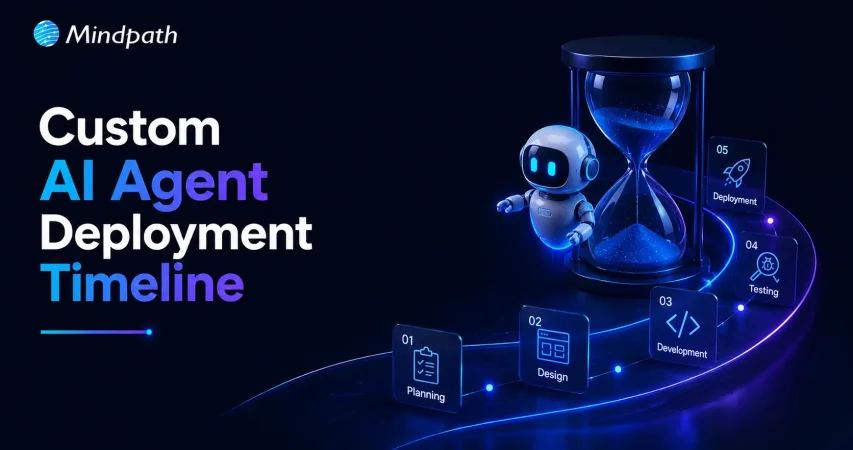
Understanding each development stage helps businesses estimate AI agent development time more accurately. Every phase serves a specific purpose, from planning and development to testing and deployment, ensuring the final AI agent performs reliably and meets business requirements.

1. Define Goals and Project Scope

Every successful AI agent starts with clear business objectives and measurable outcomes. Teams identify the problem, expected results, and project requirements before beginning development.

2. Design the AI Agent Architecture

Developers create the technical foundation by selecting suitable AI models, frameworks, and data structures. This stage ensures the AI agent can handle business tasks efficiently and scale when needed.

3. Build and integrate the AI Agent

Developers create prompts, connect business applications, and integrate external tools and knowledge sources. Secure integrations help the AI agent perform real business tasks with accurate information.

4. Test and Improve Performance

Teams evaluate the AI agent through multiple testing scenarios before production deployment. They refine prompts, fix workflow issues, and improve accuracy to deliver reliable performance.

5. Deploy the AI Agent

After successful testing, the AI agent moves into the production environment with controlled access and security measures. The time to deploy AI agent solutions depends on deployment readiness, governance checks, and rollout strategy.

6. Monitor and Optimize Continuously

Development continues after deployment through regular monitoring and performance improvements. Teams analyze user interactions, update capabilities, and optimize the AI agent for better long-term results.

How to Build an AI Agent Faster Without Compromising Quality?

  • Define clear business goals before starting development.
  • Prioritize high-impact features for the first AI agent release.
  • Prepare clean and organized business data early.
  • Choose the right AI development partner with proven expertise.
  • Use existing systems instead of building everything from scratch.
  • Test continuously throughout development to avoid costly delays.
  • Start with an MVP before expanding advanced capabilities.
  • Review project scope regularly to prevent timeline extensions.

Ready to Build Your Custom AI Agent?

The right AI agent delivers the best results when businesses plan realistic timelines, define clear requirements, and choose the right development approach. Understanding every stage, from planning to deployment, helps reduce delays, control costs, and achieve long-term business value with confidence.

At Mindpath, we deliver custom AI Agent Development Services tailored to your business goals, workflows, and scalability needs. Our experts build secure, high-performing AI agents with faster delivery and reliable implementation. Contact us to discuss your project and find the right AI solution for your business.
Frequently Asked Questions

Start by defining your business goals, required features, integrations, and expected outcomes. A development partner can evaluate these requirements and provide a realistic timeline based on project complexity, technical dependencies, testing needs, and deployment readiness instead of offering a fixed estimate.
Project delays often result from changing requirements, complex integrations, poor-quality data, extended testing cycles, or additional security and compliance reviews. Clear planning, organized data, and regular stakeholder feedback help minimize unexpected delays throughout the development lifecycle.
A proof of concept helps validate your idea before making a larger investment. It allows businesses to test functionality, identify technical challenges, gather user feedback, and confirm business value before expanding into a production-ready AI agent solution.
Connecting an AI agent with CRMs, ERPs, databases, and third-party applications requires additional development and testing. The number and complexity of integrations directly influence implementation timelines because each connection must remain secure, accurate, and reliable during deployment.
Businesses can reduce development time by defining clear objectives, preparing quality data, prioritizing essential features, and working with experienced AI specialists. Continuous testing and phased deployment also help deliver reliable AI agents while maintaining security and long-term performance.

Support Is One Click Away

Featured Posts

Related Post

Cloud computing attacks

Cloud computing has certainly revolutionized how business entities leverage technology to carry out their operations. In recent times, many businesses across diverse industries have already migrated to the cloud. These cloud computing trends have gained momentum so that businesses can take advantage of cloud computing technology. However, such a trend has also given rise to a broad range of attacks on cloud.

In the prevailing times, business entities need to know that Cloud computing attacks encompass different types of attacks by malicious actors. These malicious actors could be internal or external. However, they can cause significant damage to businesses in the highly volatile environment. Now is the perfect time to expand your knowledge relating to cloud computing attacks.

Want to strengthen your cloud security without increasing operational complexity? Mindpath’s managed cloud services provide the expertise and tools needed to secure your cloud operations

What are Cloud Computing Attacks?

A cloud computing attack refers to a malicious activity that can exploit vulnerabilities in the cloud infrastructure, applications, or services. The purpose of such attacks is to steal data, gain unauthorized access, or disrupt the usual services.  The rising instances of cloud attacks have become a major concern for businesses operating in diverse industries or sectors. 

Cloud attacks may be of various types. Businesses need to be able to answer: What are the security risks of cloud computing? They need to have an answer to this question before moving to the cloud. The knowledge in this area is vital to being prepared to face such risks in an effective and efficient manner. 

Want to strengthen your defences against cloud computing attacks? Discover cloud security tools that help identify threats and secure your workloads effectively.

Top Cloud Computing Attacks that Businesses Need to Be Aware of

The attacks on cloud that target cloud computing resources as well as infrastructure may vary considerably. It is essential for modern businesses to have a holistic insight into these threats as they have the potential to compromise the business operations and sustenance. Some of the key cloud security threats that you need to be familiar with include:

1. Denial-of-Service Attacks

The Denial-of-Service Attack is a cloud attack that intends to make a network or computer resource unavailable to the actual users. It basically floods a cloud server or service with fraudulent traffic. You need to bear in mind that a DoS attack involves a single source. On the other hand, a distributed denial of service attack may involve several compromised sources. 

As cloud environments are vulnerable, such types of attacks may lead to costly repercussions. Such attacks may lead to the disruption of service or loss of revenue for a business. Moreover, it may also cause serious damage to the reputation of a business. Understanding cloud computing vulnerabilities is essential to prevent such risks and protect cloud infrastructure.

2. Insider Threats

Insider threats refer to the cloud security threats that arise because of employees, former employees, partners, etc. They continue to affect the security in the cloud computing environment.  This threat may occur when an insider either intentionally or unintentionally does harm to the cloud security of an organization. 

The key issue that an entity needs to address is striking a balance between the privacy of employees and the security measures that have been adopted. This cloud cyber attack may be quite difficult to detect and prevent since it typically involves individuals who have the authority to access cloud assets.

3. Man-in-the-Middle Attacks

The Man in the Middle Attack takes place on the cloud when a malicious actor is able to intercept the interaction between the cloud user and the cloud service. This attack may also arise when an attacker intercepts the communication between two cloud services. The attacker basically positions themselves in the middle position in order to eavesdrop or steal sensitive information. 

These types of issues relating to cybersecurity in cloud computing need to be addressed as a priority. This is because such attacks can take advantage of cloud services that are misconfigured. They can also exploit the vulnerabilities that exist in SSL/TLS protocols. 

4. Account Hacking

Account hacking in the cloud environment refers to the unauthorized access or control of a cloud computing account by a malicious actor, such as a hacker. This can certainly allow the hacker to make use of related resources for their malicious purposes. Account hacking can also enable hackers to manipulate or steal the data that is stored on the cloud. 

Such cloud computing hacks may give rise to detrimental consequences for business entities. For instance, hackers or attackers may use password cracking techniques for the purpose of guessing or stealing the login credentials of others. Organizations need to prevent cyber attacks as they may lead to financial loss, and they can also tarnish the reputation of an organization. 

Struggling to manage infrastructure while scaling applications efficiently? Check out serverless architecture in cloud computing to learn how it lets you build and deploy apps without worrying about servers.

5. Cloud Malware Injection Attacks

Cloud Malware Injection refers to a type of cyber attack that involves the injection of malicious software, such as a virus or ransomware, into cloud resources or cloud infrastructure. Such types of attacks are gradually becoming common as more businesses are moving to the cloud. Such attacks can enable cybercriminals to compromise the infected or affected resources.  

Attackers may even steal or destroy data for their own malicious purposes. There exist numerous ways in which attackers may inject malware into the cloud infrastructure, such as by exploiting vulnerabilities in the cloud setting or by gaining unauthorized access to cloud accounts. 

6. Security Misconfiguration

In cloud computing, security misconfiguration refers to the lack of proper configuration of cloud computing resources or infrastructure. Due to the failure in terms of configuration, there may be compromised protection against cyber threats and attacks. Businesses need to bear in mind that incorrect security settings have the potential to leave the system and data vulnerable. 

Security misconfigurations are considered to be a serious issue that can lead to data breach incidents in the cloud. The issue may be the result of human error or lack of expertise. Similarly, the failure to alter insecure default settings may lead to security misconfiguration in the cloud. 

7. Side Channel Attacks

Side channel attacks in the cloud environment are able to take advantage of weaknesses or vulnerabilities in shared hardware resources. Such attacks are capable of extracting confidential data through the observation of indirect information such as power consumption and electromagnetic emissions. 

This attack involves the exploitation of information that has been leaked through the physical implementation of a system. In the cloud setting, malicious actors may carry out such types of attacks by positioning a malicious virtual machine on a legal physical host that is used by a business. This technique can enable the attacker to get access to all confidential information about the victim’s machine.  

8. Cookie Poisoning

Cookie poisoning is a type of cyber attack where an attacker is responsible for tampering with or altering the web cookies of the user. In cloud applications, this type of attack involves the unauthorized modification or the injection of malicious content into a cookie. 

Cookies are typically stored to personalise the experience of users or track their activities. Such attacks can poison the cookies of users without their knowledge to access the applications. It may lead to unauthorized access to accounts. Businesses need to deploy robust cloud security solutions so that such attacks can be prevented in an effective manner. 

Ready to take your applications to the next level in the cloud? Explore cloud-native development to learn how modern architectures improve performance and security.

Need for a Solid Cybersecurity Posture

Modern business entities need to maintain a robust cybersecurity posture. Such a posture can enable them to prevent cyberattacks. Business entities need to adopt solid cybersecurity tools and technologies so that they can safeguard sensitive information and maintain regular business operations. 

In prevailing times when cloud computing attacks are on the rise, entities across diverse industries need to prioritize their cybersecurity resilience. Proper cybersecurity preparedness is a must to ensure that organizations can effectively function in an uncertain environment. While operating in the cloud, business entities need to prioritise the adoption of robust cloud security solutions such as identity and access management, encryption, data loss prevention, and many more. 

Curious how AI can improve cloud security? Check out AI in cybersecurity to see how it detects threats faster and protects your systems.

Final Words

In the existing business landscape, more businesses are moving to the cloud. This has automatically created the need for businesses to broaden their insight relating to cloud computing attacks and threats. Several cloud attacks have been identified that are affecting businesses, such as Denial-of-Service Attacks, Insider Threats, Account hacking, and many more. 

Mindpath’s managed cloud services can ensure that your business is well protected against all types of cloud attacks. The professionals and experts will ensure that your business can derive optimum value from the cloud computing technology and stay protected from cybercriminals and other malicious actors. 

web development services

 It is undeniable that having a robust online presence is essential for any business these days. That presence can be created with the right web development services and it will yield real results. However, there are still many companies that are facing difficulties in selecting a suitable development type for their objectives. Having a good grasp of the options makes a huge difference.

Well, where do you start then? There are many specialties in the field of web development. All perform a different business function. Some emphasize on user experience and design. Others take care of complicated system architecture. Understanding the distinction will help you to invest smarter and grow faster. Let’s dive into this blog to understand 10 major types of web development and their implications for your business. So, keep reading further!

Ready to build a powerful online presence? Explore Mindpath’s web development services and turn your ideas into high-performing digital solutions.

What are Web Development Services? A Quick Glance

Web development services encompasses all aspects of creating a functional website or web app. The developers are responsible for the coding, database design, and bringing it all together. Good development is the process of converting a visual design into actual, working product. It drives all of your clicks, load and interaction online. These services are more than just website development.

These comprise performance tuning, security, updates, and continuous support services. A great web development partner will be able to cover the entire process, from planning to launch. That means your website is not just an online page; it’s a business asset.

What are the Types of Web Development Services?

Web development is a collection of many different specialized services. Each has its own function in making a successful product. Picking the right one brings great benefits: you can save your time, lower the expenses, and get better results at the same time.

However, it’s not that obvious which one to choose without a guide. So, let us show the major types of the website development services your business should be aware of.

1. Front-end Development

Frontend development is the making of the visual and interactive part of a website or a web app. It includes everything a user sees and interacts with, such as page designs, buttons, and even animations. Frontend developers rely on HTML, CSS, and JavaScript, plus frameworks like React and Vue to design interfaces that are not only fast and responsive but also user-friendly.

Key Features of Frontend Development

Let’s dive into the features of front end development that make a website visually compelling and user-friendly.

  • A good frontend loads quickly, and does not let folks bounce off the page.
  • It provides a pretty appearance that fosters trust on the first impression.
  • Users can move easily from one section to another, thanks to the smooth navigation.
  • All elements are consistent throughout Chrome, Safari, Firefox and other browsers.
  • Performance remains optimized with no lag, no freeze, no slowdowns.
  • User data is secured and the interface is protected against threats.

2. Back-end Development

All backend development work powers the processes that are invisible to users of a website. Users don’t see it; however, they can get to the business success that it facilitates practically each day. It deals with the management of servers, databases, and application logic. Python, PHP, and Node.js are the coding languages that are used to perform these activities. A website without a strong backend cannot really operate well.

Key Features of Back-end Development

Let’s look at the essential elements of back-end development that ensure reliable, secure, and efficient web development services.

  • Data is stored, managed, and accessed from structured databases in backend systems.
  • Core business rules are applied efficiently, by server-side logic.
  • APIs join frontend, backend and third-party tools together.
  • Data of user is always safe with strong authentication and encryption strength.
  • Architecture that can scale, so it won’t slow down with high traffic.
  • Payment gateways and other external integrations smoothly connect your platform.

3. Full-Stack Development

Full-stack development refers to working on both the frontend and backend sides of a website or application. They are capable of managing everything, both the user interface and the data processing backend. They represent the generalists among web development services. A single proficient developer or a developer team is often able to build, operate, and deliver a whole product without the help of others.

Key Features of Full-Stack Development

Let’s take a look at the features that make full-stack development a good business option.

  • Full stack developers take care of the entire development process all by themselves.
  • They have experience in both front end and back end technologies.
  • These popular stacks are used to create dynamic, fast web applications such as MERN.
  • The less team changeovers, the quicker the delivery, the smoother the flow.
  • Better performance and cleaner APIs through deep architectures knowledge.
  • Both sides of the app scale and adapt with ease.

4. CMS Development

CMS development involves creating websites based on platforms that allow you to handle content without the need to write any code at all. WordPress, Shopify, and Drupal are well-known instances. It’s among the most sensible web development services for companies who desire to have complete control over their content. Refresh your pages, include blogs, and modify the content whenever you want.

Key Features of CMS Development

Here are the main points that make CMS development efficient and business-friendly.

  • Intuitive editors make creating and formatting content quick and simple.
  • Everything is stored in one easy to access place.
  • Role Based permissions are used to maintain teamwork and smooth content flow.
  • Schedule and publish content on different websites and social platforms without hassle.
  • Inbuilt Analytics tools enable you to enhance content according to actual data.
  • CMS platforms have a seamless interface with CRM and marketing applications.

5. eCommerce Development

E-commerce development refers to the creation of online stores that are capable of managing product display as well as ensuring payment security. Great ecommerce development services are centered on not only quick loading times and hassle-free checkout procedures, but also on robust security measures. The smallest elements are aligned with the main objective converting visitors into buyers.

Key Features of eCommerce Development

Let’s take a look at the essential components that make any ecommerce development project successful.

  • Always, sensitive user data and payment information are guarded by robust security.
  • The payment gateway integration is seamless, ensuring smooth and reliable transactions.
  • Smart inventory tools are useful in keeping the product management organized and accurate.
  • Order management logic ensures efficient order fulfillment from click to delivery.
  • Scalable architecture helps control traffic surges without impacting performance.
  • In-built analytics makes informed business decisions every day.

6. Mobile App Development

Mobile app development means creating software for smartphones and tablets. It includes designing, programming, and testing for Android and iOS environments. Even though it is a bit different from the usual web development, nowadays mobile apps are mainly connected to web-based backends. A good mobile app delivers your business at the fingertips of the customer.

Key Features of Mobile App Development

These are some of the characteristics of a strong mobile application that will be regarded as the defining features of a well-built mobile app.

  • Smooth performance and speedy load time stop users from dropping off.
  • Offline support allows the app to function without an Internet connection.
  • Timely and personalized push notifications to re-engage users.
  • User trust comes easily with strong encryption and biometric authentication.
  • Every day, AI personalization provides more intelligent and relevant app experiences.
  • Real-time analytics monitor behavior and provide ongoing app enhancements.

7. Progressive App Web Development (PWA)

A Progressive Web App works like a native app but runs directly in a browser. It loads fast, works offline, and feels smooth on any device. PWA development is a smart choice within web development services because one codebase works across all platforms. No app store needed, just a great experience every time.

Key Features of PWA Development

Here are the core features that make PWA development a powerful modern choice.

  • Service workers enable smooth performance even on slow or no network.
  • PWAs deliver native app-like navigation and full-screen experiences seamlessly.
  • Users install PWAs directly from their browser onto any device.
  • Updates happen automatically without any app store downloads needed.
  • Push notifications keep users engaged with real-time personalized messages.
  • HTTPS hosting ensures every PWA stays secure and data stays protected.

8. Web Accessibility Development

Web accessibility development makes sure every user can navigate and use your website, including people with visual, auditory, or cognitive disabilities. It follows standards like WCAG to remove digital barriers. Within web development services, accessibility is not optional. It is a responsibility that also improves usability and expands your audience reach.

Key Features of Web Accessibility Development

Here are the key features that make a website truly accessible for every user.

  • Alt text helps screen readers describe images to visually impaired users.
  • Captions and transcripts make audio and video content fully inclusive.
  • High color contrast ratios improve readability for all users significantly.
  • Every function works smoothly using a keyboard alone.
  • Visible focus indicators show users exactly where they are navigating.
  • Skip navigation links let users jump straight to main content.

9. Web Security Development

Web security development builds protection directly into your website from day one. It covers secure coding, data encryption, and regular vulnerability checks. Cyber threats like SQL injection and data breaches are real risks every business faces. A secure website protects your users, your data, and your business reputation effectively.

Key Features of Web Security Development

Here are the core features that keep a website secure and trustworthy.

  • Multi-factor authentication ensures only authorized users access sensitive areas.
  • SSL/TLS encryption protects data during transit and storage always.
  • Secure coding practices block injection attacks and cross-site scripting effectively.
  • Content security policies prevent malicious scripts from running on your site.
  • Proper session management stops hackers from hijacking active user sessions.
  • Web application firewalls filter and monitor all incoming traffic constantly.

10. API Development and Integration

API development and integration connects your software applications so they talk to each other smoothly. It is a core part of modern web development services. Think of it as a digital bridge between your tools, systems, and platforms. Good API development saves time, reduces manual work, and keeps your entire tech ecosystem running together.

Key features of API Development and Integration

Here are the key features that make API development truly effective.

  • Multi-layer authentication keeps every API interaction fully secure.
  • Cloud-native infrastructure scales smoothly under high traffic.
  • Clear documentation makes third-party integration fast and simple.
  • Rate limiting protects servers from overload and attacks.
  • Versioning ensures updates never break existing integrations.
  • Connectors link payment gateways, CRMs, and platforms effortlessly.

Ready to Build a Website That Works for Your Business?

Web development is not one-size-fits-all. Every business has different goals, and the right web development services help you meet them. Whether you need a fast frontend, a secure backend, or a full e-commerce store, picking the right type makes all the difference.

At Mindpath, we are a web development agency that actually listens. We understand your goals and build solutions around them. Contact us; we offer solid, results-driven development that helps your business grow online and stand out from the crowd.

Frequently Asked Questions

1. Which web development service does a small business actually need?

Start with frontend and CMS development. They cover design, content, and basic functionality. As the business scales, backend and e-commerce development naturally follow.

2. How long does a web development project take?

A simple website takes two to four weeks. A full-scale web application with custom integrations can take three to six months depending on complexity.

3. What is the difference between web design and web development services?

Web design focuses on looks and feel. Web development focuses on functionality. Both work together. Great design without solid development delivers nothing, and vice versa.

4. Do businesses need both frontend and backend development?

Yes. Frontend handles what users see. Backend handles data, logic, and security. Skipping either creates gaps in performance and user experience.

5. How does web development impact business growth?

A well-built website attracts visitors, converts them into customers, and builds trust. Fast speed, mobile responsiveness, and security all contribute directly to revenue growth.

mobile app development company

Digital transformation for businesses is changing how they engage with customers, and mobile apps have become a major aspect of that process. Choosing the right mobile app development company can transform a simple idea to a robust, user-friendly app. There are many companies to choose from, and it is important to look beyond claims and find a partner that can truly deliver on what is important to you and your vision.

A company’s methodologies, creativity, and grasp of objectives, vision, and goals can have a profound impact on your app’s ultimate success. Observing how a company adapts, engages with clients, and innovates can provide you with an even clearer sense of their capabilities. Taking time to evaluate these aspects will lead to smarter decision-making. This blog will serve as a step-by-step guide to distinguishing and selecting a mobile app development agency that is right for you.

Curious to know how mobile app development enhances your digital presence among the users? Explore Mindpath mobile app development services to see how our experts can bring your imagination to reality.

Understanding Mobile App Development

Mobile app development is the process of creating software applications for mobile devices such as smartphones and tablets. It is categorised into native development (platform-specific languages like Swift for iOS or Kotlin for Android) and cross-platform development (frameworks that deploy to both iOS and Android from a single codebase). Today, users spend more time on mobile apps compared to desktop websites, averaging nearly four hours each day. Apps are used for many common tasks, from checking the weather to sending payments, making them an inseparable part of modern life.

One of the main reasons for the huge revenues is the widespread use of mobile apps, with annual global expenditures totaling billions of dollars. Moreover, the companies can use the latest mobile app development tools to create applications. This will not only delight their customers but also make their businesses run more smoothly while saving their precious time. Additionally, numerous enterprises consider it crucial for them to avail themselves of the services of trustworthy mobile app development firms. If they want to keep the edge in the market and develop the right solutions for their users’ needs.

Want to build a mobile app tailored exactly to your business goals and user needs? Check out custom mobile app development services to learn how personalized solutions drive better results.

Steps to Choose the Right Mobile App Development Company

The decision of finding the best mobile app development company is the key to converting your idea into a successful application. If you pick a company that comprehends your objectives, has good communication and gives you reliable solutions, then you are ensured a perfect development process and a stable app as the final outcome.

1. Check Industry Experience

Ensure the mobile app development company is familiar with your business area and its problems. Examine their previous works to establish whether they have accomplished solutions close to your application’s idea. Usually, the experience of the professionals in your field leads them to present you with innovative solutions and new ideas. Eventually, a bespoke mobile app development organization with a decorated history of success can uplift the utility and the relativity of your app.

2. Assess Technical Skills

First, you should analyze the level of the team’s technical expertise, which includes programming languages and frameworks. Try to find out the ways they have structured the app for development, testing, and troubleshooting. Technically strong teams will keep themselves updated with the latest mobile app development trends if they want to provide top-quality apps. Moreover, you will know if the company meets your expectations when discussing technical issues.

3. Review Design Capabilities

Take a look at their design portfolio to grasp their artistic point of view. Get access to apps that they have developed to verify the interface and the user experience. Find out if the team is able to tailor the designs to your market and potential customers. Collaborating with a custom mobile app development company gives you the guarantee that your app will have a nice design and be easy to use.

Planning to build a mobile app that stands out with smart and data-driven capabilities? Discover benefit of AI in mobile app development to check out how businesses use AI for competitive advantage.

4. Look at Client Feedback

Try looking through feedback and written recommendations of people who have previously worked with the team to get an idea of how well the team members communicate and work together. Communication is the key to knowing how the company is going to be aware of the deadlines and the way they are going to be responsible. Through this action, you will be double-checking whether the mobile application development company is able to meet your requirements before you decide to go ahead with them.

5. Consider Budget Clearly

Map out project scope, characteristics, and branding necessities to get a rough idea of the expenses. Have a chat about your budget with the team so that there are no unexpected situations arising later. Know the different working arrangements, such as fixed-price or time-and-material and select the one most suited to your needs. Being open about costs related to app development is one of the ways that trust between the two parties can be formed.

Want to choose a mobile app development company that uses the latest and most reliable tech stack? Check out top mobile app development technologies to learn what powers high-performing apps.

6. Evaluate Communication Style

A project is more likely to be successful with good and effective communication. It’s a great opportunity to get to know the team behind your project and find out how they monitor your project with progress updates and how they implement feedback. Their style is important to you, and you have to feel comfortable. A mobile app development company that has good communication skills can avoid most of the setbacks and misinterpretations.

7. Decide Team Location

Consider the benefits of onshore versus offshore teams for collaboration and costs. Onshore teams allow real-time communication, while offshore teams may offer cost advantages. Balance of convenience, talent, and budget when making your choice. A mobile app development company in USA may suit businesses looking for closer collaboration and time zone alignment.

Ready to safeguard user data and prevent common mobile app vulnerabilities? Discover application security best practices to check out proven protection strategies.

8. Verify Legal and Security Standards

Inquire about security steps, encryption, and data compliance policies. Make sure that the rights of intellectual property as well as user data are secured. Look at precedents for projects for legal and security standard conformity. A dependable Mobile app development company protects your app and keeps the confidence of the users.

9. Check Scalability and Flexibility

Your app and the team behind it can both change and evolve over time, so the team needs to be equally flexible. You should find out if they are able to not just increase the resources but also change the features according to your needs. An app that can stretch its features will be able to stay relevant in a dynamic market. Working with a custom mobile app development company is an excellent means to ensure the lifespan of your application.

10. Explore Post-Launch Support

An application has to be maintained after the launch. It is a must to have a support package which will include the response time, and they can keep the app updated for you. The team has to be composed of qualified people who will be able to cope with future demands. The assistance of a robust mobile app development company after the release of the application will keep your app stable and successful in the long run.

Want to understand why businesses invest heavily in mobile apps today? Check out benefits of mobile app development to learn how apps drive growth and customer engagement.

Ready to Build a Successful Mobile App?

One of the most important factors in the mobile app success is finding the appropriate mobile app development company to work with you. A trusted partner who leads to a hassle-free mobile-app creation and brings you a thriving future is within your reach by methodically assessing the proficiency, capabilities, design and support. Your business benefits from a wise decision made now that will allow you to advance and maintain your edge over the digital realm.

We at Mindpath provide complete mobile app development services tailored to the requirements of your business. Our skilled team creates apps those are safe, capable of scaling, and centred around user interaction, which are the main factors that increase customer loyalty and productivity. Through our commitment to innovation and excellence, we assist you in designing mobile solutions that go beyond competitive markets and produce actual business outcomes.