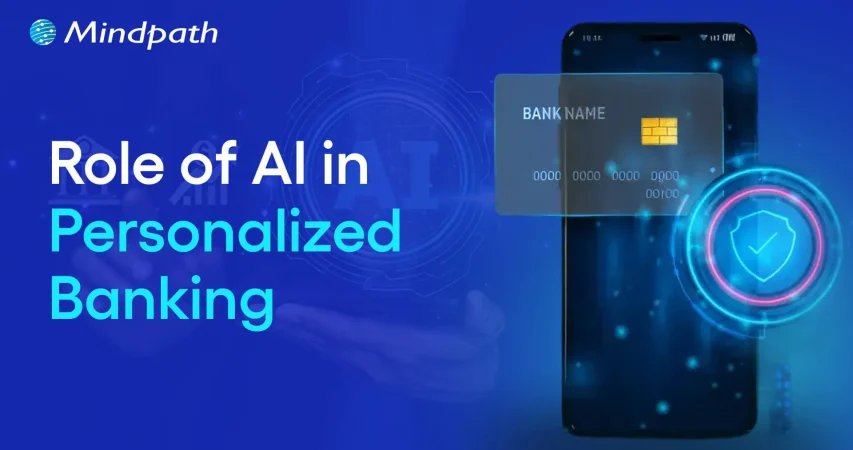
The Role of AI in Personalized Banking Experiences 

Join our Newsletter!

Featured Posts

Support Is One Click Away

Home

The Role of AI in Personalized Banking Experiences 

AI in Personalized Banking Experiences

The Role of AI in Personalized Banking Experiences 

Artificial Intelligence is redefining how individuals will interact with their banks in the future. By leveraging AI in personalized banking experiences, financial institutions can better understand their customers and serve them with both precision and care. Picture receiving financial advice that is based on your lifestyle or alerts that predict your spending needs, even before you notice them. This is no longer a dream, but rather a progressive reality that is evolving our customer relationships with the banking experience.

As technology continues to grow smarter, banks are leveraging AI to enable a more seamless, rapid, and meaningful experience at each and every interaction with customers. Technology provides opportunities to design experiences that feel human, not automated, so clients feel understood at every step. With this growing innovation, personalization is now emerging as a key competitive advantage. In this blog, we’ll explore how AI is revolutionizing the banking experience into one that is less intuitive and more focused on the customer.

Ready to revolutionize the customer experience in their banking journey with the use of AI? Mindpath offers AI development services that help you put together tools that give you personalized financial experiences.

What is AI in Personalized Banking Experiences?

AI in personalized banking experiences is when artificial intelligence is used to create more purposeful banking for all customers, using information to identify spending, saving, and investing patterns to establish services that meet needs. This provides a thoughtful and engaging experience, ultimately increasing customer satisfaction and trust with the bank.

The use of AI in banking enables banks to provide certain services beyond basic transactional exchanges. With AI, banks are able to predict and suggest to the consumer the most likely need, for instance, recommending budgeting plans or how to spend money more wisely. The smart utilization of data and technology is a way to transform and personalize a traditionally impersonal banking experience into something humanized and connected to the customer.

Personalized banking is becoming a strategic advantage for business owners managing finances at scale. Explore AI in business strategy to understand how AI-driven banking solutions support long-term growth.

How Does AI Provide Personalized Banking Experiences?

AI is redefining banking by transforming data to drive understanding and inform the experience customers will have with a bank. Below are the roles of AI in delivering personal and valued banking experiences. This makes every interaction more meaningful, predictive and customer-centric.

1. Smarter Customer Insights

The use of AI in personalized banking experiences enables banks to know their customers more deeply. It analyzes various aspects of the customers’ lives, such as their spending habits, income patterns, and financial goals to be able to provide them with what they may require next. Based on these findings, banks are empowered to give the right advice at the right time and thus enhance customer experience.

2. Personalized Product Recommendations

Artificial Intelligence in finance gives banks the ability to create money management tools that go hand in hand with the everyday life and objectives of each client. After analyzing data like saving habits or risk tolerance, AI comes up with a credit card, a loan, or an investment that is an ideal match. Such customer experience retains customers’ faith and increases their confidence in the company, making them feel recognized and appreciated.

3. Enhanced Fraud Detection and Security

AI in personalized banking experience is a great tool for making customers feel safe when handling their money. It keeps an eye on transactions in real-time, and thus, any strange activities, which are possibly fraudulent, can be easily detected. Besides an increase in safety, this reactive security system also helps to establish trust in each digital interaction made by the customer.

4. Intelligent Virtual Assistance

AI-based virtual assistants and chatbots in banking are revolutionizing the way customer service is delivered. These AI assistants are available 24/7, so customers can always rely on them to get help. These empathetic interactions help to democratize banking.

5. Targeted Marketing with a Personal Touch

One of the conveniences of AI in banking is illustrated in customized marketing strategies as well. Banks are employing insights derived from data-driven decision making to deliver communications and to extend offers that are an authentic fit for the requirements of each customer. This targeted tactic heightens the interaction and facilitates customers in discovering services which really advantage them.

6. Smarter Credit Risk Assessment

AI-powered personalized banking experiences change the way that financial institutions determine a customer’s creditworthiness. Banks using AI check quite a few different aspects of a person’s life, such as income, payment behaviors, and even spending trends, to make a more just decision about who gets the loans. This precision opens the doors to better financial products for customers, while it is a relief to the banks that the risks are minimized.

Want to know how business owners can gain better control over cash flow and financial decisions? Explore AI in decision-making to see how personalized banking insights help businesses make faster choices.

Real-World Examples of AI in Personalized Banking Experience

Throughout the finance sector, AI is developing new methods of communicating with clients and assisting them with everyday banking. Presented below are some examples of AI in banking to illustrate how financial institutions are leveraging intelligent technology to provide clients with more personalized and valuable experiences.

1. Smart Virtual Assistants

AI in personalized banking experiences uses virtual assistants to simplify daily banking tasks. They help customers manage accounts, pay bills, and get instant updates anytime.

2. Personalized Financial Guidance

AI studies customer behavior to offer tailored budgeting tips and spending insights. It helps people make smarter financial decisions that match their goals.

3. Smarter Investment Support

AI analyzes market data and customer preferences to suggest better investment options. It helps both investors and advisors plan strategies more effectively.

4. Stronger Fraud Protection

AI tracks transactions in real time to detect unusual activity quickly. This smart monitoring keeps customers’ accounts secure and builds greater trust.

Wondering what type of AI actually powers personalized banking for businesses? Explore the types of Artificial Intelligence (ANI, AGI, and ASI) to learn how banks apply intelligent systems to serve business owners better.

Ready to Transform Banking with AI Innovation?

The application of AI in customized banking experiences is transforming the way people handle their finances and interact with their bank. Through the intelligent use of data to understand the needs of each customer, AI helps making financial services more accessible, secure, and meaningful to consumers. As technology continues to evolve, AI will continue to offer everyday consumers greater personal, intelligent, and seamless experiences in modern banking.

At Mindpath, we assist financial institutions in developing intelligent and customer-centric AI solutions that redefine banking. Our AI development services allow banks to provide predictive insights, personalized products, and improved security. We leverage our expertise to help you build smart systems that convert customer interactions into trusted and lasting relationships.
Related Post

Discover the top 8 emerging technologies set to revolutionize business decision-making in the near future, including Generative AI, Web3, Blockchain, and more.
Discover the top Node.js trends shaping digital technology in 2024, from AI and TypeScript to IoT and cloud computing. Explore how Node.js drives innovation!

Related Post

LLaMA LLM

Are you hearing a lot about the LLaMA LLM lately and wondering what it is and why it’s special? If so, you’re not alone. Buzz regarding this powerful open large language model (LLM) continues to build and spread from technology forums to developer circles and the larger AI community. It’s fundamentally reshaping how many people think about AI tools and putting the spotlight on open-source innovation that has never been seen before.

The emergence of open-source LLMs fundamentally reshapes how AI is developed, shared, and scaled. Until now, the primary focus in the industry has been on the deployment and governance of closed prompts within a closed model. Large language models with open-source options, like LLaMA, are a welcome addition that now allows access for researchers, developers, and even startups, with fewer restrictions to experiment, customize, and build. It will not only provide greater access to advanced AI but also create a larger momentum for innovation across many sectors. In this blog, we’ll explore what sets LLaMA apart and how it’s driving this change. 

Looking to harness the power of LLMs and AI for your business but don’t know where to start? Mindpath offers AI Development Services to help you build, customize, and deploy intelligent solutions that drive real results.

Before diving further, let us have an idea about open LLMs: 

Understanding Open LLMs

Open-source large language models (LLMs) are incredible power AI models that can be deployed, changed, and shared for free by anyone. Where closed or paid models like OpenAI’s GPT are restricted to only those who pay to access the models, open-source LLMs are built on being open and transparent, meaning that developers and researchers can inspect, make improvements and train on their own data. These models are often contributed as a collaborative effort by communities or organizations who believe in promoting open innovation making it possible for others to learn and create new things with AI. 

There are many benefits to using open-source LLMs. They can save researchers a lot of money, because there’s no licensing fee and they can be adapted in very precise ways to what the researcher wants. Developers can also rely on strong open-source communities from which they can freely draw robust sets of tools, tutorials, and updates. This community effort often supports not only researchers’ progress but also helps more people get involved in shaping the future of these technologies. 

Curious about the different kinds of AI and how they impact businesses? Learn about the types of AI to understand where LLMs like LLaMA fit in the broader artificial intelligence landscape.

Among these Open-source LLMs, the most popular one is LLaMA LLM. Let’s dive into that! 

large-language-models-market

What is LLaMA LLM?

LLaMA is a large language model developed by Meta that can understand and generate human-like text. It learns from a huge amount of data and uses a special design, or architecture, to figure out patterns in language. This helps it give smart and relevant answers, whether it’s writing something, translating, or answering questions. 

What makes LLaMA stand out is its strong performance and the way it is available for the tech community. Many people ask, is LLaMA open source? While it’s not fully open like some models, Meta has made it available to researchers and developers, making it easier for them to explore, test, and build new AI tools using LLaMA. 

Must Read: Low-Rank Adaption (LoRA)

Why is LLaMa LLM So Popular?

LLaMA AI has quickly gained popularity in the AI community, and it’s easy to see why. Its performance, accessibility, and flexibility make it a strong choice for developers, researchers, and businesses alike. Here are some key reasons behind its rising popularity: 

1. Scalability and Efficiency

LLaMA is scalable, which means it can run on different kinds of hardware — from powerful GPUs to everyday computers. This makes it easier for researchers and developers who may not have access to expensive systems. By making advanced AI tools more reachable, LLaMA helps more people experiment and innovate. That’s why many developers now use LLaMA in app development without needing a huge setup or high costs. 

2. Adaptability

LLaMA can be trained for specific uses, which makes it really flexible. Whether it’s a chatbot for customer service or a tool that creates content, it’s possible to fine-tune LLaMA to fit different industries and goals. This adaptability means it can work well in many real-world situations. It’s not just a one-size-fits-all model, rather it adjusts to what you need it to do. 

3. State-of-the-Art Performance

LLaMA has shown top performance in different language tasks like translation, classification, and more. These results come from how well the model is designed and trained. Meta’s AI team used smart methods and architecture to make sure LLaMA performs at a high level. Because of this, it stands out as one of the most powerful tools in the language model space today. 

4. Open-Source Initiative

Meta has taken steps to make LLaMA more open and available to the research community. By releasing the models and sharing detailed documentation, they’ve made it easier for others to use, study, and build on LLaMA. As a leading example of an open source LLM, LLaMA is helping more people explore and contribute to the future of AI in a truly collaborative way.  

Want to customize large language models to fit your specific business needs? Learn how OpenAI’s Fine-Tuning API enables developers to fine-tune AI models for more accurate and specialized applications.

Real–World Applications of LLaMA

LlaMA LLM is being used in many real-life projects today. Its open nature makes it easier for developers to build and improve solutions, and it’s often seen as a strong example of how open models can drive real innovation. Here are a few practical ways people are using LLaMA today:

1. Faster Content Creation for Marketing Teams

A digital marketing agency can use LLaMA to write content like blog posts, social media captions, or newsletters. This helps them save time and focus more on creative ideas and strategies. Since LLaMA can quickly generate useful content, the team can keep up with deadlines without stress. It’s a great LLaMA open source LLM example that shows how AI can help marketing teams work faster and smarter. 

2. Smarter Chatbots for Customer Support

A business can use a chatbot powered by LLaMA to answer customer questions. The bot gives fast, helpful replies to common queries, so human support agents can handle more complex problems. Over time, the chatbot can learn from interactions and get even better. This helps improve customer satisfaction. You can even build one yourself by following a simple LLaMA open source LLM tutorial, which makes it easier for teams to create smart support tools. 

3. Breaking Language Barriers with AI

An international company can use LLaMA to translate emails, documents, or messages into different languages. This helps their teams communicate better across regions. LLaMA can provide quick and accurate translations, making global teamwork easier. With an open-source model like this, it’s possible to build tools that support real-time communication without high costs or complex setups. 

4. Understanding Customers Through Sentiment Analysis

A brand tracking tool can use LLaMA to understand how customers feel by reading reviews or social media posts. The tool can spot trends, positive feedback, or complaints. This helps companies make better decisions to improve their products or reputation. Because LLaMA is flexible and open, teams can customize it to track the right kind of feedback for their needs. 

Want to see AI in action, improving business outcomes? Explore AI chatbot examples to understand how LLM-powered chatbots are driving real-world results.

Curious about Using LLaMA for Your Business?

LLaMA LLM is changing the way people use and develop AI by making powerful language models more open and accessible. Its flexibility, strong performance, and the support of an open community allow researchers, developers, and businesses to build smarter, faster, and more customized AI solutions. As an open-source LLM example, LLaMA is helping drive innovation across many industries, breaking barriers and making advanced AI tools available to more people than ever before. 

If you want to harness the power of LLaMA in your own projects, Mindpath AI Development services can help. We specialize in building tailored AI tools using open-source models like LLaMA to meet your unique business needs. Whether you want to improve customer support, create content, or analyze data smarter, our team can guide you through every step to bring your AI vision to life efficiently and effectively. 

Frequently Asked Questions

1. How is LLaMA LLM different from other large language models available today?

LLaMA LLM stands out because of its balance between performance and accessibility. Unlike many closed models, it allows developers to explore and customize it more freely. This makes it easier to build tailored solutions while still benefiting from strong language understanding capabilities.

2. Can LLaMA LLM be used by small businesses or startups?

Yes, LLaMA LLM is suitable for startups and small businesses due to its flexibility and lower cost of access. It allows teams to build AI-powered tools without heavy investment, making advanced language technology more practical for businesses with limited resources.

3. What kind of skills are needed to work with open LLMs like LLaMA?

Working with open LLMs usually requires basic knowledge of programming, data handling, and machine learning concepts. Familiarity with tools like Python and AI frameworks can help. With strong community support, even beginners can gradually learn and build useful applications.

4. Are there any limitations when using open-source LLMs?

Open-source LLMs offer flexibility, but they may require more setup, maintenance, and technical expertise compared to managed solutions. Performance tuning, data handling, and infrastructure management are important factors to consider when planning real-world implementation.

5. How can businesses start experimenting with LLaMA without major risks?

Businesses can begin with small pilot projects to test LLaMA in real use cases like chatbots or content generation. This approach helps understand performance and value without large investment, allowing teams to scale gradually once they see positive results.

custom website development services

Companies consistently wrestle with the challenge of maintaining a smooth operation and competing in an ever-changing world. Custom website development services provide the missing link to develop a platform that matches your exact needs and workflows. When a website is built around a real process that matches a real workflow, the company will improve efficiency, and simplify tasks. This simplifies how teams work faster and will improve the extent customers interact on your website. A good website becomes a tool for growth to enable outcomes without adding more work.

Many businesses have adopted custom website development because of the time-saving nature of routine work automation, greater collaboration, and more rapid responses to shifting needs. When technology is a partner with a skilled web design company to streamline operations to connect people across different teams and functions, its powers can enhance overall productivity. A business’s online presence can become a powerful accelerator of success when a company can tie it to real business goals. In this blog, we will detail how these services can modernize and streamline your business.

Want to build a website that not just exists but also gives your brand a great online presence? Mindpath offers web development services to ensure responsive designs and smooth performance, which makes every click an opportunity for the business.

Understanding Custom Website Development Services

Custom web development means creating a website from the ground up to fit the needs of a business. Rather than just using templates or a cloned website, a custom website development company will build your platforms to express the brand’s identity, work with existing systems, and provide a uniquely personalized experience for users. Every aspect of the site is built to serve the company’s needs and enables the site to be fully functional and engaging.

By taking this approach, businesses will also have the flexibility to add features that are appropriate for their business and will help make the website easier to manage as the business grows. Additionally, there is the ability to know their site will be secure and have capacity for more users or more content over time. For companies, custom web development offers a website that looks professional, works well, and can grow with their businesses.

Must Read: Web Design and Development Services

How are Custom Web Development Services Streamlining Business Operations?

Custom web development services are primarily concerned with designing a website that reflects a business’s unique goals and key strategies. These services ensure an online presence that is at once professional and trustworthy, and sufficiently adaptable for use as a tool for the business’s development and other operational needs, both now and in the future.

Streamlining Business Operations with Custom Web Development Service

1. Streamlined Data Management

A custom web application enables the collection of information from multiple locations, thus ensuring that each department has the same up-to-the-minute information. Dashboards and reporting functions pull together the information to enable visual, timely, better decision making, and it increase overall efficiency.

2. Smarter Task Automation

Custom web development services enable automation of repetitive tasks such as order processing, invoicing, and inventory management. Minimally, this frees up the time of employees to focus on more strategic objectives and accelerate the pace of operations and thus total productivity.

3. Seamless Software Integration

A custom web development company can design applications that integrate smoothly with your existing systems like CRM or ERP tools. It is a way that frees people from the heavy work of manual data transfer in different applications and at the same time, enables the seamless integration of workflows and processes. The result is a more efficient and cohesive operational environment.

4. Minimized Human Errors

Custom-built applications incorporate highly developed validation and error-checking mechanisms. Businesses save time and avoid mistakes, improve accuracy, and reduce costs by removing the risk of human error in data entry or repetitive processes. Employees can focus on actual work and add value instead of fixing an error.

5. Improved Team Collaboration

A custom web application provides a centralized platform for sharing documents, tracking progress, and communicating in real-time. Teams can coordinate tasks more effectively, reducing misunderstandings. This enhances inter-departmental collaboration and streamlines daily workflows.

Curious how artificial intelligence can transform the way websites are built and managed? Explore our article on AI in web development to discover how AI can enhance your site’s efficiency, usability, and performance.

6. Boosted Employee Productivity

With a custom web application, teams can share documents, track progress, and communicate in real-time all in one location. This increased coordination among team members leads to a better understanding of tasks, which improves departmental collaborations and caters to their day-to-day duties better.

7. Flexible Growth for the Future

Custom web development provides businesses with solutions that expand with them. This means that the platform can accommodate more users, storage of larger datasets, and use cases when the business expands, and all without a complete redesign. This level of flexibility is important for maintaining a valuable website as a tool over time.

8. Stronger Security Measures

Custom solutions enable developers to incorporate tailored security protocols to safeguard sensitive data. Unlike generic software, custom applications can include encryption, authentication, and enhanced security measures tailored to your firm. Organizations at least know that their customer and operational data are of the highest security.

9. Enhanced Customer Experience

Custom web development services play an important role in elevating customer engagement and communication. Just to illustrate, an automated follow-up or a tracking system for orders can be a way of informing your customers at each step, thus attracting them. Consequently, it becomes a cycle of strengthening your relationships and building trust with your clients over time.

10. Long-Term Cost Efficiency

Custom website developers may have a higher upfront cost, but the ROI can be huge over time. Eliminating continuing software fees and inefficient processes can ultimately save the business money. Custom software solutions create well-performing, reliable systems that promote growth and success.

Want to build a complete website without coordinating with multiple developers? Explore our post on full-stack development for web projects to discover how a full-stack approach simplifies your workflow and accelerates delivery.

Ready to Streamline Your Business with Custom Web Development Services?

Custom web development services help businesses improve efficiency, strengthen teamwork, and enhance customer interactions. By creating websites that match real business goals, companies can save time, reduce errors, and manage operations with ease. A well-designed website acts as a strong foundation for growth and lasting success.

At Mindpath, our expert team delivers professional website development services that align with your business goals. Each custom web development service is designed to create fast, secure, and scalable websites that enhance performance and user engagement. We focus on crafting digital solutions that simplify operations and help your business grow with confidence.

What Skills to Look for while hiring a ReactJS Developer in London

Hiring a ReactJS developers in London requires assessing both technical expertise and practical experience. A skilled developer should be proficient in modern programming languages, frameworks, and tools that enhance development speed and efficiency. Below are the key technical skills to consider when hiring a ReactJS developer. 

1. Programming Languages

A ReactJS developer should be well-versed in JavaScript and TypeScript, which serve as the foundation for React apps. Knowledge of backend languages such as Node.js, Python, or Java is also beneficial for full-stack development since it ensures smooth connection between the frontend and backend. 

2. Software Development Frameworks

ReactJS developers should be familiar with React and its ecosystem, which includes Redux, Next.js and React Router. Experience with backend frameworks such as Express.js or Django is advantageous since it enables developers to collaborate quickly across several application levels.

3. Database Management

Understanding SQL (MySQL, PostgreSQL) and NoSQL (MongoDB, Firebase) databases are essential for effective data management. A professional ReactJS developer understands how to organize, retrieve, and optimize data storage for scalability and speed.

4. Cloud Platforms

ReactJS developers that are familiar with cloud services like AWS, Azure, and Google Cloud can deploy, manage, and scale apps more effectively. Cloud expertise enables developers to design serverless computing, CI/CD pipelines, and cost-effective hosting options.

5. Testing & Debugging

ReactJS developers should be knowledgeable with unit testing (Jest, Mocha), integration testing, and debugging tools (Chrome DevTools, React Developer Tools). Testing allows for the early detection of defects, which improves code quality and application stability.

6. API Development and Integration

A proficient ReactJS developer should be able to construct and integrate APIs using REST or GraphQL. API expertise provides effective data transmission between the frontend and backend, resulting in smooth application performance.

7. DevOps Tools

Experience with Docker, Kubernetes, and CI/CD technologies (Jenkins, GitHub Actions) enables ReactJS engineers to automate deployment operations. DevOps expertise ensures that apps are efficiently deployed, scalable, and maintainable.
Mindpath offers provides expert ReactJS developers in London with these essential skills, ensuring your projects are delivered with high performance and reliability. Get in touch with us today! today to hire the best talent for your development needs. 
How much does hiring a ReactJS developer cost? Learn about factors affecting rates, and how to find the best talent within your budget.