Home

How Can AI Automate Your Sales Funnel?

How Can AI Automate Your Sales Funnel?

Join our Newsletter!

AI for Sales Automation

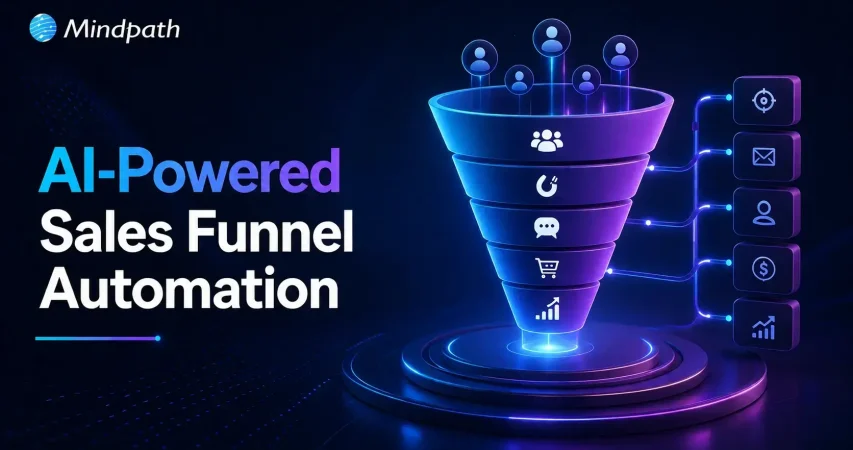
Sales teams today are under constant pressure to move faster, respond quicker, and convert more leads without burning out their staff. This is where AI sales automation comes in, helping businesses handle repetitive tasks, qualify leads, and guide prospects through the funnel without needing constant manual input.

Key Takeaways

  • 01
    AI agents automate lead scoring, follow-ups, and meeting scheduling, allowing sales teams to focus on closing more deals.
  • 02
    AI for sales prospecting identifies high-quality leads faster by analyzing large volumes of customer data.
  • 03
    Automated sales workflows improve response times and reduce missed follow-ups throughout the sales funnel.
  • 04
    AI-powered sales funnels engage prospects 24/7, keeping leads active and improving conversion opportunities.
  • 05
    Continuous AI learning helps optimize sales performance and improve funnel efficiency over time.

From automated follow-ups to smarter lead scoring, AI is changing how sales funnels operate at every single stage. In this blog, we are going to explore how AI can automate your sales funnel and what that actually means for your business in 2026.

Want to automate your sales funnel and close more deals with less manual effort? At Mindpath, we build AI-powered sales automation solutions that streamline lead generation, automate follow-ups, and help businesses increase conversions with intelligent AI agents.

What are AI Agents and How are They Helping Sales Teams in 2026?

AI agents are software programs built to carry out tasks on their own, based on rules, data, and learning patterns, without needing a person to guide every step. In 2026, these agents have moved well beyond simple chatbots. They now sit inside CRMs, email platforms, and scheduling tools, working quietly in the background to move deals forward.

For sales teams, this means an AI agent can read incoming leads, understand their intent, respond with relevant information, and even schedule a call, all while a sales representative is busy elsewhere. This shift is a big part of why AI sales automation has become such a common term in boardrooms this year. Businesses are no longer asking whether they should adopt it; they are asking how fast they can roll it out.

How Does AI Sales Automation Streamline Lead Generation and Prospecting?

Finding the right leads used to take hours of manual research and cold outreach. AI has changed that by doing the heavy lifting in the background, so sales representatives can focus on actual conversations instead of searching for names.

1. Smarter Lead Scoring

AI tools rank leads based on their likelihood to convert. This helps sales teams spend their time on prospects who are actually ready to buy.

2. AI for Sales Prospecting at Scale

AI can scan thousands of profiles, websites, and public data points in minutes. This gives reps a steady stream of qualified prospects without the manual grind.

3. Predictive Intent Tracking

AI studies browsing behavior, email opens, and website visits to flag buying signals. Reps get notified the moment a lead shows real interest.

4. AI Based Lead Generation From Multiple Channels

AI pulls leads from social media, forms, and third-party databases into one place. This removes the need to manually check five different tools every morning.

Automating Sales Workflows With AI

Once a lead enters the funnel, there is a lot that needs to happen correctly and on time. Missed follow ups and slow responses are two of the biggest reasons deals fall through, and this is exactly where automation earns its keep.

1. Automated Qualification Questions

AI chatbots ask the right questions upfront to filter serious buyers from casual browsers. This saves reps from wasting time on leads that were never going to convert.

2. Sales Process Automation for Follow Ups

AI sends timely, personalized follow up emails based on where a lead is in the funnel. No prospect slips through the cracks because someone forgot to check in.

3. Smart Meeting Scheduling

AI agents coordinate calendars and book meetings without the usual back and forth emails. This alone saves reps several hours every single week.

4. Deal Stage Tracking

AI updates CRM records automatically as a deal moves forward. Sales managers get a real time, accurate view of the pipeline at all times.

Building an Automated Sales Funnel That Works Round the Clock

A funnel that only works during business hours is a funnel that is leaving money on the table. AI removes that limitation by keeping every stage of the funnel active, even when the sales team has logged off for the day.

1. 24/7 Lead Engagement

Chatbots and AI agents respond to inquiries instantly, no matter the time zone or hour. Prospects get answers immediately instead of waiting until the next morning.

2. Automated Sales Funnel Nurturing

AI sends the right content to the right lead at the right stage, without a human triggering it manually. This keeps prospects warm until they are ready to talk.

3. Sales Workflow Management Software Integration

AI connects with existing tools, so data flows smoothly between marketing, sales, and support teams. Nothing gets lost between departments anymore.

4. Continuous Learning and Optimization

AI studies what worked and what did not, then adjusts messaging and timing automatically. The funnel keeps getting sharper the longer it runs.

Ready to Automate Your Sales Funnel With AI?

AI is no longer a nice to have for sales teams; it is quickly becoming the backbone of how modern funnels operate. From the first touchpoint with a lead to the final signed deal, AI sales automation is helping businesses respond faster, work smarter, and close more deals with fewer resources stretched thin. Companies that adopt this early are already seeing shorter sales cycles and happier sales teams who spend less time on admin work.

At Mindpath, we build AI development services designed around how your sales team actually works, not a generic template pulled off a shelf. Whether you need help with lead scoring, automated follow-ups, or a fully connected sales workflow, our team can design and deploy an AI agent that fits directly into your existing systems. If you are ready to see what a smarter, automated funnel looks like for your business, we would love to show you.
Frequently Asked Questions

It refers to using AI tools and agents to handle sales tasks like lead scoring, follow ups, and scheduling automatically. This reduces manual work and helps sales teams close deals faster with less effort.
AI can manage most repetitive tasks like outreach, qualification, and nurturing. However, human reps are still valuable for complex negotiations and building genuine relationships with high value clients.
No, small and mid-sized businesses benefit just as much, often more. It helps smaller teams do more with limited staff, making growth possible without hiring a large sales department right away.
AI scans data from multiple sources to identify and rank leads based on their buying intent. This means sales reps spend time on prospects who are genuinely likely to convert soon.
Yes, Mindpath designs AI agent solutions tailored to your existing tools and sales process. We focus on practical integration rather than offering a one size that fits all products.

Support Is One Click Away

Featured Posts

Related Post

Wordpress vs workflow

In the year 2025, the debate of WordPress vs Webflow is hotter than ever. This is because business entities and content creators are looking for the best platform to build secure as well as SEO-friendly websites. It is true that WordPress has been dominating the CMS market thanks to its vast plugin ecosystem coupled with high flexibility. But it is essential to bear in mind that Webflow has been gaining momentum with designers as well as startups, thanks to its no-code visual editor along with built-in hosting. 

In case you are wondering, is Webflow better than WordPress? You need to look at the main difference between these tools. You need to know which one is better so that you can choose the tool that perfectly aligns with your needs. The guide breaks down everything you need to know while choosing Webflow or WordPress.

Choosing the right platform makes all the difference when it comes to performance and growth for your online presence. Explore Mindpath’s WordPress development services for expert guidance on what your business needs.

A Deep Dive into WordPress

WordPress is the most popular content management system (CMS) in the world, currently powering over 40% of all websites on the internet. It lets you create, build, and manage your own website without needing coding knowledge. WordPress has gained massive popularity thanks to its ease of use coupled with flexibility, making it an ideal tool for beginners, professionals, and businesses alike.

At its core, WordPress is a free, open-source content management system. This means anyone can use, modify, or distribute it at no cost, and it’s continually improved by a global community of developers. One of the biggest strengths of WordPress is its SEO-friendly structure. The novel platform generates clean and crawlable code that adds value to search engines’ index content efficiently. Users can even leverage useful plugins such as Yoast SEO and Rank Math for optimizing titles and meta descriptions that can improve the visibility in search results.

An Insight into Webflow

Webflow is a cloud-based visual web development platform that lets you design, build, and launch responsive websites without writing code. It bridges the gap between design and development by letting users design visually on a canvas while the platform automatically generates clean, production-ready HTML, CSS, and JavaScript in the background. This makes Webflow a favorite among designers who want creative freedom without relying on developers.

A standout feature of Webflow that you need to be aware of is related to its design flexibility. Users have the option to create fully custom layouts as well as animations without having to write a single line of code. Webflow basically combines the best of graphic design tools with the functionality of a content management system (CMS), generating clean HTML, CSS, and JavaScript behind the scenes as you design. For businesses that need more tailored solutions, custom WordPress development offers similar flexibility with the added power of plugins, themes, and scalability, allowing organizations to build websites that precisely meet their unique requirements. It serves as a valuable tool for businesses and startups that wish to leverage its ability to deliver professional and responsive websites effectively and efficiently.

Comparison Between WordPress and Webflow

Now that you have an insight into Webflow and WordPress, it is time to look at the difference between these novel tools. Developers as well as businesses need to understand the difference between WordPress and Webflow so that they can make a wise selection. The core differences have been presented by focusing on specific areas such as ease of use, design, customisation, and many other features. 

1. Ease of Use

Webflow offers a visual no-code editor. It is highly appealing to designers as well as marketers. In fact, it is great for rapid prototyping along with pixel-perfect layouts. On the other hand, WordPress requires setup with a theme or page builder. So beginners may take some time to learn how to use the tool. However, developers with proper knowledge and experience can get full control over the tool. Thus, while discussing Webflow vs WordPress, a major difference between them revolves around the ease of use.  

2. Design and Customization

Webflow serves as an ideal tool for making custom designs without requiring any coding. The responsive control built in can ensure that users can derive optimum value from the tool even if they have limited coding-related skills. On the other hand, WordPress has a large ecosystem of themes as well as plugins. These elements make it highly customizable in nature. But this maturity also makes it plugin-dependent at times.

3. SEO Features

Webflow provides built-in SEO tools such as meta tags and schema options. It even delivers strong performance when it comes to integrated hosting. However, WordPress relies on plugins such as Yoast SEO for advanced SEO control. Thus, this feature makes WordPress extremely powerful, which is capable of precise optimization. You need to bear in mind that, starting from Webflow to WordPress, the role of top SEO features is a must for users.

Stuck deciding whether WordPress or Drupal is a better match for your business? Our WordPress vs Drupal guide breaks down key differences to help you pick the perfect solution.

4. Security

While talking about WordPress vs Webflow, it is a must to take into account the security aspects. Webflow is certainly more secure by default in comparison to WordPress. This is mainly because it offers built-in security features such as DDoS and SSL protection. The top-notch security feature of Webflow acts as its major strength. When it comes to WordPress, the security mainly depends on users. You need to manage separate security plugins and carry out frequent maintenance in order to prevent vulnerabilities. In order to boost the level of security, you need to make sure that you, as a user, maintain cybersecurity resilience while developing your website. 

5. Performance

Webflow is capable of offering better out-of-the-box performance. This is mainly because of integrated hosting coupled with a global Content Delivery Network and clean code. On the other hand, when it comes to WordPress, its performance mainly depends on the chosen hosting and plugins. The selected theme can also impact the performance that is delivered by the tool. If you use Webflow, your website can load faster by default. But if you choose WordPress, you can rest assured about the site performance if you choose appropriate hosting. 

6. Pricing

If you are wondering – is Webflow similar to WordPress in terms of pricing, the answer is no. The pricing of WordPress is variable in nature. You may have to incur separate costs for different things, such as hosting and a domain. Similarly, the price also depends on the chosen plugins and themes. So it may seem cheaper initially, but its price may increase with additional functionality. When it comes to Webflow, the pricing is based on the all-inclusive subscription model. It can become expensive for you if you opt for higher-tier plans.  

Want to make sure your WordPress site is accessible to everyone? Check out our post on improve WordPress web accessibility to learn practical steps for making your site more inclusive and user-friendly.

WordPress vs Webflow – Comparison Table

The difference between WordPress and Webflow has been presented in the table below. You need to understand how Webflow and WordPress are different from each other so that you can choose the ideal tool wisely. The insight can surely guide you to decide which platform you intend to use to fulfil your specific needs. 

Features Webflow WordPress
Ease of Use  No Coding Knowledge needed  Coding knowledge is not strictly needed but can help for advanced customization
Design and Customization Highly flexible in nature  Availability of extensive themes for customization
SEO Features Built-in SEO tools Availability of SEO friendly structure 
Security  High security  Low security 
Performance High optimization for speed Performance depends on hosting 
Pricing Subscription-based pricing model Variable pricing model

Final Winner Between WordPress and Webflow

You must choose Webflow if you prioritize visual design control along with built-in hosting. Webflow is the better choice if you need to manage your website in a simple way. It is well-suited for small business entities as well as startups that want to launch their site quickly with a clean and modern design.

WordPress is an ideal choice for you if you are looking for scalability and advanced SEO capabilities, along with flexibility through plugins. In such cases, WordPress can certainly act as a stronger platform that can meet your needs perfectly. The platform is best-suited for enterprises and e-commerce stores that wish to have full control over SEO as well as integrations. 

Therefore, both Webflow and WordPress serve as useful tools. You need to choose between WordPress and Webflow by considering your needs. In case you are wondering – Does Webflow work with WordPress? The good news is, yes! Webflow can definitely work along with WordPress if you utilize the official Webflow Pages plugin. It will certainly allow you to build pages in Webflow while serving them on your WordPress site.

Worried about security risks and vulnerabilities on your WordPress site? Read our guide on safeguarding WordPress vulnerabilities to learn how to protect your site and keep it secure against threats.

Final Words

The emergence of WordPress and Webflow has been transformational in the prevailing business world. Both these platforms have their unique strengths and advantages. The ultimate choice between WordPress and Webflow in the year 2026 mainly depends on the goals of your website and your budget. You also need to take into consideration the long-term growth plan before making the choice between WordPress and Webflow.

If you wish to derive optimum value from WordPress, you need to partner with a reliable partner. Mindpath’s top-grade WordPress development services can certainly help you develop a world-class website. It can offer the ultimate go-to solution in terms of scalability as well as limitless customization. You can also take advantage of the advanced SEO-friendly structure in order to boost the online visibility of your website. It can certainly give an edge to businesses in the competitive business world.

Frequently Asked Questions

Cloud computing attacks

Cloud computing has certainly revolutionized how business entities leverage technology to carry out their operations. In recent times, many businesses across diverse industries have already migrated to the cloud. These cloud computing trends have gained momentum so that businesses can take advantage of cloud computing technology. However, such a trend has also given rise to a broad range of attacks on cloud.

In the prevailing times, business entities need to know that Cloud computing attacks encompass different types of attacks by malicious actors. These malicious actors could be internal or external. However, they can cause significant damage to businesses in the highly volatile environment. Now is the perfect time to expand your knowledge relating to cloud computing attacks.

Want to strengthen your cloud security without increasing operational complexity? Mindpath’s managed cloud services provide the expertise and tools needed to secure your cloud operations

What are Cloud Computing Attacks?

A cloud computing attack refers to a malicious activity that can exploit vulnerabilities in the cloud infrastructure, applications, or services. The purpose of such attacks is to steal data, gain unauthorized access, or disrupt the usual services.  The rising instances of cloud attacks have become a major concern for businesses operating in diverse industries or sectors. 

Cloud attacks may be of various types. Businesses need to be able to answer: What are the security risks of cloud computing? They need to have an answer to this question before moving to the cloud. The knowledge in this area is vital to being prepared to face such risks in an effective and efficient manner. 

Want to strengthen your defences against cloud computing attacks? Discover cloud security tools that help identify threats and secure your workloads effectively.

Top Cloud Computing Attacks that Businesses Need to Be Aware of

The attacks on cloud that target cloud computing resources as well as infrastructure may vary considerably. It is essential for modern businesses to have a holistic insight into these threats as they have the potential to compromise the business operations and sustenance. Some of the key cloud security threats that you need to be familiar with include:

1. Denial-of-Service Attacks

The Denial-of-Service Attack is a cloud attack that intends to make a network or computer resource unavailable to the actual users. It basically floods a cloud server or service with fraudulent traffic. You need to bear in mind that a DoS attack involves a single source. On the other hand, a distributed denial of service attack may involve several compromised sources. 

As cloud environments are vulnerable, such types of attacks may lead to costly repercussions. Such attacks may lead to the disruption of service or loss of revenue for a business. Moreover, it may also cause serious damage to the reputation of a business. Understanding cloud computing vulnerabilities is essential to prevent such risks and protect cloud infrastructure.

2. Insider Threats

Insider threats refer to the cloud security threats that arise because of employees, former employees, partners, etc. They continue to affect the security in the cloud computing environment.  This threat may occur when an insider either intentionally or unintentionally does harm to the cloud security of an organization. 

The key issue that an entity needs to address is striking a balance between the privacy of employees and the security measures that have been adopted. This cloud cyber attack may be quite difficult to detect and prevent since it typically involves individuals who have the authority to access cloud assets.

3. Man-in-the-Middle Attacks

The Man in the Middle Attack takes place on the cloud when a malicious actor is able to intercept the interaction between the cloud user and the cloud service. This attack may also arise when an attacker intercepts the communication between two cloud services. The attacker basically positions themselves in the middle position in order to eavesdrop or steal sensitive information. 

These types of issues relating to cybersecurity in cloud computing need to be addressed as a priority. This is because such attacks can take advantage of cloud services that are misconfigured. They can also exploit the vulnerabilities that exist in SSL/TLS protocols. 

4. Account Hacking

Account hacking in the cloud environment refers to the unauthorized access or control of a cloud computing account by a malicious actor, such as a hacker. This can certainly allow the hacker to make use of related resources for their malicious purposes. Account hacking can also enable hackers to manipulate or steal the data that is stored on the cloud. 

Such cloud computing hacks may give rise to detrimental consequences for business entities. For instance, hackers or attackers may use password cracking techniques for the purpose of guessing or stealing the login credentials of others. Organizations need to prevent cyber attacks as they may lead to financial loss, and they can also tarnish the reputation of an organization. 

Struggling to manage infrastructure while scaling applications efficiently? Check out serverless architecture in cloud computing to learn how it lets you build and deploy apps without worrying about servers.

5. Cloud Malware Injection Attacks

Cloud Malware Injection refers to a type of cyber attack that involves the injection of malicious software, such as a virus or ransomware, into cloud resources or cloud infrastructure. Such types of attacks are gradually becoming common as more businesses are moving to the cloud. Such attacks can enable cybercriminals to compromise the infected or affected resources.  

Attackers may even steal or destroy data for their own malicious purposes. There exist numerous ways in which attackers may inject malware into the cloud infrastructure, such as by exploiting vulnerabilities in the cloud setting or by gaining unauthorized access to cloud accounts. 

6. Security Misconfiguration

In cloud computing, security misconfiguration refers to the lack of proper configuration of cloud computing resources or infrastructure. Due to the failure in terms of configuration, there may be compromised protection against cyber threats and attacks. Businesses need to bear in mind that incorrect security settings have the potential to leave the system and data vulnerable. 

Security misconfigurations are considered to be a serious issue that can lead to data breach incidents in the cloud. The issue may be the result of human error or lack of expertise. Similarly, the failure to alter insecure default settings may lead to security misconfiguration in the cloud. 

7. Side Channel Attacks

Side channel attacks in the cloud environment are able to take advantage of weaknesses or vulnerabilities in shared hardware resources. Such attacks are capable of extracting confidential data through the observation of indirect information such as power consumption and electromagnetic emissions. 

This attack involves the exploitation of information that has been leaked through the physical implementation of a system. In the cloud setting, malicious actors may carry out such types of attacks by positioning a malicious virtual machine on a legal physical host that is used by a business. This technique can enable the attacker to get access to all confidential information about the victim’s machine.  

8. Cookie Poisoning

Cookie poisoning is a type of cyber attack where an attacker is responsible for tampering with or altering the web cookies of the user. In cloud applications, this type of attack involves the unauthorized modification or the injection of malicious content into a cookie. 

Cookies are typically stored to personalise the experience of users or track their activities. Such attacks can poison the cookies of users without their knowledge to access the applications. It may lead to unauthorized access to accounts. Businesses need to deploy robust cloud security solutions so that such attacks can be prevented in an effective manner. 

Ready to take your applications to the next level in the cloud? Explore cloud-native development to learn how modern architectures improve performance and security.

Need for a Solid Cybersecurity Posture

Modern business entities need to maintain a robust cybersecurity posture. Such a posture can enable them to prevent cyberattacks. Business entities need to adopt solid cybersecurity tools and technologies so that they can safeguard sensitive information and maintain regular business operations. 

In prevailing times when cloud computing attacks are on the rise, entities across diverse industries need to prioritize their cybersecurity resilience. Proper cybersecurity preparedness is a must to ensure that organizations can effectively function in an uncertain environment. While operating in the cloud, business entities need to prioritise the adoption of robust cloud security solutions such as identity and access management, encryption, data loss prevention, and many more. 

Curious how AI can improve cloud security? Check out AI in cybersecurity to see how it detects threats faster and protects your systems.

Final Words

In the existing business landscape, more businesses are moving to the cloud. This has automatically created the need for businesses to broaden their insight relating to cloud computing attacks and threats. Several cloud attacks have been identified that are affecting businesses, such as Denial-of-Service Attacks, Insider Threats, Account hacking, and many more. 

Mindpath’s managed cloud services can ensure that your business is well protected against all types of cloud attacks. The professionals and experts will ensure that your business can derive optimum value from the cloud computing technology and stay protected from cybercriminals and other malicious actors. 

attention mechanism explained

In the rapid innovation of AI, there are some innovations that don’t just boost existing techniques but also completely change the field. And one such innovative breakthrough is the attention mechanism. Are you searching for the attention mechanism explained in easy words to get a better idea about it? If yes, then this is the right place for you. The attention mechanism has completely changed the process of textual sequential data handling. Besides, it increases NLP’s capabilities. The attention mechanism also has a massive impact on computer vision, along with other domains. 

In this detailed blog, we will dive deep into the attention mechanism explained through some easy examples. Besides, we will go through different types of attention mechanisms and understand why it is a game-changer for AI models.  

Want to see how the attention mechanism can transform your workflows by enabling more precise AI applications? Mindpath’s AI development services bring these advancements to life through scalable, high-performance AI solutions designed for your business goals.

What is the Attention Mechanism?

Before exploring the attention mechanism explained in detail, let’s try to decode the basics. 

Suppose you are reading a sentence that says “John is playing football”. What will be your answer if someone asks “Who is playing football?” You will instantly say “John”. If you analyze, you will understand that here you don’t through the entire sentence. You just focus on the important part, i.e., the subject or name. This is what the attention mechanism does. 

The attention mechanism is a deep learning technique that allows AI models to dynamically weigh and prioritize the most relevant parts of an input sequence. It operates through three core components: queries, keys, and values, which work together to resolve context and compute relevance scores across tokens. This mechanism forms the core of modern Transformer architectures, powering large language models like GPT, BERT, and T5. It has significantly improved model performance across tasks such as question answering, image analysis, summarization, and translation.

The Example of Attention Mechanism

To understand more about the process of attention mechanisms, consider this sentence translation task as an example. 

Let’s take the sentence “ The dog is enjoying his treat.” When a model translates the sentence, it needs to understand the subject first. Based on that, it will generate the result. An attention mechanism helps models assign scores or weights to every word. Then, it considers the score to understand the important words. “The” gets a low score as it is a determiner. Dog receives the highest weight as it is the subject. The word “Sat” mostly attends to the word “Dog” to understand the meaning clearly.  By adjusting these scores, models generate results that are more accurate. Well, it’s just like how we focus on a crucial part when describing meaning. 

What are the Different Types of Attention Mechanisms?

Now that we have discussed the attention mechanism explained with an example, let’s explore the different types of attention mechanisms. Each mechanism plays an important role in how models process, understand, and prioritise data while performing tasks such as contextual reasoning or summarisation. 

1. Additive Attention

Introduced by Bahdanau et al., this was one of the oldest attention mechanisms. It was primarily used for machine translation. It functions by combining the query of the decoder with the encoder’s hidden state or the key. After that, it passes them through a feed-forward neural network to calculate the attention score. It is a perfect option for handling input and output sequences of varying lengths. 

2. Self-Attention

This marks a major turning point in AI models. A crucial feature of Transformer models,  self-attention helps AI models focus on different parts within the same sentence. This makes the model understand the context. Self-attention enables more accurate contextual understanding. That’s why it is vital for AI models such as GPT,  T5, H20.ai, and BERT. 

3. Multiplicative Attention

This version of the attention mechanism simplifies the process. Instead of concatenation, this mechanism utilizes a dot product between the decoder and encoder’s hidden states to compute the score. It is more efficient as well as faster compared to additive attention. It is also available in two sub-variants, such as Global attention and Local attention. 

4. Cross-Attention

It is generally used to compare two input sequences. When performing tasks such as machine translation, the AI model utilizes information from the target as well as the source sequences to establish relationships between them. This mechanism enables models to focus on the relevant parts to generate new elements. Developers can use it the self-attention mechanism to make transformer models handle complex tasks. 

5. Scale Dot-Product Attention

Transformer models like GPT, come equipped with this mechanism.  It calculates the weights by taking the key vector and the dot product of the query. It eliminates sequential bottlenecks, which are common in earlier models like Recurrent Neural Networks. 

6. Multi-Head Attention

As a powerful extension of self-attention, it can run multiple operations in parallel. Each head learns various aspects of data. For instance, while one head may capture semantics, another may focus on syntax. The outputs are then combined and transformed. This makes the model create a more nuanced and richer representation of the input. 

These types of attention mechanisms demonstrate the advancement of attention techniques in AI. With these innovations, AI models have moved beyond rigid processing. 

Looking for efficient ways to optimize large AI models? Discover Low-Rank Adaptation (LoRA) to explore techniques that increase model performance with minimal resources.

The Rise of Transformer Architecture

In 2017, a paper named “Attention Is All You Need” introduced the Transformer architecture. It abandoned convolutional and recurrent layers.

You might be wondering why it is revolutionary. Here are the reasons. 

1. Elimination of Long-Range Dependencies

By computing attention between multiple data points in a sequence directly. This solves the long-standing issues of processing long-term dependencies. The distance between words will always be the same, regardless of their position in the original sentence. 

2. Parallelisation

In general, RNNs are sequential. That means you may need to use the hidden state of the previous step to compute the next. On the other hand, self-attention enables AI models to carry out computations for various parts in the sequence in parallel. This, in turn, significantly speeds up model training times. 

3. The Transformer Effect

The transformer architecture, powered by attention mechanisms, can unlock the maximum potential of transfer learning. By effectively pre-training on unlabeled datasets, models such as can learn deep language representations. 

After that, these models can be further optimised with minimal labelled data. They can offer accurate outcomes while performing various tasks. 

Wondering how transformer-based AI models work behind the scenes? Explore the Large Language Model (LLM) guide to learn how attention layers power advanced AI applications.

Applications of Attention Mechanism in AI

The attention mechanism is a core element of modern AI. It enables various AI models to focus on the input data’s relevant parts. Here is how it is driving impact. 

1. Machine Translation

Attention mechanism helps AI models analyze the right words present in source sentences. This, in turn, makes translation context-aware and more accurate. 

2. Image Captioning

Focusing on certain areas of an image helps models to create more descriptive and meaningful captions. 

3. Question Answering Systems

Attention enables AI models to focus on relevant parts of a question. As a result, they produce more precise answers with updated information. 

4. Speech Recognition

It also significantly improves how models maintain a balance between text and spoken words. The results? Improved fluency and recognition accuracy. 

Looking to implement advanced AI solutions in your business? Explore AI consulting to discover how expert guidance helps leverage attention-powered models for smarter and data-driven results.

Enabling Smart Learning in AI Models

After going through this attention mechanism explained in easy words, we can say that it marks a vital moment in AI model evolution. By giving models a context-aware way to focus on the relevant data, the attention mechanism eliminates the limitation of step-by-step processing. 

That is why today’s AI models can process images with impressive accuracy. Besides, they can offer meaningful conversations. Thinking about harnessing the power of the attention mechanism for your AI tools? Mindpath can help you with this. Our AI development services help businesses deploy, optimise, and integrate attention mechanism-powered models. We ensure you benefit from high-performance, context-rich AI. The future of smart learning is here, and we can lead you to attain the desired success. 

Frequently Asked Questions