Making Smarter Choices: The Impact of Decision Intelligence on Business Success

Join our Newsletter!

Featured Posts

Support Is One Click Away

Home

Making Smarter Choices: The Impact of Decision Intelligence on Business Success

Decision Intelligence

Making Smarter Choices: The Impact of Decision Intelligence on Business Success

Have you ever wondered how top companies make quick, informed decisions that keep them ahead of the competition? That’s where decision intelligence comes in! But what does this mean for businesses like yours? How can harnessing decision intelligence help you navigate uncertainty and drive success? In this blog, we will explore the fascinating world of decision intelligence and uncover its potential. So, let’s dive in! 

What is Decision Intelligence?

Decision Intelligence (DI) is the way organizations utilize artificial intelligence (AI) to make smarter decisions. It focusses on achieving results that assist the organization to achieve its objectives. Companies can employ Decision Intelligence to improve the efficiency of each department and increase overall performance. A firm, for example, can utilize DI to analyze sales data, better understand client preferences, and develop new methods to generate profit. Businesses can become more efficient and productive by leveraging smart technology to support their choices.  

Why is Decision Intelligence Important for Businesses?

Decision intelligence is important because it enables businesses to make rapid and precise decisions by combining AI and data. This implies that firms can resolve problems more quickly and better satisfy their customers’ requirements. Companies that use Decision Intelligence can collect and analyze data using smart technologies to predict the best results for their decisions. However, Decision Intelligence does not replace people in decision-making processes. Instead, it empowers people by improving their access to all corporate data. This allows them to comprehend the full picture and make the best decisions possible. Businesses can use Decision Intelligence to make data-driven choices at all levels. Additionally, it improves their operational visibility, which can offer thrilling outcomes that could revolutionize their success! 

Benefits of Decision Intelligence (DI)
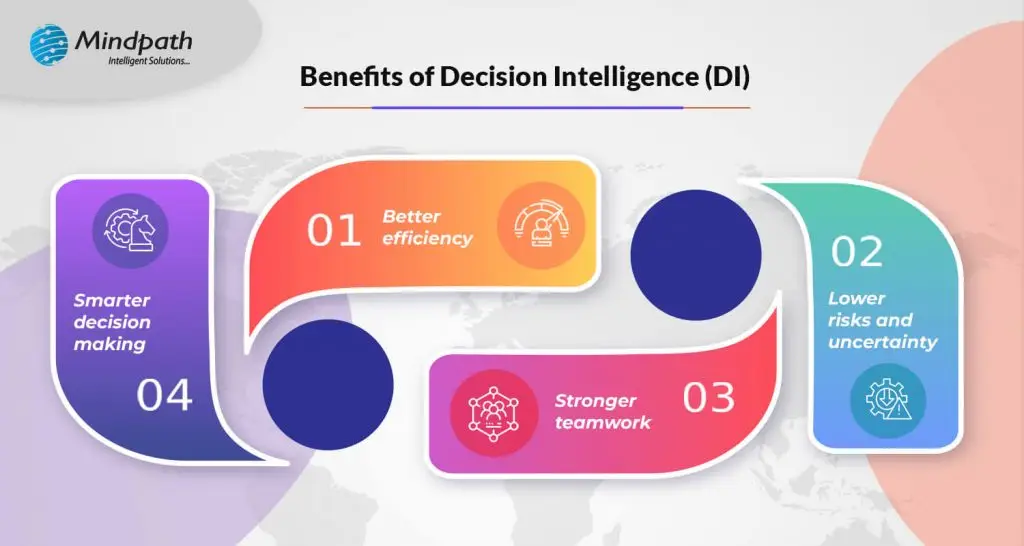
1. Better efficiency

One of the primary advantages of Decision Intelligence is its capacity to increase organizational efficiency. Decision Intelligence allows leaders to make faster and more informed decisions by delivering the relevant information at the right time. When leaders have access to real-time data, they can quickly analyze circumstances and comprehend the consequences of their decisions. This urgency is essential in today’s fast-paced corporate climate, when delays can result in missed opportunities or bad consequences. For example, if a corporation observes a rapid shift in client behavior, Decision Intelligence can assist executives in immediately analyzing the data, allowing them to adjust their strategy without wasting time. 

Furthermore, Decision Intelligence enables organizations to simplify their operations. When executives have easy access to important insights, they can eliminate superfluous processes in the decision-making process. This not only saves time, but also allows teams to focus on what is genuinely important, resulting in improved cooperation and more successful outcomes. As a result, businesses using Decision Intelligence become more responsive. They can adjust to market developments, client requirements, and internal issues more quickly and adaptably. 

2. Lower risks and uncertainty

Another significant benefit of Decision Intelligence is its capacity to assist organizations in reducing risks and uncertainties. While risks are always there in business, Decision Intelligence enables businesses to detect possible dangers earlier. Organizations can detect warning indicators, such as diminishing customer satisfaction, and take proactive efforts to resolve issues before they worsen. 

In addition to recognizing risks, Decision Intelligence enables firms to investigate several potential consequences of their actions. Organizations can utilize predictive analytics to model numerous scenarios and better understand the possible consequences of their decisions. This competence allows leaders to balance the benefits and drawbacks of many alternatives, making it simpler to select the best course forward while minimizing unwanted consequences. Furthermore, decision intelligence enables organizations to design effective risk management methods. Companies that anticipate possible issues might develop plans to limit their effect. For example, if a company expects supply chain interruptions, it might seek alternate suppliers ahead of time. 

3. Stronger teamwork

Improved teamwork is another significant advantage of Decision Intelligence. Decision Intelligence helps stakeholders align throughout the organization by providing a single source of truth for data and analytics. When everyone has access to the same correct information, it is simpler for teams to communicate effectively and collaborate on common goals. 

With Decision Intelligence, different departments can turn to the same data, minimizing misconceptions and promoting a cohesive strategy. This transparency guarantees that everyone understands the same thing, whether it’s about sales objectives, customer feedback, or operational issues. When teams understand their common goals and have accurate facts to back up their talks, they can work more effectively. Furthermore, Decision Intelligence promotes collaboration by breaking down the barriers between departments. When individuals from several departments exchange thoughts and data, it results in improved problem-solving and new solutions.  

4. Smarter decision-making

Improved decision-making is a major advantage of Decision Intelligence. Executives can more effectively recognize and analyze distinct scenarios by utilizing analytics in key moments. This helps people to better assess the probable repercussions of their choices, resulting in more informed judgements. 

When leaders use data-driven insights, they can consider the benefits and drawbacks of several solutions before making a decision. For example, if a firm is thinking about releasing a new product, Decision Intelligence can help executives evaluate market trends and client preferences. This thorough examination enables them to make the best choice that matches the company’s objectives. 

Also Read: 5 Conversational AI Trends To Watch Out For In 2024

Decision Intelligence Services at Mindpath

Mindpath’s Decision Intelligence services help organizations make informed choices by integrating advanced analytics with human insights. Unlike traditional artificial intelligence, which mostly automates processes and makes predictions, our methodology assists executives in evaluating many scenarios and outcomes, ensuring they have a comprehensive perspective of their corporate objectives.  By offering a single source of truth for data, we encourage stakeholder engagement and minimize divisions between departments. This alignment enables everyone to work towards shared goals, resulting in better informed, effective decision-making throughout the organization. 

Wrapping Note!

In today’s fast-paced corporate environment, decision intelligence is essential for organizations attempting to succeed in the face of uncertainty. Companies can make better, quicker choices by integrating modern analytics and human insights. The benefits like increased efficiency, lower risks, stronger cooperation, and better decision-making, show how Decision Intelligence can alter operations and drive performance. 

At Mindpath, we are dedicated to assisting organizations in achieving their objectives by using decision intelligence. By offering a single source of truth and encouraging cooperation, we enable organizations to successfully handle problems and grasp opportunities. Mindpath’s Decision Intelligence services can help you unleash your organization’s full potential. 

Ready to transform your business with smarter decision-making?

Partner with Mindpath’s Decision Intelligence services for data-driven success.
Related Post

Explore the future of programming with emerging languages like Python, Rust, and more. Learn how Mindpath can help you stay ahead in tech.
Discover why ReactJS is perfect for Progressive Web App (PWA) development. Learn how Mindpath can help you build high-quality PWAs.

Related Post

staff augumentation

In today’s world where technology is enhancing at a fast pace, businesses cannot afford to slow down, not even for a second. As deadlines are tighter, client demands are growing and skilled talents are harder to find, IT staff augmentation can be the perfect solution for these. Just think: what if you could access skilled professionals whenever you wanted them, whether it is to scale up a project or as expertise to reach a short-term goal, without having to go through the time-consuming hiring process? Isn’t it fascinating?

Staff augmentation allows you to grow as you need, with no boundaries, as many organizations are opting for faster and more flexible alternatives. If you hear this term frequently but aren’t sure exactly what it means and how it works, you are in the right place. In this blog, we will walk you through the essential things to know about staff augmentation. We will explain how staff augmentation works and describe the main benefits of this service in easy words! There is much value in exploring staff augmentation as a way to improve your team’s capabilities and altogether enhance your work outcomes. 

Looking for a partner you can trust to boost your IT projects? Mindpath is here to provide top-end services in the sphere of IT staff augmentation.

What is Staff Augmentation?

Staff Augmentation is when you hire competent professionals from an external agency to assist your in-house team for a defined period of time. These professionals aren’t permanent employees, but they will consider themselves regular members of your team. This is a flexible way to obtain extra assistance when your team is busy, or you require a special skill to complete a project.

To clarify, here’s a staff augmentation example. Suppose you are the owner of an online clothing store, and you want to introduce a mobile shopping app before the holiday season arrives. Your in-house developers are actively working on new updates for your website and are currently unable to take on other work. Instead of hiring full-time staff, you use IT staff augmentation to put some mobile app developers into your project through a trusted agency. The app developer will work with your task force, build the app, and when you are ready to launch it, their work will finish. This will give you the appropriate skills, at the appropriate time, without the lengthy hiring process or administrative burden of bringing full-time employees. 

Types Of Staff Augmentation

Staff augmentation comes in different types to match different business needs. Whether you need help with a short project or long-term support, there’s a model that fits just right.

1. Project-Based Staff Augmentation

This type is used when a company needs extra help for a specific project. Skilled professionals join the team just for that project and leave once the work is done. It’s a smart way to get things done faster without adding long-term costs.

2. Temporary Staff Augmentation

In this model, companies bring in experts for a short time to fill sudden gaps or meet urgent deadlines. It helps teams stay on track without rushing permanent hires. It’s great for short-term tasks or unexpected workload spikes.

3. Long-Term Staff Augmentation

Here, professionals work with the company for a longer time, often for months or even years. It’s helpful when you need ongoing support or special skills that your team doesn’t have. This model also helps reduce hiring costs while keeping projects moving.

4. Onshore Staff Augmentation

This means hiring professionals from the same country or region. It’s easier to work together because of the same time zone and better communication. Teams also benefit from cultural similarities and quicker collaboration.

5. Offshore Staff Augmentation

In this type, companies hire skilled people from other countries where labor costs are lower. It allows access to global talent and helps save money. It works well for remote projects that don’t need the team to be in the same location.

What is the IT Staff Augmentation Process?

The staff augmentation process may sound complex, but it’s actually quite simple when broken down into clear steps. Here’s how it works from start to finish to help you get the right talent for your business or project.

1. Identify Your Needs

Start by understanding what kind of skills or experience you need for the project. This helps you clearly define the roles and responsibilities for the temporary team members.

2. Estimate Team Size

Decide how many people you’ll need to get the job done smoothly and on time. Having a clear number makes it easier for your staffing partner to find the right talent.

3. Connect with a Staffing Partner

Once your needs are clear, your staff augmentation agency begins searching for the right professionals. They use their wide network to find candidates who match your project goals.

4. Screen and Shortlist Candidates

The agency carefully checks skills, experience, and qualifications before shortlisting the best profiles. You’ll then be invited to an interview and pick the ones who fit your team well.

5. Evaluate and Hire

Once you find the right candidates, you can try a short trial period to see how they perform. If everything goes well, you move forward by hiring and adding them to your team.

Benefits of Staff Augmentation

IT staff augmentation is becoming a go-to solution for businesses looking to strengthen their teams without long hiring delays. Here are the key benefits that make this approach a smart choice for many companies.

1. Team Scalability

One of the biggest benefits of staff augmentation is the ability to scale your team up or down as needed. You can bring in more people during busy times and reduce the team once the work is done. This is perfect for businesses with changing workloads or seasonal demands. It helps you stay efficient without overspending on full-time staff.

2. Access to Skilled Professionals

With staff augmentation, you get access to a large network of talented professionals through a trusted IT staff augmentation company. No matter what skill or experience level you need, there’s someone ready to support your project. This helps you find the right people faster without long hiring processes. It saves time and ensures your project is handled by experienced people.

3. Increased Productivity

Bringing in extra support allows your core team to focus on what they do best. They won’t get overwhelmed with too many tasks, and quality will stay high. With the right help in place, everyone works more efficiently. This leads to faster results and better outcomes.

4. Reduced Hiring Risk

Hiring full-time employees can be risky if they don’t turn out to be the right fit. With staff augmentation, you can try out professionals before making long-term decisions. It also allows you to bring in people who complement your team’s strengths. This makes your team stronger and reduces the risk of hiring mistakes.

5. Fresh Expertise and Ideas

Staff augmentation brings in people who have worked with many other companies and industries. They often come up with new ideas, fresh perspectives, and valuable insights. This can inspire your existing team and lead to better solutions. It’s a great way to bring innovation into your projects without a big change.

Ready to Boost Your Team the Smarter Way?

This blog gave us a complete look at how IT staff augmentation works and why it is becoming the smart choice for many businesses today. From types and processes to key benefits, everything you read helps you see how this flexible model can boost your team, meet project goals faster, and save hiring time without compromising quality. 

At Mindpath, we offer trusted IT staff augmentation services to help you grow your team quickly and smoothly. Whether you need short-term support or long-term experts, our skilled professionals are ready to join your projects. With the right talent at the right time, we help your business stay strong, flexible, and always ready for growth.  

Discover staff augmentation for IT projects, its benefits, and top providers in the USA. Learn how it can bridge gaps and save costs.
Fintech software development

Have you ever wondered how your bank manages to offer seamless online services, instant transactions, or personalized financial advice? The answer lies in Fintech software development. But what makes it so crucial in the world of modern banking? In this blog, we will explore Fintech software development and how this technology is transforming the way we manage our finances. So, let’s dive in! 

What is Fintech?

Fintech is a phrase that refers to emerging technology that enables financial services to be delivered more quickly and efficiently. It entails creating software that allows financial institutions and clients to communicate and manage funds in ways that were previously impossible. Fintech software development focusses on providing tools and apps that aid in financial decision-making, improve client experiences, and make financial services more accessible. It enables customers to take control of their financial situation, with advantages such as ease of access, increased customer satisfaction, and lower costs. 

What is Fintech Software Development?

Financial software development involves building digital systems and solutions tailored to the financial industry. Like other software development methods, it focusses on creating solutions that assist both companies and their customers. Financial software may offer up multiple opportunities for business by leveraging current technology stack, helping businesses to fulfil their goals. These solutions enable businesses to cut expenses, increase security, and create more personalized customer experiences. 

Types Of Fintech Software Development

1. Types Of Fintech Software Development

Insurance technology (InsurTech) is software that enables insurance businesses to operate more efficiently. InsurTech allows businesses to analyze risks, offer better discounts, and make it easier for customers to apply for insurance and handle their claims. This kind of software may be used for a variety of insurance products, including life, automobiles, house, and pet insurance. It improves and speeds up the entire process for both the organization and the customer. 

2. Payment Processing Software

Payment processing software handles all transactions for a financial institution. It acts as a mediator, linking payment service providers along with cardholders to facilitate online and mobile payments. This software enables even small enterprises to take credit cards and online payments easily. 

3. Digital Banking Software

Without physically visiting a bank, customers may receive financial services and manage their bank accounts with the help of digital banking software. This software allows users to accomplish anything they would do at a real bank, including opening accounts, asking for loans, moving funds, and making transactions, from any of their devices. 

4. Investment Software

Investment software is an efficient tool that aims to make investment accessible to anyone, not only those who are wealthy. It streamlines the investing process by cutting costs, removing mediators, and making trading, bidding, and purchasing easier for users. 

5. Tax Management Software

Tax management software is useful because it streamlines the often-complex process of handling and submitting taxes. This financial software allows firms to simply produce, submit, and handle tax documents. Most processes are automated, so you don’t require prior expertise or an accountant to efficiently manage your taxes.

Ready to Revolutionize Your Fintech Solutions? 

Mindpath specializes in creating custom software tailored to your needs. 

Benefits of Fintech Development Services

1. Enhanced Security

Fintech development employs modern technology such as encryption, artificial intelligence, and biometrics to safeguard financial information. These tools assist in detecting fraud and creating a secure environment for transactions. Furthermore, it includes high security requirements to secure data, so preventing identity theft and other online hazards. 

2. Greater Accessibility

Fintech enables everybody to access financial services from anywhere, regardless of their location or financial position. Fintech eliminates conventional obstacles such as high charges and difficult procedures, allowing anybody with internet connection to easily utilize a variety of services ranging from banking to investing on any device. This increased accessibility enables more people to receive financial assistance and manage their money more efficiently. 

3. Reduced Costs

Fintech may reduce operating expenses and share the savings with their clients. Fintech solutions are often less expensive than traditional services because they employ digital technology to automate operations, lowering human labor and administrative costs. This enables banks to provide reduced rates and fees, saving clients’ money. Furthermore, fintech increases transparency and flexibility, allowing users to make intelligent choices and customize solutions to meet their specific needs. 

4. Boosted Operational Efficiency

Fintech helps financial institutions to automate procedures, improve operations, and provide better customer service. By replacing human processes with automated solutions, expenses are reduced, and efficiency is increased, resulting in quicker, more precise operations. Fintech also helps to reduce risk by enhancing data tracking and monitoring. Additionally, it provides insights into client behavior and financial patterns, allowing institutions to make smarter judgements. 

5. Automated Financial Processes

The automation of financial processes is a significant advantage of Fintech. It makes it easier and quicker financial management for consumers by allowing them to set up automated payments, move cash across accounts, and receive alerts for significant events. This automation improves accuracy while also reducing the amount of manual effort required for financial transactions. Consequently, businesses and customers might save time, money, and improve efficiency. 

Fintech Development Services at Mindpath

At Mindpath, we provide Fintech development services to improve and simplify financial services. We specialize in developing digital tools and apps that simplify money management, transaction processing, and access to financial services. Our team builds unique solutions that are adapted to your specific requirements, such as mobile apps for banking, investment platforms, and payment systems. We prioritize making these products simple to use and secure, allowing you to manage your funds effectively and safely. Here are some of our services: 

1. Requirement Analysis & Planning

We collaborate to understand your unique financial needs and plan a solution that aligns with your business goals. 

2. Custom Application Development

We develop bespoke fintech applications, including mobile banking apps, investment platforms, payment systems, and more, tailored to your specifications. 

3. Integration with Existing Systems

Our solutions integrate seamlessly with your current financial systems to ensure smooth and efficient operations. 

4. Maintenance & Support

We offer ongoing support and maintenance to keep your fintech applications secure, up-to-date, and running efficiently. 

Wrapping Up!

Fintech software development is changing the way we manage our financial resources, making it easier and more efficient than ever before. Fintech is transforming the financial industry in a variety of ways, including increased security, cost savings, and work automation. Whether used to manage investments, make payments, or access financial services, this software provides extraordinary convenience and accessibility. As technology evolves, fintech will continue to drive innovation and improve financial services for everybody. 

At Mindpath, we want to help you take full advantage of these exciting advancements. Our team develops personalized fintech solutions to help you manage your finances more easily and securely. Whether you require a new app, enhanced integration, or continuing maintenance, we have you covered. 

Looking for Cutting-Edge Fintech Development?

At Mindpath, we deliver innovative solutions designed to elevate your financial services. 

GenAI in Retail & E-Commerce

Have you ever wondered how technology is changing the way we shop? Imagine walking into a store where the products seem to know your preferences or visiting an online shop that feels personalized just for you. With GenAI applications making waves in retail and e-commerce, these scenarios are becoming a reality. How are retailers harnessing the power of artificial intelligence to enhance customer experiences and streamline operations? In this blog, we will explore the exciting world of GenAI in retail and E-commerce. 

Generative artificial intelligence (generative AI) is a form of AI capable of producing new content and ideas, such as conversations, stories, images, videos, and music. AI technologies aim to replicate human intelligence in nontraditional computer tasks such as image identification, natural language processing (NLP), and translation. Generative AI represents the next phase in artificial intelligence. You can teach it to understand human language, programming languages, art, chemistry, biology, or any other complicated topic. It leverages previously trained data to tackle new issues. For example, it can acquire English vocabulary and compose a poem using the words it processes. Your organization can utilize generative AI for a variety of applications, including chatbots, media production, and product development and design. 

Now, let’s dive in to explore GenAI Applications in retail and E-commerce! 

GenAI Applications in Retail and E-commerce

1. Virtual Shopping Assistants

Chatbots are becoming increasingly important in retail as they use artificial intelligence to assist customers when shopping online. These virtual assistants can answer product-specific queries, such as pricing and availability. They also recommend things based on customer preferences, making the buying experience more personalized. 

Chatbots also answer basic customer care questions, such as how to return an item or handle product faults. They can help clients track their orders and understand the delivery timings. One of the benefits of chatbots is that they can gain from the content on your website and other resources. This means they can receive more education about your company, making it easier for them to answer enquiries. 

Chatbots are available 24 hours a day, seven days a week, so clients can look for assistance at any time. If a customer needs to speak with a person, the chatbot may collect their information and forward it to your sales or support staff for further action. This manner, you can ensure that clients get help whenever they need it, even outside of normal office hours. 

2. Real-Time Sales and Support Solutions

Generative AI benefits customers in retail, but it also improves the experience of support agents and sales colleagues. AI systems can simplify and improve consumer interactions by giving real-time help. For example, systems such as Talkative provide useful functionality for agents. One important element is the knowledge base, which enables rapid replies during live conversations. When configured, generative AI can get the knowledge base and provide suitable responses based on the context of the discussion. This enables agents to respond faster and provide more precise information.  Another useful feature is the AI Agent Copilot, which is intended to improve reaction time and quality. This features an internal chatbot called “Navi” that supports agents by answering queries depending on the current discussion and knowledge base. This can be especially useful during sales pitches, allowing agents to complete agreements more successfully. Furthermore, an AI Autocomplete tool anticipates and completes agent messages, saving typing time and speeding up answers. Furthermore, AI Agent Rephrases enhance the messages that agents send during conversations. Instead of manually revising each response, the AI proposes better language and may change the tone to meet the circumstance, whether that means making it more friendly, professional, or just fixing syntax and spelling. 

3. AI Training for Sales Teams

Training sales and support workers is essential for sustaining excellent service standards in the retail business. Generative AI can automate and improve this training process, ensuring that agents are well-equipped to help clients successfully. For example, you can use an AI training platform to provide realistic customer interaction scenarios for agents to practice. This allows agents to practice answering frequent product enquiries and managing returns, which helps them build confidence and enhance their abilities. 

AI training can boost your retail business in a variety of ways. For new employees, it can replicate common customer enquiries, allowing them to learn in a helpful atmosphere. Furthermore, the AI can give precise product knowledge, allowing agents to solve problems and properly reply to consumer enquiries. Agents can also improve their sales skills by dealing with virtual customers in low-pressure settings. This allows students to improve their pitching abilities and learn how to properly handle objections. Furthermore, AI can assist agents improve their communication and empathy by providing feedback on their encounters, resulting in greater customer connections. 

Finally, the training tool can help agents prepare for tough scenarios, such as dealing with difficult clients or receiving urgent complaints. Role-playing these scenarios allows agents to acquire effective dispute resolution tactics and preserve client happiness. 

4. AI-Driven Marketing Strategies

Generative AI in retail does more than simply automate customer service and improve the e-commerce experience; it also increases customer satisfaction through optimized marketing and advertising. 

One of the primary advantages of generative AI is its potential to simplify the creative process for marketing teams. By automating content generation, many marketing materials can be generated rapidly and efficiently. Retail businesses can develop online content such as blogs and landing pages, as well as compelling product descriptions. 

Furthermore, generative AI can help create engaging social media posts and targeted email campaigns, as well as educational infographics, eye-catching promotional movies, and thorough brochures. This technology enables retail businesses to generate a wide variety of marketing material while dramatically decreasing the time and expenses associated with traditional content generation techniques. Retail firms may use generative AI to improve their capacity to interact with customers and boost engagement. 

GenAI Services at Mindpath

Mindpath provides Generative AI services to assist retailers and e-commerce enterprises in improving their operations and customer service. Our clever chatbots offer 24-hour service, answering customer inquiries and aiding with orders, making shopping easier for everyone. We also help companies engage with their customers by swiftly creating interesting marketing material such as product descriptions, social media postings, and email campaigns. Furthermore, our AI-powered training programs prepare sales and support professionals by resembling client interactions. This allows them to enhance their abilities and offer better service. 

Wrapping Up!

The integration of Generative AI in retail and e-commerce is transforming the way businesses interact with customers and manage operations. By utilizing virtual shopping assistants, real-time support solutions, AI-driven training programs, and innovative marketing strategies, retailers can create a more personalized and efficient shopping experience. Mindpath’s Generative AI services empower businesses to enhance customer engagement, streamline processes, and ultimately drive sales growth. As technology continues to evolve, embracing Generative AI will be essential for retailers aiming to stay competitive in an ever-changing market. With these advanced tools at their disposal, businesses can better understand and meet customer needs, ensuring success in the dynamic world of retail and e-commerce. 

Want to transform your retail experience?

Partner with Mindpath to discover how our Generative AI solutions can elevate your business.

Explore the impact of Generative AI in retail and e-commerce, enhancing customer experiences, streamlining operations, and driving engagement.