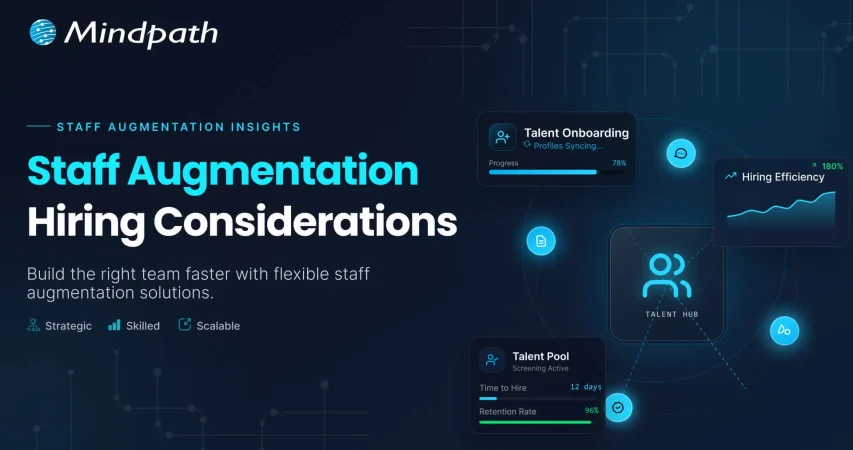
Top 10 Considerations When Hiring Talent through Staff Augmentation

Join our Newsletter!

Featured Posts

Support Is One Click Away

Home

Top 10 Considerations When Hiring Talent through Staff Augmentation

staff augmentation hiring

Top 10 Considerations When Hiring Talent through Staff Augmentation

Staff augmentation has turned out to be a popular strategy for businesses that want to access specialised skills. As per the recent statistics, the IT staff augmentation market size is going to reach USD 857.2 billion by 2032 (Source). This approach can help you scale your workforce while remaining ahead in the competitive landscape.

If you are also thinking of staff augmentation hiring, there are several key factors that should be carefully considered. This ensures a seamless and effective integration of external experts into your organisation. In this blog, we will further explore what you should take into account when your staffing solution demands quality staff augmentation.

Looking for a faster way to strengthen your workforce without compromising on quality? At Mindpath, we offer staff augmentation services that help you scale your team with highly qualified professionals.

What Does Staff Augmentation Hiring Actually Mean?

Staff augmentation is a practice where you temporarily add external professionals to your existing workforce. Further, 65% of recruiters are including AI tools in staff augmentation to support talent acquisition (Source). These experts bring specialised skills and new perspectives. They also have the ability to get along with your team effectively while understanding your team’s dynamics.

So, whether you demand a professional developer or a financial analyst, hire talent through staff augmentation if you want a solution without any permanent hiring commitment.

Must Read: Staff Augmentation Trends

Staff Augmentation Best Practices that Let Your Company Perform Exceptionally

It is necessary for your business to meet the changing technology requirements of the digital world. Further, you need to keep your resources intact while keeping the project on track. The staff augmentation model accesses organisations to effectively fill in the skills gaps and maintains flexibility that is not possible in traditional hiring.

However, successful staff augmentation hiring needs careful planning and the right approaches, as given in this section.

1. Be Clear About Your Needs

Before you initiate the process of hiring through staff augmentation, it is important to have clarity about your business’s specific requirements. Understand what skills or expertise you are lacking internally? What are your goals, and why do you intend to outsource a new team?

Accurately defining your requirements can help you find the right talent. One of the most essential staff augmentation best practices is having clarity. The more precise your expectations are, the better the results will be.

2. Pick the Right Staff Augmentation Model

Not every project needs the same level of external support. There are some common types of staff augmentation models that are listed here.

  • Long-Term Augmentation

 This is effective for your ongoing projects that need to be completed within a given timeframe.

  • Short-Term Augmentation

 This approach is suitable for urgent or temporary requirements.

  • Skill-Based Augmentation

It is necessary when you require specific skills for your project.

3. Partner with a Reputable and Experienced Provider

Selecting the right IT staff augmentation services is a critical step in the whole process. So, you must research and pick a reputable company with a good track record of success. Further, the provider should have a well-established talent pool and a history of offering top-rated professionals. The team should also align with your business requirements.

4. Verify their Collaborative Features

Instead of just valuing the technical skills of the experts, you should also assess their collaborative standards. They should match your team’s communication approaches while showing compatibility with the workflow. You can also assess their language proficiency and ability to work in collaborative environments.

Poor or ineffective communication can delay your projects while increasing the misunderstanding rate. A good cultural fit ensures a seamless integration while developing your productivity aspects.

5. Be Assured of Data Security

When you hire talent through staff augmentation, the team might have access to your data. So, before you make a deal with them, sign NDAs and agreements. Ask about the security policies and restrict access as per the required roles. You shouldn’t ignore the security aspects at all. A single breach can tarnish your market reputation within minutes.

Planning to scale your workforce without overspending on full-time hires? Discover our cost-effective IT staff augmentation blog to learn practical cost-saving approaches while enhancing your workforce.

6. Go through the Pricing Structure

Average IT staff augmentation costs between USD 50,000 and USD 199,999. However, the pricing differs as per the requirements of your business. So, be assured of the providers’ monthly and hourly costs.  Also assess their administrative fees or if they have any hidden costs. Ask about their overtime policies and replacement guarantees.

7. Verify their Flexibility

Your project requirements might change anytime. A reliable staff augmentation model should allow you to scale your resources as needed. It should also allow you to replace underperforming talent quickly and add new skill sets when required.

Flexibility ensures your team can adapt to any changes without any delays.

8. valuate their Performance

Establish clear performance metrics and KPIs to verify the effectiveness of your augmented staff. Verifying the team on a daily basis can make the external team understand your project values while helping your project get completed on time.

9. Plan a Seamless Onboarding Process

Even experienced professionals seek clarity when it comes to keeping their project aligned with the business. So, your structured staff augmentation hiring process should remain clear about your needs. The external team should have precise access to tools and documentation. You should introduce them to your internal teams and define the workflows.

10. Exit Strategy

Understand what you are going to do when the specific project is completed. Make a plan for your transition and assess when you should end the services of your outsourced team.

Looking to streamline your team integration process for faster results? Check out our augmented staff onboarding guide to learn proven strategies for seamless execution.

Why Staff Augmentation Hiring is a Strategic Approach for Your Company?

The staff augmentation model can offer you a series of benefits if you implement it correctly.

  • It can help you hire faster as compared to traditional recruitment processes.
  • It offers access to global talent pools.
  • You can enjoy greater project flexibility and reduced operational charges.
  • Further, your project delivery will be completed within the given timeline.

Common Mistakes to Avoid in Staff Augmentation Hiring

While the model is very effective, organisations still make such mistakes that need to be avoided.

  • Selecting vendors based only on cost.
  • Hiring with clear project objectives.
  • Ignoring cultural fit.
  • Lack of onboarding and performance assessment.

Avoiding or preventing such mistakes can help your staff augmentation hiring be more result-oriented and convenient as per the market needs.

Looking to choose the right outsourcing model for your business needs? Check out our staff augmentation vs managed services comparison to learn the key differences and benefits.

When You Should Hire Talent through Staff Augmentation?

Consider this valuable approach if you need to quickly scale your development team or you want to bridge the skill gap. An outsourced team can easily support a new product launch while helping you with digital transformation. Most importantly, it can reduce the hiring overhead. IT augmentation services offer flexibility, speed, and long-term employment commitments that encourage your business productivity.

Bottom Line

Hiring talent through staff augmentation can be a strategic approach that can help your organisation with the right skills and expertise. Moreover, it can help you stand strongly in today’s competitive business environment. By following the staff augmentation best practices, you can easily build high-performing teams quickly.

If your company is looking forward to hiring talent through staff augmentation, benefit from working with professional providers who understand your project dynamics. They also understand your technical requirements and team integration. With Mindpath, staff augmentation services, your business can easily access knowledgeable industry experts. Further, we can assure you of achieving all your technology goals without any risks and delays.
Related Post

Learn how combining React and AI enhances front-end development, offering smarter, personalized user experiences and dynamic features.

Related Post

Custom software development mistakes

What can cause a well-planned software project to stray off track? Have you ever thought about this? Most of you must have found yourself in a similar situation, right? If so, you are not alone. Many organizations, just like yours, start with the right intentions, a highly skilled team, and a strong idea, but often face delays or an unexpected outcome. Typically, the problem dwells in small custom software development mistakes that begin in the early phases, and it ultimately grows into bigger challenges. If you ignore the early warning signs, it can quickly slow down the whole process. So, how do you keep a custom software project on target, on a clear and quick path toward your business goals?

Every custom software project is full of important decisions that shape the final product. From how you outline your needs to how your team communicates, every aspect matters a little more than you think. Without a defined process, even good ideas have a tendency to derail. In this blog, we will highlight the key custom software development pitfalls you need to avoid, making sure your custom software project stays on track! So, keep reading to find out!

Looking forward to tailoring a software which exactly fit your organizational needs? At Mindpath, we offer custom software development services that help in designing and developing software that meets your business goals.

Why Choose Custom Software Development for Your Business?

Custom software development is a process to create tailor-made software for your organization. It reflects your exact workflow, needs, and goals of the users. It is designed to suit your needs by solving your problems, rather than using predefined features as is the case with off-the-shelf software. Custom software offers better performance, is easily scaled, and puts you in control of the functionality, design, and updates as your business adapts and grows.

Standard software may be quicker to set up; however, it is inflexible, comes with ongoing licensing, and requires ongoing hardware changes. Custom software, on the other hand, is a long-term investment. It does not have unnecessary features, it supports your effective operation, and it also fits in smoothly with your systems. Interestingly, if it is designed by your team, it reduces time, minimizes long-term costs to improve decision-making throughout your business.

Let us take a quick dive into the benefits of custom software development:

1. Custom software will scale with your business as it grows. It also adapts easily when you expand your services or change your processes without incurring the costs of upgrades.

2. It is developed around your specific workflows and business objectives. This provides you with smoother operations without the restrictions and inefficiencies of a one-size-fits-all system.

3. Custom software also integrates well with your current systems. It allows data to flow from one platform to another with minimal manual work and with fewer mistakes.

4. It ultimately saves you money over time, and you won’t incur future licensing fees. You pay for only what you require, and the total cost of ownership is lower.

5. Custom solutions differentiate you in the marketplace. With unique features and enhancements to the user experience, you can be more competitive and more customer-centric.

6. It makes teams more productive in their daily tasks. When software matches each role, teams work faster, make fewer mistakes, and deliver better results.

Want to know more about the benefits of custom software development for your business? Head to our blog: Top Benefits of Custom Software Development

Top Mistakes to Avoid in Custom Software Development

Knowing the common challenges of custom software development is important for creating a successful solution. Many teams overlook some small but critical details, which are often the reason why custom software projects fail or are delayed.

Top Mistakes to Avoid in Custom Software Development

1. Lack of Clear Planning

A very frequently made mistake in custom software development is a lack of planning. If the business objectives are unclear and there is no well-structured roadmap in place, projects like these can end up with inflated costs and delays.

To prevent this, first ensure that key stakeholders are engaged and assess current processes, technologies, and long-term needs. Specify system requirements in detail, including integrations, UI/UX, architecture, and security, before you start the development.

2. Neglecting Quality Assurance and Testing

Omitting or neglecting testing is one of the common custom software development mistakes that can result in considerable problems post-launch. In many instances, some form of quality assurance takes place; however, in sufficient time to perform quality assurance, or altogether ignoring QA means bugs are left unidentified until it has become much harder (and much more expensive to fix).

In order to eliminate custom software mistakes like this, testing should be completed by qualified individuals using legitimate QA and UAT practices to deliver software that provides the customer or user, by and large, what they require to a fully qualified and operational level.

3. Underestimating Project Costs

Cost overruns are one of the most frequent custom software mistakes, primarily due to vague requirements and complexities not being properly assessed. When there is no clear requirement scope, budgets can easily become unbounded, creating delays and the likelihood of project failure.

To tackle this issue, establish a clear MVP with key features and distinguish them from desirable features. This will lead to realistic budgets and phases that can be developed incrementally and in alignment with business goals.

4. Ignoring Long-Term Maintenance Needs

Lack of planning for the ongoing maintenance of software is a challenge in the software development process. It can result in performance and obsolescence issues. Many well-built software solutions are inefficient and potentially vulnerable when support doesn’t happen, and you should not be surprised if yours is in the same boat when software support does not take place.

How can you prevent this? One place to start is with a clear maintenance strategy from the beginning. Budget for planned updates, security patches, and feature improvements so your software can run efficiently and securely.

If you’re planning a custom solution, our step-by-step guide to the custom software development process will help you understand each stage clearly.

5. Overlooking Third-Party Integration

Not considering compatibility issues with third-party systems is a custom software development mistake that can slow down development and reduce software performance. A poor integration strategy can result in data flow problems, missing functionality, and even unanticipated system failures.

To avoid this possibility, complete a full tech audit and feasibility study at the beginning of the project to help ensure the intended integration will go smoothly when the project is complete. This allows you to make informed decisions to move forward with a strategy that meets your business needs.

6. Inadequate Documentation Practices

Poor documentation is a custom software development mistake that results in a misalignment of expectations, confusion, and challenges for long-term maintenance. Documenting decisions and details of the project is imperative. Without documentation, teams cannot go back to understand or support the software later.

To avoid this mistake, be sure to define the scope of the project in advance and document as you go. Another solid practice is to have complete user documentation and technical documentation to enhance transparency, ease of handoff, and longevity.

7. Ineffective Communication

Poor communication is a common issue that leads to misunderstandings, missed deadlines, and project inefficiencies. When teams and stakeholders are not aligned, important decisions and updates can be lost or misinterpreted.

Following custom software development best practices involves maintaining open communication channels, regular check-ins, and clear documentation. This helps ensure transparency, accountability, and better collaboration throughout the development process.

Want to Build Smarter by Avoiding Common Custom Development Mistakes

Successful software projects rely on clear planning, communication, testing, and proper budgeting. Avoiding these common custom software development mistakes helps keep your solution on track and aligned with your business goals. By recognizing early pitfalls and following best practices, your team can build scalable, efficient software that delivers long-term value.

As a trusted custom software development company, we at Mindpath provide tailored solutions built around your unique business goals. Our custom software development services ensure seamless integration, ongoing support, and full transparency throughout the project lifecycle. Partner with us to turn your vision into a secure, high-performing solution that grows with your business.

Emerging Technologies

In the digitalized era, several new emerging technologies have surfaced that are full of promise. The identification of such technologies is essential for individuals as well as businesses. This is because they can influence the lives of people in society and the overall economy.

Before identifying different types of emerging technologies, it is important to understand the emerging technologies meaning. Emerging technologies are rapidly evolving technologies whose potential is yet to be realized entirely. AI is among the top emerging technologies examples that one can come across. 83% of business entities have claimed that they prioritize AI in their business plans. A comprehensive list of new technologies has been developed that can transform the digital realm.

Ready to explore how emerging technologies like AI, Blockchain, and IoT can transform your business? Contact us to discover how our expertise can turn these emerging trends into practical solutions

Top Emerging Technologies

Now that you are familiar with the concept of emerging technologies, it is time to look at some of the top emerging technologies. Currently, new technologies are entering the digital space like never before. It is crucial for IT leaders to keep track of emerging trends and technologies. The insight can enable them to leverage top technologies to shape the future with responsible innovation. The list highlights the 8 types of emerging technologies in a digital world that can act as a revolutionary force in 2026.

1. Artificial Intelligence

While discussing the topic of emerging technologies, the first novel technology that comes to mind is undoubtedly Artificial Intelligence (AI). AI can be defined as the ability of computer systems to emulate human intelligence. This emerging technology enables machines to reason, learn, and perceive just like humans. Although AI is still in its nascent stage, it has evolved into a powerful tool that is redefining diverse industries such as healthcare, manufacturing, education, and many more. While making technology-related predictions, one cannot ignore AI.

2. Virtual Reality and Augmented Reality

Virtual Reality (VR) and Augmented Reality (AR) are undoubtedly among the top cutting-edge technologies in 2026. VR is capable of immersing users in environments that are fully simulated. Thus, it blocks the actual world and allows individuals to experience a virtual space. AR technology integrates digital elements into the real world. As a result, it is capable of enhancing the perception of users with rich contextual information as well as visuals. AR and VR have found a place in Gartner technology trends 2026 as they are capable of offering immersive experiences to users.

3. Blockchain

While discussing the topic of Emerging Technologies 2026, one has to consider blockchain technology. Blockchain can be defined as a digitalized and immutable ledger that is capable of recording transactions while tracking assets across a business network. It is among the latest technology trends since it is highly transparent and secure in nature. This novel technology has gained high prominence in recent years due to cryptocurrencies.

4. Internet of Things

The Internet of Things or IoT is definitely among the most promising technologies that exist today. It basically helps connect physical devices to the internet. Therefore, it is possible to gather, share, and process data in a seamless manner. It is certainly among the top trending technologies that are transforming lives. Today, it is common to leverage IoT technology to create smart cities. In the future, the capabilities of IoT may reach new heights, and its presence may expand further.

Wondering how small businesses can benefit from new tech? Explore emerging technologies for small businesses to boost growth and efficiency.

5. Robotics

Robotics is certainly among the top technologies that exist in the year 2026. It is a rapidly evolving innovation that has been reshaping industries through automation and efficiency. This is among the top trending techs as it is capable of designing, operating, and using robots. The emergence of robotics technology has made it possible to utilize robots so that they can perform repetitive tasks. The strategic adoption of this technology can boost the overall efficiency of businesses across various industries.

6. Agentic AI

Today, Agentic AI is recognized as one of the top innovative digital technologies. Agentic AI has sophisticated reasoning capability, which enables it to solve complex problems. This novel technology can make decisions in an autonomous manner. Thus, it does not rely on human intervention to achieve challenging goals and objectives. It is a novel technology that is able to adapt in real-time. Hence, it acts as a valuable tool for businesses in the current times. By leveraging agentic AI technology, businesses can understand customer intent and predict their future needs. Thus, they can easily get a competitive edge in their area of operation.

7. Quantum Computing

Quantum Computing is among the most promising emerging technologies that exist now. This evolving field basically relies on quantum mechanics for solving complex problems. Thus, its ability to handle problems is a much more efficient way as compared to conventional computer systems. Although this novel technology is in its early stages, it is full of promise. The evolution of quantum computing can revolutionize diverse areas such as cryptography as well as drug discovery. This emerging technology is based on aspects relating to physics, mathematics, and computer science. This innovation is among the top predictions for 2026 that businesses need to focus on.

8. Ambient Computing

The list relating to emerging technologies cannot be complete without ambient computing. Ambient computing refers to the technology that can be seamlessly integrated into one’s surroundings. Thus, it can become an intuitive part of one’s life. The purpose of such technology is to create environments that are capable of responding to human needs. Ambient Computing is among the new and emerging technologies that rely on both IoT as well as AI. One of the most popular examples in this context involves wearable devices that monitor the health condition of individuals.

Planning to modernize your business with new technology? Check out digital transformation for businesses to learn how tech boosts innovation and competitiveness.

Challenges Associated with Emerging Technologies

It is true that diverse types of novel technologies are arising that hold immense promise. However, they also give rise to certain challenges and concerns. A number of challenges have been identified relating to the top types of emerging technologies in the digital world.

1. Ethical concerns

A common issue that arises in the digital space due to emerging technologies revolves around ethical concerns. For example, Agentic AI is the latest emerging technology that gives rise to ethical issues relating to bias and poor transparency.

2. Privacy concerns

A common concern that exists in the digital world is related to privacy risks. Malicious actors may exploit emerging technologies by using sophisticated techniques. As a result, the privacy of online users may be at the receiving end.

3. Regulatory challenges

As technologies are constantly evolving, the regulatory landscape is not entirely developed. Thus, it creates gaps that may be exploited. For instance, poor regulations may increase the risk relating to cybersecurity aspects.

Want to stay ahead in the digital era? Explore digital transformation trends to see how emerging technologies are reshaping business and innovation.

Final Words

In the prevailing technology-driven era, new types of technologies are coming into existence. Some of the most promising technologies are AI, Blockchain, IoT, and many more. These technologies hold the promise to redefine the digital space like never before.

The list of emerging technologies highlights some of the top technologies that can impact individuals as well as businesses. In addition to identifying these technologies, a number of challenges have been identified. It is necessary to take into consideration their potential along with the associated challenges as these elements may together transform the digital space. Mindpath helps businesses and individuals navigate these emerging technologies through tailored solutions and expert guidance

Explore emerging technologies like robotics, AI, and cybersecurity innovations and driving future success for businesses.
custom software development

In the digital-first world, businesses are leaning more towards custom software development to meet their own goals and support customer expectations. Whether automating a process, improving user experience, or improving team productivity, the right software makes all the difference. While custom software gives flexibility and power, the way they are built is not always a straightforward process. Small errors during the development can lead to large setbacks, and it is important to understand the best way to go about the process.

A successful custom software project starts with good direction and good decision-making, up front. Every step, from planning to production, is a critical one in the process. In this article, we will look into some fundamental dos and don’ts of custom software development to help you avoid mistakes and navigate confidently for the purpose of building software that works for you. 

Before we dive in, let’s have an idea of what is custom software development. 

Want software that actually solves your challenges instead of adding more? At Mindpath, we offer custom software development services that build tailored tools to improve efficiency and drive real results.

What is Custom Software Development?

Custom software development means creating software that is specially designed for a specific business or group. Unlike off-the-shelf software that’s made for everyone, custom software is built from the ground up to meet unique needs, solve particular problems, and support specific goals. It includes the planning, construction, testing, launch, and maintenance of the software to ensure it maintains its performance over time.

If you are asking, what is an example of customized software? A great example can be a custom search engine. It enables developers to modify how search results appear based on what the user is searching for. It is not just searching broadly; it is displaying whatever they are looking for using smart algorithms, so it helps them find and quickly display the most relevant information. 

Must Read: Custom Software Development Guide 2025

Benefits of Custom Software

1. Personalization

Custom apps are made just for your business, so they fit your needs perfectly. This helps your project stand out and gives you a strong edge over others.  

2. Long-Term Cost Savings

Custom software may cost more at the start, but it saves money over time. You can build it part by part to fit your budget and save yourself later with unforeseen costs.  

3. Enhanced Security & Reliability

The security features of custom solutions follow the best security procedures to protect your data. Usually, all custom solutions are thoroughly tested, so your software will be more functional and safer to use.  

4. Built-In Flexibility & Growth

Your business can grow or change over time, and your custom software can too. You can add features or updates whenever the business needs it.  

5. Smooth System Integration

The custom tools can connect seamlessly with the systems you use today so you can do your job faster and your team make better decisions. 

Curious how custom solutions can support your growing business? Explore the key benefits of custom software development and see how it helps companies scale with confidence.

Dos of Custom Software Development

To achieve the best results from software development tailored specifically for your business needs, you want to make sure you follow the right steps from the beginning. These best practices will help to ensure your project stays on track and is a success. 

1. Be Clear on Goals

Before building custom software, you should be clear about your business objectives. Consider what issue you are trying to solve or what task you want to simplify. Speak to the people who are doing that work now and evaluate how existing tools are being used. It is equally useful to define existing software solutions and to evaluate what features you like or dislike. 

2. Define Requirements

It’s really important to provide clear software requirements, and it can be challenging to do this without appropriate support. If you don’t have the time or the team to devote to this type of analysis, then consider engaging the services of a professional, such as a solution architect or business analyst. They will help you articulate your requirements in a manner that the development team can understand and build.  

3. Choose the Right Software Development Company

Choosing the right custom software development company is a big step toward your project’s success. Look for a team that understands your industry, has done similar work before, and offers the skills your project needs. A good company will communicate clearly, follow a strong process, and take data security seriously. 

4. Utilize Existing Tools and Platforms

Using existing software tools and platforms can save time and money when building custom solutions. By combining off-the-shelf software with custom features, businesses get reliable systems without starting from scratch. This approach helps growing businesses cut costs while still getting great value from custom software development. 

5. Estimating Your Project’s Return on Investment (ROI)

When planning your project, it’s important to estimate the return on investment or ROI for different options. You might compare building custom software, integrate existing tools, or buying off-the-shelf solutions. ROI measures the benefits your business gains from using new software, like higher revenue or better productivity.  

Want to know the method behind building scalable and maintainable software? Learn how the software development life cycle helps you streamline development by providing a structured approach that improves efficiency and overall project outcomes.

Don’ts of Custom Software Development

Avoiding common mistakes is just as important as following the right steps when developing custom software. Here are some key things you should avoid during the custom software development process. 

1. Neglect Data Management

Never overlook data security when building custom software. A small mistake can lead to a data breach, which can hurt your business, cost money, and damage customer trust. Always use secure development practices and make sure your software partner handles your data carefully. 

2. Complex UX Design

Making the design too complex can confuse users and slow down development. A simple and clear user experience helps people use the software easily and keeps the project on track. Always focus on what your users really need and design with simplicity in mind. 

3. Overlook Integration Needs

It’s important to plan how your new software will connect with your existing tools. Ignoring integration can lead to extra work, errors, or missing features later. Make sure all needed integrations are listed early and tested properly before launching. 

4. Ignore Scope Change Impacts

Changing your software project’s scope during development can lead to more time, higher costs, and confusion. Even small changes may require big updates in design, development, and planning. It’s best to plan everything clearly from the start and avoid adding new features unless absolutely needed. 

5. Delay User Testing

Don’t wait until the end of your project to test the software. It’s important to test features and gather feedback while the software is still being built. This helps fix issues early and makes sure everything works well for your users. 

Concerned about risks that could slow down your custom software build? Explore the major custom software development mistakes that can disrupt progress and find out how to avoid them.

Ready to Build Custom Software that Truly Works for Your Business?

A successful software project depends on clear goals, careful planning, and avoiding common pitfalls like data mismanagement and scope changes. By following best practices and testing early, businesses can create powerful solutions that boost productivity and growth while meeting unique needs. 

At Mindpath, we provide custom software development services designed to meet your unique business needs. Our solutions are built to enhance efficiency and growth. We also offer business intelligence services that deliver valuable insights. These insights help you make informed decisions and drive long-term success. Partner with us to build software that truly supports your goals. 

Frequently Asked Questions

1. How to decide if custom software development is the right choice for a business?

Choosing custom software development makes sense when existing tools do not fully meet business needs. It is ideal for companies that want better control, flexibility, and scalability. Evaluating long-term goals, workflows, and expected returns helps in making a confident and practical decision.

2. What should be prioritized first in custom software development projects?

The first priority in custom software development should always be clarity. Clear goals, defined user needs, and proper planning create a strong foundation. Without this, teams may face confusion, delays, and rework, which can impact both timelines and overall project success.

3. How can businesses ensure smooth collaboration with development teams?

Strong communication plays a key role in successful collaboration. Regular updates, clear documentation, and shared expectations help both sides stay aligned. Using simple workflows and feedback cycles also ensures that issues are addressed early and progress remains consistent throughout the project.

4. What are the early signs that a software project may face challenges?

Delays in planning, unclear requirements, and frequent unexpected changes are common warning signs. Poor communication and lack of testing can also create issues. Identifying these early allows teams to take corrective steps before they affect the overall quality and delivery timeline.

5. How can user feedback improve the final software outcome?

User feedback helps teams understand what works well and what needs improvement. Gathering input during development allows quick fixes and better feature alignment. This leads to software that is more user-friendly, efficient, and closely matched to real business needs and expectations.

Learn the essential dos and don’ts of custom software development to ensure project success and create tailored solutions.