AI Tech Stack Guide for Building AI-Powered Applications

Join our Newsletter!

Featured Posts

Support Is One Click Away

Home

AI Tech Stack Guide for Building AI-Powered Applications

AI Tech Stack Guide

AI Tech Stack Guide for Building AI-Powered Applications

A solid and consistent AI tech stack is crucial to building powerful AI applications that actually operate. It merges the right data tools, machine learning frameworks, cloud environments, and deployment platforms to ensure your app absorbs data, learns from it, and improves over time. Smart decisions made at each layer will create a smoother development cycle, giving you a more powerful and scalable final product.

Every component of an AI tech stack combines to enable your application to be precise, quick, and able to handle real-world obstacles. Understanding how each piece is put together will enable you to sidestep potential obstacles and build smarter solutions. In this blog, you will see how to combine all of these pieces to build AI-powered applications that pass the real-world test.

Want to enhance your product with intelligent features? From recommendation engines to predictive analytics, Mindpath’s AI development services bring advanced capabilities to your applications.

What is a Tech Stack?

A tech stack is the group of tools and technologies used to build and run a software application. It includes everything from the AI programming languages and frameworks to the databases, servers, and APIs that help different parts work together. Every choice you make for your tech stack shapes how your product works, how easily it can grow, and what skills your team will need to keep it running smoothly.

A good tech stack also makes it easier to track how people use your product and see where you can improve. For any company building software, investing in the right tech stack is an important step. It gives your team what they need to create, maintain, and improve your product, so it keeps meeting customer needs as you grow.

What Does AI Tech Stack Mean?

An AI tech stack encompasses all of the required tools, frameworks, libraries, and systems for the full development, deployment, and management of an AI-powered application. It covers the whole journey of an AI application from when you find and clean data, to training your model, to getting it in action. Whether it is a chatbot, image analysis, or a predictor, the right tech stack will seamlessly work in the background to optimize the performance of your solution while it learns.

Finding the right combination of tools can keep your team organized and the project prepared to scale. Having a clear tech stack allows you to spend less time fixing a glitch and more time creating a smart feature that provides value. Preparing a clear tech stack can also provide you with a solid foundation to better manage more users, test new ideas and iterate on the AI solution, while adapting to the changing requirements of the technology.

Looking to align your AI tech stack with the most impactful advancements in the industry? Discover the top AI trends shaping the next generation of intelligent solutions.

Types of AI Tech Stack

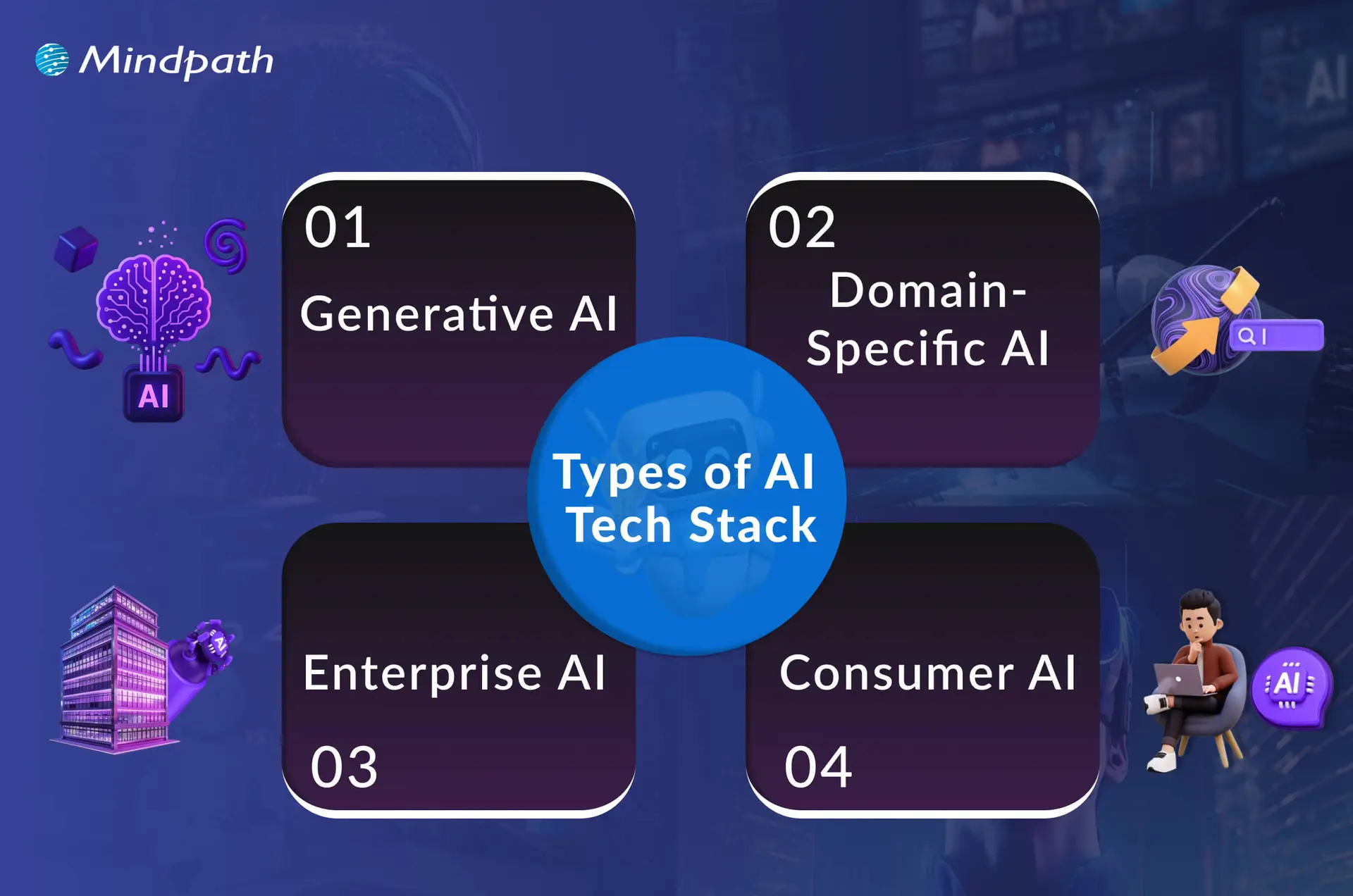
There are different types of Artificial Intelligence tech stacks, each designed to handle specific tasks and goals. Understanding these categories helps you choose the right tools for your project’s needs.
Types of AI Tech Stack

1. Generative AI

The GenAI tech stack provides the means to build intelligent systems that can produce new products like text, images, or audio. It blends together the powerful models available, the right data, and the handiest tools to streamline and improve development.

2. Domain-Specific AI

Some sectors require targeted stacks to accommodate specialized needs and regulations, such as healthcare, finance, and retail, that engage with trusted AI outcomes.

3. Enterprise AI

This works with large organizations and allows them to develop their own AI capabilities with respect to their internal processes and suitability for their growth. It integrates bespoke development, optimal operations, and seamless integration, providing an organized approach to their more complex requirements.

4. Consumer AI

It focuses on delivering users top-level, helpful, simple, and fast AI experiences they can engage with every day. Consumer AI taps into models, smart apps, and solid cloud or edge connections to produce a seamless experience for users.

Curious about where AI is headed? Head to our blog The Future of AI: How AI is Transforming the World to learn more!

Layers of an AI Tech Stack

Building an effective AI system means understanding how each layer supports the next. These layers work together to turn raw data into smart, reliable applications.
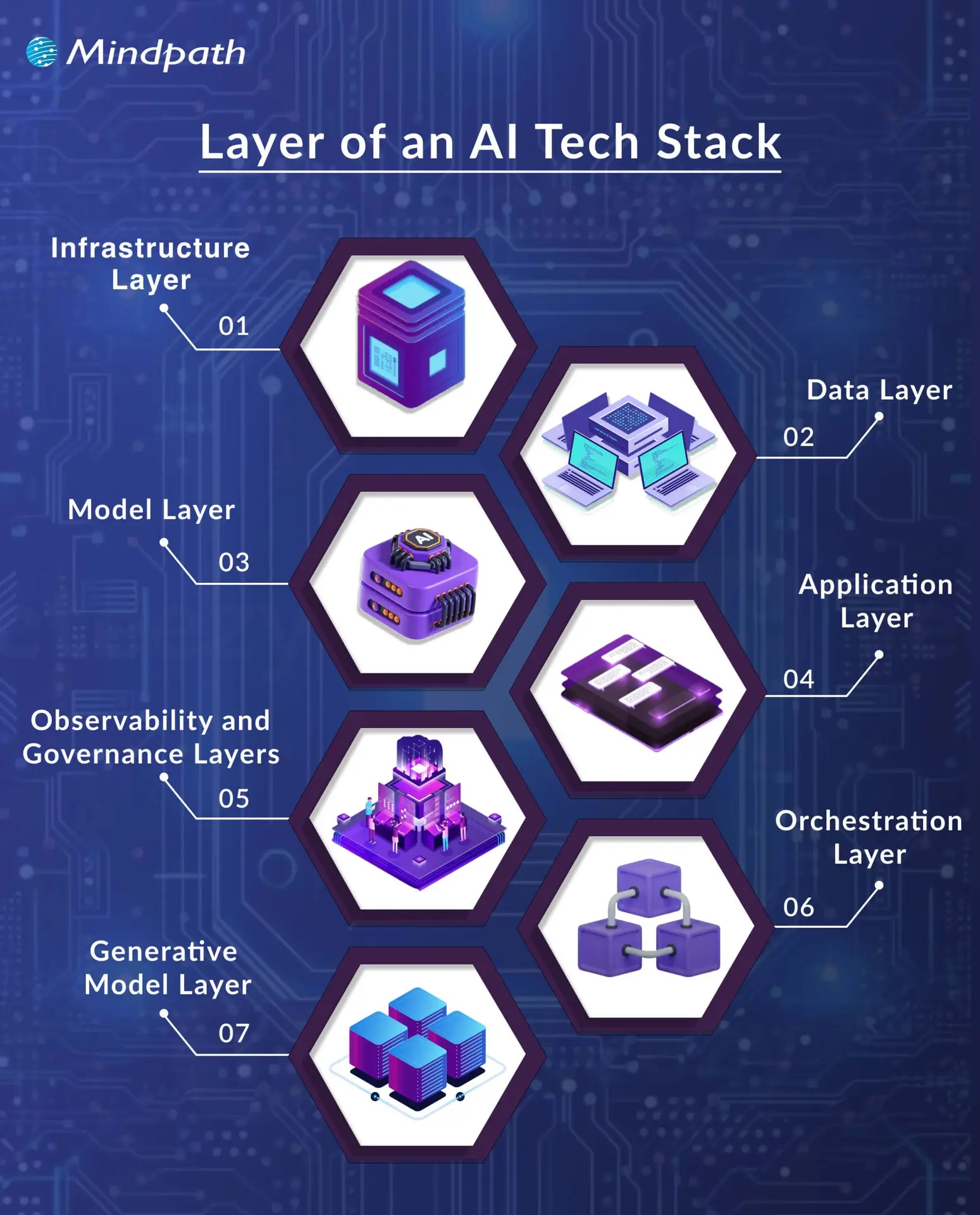
layer of an AI tech stack

1. Infrastructure Layer

This layer forms the base of a modern AI stack, giving you the hardware and software needed to build and run AI systems. It covers everything from powerful processors to storage and operating systems that keep everything running smoothly. Without a strong foundation here, AI development would be slow and unreliable.

2. Data Layer

Good data is the heart of AI application development. This layer handles how data is collected, stored, cleaned, and prepared for use. Clean, well-organized data helps models learn accurately and perform better.

3. Model Layer

This layer is where you build and train the brains of your AI. It includes frameworks and tools that make it easier to design, test, and deploy models. A well-managed model layer speeds up AI app development and boosts results.

Must Read: AI for Customer Service

4. Application Layer

Here, all your hard work connects directly with users. This AI tech stack layer includes the user interface, APIs, and logic that bring your AI features to life. A clear application layer ensures people get real value from your AI.

5. Observability and Governance Layers

These layers help you keep an eye on how well your AI works and that it stays secure and fair. They cover monitoring, performance checks, and rules for data protection. Together, they build trust and long-term success.

6. Orchestration Layer

This part keeps every piece of your AI system working together smoothly. It manages workflows and automates tasks to save time. Proper orchestration means you spend less effort fixing things and more time improving them.

7. Generative Model Layer

This layer focuses on models that can create new content like text or images. It uses strong foundation models and customizes them for what your project needs. A good setup here drives innovation for creative AI solutions.

Struggling to choose the right AI model to power your AI-driven application? Explore our detailed guide on the top AI models to understand their capabilities, strengths, and real-world applications

Best Practices for Building an AI Technology Stack

Building an effective AI tech stack takes careful planning and the right approach for your goals. Following best practices helps you make smart choices and get the most out of your AI development tools and resources.

1. Define Your AI Goals Clearly

Start by knowing exactly what you want your AI tech stack to do. Clear goals help you choose the right tools and avoid wasting time on things you don’t need. It could be improving customer service, automating tasks, or predicting trends. When everyone understands the goal, the project runs smoother and stays focused.

2. Prioritize Good Data Early

Good AI starts with good data that’s clean, organized, and reliable. Make sure you have a strong system to collect and manage your data from day one. Accurate data helps your models learn better and make smarter decisions. Invest time in setting up clear data processes to get the best results.

3. Keep It Flexible and Automated

A flexible setup makes it easier to update or add new tools as your needs change. Modular systems let you swap parts without starting over, saving time and money. Use automation to handle boring, repetitive tasks, so your team can focus on important work. This approach helps you scale and stay ready for growth.

Wondering which generative AI tools are transforming modern AI application development? Learn more about the top GenAI tools for the future of AI development to strengthen your AI tech stack.

4. Ensure Security and Teamwork 

Keeping your AI secure should always be a top priority, especially when handling private data. Follow all rules and regulations to stay compliant and avoid risks. Make sure your team works well together by setting clear roles and sharing information. Strong teamwork and security build trust in your AI system.

5. Keep Improving Your Models

Your AI models should never stand still. Create a process to check how they perform and update them with fresh data. This helps your system stay smart and relevant as things change. Regular updates mean better results and a competitive edge.

6. Plan for Easy Growth

Think ahead so your system can handle more users, bigger data, and new features as you grow. A scalable setup saves you from costly rebuilds later. Make sure your tools and infrastructure can expand without any problems. This way, your AI stays strong no matter how much your business grows.

Not sure how to strategically implement AI beyond just the technical stack? Explore our detailed guide on AI in business strategy to understand how to turn AI capabilities into measurable business value.

Looking to Power Your Business with Smart AI Tech Stack?

A clear and well-structured AI tech stack makes it easier to turn complex ideas into reliable AI applications. By choosing the right tools and following smart practices, you can handle data better, keep your systems secure, and scale with confidence. A good foundation now means your solutions will adapt smoothly as your needs and goals grow.

At Mindpath, we offer trusted AI development services to help you build and maintain AI solutions that work in real business scenarios. Our team combines the best tools and strategies to design applications that learn, perform, and deliver results. Let us help you leverage AI to achieve your goals and maximize the value of your investment.
Related Post

Discover staff augmentation for IT projects, its benefits, and top providers in the USA. Learn how it can bridge gaps and save costs.
Discover the ultimate guide to hiring Node.js developers in London. Learn about the skills, benefits, and cost factors involved in finding the right talent for your project.

Related Post

retail IT sourcing

The retail industry has undergone a great transformation due to its widespread adoption of IT outsourcing services. Recently, the global IT sourcing service market size is expected to reach USD 752.08 billion by 2031. So, by outsourcing the major IT functions like technical support, infrastructure management, and site development, your retail business can prioritize its core approaches. Further, you can strategize better features for satisfying your customers in the long run.

The following approach has made many retail businesses stick to better process agility. So, you can easily adapt to changing market demands without worrying about handling IT operations internally. Let us further analyze how retail IT sourcing can smartly empower your business.

Looking to enhance customer experience and streamline your retail processes? At Mindpath, we offer scalable retail and ecommerce software development services built for performance.

Why Retailers are Facing Growing Technology Pressure?

As per the trends of McKinsey, around 40% of consumers claimed to switch their retailers or brands. So, such a pattern is putting retailers under constant pressure to innovate something unique while maintaining streamlined daily operations. Moreover, customers are more into fast proceedings and personalized approaches while being mindful about data security. Most importantly, they demand consistent experience throughout offline and online platforms.

To meet such valuable preferences, you need to rely on modern retail IT solutions.

But assigning the whole task to your in-house team can be a bit challenging. Rising IT operational charges might hamper you, along with inefficient skills. Further, an unresponsive system might impact your sales. This is why outsourcing experts can be your ultimate option.

What is Retail IT Outsourcing?

In retail IT outsourcing, you need to partner with an external technology provider to manage your IT functions. Such skilled professionals can help you with innovative retail IT services that can upgrade your business operations while encouraging customer experience.

So, instead of depending upon huge internal teams, your business can leverage the authenticity of experienced professionals. Further, outsourced teams come with better experience and industry knowledge. Such adoption can also allow your retail business to follow its core responsibilities.

Wondering how evolving digital solutions are influencing modern retail operations? Read our Digital Transformation Trends blog to uncover the strategies defining the future of retail.

Why Retail IT Sourcing Makes Sense for Modern Retailers?

Here you can discover why outsourcing retail industry IT services can be beneficial and how it can help your business gain a competitive edge. Further, it allows you to discover many influential opportunities that you might have missed to date.

1. Cost-Efficiency Without Compromising on Quality

Retail IT outsourcing services can be financially helpful while saving on expenses. When you outsource the IT team, it can minimize the operational charges that include labor expenses. For example, your company can save up to 70% on its labor costs by discovering the talent pool in countries with minimal wage standards.

Such financial flexibility allows businesses to channelize the resources more effectively.

2. Better Customer Experience

Outsourcing can essentially make your customer experience better by offering them 24/7 support along with multilingual service. This can help your customers get efficient and timely assistance, no matter what time zone they follow. Moreover, this approach is beneficial for retail businesses that have a global customer base.

Moreover, through IT outsourcing, businesses and modern retailers can integrate modern service solutions like social media support and live chat.

3. Flexibility and Scalability

One of the most detailed advantages of retail outsourcing services is its scalable features. You can easily broaden your operations or make them minimal as per the market requirements and seasonal peaks. Further, this flexibility is essential in fast-paced e-commerce businesses, where your customers need frequent changes as per the trends.

Must Read: AI in E-commerce

4. Prioritize Core Competencies

If you prefer retail IT sourcing for your non-core functions, you can easily focus on the core competencies of your business. Some of the major elements include brand strategy, product development, and market expansion. Such focus can allow your business to innovate and prove its uniqueness in the crowded market.

5. Technological Advancements

Outsourcing allows retail businesses access to the trendiest technological advancements without any in-house investments. Additionally, outsourced partners also bring specialized expertise in modern tech like big data analytics, machine learning, and AI.

6. Improved System Reliability

Downtime in your retail business can directly influence your customer trust and sales. So, outsourced retail IT services proactively monitor the systems while managing the updates.

Ready to enhance retail efficiency with intelligent solutions? Explore AI and business strategies that drive innovation and accelerate sustainable growth.

What are Some Eminent Retail Industry IT Services That Can Be Outsourced?

Understanding the massive scope of retail IT sourcing can help you acknowledge the best functions that need to be outsourced.

1. Inventory Handling

This type of outsourcing mainly involves tracking stock levels and managing reorders. It can also align your warehouse functions. A professional team will always use modern tools to verify the inventory quickly while lessening the chances of overstocking or running out of products.

2. Managed IT Support

This approach includes maintaining hardware and software, monitoring systems, handling updates, and backups. Further, managed services can encourage your operations while lessening the efforts of your internal teams.

3. Managing Cloud Infrastructure

Cloud-related retail IT services can encourage scalability while adopting real-time visibility. Further, outsourcing cloud management can assure you of great performance and cost efficiency without any internal defects.

Also Read: Digital Transformation for Business 

4. Technical Support

Professional outsourced teams can help your retail company resolve the technical issues quickly while ensuring your system performs well. Further, it accesses your in-house team to leverage the best features for its customers.

This approach can give rise to quick resolutions while keeping your online operations intact.

5. Custom Development

Retailers generally require applications that remain streamlined. Starting from inventory tracking tools to engagement patterns, everything has to be in shape. So, outsourced retail IT solutions can build and integrate such functions precisely while prioritizing your core requirements.

Challenges You Might Face Without IT Outsourcing

As retail operations have become more technology-driven, managing IT internally can give rise to a series of risks. Some of the eminent ones have been given below.

  • Frequent system crashes.
  • Limited access to professional IT knowledge.
  • Difficulty in following the trendiest retail technologies.

Struggling to scale your retail systems efficiently? Read how custom software development can help you deliver personalized retail journeys.

Conclusion

Outsourcing retail IT services has become extremely important for businesses that want growth while keeping their operations intact. So, partnering with outsourcing providers can help your company have access to expertise in order fulfillment, technical support, and much more. Further, you can think of innovations while being customer-focused in this rapidly evolving retail environment.

If you also want to seek quality-oriented and dependable outsourced IT services, Mindpath stands as your top choice. We offer tailored retail IT outsourcing services that are designed to support your modern retail operations while helping you adopt long-term digital success.

FAQs

1. How Can Outsourcing IT Services Influence Your Retail Businesses’ Operational Efficiency?

Outsourcing a team for your IT functions can align your operations by offloading time-consuming tasks like customer support and inventory management. This allows your in-house teams to prioritize strategic initiatives.

2. Is Retail IT Outsourcing Viable for Small and Mid-Sized Retailers?

Outsourcing is extremely viable for small and mid-level retailers as it offers access to advanced IT facilities without being a burden on your pockets.

3. How Can Outsourcing Services Enhance the Supply Chain of My Retail Company?

Outsourcing can encourage the supply chain of your retail company by leveraging logistics and inventory management expertise. It also ensures that you offer the projects on time without any delays.

4. Can Retail Outsourcing Support Both My Online and Physical Store Operations?

Outsourcing partners generally manage integrated systems that support e-commerce platforms, POS systems, and inventory management across physical and digital operations.

5. How Can an IT Outsourcing Company Help Me During Peak Sales Seasons?

Outsourced IT teams can assess the infrastructure while monitoring performance and providing rapid support during high-traffic seasons.

Discover how Retail IT Outsourcing helps retailers save costs, enhance customer service, and stay competitive in today’s fast-paced market.
top genAI tools

If you’ve been paying attention to the tech world lately, you must have seen how the best GenAI tools are revolutionizing the way we can accomplish our jobs. Whether it is writing content in seconds or smartly developing sophisticated apps without heavy layers of coding, innumerable examples exist of how these tools are helping people do more with less effort. These AI tools are quickly becoming the new solution for developers, creators, and organizations who want to increase their speed and get better results.

The evolution of GenAI is transforming how industries approach work and innovation. Work that could take hours, and manual efforts are now being dramatically reduced to minutes through intelligent tools. Developers and organizations are employing GenAI tools in many everyday tasks. They provide efficiency, less effort, and improved outcomes. In this blog, we will showcase the most powerful GenAI tools carving the future of AI development. You’ll get a quick look at what they do and why they matter.

Looking to transform your ideas into intelligent, future-ready solutions with Generative AI? Our expert AI development services help you build scalable, smart systems that drive real business impact.

What is Generative AI?

Generative AI is an intelligent technology that creates new things using AI, like text, images, video, and even code. Generative AI can move beyond simply answering questions or completing simple tasks; it is able to generate something new. This allows businesses to operate more quickly and continually come up with new ideas.

Countless organizations are now taking advantage of generative AI to save time and operational efficiencies. Businesses apply it to write emails, design graphics, make advertisements as well as create chatbots. By leveraging generative AI, businesses can reduce manual labor, have fewer errors, and provide customers with their services in a more personalized and timely manner.

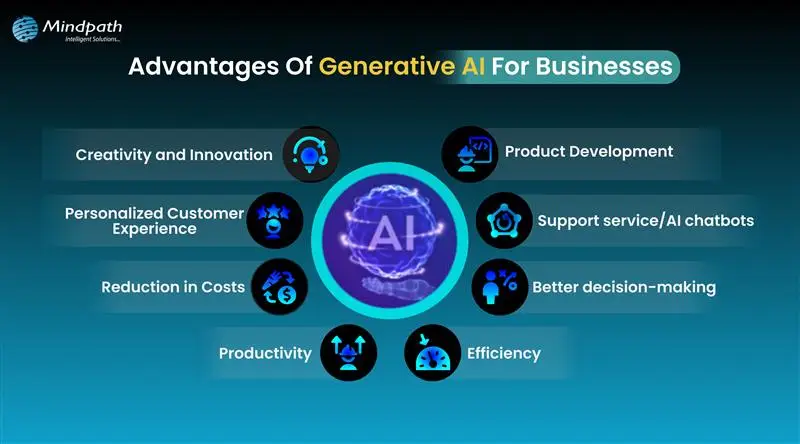
Here are some advantages of generative AI for businesses:

  • Creativity and Innovation – Generative AI allows businesses to develop more ideas and make new content.
  • Productivity – It saves time by taking responsibility for boring, menial tasks.
  • Efficiency – It allows work to be completed more quickly and with fewer errors.
  • Personalized Customer Experience – Business can create more personalized and relevant content for the customer.
  • Product Development – It can develop new products faster through automated coding, idea generation, and design enhancements.
  • Support Service/AI chatbots – It supports customer service chatbots that are capable of answering customer questions.
  • Better Decision-making – It provides some basic recommendations to businesses using data so they can make better decisions.
  • Reduction in Costs – It results in cost savings through automation of tasks and improved operations.

Curious about where Generative AI is headed next? Explore the top Generative AI Trends for 2025 and stay ahead of the innovation curve.

Best Generative AI Tools Driving the Future

Generative AI tools are making a big impact by helping businesses create content, improve services, and speed up their workflows. These tools are easy to use and offer smart solutions for many daily tasks. Below is a generative AI tools list that showcases the top tools shaping the future of work and technology.

1. Gemini 

Gemini is one of the best AI tools for students who need help with research, writing, and learning new topics. It works like a smart assistant that gives clear answers, supports multiple languages, and connects well with Google’s tools. It’s great for organizing ideas and understanding complex information more easily.

2. ChatGPT

ChatGPT is a helpful AI tool for writing, support, and idea generation. It can answer questions, create content, and help you think through new ideas. Whether you’re stuck on a project or need help with writing, it’s like having a smart assistant that’s ready to guide you anytime.

3. Cohere

Cohere is one of the useful generative AI tools for developers who want to build smart apps with language features. It helps create text for chatbots, search tools, and marketing content. Developers can use its API to train custom models and add natural language understanding to different types of projects.

4. GitHub Copilot

This tool is a great example of generative AI for coding, helping developers write code faster with real-time suggestions. It works smoothly with popular editors like Visual Studio Code and supports many languages. It also learns your coding style to give more personalized tips, making your development process easier and quicker.

5. AlphaCode

AlphaCode is a helpful generative AI coding tool that supports developers with tasks like writing code, fixing bugs, and learning new programming languages. It can save time by handling repetitive work and giving smart suggestions. It also helps improve code quality and makes team coding easier with shared ideas and solutions.

6. Microsoft Copilot

Microsoft Copilot is a smart assistant that helps with both coding and office work. It gives helpful code suggestions, writes documentation, and works well with tools like Visual Studio and Microsoft 365. It’s a great support tool for developers and teams who want to work faster and more efficiently.

7. Canva AI

Canva AI makes graphic design simple and fast, even if you’re not a designer. With its easy drag-and-drop setup and ready-made templates, you can create eye-catching visuals in minutes. It also gives smart design suggestions and helps keep your brand style consistent across all your projects.

8. DALL-E 2

This is one of the most creative generative AI applications, turning simple text into detailed images. You just describe what you want, and it creates visuals in different styles. It’s great for bringing ideas to life, whether you’re designing something new or showing a concept in a fun, visual way.

9. Microsoft Power Apps

This tool makes building apps easier by letting you use simple chat-like prompts instead of writing a lot of code. It helps create database layouts and app designs quickly. It’s great for teams working together and speeds up the whole process, though it works best within the Microsoft environment.

10. Turing’s CodeGen Copilot

This tool is one of the useful generative AI tools for programmers who want to save time and avoid repeating the same coding tasks. It fits well with tools like GitHub and Jira, making the workflow smoother. It helps boost productivity and lets developers focus more on creative and important work.

To explore how Generative AI is reshaping mobile and web experiences, check out our in-depth article on the Role of Generative AI in App Development. It dives into real-world applications and how this technology accelerates innovation in app design and functionality.

Want to Boost Your Workflows with the Best GenAI Tools?

GenAI tools are changing how we work, learn, and innovate. From faster coding to better customer service and content creation, these tools help users do more in less time. They are now essential for staying efficient, creative, and competitive in today’s fast-moving digital world.

Mindpath offers GenAI powered solutions to help businesses automate tasks, build smarter apps, and improve customer experience. Our expert team delivers AI tools that fit your goals, helping you reduce time, cut costs, and grow faster. Let us help you transform your business with our world-class, customised AI development services.

Frequently Asked Questions

1. How can businesses choose the right generative AI tools for their needs?

Choosing the right generative AI tools depends on business goals, tasks, and team requirements. Some tools focus on content creation, while others support coding or design. Evaluating ease of use, integration options, and scalability helps businesses select tools that deliver the best value.

2. Are generative AI tools easy to use for non-technical users?

Many generative AI tools are designed with simple interfaces that allow non-technical users to get started easily. Features like drag-and-drop design, natural language prompts, and guided workflows make it possible to use these tools without deep technical knowledge.

3. Can generative AI tools replace traditional software completely?

Generative AI tools are powerful, but they do not fully replace traditional software. Instead, they enhance existing tools by adding automation and intelligence. Businesses still rely on standard systems, while AI tools help improve speed, creativity, and overall efficiency.

4. How do generative AI tools improve productivity in daily tasks?

Generative AI tools help automate repetitive work like writing, designing, and coding. This reduces manual effort and allows teams to complete tasks faster. By handling routine activities, these tools free up time for more strategic and creative work.

5. What are the key challenges when using generative AI tools in business?

While generative AI tools offer many benefits, challenges include data privacy concerns, accuracy issues, and dependency on quality input. Businesses need proper guidelines and monitoring to ensure reliable outputs and responsible use while getting the most out of these tools.

Discover top GenAI tools revolutionizing AI development. Enhance creativity, automate tasks, and streamline processes for your business success!
trends in education

The transformative changes in the world of education have been fuelled by a wave of technological innovation. Just like other big sectors like finance, technology has had a formidable impact on the education industry. The emphasis on trends in education technology is gradually increasing as education has moved beyond the boundaries of classrooms. Education is becoming more personalized and dynamic with the help of different technologies, thereby establishing the foundations of EdTech. It is important to understand that EdTech is no longer another emerging trend. Educational technology, or EdTech, is now an integral element in the basic approach for acquiring knowledge. Let us find out the most notable trends that will dominate educational technology in 2026 and beyond.

Not sure how to move forward with education technology for your business? Contact us, we support organisations in building reliable and future-ready solutions.

Existing State of Education Technology

Before you learn more about the emerging education trends, you must understand the existing state of education technology or EdTech. The future of educational technology can revolutionize education on a global scale and create opportunities for students and educators. The EdTech industry is expected to become a $400 billion market by 2026 with new technologies redefining leaning experiences. Educational technology has the potential to address long-standing challenges in education alongside introducing the benefits of inclusivity, adaptability and accessibility.

As education gears up to become a $10 trillion industry by 2030, it is important to understand the scope of education technology. The integration of EdTech solutions has helped in creating ecosystems where learners can access knowledge anytime, anywhere. According to the World Economic Forum, the EdTech industry will serve more than 350 million post-secondary graduates and 800 million K-12 graduates worldwide in 2026. With such impressive numbers expected from the EdTech industry, you have strong reasons to believe that the industry will foster new trends.

Want to explore how AI can enhance teaching and learning experiences? Check out chatbots in education to discover how intelligent assistants provide real-time guidance and improve knowledge retention.

Unraveling the Big Trends for EdTech in 2026 and Beyond

The digital transformation of education with EdTech has been nothing short of a revolutionary experience for educators, learners and management. If you take a look at current educational trends, you will discover the significance of EdTech in transforming classrooms. Innovative technologies like artificial intelligence, virtual reality and other adaptive technologies have served as powerful tools for learners. The following sections will introduce you to some of the emerging trends in EdTech for 2026 and beyond.

1. Hyper-personalized Learning

The future of learning will rely a lot on artificial intelligence and there is no doubt in it. With the rising use of generative AI in education, learners and educators can capitalize on multiple advantages for better learning. Artificial intelligence plays a major role in adapting the learning experience to unique strengths, weaknesses and learning styles. Generative AI is shaping a new reality of education where personalized learning systems will ensure efficient learning experiences for every learner.

AI-powered learning systems can review the performance of learners, identify their knowledge gaps and also understand their individual learning styles. The systems can use the data to generate customized lessons, learning paths or adjust the difficulty of lessons. As a result, no student will be left behind in the learning journey and everyone will find equal opportunity to grow further.

2. New Role of Blockchain

Blockchain technology has been associated frequently with transformation of the education sector for its distinctive traits like cryptography or immutability. Blockchain is one of the biggest tech trends in education that can provide a completely new and efficient solution to verification of academic achievements. The concerns of fake certificates create troubles for deserving candidates who miss out on opportunities due to lack of verifiable credentials.

Blockchain can help in secure storage and verification of academic credentials like diplomas, degrees and certifications. As a result, learners will have more control over their academic records while enjoying the flexibility of distributing their credentials without the fear of copyright infringement. Blockchain can provide tamper-proof or immutable digital identities on a public ledger, thereby reducing the possibilities of fraud.

3. Adaptive Learning

Most of the discussions about the use of artificial intelligence in the education sector revolve around personalized learning. You can find many applications of AI in the field of education such as education chatbot apps that can solve learner queries at different stages. Adaptive learning through chatbot apps will emerge as one of the biggest trends in EdTech in 2026 and beyond. The primary goal of adaptive learning will focus on dynamic modification of lessons and content difficulty according to real-time assessment of student performance and engagement.

Adaptive learning systems will measure the progress of learners, identify their weaknesses and prepare learning paths that can guarantee success. The emphasis on lifelong learning along with growth of the online learning market creates more opportunities for adoption of adaptive learning systems. With the combination of predictive analytics, educators can use adaptive learning systems to create refined learning paths for truly personalized experiences.

4. Mix of Virtual and Augmented Reality

The list of top EdTech trends for 2026 and beyond will be incomplete without mentioning virtual and augmented reality. VR and AR have been implemented as solutions to create immersive learning experiences by transforming learners to places and situations that were previously unimaginable. For instance, VR can help learners visit historical sites in the classroom while AR displays overlay of digital information on the real-world objects.

The growing demand for immersive learning is one of the notable indicators of the rise of VR in education. At the same time, you must know that AR and VR encourage motivation, foster collaboration and improve comprehension. Virtual lessons have proved useful in enhancing the understanding of abstract concepts. Most important of all, VR and AR also present new opportunities for encouraging collaboration between learners and educators.

5. Bridging the Accessibility Gaps

As the world ushers in a new era of education, the primary use of IT in education will become more about making education accessible to everyone. The innovative use of technology in education with new EdTech solutions helps in achieving digital equity and accessibility. Learners can rely on EdTech to access education irrespective of their socio-economic background, physical abilities or geographic location.

Big organizations such as UNESCO recommend that local solutions will play a crucial role in transforming digital learning. One of the prominent emerging trends in educational technology will focus on creating infrastructure for digital literacy training, especially in low availability of resources. The only goal behind reducing the accessibility gaps will be about ensuring that every learner gets the opportunity to achieve their dreams.

Final Thoughts

The most noticeable trends for the domain of EdTech in 2026 and beyond include AI, blockchain and adaptive learning. VR and AR will also be the most prominent technology trends in education in future. You should know that these technologies will define future trends in education in 2026 and beyond with their transformative potential. For instance, AI can not only provide the foundation for hyper-personalized learning experiences but also create adaptive learning systems. You should also remember that data privacy and security will be prominent areas of concern in the future of EdTech. The challenges of potential biases in algorithms and the cost of implementing EdTech solutions will also create obstacles in future.

One of the crucial highlights that you should know about the higher education industry trends and EdTech focuses on opportunities. Educational technology will provide more productive and engaging learning experiences to every learner without any boundaries. At the same time, EdTech will also empower educators with resources that make them focus more on meaningful interactions. At Mindpath, we help organizations adapt to these evolving trends by building scalable and future-ready EdTech solutions.