

What can cause a well-planned software project to stray off track? Have you ever thought about this? Most of you must have found yourself in a similar situation, right? If so, you are not alone. Many organizations, just like yours, start with the right intentions, a highly skilled team, and a strong idea, but often face delays or an unexpected outcome. Typically, the problem dwells in small custom software development mistakes that begin in the early phases, and it ultimately grows into bigger challenges. If you ignore the early warning signs, it can quickly slow down the whole process. So, how do you keep a custom software project on target, on a clear and quick path toward your business goals?
Every custom software project is full of important decisions that shape the final product. From how you outline your needs to how your team communicates, every aspect matters a little more than you think. Without a defined process, even good ideas have a tendency to derail. In this blog, we will highlight the key custom software development pitfalls you need to avoid, making sure your custom software project stays on track! So, keep reading to find out!
Looking forward to tailoring a software which exactly fit your organizational needs? At Mindpath, we offer custom software development services that help in designing and developing software that meets your business goals.
Why Choose Custom Software Development for Your Business?
Custom software development is a process to create tailor-made software for your organization. It reflects your exact workflow, needs, and goals of the users. It is designed to suit your needs by solving your problems, rather than using predefined features as is the case with off-the-shelf software. Custom software offers better performance, is easily scaled, and puts you in control of the functionality, design, and updates as your business adapts and grows.
Standard software may be quicker to set up; however, it is inflexible, comes with ongoing licensing, and requires ongoing hardware changes. Custom software, on the other hand, is a long-term investment. It does not have unnecessary features, it supports your effective operation, and it also fits in smoothly with your systems. Interestingly, if it is designed by your team, it reduces time, minimizes long-term costs to improve decision-making throughout your business.
Let us take a quick dive into the benefits of custom software development:
1. Custom software will scale with your business as it grows. It also adapts easily when you expand your services or change your processes without incurring the costs of upgrades.
2. It is developed around your specific workflows and business objectives. This provides you with smoother operations without the restrictions and inefficiencies of a one-size-fits-all system.
3. Custom software also integrates well with your current systems. It allows data to flow from one platform to another with minimal manual work and with fewer mistakes.
4. It ultimately saves you money over time, and you won’t incur future licensing fees. You pay for only what you require, and the total cost of ownership is lower.
5. Custom solutions differentiate you in the marketplace. With unique features and enhancements to the user experience, you can be more competitive and more customer-centric.
6. It makes teams more productive in their daily tasks. When software matches each role, teams work faster, make fewer mistakes, and deliver better results.
Want to know more about the benefits of custom software development for your business? Head to our blog: Top Benefits of Custom Software Development
Top Mistakes to Avoid in Custom Software Development
Knowing the common challenges of custom software development is important for creating a successful solution. Many teams overlook some small but critical details, which are often the reason why custom software projects fail or are delayed.
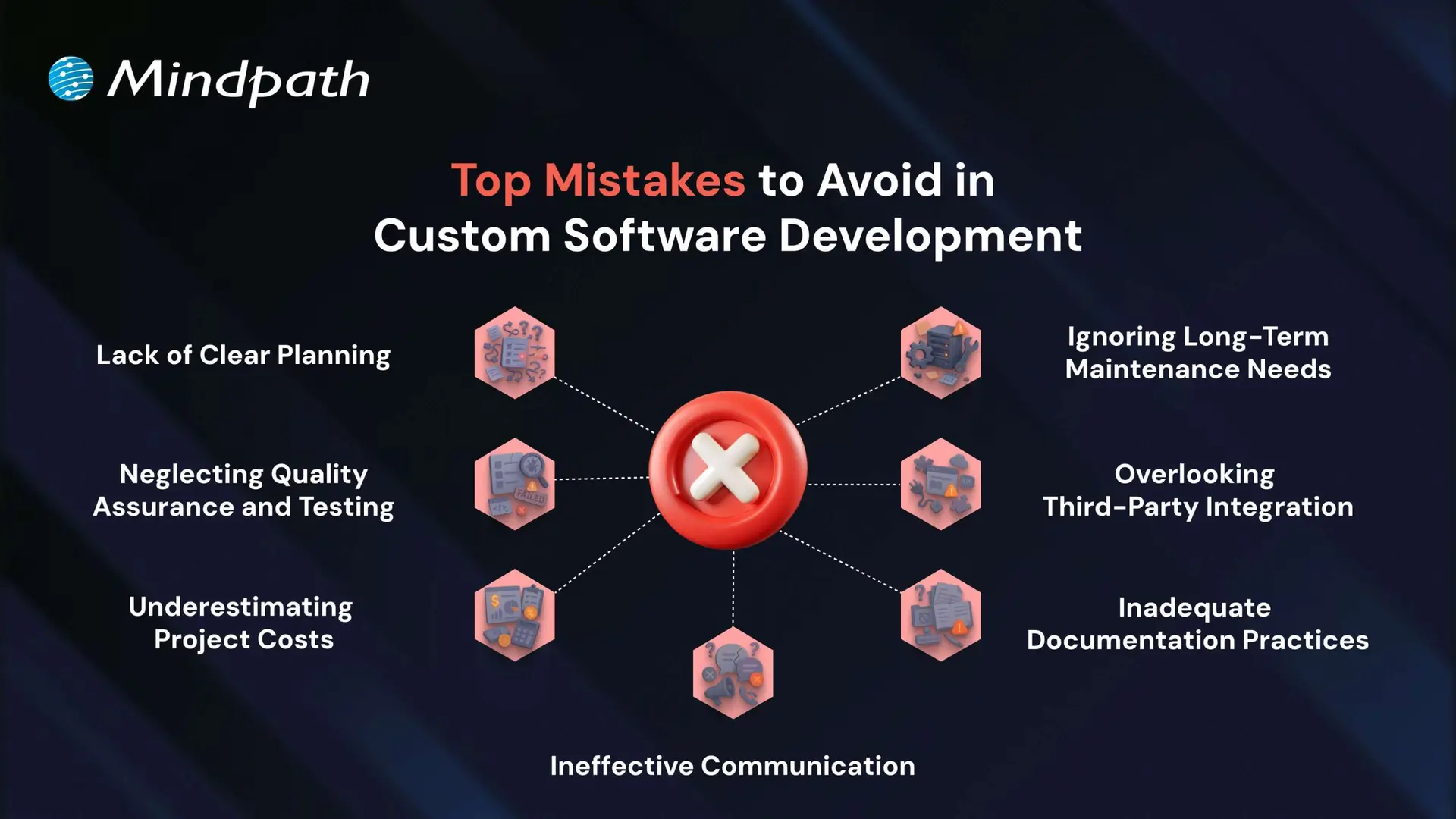
1. Lack of Clear Planning
A very frequently made mistake in custom software development is a lack of planning. If the business objectives are unclear and there is no well-structured roadmap in place, projects like these can end up with inflated costs and delays.
To prevent this, first ensure that key stakeholders are engaged and assess current processes, technologies, and long-term needs. Specify system requirements in detail, including integrations, UI/UX, architecture, and security, before you start the development.
2. Neglecting Quality Assurance and Testing
Omitting or neglecting testing is one of the common custom software development mistakes that can result in considerable problems post-launch. In many instances, some form of quality assurance takes place; however, in sufficient time to perform quality assurance, or altogether ignoring QA means bugs are left unidentified until it has become much harder (and much more expensive to fix).
In order to eliminate custom software mistakes like this, testing should be completed by qualified individuals using legitimate QA and UAT practices to deliver software that provides the customer or user, by and large, what they require to a fully qualified and operational level.
3. Underestimating Project Costs
Cost overruns are one of the most frequent custom software mistakes, primarily due to vague requirements and complexities not being properly assessed. When there is no clear requirement scope, budgets can easily become unbounded, creating delays and the likelihood of project failure.
To tackle this issue, establish a clear MVP with key features and distinguish them from desirable features. This will lead to realistic budgets and phases that can be developed incrementally and in alignment with business goals.
4. Ignoring Long-Term Maintenance Needs
Lack of planning for the ongoing maintenance of software is a challenge in the software development process. It can result in performance and obsolescence issues. Many well-built software solutions are inefficient and potentially vulnerable when support doesn’t happen, and you should not be surprised if yours is in the same boat when software support does not take place.
How can you prevent this? One place to start is with a clear maintenance strategy from the beginning. Budget for planned updates, security patches, and feature improvements so your software can run efficiently and securely.
If you’re planning a custom solution, our step-by-step guide to the custom software development process will help you understand each stage clearly.
5. Overlooking Third-Party Integration
Not considering compatibility issues with third-party systems is a custom software development mistake that can slow down development and reduce software performance. A poor integration strategy can result in data flow problems, missing functionality, and even unanticipated system failures.
To avoid this possibility, complete a full tech audit and feasibility study at the beginning of the project to help ensure the intended integration will go smoothly when the project is complete. This allows you to make informed decisions to move forward with a strategy that meets your business needs.
6. Inadequate Documentation Practices
Poor documentation is a custom software development mistake that results in a misalignment of expectations, confusion, and challenges for long-term maintenance. Documenting decisions and details of the project is imperative. Without documentation, teams cannot go back to understand or support the software later.
To avoid this mistake, be sure to define the scope of the project in advance and document as you go. Another solid practice is to have complete user documentation and technical documentation to enhance transparency, ease of handoff, and longevity.
7. Ineffective Communication
Poor communication is a common issue that leads to misunderstandings, missed deadlines, and project inefficiencies. When teams and stakeholders are not aligned, important decisions and updates can be lost or misinterpreted.
Following custom software development best practices involves maintaining open communication channels, regular check-ins, and clear documentation. This helps ensure transparency, accountability, and better collaboration throughout the development process.
Want to Build Smarter by Avoiding Common Custom Development Mistakes
Successful software projects rely on clear planning, communication, testing, and proper budgeting. Avoiding these common custom software development mistakes helps keep your solution on track and aligned with your business goals. By recognizing early pitfalls and following best practices, your team can build scalable, efficient software that delivers long-term value.
As a trusted custom software development company, we at Mindpath provide tailored solutions built around your unique business goals. Our custom software development services ensure seamless integration, ongoing support, and full transparency throughout the project lifecycle. Partner with us to turn your vision into a secure, high-performing solution that grows with your business.
Frequently Asked Questions
1. How do businesses know if they really need custom software?
Businesses usually need custom software when existing tools no longer support their workflows, growth, or customer needs. If teams rely heavily on manual workarounds or disconnected systems, custom software can provide a more efficient and scalable solution.
2. Who should be involved in custom software planning?
Project managers, business stakeholders, end users, developers, and IT teams should all be involved early in the planning stage. Their input helps create software that meets business goals while also being practical and easy for employees to use.
3. How can businesses reduce delays during software development?
Clear communication, realistic timelines, and regular progress reviews help reduce delays. Businesses should also avoid adding too many new requirements during development, as frequent changes can slow progress and increase project complexity.
4. What makes a custom software project successful in the long run?
Long-term success depends on scalability, proper maintenance, user adoption, and ongoing improvements. Software should continue evolving with business needs instead of remaining static after launch, helping companies stay efficient and competitive over time.
5. Can custom software improve customer experience directly?
Yes, custom software can create faster, smoother, and more personalized customer interactions. Businesses can build features specifically around customer expectations, making services easier to access and improving overall satisfaction and engagement.

Approaching software development without a flexible mindset can often result in delays and stress. This is where the benefits of agile methodology come into play. Agile allows a team to react quickly to change, provide value continuously, and maintain common goals. Agile fosters teamwork, quick delivery, and incremental updates. If you ever find that you are constantly feeling stuck or that things are moving too slowly, then Agile can provide a steady flow that will keep things moving forward and adjust its plans accordingly.
Agile offers structure while maintaining flexibility. Project work is broken down into smaller bits and allows for feedback and change along the way. This helps keep developers, testers, and clients engaged through the process. People can track progress more easily and receive results faster. Agile doesn’t just focus on completing tasks, but on building something useful at every step. This blog highlights some of the primary benefits of Agile that many of today’s teams prefer to embrace.
Explore how custom software development services using agile methodologies elevate your business performance. Reach us at Minpath, and we will provide expert guidance to you every step of the way.
What is Agile Methodology?
Agile methodology is an adaptive and collaborative method of software development based on the principles set forth in the values of the Agile Manifesto. Agile focuses on teamwork, the ability to adapt, continuous improvement, and the delivery of working software in small, manageable pieces. An agile team is self-organized and can adapt quickly to changes during the development life cycle. So, what is the main objective of agile methodology? It is to be responsive and provide value more quickly.
Agile focuses on helping teams select tools and techniques for their goals rather than abiding by a single standardized process. Each project can look a little different, but they all follow the same Agile principles by planning in short iterative cycles, soliciting feedback, and adjusting from there. Ultimately, Agile allows teams to deal with uncertainty during a project in order to improve at every turn.
Types of Agile Methodologies
Agile provides several methodologies that adhere to its fundamental principles; however, they differ in structure and practice. Each is intended to foster teamwork, speed, and flexibility in its own unique way.
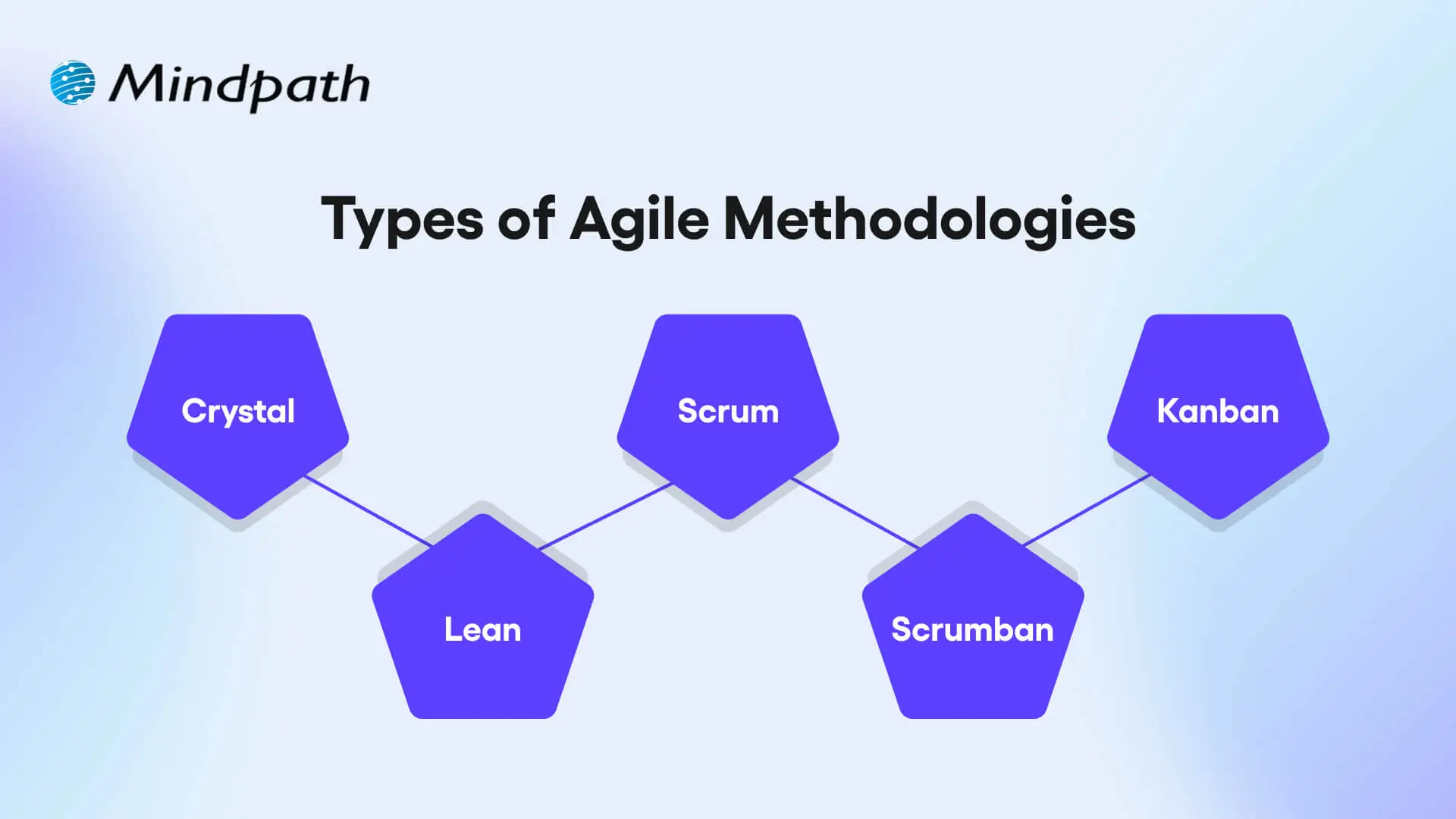
1. Crystal
Crystal is a lightweight agile methodology that encourages rapid delivery of working software, communication with customers, reducing risks, and frequent releases. It is flexible with respect to team size and project complexity, and it promotes collaboration and communication to improve team and customer feedback.
2. Scrum
Scrum is a prescribed agile framework that arranges work into fixed-length sprints, which allow the team the opportunity to inspect how much work was done so far and adjust based on that. The goal is to enhance visibility, facilitate some level of collaboration consistently, and have continuous improvement as the team works through it with prescribed roles and ceremonies.
3. Kanban
The kanban approach is concerned with delivering work continuously and has a strong lean focus on improving the process. The visual workflow helps teams find bottlenecks, work on reducing cycle times, and allows managing work to be simplified using boards and cards.
4. Lean
Lean focuses on maximizing customer value by eliminating waste and improving efficiency throughout the development process. It supports fast delivery, strong team collaboration, and quick response to feedback.
5. Scrumban
Scrumban fuses the structured planning of Scrum with the visual task management of Kanban to allow flexible value-based delivery. It is an adaptable and process-focused method that allows teams to incorporate regular updates, rapid releases, clear task ownership, and adaptability as project needs change.
Wondering how Agile practices fit into the bigger picture of building high-impact web applications, our web app development roadmap outlines the full step-by-step journey from planning to deployment.
Top Benefits of Agile Methodology
Agile provides a modern approach for the management of software projects, which is focused on flexibility, collaboration, and rapid delivery. Here are some important agile software development benefits that aid teams in creating better products with better timeliness.
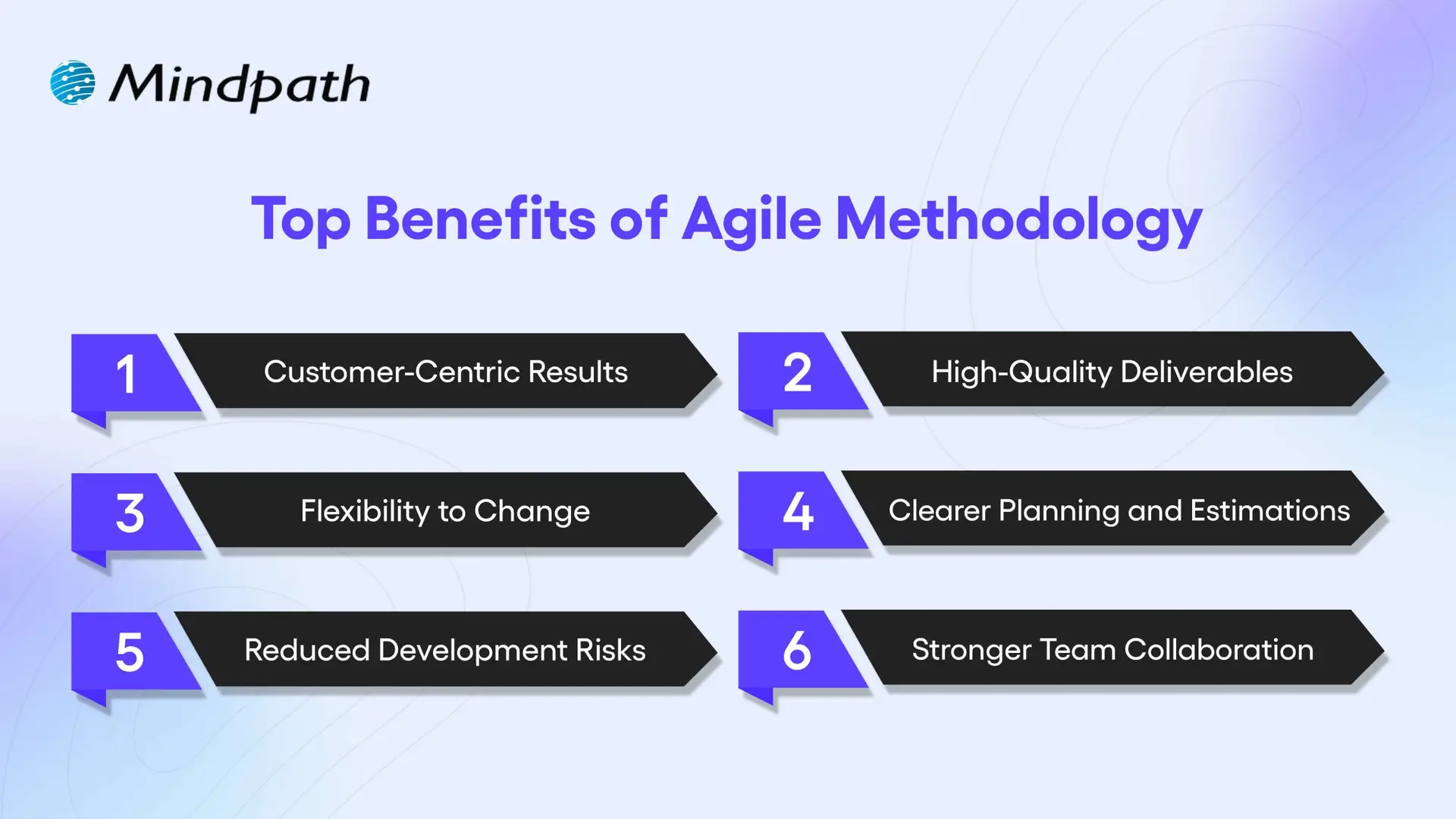
1. Customer-Centric Results
Agile methodologies promote regular feedback and involvement from customers in every aspect of development, leading to products that can be tailored to more accurately fit the needs of the user. One of the key agile software development advantages is that this increases customer satisfaction (as perceived by customers during development) and trust moving forward.
2. High-Quality Deliverables
With every sprint of work teams are testing and improving their work. You will note that the ongoing improvement is one of the key benefits of agile software development, and it helps teams develop stable and reliable products. Solving problems early is part of the workflow.
3. Flexibility to Change
Agile teams can quickly adjust plans in response to new feedback or ever-changing goals, and ease of change is one of the greatest strengths of agile software development. The essence of agility is the ability to stay aligned with business needs without spending unnecessary time or going off track.
4. Clearer Planning and Estimations
Agile operates within short, structured cycles, which allow for considerably improved estimation of timelines and budgets. This is one of the most important benefits of agile software development, especially for project managers whose primary goal is to solicit the meters for project planning in the most effective way possible. Predictable progress encourages smarter decisions.
5. Reduced Development Risks
Frequent reviews and updates allow teams to catch issues early when they are still not serious problems. This built-in risk control offered by agile is of major benefit to agile project success. Agile provides full visibility into work progressing at all times.
6. Stronger Team Collaboration
Agile encourages daily stand-ups, a routine dialogue, and real-time feedback/updates. This collectively helps with teamwork, collaboration, and confusion regardless of role. Better communication is one of the fundamental advantages of agile methodology and contributes to an easier, smoother project flow.
Want to know how businesses turn ideas into scalable software solutions? Explore the custom software development process and the role Agile plays in efficient execution.
Ready to Embrace the Agile Advantage?
Agile has changed the way modern teams build software by promoting collaboration, speed, and flexibility. The benefits of agile methodology include higher customer satisfaction, better product quality, reduced risk, and smoother workflows. By using short cycles and continuous feedback, Agile helps teams deliver faster, smarter, and with greater confidence, making it a preferred choice for many development teams today.
Want to apply these custom software development benefits to your next project? At Mindpath, we offer custom software development services built around proven agile methodologies. Contact us and our team will help you with clear communication, flexible planning, and faster delivery that meets your business goals. With Mindpath, you get tailored solutions that revolve around your business requirements and deliver long-term value with every sprint.
Frequently Asked Questions
1. Is Agile methodology suitable only for software development projects?
No, Agile is used in many industries beyond software development, including marketing, healthcare, education, and product management. Any team that needs flexibility, faster delivery, and continuous improvement can benefit from adopting Agile practices in their workflow.
2. How long does it take for a team to adapt to Agile?
The transition time depends on team size, experience, and project complexity. Some teams adapt within a few weeks, while others may need a few months to fully understand Agile practices and build a smooth collaborative workflow.
3. Can Agile work for large enterprise projects?
Yes, Agile works well for both small and large projects. Large enterprises often use scaled Agile frameworks to manage multiple teams while maintaining collaboration, transparency, and faster delivery across complex projects and departments.
4. What tools are commonly used in Agile project management?
Teams often use tools like Jira, Trello, Asana, and Azure DevOps to manage Agile workflows. These tools help track tasks, manage sprints, monitor progress, and improve communication between developers, testers, and stakeholders.
5. How does Agile improve communication between clients and development teams?
Agile encourages regular meetings, sprint reviews, and continuous feedback throughout the project. This keeps clients involved in decision-making, improves transparency, and helps development teams stay aligned with changing business expectations and project goals.
Companies today understand that it’s essential to have satisfied customers at every touchpoint, to keep in front, and that is where the magic of Conversational AI resides. Are you wondering what is conversational AI? It is the technology that informs smart chatbots and virtual assistants that provide 24/7 interactions for infinitely scalable engagements. Organizations leverage conversational AI to reduce waiting hours, respond to customer inquiries in real-time, and keep delivering a consistent quality of service.
This amazing technology is enhancing efficiencies, saving costs, and maximizing customer satisfaction. Conversational AI stands to revolutionize the performance of an organization, as well as the measurement of its growth, by automating processes with personalized support. If you’re interested in how it works and what benefits it has in store for you, let’s discuss all its amazing features in this blog, step by step.
Are you looking to implement smart chatbots or a virtual assistant in your business to enhance customer engagement? Mindpath’s AI Development Services will help you achieve customer satisfaction with 24/7 support.
What is Conversational AI?
Conversational AI is smart technology that helps artificial intelligence bots like chatbots and virtual assistants talk with people in a natural, human-like way. It’s all about making AI more human, so interactions feel real and engaging. By understanding what we say and how we say it, these systems make conversations easier and more helpful for everyone.
Conversational AI is built using machine learning and natural language processing, and it harnesses the knowledge of millions of conversations. Learning from these conversations allows artificial intelligence bots to improve upon responding to questions, solving problems, and predicting what a customer may need next more accurately. It’s a powerful step toward making AI more human and building better customer experiences.
Types of Conversational AI
There are different types of Conversational AI technologies a business can use to meet customers and deliver its services to them. Each one operates in its own way and could have its own niche when it comes to customer support, sales, or engagement objectives.
1. Voice Bots/Assistants
Voice bots and assistants are a type of conversational technology that interacts with people through spoken language. They listen to what a person says, figure out what they need, and respond naturally. This makes everyday tasks easier, from playing music to managing smart home devices.
2. AI Chatbots
AI chatbots are a powerful type of conversational AI designed to hold natural, human-like chats. These conversational agents use advanced language models to understand context and respond in a way that feels personal and clear. They help businesses handle complex questions and provide better support around the clock.
3. Interactive voice response (IVR)/Interactive voice assistants (IVA)
Interactive Voice Response and Interactive Voice Assistants are a type of conversational AI that helps people navigate phone systems using voice or keypad inputs. They understand what a caller needs and guide them to the right solution without long wait times. This makes customer service smoother, faster, and more convenient.
Wondering how conversational AI is advancing into systems capable of autonomous action and decision-making? Explore how Agentic AI is redefining intelligent, self-directed digital behavior.
Advantages of Conversational AI
Conversational AI has become an important part of how companies connect with people today. Here are some key advantages it can bring to your business.
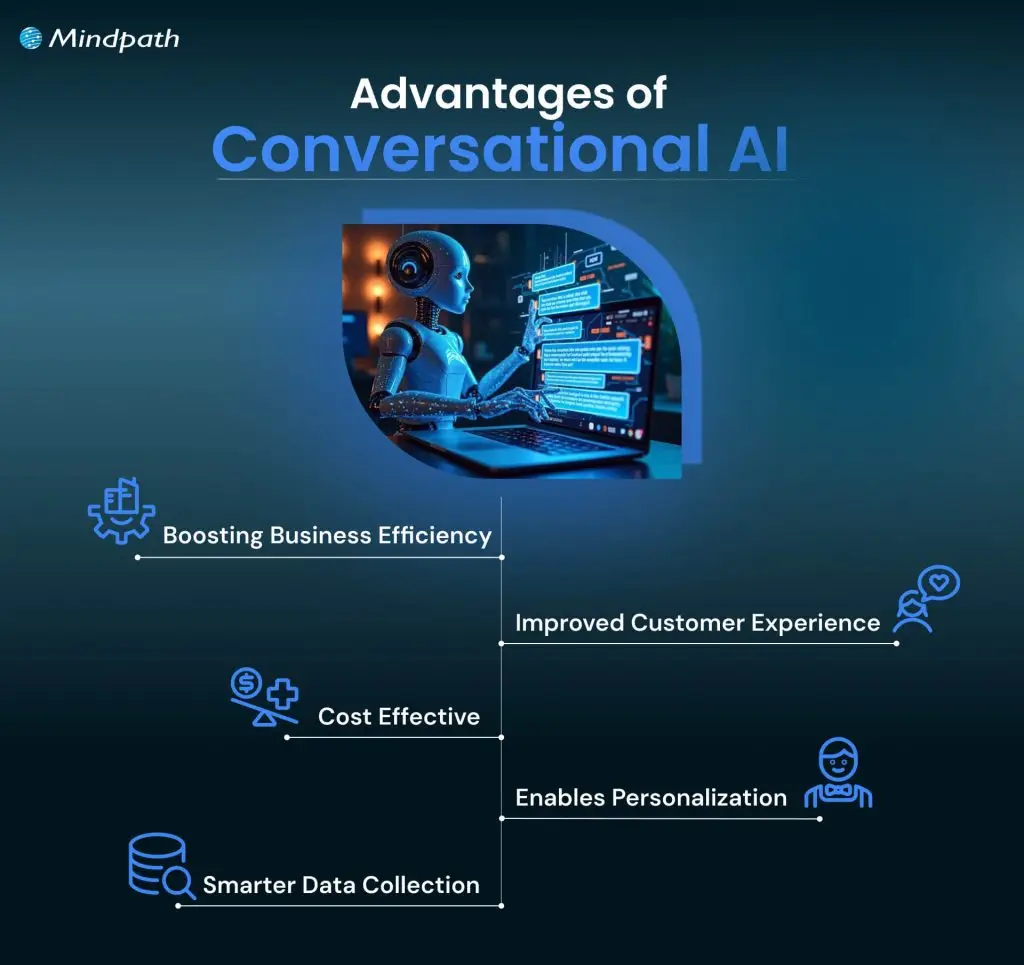
1. Boosting Business Efficiency
Conversational Artificial Intelligence can manage many routine tasks without needing a human agent every time. This means your team can spend more time on important work while the AI handles simple customer conversations. With artificial intelligence conversation tools available 24/7, your business can solve customer queries faster and work more efficiently, showcasing the many benefits of chatbot technology for operational productivity.
2. Cost-Effective
A good conversational AI platform can handle customer calls and chats automatically, with little need for extra staff. By making AI more human and accurate, it helps you manage high volumes of requests without extra cost. This saves money on daily operations and reduces mistakes, keeping your business cost-effective.
3. Improved Customer Experience
Artificial intelligence bots make it easy for customers to get quick answers and help whenever they need it. This technology offers personalized replies and a smooth, contactless service for people all over the world. It creates a better customer experience and keeps people happy with your business.
4. Enables Personalization
This technology learns from each customer’s information, like location and past interactions, to offer a more personal chat experience. It can suggest helpful answers and next steps based on what each person needs. This makes solving problems faster and reduces the need for follow-up calls.
5. Smarter Data Collection
This technology helps you collect useful information from every customer conversation. By tracking what people say and how they interact, you can spot trends and understand what customers really want. This makes it easier to improve your sales and marketing strategies over time.
Want to explore the innovations shaping the future of conversational AI? Explore our blog on the top AI trends to discover the emerging technologies redefining intelligent communication.
Use Cases of Conversational AI
Conversational AI can be used in many ways to make business operations smoother and customer interactions better. Here are some common use cases that show how an example of conversational AI works in real life.
1. Conversational IVR Systems
Modern IVR systems let customers speak naturally instead of pressing buttons to find help. For example, airlines now use conversational IVR to let travelers say things like “Change my flight” or “Check flight status” and get quick answers without waiting for a live agent.
2. Seamless Transfer to Live Agents
When a bot can’t handle a request, it passes the chat to a live agent along with all the details, so nothing gets lost. For example, a telecom company’s virtual assistant can detect when a billing issue is too complex and smoothly transfer the full conversation to a specialist who can resolve it faster.
3. Round-the-Clock Support
These chatbots answer simple customer questions at any time of day without needing a live agent. For example, an online retailer’s chatbot can help shoppers check order status or find return instructions even after business hours.
4. Tailored Product Recommendation
This technology suggests items people might like based on what they’ve bought or browsed before. For example, a streaming service’s chatbot can recommend new shows or movies based on what you’ve just finished watching.
Ready to build conversational AI that boosts sales and strengthens customer engagement? Learn how AI in e-commerce transforms online shopping experiences and drives measurable business growth.
5. Effortless Onboarding
These assistants help new employees feel confident and prepared by guiding them through company policies and tasks step by step. For example, an HR team can use an AI onboarding assistant to help new hires complete paperwork, set up work tools, and get reminders about training sessions.
6. Task Automation
These bots connect chats to your business tools, so tasks like updating customer records or creating tickets happen instantly. For example, the best conversational AI chatbot for an e-commerce store can automatically create a return request and send an update to the warehouse team.
7. Faster Lead Conversion
These chatbots ask visitors the right questions to see if they’re a good fit for your product or service. For example, a real estate company’s chatbot can collect details about a buyer’s budget and location, then connect them with the right agent.
8. Timely Updates
These AI tools send helpful reminders and updates before customers even ask, keeping everyone informed and stress-free. For example, a healthcare provider can use this to remind patients about upcoming appointments or share wellness tips.
If you want to use AI to improve your healthcare services. Learn from our blog AI in Healthcare, where we highlight real-world use cases of conversational systems supporting medical professionals and patients.
Conversational AI Best Practices
Using Conversational AI, the right way can help you get the best results for your business and your customers. Here are some best practices to keep in mind as you build and manage your AI solutions.
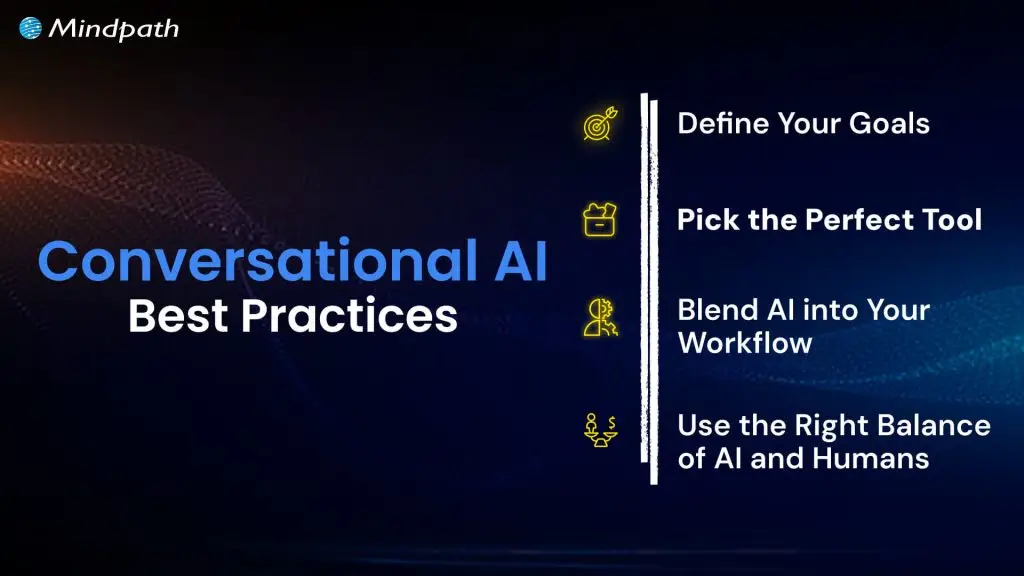
1. Define Your Goals
Always be clear about why you want to use conversational AI and what you want to achieve. Make sure it fits well with your bigger business plans, so it truly adds value.
2. Pick the Perfect Tool
Pick a conversational AI tool that fits your industry and matches your budget and goals. Make sure it can grow with your business, so you get the most value over time.
3. Blend AI into Your Workflow
Connect your conversational AI with your other business tools so it works smoothly with your daily tasks. This makes your processes faster, more accurate, and more useful for your team.
4. Use the Right Balance of AI and Humans
Let AI handle simple, repetitive tasks while your team focuses on work that needs a human touch. Always set clear points where the bot should hand over to a person for the best customer experience.
Curious how AI can optimize your workforce and improve business outcomes? Check out AI redefining job roles in Tech to see how intelligent systems are reshaping employee roles and driving operational efficiency.
Ready to Take the Next Step with Conversational AI?
Conversational AI is transforming how businesses connect with people by making everyday interactions faster and more personal. It helps companies work smarter, serve customers better, and grow with less effort. Now that you know what is conversational AI, you can start using it to create more value.
Mindpath offers professional custom chatbot development services to help you build and launch conversational AI that matches your business goals. Our experts create secure, easy-to-scale chatbots, voice assistants, and smart integrations. Let us help you deliver great customer experiences and stay ahead in the AI space.
Frequently Asked Questions
1. What industries benefit the most from conversational AI?
Industries like ecommerce, healthcare, banking, travel, education, and telecom benefit greatly from conversational AI. These businesses handle large customer interactions daily, so AI helps improve response times, customer engagement, and operational efficiency without increasing support workload.
2. Can conversational AI handle complex customer conversations?
Modern conversational AI can manage many complex conversations by understanding context and customer intent. When situations become too advanced, the system can transfer the conversation to a human agent while keeping the discussion history for a smoother experience.
3. How does conversational AI improve customer retention?
Conversational AI improves retention by providing quick support, personalized recommendations, and consistent communication. Customers are more likely to stay loyal to businesses that respond fast, solve problems easily, and offer convenient experiences across different channels.
4. Is conversational AI difficult for employees to use?
Most conversational AI platforms are designed with simple dashboards and easy management tools. Employees usually need minimal training to monitor conversations, update responses, and manage workflows, making adoption much easier for teams across departments.
5. How can businesses measure the success of conversational AI?
Businesses can track metrics like response time, customer satisfaction, lead conversion, support cost reduction, and resolution rates. Monitoring these results helps companies understand how conversational AI improves operations and customer experiences over time.
Custom software development is becoming the primary driver for businesses to get ahead of the curve in 2026. Businesses no longer rely on ready-made tools as existing tools fall short of meeting unique requirements. More recently, there is a higher need for tailored solutions that incorporate an organization’s goals and can scale as the firm grows. So, how will businesses ensure their software not just helps with their operations, but ultimately provides a legitimate competitive advantage?
In today’s fast-paced digital landscape, the right software is not only technology but also a strategy in practice. With custom software, businesses foster solutions that face specific challenges and ignite innovation. This guide walks through the core aspects of custom software development, including its definition, different types, benefits, key factors, and process. With a successful approach, adequately designed custom-built systems will enable progress and lead to long-term success.
At Mindpath, our custom software development services deliver secure and scalable services that meet your business goals and enhance your business performance.
What is Custom Software Development?
Custom software development builds software solutions designed for a business’s specific needs. Instead of using generic tools developed for all businesses, many companies are developing their own custom software applications to support their unique company goals, internal workflows, and their customers. The custom software process includes planning, designing, developing custom software, and then ongoing software updates. This proactive approach might help a business increase efficiency, allow the business to expand, and create a steady stream of revenue.
The basis of this method is personalization. Developers create each feature with intention, supporting groups like marketing or sales, and enhancing customer brand participation through apps and platforms. These tailored solutions align and integrate smoothly into existing processes, improving productivity. When businesses select the right design and functionality, they receive a competitive advantage and increase their ability to outgrow the competition in a rapidly evolving digital landscape.
Must Read: Software Development Cost
Types of Custom Software Solutions
Businesses face unique challenges, so they will need specific solutions to meet their goals. When used effectively, there are many kinds of custom software development solutions that can take advantage of that to drive efficiency and growth.
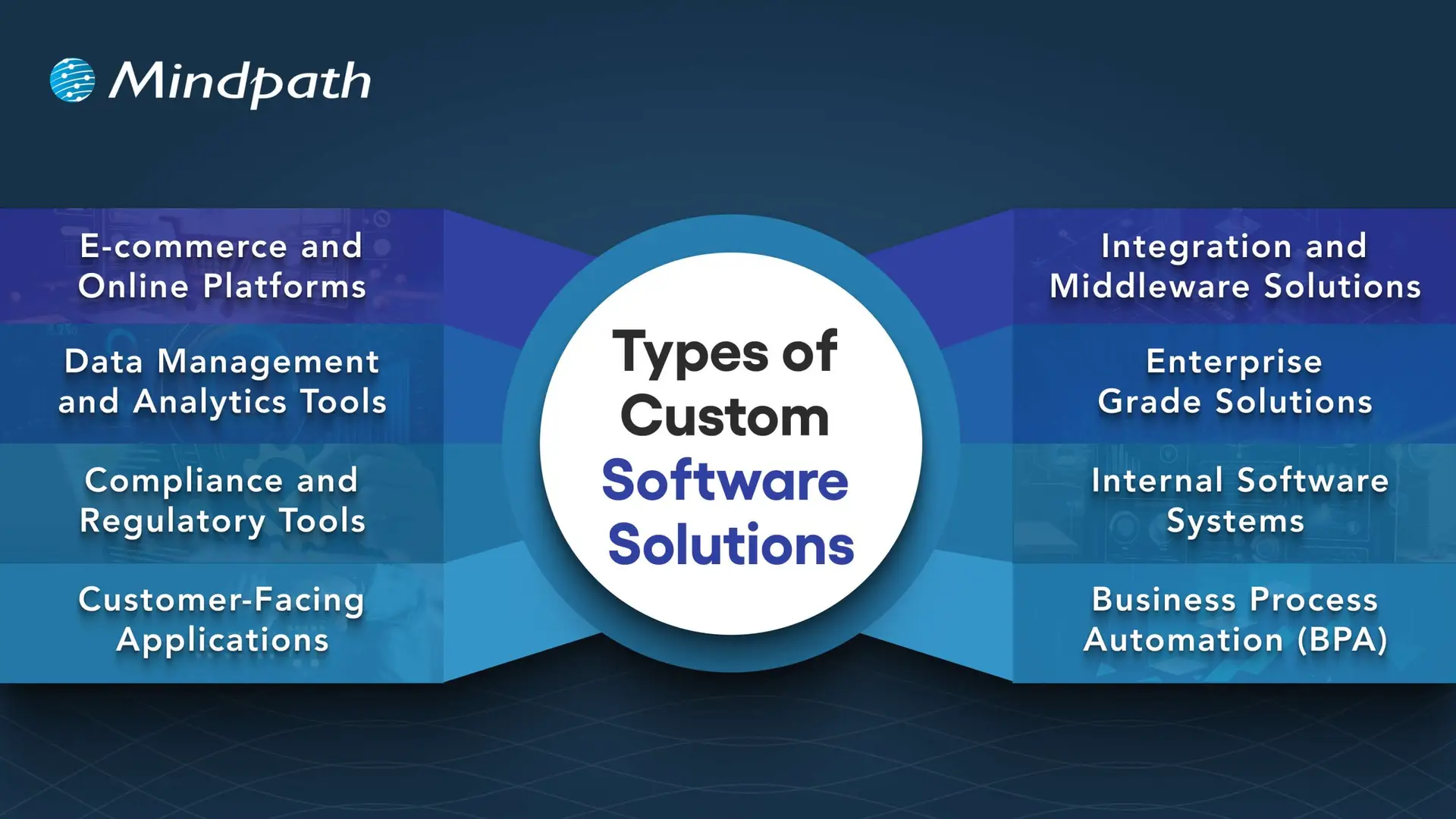
1. E-commerce and Online Platforms
Online businesses require more than a basic website. Custom platforms take care of payment, inventory, and customers quickly and accurately.
2. Data Management and Analytics Tools
Companies generate a never-ending amount of data every day. Analytics tools provide actionable insights from that data, which decision-makers can invest in, as there is confidence in the analytics.
3. Compliance and Regulatory Tools
The industries with strict rules continue to change at a breakneck speed. Compliance software can help you track, report, and reduce risks.
4. Customer-Facing Applications
Customers expect a seamless digital experience, and mobile apps, portals, or self-service tools can provide a simple and engaging interaction.
5. Integration and Middleware Solutions
It’s not very common for systems to connect themselves. Middleware acts as a bridge between those systems and allows for the free flow of information across platforms.
6. Enterprise Grade Solutions
Large organizations need powerful systems to maintain efficiency. ERP, CRM, and BI software all gather data into one controllable system.
7. Internal Software Systems
Day-to-day operations require intelligent systems. HR management platforms, scheduling software, and inventory solutions help maintain workflow efficiency.
8. Business Process Automation (BPA)
Manual tasks challenge the organization as a whole. Custom software development will provide a BPA solution that reduces repetitive, verifiably redundant work and frees up time.
Want to know the method behind building scalable and maintainable software? Learn how the software development life cycle helps you streamline development by providing a structured approach that improves efficiency and overall project outcomes.
Benefits of Custom Software Development
Each organization operates differently, so that’s why software customizations are very important. When you choose custom solutions, companies will have the tools that meet their needs and bring value over the long term.
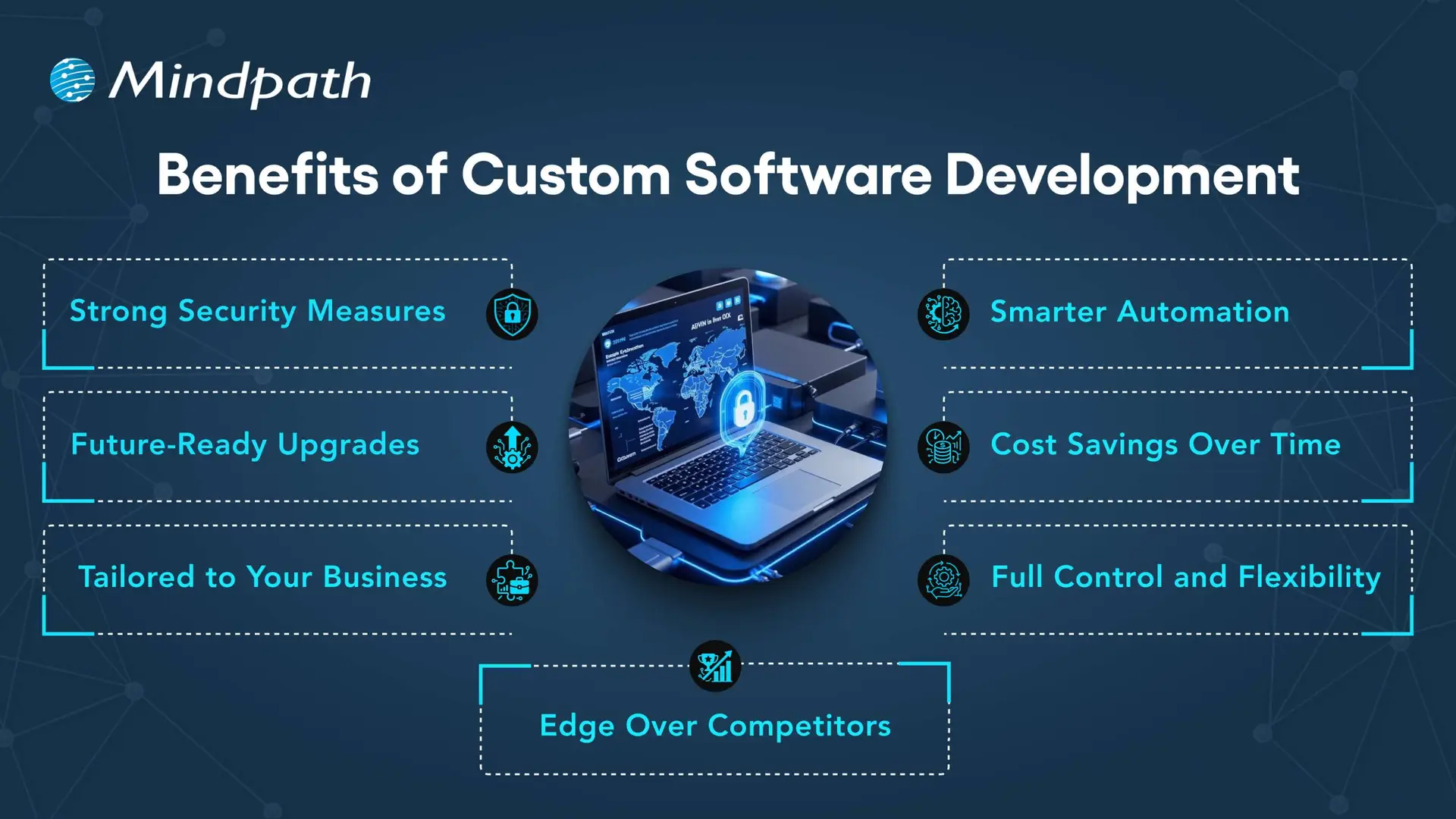
1. Strong Security Measures
Every day, businesses deal with the threat of crime, and good protection is necessary. With custom solutions, businesses can create the security features that fit their unique needs.
2. Smarter Automation
Repetitive work that wastes time is unnecessary. Automated workflows make everything more efficient, giving teams more time to focus on innovative opportunities.
3. Future-Ready Upgrades
Technology will continue to change, and existing systems are often outdated. A custom solution is easy to upgrade, so businesses can stay up to date.
4. Cost Savings Over Time
It’s common to think of generic tools as the less costly option, but they come with hidden costs. A custom-built system can expand with the business and reduce your long-term costs.
5. Tailored to Your Business
Every company has its own workflows, and off-the-shelf, one-size-fits-all tools rarely truly fit. Custom software design considers workflows and goals to create solutions tailored to specific needs.
6. Full Control and Flexibility
Companies have the decision on how their software evolves. From additional feature requests to maintenance, a company is in control of all aspects of software.
7. Edge Over Competitors
To be different, you need unique solutions. Custom software development allows companies to create custom tools that enhance their efficiency and develop stronger customer relationships.
Curious how businesses are building world-class software teams without geographical limits? Explore how our offshore software development can deliver skilled talent and cost-effective solutions.
Step-by-Step Custom Software Development Process
Custom software development has a well-defined process to deliver the best quality product. Using the proper methodology, a custom software development process business makes certain that everything is completed to specific objectives for each project. Here is the process:
1. Requirements and Planning
The process begins with identifying and researching the client’s needs to lay the right framework. The team documents goals, scope, and technology decisions in order to have a clear foundation. During this clarity stage, teams quickly put together custom-made software with a common understanding.
2. UX/UI & System Design
Once they define the requirements, designers and architects start creating wireframes, prototypes, and system architecture for the solution. They start defining the database structure, user experience (UX), and technical workflow in order to ensure everything flows and goes according to plan. Designers create all custom software to be easy to use, scalable, and low-risk.
3. Development Execution
Developers write code based on the approved design and requirements. They develop using agile and best practices and build the functional modules incrementally. Organizations will receive reliable solutions designed to promote their long-term success.
4. Testing & Quality Assurance
Testing validates both functional and performance on devices, platforms, and use cases. Testers perform unit, integration, and regression tests to detect any issues as soon as possible. This step guarantees quality standards in custom software development solutions before delivery.
5. Deployment & Continuous Support
Once testing verifies quality, the team deploys the software on-premises or in cloud environments. The team will continually provide updates, fixes, and improvements to help maintain the effectiveness of the system. We will perform a continuous improvement process to generate value and to prolong the entire application lifecycle.
Concerned about risks that could slow down your custom software build? Explore the major custom software development mistakes that can disrupt progress and find out how to avoid them.
Key Factors to Consider When Building Custom Software
When it comes to building a custom piece of software, it’s more than just writing the code. It’s important to pay attention to the factors that drive the success and make sure your software aligns with your vision of the future in your business.
1. Build vs Buy Decision
Evaluate if building from scratch or buying ready-made solutions best supports your custom software development goals.
2. In-House Team or Outsourcing
Choose between in-house development and outsourcing based on expertise, resources, and project scope.
3. Right Development Methodology
Select the right approach, like Agile or Waterfall, to match your project’s complexity and goals.
4. Focus on User Experience
Design software with intuitive navigation, usability, and efficiency to boost adoption
5. Scalability and Future Growth
Plan for growth by ensuring the custom software development solution can scale easily as your business expands and technology evolves.
Trying to understand the common pitfalls in creating custom software? Check out our blog to learn the essential custom software development dos and don’ts that every business should follow for a smooth process.
Ready to Transform Your Business with Custom Software?
Custom software development continues to be the core driver of innovation, growth, and competitive advantage. By focusing on tailored solutions, businesses overcome unique challenges, streamline operations, and stay prepared for the future. With the right approach, companies build systems that scale seamlessly, improve efficiency, and deliver long-term results in today’s fast-moving digital world.
Partnering with a trusted custom software development company gives you access to expert guidance, advanced technologies, and proven strategies. At Mindpath, our custom software development services empower businesses to create secure, scalable, and future-ready solutions. From strategy to execution, we ensure every step adds measurable value, helping organizations achieve their vision with confidence and clarity.
Frequently Asked Questions
1. How long does it usually take to develop custom software?
The timeline depends on the project size, features, and complexity. Small solutions may take a few months, while enterprise-level systems can take longer. Proper planning and regular communication help keep development on schedule and reduce unexpected delays.
2. Can custom software work with existing business systems?
Yes, custom software is designed to integrate with existing tools, databases, and platforms. This helps businesses avoid replacing everything at once while improving workflow efficiency and keeping operations connected across departments.
3. What happens if business requirements change during development?
Custom software projects are flexible, especially when using Agile development methods. Features and priorities can be adjusted during the process to match changing business needs without starting the project from scratch.
4. How do businesses maintain custom software after launch?
After deployment, businesses usually receive ongoing support, updates, bug fixes, and performance improvements. Regular maintenance keeps the software secure, efficient, and compatible with new technologies as the business grows.
5. Is custom software a good option for startups?
Yes, startups can benefit from custom software because it supports unique business ideas and future scalability. It helps create personalized customer experiences and gives startups more flexibility to adapt quickly in competitive markets.

Think about the potential of AI in business strategy, accelerating your organization with enhanced insights and improved decisions. Imagine having intelligent tools to assess complex data, identify unseen patterns, and let your team have more freedom to genuinely innovate and grow. By adopting the right mindset, companies today are giving themselves a true competitive advantage with AI and changing every aspect of their operations daily.
This intelligent technology is helping companies find new opportunities, create more relevant customer experiences, and briskly adapt to changes in market needs. Embedding artificial intelligence benefits organizations to yield positive results. When used prudently, AI becomes a trusted partner in increasing efficiencies and establishing long-term, viable success.
In this article, you will learn about how AI can transform your strategy and scale your business. Let’s dive in!
Want to enhance your business strategy with artificial intelligence? Mindpath AI development services have a combination of providing strategic insights with hands-on expertise to provide intelligent growth across your organization.
What is an AI Business Strategy?
A business strategy is like an explicit blueprint that directs a company toward its goals. It answers important questions about where a business wants to go, how it plans to get there, and what makes it different from the rest of the marketplace. A clear strategy helps everyone understand the overall objective of the business and keeps colleagues headed in the right direction while working together.
Bringing AI into the plan strengthens the marketing strategy. An artificial intelligence strategy or AI strategy for business growth means using artificial intelligence to better facilitate your business objectives. This could mean improving customer service, making more effective decisions with your data, or even many other entirely distinct initiatives. The aim is to leverage smart tools to execute better, smarter, faster, while staying ahead of your competition.
Also Read: AI in E-Commerce
Benefits of an AI Business Strategy
Having an AI business strategy can open up new opportunities and make your company more competitive. Here are some key benefits that show why investing in AI is worth it:
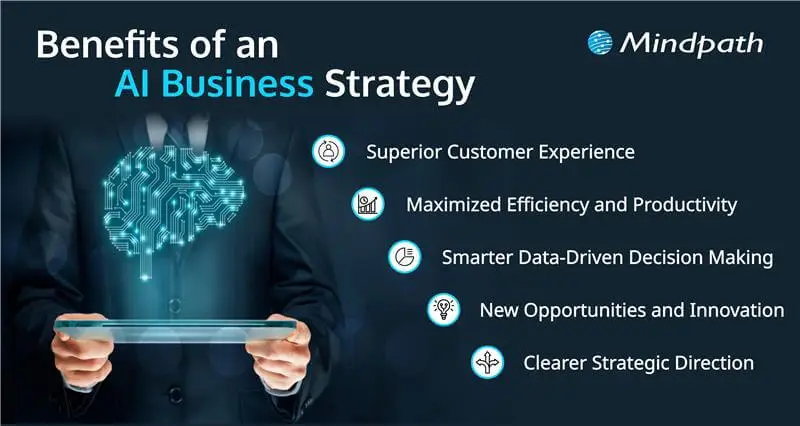
1. Maximized Efficiency and Productivity
AI can take care of repetitive work, so teams can spend more time on creative ideas and solving problems. It makes daily tasks easier and quicker, which improves workflow in every department. By spotting delays and gaps in processes, AI helps companies get things done faster. This boost in productivity helps businesses stay competitive. Companies can do more with less time and effort when using AI in business.
2. Smarter Data-Driven Decision Making
Using AI in business helps leaders make better decisions based on real data. AI tools can study huge amounts of information and find trends or risks that people might miss. This means managers can act faster and with more confidence. Predictive tools even help businesses see what customers might want next. Smart decision-making is key to staying ahead in a changing market.
You can learn more about how AI can transform decision-making in our guide, Power of AI in Decision-Making.
3. New Opportunities and Innovation
AI encourages companies to try new ideas and find fresh ways to earn money. It supports innovation by helping teams develop new products or enter new markets. With AI, companies can test different ways to work and reach more people. This can create new income streams and keep a business strong in tough markets. Staying open to new ways of working keeps the company growing.
4. Superior Customer Experience
AI for customer service makes it easier to understand what customers like and want. Businesses can offer more personal services, like tailored suggestions or special offers. Chatbots and AI tools give customers quick answers, anytime they need help. This keeps people happy and more likely to come back. Good customer service is always important, and digital transformation with AI makes it even better.
5. Clearer Strategic Direction
AI business strategies help companies plan for the future with clear data. Teams can set better goals because they know what is working and what needs to be changed. AI tools keep an eye on the market and help businesses adjust plans when needed. This makes it easier to stay on track even if things shift. A strong strategy backed by AI keeps everyone moving in the same direction.
How to Build an AI Business Strategy?
Building an AI business strategy takes careful planning and clear goals. Here are some practical steps to help you get started the right way:
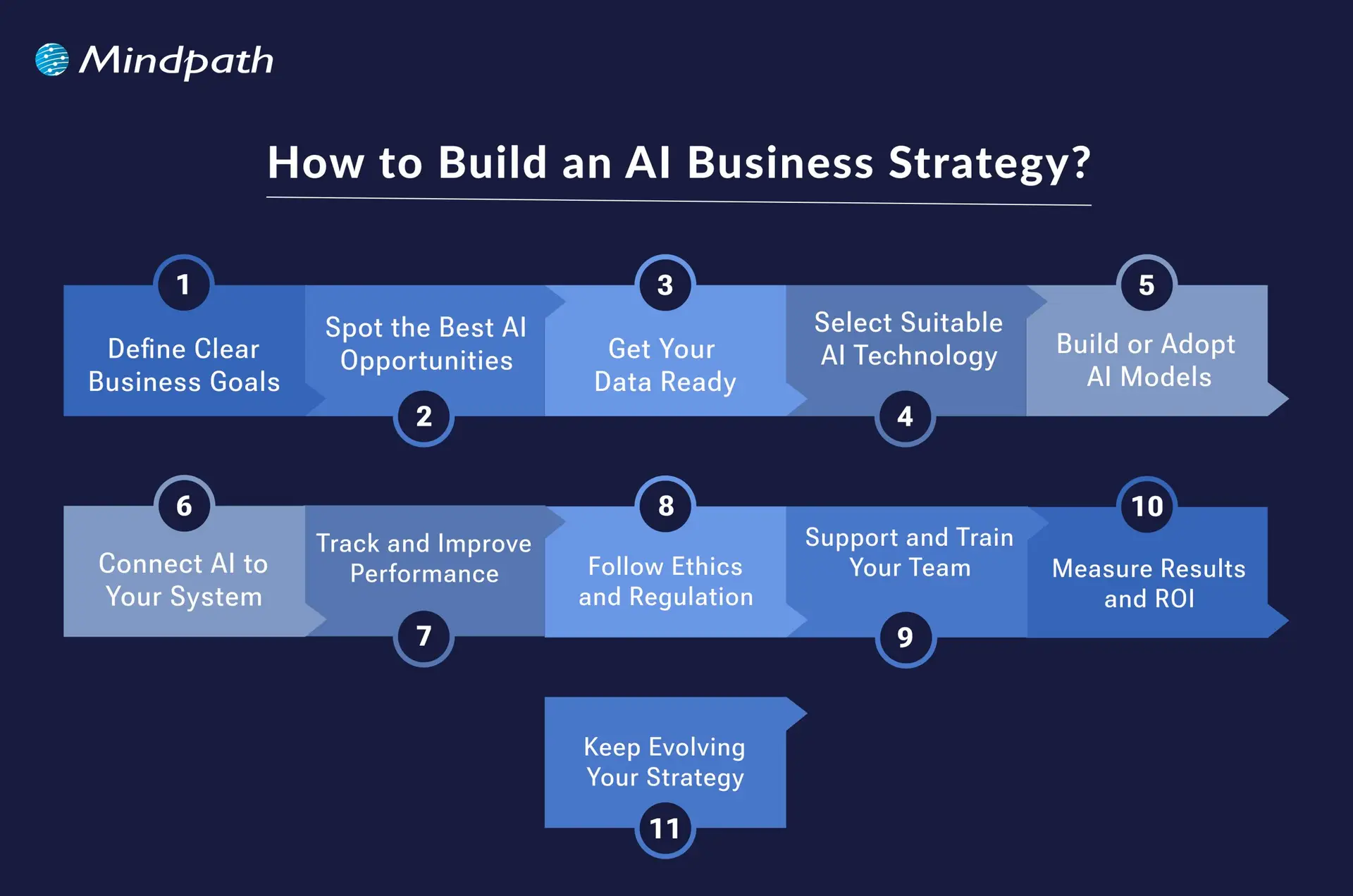
1. Define Clear Business Goals
Start by deciding what you want to achieve with AI, like increasing sales, lowering costs, or improving customer service. Clear goals strategized by the expert AI consultant help you focus your efforts where they matter most. Knowing what you want makes it easier to pick the right AI tools later. A strong direction keeps your entire team aligned and motivated.
2. Spot the Best AI Opportunities
Look at your daily operations and see where AI can add the most value. This might be in customer support, marketing, supply chain, or product development. Finding the right areas will help you get quick wins and build confidence. Prioritizing these areas makes your investment more effective.
3. Get Your Data Ready
Good data is the foundation for AI success. Collect useful data from different parts of your business and make sure it’s accurate and well-organized. Clean and reliable data will help your AI tools work properly. Better data means better insights and fewer errors down the road.
4. Select Suitable AI Technologies
Explore the AI tools that match your goals and the type of data you have. This could include machine learning, chatbots, or automation software. Choose technologies that are practical and align with your strategy. Pick tools that your team can actually use and manage well.
5. Build or Adopt AI Models
Develop AI models that fit your business needs, either with your own experts or trusted partners. Some companies build custom models, while others use ready-made solutions. Test your models to make sure they perform well in real-world situations. Good models help you solve problems faster and smarter.
Ready to adopt the recent AI trends into your business? Read our detailed blog on Top AI trends, which provides a deeper understanding of how to implement AI into your business for future growth.
6. Connect AI to Your Systems
Make sure your new AI tools work smoothly with your current software and workflows. This may need teamwork between IT, data, and business teams. Good integration helps people use AI with less hassle. Seamless systems keep operations running without major disruptions.
7. Track and Improve Performance
Keep an eye on how your AI strategy is working post-implementation. Use regular checks to fix any issues and update the system with fresh data. A little maintenance keeps your strategy useful and accurate over time. Monitoring helps you spot new opportunities for improvement too.
8. Follow Ethics and Regulations
Think about the rules and responsibilities that come with using AI. Protect customer privacy and make sure your AI solution doesn’t create unfair bias. Stay up to date with local and international laws. Acting responsibly builds trust with customers and partners.
9. Support and Train Your Team
Help your team learn how AI fits into their work. Offer training so they feel comfortable using new tools and workflows. Encourage them to ask questions and share feedback. Well-trained employees make AI adoption smoother and more effective.
10. Measure Results and ROI
Decide which numbers will show if AI is really helping your business. This might be cost savings, higher sales, or better customer feedback. Keep tracking these results over time to see progress. Proving ROI makes it easier to get support for future AI projects.
11. Keep Evolving Your Strategy
Treat your AI business strategy as a work in progress. Keep testing, learning, and improving how you use AI as your goals change. Regular updates keep you competitive in a fast-changing market. A flexible approach helps you make the most of every opportunity.
Planning to leverage the power of artificial intelligence, understanding the technologies that drive it has become a crucial advantage. To dive deeper into the tools and technologies behind AI innovation, explore our detailed guide on the AI programming languages.
Ready to Transform Your Business with AI?
Adopting AI in business strategy helps your company make smarter choices, improve operations, and deliver better customer experiences. By understanding your goals and using AI wisely, you can drive innovation and stay ahead of the competition. Start with clear steps, keep learning, and stay flexible. This approach ensures that AI becomes a real advantage for your business growth.
At Mindpath, our AI development services are designed to help you unlock real results with confidence. We create solutions that match your unique needs, from custom AI models to smooth system integration. Our team works closely with you to ensure your strategy delivers value today and in the future. Let’s build an AI-powered roadmap for your success.
Frequently Asked Questions
1. How can small businesses start using AI without a huge budget?
Small businesses can begin with simple AI tools like chatbots, automated emails, or data analysis platforms. Start with one business problem instead of changing everything at once. Many affordable AI solutions today are scalable, making it easier to grow gradually without large upfront investments.
2. What challenges do companies usually face when adopting AI?
The biggest challenges are poor data quality, lack of skilled teams, and unclear business goals. Some companies also struggle with employee resistance to change. Proper planning, training, and choosing the right AI partner can make adoption much smoother and more successful.
3. How long does it take to see results from an AI strategy?
The timeline depends on the type of AI solution and business goals. Some companies notice improvements in productivity and customer support within a few months. Larger AI transformations may take longer, especially when they involve multiple departments and system integrations.
4. Can AI replace employees completely in business operations?
AI is designed to support employees, not completely replace them. It handles repetitive tasks and data-heavy work so teams can focus on creativity, strategy, and customer relationships. Businesses that combine human skills with AI usually achieve better results than relying only on automation.
5. How do businesses know if their AI strategy is actually working?
Businesses should track measurable outcomes like cost savings, faster processes, customer satisfaction, or increased sales. Regular performance reviews help identify what is working and what needs improvement. A successful AI strategy should create visible value for both the business and its customers.

Did you notice how quickly the business environment is shifting for small enterprises? Business owners are seeking better ways to operate their business, acquire customers, and outpace the competition. That is where the role of emerging technology for small businesses becomes crucial. These technologies are no longer considered unattainable, but they are important considerations in your daily routine. If you’re trying to understand how to keep up with the pace, you’re already on the right path.
This transition isn’t merely an upgrade of tools. It’s a change in how small businesses think, plan, and grow. Through artificial intelligence, automation, and cloud services, these technologies are evolving the way companies can more efficiently make the moves toward enhanced workflows, laterally engage new markets, and leverage a better use of resources. What once seemed complex or expensive is now easier to adopt and use. In this blog, we’ll look at how these emerging technologies are shaping a stronger and smarter future for small businesses.
Adopting the right technologies can be challenging for small businesses. At Mindpath, we provide IT Consulting Services that help small and growing businesses harness emerging technologies.
Importance of Emerging Technologies for Small Businesses
Emerging technologies in business are becoming very important for small businesses that want to grow and stay competitive. These tools help small teams work faster, reduce costs, and serve customers better. These technologies make everyday tasks easier and help businesses manage more with less effort. For small businesses, this means saving time, avoiding manual errors, and focusing more on customer needs and business goals.
As the market keeps changing, small businesses must keep up with new trends and tools. Using the right technology helps improve service, increase profits, and make smarter decisions. It also helps small businesses compete with larger companies by giving them the same tools to operate smoothly and efficiently. In today’s fast-moving world, using the right technologies is a good idea and important for growing and staying successful.
Want to stay ahead in a rapidly evolving business landscape? Discover how digital transformation for businesses enables small businesses to adopt emerging technologies and unlock new growth opportunities.
Impact of Emerging Technologies on Small Businesses
The future of small businesses is being shaped by constant changes in technology. As digital tools become more advanced, the impact of emerging tech on local businesses is becoming harder to ignore. Here are some key areas where this shift is starting to make a difference.
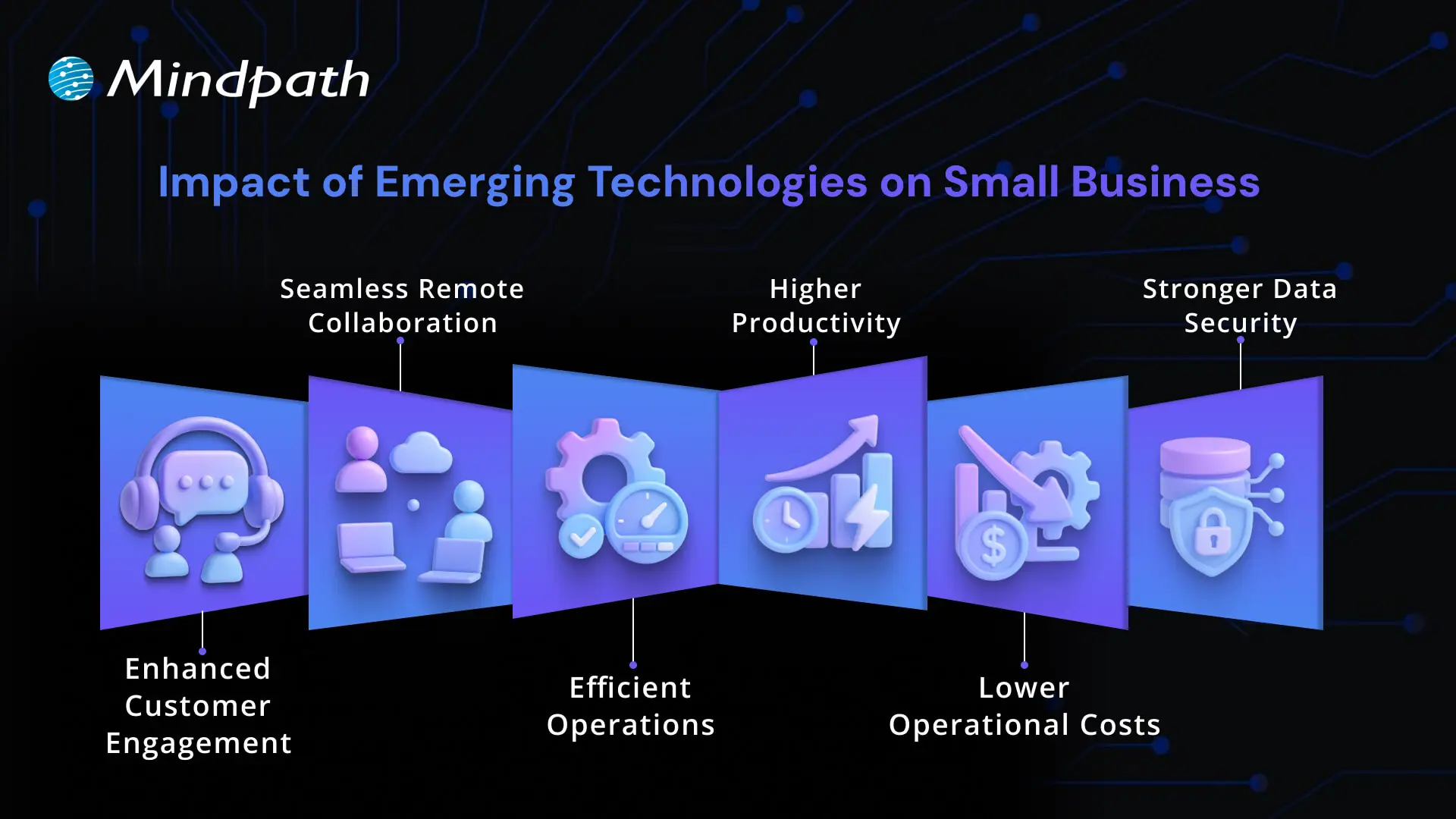
1. Enhanced Customer Engagement
Emerging technologies for small businesses are changing how they talk to their customers. Tools like live chat, easy websites, and chatbots help give quick answers. These tools also help businesses know what their customers like or need. This builds stronger trust and long-term relationships.
2. Seamless Remote Collaboration
Digital transformation for small businesses makes it simple for teams to work from different places. Online tools help people talk, share work, and stay connected. This solves the problem of working across locations. It keeps everyone on the same page and helps the business run better.
3. Efficient Operations
New technology helps small businesses work better every day. Tools like AI and cloud systems reduce the time spent on manual tasks. This means fewer errors and quicker results. Emerging technologies for small businesses help manage operations smoothly and save time.
4. Higher Productivity
How technology is changing small businesses can be seen in faster and more efficient work. New tools help track inventory, manage customers, and understand buying habits. This improves decision-making and cuts down on mistakes. Businesses save time and get better results.
5. Lower Operational Costs
New tech helps small businesses save money and stay efficient. Automation tools reduce extra work and help finish tasks quickly. Online platforms for sales and support are more affordable now. This helps businesses grow while using fewer resources.
6. Stronger Data Security
Small businesses worry about keeping customer data safe. With new tech tools like secure cloud storage, that’s easier to do. These tools help prevent online threats and protect payment details and private information. This keeps the business and its customers safe and confident.
Curious how AI can give your small business a competitive edge? Learn about the Future of AI and how emerging technologies are reshaping growth, efficiency, and innovation for businesses like yours.
Top Emerging Technologies for Small Businesses
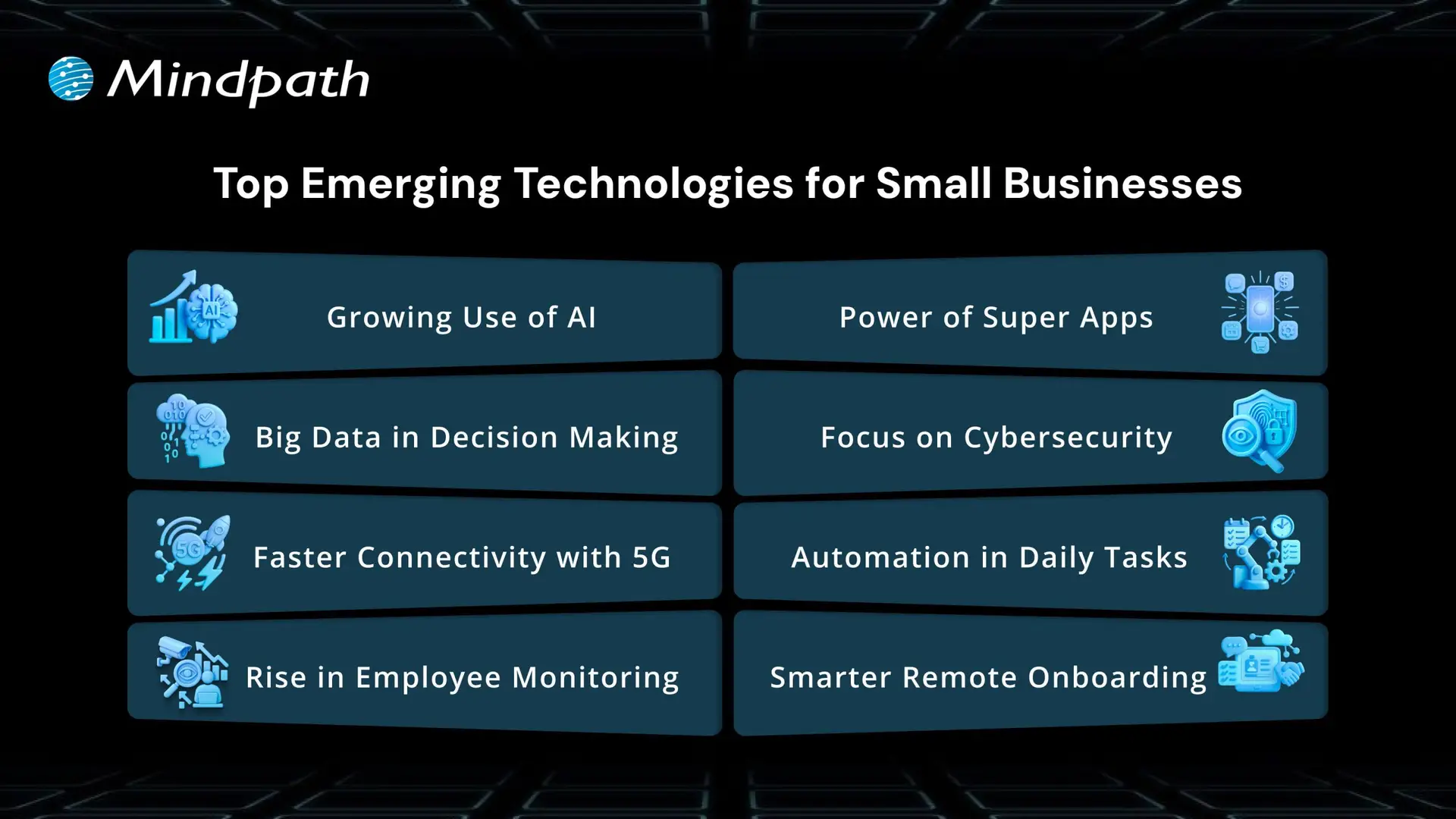
Emerging technologies in business are opening new opportunities for small companies to grow, compete, and serve their customers better. Here are some of the top technologies that are helping small businesses work smarter and achieve more:
1. Growing Use of AI
AI for small businesses is becoming easier to use and more helpful. It’s already improving customer service, reducing errors, and saving time in industries like retail and insurance. Businesses are seeing a quick return on their AI investments through features like chatbots and fraud detection. This highlights how AI for customer services and other emerging technologies are making small business operations more affordable and practical.
2. Big Data in Decision Making
Big data is helping small businesses understand their market and make better decisions. Many companies are already seeing increased profits through the use of data tools. This shows that data is not just for large enterprises anymore. Small businesses can now use insights to improve planning and stay ahead.
3. Faster Connectivity with 5G
5G brings faster data, less delay, and better connections for devices. It helps small businesses use more smart tools and supports the growing number of IoT devices. As 5G becomes more available, small businesses can expect smoother communication and faster service. This will push emerging technologies for small businesses into more areas of daily work.
4. Rise in Employee Monitoring
As hybrid work grows, more companies are using employee monitoring software. It helps track productivity and improve communication between remote teams. With higher demand since the pandemic, businesses now rely on these tools to manage their teams better. These systems are becoming a core part of small business technology trends.
5. Power of Superapps
Superapps combine many tools into one, helping businesses manage tasks more easily. They solve problems like software not syncing and reduce wasted time. Small businesses can benefit from apps that handle messaging, scheduling, and customer data all in one place. This kind of smart unification improves efficiency and teamwork.
6. Focus on Cybersecurity
Many small businesses still believe they won’t face cyberattacks, but the risk is growing fast. New threats require better protection for data and systems. By leveraging AI in cybersecurity, businesses can detect threats faster, respond more effectively, and strengthen their overall security posture. More businesses are now focusing on backup plans and stronger security tools. Acting early helps avoid major problems later.
7. Automation in Daily Tasks
More businesses are turning to automation to reduce workload and save money. It helps with tasks like pricing, inventory, and customer service. Even with fewer workers, companies can still run smoothly and meet their goals. Automation is becoming a must-have for efficiency and smart growth.
8. Smarter Remote Onboarding
Remote onboarding is now a key step for hiring and welcoming new team members. Businesses are using technology to make new hires feel connected and supported. Software helps introduce the company culture and build the right relationships. This helps companies keep talent and improve their team experience from day one.
Looking to scale your tech capabilities without breaking the budget? Learn about the key benefits of hiring remote developers and how they can help small businesses adopt emerging technologies faster and smarter.
Power Your Business Growth with Smart Tech
The future belongs to small businesses that move with change. By adopting emerging technologies for small businesses, you work smarter, cut waste, and serve customers better. These tools help you compete, make faster decisions, and grow with confidence. What once felt out of reach is now practical, scalable, and ready for you to use as you plan the next step.
Mindpath helps you turn tech goals into real progress. Our team guides your choices, sets up the right tools, and trains your people to use them well. We focus on clear steps, measurable results, and support that grows with you. Let’s map your priorities and launch changes that deliver value fast for lasting growth and stronger customer results in practice.
Frequently Asked Questions
1. What are the most practical emerging technologies for small businesses to adopt first?
Start with tools that solve immediate problems. AI-powered customer service, cloud storage, and automation for repetitive tasks deliver quick, measurable results. Emerging technologies for small businesses work best when adopted gradually with clear goals. Trying to implement everything at once often leads to confusion, wasted budget, and low team adoption rates.
2. How much budget should a small business set aside for adopting new technologies?
There is no fixed number, but starting small is always smarter. Many cloud and AI tools offer affordable subscription models specifically designed for smaller teams. Focus on technologies that directly reduce costs or increase revenue first. As returns become visible, reinvesting those gains into further technology adoption becomes a natural and sustainable progression.
3. How do small businesses protect customer data when adopting new digital tools?
Always choose platforms with strong encryption, compliance certifications, and regular security updates. Train staff on basic cybersecurity practices from day one. Many modern tools now include built-in security features that require minimal technical knowledge to activate. Prevention is significantly cheaper than recovering from a data breach after damage has already occurred.
4. Can small businesses realistically compete with larger companies using emerging technologies?
Yes, and this is one of the most exciting shifts happening right now. Many emerging technologies level the playing field by giving small teams access to enterprise-grade tools affordably. Speed and agility are natural advantages small businesses already have. The right technology amplifies those strengths rather than creating an entirely new competitive dynamic.
5. How do small business owners know when they are ready to adopt a new technology?
Readiness comes down to three things: a clear problem to solve, a willing team, and a realistic budget. If a technology addresses a genuine operational gap and your team can support it, the timing is right. Adopting tools out of trend pressure rather than business need almost always leads to poor outcomes.
Have you been paying attention to the speed at which DevOps trends are changing and how they are affecting businesses? If you’re managing a tech team or are just about to scale up your operations, you may already be thinking about the implications of these trends on your success. As more companies adapt to smarter workflows and quicker ways of delivering value, being up to date is critical. So, how can you stay on top of it without falling behind?
Finding the answer to this question involves understanding the trends that affect how we run businesses in the real world. DevOps best practices today are designed to bring automation, cloud-native tools, or security-first approaches to solve the problems we face in modern situations. Being aware of what’s meaningful and useful can help your team be more effective while accelerating time to market. In this blog, we will examine key trends and look at how they can create real results for your organization.
As businesses embrace DevOps in 2026, the need for expert guidance becomes crucial. At Mindpath, our DevOps Consultation & Implementation services ensure organizations can adopt the right strategies and technologies to stay competitive.
Understanding DevOps: A Quick Dive-in
DevOps is a development approach in which software developers and IT teams collaborate on software and business processes. By working together, they share responsibilities and use tools to speed things up and facilitate the flow of work. DevOps is centered around good communication, collaboration, and automation. In essence, DevOps can deliver near-instant software, identify issues sooner, and get a better and quicker flow between building and deploying applications. As a result, many organizations leverage DevOps for business strategy and agility since it can enhance both speed and efficiency.
In this approach, one team often takes care of everything, including coding, testing, releasing, and maintaining the software. This removes delays and improves software quality. Teams use automation tools to speed up tasks and reduce errors. DevOps also brings security into the process right from the beginning, so it becomes part of every step. This working method helps businesses launch better software faster while keeping systems stable and secure.
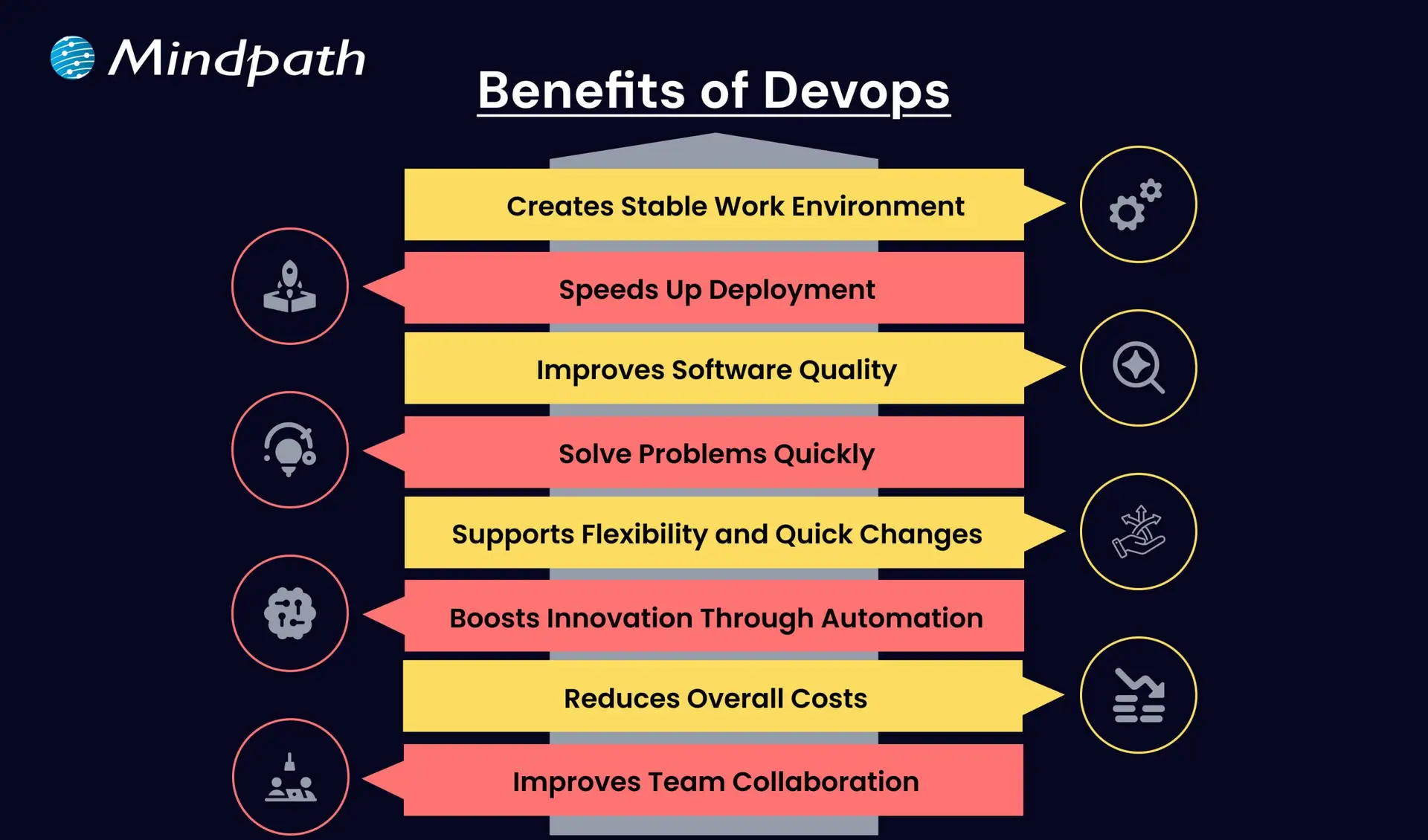
Here are some of the benefits that DevOps can offer:
1. Creates a Stable Work Environment
DevOps helps teams handle changes easily without stress. It brings a better balance to daily work and keeps operations running smoothly.
2. Speeds Up Deployment
DevOps allows faster software releases with fewer delays. This helps businesses deliver new features quickly and stay ahead in the market.
3. Improves Software Quality
With regular testing and feedback, DevOps helps catch bugs early. Teams can focus on creating better products with fewer errors.
4. Solve Problems Quickly
DevOps uses monitoring tools to spot issues fast. Smaller and frequent updates make fixing problems easier and more reliable.
5. Supports Flexibility and Quick Changes
DevOps builds a flexible work style where teams can respond to change easily. It helps businesses adapt to market needs faster.
6. Boosts Innovation Through Automation
By reducing manual tasks, DevOps gives teams more time for new ideas. This leads to faster improvements and better products.
7. Reduces Overall Costs
DevOps combines tasks and reduces the need for rework. This saves time, uses resources better, and cuts down project costs.
8. Improves Team Collaboration
DevOps encourages better teamwork and shared goals. Clear communication between teams leads to faster decisions and stronger results.
Aiming to enhance operational efficiency and reduce development risks? Check out our blog on DevOps Challenges and Solutions to discover proven approaches that improve performance, stability, and cross-team cooperation.
Top DevOps Trends 2026
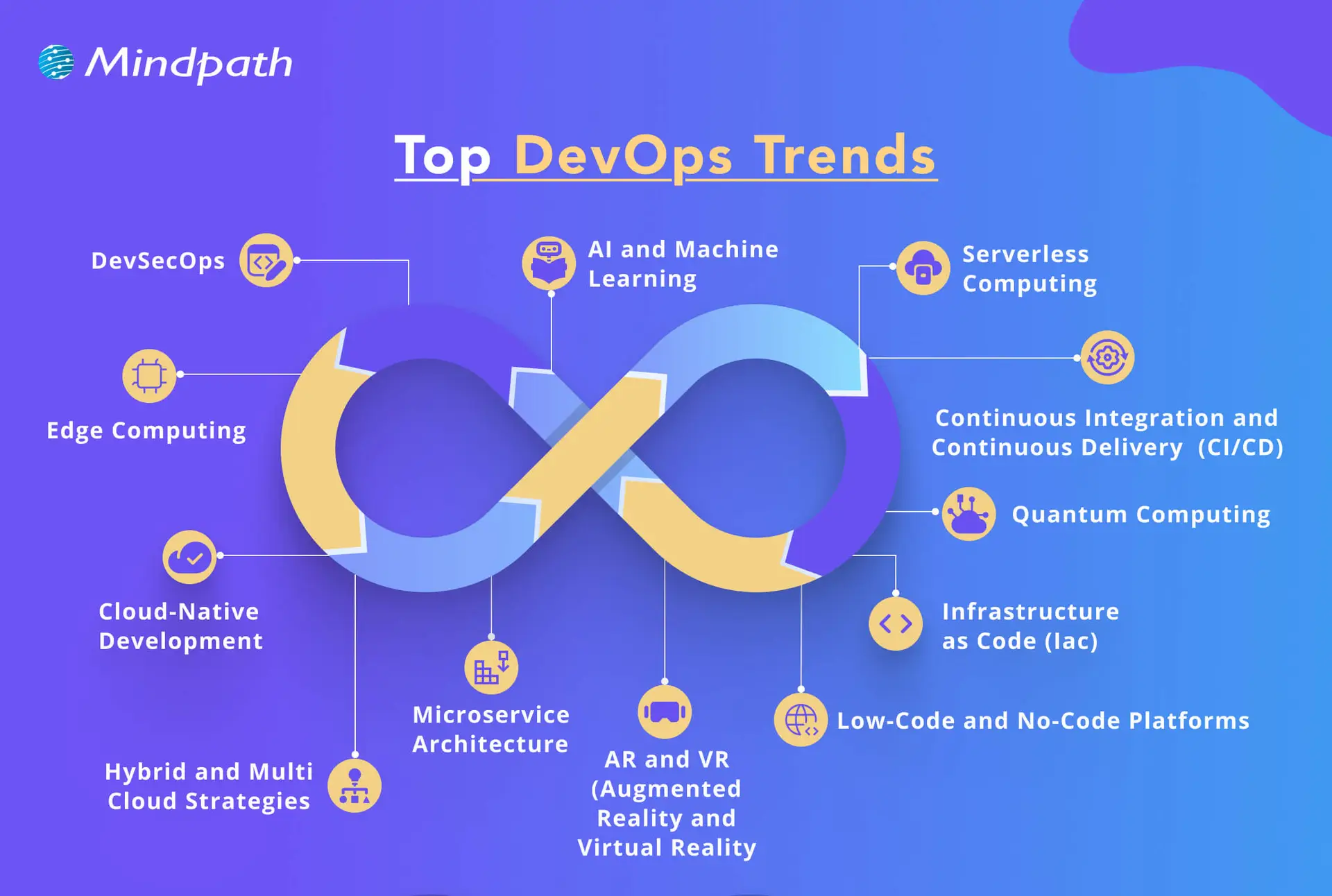
As technology continues to evolve, companies are rethinking how they build, test, and deliver software. DevOps trends for businesses in 2026 show a clear shift toward smarter tools, stronger collaboration, and faster delivery. By following the latest DevOps transformation strategies, organizations can stay ahead and build systems that are both efficient and future-ready.
1. DevSecOps
DevSecOps is becoming a key part of DevOps innovation, where security is built into every stage of the development process. Instead of adding security at the end, teams now include it early to catch risks before they grow. This trend helps businesses create safer applications by using automated testing and continuous monitoring within the DevOps workflow.
2. AI and Machine Learning
AI and machine learning is one of the latest DevOps trends, helping teams work faster and smarter. These technologies support intelligent monitoring, find unusual behavior in systems, and give early warnings before issues grow. By using data to guide decisions, DevOps teams can improve system performance and reduce downtime.
3. Serverless Computing
Serverless computing is becoming a popular trend in DevOps for business success because it removes the need to manage servers. It allows teams to focus only on writing code, which speeds up development and reduces overhead. This approach also helps businesses save costs by using resources only when needed, making operations more efficient.
4. Continuous Integration and Continuous Delivery (CI/CD)
Continuous Integration and Continuous Delivery (CI/CD) is a key DevOps trend that helps teams deliver software faster and with fewer errors. It allows developers to regularly merge code changes, test them automatically, and deploy updates smoothly. This approach improves software quality and supports a steady flow of new features to users.
5. Infrastructure as Code (IaC)
Infrastructure as Code is a growing trend that helps teams manage infrastructure through written code instead of manual steps. It ensures consistency across development, testing, and production, reducing errors and saving time. As one of the leading DevOps tools and technologies, it allows automated setup and easy tracking of changes in infrastructure.
6. Microservices Architecture
Microservices architecture is a DevOps approach where an application is built using many small, separate services. Each service handles a specific function and can be updated or scaled on its own without affecting the rest of the system. This makes the software more flexible, easier to manage, and better at handling changes or failures.
7. Cloud-Native Development
Cloud-native development is a modern way of building applications that fully uses the power of cloud computing. It is one of the key DevOps trends helping businesses create software that can easily grow, move, and adapt to changing needs. By using containers and microservices, teams can build flexible and efficient systems that are ready for fast updates and smooth scaling.
8. Edge Computing
Edge computing is a growing part of modern DevOps trends that focuses on processing data close to where it is created. This reduces delays and improves the speed of applications by handling data locally instead of in a central server. It also helps save bandwidth and supports real-time decision-making, making systems faster and more efficient.
9. Hybrid and Multi-Cloud Strategies
Hybrid and multi-cloud strategies are important DevOps trends that give businesses more flexibility and control over their cloud usage. By using services from different cloud providers, teams can choose the best tools and features for each task. This approach improves performance, reduces risk, and avoids being tied to one provider.
10. Low-Code and No-Code Platforms
Low-code and no-code platforms are shaping the future of DevOps by making application development easier and faster. These tools allow non-developers to build and launch apps with simple interfaces, helping teams save time. By handling basic tasks through these platforms, developers can focus on more complex work and boost overall productivity.
11. Quantum Computing
Quantum computing is an emerging part of DevOps trends with the potential to solve complex problems much faster than traditional systems. Although still in the early stages, it may one day help teams handle advanced computing tasks more efficiently. As the technology grows, it could bring powerful new capabilities to DevOps in areas like testing, simulation, and optimization.
12. AR and VR (Augmented Reality and Virtual Reality)
Augmented Reality and Virtual Reality are becoming new DevOps trends that support better training, simulation, and team collaboration. These technologies create realistic, hands-on experiences that help teams learn and solve problems more effectively. AR and VR also improve remote teamwork by making interactions more engaging and productive.
Looking to combine fast DevOps practices with automated security checks? Check out our blog on DevOps vs DevSecOps to understand how DevSecOps adds proactive, automated safeguards to every stage of your pipeline.
Is Your Business Ready to Benefit from the Latest DevOps Trends?
DevOps trends continue to shape how businesses grow through faster delivery, better collaboration, and smarter tools. Staying updated helps teams move quickly, improve software quality, and remain competitive in a rapidly changing market. By understanding and applying these trends, companies can build stronger systems and create real value with every software release.
At Mindpath, we offer expert DevOps services that help businesses streamline processes, boost collaboration, and deliver software faster. Our team uses modern tools and proven strategies to support automation, cloud-native development, and continuous delivery. Contact us and we’ll guide you through each stage with clear planning, smooth implementation, and reliable support tailored to your business goals.
Frequently Asked Questions
1. How do DevOps trends in 2026 actually affect day-to-day development team operations?
DevOps trends in 2026 are directly changing how teams plan, build, and ship software daily. Automation reduces manual work, AI flags issues earlier, and cloud-native tools speed up deployments. Teams that adopt these shifts experience fewer bottlenecks, faster releases, and significantly better collaboration across development and operations functions.
2. Is DevOps only relevant for large enterprises or can smaller businesses benefit too?
DevOps works exceptionally well for businesses of all sizes. Smaller teams actually benefit faster because there is less organizational resistance to change. Adopting automation, CI/CD pipelines, and cloud tools helps small businesses compete with larger players by delivering software faster and maintaining higher quality with leaner resources.
3. How long does it typically take a business to see results after adopting DevOps practices?
Most businesses notice improvements in deployment frequency and team collaboration within three to six months. Deeper results like reduced downtime and better software quality take longer to measure accurately. The speed of results depends heavily on team readiness, tooling choices, and how consistently DevOps practices are applied across workflows.
4. What is the biggest challenge businesses face when shifting to a DevOps culture?
The biggest challenge is rarely technical. It is cultural. Getting development and operations teams to share responsibilities, communicate openly, and trust automated processes takes time and strong leadership. Many organizations underestimate this human side of DevOps adoption and focus too heavily on tools while neglecting team alignment and mindset shifts.
5. How does DevSecOps differ from traditional security practices in software development?
Traditional security is applied after development is complete, which creates costly delays and vulnerabilities. DevSecOps integrates security checks at every stage of the pipeline from day one. This proactive approach catches risks earlier, reduces remediation costs, and ensures that security never becomes a bottleneck slowing down release cycles.