Latest Insights On
GenAI, Tech, and Digital Transformation
Stay updated with expert insights, success stories, and real-world applications of cutting-edge technology.
Generative AI is changing how modern firms operate, innovate and grow. By harnessing generative AI applications for enterprises and adopting generative AI for business, they are finding better ways to create, plan, and deliver value. It helps teams speed up the flow of work, foster creativity, and make data-driven decisions with greater accuracy. Each industry has begun to see how this technology is turning challenges into opportunities to succeed.
With growing adoption, generative AI is becoming a central component of business strategy. One of the main areas where it is applied is customer experience improvement and gen AI in market research, helping organizations better understand trends, customer behavior, and insights. The simplification of the company’s processes and the building of more adaptable systems that can react to the changes in the market. As a result, it is reshaping the entire way companies handle their innovations and efficiencies. In this article, we will uncover the different applications of generative AI for everyday scenarios, and the ways in which companies employ it to bring positive changes. Therefore, let’s tread further into it!
Ready to translate the GenAI opportunities into real operational impact for your organisation? Mindpath offers AI development services that guide you on how to turn your ideas into product-ready systems.
Understanding Generative AI: A Quick Dive In
Generative AI is changing the ways in which businesses innovate by generating real and useful outputs in a manner that incorporates data-driven insights through machines, marking the ongoing gen AI revolution. It assists organizations to increase creativity, decision-making, and accelerate the processes within departments. This technology is going viral due to its capability to transform ideas into workable solutions. This results in business growth that can be measured.
Based on a report by Grand View Research, generative AI is estimated to have a market value of 16.87 billion USD in 2026 and will grow to 109.37 billion USD by 2030, at a CAGR of 37.6%. The rising adoption of generative AI applications in enterprises is a clear signal that companies are using the technology to update their processes, create new products and maintain their competitive advantage in the digital era.
Looking to stay ahead of enterprise innovation in generative AI? Check out Gen AI trends to learn what’s shaping real-world business adoption.
Benefits of Generative AI for Enterprises
Here are some key benefits of generative AI for enterprises:
1. Generative AI opens the door for anyone to use sophisticated creative tools. Thus enabling non-technical and non-design people to make high-quality content of a professional nature. Such a transformation has the potential to ignite creative and innovative ideas in the whole industry sector.
2. It enhances the overall productivity by overcoming the monotonous activities involved in text summary, code generation, and drafting of content. Subsequently, the employees will be capable of focusing on the tasks that are of a strategic nature and of high value, thereby yielding real results.
3. With the help of generative AI applications for enterprises which automate content creation, product design, and data analysis, companies can save both time and money. Such efficiencies are instrumental in speeding up projects and reducing operational costs by a large margin.
4. In addition, research and development benefits from this as well, as it allows specialists to validate their hypotheses at a quicker pace and process a vast amount of data. Consequently, the time to first discovery, quality of materials, and rate of innovation across sectors are all increasing.
5. Generative AI is a creative tool that can be used in conjunction with human beings to come up with fresh ideas and new design paths. It energizes innovation and enables the creative teams to extend their creative limits in any discipline.
6. GENAI technology is also a big factor behind personalization as it helps in creating content and recommending products or services that are suitable for the tastes of each user. Hence, customer experiences become more delightful, and the level of engagement gets higher.
Wondering how creative teams leverage generative AI beyond simple content generation? Discover how generative AI works in the creative industry to check out real-world enterprise use cases.
What are the Applications of Generative AI in Businesses?
Businesses of various industries are implementing real-life examples of generative AI, showcasing practical generative AI use cases to raise their creativity levels, accelerate their workflows and make their decisions more efficient. Our focus will be on how companies are leveraging this technology for the transformation of their operations, the increase of their innovation, and the provision of an intelligent customer experience.
1. Software Development
-
Automating Software Testing
One of the ways generative AI tools enhance software testing is by the automatic creation of test cases and running them for checking software quality. They analyze the code, locate the errors at the earliest stage, and complete the developers’ fixing process by giving them the solution promptly before the release.
-
Improving Code Quality
Artificial Intelligence (AI) code writing assistants analyze the already written code and propose better alternatives for writing. They locate defects, enhance the readability, and generally, the codebase becomes more efficient.
-
Writing and Completing Code Faster
Developers employ generative AI-powered coding examples from real-world applications to create code snippets or even finish a whole function just by giving a text prompt. As a result, they are able to cut down on their time spent on tedious tasks and increase the pace of software development.
2. Marketing and Sales
-
Creating Social Media Content
One of the major generative AI applications that businesses may leverage is the automatic production of social media content which may include captions, visuals, and hashtags. Thus, enterprises are able to go on with their online presence and, concurrently, communicate with their target audience in a most efficient way.
-
Personalizing Email Campaigns
Another major business use of generative AI is the development of one-to-one emails that represent the customer’s preferences and behavior. With such a method, firms become capable of providing authentic and influential messaging, which, as a result, gives rise to the intensification of the customer relationships and the growth of engagement.
-
Writing Engaging Ad Copy
One of the major business examples that generative AI can be used for is the creation of brief ad texts and a few words describing different ad campaigns. It allows the marketing department to be agile in the execution of their creativity by rapid testing various options and identifying the best response from the targeted customers.
Planning to modernize financial workflows with intelligent automation? Discover Gen AI in finance to check out real-world enterprise use cases.
3. Finance Department
-
Detecting Fraudulent Activities
One of the key generative AI applications for enterprises is the case of figuring out fraudulent financial transactions. By keeping an eye on the trends in real-time, it notifies the responsible units when evoking abnormal conduct is detected that can be used to commit a fraud.
-
Automating Regulatory Compliance
By means of generative AI, the bank can keep up with the ever-changing compliance regulations since the system itself keeps track of the regulatory changes and also drafts reports automatically. This tool has the advantage of letting the organization cut down on the manual labor and abiding by the updated regulations.
-
Personalizing Financial Advice
Generative AI enables financial advisors to come up with tailored investment plans that depend on the client’s objectives and the level of risk they’re comfortable with. The technology equips the professionals to make wiser suggestions and to give more understandable portfolio insights.
4. Manufacturing Department
-
Designing Products and Parts
Generative AI is a tool for engineers to find several design alternatives by using specified materials, measurements, and performance requirements, making AI in manufacturing a practical support for faster and smarter design decisions. The turnaround for new product development is greatly enhanced with the help of creative and efficient design variations being readily available for selection.
-
Optimizing the Supply Chain
Supply chain optimization is one of the most effective generative AI applications for enterprises. Such a system scans massive data files to forecast consuming patterns, to streamline transportation, and to give advance warnings of delays in the production line.
-
Enhancing Manufacturing Efficiency
Generative AI helps Manufacturers detect the variation in the production process that results in lower resource consumption. The latter is creating more productive and efficient workflows that not only increase output levels but also reduce the waste.
Ready to understand why enterprises are shifting beyond prompt-based AI systems? Check out Agentic AI vs Generative AI to learn how intelligent agents reshape workflows.
Ready to Unlock the Power of Generative AI for Your Business?
Generative AI changes the whole business landscape by redefining the ways companies innovate, create, and operate. The usage examples of the different industries show that it is a potent instrument. This enhances the creativity, productivity, and decision-making abilities of the employees. Companies implementing such technology are able to maintain a competitive position amid the turbulent market conditions and increase their velocity of growth. This brings more intelligent solutions with a positive environmental impact to the market.
At Mindpath, we offer expert AI development services designed to help enterprises integrate and scale generative AI solutions with confidence. Our team builds intelligent systems that automate tasks, optimize workflows, and enhance customer experiences. Partner with Mindpath to transform your business with custom AI-driven innovations that accelerate growth and redefine digital success.
The technology landscape has been drastically developing at a great pace. Businesses are under pressure to innovate faster and deploy more reliable customer experiences. At this great transformation, the conversation around DevOps vs. Traditional IT has become critical. So, the right approach can influence your speed, innovation, costs, and even customer satisfaction.
Further, there are some companies that still benefit from the structure and control of traditional models. On the other hand, others need the agility and automation that DevOps delivers. In this blog, you are going to understand the difference. This can also help you make the right choice that matches your business goals.
Planning to modernize your IT operations for faster and more efficient delivery? Mindpath offers DevOps services that help streamline workflows, enhance collaboration, and accelerate your development lifecycle.
What is Traditional IT?
The global IT services market size has already reached USD 1,652.27 billion this year. Further, it is going to expand to reach USD 3,299.78 billion by 2033. So, traditional IT values a structured process and initiates work step-by-step. Here, different teams manage multiple parts of the software development lifecycle. For example, developers write the code, and testers will verify if the system has any issues.
This structure majorly values the Waterfall model, where every phase must be completed before shifting to the next one. One of the best parts of traditional IT infrastructure is that it ensures thorough documentation and testing. But it somehow makes the process slower and more rigid. Any last-minute change can include major delays and disturbances.
- You can have clear department roles and responsibilities.
- It is a better option for legacy applications.
- You can have strong control over infrastructure and other processes.
- It is easily compliant in highly regulated environments.
What is DevOps?
The DevOps market size is expected to reach USD 108.26 billion by 2035. As per the recent statistics, around 72% developers are using the Agile method, whereas 46% of organisations are combining methodologies. So, DevOps is a modern and collaborative approach that combines development and operations into an individual workflow.
Instead of working in isolated teams, DevOps creates a culture of shared responsibility. Further, your whole team can leverage the relevance of automation and continuous improvements.
- Unlike a traditional system, DevOps values agile principles.
- It initiates modern IT operations that automate tasks like testing, integration, and deployment.
- Additionally, this approach can help you reduce errors while improving the overall efficiency.
The Major Difference Between DevOps vs. Traditional IT
Both approaches aim to support your business technology. However, they hold some prominent differences as given below.
1. Deployment Speed
Traditional IT mainly uses scheduled releases, sometimes weekly or monthly. On the other hand, DevOps supports continuous releases through automation. This means you can go live with your features, fixes, and updates faster.
2. Team Structure
Your whole team might remain separated in traditional IT. Developers need to write the code, and they deploy it while handling the issues in the later stage. This can create communication gaps and delays. However, in DevOps, teams can work together from the beginning. This is one of the biggest DevOps benefits for business. Your developers and testers will have ownership.
3. Infrastructure Management
Traditional environments majorly depend on physical servers or manually managed systems. But DevOps relies on cloud environments, containers, and automation to handle infrastructure effectively.
4. Risk Handling
Traditional IT might avoid changes because it can introduce instability in the whole system. However, DevOps is capable of handling risks differently. Instead of making fewer big changes, it allows you to include smaller and more frequent updates.
Top DevOps Benefits for Business and IT Operations
Here are some top DevOps benefits for business that can incredibly encourage your performance in the long run.
1. Faster Time to Market
One of the biggest advantages of DevOps is speed. With automation, you can reduce the chances of delays in testing, deployment, and monitoring. This means your business can launch new products or features much faster.
2. Effective Collaboration
Instead of your teams blaming each other when issues arise, DevOps allows you to have better communication. They can work together and share goals and vision.
3. Higher Reliability
DevOps is not just about moving fast. It accesses continuous monitoring, automated testing, and smaller releases. This makes your systems stable over time.
4. Reduced Operational Charges
Manual processing can be expensive for you. Repetitive deployments, testing, and infrastructure management can consume your time and resources. So, DevOps can reduce these defects through precise automation.
5. Improved Security
With the right DevOps implementation, security assessment and monitoring tools can be directly added to your delivery pipeline. So, fewer blind spots mean faster issue assessment.
Why are Traditional IT Advantages Still Making Sense?
With the ultimate rise of DevOps, traditional models are still relevant in the market. Here are the situations where traditional advantages can be more prominent than speed.
- You handle a strict environment with severe policy regulations.
- Your application updates are infrequent and not very urgent.
- Your internal team is structured around conventional infrastructure management.
A Brief Comparison Between Traditional IT vs. DevOps
Here are some key aspects that define the values of DevOps vs. traditional IT in a structured way.
| Factors | Traditional IT | DevOps |
| Core Strength | Stability and Control. | Speed and collaboration. |
| Team Structure | Excludes teams from development and operations. | Make a team to work together. |
| Infrastructure | Values manual proceedings. | Use automation. |
| Business Impact | Helps in maintaining stable IT environments. | Supports modern IT operations. |
| Best For | Regulated Industries | Fast-Growing Businesses |
The Best Approach for Many Businesses
You need to understand that organizations don’t just jump directly from traditional IT infrastructure to full DevOps. In fact, they change with time. They start by automating the testing phase while influencing the operation pipelines. Further, they might move selected workloads to the cloud while modernizing one application at a time. This hybrid approach can work best because it reduces disruptions while still bringing in the benefits of modern IT operations.
Conclusion
When it comes to DevOps vs. Traditional IT, both approaches come with their own uniqueness. But, in today’s highly developing technological world, DevOps is becoming a serious choice among competitive businesses. However, the best approaches depend on your business goals and growth plans.
If you are ready to make the shift to DevOps and future-proof your business, Mindpath can be your ideal partner. With our cloud and DevOps services, we help bridge the gap through automation, scalable infrastructure, and DevOps-led transformation solutions.
Large Language Models (LLMs) are one of the most transformative, or we can say critical, breakthroughs in AI. LLMs are redefining how people communicate, create, and make decisions. It is believed that the future of large language models (LLMs) will have a greater influence and go beyond just chatbots. AI models like Claude, Bard, and ChatGPT have shown their ability to produce human-like text. However, we are just beginning to explore what LLMs can do. Next-generation LLMs will be multimodal and hyper-intelligent, capable of managing more complicated tasks. This blog will discuss the present state of LLMs and their future in AI. Most importantly, we will understand how to guide modern AI responsible for safe, inclusive and meaningful impact.
Want to leverage the power of large language models beyond off-the-shelf tools? Discover Mindpath’s LLM Development Services to develop customized AI solutions tailored to your business goals.
Basics of Large Language Models (LLMs)
Let us explain this to you in simple words. Large Language Models (LLMs) are sophisticated and advanced artificial intelligence systems. These systems have the capabilities to understand and generate human-like text.
These models are developed utilizing deep learning methods or transformer architecture. It enables them to easily analyze a massive amount of data to generate relevant text. LLMs can handle different tasks, such as content generation, translation, and summarization.
Evolution of LLMs – Understanding the Key Milestones
Before we start a detailed discussion on the future of large language models (LLMs), it would be nice to take a moment to appreciate how far LLMs have come. From just a simple, rule-based chatbot to a multimodal AI system, LLMs’ evolution is quite extraordinary.
1. Pre-2010- Laying the Foundation
- 1950s -1970: NLP groundwork was laid out by AI research. A major milestone was Eliza. This was the first chatbot that could mimic human-like interaction. It was written in rule-based scripts.
- 1980s- 1990s: NLP changed to statistical techniques and could support data-driven and more flexible language processing.
2. The Emergence of Vector Representations
- 2010: Many NLP works were powered by Machine Learning.
- 2013: Google presented Word2vec to the world. It effectively captured semantic relations and improved the performance of NLP.
3. Rise of RNNs and Attention
- 2014: Seq2seq or Sequence-to-sequence models and RNNs or Recurrent Neural Networks witnessed massive popularity.
- 2015: The attention mechanism came to the limelight. It also allowed AI models to emphasize important components in a sequence, which enhanced the speed and quality of translation.
- 2017: The paper “Attention is All You Need” introduced the transformer architecture. That revolutionized NLP and allowed better sequence handling.
Wondering what enables LLMs to focus on the most relevant information in a sentence? Discover attention mechanism explained and check out how it works in real AI models.
4. Emergence of BERT & GPT
- 2018: OpenAI released a system called Generative Pretrained Transformer or GPT. It showcased unsupervised learning of AI models. On the other hand, Google launched Bidirectional Encoder Representations from Transformers or BERT in October. The aim was to enhance the contextual understanding of models.
5. Scaling Up
- 2019: OpenAI launched GPT-2 with around 1.5 billion parameters. It produced context-based, extended text.
- 2020: GPT-3 was introduced with 175 billion parameters. The model was incredible in answering questions, text generation and translation.
6. Multimodality and Democratisation
- 2021 – 2022: Newer models began to appear. That includes the Meta OPT and Google LaMDA. OpenAI introduced a multimodal AI model, DALL-E, capable of generating images with text analysis.
Apart from these, GPT-4 and other creative systems, including Midjourney, increased the capabilities of multimodality.
7. Open Innovation, Efficiency, and Localization
- 2024: LLMs witnessed significant improvements in alignment, training efficiency and reasoning. Furthermore, open-source models also gained traction. The use of lighter architectures enabled on-device deployment.
- Organizations adopted fine-tuned LLMs and RAG or Retrieval-augmented Generation for domain-specific and secure use.
- 2025: LLMs are embedded in different sectors such as finance, education and healthcare. The rising adoption forced organization to shift focus to data privacy and regulatory compliance.
From rule-based models to today’s multimodal, responsible AI systems, this timeline reflects the remarkable evolution of large language models (LLMs). Now, let’s talk about the future of Large Language Models (LLMs) and the driving factors behind the rising trends.
Planning to customize large language models for specific business use cases? Check out OpenAI’s Fine-Tuning API tutorial to learn how tailored AI models improve performance.
The Future of Large Language Models (LLMs)
The future of Large Language Models (LLMs) goes beyond chat-based interactions, establishing a foundation for significant advancements. It will not be wrong to say that new models are set to revolutionize how organizations function.
The introduction of the LLMs into the major workflows will enable organizations to experience unprecedented levels of strategic foresight, accuracy and automation. Now, let’s understand about the influence of LLM on major AI-centric industries.
1. Healthcare
Large language models are significantly reshaping the global healthcare industry by:
- Supporting bioinformatics and making the process of drug discovery quick and effective.
- Automating documentation to lower the administrative workload.
- Summarizing multiple medical literature quickly to enable evidence-based, quick decisions.
- Improved patient engagement through interactive and intelligent chatbots.
Must Read: AI in Healthcare
2. FinTech
Even though the adaptation rate is not that high, every financial institution can benefit from the integration of LLMs through:
- Automated yet accurate financial reconciliation and reporting.
- Pattern-based risk modelling and fraud detection.
- Processing and handling complex regulatory frameworks while ensuring maximum accuracy.
3. Legal Tech
In the field of legal services, large language models enable:
- Real-time tracking of compliance.
- Faster contract analysis as well as drafting.
- Improved legal research, covering multiple jurisdictions.
- Precise summarization of case laws and legal precedents.
4. SaaS and Enterprise
The LLMs are transforming several enterprise operations by:
- Enhancing team collaboration and communication.
- Automating workflows in different departments.
- Helping developers with tasks like documentation, debugging, code generation and more.
- Creating as well as maintaining dynamic knowledge bases.
Also Read: Saas Trends
5. Marketing
In marketing, these models support creativity and performance through:
- Automating SEO-rich product descriptions and blog writing.
- Creating hyper-personalized emails, social media content and ad copy.
- Increasing ad campaign targeting using predictive language modelling.
- Understanding and analyzing market trends and customer sentiment.
These applications clearly demonstrate that the future of Large Language Models (LLMs) will be defined by scalable impact, niche-specific intelligence, and deep integration. Almost every industry is now adopting customized LLMs, and this increases the potential for LLMs’ transformation.
Want to fine-tune large language models without high computational costs? Check out Low-Rank Adaptation (LoRA) to learn an efficient approach to model customization.
Key LLMs Trends to Watch
As large language models (LLMs) are continuously evolving, various key LLM trends are emerging. These trends will surely redefine LLMs’ trajectory in the coming years.
1. Smart and Smaller Models
Lightweight and efficient AI models such as TinyLlaMA and Mistral have proved that performance and efficiency can coexist.
2. Retrieval-Augmented Generation
RAG significantly influences how LLMs process external data. The combination of real-time data retrieval and generative capabilities has enabled models to offer accurate responses.
3. Multilingual Mastery
LLMs will become fluent in different languages, enabling global accessibility.
4. Community-Driven Advancement
Various community-driven AI models will influence innovation, especially in research and education.
5. Autonomous Agents
LLMs will be autonomous. They will perform tasks like planning and execution without any human intervention.
These amazing trends are an indication of a bright future of Large Language Models (LLMs), where they will transform from passive to highly intelligent systems.
Ready to understand how different AI categories shape the evolution of large language models? Check out types of AI to learn how each form impacts modern LLM development.
Challenges and Considerations
The increased impact of LLMs in industries presents certain issues. These problems should be addressed to make the deployment sustainable and responsible.
1. Improving equity and minimizing bias.
2. Maximizing energy efficiency and sustainability in models.
3. Designing LLMs keeping privacy, regulation, and copyright in mind.
Well, collaborative governance, interdisciplinary research, and transparent development methods will have important roles in the future of LLMs in AI.
Curious how organizations turn LLM innovation into real business value? Discover AI consulting to check out strategic approaches for deploying AI effectively.
Looking Ahead – Moving Toward a Massive Transformation
ChatGPT may have brought the large language models (LLMs) to the limelight, but the true transformation of LLMs is just beginning. It can be said that the future of large language models (LLMs) is more exciting. They will change how users interact with AI models and how these models collaborate with users across different industries.
However, you should keep in mind that staying ahead of the trends means leveraging more than just tools. It requires an extensive knowledge on the philosophy that backs the models. And this is where Mindpath can help. Whether you are optimizing your existing AI system or creating AI-integrated workflows, our AI development services can assist you in harnessing the true power of modern LLMs. From ethical guidance to tailored implementation and optimization, we can handle everything. Consider us as your trusted AI partner and prepare to unleash the transformative capabilities of LLMs.
The realm of Web Programming Languages is full of dynamism. In the year 2026, it is most likely to undergo further evolution and change. In fact, the domain of web development languages is likely to blend innovation with stability. The most popular web programming languages that remain at the core of the software ecosystem are Python and JavaScript.
Both individuals and businesses need to be aware of the most popular web programming languages. The insight is essential since these languages are key when it comes to developing applications and websites. If you wish to create your own app or site, choosing the best website programming languages is a must. It is the perfect time to explore the top Web Programming Languages in 2026.
Planning to use the latest web programming languages to get your website ready for better growth and performance? At Mindpath, we provide tailored web development services built with the technologies your business needs to succeed.
An Insight into Web Programming Languages
Web development involves a number of programming languages for both front-end and back-end development. You can use programming languages in order to give computer systems instructions that they can properly understand. A programming language refers to a human-readable programming code.
Programming Languages can be in the form of general-purpose languages and domain-specific languages. You need to bear in mind that domain-specific languages function within specific programming environments. On the other hand, in the case of general-purpose languages, it is possible to interpret or compile them without having any knowledge of the platform. Developers make use of website programming languages in order to build dynamic web pages. You can choose the programming language for website development based on whether it can be used for front-end or back-end development.
Also Read: AI Programming Languages
Best Programming Languages for Web Development
In the rapidly evolving programming language setting, a wide variety of programming languages have come into existence. You need to have an insight into these languages so that you can choose the ideal language that can help develop apps and sites based on your needs and goals. The best programming languages for web development include:
1. HTML
When it comes to web development, HTML certainly serves as the ultimate cornerstone. This is because it offers a standardized approach to creating web pages. Thus, if you wish to have a career as a web developer, it is fundamental to master HTML. It is considered by many to be the best programming language for web development. The straightforward syntax of HTML makes it quite easy for beginners to understand.
HTML not only dictates the visual presentation on a web page, but it also defines its overall structure. It offers semantic elements such as a header and a footer, which can give proper meaning to your content. As a result, it improves accessibility along with search engine optimization. HTML even enables the creation of hyperlinks for the purpose of linking different web pages together. It even supports responsive design through elements such as media queries and meta tags.
Want to modernize your website using popular web technologies? Learn how to convert HTML to WordPress and keep your site aligned with current development trends.
2. JavaScript
When it comes to web development programming languages, one cannot miss out on JavaScript. JavaScript is a high-level interpreted language that is widely used. Developers use this specific language in order to create and manage dynamic content on sites. It has gained massive popularity over the years since it works in conjunction with HTML as well as CSS.
JavaScript is mainly utilized for the creation of dynamic content that you find on web browsers. Since it is a high-level programming language, it is easy to write and understand code. This automatically simplifies the job of developers and programmers. It is known for its high versatility. You can use the specific website development programming language for developing mobile applications and working on server-side development. You also need to bear in mind that the rich library ecosystem streamlines the entire web development process.
3. CSS
Cascading Style Sheets, commonly known as CSS, is among the top web development programming languages today. CSS is a stylesheet language that web developers can use for describing the presentation of a document that has been written in XML or HTML. This programming language is responsible for controlling how elements must be rendered on screen or other forms of media.
CSS enables web developers to develop web pages that are highly visually engaging. You can develop web pages with diverse layouts, fonts, and colors. One of its unique features is related to visual styling. You can have control over a plethora of visual properties if you use CSS, such as alignment and spacing. Thus, developers can have proper control over the look as well as feel of web pages. You can also use CSS to add interactive elements in web pages, such as animations, which can enhance the experience of users.
4. Python
Python is an immensely popular open-source programming language. It is mainly used for back-end web development. Many believe it to be the best language for website development because of its ease of learning. Moreover, the extensive libraries of Python support novel technologies such as Machine Learning and Artificial Intelligence. This makes Python a highly versatile language in the web programming context.
As Python is a high-level language, it enables you to write complicated logic in fewer lines of code. If you use the language, the process of debugging can get easier. This is because Python is capable of executing code line by line. Within a short span of time, the programming language has gained massive popularity because of its versatility and usability. Individuals who wish to have a career in the IT domain must definitely consider mastering a specific programming language.
Planning to build or maintain WordPress sites with confidence? Explore WordPress and PHP compatibility to understand how they work together to support modern web applications.
5. PHP
PHP is a general-purpose scripting language that has gained high popularity in the web development setting. You can utilize the open-source language in order to create dynamic types of websites. PHP does not require compilation because it is an interpreted language. As a result, developers can directly embed PHP within HTML. This language allows the streamlined integration of server-side logic with online web pages.
One of the main advantages of the PHP programming language is related to the user-friendly syntax. This user-friendliness makes it relatively simpler for beginners who are into web development. Due to the open source feature of PHP, it acts as a cost-efficient option for modern firms. The elimination of licensing fees automatically reduces the development costs for users.
Over the past few years, a diverse range of web programming languages has emerged. While some have strengthened their presence, there are others that are gradually fading. You need to always be aware of the most popular web development languages. This is because their popularity as well as demand keeps on fluctuating. The future of web programming languages is certainly full of high potential.
Wondering how to build modern web applications in 2026? Discover how a web development company helps you use popular technologies effectively.
Final Words
The web programming language landscape is flourishing currently, and it is likely to do so in the future as well. In the year 2026, it is necessary for you to know the top languages so that you can make the right selection. Some of the most popular languages include HTML, JavaScript, Python, and many more. You need to bear in mind that the popularity of these programming languages may fluctuate in a dynamic environment.
Mindpath’s experts have high expertise in providing web development services. Businesses can reach out to our experts if they wish to leverage the most popular language to develop their web pages. Our highly skilled developers will leverage their skills and prowess so that you can have a highly interactive and engaging website.
It may sound easy to create a site in 2026, yet one must be very careful with planning. The web development cost is a topic that can cause a real debate between business owners and project teams. People desire to make a good investment. Although a budget is significant, the ultimate outcomes must be considered first. The overall cost is dependent on the design, features, and future needs. Having experience in a tech-expert company, we observe that people tend to stop at this point and reconsider themselves. Such a break enables them to become wiser with digital decisions.
In fact, knowing the cost is not just a matter of money. It is a matter of aligning your idea with the appropriate solution. Companies nowadays require speedy websites that can develop without any problems and remain safe. The prices are being influenced by these demands gradually. However, the latter still goes on changing because of new tools and trends. This puts cost planning at a higher level than before. So, in this blog, we explain what shapes website development prices in 2026 and how to plan them clearly.
Want a website that works effectively for your business without exceeding your budget? Mindpath’s web development services create tailored solutions that are reliable, scalable, and affordable.
Why Cost Matters While Creating a Website?
Cost planning determines the degree of strength of your website, and it influences all decisions. Website development cost directly dictates the quality of design, functionality, security, and user experience, and ultimately your site’s conversion rate. An effective budget allows one to employ talented professionals and prevent poor growth. It also helps avoid hidden fees and expensive redesigns caused by poor performance or technical downtime. Webpage development cost also includes hosting, tools, and testing. A combination of these components forms a site that can support business objectives and generate long-term value.
The site also requires routine maintenance to continue to be useful after launching. Web development service costs involve updates, security checks, and performance improvements. These measures make the site stable and reliable. A preplanned budget also regulates the alterations in features and averts unnecessary costs. You can monitor the leads and sales with proper cost planning. This enables the site to be a powerful, quantifiable business resource.
Want to avoid unexpected website development costs? Check out the web development roadmap to understand project milestones and cost drivers.
Factors Influencing Website Development Costs in 2026
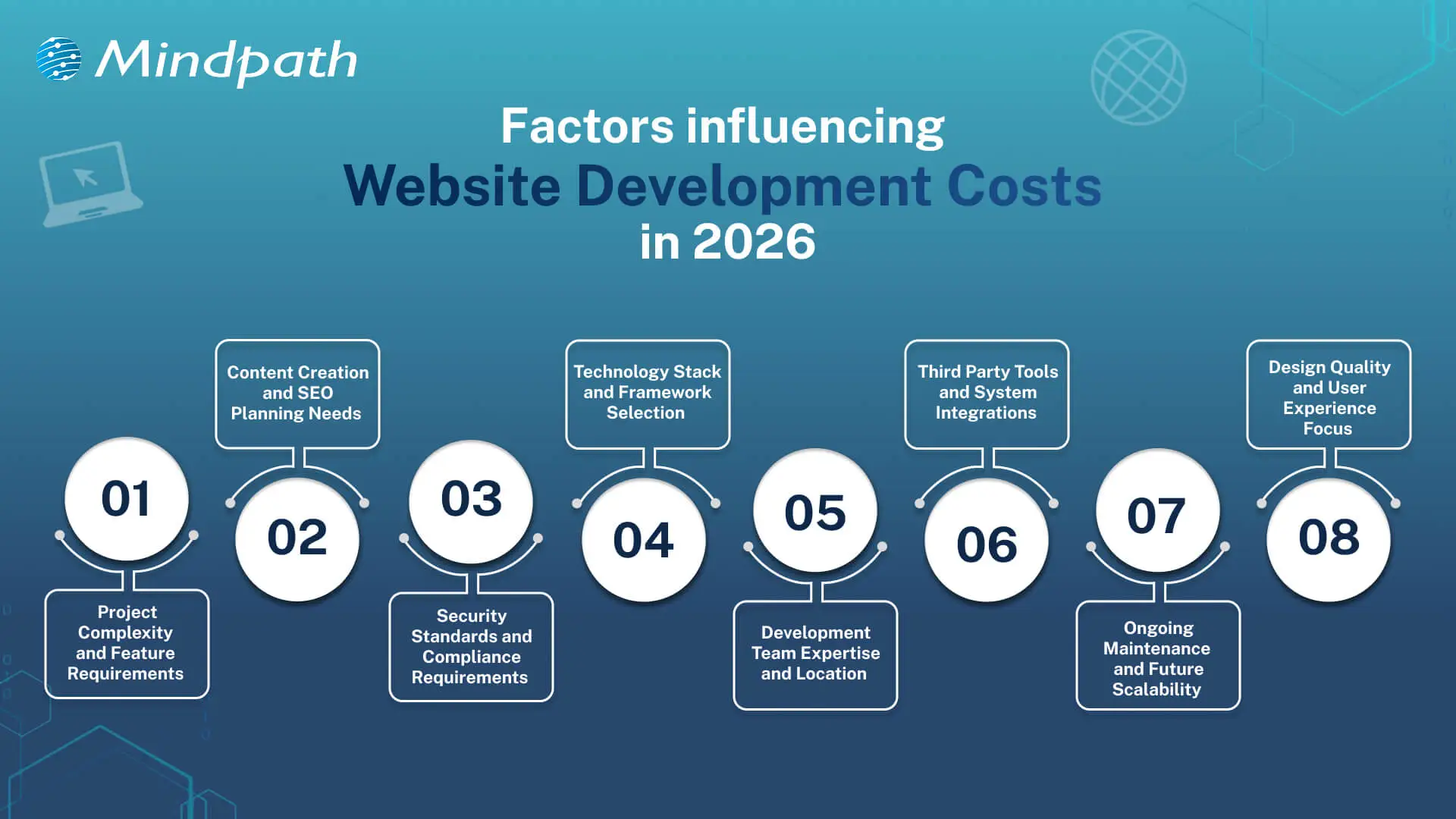
Website expenses in 2026 are based on a combination of various intertwined aspects that will inform the course of planning decisions. Webpage development and website design cost makes businesses understand how to establish a realistic budget early.
1. Project Complexity
Basic websites are inexpensive and will satisfy fundamental requirements. The inclusion of more specific features like e-commerce or user accounts complicates and adds more planning. All these additions increase the average website development costs.
2. Content and SEO Requirements
Excellent content is advantageous to the user and the search engines. Establishing the SEO takes serious planning and technical effort. This increases visibility but increases the budget.
3. Security and Compliance Needs
Secure websites save the data of users and maintain the reputations of the business. Compliance regulations impose additional development phases, which introduce relevant layers of costs.
4. Technology Stack Choices
The contemporary tools determine the strength of a web site. It is time-consuming to work with AI, AR, and sophisticated frameworks. This option has a powerful influence on the website development costs.
Curious why some web projects cost more than others? Discover web development tools and see how technology choices influence productivity and expenses.
5. Development Team and Location
Expert teams provide scalable and stable websites. Compared to freelancers, agencies are more expensive due to their wider knowledge. Location is also a factor that affects rates and total expenditure.
6. Third Party Integrations
Websites usually have a connection with payment or CRM tools. Additional setup and testing time is added in every connection. An increase in integrations implies increased development effort.
7. Maintenance and Scalability
Websites need updates after launch. Hosting, fixes, and growth planning require steady investment. These costs support long-term performance and ROI.
8. Design and User Experience
Good design improves trust and user flow. Custom layouts need research and testing across devices. This work increases value and raises the average website development cost.
Looking to understand how emerging trends affect website development costs? Check out the latest web development trends to see how new technologies and practices influence project scope.
Understanding Website Development Costs
Website development costs depend on planning, technology, and business goals working together. Understanding these costs helps businesses make smart decisions before starting development.
1. Enterprise Website
The cost usually starts from £50,000 and can exceed £150,000 based on scale. Pricing increases due to security, integrations, and multi-language requirements.
2. Single-Page Website
Costs typically range between £250 and £800 for a basic setup. The price stays low because development time and features remain minimal.
3. Custom Web Platform
These platforms cost between £15,000 and £75,000 or more depending on logic. Higher costs reflect custom development, testing, and long build cycles.
Curious how web development costs compare to full-scale software projects? Discover software development cost insights to understand long-term budgeting and investment planning.
4. Small Business Website
The average cost falls between £800 and £3,000 for 5 to 10 pages. Pricing depends on CMS use, design level, and basic SEO setup.
5. E-Commerce Website
Costs usually start around £2,500 and can exceed £20,000. The final price depends on products, payment systems, and inventory complexity.
6. Advanced Brochure Website
Pricing ranges from £3,000 to £8,000 for custom design builds. Costs rise due to animations, performance hosting, and lead-focused features.
Planning your web development budget more effectively? Explore web development technologies to see how choosing the right stack affects cost and performance.
Ready to Plan Your Website Budget with Confidence?
Planning a website in 2026 needs clarity and smart thinking. Costs connect with design, features, security, and growth plans. Website development costs change with every decision you make. Clear planning avoids confusion later. It also helps balance value and spending. When you understand web development pricing, you invest with purpose and confidence.
Mindpath web development services focus on clarity, quality, and growth. Our teams plan projects with clear goals and transparent charges for website development. We build secure, scalable websites that support real business needs. Every solution balances performance and cost. With Mindpath, planning stays simple and results stay strong.

Growing a start-up can be thrilling, but every technical choice made carries a lot of responsibility for your company’s future. You need to hire dedicated developers who will be able to transform your ideas into reality. When you look for developers, you are looking for someone with dedication, dependability, and shared intention.
At this point in time, there is usually a lot of pressure and excitement. You want your developers to be able to work together as a team and complete their tasks smoothly and efficiently. You want to set an example of how to maintain a good pace in this process by establishing expectations about pace, important tasks, and accountability.
When the momentum is strong, the hiring mindset gets more and more refined and purposeful. You actually look for clarity, consistency, and long-term alignment. Stable developers make your rapid plans more viable. On the other hand, bad choices can waste your time and confuse your team. Having a well-defined hiring approach saves you from that kind of trouble. It makes it easier to take good decisions and execute your plans without hitches. In this article, we will explain the steps that will give you confidence and guidance in hiring the right developers.
Want to hire dedicated developers who can bring your startup ideas to life efficiently and reliably? Mindpath provides expert developers and custom solutions that help startups build scalable and high-performing web applications.
Why Do Companies Need to Hire Dedicated Developers?
The companies that opt for dedicated teams benefit from their ability to provide consistent focus and measurable results. When you hire dedicated developers who work on a single project, the efficiency and effectiveness of the development team increase. Developers also bring an entirely different approach to the project based on their expertise. They create quality code that is free from errors, thus improving the quality and decreasing the time to market. In addition, dedicated teams are typically less expensive than managing a full-in-house team.
This method enables businesses to be adaptable and grow over time. Firms are able to hire developers according to the requirements of the project. Also, they have the freedom to extend their workforce without any waiting time or interruption. Skilled developers bring down the chances of unsuccessful outcomes by efficient organizing. Experienced developers also provide updates and support after the launch of a new product. Therefore, businesses continue to have direct control over their business goals and outcomes.
Key Responsibilities of a Dedicated Developer
1. A committed programmer assumes full ownership of the product. They deal with frontend and backend and mobile requirements with great ownership and coherency.
2. They create the MVP within a short time to gauge ideas in the market. This assists startups to learn quickly and adapt without wasting time.
3. They develop the product to expand alongside the business. They take care of updates, corrections and long-term support as well.
4. They introduce expertise that startups usually do not have in-house. That is the reason why most startups prefer to hire dedicated developers at an early stage.
5. They are knowledgeable about the startup vision, culture, and roadmap. This orientation maintains development towards actual business objectives.
6. Startups hire remote developers as part of the core team that works in the same direction. This guarantees quickness, efficiency, and good cooperation.
Planning to build and launch your product efficiently? Explore how creating an MVP for startups helps validate ideas faster and ensures you hire the right developers for early-stage success.
Key Steps to Hire Dedicated Developers for Your Startup
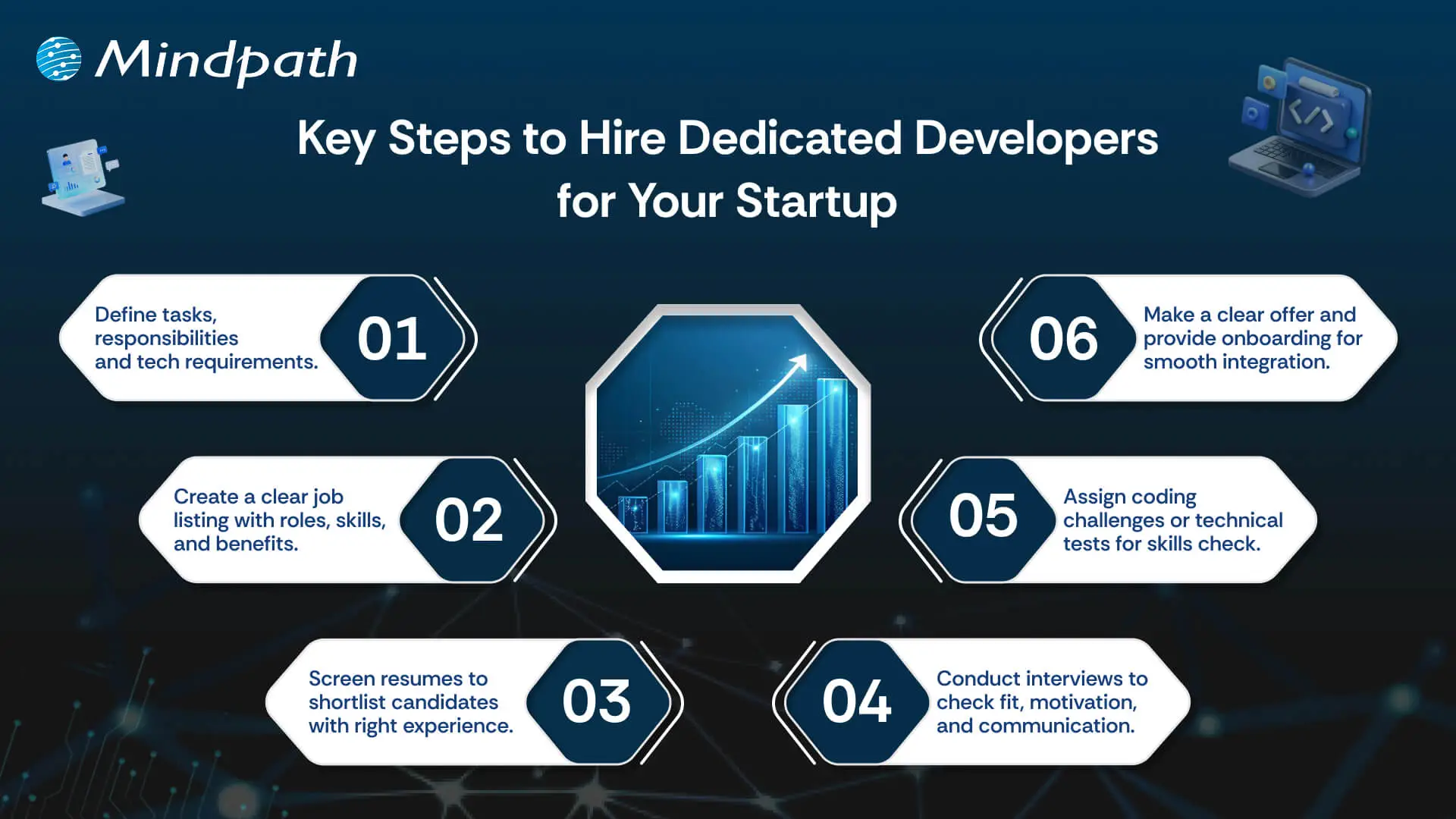
Recruiting appropriate technical talent determines the manner in which a startup is formed and developed. These are the major steps to hire dedicated developers for your startup in a clear-cut and controlled manner.
1. Define Your Development Needs
Be clear about the tasks, responsibilities, and objectives of the developer position. Choose the technical infrastructure, level of experience, and the soft skills. Share these requirements to get the right candidates that would fit into your startup vision and culture. This will guarantee that you get the perfect match prior to the hiring process.
2. Create an Attractive Job Listing
Prepare a precise and brief job advertisement specifying the job, the requirements, and company benefits. Exhibit growth prospects and culture. Advertise in job boards, social media and professional networks to access competent candidates. A good listing attracts and enhances the quality of response.
3. Screen Resumes Efficiently
Filter through applications to identify those candidates who meet your requirements. Check technical skills, experience and applicable education. Find the transferable skills where necessary. Filter out applicants to proceed to the next step. This can save time and concentrate on the best talent.
4. Conduct Initial Interviews
Screen shortlisted candidates on the phone or via video call. Evaluate cultural fit, motivation, and communication skills. Question regarding experience and problem-solving. Present your business, objectives, and culture. This assists the two parties in assessing their compatibility prior to proceeding.
5. Test Technical Skills
Give coding challenges or relevant technical tasks. Evaluate skills based on your project needs. Ensure tests reflect real-world tasks they will handle. Review results carefully to confirm the candidate can deliver high-quality work. This step ensures practical readiness.
6. Make an Offer and Onboard
Share a clear job offer with salary, benefits, and start date. Upon acceptance, offer adequate on-boarding and support to ensure that they settle as soon as possible. Cultivate learning and development to create long-term engagement. This assists startups to successfully hire dedicated developers and assimilate them seamlessly.
Need to scale your development team quickly without long-term commitments? Explore our staff augmentation guide to learn how startups can add skilled developers on demand while staying flexible and cost-effective.
Ready to Hire Dedicated Developers in UK for Your Startup?
How well you hire the right tech candidate will help you to decide your startup’s future. If you stick to the proper procedure, you can effectively hire committed developers without wasting time. This will allow you to quickly develop and launch products, produce high-quality work, and build for long-term success. Defining what you are looking for, reviewing candidates, and assessing competencies helps minimize risks associated with the hiring process. Using this method will provide your company with a more effective development process and consequently generate superior business results.
Mindpath is your option to get the best solutions if you want to hire dedicated web developers for your startup. Our teams are committed to delivering bespoke web development services that are focused, fast, and of high quality. We are a perfect fit with your objectives as we keep on supporting and updating you. By selecting Mindpath, we guarantee your projects will be carried out efficiently, and with high technical standards.
The potential of artificial intelligence to revolutionize business processes revolves around enhancing efficiency, driving smarter decision-making, and fostering innovation. According to Forbes, generative AI can add $4.4 trillion to the global economy, which is hard to ignore for any business (Source). However, the challenges of AI adoption have held back many businesses from tapping into the full potential of AI.
With AI becoming a hot topic in team chats and boardroom meetings, it is reasonable to wonder why business owners think twice before AI adoption. The problem is that around 74% of businesses struggle to achieve anything of value from their AI initiatives (Source). Many organizations encounter different types of challenges during AI adoption, and understanding them can help in finding the ideal solutions.
Handling the challenges of AI Adoption can be complex, but technical expertise can help you overcome hurdles. Our AI development services help businesses overcome challenges and provide tailored solutions.
Unravelling the Common Challenges for AI Adoption
The utility of artificial intelligence for businesses and predictions regarding its value in the future encourage business leaders to think about AI adoption. At the same time, many businesses that have implemented AI in their processes and systems have not captured value from their AI projects.
The journey of AI adoption in business presents formidable challenges, which businesses must understand before implementing artificial intelligence. The following challenges for AI adoption serve as the biggest roadblocks in making the most of the capabilities of artificial intelligence.
1. No Strategy or Vision
The biggest barrier to successful AI implementation is the lack of strategy and vision. If your organisation doesn’t have a well-defined AI strategy, the risks of misalignment grow stronger, especially when considering the future of AI. Without a strategy, businesses might begin their AI initiatives without understanding how AI will align with business goals. The outcome of ignoring strategy manifests in the form of disjointed pilot projects and a lack of quantifiable goals.
Strategy and vision are the foremost AI implementation challenges that organizations should focus on to capture tangible value from AI. The lack of these two things will turn any AI adoption project into an expensive experiment. Furthermore, leaders without a vision and understanding of how AI will contribute to strategic goals can fail after the initial excitement fades away.
2. Lack of AI Expertise
One of the formidable challenges to the success of AI projects is the lack of AI experts. The skill gap in the AI landscape is extremely huge as demand for AI talent outweighs the supply by significant margins, with AI redefining job roles in tech. Many companies don’t have the professionals with technical expertise required for developing, deploying, and managing AI solutions. Some of the notable AI jobs, including data scientists, AI ethicists, and machine learning engineers, have been gaining a lot of attention. However, businesses have to struggle a lot to find the right professional for such jobs.
The list of artificial intelligence challenges will also shed light on the fact that existing IT teams may not have the knowledge to incorporate AI in legacy systems. On top of it, everyone in the workforce cannot understand the nuances of deploying AI models and maintaining them. The talent deficit drives companies to invest heavily in training their existing employees, thereby imposing the burden of time and training costs.
3. Upfront Costs and ROI Uncertainty
Speaking of the burden of costs, business owners must know that the initial investment for AI projects can be huge. The massive upfront costs for AI initiatives include costs of technology infrastructure, software licenses, maintenance costs, and talent acquisition. While enterprise AI adoption offers promising results in the long run, the initial investment is difficult to procure for many businesses. In addition, many businesses could not come up with a justification for the huge upfront investment in specific business use cases of AI.
The uncertainty regarding ROI expected from AI projects can create difficulties in measuring potential cost savings, competitive advantage, or expected revenue growth. As a result, the business leadership might not buy into the project, ultimately leading to difficulties in funding. Such types of AI projects generally fail to move beyond the pilot phase, and some never see the light of day.
Looking to turn AI from an experiment into a strategic advantage? Explore AI in business strategy to understand how the right approach drives measurable impact.
4. Cultural Resistance
Cultural resistance from employees of an organization is obviously one of the most prominent challenges for AI adoption. It provides a clear explanation of why AI projects fail, as disgruntled employees can be the biggest roadblock for an organization’s growth. Employees are likely to harbor fears that AI will replace them, thereby making them more resistant to AI tools and technologies.
Without understanding the purpose and benefits of AI, employees will become more critical of AI and create new challenges. The fear of losing their jobs can make employees more resistant to training, which will result in a lack of enthusiasm for AI projects. On top of it, lower user adoption due to cultural resistance can have a negative impact on the most carefully planned AI projects.
6. Blending with Legacy Systems
Another formidable challenge for AI adoption is the integration with legacy systems. The line of difference between modern AI tools and the outdated legacy systems and the need for modernizing legacy systems can be the biggest headache for business owners. Existing legacy systems might not have the flexibility, interoperability, or scalability to work with new AI platforms. It is one of the common AI integration issues that results in operational inefficiencies, technical complexities, and data silos.
Some businesses might assume that forced integration of AI with legacy systems can solve the problem. However, it would lead to consequences like unexpected costs, project delays, and large amounts of technical debt. Many businesses have failed in their AI initiatives due to the inability to map system connections and facilitate seamless data flow across different platforms.
7. Data Quality and Governance
The effectiveness of AI models depends significantly on the quality of data used to train them. Data quality and governance also take a top spot among the challenges in AI adoption as businesses struggle to find the ideal data for their AI systems across different types of AI. For example, businesses have massive collections of data, plagued by the issues of accessibility, governance, and quality. Businesses have to struggle with issues due to inaccurate, inaccessible, biased, or incomplete data, as they cannot be used in training AI models.
Almost every business that aims to adopt AI cites data accuracy and bias as major challenges. On top of it, the lack of proprietary data for customizing models can restrict the possibilities of effective AI implementation. It is also important to note that data privacy and confidentiality also emerge as prominent challenges for AI projects that deal with sensitive information.
Wondering if your organization is truly ready to adopt AI? Check out our AI readiness checklist to see how businesses can align strategy, data, and technology for successful AI adoption.
How Can Businesses Overcome the Challenges to AI Adoption?
The best way to address the challenges for AI adoption in business involves a strategic and multi-faceted approach. Businesses must aim to fight against the challenges with technology, processes, and people rather than focusing on a specific domain. The following sections offer some valuable recommendations to overcome the challenges in adopting AI for businesses.
1. Develop an AI Strategy
Before starting any AI project, businesses must have a clear and actionable AI strategy that aligns with business goals. The strategy will help you identify the use cases that deliver the most significant impact by addressing specific pain points. Business leaders must focus on projects that promise measurable value advantages in different business operations. Another suggestion to address such challenges involves explaining AI risks and limitations to business leaders. On top of it, businesses must establish an AI governance team, a clear AI roadmap, and measurable KPIs for AI initiatives.
2. Bridging the Skill Gap
Business owners should adopt an innovative approach to address the challenge of skill deficit for AI projects. As AI trends continue to evolve, the approach should begin with training the existing workforce through internal training programs, online learning platforms, and workshops. Apart from promoting AI literacy, businesses should also bring in AI specialists or collaborate with AI vendors when required. Another crucial aspect of the upskilling initiatives for AI projects focuses on AI ethics training to ensure responsible AI development.
3. Show Clear Business Value
The strategic approach to resolving AI adoption challenges must also focus on creating a clear business case for AI. Smaller pilot projects that showcase measurable business value can be the best place to begin. Most important of all, business leaders must also establish benchmarks for success before implementation and track the progress of projects. Quantified impression of benefits, including revenue growth, cost savings, and customer engagement, can provide a clear idea of project success.
4. Seamless Integration and Data Governance
Integration with legacy systems does not have to be a challenge in AI projects, as foresight can solve the problem. Businesses can integrate IT teams in AI initiatives to map out system connections and prepare for integration challenges. Leaders should also take the initiative to foster collaboration between IT and business teams to ensure alignment with business needs. Furthermore, implementing data governance helps in avoiding conflicts during integration while ensuring privacy and quality training of AI models.
Struggling to turn AI strategies into real business outcomes? Explore our AI consulting guide to learn how expert guidance helps organizations overcome adoption challenges and implement AI successfully.
Final Thoughts
The challenges in the journey to adopt AI create huge roadblocks for any type of business trying to embrace AI. However, the solution to prominent business challenges in implementing AI revolves around identifying and understanding the challenges. For instance, business owners must learn how the lack of a clear strategy can affect AI adoption. As a result, business owners will pay attention to developing a well-defined AI roadmap.
We at Mindpath will help you find the ideal solution to overcome AI adoption challenges in any industry. Our years of experience in implementing end-to-end AI solutions have empowered us to address any problem in implementing AI. Reach out to our consultants and figure out the best strategic approach to embrace AI in your organization right now.
In the digital world, cloud computing technology has transformed how business entities store, manage, and process data. The cloud has certainly become the backbone of the modern infrastructure of startups and large enterprises. It not only offers flexibility to business undertakings, but it also offers scalability along with cost efficiency. The rising popularity of cloud has undoubtedly increased the significance of cloud security.
Cloud security involves a series of practices and technologies that can address internal and external threats relating to business security. Businesses operating today must realize the importance of cloud security and be aware of cloud security risks so that they can effectively leverage cloud-based tools. It is time to address the question of ‘what is cloud security’ at a holistic level.
Want to strengthen cloud security without increasing operational overhead? At Mindpath, Cloud Infrastructure Services handle security, monitoring, and optimization so your team can focus on growth.
An Insight into Cloud Computing
Cloud computing is the on-demand delivery of computing resources, including storage, servers, databases, networking, and software, over the internet. Rather than owning and maintaining physical data centers, businesses access these services on an as-needed basis, typically through a pay-as-you-go pricing model. Through the proper leveraging of cloud solutions, businesses have the opportunity to scale quickly while reducing their IT costs.
Several business entities across diverse industries have been adopting cloud technology lately. However, this also means that organisations need to understand cloud security and the potential cloud computing attacks that could compromise their systems. Addressing this key question allows businesses to safely and successfully leverage cloud technology while mitigating risks.
What is Cloud Security?
Cloud security is a collection of cybersecurity policies, controls, technologies, and best practices designed to protect cloud-based applications, data, and infrastructure against unauthorised access, cyberattacks, and data loss. It incorporates key mechanisms such as encryption, identity management, and proactive threat monitoring to prevent and mitigate threats, while also ensuring regulatory compliance for organisations. Some of the key goals of cloud computing security include:
1. Ensure that the security of sensitive and confidential data of organizations is maintained. Moreover, the security of the data has to be maintained when the data is at rest and in transit.
2. Effectively manage multi-cloud challenges that arise when the services of multiple cloud service providers are used by business enterprises.
3. Make sure that only authorized users and devices are able to gain access to the cloud environment.
Wondering how emerging trends are shaping cloud security? Check out the latest cloud computing trends to learn what’s driving secure cloud adoption.
Risks and Challenges Relating to Cloud Security
Poor cloud computing security has the potential to give rise to a broad range of risks as well as challenges. Now that you know what is cloud computing security it is time to look at some of the associated challenges and risks, such as:
1. Data Breach and the Possibility of Fines
Poor quality of cloud cybersecurity has the potential to lead to data breach incidents. When organizations operate in the cloud and security is neglected, it may lead to serious consequences as their sensitive data may be exposed to malicious actors. It means that organizations may fail to comply with the relevant laws and policies. Thus, they may have to pay huge fines.
2. Compliance-Related Violations
In the absence of a cloud security strategy, organizations may end up violating the applicable regulations. With the passage of time, it may affect the credibility of businesses in the operational industry. Violation in this area may give rise to financial and non-financial effects for businesses.
3. Poor Visibility and Monitoring
The lack of security in cloud computing may lead to a lack of centralized visibility. Organizations may also fail to get real-time insight relating to the threat that they may be facing in the cloud environment. With the absence of robust cloud security solutions, organizations may feel crippled and they may not be Able to leverage cloud computing technology to the fullest.
4. Data Losses
Poor practices relating to cloud computing and cybersecurity involve not frequently maintaining backups of your data. Organizations that adopt such practices face the risk of data loss. It may ultimately have an adverse impact on their information integrity. Moreover, systems of the organization may fail because of poor data security practices. As a result, business continuity may be at the receiving end in the long run.
Looking to improve cloud security as environments become more complex? Learn more about cloud-native development and how it supports secure, scalable apps.
Key Benefits of Cloud Security
Organizations need to prioritize both cloud and cybersecurity. Robust cloud security can give rise to a broad range of benefits for businesses operating in diverse industries. Some of the key benefits of cloud security include:
1. Solid Data Protection
Cloud security can play a catalytic role and help safeguard your sensitive business data. It can even employ advanced encryption practices to make sure that unauthorized parties cannot gain access to your data. Along with robust data protection, it can minimize the downtime of businesses and give rise to other advantages, such as the automation of backups and faster disaster recovery.
2. Regulatory Compliance
Proper cloud security can enable organizations to meet different types of compliance standards. They can even help organizations adhere to relevant frameworks such as CIS Benchmark, NIST, and many more. By prioritizing regulatory compliance, the chances of fines and penalties can be reduced considerably.
3. Real-Time Threat Detection
Cloud server security solutions can help in the detection of threats on a real-time basis. The insight can certainly empower organizations to respond to such threats in a timely manner. In current times, when the risks from malicious actors in the cyber setting are immense, real-time threat detection has become non-negotiable for businesses.
4. Scalability and Cost-Efficiency
Cloud security is the ultimate answer to scalability and cost-efficiency for businesses that wish to leverage the cloud to the fullest. Moreover, robust cloud security can certainly help business entities to become more agile, and they do not have to worry about their scalability concerns. Since cloud security is scalable in nature, it can easily adapt to the changing needs of businesses. Thus, organizations can modify their cloud security posture in order to accommodate new users, data, or applications.
Planning to upgrade your cloud security strategy for the future? Check out cloud security tools in 2026 to discover the technologies shaping next-generation protection.
Importance of Cloud Computing Security
In the prevailing times, a greater number of businesses are migrating to the cloud. In order to make the most of cloud technology, it is essential for businesses to understand the importance of cloud security. The role of cloud security is indispensable to ensure that the data and applications of businesses remain safe and secure in the cloud setting.
It is true that third-party cloud computing service providers are responsible for managing the infrastructure. However, businesses have the responsibility to take care of data asset security. Although cloud service providers may adopt best practices, organizations must be vigilant about potential cloud computing vulnerabilities on their side.
As security threats have become more advanced and sophisticated in nature, the importance of cloud computing security has automatically grown significantly. Organizations operating in diverse industries need to take active steps to strengthen their cloud security so that they can function in the cloud setting while maintaining a solid security posture that minimizes the threats from malicious third parties.
Must Read: Multi-Cloud vs. Hybrid Cloud
Common Types of Cloud Security Solutions
In the prevailing times, there exists a diverse range of cloud security solutions. You need to familiarize yourself with some of the most popular solutions so that you can deploy them in a real-life setting. Some of the key cloud security solutions that exist today are:
1. Identity and Access Management
Identity and Access Management (IAM) services and tools assist enterprises in the deployment of policy-driven enforcement protocols. They are for the users who attempt to access on-premise as well as cloud-based services. The chief functionality of Identity and Access Management is to develop digital identities for every user so that they can be actively monitored.
2. Data Loss Prevention
Data Loss Prevention (DLP) can help organizations gain visibility into the data that they store and process. This is possible by providing them with the capabilities for automatically discovering, classifying, and de-identifying regulated cloud data.
3. Security Information and Event Management
Security Information and Event Management (SIEM) combines security information along with security event management in order to offer automated monitoring, detection, and incident response to threats that arise in the cloud environment. SIEM leverages AI and ML technologies for examining and analyzing log data generated across applications and network devices.
4. Public Key Infrastructure
Public Key Infrastructure (PKI) refers to a framework that is used for managing secure and encrypted information by using digital certificates. These solutions provide authentication services for apps and verify that the data is not compromised and remains confidential throughout transportation.
Planning to build scalable applications without managing servers? Check out our blog on serverless architecture in cloud computing to learn how it simplifies deployment while supporting secure and efficient workloads.
Final Words
The significance of cloud security has been gaining momentum in the past few years. As more organizations across diverse industries and sectors are moving to the cloud, the need for robust cloud security is growing like never before. Some of the main benefits of cloud security include solid data protection, regulatory compliance, and many more.
Mindpath’s top-grade cloud managed services can ensure that your business can effectively leverage cloud computing technology. With our solutions, you can optimally manage, migrate, and optimize your workload with our excellent cloud infrastructure solutions. Moreover, you can rest assured about cloud security aspects, as our experts will take care of everything.
Frequently Asked Questions
Have you ever wondered how AI app development can take a basic idea and create something that is smart, user-friendly, and helpful? Imagine an app that learns, impacts your activities, and improves your life without cognitive load! By developing an appropriate strategy, businesses can build apps that make a difference. A well-thought-out strategy will position you to create something that adds real value to users every day.
That’s why an AI app development playbook is necessary. A good playbook maps out the process into actionable steps, so it doesn’t feel overwhelming. A playbook will guide you through the process of validating your idea, selecting the right tools, developing your app, testing it, and launching it. The playbook provides a roadmap to work from, which can save time, reduce risk, and set you apart from the competition. In this blog, you will learn more about how this playbook can help you succeed. So let’s dive in!
Looking for a way to adopt an AI-powered application? Our AI development services help businesses and teams to build intelligent apps that are secure, scalable, and relevant to the needs of the user.
What Does AI App Development Mean?
AI app development is the process of building software applications that integrate artificial intelligence to perform tasks that typically require human intelligence. Unlike traditional apps that follow fixed, pre-written rules, AI-powered applications use machine learning, data pipelines, and intelligent models to learn, adapt, and make decisions in real time. This includes understanding human language, recognizing images, making recommendations, or learning users’ preferences over time. By relying on sophisticated algorithms, machine learning models, and large data samples, developers can build applications that keep improving and deliver more relevant, valuable experiences the longer they’re used.
In contrast to traditional app development, which has fixed rules and stagnant workflows, AI app development allows apps to update, evolve, and respond in real time. AI development uses data processing, pattern recognition, and predictions to be presented in a flexible state and to solve more complex problems. With the right strategy, app development with AI can equip businesses with solutions that differentiate them from competitors and adapt to new user demands.
What is an AI App Development Playbook?
An AI app development playbook is a structured guide that helps teams and businesses create applications powered by artificial intelligence. It brings together proven methods, industry best practices, and practical tips to manage the unique challenges of building AI solutions.
Instead of approaching development without direction, a playbook provides clarity and keeps everyone aligned with the same vision and goals. It helps you make better decisions, avoid common mistakes, and use resources more effectively. Having an AI app development playbook means you have a clear plan to turn an innovative idea into an intelligent, successful application.
Looking to leverage artificial intelligence to make your mobile apps smarter and more user-friendly? Discover how AI in mobile apps can enhance functionality, personalization, and overall user experience.
Benefits of Building AI App Development Playbook
A well-crafted playbook does more than just outline steps; it brings clarity to every decision you make during AI app development. It helps you build with confidence and turn innovative ideas into real, valuable solutions. Let’s dive into some of its benefits:
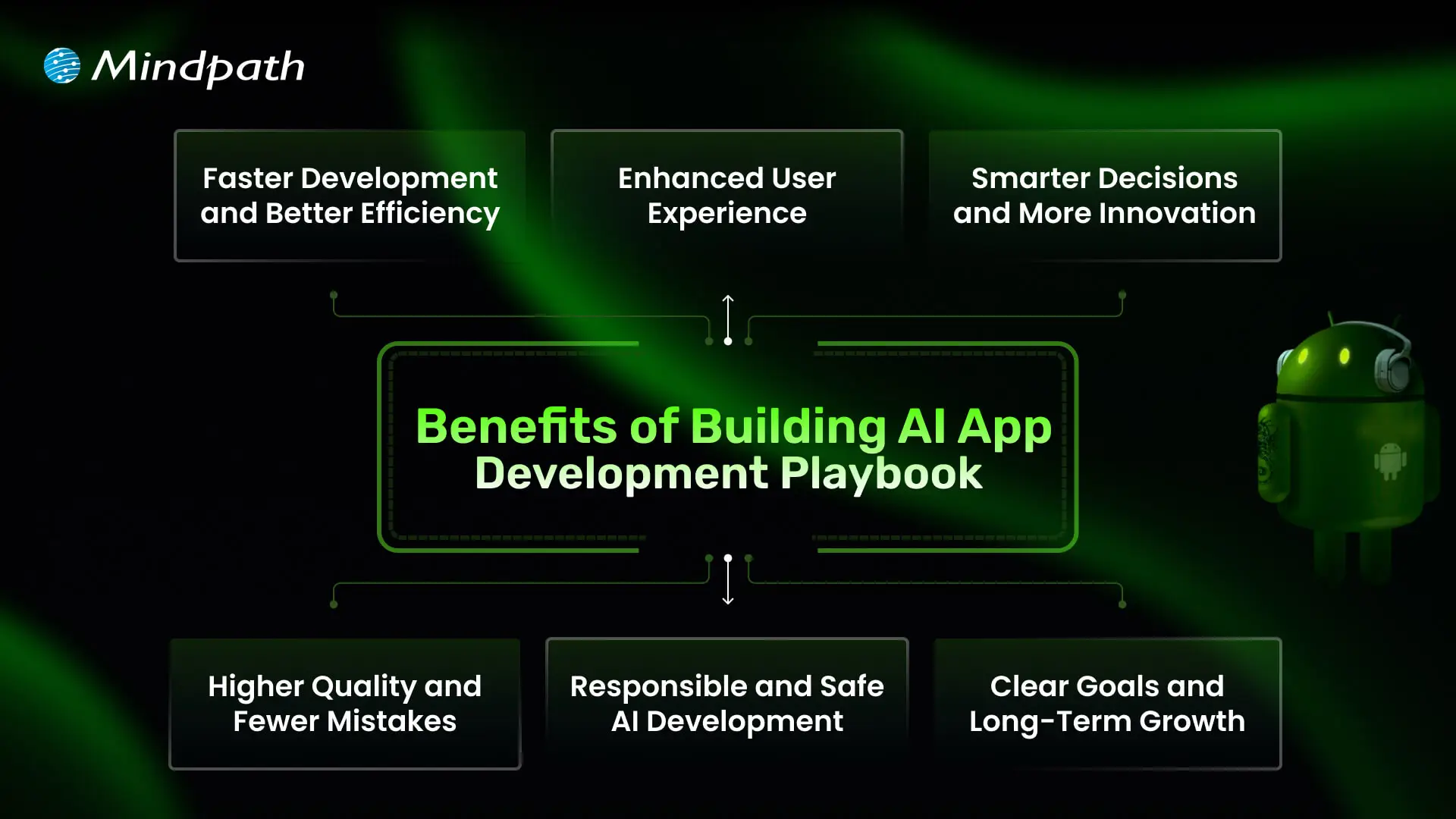
1. Faster Development and Better Efficiency
A well-structured playbook helps teams work smarter and avoid wastage of time. By following proven steps and using the right AI development tools, you can speed up tasks like coding and testing. This leads to faster delivery and more efficient use of resources.
2. Enhanced User Experience
A clear plan helps you build apps that feel more personal and easier to use. Smart features like chatbots and recommendations keep users engaged and satisfied. With the right approach, your app becomes something people enjoy using every day.
3. Smarter Decisions and More Innovation
A playbook supports better choices by using data and clear workflows. Teams can experiment and improve quickly, turning ideas into working features faster. This creates an environment where new ideas thrive.
4. Higher Quality and Fewer Mistakes
When you follow a playbook, your team knows when and how to test and debug. This helps catch issues early and maintain a higher standard. In the end, users get a stable app that works as expected.
5. Responsible and Safe AI Development
A strong guide ensures your team builds solutions that are fair, secure, and trustworthy. It helps address risks like bias or privacy concerns early on. This makes your AI software development more reliable and compliant with industry rules.
6. Clear Goals and Long-Term Growth
A playbook aligns your team with clear objectives that support your business goals. It helps you plan where AI fits best, including when to add features like AI chatbot development services that bring real value. This approach keeps you competitive and ready for steady growth.
Want to enhance user engagement and automate interactions in your AI applications? Discover how lead generation chatbot strategies can streamline customer interactions and boost conversions.
Steps to Build an AI App Development Playbook
Creating an AI app development Playbook gives your team a clear roadmap to build smarter, more reliable applications. It helps you plan each stage carefully, avoid common mistakes, and deliver real value to users. Use these practical steps to shape a playbook that keeps your AI projects focused and successful.
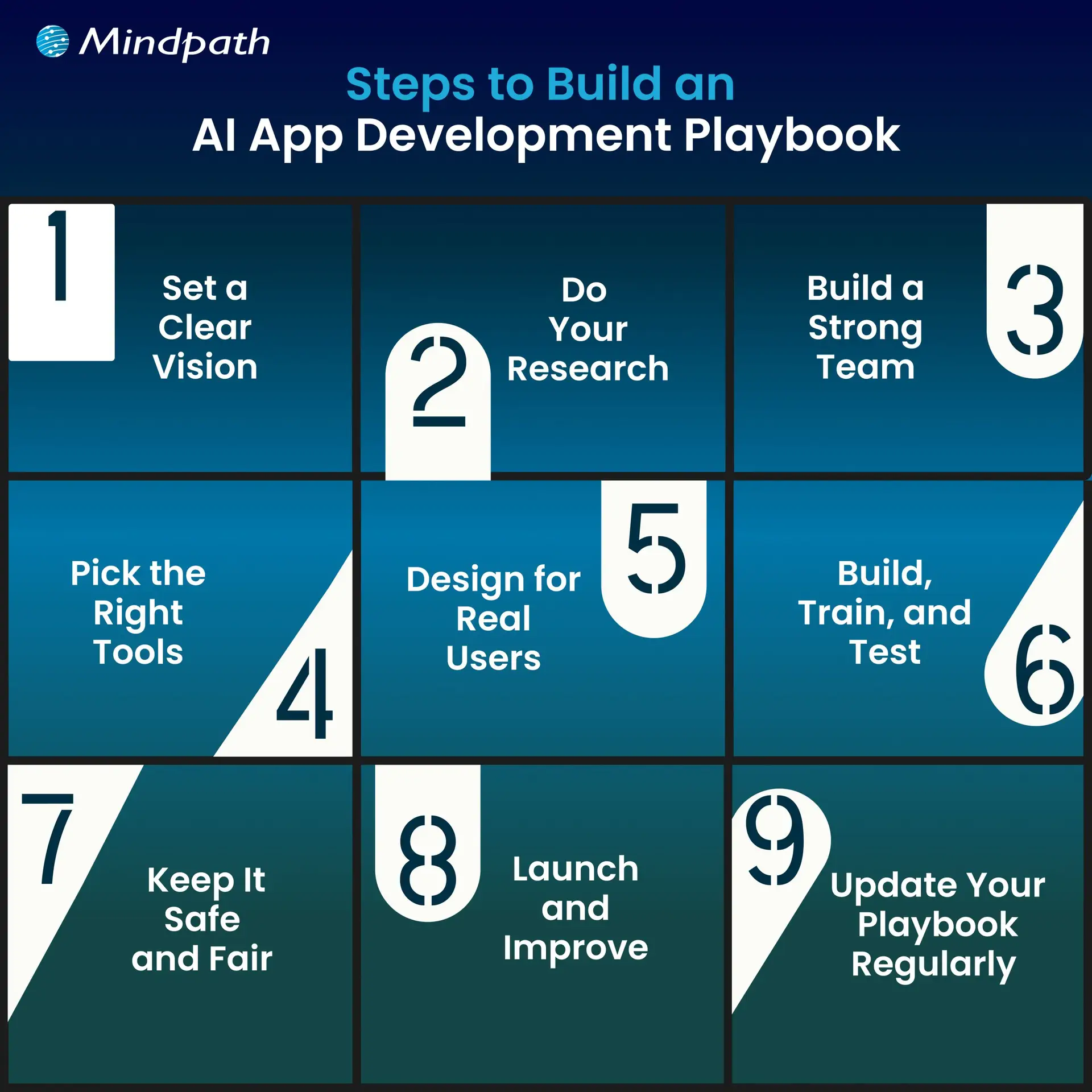
1. Set a Clear Vision
Begin by defining exactly what your AI app should achieve and why it matters. Know the specific problem you’re solving and the audience it will help. Make sure your vision is realistic and tied to your broader business goals. A clear vision gives your team direction and purpose. It sets the tone for every decision you make during development.
2. Do Your Research
Spend time understanding your market, target users, and any competitors. Identify the data you’ll need and check if you can access it responsibly. Look into what AI features will add the most real value. Planning for data privacy and quality early helps you avoid problems later. Good research lays the groundwork for a stronger build.
3. Build a Strong Team
Bring together people with the right mix of skills in AI, design, development, and testing. Make sure everyone understands their role and how they’ll work together. Clear communication and teamwork keep the project on track. A well-prepared team can solve challenges faster. This creates a smoother workflow and better results.
4. Pick the Right Tools
Choose AI development tools, frameworks, and cloud platforms that fit your app’s goals and budget. Look for trusted solutions that make it easier to train, test, and update your AI models. Make sure your tech stack supports scaling as your app grows. Keep your tools flexible so you can adapt to new trends and needs. The right setup saves you time and keeps development efficient.
Want to stay ahead in the rapidly evolving world of artificial intelligence? Discover the latest AI trends that are shaping applications, development, and business strategies for the future.
5. Design for Real Users
Think about how people will actually use your app in daily life. Keep the design simple, clear, and focused on solving user problems. Test early designs with real users to spot areas that need improvement. A smooth experience builds trust in your AI features. The best AI apps feel helpful and natural, not confusing or intrusive.
6. Build, Train, and Test
Start with a minimum viable product that gets the basics right. Train your AI models using clean, reliable data to get accurate results. Test often to catch problems early, rather than fixing big issues later. Use real user feedback to improve your app’s performance. A strong cycle of training and testing keeps your app working well over time
7. Keep It Safe and Fair
Map out how you will securely and responsibly handle user data. You should address any possible biases in your AI models to ensure your app is fair to all users. Stay on top of current data protection practices and regulations. Establish guidelines for your team to follow for every engagement. Following these steps will help you establish trust and remain ethical with your AI solutions.
8. Launch and Improve
Prepare to launch by testing your app in a real-world environment. Observe the ways your app works and the way users will interact with it. Explore what aspects work well and what aspects need improvement. Record these notations for use very soon after launch. Consistent updates allow you to keep your AI app up to date and trustworthy.
9. Update Your Playbook Regularly
Treat your playbook as a living document that grows with every project. After each launch, review what went well and what you could do better. Add lessons learned, updated tools, and new best practices. This keeps your team ready for future AI projects. A well-maintained playbook is an investment in long-term success.
Looking to ensure that your AI applications are secure and reliable for users? Discover essential strategies for protecting your apps by exploring web application security guide.
Want to Turn Your Smart Ideas into a Powerful AI App?
Creating an AI app development playbook helps you move an idea forward with structure, focus, and confidence. It guides your team through clear steps that save time, reduce mistakes, and make the most of available resources. With a practical playbook, you can deliver apps that adapt, solve real problems, and keep users engaged. It’s the smartest way to stand out.
Mindpath is a renowned AI development company that helps businesses build solutions that work in the real world. Our AI development services cover everything you need to plan, develop, test, and grow your app responsibly. We bring trusted strategies and proven tools to your project. Let’s work together to turn your AI app vision into a successful story.
Frequently Asked Questions
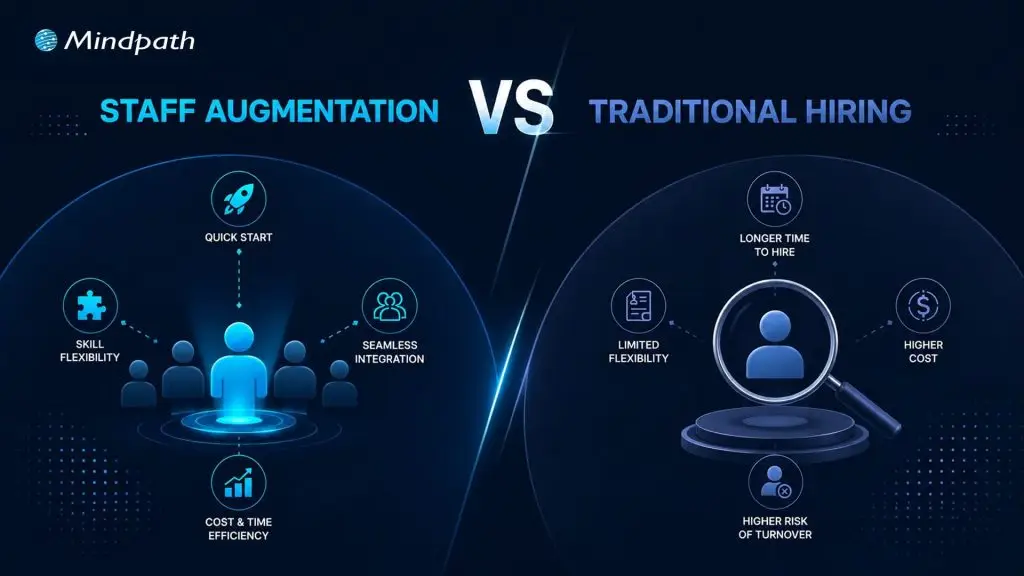
The hiring process for finding the right employees is more complex than ever before. In today’s world, businesses are under constant pressure to grow quickly, remain lean and produce results. Leaders can make better workforce decisions when they grasp the staff augmentation meaning. It’s not all about filling seats. It’s all about the right team at the right time. Many companies continue to hire traditionally because that’s the way they’ve always done it. But the world of business has undergone significant changes. So, the question is, is traditional hiring still the most effective approach?
This answer will depend upon your objectives. Projects require permanent staff members for long periods of time. Others require skills that are specialized for several months. Both models have their own merits and demerits. You could lose time, money, and momentum if you select the wrong one. Talent markets will become more competitive, and flexibility will be a game-changer. We will explain these two models in this blog in a clear way, so that you can make a confident selection. So, let us keep reading further!
Looking for a reliable partner who handles the entire talent search so you can stay focused on delivery? Mindpath offers end-to-end IT staff augmentation services that connect you with experienced professionals who are ready to contribute from day one.
What is Staff Augmentation?
Staff augmentation meaning is easy to understand. Essentially, you bring in outside experts on a temporary basis to enhance your current team. These experts are not separate from your staff but rather work with them. They help in areas where skills are lacking without the need for permanent hires. Companies in various industries like IT, finance, healthcare, etc. adopt this model. It allows them to get the right people at the right time.
Think of it as a hiring strategy that offers a lot of flexibility. Rather than spending lots of time hiring, you simply get highly-skilled professionals who are ready to work almost immediately. Typically, a third-party staffing agency takes care of uncovering candidates for you. Not only will your workforce be strengthened but also your work will be expedited by this method. It’s as simple as that.
Must Read: Staff Augmentation Trends
Key Benefits of Staff Augmentation
Staff augmentation offers more than just the number of workers. It provides the enterprise a wise, speedy, and adaptable route to expansion. Here are the main advantages of why most companies decide to switch.
1. Access to Specialized Skills
Skill deficiencies may hinder progress of ambitious projects. With staff augmentation, you can get niche experts right away, be it AI developers or specialized engineers, without spending months on training.
2. Faster Hiring
Traditional recruitment methods only offer the quality of well vetted, experienced professionals but it takes the advantage of time. Staff augmentation meaning is that it can give you professionals who are ready to work at a short notice.
3. Control Over Projects
In staff augmentation work, you are given full control over the management team which is completely different from traditional outsourcing. You are the one leading the team, deciding the priorities and having full control over every project decision.
4. Enhanced Productivity
Overworking your permanent team is a sure way to cause burnout and reduce productivity. Hiring augmented personnel is an effective way to balance the workload efficiently, enabling each team member to deliver their highest level of performance.
5. Flexibility and Scalability
Project needs are always changing, and your team size has to change accordingly. Staff augmentation gives you the opportunity to increase or decrease your team size with great simplicity. It makes your business able to respond to changes at all times.
Drawbacks of Staff Augmentation
Each of the hiring models presents its own set of challenges. Here are some of the disadvantages to consider.
- Contract rates are higher on extended projects than on full-time salaries.
- It takes time for external personnel to get to know the internal processes.
- Transient employees have a difficult time with company culture.
- Important project information is lost when the contract is terminated.
- Access to the system for others poses significant threats to data security.
- Taking on external professionals puts additional strain on the internal managers.
What is Traditional Hiring?
Traditional hiring meaning is a simple concept. First, a business posts the available position, then goes through the submitted resumes, eventually interviewing the potential candidates, and ultimately deciding on the one that is the best fit. Companies assess individuals mainly on their qualifications, work history, and alignment with company culture. For many years, it has been the default method of recruitment.
This model emphasizes on long-term commitment of both sides. The employer spends time and other resources to recruit a permanent employee who will fit the company well. The process is quite extensive but the progress is usually slow. It is the most appropriate model when a company needs devoted, full-time employees for their continuous positions.
Key Benefits of Traditional Hiring
Let’s examine the main advantages that continue to make traditional hiring a relevant and widely trusted method.
1. Stronger Team Cohesion
Working in permanent teams helps establish closer relationships and make collaboration smoother as time passes. Regular teamwork tends to establish trust and boost productivity.
2. Better Cultural Alignment
Traditional recruitment enables you to hire candidates that fit your values perfectly. Employees who are a good cultural match adjust more quickly and make a significantly higher contribution.
3. Greater Long-Term Commitment
When a person works full-time, they usually immerse themselves fully in the growth and success of your business. Their dedication leads to stability and a greater feeling of personal responsibility.
4. Continuous Skill Development
Businesses have the option of upskilling their employees and preparing them for bigger responsibilities down the line. This not only results in a skilled and dedicated team but also reduces the need for frequent external hiring.
Staff Augmentation vs Traditional Hiring: A Comparison Table
Figuring out which model suits your business better is way easier when you put them next to each other visually. Here’s an overview that explains what is staff augmentation meaning and how do the traditional hiring compare to staff augmentation on the aspects that matter the most to your company.
| Criteria | IT Staff Augmentation | Traditional Hiring |
| Flexibility | High – Can scale up/down as needed | Low – Fixed, long-term commitments |
| Cost | Cost-effective, reduced overhead | Higher costs, including benefits and office space |
| Time to Hire | Quick onboarding with pre-vetted candidates | Lengthy recruitment and onboarding process |
| Access to Talent | Access to specialized, global talent quickly | Limited to available local talent |
| Project Adaptability | Easily adapt to changing project needs | Rigid, less adaptable to project changes |
| Commitment | Short-term or project-based | Long-term employment contracts |
Which Hiring Model is Right for Your Business?
Traditional hiring has its place, but today’s fast-moving business world demands more flexibility. Staff augmentation meaning becomes clear when speed, skills, and cost-efficiency matter most. When comparing staff augmentation or traditional hiring, augmentation consistently proves smarter for businesses that need to scale without long-term burdens or heavy recruitment cycles.
At Mindpath, we provide staff augmentation services that connect you with top-tier talent instantly. Our vetted professionals plug into your team seamlessly and deliver results from day one. Let us help you build smarter, move faster, and grow confidently.
In the digital world, new digital technologies are emerging at a rapid pace. It is imperative for business entities operating in diverse industries and sectors to familiarize themselves with the top digital transformation trends in 2026. The global spending on digital transformation is likely to touch USD 3.9 trillion by the year 2027. It highlights the bright future of digital transformation.
In order to stay ahead in the competitive business space, you need to keep a tab on the key trends that contribute to digital transformation for businesses. The insight into these trends can surely guide your business towards a path of innovation and creativity. Let us explore some of the chief trends that can influence the trajectory of your business in 2026.
Looking to use the digital transformation trends practically in your business operations to enhance performance? Contact us to get personalized advice on how to implement these trends successfully.
Digital transformation trends are the emerging technologies, strategies, and business practices that organizations adopt to modernize operations, improve customer experiences, increase efficiency, and drive innovation through digital technology.
Major Digital Transformation Trends in 2026
Businesses need to familiarize themselves with major digital transformation trends that are dominating in 2026. Such trends can create new opportunities for businesses to stay ahead in their industries. The top digital transformation trends include:
1. Rapid Adoption of Generative AI
The emergence of generative AI has certainly broadened the boundaries of Artificial Intelligence. In fact, you cannot ignore AI and automation in digital transformation today. By leveraging generative AI for business, they have the amazing opportunity to redefine personalization. Moreover, by making use of generative AI capabilities, it has become possible for businesses to automate the content creation process.
It is undoubtedly among the top trends that are catching up among businesses. You can strategically integrate generative AI elements to showcase your commitment to innovation. In the future, as generative AI further matures, businesses can transform their existing workflows as well as processes.
2. Boosting Efficiency through Cloud Computing
Cloud computing is certainly among the top enablers of digital transformation for businesses at present. Businesses need to keep track of the latest cloud computing trends in 2026 so that they can improve their productivity. Moreover, it can also create an opportunity for businesses to minimize their overall costs.
Businesses can consider adopting a hybrid cloud infrastructure. It will enable them to ensure high portability, IT agility, and vendor-related flexibility. Businesses cannot ignore the strategic relevance of cloud computing technology in their digital transformation journey. It can play a catalytic role by fostering innovation for businesses.
3. Rising Adoption of Mobile Technologies
While discussing the topic of digital transformation, one cannot omit mobile technologies. Instead, it is among the top digital transformations in IT that one can come across. Today, the reliance on mobile is expanding among customers. This trend has automatically been driving digital transformation initiatives among businesses today.
Regardless of the industry in which businesses operate, it is essential for businesses to develop mobile apps. By doing so, the communication between businesses and their potential and existing customers can be simplified. It can certainly redefine the overall experiences of customers. It can even give rise to new opportunities for businesses to transform the customer journey.
4. Increased Focus on Cybersecurity
In the highly dynamic and volatile cyberspace, businesses have started refocusing on cybersecurity aspects. The rapid adoption of new types of technologies has automatically escalated cybersecurity concerns for businesses as well as customers. This is because malicious actors such as cybercriminals and online hackers have been using sophisticated techniques to compromise the security of legitimate users online.
To prepare themselves in the evolving cybersecurity space, businesses have started prioritizing their cybersecurity preparedness. Modern businesses are adopting new cybersecurity measures and interventions to strengthen their cybersecurity posture. This specific trend is likely to gain further prominence in the evolving digital landscape.
Wondering how artificial intelligence is reshaping security in the digital era? Check out AI in cybersecurity to learn how intelligent threat detection and automation are transforming protection strategies in 2026.
5. Shift Towards Data-Driven Business
In the contemporary business world, the role of emerging technologies in digital transformation is surely instrumental. It has also created an opportunity for businesses to shift towards a data-driven approach. Today, businesses are relying on concrete data and facts to make decisions. Such a shift has undoubtedly shown the high value of rich and insightful data for businesses.
By relying on real-time and accurate data, it has become possible to respond to the evolving needs of customers promptly. Furthermore, it has also empowered businesses to adapt to the dynamic business climate and make cautious and well-informed decisions. It is definitely a major source of competitive advantage for businesses in the current times. This particular trend certainly holds the promise to redefine the journey of businesses as well as their customers.
6. Growing Popularity of Agentic AI
Although the concept of Agentic AI is in its nascent stage, it has captured the attention of one and all. In fact, this novel technology holds the promise to become a cornerstone of digital transformation for modern businesses. By integrating agentic AI, businesses can automate repetitive tasks. Furthermore, this technology can enable businesses to optimize their overall decision-making process.
Even though Agentic AI is still evolving, it has started to impact several industries and businesses. As such systems have a high degree of autonomy, they can make important decisions with little human intervention. It is certainly among the top emerging technologies in digital transformation that businesses must focus on.
7. High Expansion of Edge Computing
Edge computing is a novel concept where data processing and data storage are brought closer to the source of data. This approach has been gaining considerable momentum in the business world today. This is because it can give rise to a host of benefits for businesses in the form of reduced latency, better real-time responsiveness, and reduced use of bandwidth.
In the competitive business landscape, edge computing certainly acts as a vital source of advantage for businesses today. By leveraging the novel technology, businesses can carry out their operations in a more reliable manner. Moreover, it also creates the opportunity for businesses to save costs by reducing the amount of data that is transmitted to the cloud.
Strategic Importance of Digital Transformation
In the prevailing business environment, it is imperative for businesses to familiarize themselves with the latest digital transformation trends for 2026. By being aware of the emerging technologies, you can strategically deploy appropriate digital technologies to advance towards your digital transformation journey.
Digital transformation is of high strategic importance for entities since it can boost efficiency, promote automation, and improve the experience of customers. Moreover, it can foster innovation, which is a must for contemporary businesses today. By leveraging digital transformation for business growth, you can ensure that your business can effectively adapt to the evolving business climate. It can serve as the ultimate pathway that can help businesses achieve sustainable growth in the digital age.
Wondering how digital trends drive real business impact? Discover digital transformation for businesses to see how companies are evolving in 2026.
Final Words
In the 21st century, digital technologies have been influencing how business entities operate. In order to adapt to the rapidly evolving business setting, it is a must for businesses to keep a tab on the top digital transformation trends. A broad range of trends has been identified, including the rapid adoption of Generative AI, leveraging cloud computing, rising use of mobile technologies, increased focus on cybersecurity, and a shift towards data-driven business. Similarly, businesses are also focusing on novel technologies like Agentic AI as well as edge computing to boost their capabilities.
As the strategic relevance of digital technologies is immense, businesses must choose a top service provider that can help them advance in their digital transformation journey. Businesses must consider the innovative solutions of Mindpath to stay ahead in the digital transformation race. The modernization and digitalization of solutions can surely help businesses thrive in the technology-driven business world.
Artificial Intelligence has certainly surfaced as a transformative force in the DevOps realm. In the current times, DevOps teams and professionals have the opportunity to leverage top Artificial Intelligence tools in order to streamline the software development process while promoting resource optimisation. 61% entities have reported that the adoption of AI in DevOps has significantly boosted their delivery ability.
Both novice and experienced DevOps professionals need to familiarise themselves with the strategic role of AI for the DevOps approach. The insight is crucial to capitalise on the capabilities of AI and strengthen how the DevOps approach is adopted while developing software solutions. Let’s identify some of the major AI tools that are revolutionising DevOps at the moment.
Want to adopt AI in DevOps with full potential? Mindpath’s AI Development Services provide full assistance on how you can select and implement the right tool according to your specific requirements.
Best AI Tools for DevOps Teams
Artificial Intelligence has been gaining high prominence in the DevOps arena. Within a short span of time, diverse AI tools have emerged that have simplified the work of DevOps teams. These tools have immense potential to redefine the DevOps approach.
It is imperative to identify the AI tools for DevOps so that you can simplify diverse processes relating to automation, security, code development and many more. Some of the top AI tools for DevOps professionals include:
1. GitHub Copilot
GitHub Copilot is undoubtedly one of the most popular AI tools for DevOps experts that exists today. It can be used as an extremely useful tool that is powered by Artificial Intelligence, which simplifies coding. It is capable of making suggestions to coders. Moreover, it can also assist coders by providing valuable assistance in entire functions. As a result, by leveraging the specific tool in the DevOps landscape, it is possible for developers to write code in an efficient manner. Furthermore, by leveraging the specific tool, the possibility of making errors is substantially reduced. GitHub Copilot represents a significant step toward the future of AI in software development and DevOps workflows.
2. AWS Codeguru
The popularity of Amazon Codeguru has been skyrocketing in recent times. It serves as a perfect tool that DevOps professionals can use for the purpose of automating code analysis. A highlight of this particular artificial intelligence for DevOps is that it is capable of making intelligent recommendations relating to code reviews. Coders and software developers can also rely on the specific tool to gain insightful suggestions relating to the performance of applications. With the help of this top-grade AI tool, DevOps teams can locate issues and improve the quality of their code, and fully leverage the benefits of AI in their development workflows.
3. Datadog
Datadog is a popular AI-driven platform that simplifies the processes for development teams. It is certainly among the top DevOps for business tools that can be used for diverse purposes such as monitoring, security, and performance. This tool offers rich insights to DevOps teams in terms of the behaviour of the software application and the overall health of the infrastructure. It certainly serves as a holistic tool that can offer observability power in an end-to-end manner to DevOps teams. You can definitely capitalise on this tool to achieve goals relating to real-time observability, unified monitoring, and troubleshooting.
4. Splunk
Splunk has gained a solid reputation in the DevOps scene of the current times. It acts as a robust data analytics and monitoring platform that can be used by DevOps teams. By choosing the specific AI-based tool, you can get complete visibility across the full software development lifecycle. In case you have limited familiarity with the particular tool, you can consider partnering with top providers of DevOps services. DevOps teams can leverage Splunk for diverse purposes, including monitoring of performance, event and log monitoring.
5. Sysdig
Sysdig serves as one of the most comprehensive DevOps platforms available for software developers at present. It has been specifically designed for diverse purposes such as monitoring and security in containerised environments. A chief highlight of the tool is that it integrates operations along with top security and offers unified control and visibility to teams. Thus, throughout the software development lifecycle, DevOps professionals can have a solid insight into the process. Moreover, you can rest assured about compliance and monitoring aspects by utilising the tool.
Trying to keep up with the rapidly evolving DevOps landscape as we move into 2026? Explore the latest DevOps trends shaping modern development, automation, and AI-driven workflows.
6. Dynatrace
In the contemporary DevOps landscape, the Dynatrace tool has been playing a cardinal role. It acts as an ideal observability platform that can be leveraged by DevOps teams while developing top-notch software applications. You can take advantage of this app to simplify processes relating to monitoring, collaboration, and automation. Furthermore, Dynatrace offers a broad range of tools that can create value for you relating to resilience engineering, release validation, and automated remediation of problems. The powerful capabilities of the AI tool can empower your DevOps team while developing novel software solutions.
7. Ansible
Ansible is a popular open source automation tool that streamlines DevOps practices for professionals. This tool is primarily used for the purpose of streamlining as well as automating a broad range of IT tasks and processes. It significantly contributes to the DevOps process by focusing on areas such as configuration management, deployment of applications, and the provisioning of infrastructure. Moreover, DevOps teams can leverage the AI-based tool to perform orchestration. This is because Ansible facilitates the orchestration of complex workflows and supports the coordination of multiple tasks.
8. Harness
In the current DevOps realm, Harness has emerged as a holistic software delivery platform., By using the specific tool, your DevOps team can automate the full software development process. Therefore, starting from continuous integration and continuous delivery, you can automate ongoing tracking of errors. Harness has been recognised as one of the most useful tools for DevOps professionals. With the help of the AI tool, your DevOps team can certainly accelerate the software development process and minimize the possibilities of errors and mistakes.
9. Argo CD
In recent times, Argo CD has surfaced as a popular AI tool that can be used by DevOps professionals. It is basically a declarative continuous delivery tool. By using the tool, it is possible for DevOps teams to automate the management as well as the deployment of software apps within Kubernetes clusters. The fact that it is open source in nature enables DevOps teams to use it in a highly versatile and flexible manner. The specific tool offers a broad range of features to users, such as single sign-on integration, multi-cluster management, and many more.
10. Snyk
While adopting the DevOps approach to develop software solutions, one cannot ignore the security aspect. This is when the Snyk tool comes into the picture. Snyk is a developer-first platform that incorporates security elements into the software development process. You can utilize this specific AI tool in your DevOps process for scanning vulnerabilities in code, containers and open-source dependencies. This tool is well-suited for diverse DevOps teams since it perfectly integrates with various elements, such as developer workflow, as well as cloud platforms. You can leverage the tool since it offers actionable insights that can enhance the overall quality of your software solution.
Looking to overcome DevOps hurdles such as security risks, and scalability issues? Discover DevOps challenges and solutions that help organizations overcome these issues and improve operational efficiency.
Benefits of AI Tools in DevOps
The use of AI tools in DevOps processes can give rise to a host of benefits for DevOps teams. Some of the major benefits that you must be aware of include:
1. Better reliability
DevOps teams can leverage AI capabilities to create highly reliable software solutions. This is mainly possible by making use of the predictive analysis function of AI technology.
2. Faster Software creation process
Software development can be quite time-consuming. However, by leveraging AI tools, it is possible to automate diverse processes. It can ultimately speed up the software development process for teams.
3. Proactive resolution of issues
Issues can act as major bottlenecks while developing software applications. With the help of the right AI tools, it is possible for DevOps teams to proactively deal with issues. Therefore, the overall quality of the software solution can also improve.
4. Improved collaboration
By using AI tools or generative AI tools for DevOps, it is possible for professionals to enhance collaboration. Collaboration can certainly open up new and better opportunities that can strengthen the overall process relating to the development of software solutions.
Want to learn how DevOps can transform your business and accelerate your development processes? Discover the benefits of DevOps for a deeper understanding of its impact and value.
Final Words
In the dynamic DevOps arena, the use of artificial intelligence tools is considered to be a necessity. DevOps teams need to be aware of the top tools so that they can strategically use them while creating software solutions. The selection of the right kinds of tools can certainly streamline the software development processes for you. Some of the top tools that you must be aware of include GitHub Copilot, AWS Codeguru, Datadog, Splunk, Sysdig, etc.
We at Mindpath help businesses to make the most of the top AI tools for DevOps with our AI Development Services. Our professionals ensure that the perfect AI tools are chosen that are in line with your DevOps processes. Moreover, you can see how intelligent DevOps can strengthen the quality of your software solutions.
Join our Newsletter!
categories
Join the world's largest training library and unlock new opportunities!
Featured Posts
Turn Insights Into
Real Business Solutions
Exploring trends is only the beginning. Whether you’re planning AI adoption, modernizing legacy systems, or building scalable software, our experts help transform ideas into practical business outcomes.