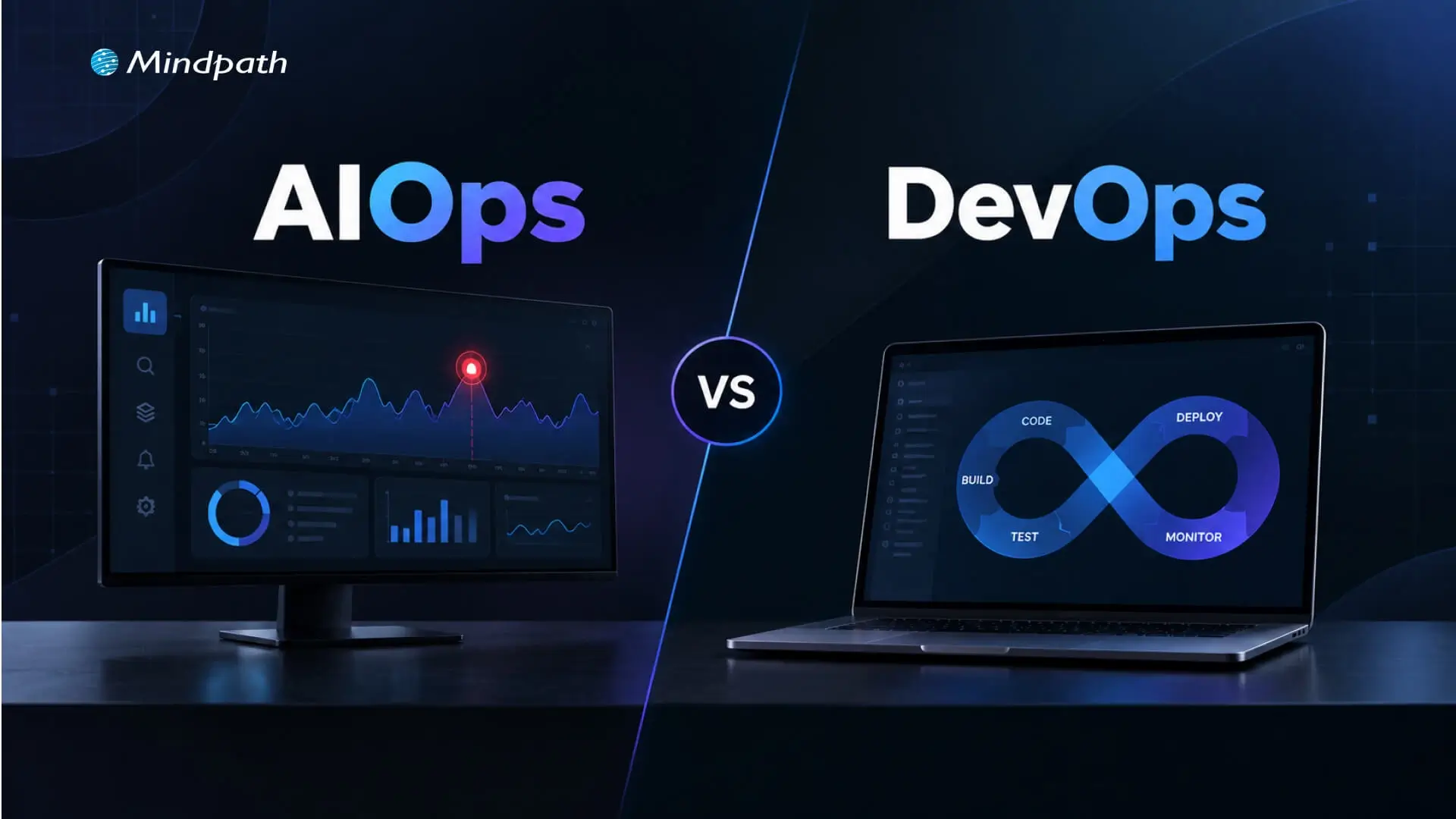
The technology landscape has been drastically developing at a great pace. Businesses are under pressure to innovate faster and deploy more reliable customer experiences. At this great transformation, the conversation around DevOps vs. Traditional IT has become critical. So, the right approach can influence your speed, innovation, costs, and even customer satisfaction.
Further, there are some companies that still benefit from the structure and control of traditional models. On the other hand, others need the agility and automation that DevOps delivers. In this blog, you are going to understand the difference. This can also help you make the right choice that matches your business goals.
Planning to modernize your IT operations for faster and more efficient delivery? Mindpath offers DevOps services that help streamline workflows, enhance collaboration, and accelerate your development lifecycle.
What is Traditional IT?
The global IT services market size has already reached USD 1,652.27 billion this year. Further, it is going to expand to reach USD 3,299.78 billion by 2033. So, traditional IT values a structured process and initiates work step-by-step. Here, different teams manage multiple parts of the software development lifecycle. For example, developers write the code, and testers will verify if the system has any issues.
This structure majorly values the Waterfall model, where every phase must be completed before shifting to the next one. One of the best parts of traditional IT infrastructure is that it ensures thorough documentation and testing. But it somehow makes the process slower and more rigid. Any last-minute change can include major delays and disturbances.
- You can have clear department roles and responsibilities.
- It is a better option for legacy applications.
- You can have strong control over infrastructure and other processes.
- It is easily compliant in highly regulated environments.
What is DevOps?
The DevOps market size is expected to reach USD 108.26 billion by 2035. As per the recent statistics, around 72% developers are using the Agile method, whereas 46% of organisations are combining methodologies. So, DevOps is a modern and collaborative approach that combines development and operations into an individual workflow.
Instead of working in isolated teams, DevOps creates a culture of shared responsibility. Further, your whole team can leverage the relevance of automation and continuous improvements.
- Unlike a traditional system, DevOps values agile principles.
- It initiates modern IT operations that automate tasks like testing, integration, and deployment.
- Additionally, this approach can help you reduce errors while improving the overall efficiency.
The Major Difference Between DevOps vs. Traditional IT
Both approaches aim to support your business technology. However, they hold some prominent differences as given below.
1. Deployment Speed
Traditional IT mainly uses scheduled releases, sometimes weekly or monthly. On the other hand, DevOps supports continuous releases through automation. This means you can go live with your features, fixes, and updates faster.
2. Team Structure
Your whole team might remain separated in traditional IT. Developers need to write the code, and they deploy it while handling the issues in the later stage. This can create communication gaps and delays. However, in DevOps, teams can work together from the beginning. This is one of the biggest DevOps benefits for business. Your developers and testers will have ownership.
3. Infrastructure Management
Traditional environments majorly depend on physical servers or manually managed systems. But DevOps relies on cloud environments, containers, and automation to handle infrastructure effectively.
4. Risk Handling
Traditional IT might avoid changes because it can introduce instability in the whole system. However, DevOps is capable of handling risks differently. Instead of making fewer big changes, it allows you to include smaller and more frequent updates.
Top DevOps Benefits for Business and IT Operations
Here are some top DevOps benefits for business that can incredibly encourage your performance in the long run.
1. Faster Time to Market
One of the biggest advantages of DevOps is speed. With automation, you can reduce the chances of delays in testing, deployment, and monitoring. This means your business can launch new products or features much faster.
2. Effective Collaboration
Instead of your teams blaming each other when issues arise, DevOps allows you to have better communication. They can work together and share goals and vision.
3. Higher Reliability
DevOps is not just about moving fast. It accesses continuous monitoring, automated testing, and smaller releases. This makes your systems stable over time.
4. Reduced Operational Charges
Manual processing can be expensive for you. Repetitive deployments, testing, and infrastructure management can consume your time and resources. So, DevOps can reduce these defects through precise automation.
5. Improved Security
With the right DevOps implementation, security assessment and monitoring tools can be directly added to your delivery pipeline. So, fewer blind spots mean faster issue assessment.
Why are Traditional IT Advantages Still Making Sense?
With the ultimate rise of DevOps, traditional models are still relevant in the market. Here are the situations where traditional advantages can be more prominent than speed.
- You handle a strict environment with severe policy regulations.
- Your application updates are infrequent and not very urgent.
- Your internal team is structured around conventional infrastructure management.
A Brief Comparison Between Traditional IT vs. DevOps
Here are some key aspects that define the values of DevOps vs. traditional IT in a structured way.
| Factors | Traditional IT | DevOps |
| Core Strength | Stability and Control. | Speed and collaboration. |
| Team Structure | Excludes teams from development and operations. | Make a team to work together. |
| Infrastructure | Values manual proceedings. | Use automation. |
| Business Impact | Helps in maintaining stable IT environments. | Supports modern IT operations. |
| Best For | Regulated Industries | Fast-Growing Businesses |
The Best Approach for Many Businesses
You need to understand that organizations don’t just jump directly from traditional IT infrastructure to full DevOps. In fact, they change with time. They start by automating the testing phase while influencing the operation pipelines. Further, they might move selected workloads to the cloud while modernizing one application at a time. This hybrid approach can work best because it reduces disruptions while still bringing in the benefits of modern IT operations.
Conclusion
When it comes to DevOps vs. Traditional IT, both approaches come with their own uniqueness. But, in today’s highly developing technological world, DevOps is becoming a serious choice among competitive businesses. However, the best approaches depend on your business goals and growth plans.
If you are ready to make the shift to DevOps and future-proof your business, Mindpath can be your ideal partner. With our cloud and DevOps services, we help bridge the gap through automation, scalable infrastructure, and DevOps-led transformation solutions.