
Latest Insights On
GenAI, Tech, and Digital Transformation
Stay updated with expert insights, success stories, and real-world applications of cutting-edge technology.
Businesses are under pressure to do more with the systems they already have. Replacing a CRM, ERP, or support platform just to add AI is rarely practical. AI API integration offers another path: connect AI directly to existing workflows to automate tasks, accelerate decisions, and create more value from technology investments already in place.
Key Takeaways
- 01
AI APIs connect intelligent capabilities with existing business applications and workflows. - 02
Businesses can add AI without replacing established technology systems. - 03
Choosing the right AI capability depends on specific business goals and data. - 04
Secure architecture helps manage data, performance, costs, and scalability. - 05
Phased implementation makes AI integration easier to test, measure, and expand.
But adding an AI API is not as simple as connecting two systems. Businesses must consider data, security, compatibility, performance, and scalability before AI can work reliably in day-to-day operations. In this blog, we will explore how businesses can integrate AI APIs with existing systems effectively. Let’s begin!
Ready to connect AI with your existing business systems? Mindpath offers AI Integration Services to help businesses connect AI capabilities with existing applications and workflows.
Understanding AI APIs and System Integration
Businesses often have valuable data, established workflows, and critical applications they cannot afford to replace. AI APIs provide a practical way to add intelligence to this existing infrastructure. They act as a bridge between business applications and AI services, allowing systems such as CRMs, ERPs, and support platforms to send data to AI models and use the results within existing workflows.
Most AI services use endpoints through a REST API for AI models, with requests and responses commonly exchanged in JSON. This lets development teams integrate capabilities such as summarization, classification, content generation, and information extraction without building models from scratch. The business can focus its resources on connecting AI to the right processes while keeping its existing technology foundation intact.
Choosing the Right AI Capabilities for Your Business
AI integration creates value when the capability solves a specific business problem, rather than when AI is added simply because it is available. Before choosing an API, businesses should identify the task, the people using it, the data involved, and the outcome they want to improve.
Some practical capabilities include:
1. Text generation
Create product descriptions, emails, reports, or internal content faster.
2. Summarization
Turn lengthy documents, meetings, or customer conversations into concise insights.
3. Classification
Categorize support tickets, customer feedback, documents, or incoming requests automatically.
4. Image recognition
Extract information from images, forms, invoices, or visual content.
5. Recommendations
Personalize products, content, or actions based on customer and business data.
6. Forecasting
Analyze historical information to support demand, sales, or operational planning.
The right AI API for business should fit the existing workflow, data environment, and technical requirements. Starting with one clearly defined use case also makes it easier to measure results before expanding the integration.
How Does AI API Integration Fits into Existing Systems?
Choosing the right AI capability is only the first step. The next question is how that capability will fit into the systems and workflows already running across the business. AI API integration works best when businesses map where AI can add value without creating unnecessary changes to existing applications or processes.
A practical integration should consider:
1. Existing systems
Identify the CRM, ERP, support tools, databases, and applications AI needs to connect with.
2. Data flow
Define what information AI receives, how it is processed, and where the output goes.
3. Integration layer
Use middleware, adapters, or API gateways when direct connections are difficult, especially with legacy systems.
4. Security
Protect API credentials and control which systems and users can access AI services.
5. Performance
Account for response times, API limits, traffic volumes, and expected workloads.
6. Scalability
Design the integration so new AI capabilities and business systems can be added without major rework.
This approach helps businesses introduce AI without disrupting established operations while creating a reliable foundation for future use cases.
How to Integrate AI APIs Into Business Systems?
Once the right AI capability and integration architecture are identified, businesses can move toward implementation. A structured approach helps development teams connect AI without disrupting existing workflows. This becomes particularly important when businesses need to connect AI to legacy systems, where older applications may lack modern API support.
Here are eight practical steps for integrating an AI API:
1. Define the Business Use Case
Start with one specific workflow and identify the task AI will improve. Define the expected outcome, users, data requirements, and measurable success criteria before development begins.
2. Select the Right AI API
Compare available APIs based on capability, output quality, pricing, latency, documentation, security requirements, and usage limits. The selected API should fit both the business objective and technical environment.
3. Map Existing Systems
Identify the applications, databases, workflows, and integration points involved in the process. For legacy applications, determine if middleware, adapters, or an API gateway is needed to establish communication.
4. Configure API Authentication
Set up secure authentication using API keys, tokens, or other supported methods. Credentials should be stored securely and access should follow the principle of least privilege.
5. Build and Validate Data Flows
Define how data will move between the business system and the AI API. Validate request payloads, data formats, permissions, and sensitive information before sending data to the model.
6. Add Error and Rate-Limit Handling
AI APIs can experience timeouts, service errors, or usage limits. Build retries, timeout controls, rate-limit handling, logging, and fallback workflows so temporary failures do not disrupt business operations.
7. Test With Realistic Workloads
Test the integration using representative data and expected traffic levels. Evaluate response accuracy, latency, security, system stability, and how AI outputs affect the downstream workflow.
8. Roll Out and Monitor Gradually
Begin with a controlled deployment instead of connecting AI across every workflow at once. Monitor API usage, costs, performance, output quality, and user adoption before expanding to additional systems and use cases.
Securing and Managing AI API Integrations
Connecting an AI API to a business system also means giving AI access to business data. That makes security and governance a core part of the integration, not an afterthought. Businesses need controls that protect sensitive information while keeping AI services reliable, cost-efficient, and aligned with internal policies.
Key areas to manage include:
1. Secure authentication
Protect API keys, tokens, and service credentials through secure storage and controlled access.
2. Data privacy
Limit the information sent to AI services and apply appropriate controls to sensitive or personally identifiable information.
3. Access controls
Define which applications, teams, and users can access specific AI capabilities and data.
4. Audit logging
Track API requests, system activity, errors, and AI outputs to support monitoring and accountability.
5. Output controls
Validate AI-generated results before they trigger important business actions or enter downstream systems.
6. Performance monitoring
Track response times, failure rates, API usage, and output quality to identify issues early.
7. Cost management
Monitor request volumes, token usage, and model selection to prevent unexpected API expenses.
8. Fallback mechanisms
Maintain alternative workflows when an AI service becomes unavailable or produces an unusable response.
Measuring the Value of Artificial Intelligence API Integration
AI integration should deliver measurable business value, not simply add another technology layer. After deployment, teams should track how the integration affects workflows, users, costs, and outcomes.
Useful metrics include:
1. Time saved
Measure reductions in manual work and processing time.
2. Accuracy
Track the quality and consistency of AI outputs.
3. Adoption
Monitor how frequently employees or customers use the integrated capability.
4. Cost efficiency
Compare API and implementation costs with operational savings.
5. Business impact
Measure improvements in customer satisfaction, productivity, or process efficiency.
Once results are clear, businesses can expand the integration to additional workflows and systems while using the initial learnings to guide future AI initiatives.
AI API Integration Challenges and How to Avoid Them
Artificial intelligence API integration can deliver strong business value, but common technical and operational challenges can slow adoption. Planning for these issues early helps teams build integrations that remain reliable as usage grows.
1. Poor data quality
Clean and validate data before sending it to AI APIs.
2. Legacy compatibility
Use middleware or adapters to connect older systems.
3. Security gaps
Apply strong authentication, access controls, and data protection.
4. API dependency
Design flexible integrations to reduce vendor lock-in.
5. High latency
Choose suitable models and optimize request and response flows.
6. Unexpected costs
Monitor API usage, token consumption, and request volumes.
7. Unreliable outputs
Add validation and human review for critical workflows.
8. Scaling issues
Test higher workloads before expanding across business systems.
Comparing AI API Options for Business Integration
Businesses can choose different approaches based on their requirements for control, cost, scalability, and maintenance.
| AI API Provider | Core Strength | Ideal Business Use Case | Key Technical Highlight |
|---|---|---|---|
| OpenAI API | Advanced language and reasoning models | AI agents, automation, content workflows | Strong tools, structured outputs, long context |
| Anthropic Claude API | Long-context reasoning and analysis | Document analysis, coding, research workflows | Large context windows, strong reasoning capabilities |
| Google Gemini API | Multimodal AI and data processing | Video, audio, document-heavy applications | Large context, multimodal model capabilities |
| Groq | Fast, low-latency inference | Real-time chat and voice applications | High-speed inference across supported models |
| SiliconFlow | Flexible multi-model AI infrastructure | Multi-model applications and AI platforms | Unified access to multiple AI models |
| AWS Bedrock | Managed enterprise AI infrastructure | Regulated workloads and AWS environments | Multiple models with AWS governance controls |
| Azure OpenAI | Enterprise AI within Azure | Microsoft-based business applications | Azure security, compliance, and integration capabilities |
Ready to Connect AI With Your Existing Systems?
AI API integration gives businesses a practical way to add intelligence without replacing established systems. With the right use case, architecture, security controls, and implementation approach, organizations can build reliable AI-powered workflows that improve efficiency, decision-making, and business performance.
Mindpath AI development services help businesses connect AI capabilities with existing applications and workflows. From integration planning and API development to AI implementation, we help businesses build scalable integrations aligned with their technical and business requirements.
Software teams are entering a new phase where ideas can move toward working products with remarkable speed. AI software development is reshaping how teams plan, prototype, code, test, and deploy applications. But faster execution alone does not guarantee better software. Teams still need structure, technical judgment, and clear ownership.
Key Takeaways
- 01
AI can accelerate software development across planning, coding, testing, and deployment. - 02
AI helps teams turn software ideas into working prototypes faster. - 03
Human review remains essential for code quality, security, and technical decisions. - 04
A structured AI development process helps teams scale AI adoption effectively. - 05
Successful AI development balances automation with clear ownership, testing, and governance.
The real opportunity lies in combining AI capabilities with disciplined development practices. Teams can reduce repetitive work, validate ideas earlier, and improve delivery workflows while keeping quality and security under control. In this blog, we will explore how AI software development takes an idea from concept to production in 2026.
Ready to turn your software idea into a production-ready AI solution? Mindpath offers AI Development Services to help businesses design, build, and scale AI-driven software.
What is AI Software Development?
AI software development refers to using artificial intelligence across different stages of building software, including planning, coding, testing, debugging, documentation, and deployment. In 2026, this can involve AI coding assistants, AI agents, automated testing tools, and intelligent development workflows that help teams complete repetitive and time-consuming tasks more efficiently.
Unlike traditional development, where most tasks depend entirely on manual execution, AI-supported workflows can assist developers with generating code, identifying potential issues, creating test cases, and improving existing code. Developers still define requirements, make architectural decisions, validate outputs, and take responsibility for the final product. The goal is not to remove human involvement, but to make the development process more efficient, consistent, and scalable.
Let’s look at how AI software development differs from traditional development:
| Area | Traditional Development | AI Software Development |
|---|---|---|
| Planning | Mostly manual requirements and task planning | AI assists with requirements, user stories, and task breakdown |
| Coding | Developers write most code manually | AI can generate, explain, and refine code |
| Testing | Test cases are created and maintained manually | AI can generate tests and identify potential issues |
| Debugging | Developers investigate issues manually | AI helps analyze errors and suggest fixes |
| Documentation | Often created separately after development | AI can generate and update documentation during development |
| Code Review | Primarily handled through developer reviews | AI can provide an additional review layer before human approval |
| Deployment | Teams manage defined CI/CD workflows | AI can assist with deployment checks, monitoring, and automation |
| Human Role | Developers execute and validate most tasks | Developers guide, review, validate, and make key technical decisions |
What are the Key Benefits of AI Software Development?
AI software development brings intelligence into different stages of the development lifecycle, helping teams handle repetitive work, accelerate delivery, and make development workflows more responsive. Its value comes from using AI where it can support developers without removing the need for technical judgment and human review.
Key benefits include:
1. Faster Development
AI can generate code, documentation, test cases, and development tasks, reducing repetitive effort.
2. Rapid Prototyping
Teams can turn ideas into functional prototypes quickly and validate concepts earlier.
3. Improved Testing
AI can identify potential issues, generate test scenarios, and support continuous quality checks.
4. Smarter Debugging
Development teams can use AI to analyze errors and suggest possible fixes faster.
5. Workflow Automation
AI can automate routine development activities across coding, testing, documentation, and deployment.
6. Scalable Development
AI-supported workflows can help teams manage larger development workloads without increasing manual effort at the same pace.
7. Enterprise Readiness
Enterprise AI development can incorporate stronger security, governance, access controls, monitoring, and compliance requirements into AI-driven software workflows.
How Does AI Support Software Building and Testing?
Once a prototype is validated, the next stage is turning it into reliable, production-ready software. AI can support developers across coding, testing, debugging, and review, helping teams reduce repetitive work while keeping technical decisions under human control.
As part of a structured AI development process, teams can use AI for:
1. Code Generation
Create initial code, functions, components, and APIs based on defined requirements.
2. Code Refactoring
Identify repetitive or inefficient code and suggest cleaner implementation approaches.
3. Test Creation
Generate unit tests, test cases, and scenarios that cover different application behaviors.
4. Debugging Support
Analyze errors, trace potential causes, and suggest possible fixes for developer review.
5. Code Review
Detect potential bugs, inconsistencies, security concerns, and maintainability issues before approval.
6. Documentation
Generate technical documentation, code explanations, and development notes alongside implementation.
7. Developer Assistance
Help developers understand unfamiliar code, explore implementation options, and resolve routine development tasks faster.
How Do You Move AI-Driven Software into Production Safely?
After development and testing, the software needs to move through deployment without compromising security, reliability, or performance. AI software development can support this stage by helping teams automate deployment checks, review configurations, monitor application behavior, and identify potential issues before they affect users.
A structured production workflow should include:
1. Deployment Checks
Validate builds, configurations, dependencies, and release requirements before deployment.
2. Security Validation
Scan code and dependencies for vulnerabilities and enforce established security standards.
3. Automated Monitoring
Track application performance, errors, usage patterns, and unusual behavior after release.
4. Access Controls
Restrict sensitive systems, data, and deployment actions based on defined roles and permissions.
5. Human Approval
Keep critical release decisions under appropriate developer, security, or engineering review.
6. Continuous Improvement
Use production feedback and monitoring data to identify issues and improve future releases.
What Challenges Can Teams Face with AI Software Development?
AI can speed up many development tasks, but introducing it into existing workflows can create new challenges. Teams may see quick gains in code generation while facing additional review, testing, security, or integration work. Understanding these issues helps organizations use AI where it creates measurable value instead of adding unnecessary complexity.
Some common challenges include:
1. Code Quality
AI-generated code can contain errors, inefficient logic, or implementation choices that require developer review.
2. Security Risks
Generated code may introduce vulnerabilities or rely on outdated or unsuitable dependencies.
3. Context Gaps
AI tools may lack the business, technical, or architectural context needed for complex decisions.
4. Review Overhead
Developers may spend additional time validating, testing, and correcting AI-generated outputs.
5. Tool Sprawl
Using too many disconnected AI tools can create inconsistent workflows and increase management effort.
6. Unclear Results
Faster code generation does not always translate into faster releases or better software.
7. Over-Reliance
Teams can become dependent on AI suggestions without developing sufficient review and validation practices.
How Can Teams Build a Repeatable AI Development Process?
A successful AI development process needs clear stages, defined responsibilities, and review points that keep AI use practical and controlled. Instead of allowing developers to use AI tools independently, teams can establish guidelines for selecting tools, handling data, reviewing outputs, testing generated code, and approving production releases.
A repeatable approach can include:
1. Define Use Cases
Identify development tasks where AI can reduce repetitive effort or improve productivity.
2. Set Tool Guidelines
Choose AI tools based on security, integration, reliability, cost, and development requirements.
3. Establish Review Gates
Define where developers must review AI-generated code, tests, documentation, and technical decisions.
4. Protect Development Data
Set clear rules for source code, customer information, credentials, and other sensitive data.
5. Track Quality
Measure defects, review effort, testing results, deployment frequency, and maintainability alongside development speed.
6. Refine Workflows
Review outcomes regularly and adjust AI usage based on developer feedback and project requirements.
Ready to Turn Your Software Ideas Into Production?
AI can accelerate software development when teams combine automation with clear processes, testing, security, and human oversight. A structured approach helps businesses move ideas through prototyping, development, and deployment while maintaining quality and control throughout the lifecycle.
Mindpath AI development services help businesses design, build, and scale AI-driven software with practical engineering expertise. As an AI software development company, Mindpath supports teams in turning ideas into reliable, production-ready applications.

Key Takeaways
- SLMs suit focused tasks requiring speed and efficiency.
- LLMs handle complex workloads requiring broader capabilities.
- Model size alone does not determine business value.
- SLMs can reduce infrastructure and inference costs.
- Hybrid models can balance cost, speed, and accuracy.
Choosing the right model depends on the workload, data, accuracy expectations, deployment environment, response speed, and budget. A larger model may offer greater flexibility, but a smaller one can be more practical for specific applications. This blog compares both approaches to help businesses make informed AI decisions.
Understanding Both Small and Large Language Models
Small language models (SLMs) are compact AI models designed to handle specific tasks with fewer computational resources. Their focused architecture can deliver faster responses, lower infrastructure requirements, and more efficient deployment. Businesses can use SLMs for tasks such as classification, summarization, document processing, internal knowledge queries, and workflow automation where highly specialized performance matters.
Large language models (LLMs) are built with significantly larger parameter sets and broader training capabilities. They can understand diverse instructions, manage complex context, generate detailed content, and support advanced reasoning across different business scenarios. For LLM vs SLM for business, the right choice depends on the complexity of the workload, expected performance, deployment requirements, and available budget.
The key difference is not simply model size. It is how effectively each model matches the task it needs to perform. An SLM can be highly effective for a focused workflow, while an LLM can provide greater flexibility for applications requiring broader capabilities. Businesses can also explore this large language model guide to understand LLM capabilities in greater detail.
How Do Language Models Work?
Language models learn patterns in text and use those patterns to generate relevant responses based on the input they receive. During training, a model processes large amounts of data and adjusts its parameters to recognize relationships between words, concepts, and context. During inference, it uses this learned knowledge to predict and generate an appropriate output.
The main difference between small and large models comes from their scale, training approach, and resulting capabilities. SLMs generally use fewer parameters and require less computing power, making them suitable for focused tasks. LLMs use larger architectures that can handle broader context, complex instructions, and diverse workloads. However, model size alone does not determine performance. Data quality, fine-tuning, retrieval, prompting, and evaluation also influence how effectively a model performs for a business use case.
Businesses considering model customization can also explore RAG vs fine-tuning to understand different approaches for improving AI performance.
Lightweight AI Models vs Large Language Models: Key Business Differences
Choosing between SLMs and LLMs requires looking beyond model size. The small language models vs LLM decision should consider how each option performs against practical business requirements such as speed, accuracy, infrastructure, privacy, and customization.
1. Performance and Accuracy
LLMs generally have an advantage when applications require complex reasoning, broad knowledge, or varied instructions. SLMs can deliver strong results for narrowly defined tasks, especially when they are trained or fine-tuned for a specific business domain.
2. Speed and Latency
Smaller models typically need fewer computational resources, which can support faster responses. This makes SLMs useful for high-volume applications where even small delays can affect user experience or operational efficiency.
3. Infrastructure Requirements
LLMs often require greater memory and computing capacity for deployment and scaling. SLMs can operate with lighter infrastructure, making them attractive for businesses with limited resources or applications that need local or edge deployment.
4. Privacy and Control
Businesses handling sensitive information may prefer architectures that provide greater control over where data is processed. Smaller models can support private or controlled deployments, although security ultimately depends on the complete AI architecture, data practices, and access controls.
5. Customization
SLMs can be highly effective when a business has a clearly defined use case. Fine-tuning or domain adaptation can help optimize them for specialized tasks, while LLMs provide broader capabilities when applications need to support many different types of requests.
The better choice depends on the workload. Businesses should evaluate actual performance, operating costs, infrastructure needs, and business outcomes instead of assuming that the largest model will deliver the best overall value. An AI readiness checklist can also help businesses assess their requirements before selecting an AI approach.
Small Language Models vs Large Language Models: Comparison
| Factor | Small Language Models (SLMs) | Large Language Models (LLMs) |
|---|---|---|
| Model Size | Smaller and task-focused | Larger with broader capabilities |
| Performance | Strong for specific workloads | Strong for complex, diverse workloads |
| Response Speed | Generally faster | Can require more processing time |
| Infrastructure | Lower compute and memory requirements | Higher infrastructure requirements |
| Operating Cost | Typically lower at scale | Typically higher at scale |
| Accuracy | High for well-defined tasks | Better suited to complex and varied tasks |
| Customization | Easier to optimize for specific use cases | Broad customization across diverse applications |
| Privacy & Deployment | Well suited to controlled or local environments | Often requires more robust deployment infrastructure |
| Scalability | Efficient for high-volume, repetitive tasks | Better for applications with varied and growing demands |
| Best For | Classification, extraction, summarization, focused automation | Complex assistants, reasoning, content generation, broad AI applications |
Small Language Model vs LLM Cost: What Should Businesses Consider?
Cost can vary significantly based on model size, usage volume, hosting, and infrastructure. The small language models vs LLM decision should therefore consider total operating cost, not model pricing alone.
1. Compute Requirements
SLMs generally require lower computing resources than LLMs, which can make them more practical for workloads where infrastructure efficiency is a priority.
2. Infrastructure Cost
SLMs generally require lower infrastructure resources, while LLMs often require more powerful computing capacity for deployment and scaling.
3. Inference Cost
SLMs can have lower inference costs for many high-volume tasks. LLMs can cost more when workloads require larger amounts of computation.
4. Hosting
SLMs can run on lighter infrastructure, making them suitable for certain controlled or local environments. LLMs often need more powerful compute to maintain expected performance.
5. Scaling Cost
Smaller models can be more economical for repetitive, high-volume workloads. LLM costs can increase significantly as usage grows, particularly for resource-intensive applications.
6. Fine-Tuning
Fine-tuning can be practical for SLMs when the objective is to optimize performance for a focused task. LLM fine-tuning may require greater compute resources depending on the model and approach.
7. Operational Cost
SLMs generally consume fewer resources, while LLMs can require greater infrastructure and operational capacity.
8. Best Cost Advantage
SLMs can offer a strong cost advantage for high-volume, specialized tasks. LLMs can justify higher costs when advanced reasoning, flexibility, or broader capabilities directly support valuable business outcomes.
The most cost-effective option depends on the workload. An SLM can reduce recurring compute expenses, while an LLM may justify its higher cost when advanced reasoning, flexibility, or broader capabilities directly support business value. Businesses can also explore the cost of AI agents to better understand how AI architecture can affect operating expenses.
Small Language Model vs LLM for Business: Which Use Cases Fit Each?
The right model depends on what the business needs the AI system to accomplish. SLMs are often effective for focused, repetitive workloads, while LLMs are better suited to applications that require broader knowledge, complex reasoning, and flexible interactions.
1. When Small Language Models Make Sense
- Text classification: Categorize customer requests, documents, or internal records.
- Information extraction: Identify names, dates, entities, and other structured information.
- Summarization: Condense reports, tickets, meeting notes, and internal documents.
- Workflow automation: Handle predictable steps within business processes.
- Internal knowledge tasks: Answer focused questions using company-specific information.
- High-volume processing: Manage repetitive requests where speed and operating cost matter.
These use cases can benefit from efficient models that deliver consistent performance without requiring the broader capabilities of a large model. Businesses can also explore relevant AI use cases for business when identifying opportunities for specialized AI models.
2. When Large Language Models Make Sense
- Complex reasoning: Analyze situations that require multiple steps or broader context.
- Customer-facing assistants: Handle diverse questions and changing conversation flows.
- Content generation: Create detailed marketing, business, technical, or creative content.
- Coding assistance: Support development tasks across multiple programming languages and frameworks.
- Complex document analysis: Understand and connect information across lengthy or varied documents.
- General-purpose AI applications: Support multiple business functions through a single flexible model.
LLMs can be valuable when applications need to support diverse requirements through a flexible model. Businesses integrating AI into existing systems can also review AI integration in business for additional considerations.
3. When a Hybrid Approach Works Better
Businesses do not always need to choose one model for every task. A hybrid architecture can route simple requests to an SLM while sending complex or uncertain queries to an LLM. This approach can help balance cost, speed, accuracy, and capability as AI workloads grow.
Which Language Model Is Right for Your Business?
Choosing between an SLM and an LLM should start with the business problem, not the model’s size. Small models can deliver speed, efficiency, and lower costs for focused workloads, while LLMs offer broader capabilities for complex applications. The right choice depends on performance needs, data, infrastructure, scalability, and long-term business value.
Mindpath AI development services help businesses select, build, fine-tune, and optimize AI models around their specific requirements. From model selection and fine-tuning to RAG development and AI application development, Mindpath helps create AI architectures that balance performance, cost, security, and scalability.
AI systems can make high-impact decisions at remarkable speed, but their reliability depends on factors that are easy to overlook. Poor training data, hidden bias, model drift, weak validation, or unclear accountability can turn a promising AI system into a business and compliance risk. AI model risk management gives organizations a structured way to identify these weaknesses early, establish appropriate controls, and maintain confidence in model-driven decisions.
Key Takeaways
- AI model risks can emerge even when models perform well.
- Clear ownership strengthens accountability across the model lifecycle.
- Risk classification helps prioritize controls for high-impact models.
- Continuous monitoring catches drift and unexpected model behavior.
- Responsible AI requires governance, validation, and human oversight.
The challenge is not simply building a model that performs well during development. Teams must also understand how it behaves under changing conditions, who is accountable when something goes wrong, and how its decisions can be reviewed and justified. This makes risk management an ongoing discipline spanning development, deployment, governance, and monitoring. In this blog, we will explore the core practices for building safer, more reliable AI systems.
Looking to build safer and more reliable AI systems? Mindpath provides AI Development Services to help businesses design, develop, and implement AI solutions with reliability and responsible development in mind.
What is AI Model Risk Management?
AI model risk management is the structured process of identifying, assessing, controlling, and monitoring risks associated with an AI model throughout its lifecycle. It covers the decisions made before development, the way a model is trained and validated, how it performs in production, and what happens when its behavior changes or produces an unacceptable outcome. The objective is not to eliminate every possible risk, but to understand the risks well enough to apply controls that match their potential impact.
AI model risk differs from traditional software risk because model behavior is influenced by data and statistical patterns rather than only predefined rules. A conventional application may produce an incorrect result because of a coding defect. An AI model can produce unreliable results even when the underlying code works as intended because its training data is incomplete, biased, outdated, or poorly representative of real-world conditions. Its performance can also shift as users, inputs, or operating environments change.
Teams therefore need to assess several interconnected risk categories, including the following:
1. Data Risk
Inaccurate, incomplete, biased, or poorly governed data can undermine model outcomes. Data quality issues can affect training, validation, and production performance, making strong data controls an essential part of AI model risk management.
2. Performance Risk
A model may perform well in testing but fail under real-world conditions or unfamiliar inputs. Performance should therefore be evaluated across realistic scenarios and monitored after deployment to identify unexpected degradation.
3. Bias and Fairness Risk
Uneven outcomes across user groups can create ethical, legal, and reputational consequences. Organizations should evaluate models for potential bias and assess whether outcomes remain appropriate across relevant populations and use cases.
4. Explainability Risk
Limited visibility into model reasoning can make important decisions difficult to review or challenge. Where AI systems influence high-impact decisions, organizations need appropriate explanations and documentation to support accountability.
5. Security and Robustness Risk
Models may be manipulated, exposed to adversarial inputs, or behave unpredictably under abnormal conditions. Security and robustness controls help organizations reduce the likelihood and impact of these risks.
6. Compliance and Governance Risk
Weak documentation, unclear ownership, or inadequate controls can create regulatory and accountability gaps. Governance requirements should therefore be established throughout the AI model lifecycle.
Building a Governance Framework
Before organizations define individual controls, they need a governance structure that establishes who owns AI risk, how it is assessed, and when a model can move into production. A governance framework creates consistency across AI projects and gives technical, legal, security, and business teams a shared basis for evaluating risk.
The NIST AI Risk Management Framework provides a useful reference for organizing these responsibilities around identifying, assessing, and managing AI risks.
A strong governance structure typically clarifies the following areas:
1. Accountability
Assign clear ownership for each model, including responsibility for approval, monitoring, and responding to incidents.
2. Model Inventory
Maintain a central record of AI models, their intended uses, data sources, owners, versions, and deployment environments.
3. Risk Classification
Group models according to factors such as business impact, decision sensitivity, data exposure, and potential harm.
4. Defined Policies
Establish organizational requirements for development, validation, documentation, security, privacy, and responsible AI practices.
5. Approval Workflows
Set clear review gates before development, deployment, major model changes, or expansion into new use cases.
6. Cross-Functional Review
Bring relevant stakeholders together so technical performance is considered alongside legal, security, operational, and ethical concerns.
7. Documentation Standards
Keep consistent records of model purpose, limitations, testing results, assumptions, decisions, and ownership throughout the lifecycle.
8. Regulatory Alignment
Map internal governance requirements against applicable regulations and recognized frameworks to maintain a defensible approach to AI oversight.
These foundations make AI model risk management an organizational responsibility rather than an isolated task handled by the data science team. They also provide the structure needed to evaluate models consistently as AI adoption expands across different functions and use cases.
Best Practices for AI Model Risk Management
Strong controls should cover the full AI lifecycle, not only model development. The NIST AI Risk Management Framework provides a useful foundation for organizing these practices around trustworthy, accountable, and measurable AI.
1. Establish Clear Risk Ownership
AI model risk management works best when accountability is assigned before a model reaches production.
- Define who owns the model, data, validation, approval, and ongoing monitoring.
- Assign escalation paths for incidents, performance degradation, and unexpected outputs.
- Involve technical, legal, security, compliance, and business teams for high-impact use cases.
- Set approval authority according to the model’s potential business and user impact.
2. Classify Models by Risk
Not every AI model needs the same level of scrutiny. A risk-based classification helps organizations focus resources where failures could cause the greatest harm.
- Categorize models using factors such as decision impact, data sensitivity, autonomy, and user exposure.
- Apply stronger controls to models involved in financial, employment, healthcare, or other high-impact decisions.
- Define minimum validation and documentation requirements for each risk tier.
- Reassess the classification when the model, data, or use case changes.
3. Strengthen Data Controls
Model reliability starts with the quality and suitability of its underlying data.
- Check datasets for missing values, inconsistencies, outdated records, and potential sources of bias.
- Assess whether training data adequately represents the populations and scenarios the model will encounter.
- Track data lineage so teams can identify where critical inputs originated.
- Document important dataset characteristics, limitations, and processing decisions.
4. Validate Before Deployment
A strong validation process should challenge a model beyond its standard accuracy score. These AI safety best practices help identify weaknesses that conventional testing may overlook.
- Test accuracy, robustness, fairness, and reliability against predefined acceptance criteria.
- Use edge cases and realistic scenarios to expose failure modes.
- Conduct independent reviews for high-risk models.
- Test how the model behaves when inputs are incomplete, unusual, or outside its intended scope.
- Require documented approval before production deployment.
5. Build Responsible AI Controls
Responsible AI practices should be embedded into model development rather than added after deployment.
- Evaluate models for discriminatory or disproportionately harmful outcomes.
- Define clear limitations and situations where human intervention is required.
- Provide appropriate explanations for decisions that materially affect users.
- Establish processes for users or affected parties to raise concerns or challenge outcomes.
- Record ethical considerations alongside technical performance results.
6. Integrate Governance and Ethics
Effective AI governance and ethics connect technical controls with organizational accountability.
- Create policies covering acceptable AI use, model approval, data handling, monitoring, and incident response.
- Maintain a centralized inventory of models and their owners.
- Keep consistent records of assumptions, testing results, known limitations, and approvals.
- Review governance requirements as regulations, business objectives, and AI capabilities evolve.
7. Monitor Models Continuously
Deployment is the beginning of operational risk management, not the end. AI model risk management should continue through regular monitoring and revalidation.
- Track performance, data drift, output quality, fairness indicators, and unusual behavior.
- Establish thresholds that trigger investigation or model review.
- Capture user feedback and production incidents as evidence for ongoing improvement.
- Revalidate models after significant changes to data, algorithms, integrations, or business use.
- Retire or replace models that consistently fall outside approved risk limits.
Is Your Team Ready to Manage AI Model Risk?
Building reliable AI requires more than strong model performance. Effective governance, disciplined data practices, rigorous validation, human oversight, and continuous monitoring help organizations identify risks before they affect customers, operations, or business decisions. A structured approach also makes it easier to respond when models behave unexpectedly and maintain trust as AI systems evolve.
Mindpath’s AI development services help businesses build and strengthen AI systems with risk, reliability, and responsible development in mind. From AI strategy and model development to RAG, fine-tuning, data engineering, and AI governance, our team helps organizations establish practical controls across the AI lifecycle. Partner with Mindpath to build AI systems designed for dependable, responsible, and production-ready performance.

Agentic AI Architecture defines how autonomous AI systems understand goals, plan actions, use tools, and complete tasks with limited human intervention. Unlike basic AI applications, these systems can make decisions across multiple steps while responding to changing context. As businesses adopt autonomous workflows, understanding their architecture becomes essential for building reliable, scalable, and controlled AI solutions.
Key Takeaways
- Agentic AI systems can plan, reason, use tools, and complete tasks with limited human intervention.
- Architecture combines models, memory, planning, tools, orchestration, interfaces, and guardrails for reliable performance.
- Single agent and multi agent patterns suit different levels of workflow complexity and coordination.
- Building autonomous systems requires careful model selection, integrations, memory, evaluation, orchestration, and deployment controls.
- Production systems need security, reliability, observability, governance, cost management, and appropriate human oversight.
This autonomy depends on how different architectural components work together. Models provide reasoning, memory preserves context, tools connect systems, and orchestration manages actions across workflows. Poor architectural choices can create unreliable behavior, unnecessary costs, and security risks. In this blog, we will explore the components, patterns, development process, use cases, and production considerations behind autonomous AI systems.
Ready to build a reliable agentic AI solution? Mindpath offers Agentic AI Development Services to help businesses design autonomous systems around their specific operational requirements.
What are Agentic AI Systems?
Agentic AI systems can interpret objectives, evaluate available information, plan actions, and execute tasks across multiple steps. Unlike conventional chatbots that mainly respond to prompts, agent-based AI systems can decide what action should follow based on context and progress. This enables AI to handle dynamic tasks where predefined instructions cannot cover every situation.
At a basic level, these systems follow a perceive, plan, and act cycle. The system first gathers information from users, data sources, or connected tools. It then determines the next suitable action before executing it and assessing the result. This cycle can repeat until the defined objective is completed, or human intervention becomes necessary. Businesses exploring practical applications can also review agentic AI examples to understand where autonomous workflows can create value.
Core Building Blocks of Agentic AI Architecture
An effective Agentic AI Architecture combines several components that give autonomous systems the ability to reason, remember, act, and remain controlled. Each layer has a specific role in converting a business objective into reliable actions.
1. Reasoning engine
Interprets context, evaluates information, and determines suitable actions.
2. Memory
Stores relevant short term and long term context for continuity.
3. Planning
Breaks complex objectives into manageable steps and adjusts plans when conditions change.
4. Tools
Connects the system with APIs, databases, applications, and other business systems.
5. Environment interfaces
Allow the system to observe external data and interact with its operating environment.
6. Orchestration
Coordinates models, tools, memory, workflows, and multiple tasks across the system.
7. Guardrails
Apply permissions, policies, validation, and human oversight to control autonomous actions.
These components work together rather than operating as isolated layers. For example, memory can provide context to the reasoning engine, while tools allow the system to act on that reasoning and orchestration determines how each step fits into the larger workflow.
Common Agentic Architecture Patterns
Different agentic ai architecture patterns suit different levels of task complexity, autonomy, and coordination. Choosing the right pattern helps organizations balance performance, scalability, cost, and control. The broader landscape of AI agent types and benefits can also help teams evaluate which approach best fits a specific business workflow.
1. Single Agent
One agent handles reasoning, planning, tool use, and task execution. Best for focused workflows with limited dependencies.
2. Multi-Agent
Multiple specialized agents collaborate on different responsibilities. Useful when tasks require distinct expertise or parallel processing.
3. Hierarchical
A supervisory agent coordinates specialized agents and assigns tasks based on the overall objective. Suitable for complex enterprise workflows.
4. Retrieval Augmented
The system retrieves relevant information from trusted knowledge sources before reasoning. Effective for knowledge intensive tasks requiring current or domain specific information.
5. Tool-using
The agent dynamically selects APIs, databases, software, or other tools to complete actions. Ideal for workflows requiring interaction with external systems.
How Autonomous AI Systems Are Built?
Building autonomous AI systems requires a structured approach that connects reasoning, context, actions, and control. An AI agent orchestration architecture helps coordinate these components so the system can execute tasks consistently across different tools and workflows. Teams planning broader AI adoption can also use an AI roadmap to align architecture decisions with business goals and implementation priorities.
1. Define the Objective
Establish the business goal, expected outcomes, boundaries, and level of autonomy required.
2. Select the Model
Choose a reasoning model based on task complexity, accuracy, latency, and operational requirements.
3. Add Memory
Determine what context the system should retain and how that information will be retrieved.
4. Connect Tools
Integrate APIs, databases, applications, and other systems required for task execution.
5. Design Orchestration
Coordinate reasoning, tool calls, memory, workflows, and decision points across the system.
6. Evaluate Behavior
Test task completion, reliability, failure handling, latency, and unexpected actions before deployment.
7. Deploy with Controls
Introduce monitoring, permissions, audit trails, human oversight, and safeguards for production use.
Choosing the Right Agentic AI Components
Selecting the right components is a critical part of how to build an AI agent that performs reliably in real business environments. Within Agentic AI Architecture, each component should match the system’s objectives, data requirements, integration needs, and expected level of autonomy.
- Model selection: Choose a model based on reasoning ability, response quality, latency, context handling, and deployment requirements.
- Memory system: Select memory based on how much context the agent needs to retain and retrieve during tasks.
- Tool access: Provide only the APIs, databases, and applications required for the agent’s responsibilities.
- Orchestration layer: Use orchestration to manage task sequences, tool calls, decisions, retries, and coordination between components.
- Integration needs: Ensure the architecture can securely connect with existing business systems without creating unnecessary dependencies.
- Control mechanisms: Add permissions, validation, monitoring, and human approval where autonomous actions could create operational risk.
Integration is particularly important when autonomous systems need to work with existing applications and data. A well-planned AI integration strategy for business can help teams connect agent workflows with existing operational systems while maintaining appropriate controls.
Single Agent vs Multi Agent Architecture
The choice between a single agent and multiple specialized agents depends on task complexity, coordination requirements, and operational control. Understanding single agent vs multi agent architecture helps organizations select a design that delivers the required capabilities without introducing unnecessary architectural complexity.
| Architecture | Best suited for | Key advantage | Main consideration |
|---|---|---|---|
| Single Agent | Focused, well defined workflows | Simpler development and management | Can become difficult to manage as responsibilities grow |
| Multi Agent | Complex workflows with specialized tasks | Enables specialization and parallel execution | Requires stronger coordination and monitoring |
| Hierarchical | Large workflows with multiple dependencies | Centralized task delegation and control | Adds orchestration complexity |
| Tool Using | Tasks requiring external systems | Enables direct interaction with business tools | Requires secure tool permissions and validation |
| Retrieval Augmented | Knowledge intensive workflows | Grounds responses in relevant information | Depends on retrieval quality and data freshness |
For workflows that require several specialized agents to collaborate, multi-agent AI systems provide a useful architectural direction. The right choice should still be based on the workflow rather than adopting multiple agents simply because the technology is available.
Important Considerations for Production
A production ready Agentic AI Architecture must account for how the system behaves under real workloads, unexpected inputs, and operational constraints. Strong reasoning alone is insufficient. Organizations need controls that keep autonomous actions secure, observable, reliable, and aligned with business policies.
- Security: Protect models, data, credentials, APIs, and connected systems from unauthorized access.
- Reliability: Design for failures, tool errors, incomplete information, retries, and unexpected agent behavior.
- Observability: Track decisions, tool calls, latency, errors, and outcomes to identify issues quickly.
- Cost: Monitor model usage, tool calls, infrastructure consumption, and workflow complexity.
- Governance: Establish clear policies for data access, permissions, compliance, and accountability.
- Human oversight: Require human approval for sensitive, high impact, or irreversible actions.
- Risk reduction: Use guardrails, validation checks, restricted permissions, testing, and continuous evaluation before expanding autonomy.
Security and responsible deployment should remain part of the architecture from the beginning. Teams can also review Mindpath’s guidance on AI safety and responsible AI development when defining safeguards for autonomous systems.
Ready to Build a Reliable Agentic AI System?
Agentic AI architecture brings reasoning, memory, planning, tools, orchestration, and safeguards together to create systems that can work toward defined goals. The right architecture helps businesses achieve greater autonomy while maintaining reliability, security, and control. Careful design remains essential as AI systems take on increasingly complex business responsibilities.
Mindpath’s AI development services help businesses design and implement intelligent systems around their specific operational requirements. From architecture planning and model selection to integrations, evaluation, and deployment, Mindpath can support teams in building reliable AI solutions that are practical, scalable, and ready for real-world use.
AI Agent ROI helps businesses understand whether an AI investment creates measurable value beyond general efficiency claims. Instead of relying on assumptions, leaders can evaluate savings, productivity gains, revenue impact, and other outcomes against implementation costs.
Key Takeaways
- 01
AI Agent ROI measures financial and operational value against the costs of implementing and maintaining AI solutions. - 02
A reliable ROI calculator combines costs, time savings, adoption rates, revenue effects, and realistic business assumptions. - 03
Businesses should track productivity, cost avoidance, cycle time, errors, customer satisfaction, and revenue contribution. - 04
Clear baselines, quality data, user adoption, and accurate attribution make AI ROI estimates more reliable. - 05
Focused use cases, measurable outcomes, and ongoing tracking help businesses build stronger AI investment decisions.
A clear measurement approach also helps businesses decide which use cases deserve investment and which need refinement. In this blog, we explain how an AI agent ROI calculator can measure business impact using practical inputs, realistic assumptions, and relevant business metrics.
Ready to measure the real value of your AI investment? Mindpath offers AI development services to help businesses plan, implement, integrate, and measure AI solutions aligned with measurable business outcomes.
What AI Agent ROI Means for Business?
AI Agent ROI measures the business value generated by an AI system compared with the investment required to build, deploy, and maintain it. It looks beyond basic cost savings to show how AI can improve productivity, speed up decisions, support revenue growth, and reduce operational risks.
Unlike traditional software ROI, AI Agent ROI can include value from systems that handle changing tasks, support employees, and make decisions within defined boundaries. Businesses can measure labor savings, reduced errors, faster workflows, improved customer experiences, and revenue opportunities to understand the wider impact.
A strong ROI assessment should connect these outcomes with clear financial and operational measures. This helps leaders understand where AI creates measurable business value and provides a stronger basis for deciding whether to pilot, scale, or improve an AI initiative.
How an AI Agent ROI Calculator Works?
An AI agent ROI calculator combines project costs, expected benefits, and business assumptions to estimate the potential return. The calculation becomes more useful when businesses use realistic data instead of broad estimates.
1. Define the baseline
Record current costs, processing time, workload, error rates, and performance before implementation.
2. Add implementation costs
Include development, integration, platform fees, data preparation, monitoring, and ongoing maintenance.
3. Estimate time savings
Calculate how much employee time the system can save across the targeted workflows.
4. Measure financial benefits
Compare expected savings, cost avoidance, and revenue effects against the investment.
5. Account for adoption
Adjust projections based on how quickly employees and teams are expected to use the system.
6. Compare automation ROI
Evaluate how the AI solution performs against existing automation or manual processes.
7. Test different scenarios
Compare conservative, expected, and optimistic outcomes to understand how assumptions affect results.
8. Calculate net value
Subtract total implementation and operating costs from the estimated business benefits over a defined period.
Measuring the Business Value of AI Agents
Measuring AI impact requires businesses to connect performance improvements with clear business outcomes. The AI implementation cost should be compared with measurable changes in productivity, efficiency, quality, and revenue.
| Metric | What to Measure | Business Value |
|---|---|---|
| Productivity | Time saved on repetitive tasks | Higher employee output |
| Cost avoidance | Reduced manual work and operating expenses | Lower business costs |
| Cycle time | Time required to complete processes | Faster operations |
| Error reduction | Changes in mistakes and rework | Better quality and lower losses |
| Customer satisfaction | Changes in satisfaction or response times | Improved customer experience |
| Revenue contribution | Revenue influenced by AI supported activities | Stronger financial returns |
Businesses should separate direct savings from indirect benefits when calculating ROI. Direct savings are easier to quantify, while improvements in customer experience, employee capacity, and decision making may require longer term tracking. Regular measurement helps confirm whether the expected value continues to justify the investment.
Where AI Agents Create Measurable Impact?
Different business functions can generate different types of value from AI agents. Tracking the right outcomes for each use case makes AI Agent ROI easier to understand and connect with business goals.
1. Customer support
AI agents can handle routine queries, reduce response times, and help support teams manage higher request volumes.
2. Sales operations
They can qualify leads, update customer records, and reduce time spent on repetitive sales tasks.
3. Finance
AI agents can support invoice processing, transaction checks, and financial reporting to reduce manual effort.
4. IT operations
They can assist with ticket management, troubleshooting, and routine system tasks, improving response and resolution times.
5. Supply chain
AI agents can monitor workflows, identify delays, and support faster decisions across supply chain operations.
6. Internal knowledge work
They can help employees find information, summarize documents, and complete routine research tasks more efficiently.
The value will vary across use cases because each process has different costs, workloads, risks, and performance goals. Businesses should measure outcomes against a clear baseline to identify where AI creates the strongest return.
Common Barriers to Proving AI Agent ROI
Calculating AI ROI can become difficult when businesses lack reliable data or clear benchmarks. Several practical barriers can affect the accuracy of expected returns and make results harder to defend.
1. Unclear baselines
Without accurate pre- implementation data, businesses cannot confidently compare performance improvements.
2. Weak data quality
Incomplete or inconsistent data can produce unreliable calculations and misleading ROI estimates.
3. Integration complexity
Connecting AI agents with existing systems can increase costs, timelines, and implementation effort. AI integration services can support businesses in connecting AI solutions with existing systems and workflows.
4. Orchestration challenges
Complex workflows may involve multiple systems, making it harder to identify which improvements come from AI.
5. Limited user adoption
Low employee adoption can reduce expected benefits and create a gap between projected and actual returns.
6. Difficult attribution
Revenue growth or productivity gains may involve several tools and processes, making direct AI impact harder to isolate.
7. Changing costs
Model usage, infrastructure, maintenance, and monitoring costs can change over time and affect projected returns.
Addressing these barriers requires realistic assumptions, consistent tracking, and clearly assigned ownership. This makes ROI estimates more reliable and helps businesses evaluate AI performance over time.
How to Turn AI Agent ROI Into a Business Case?
A strong ROI calculation becomes useful when businesses can connect the results to clear investment decisions. Use the following checklist to turn measured outcomes into a practical business case:
1. Define the business goal
Connect the AI initiative to a specific operational, financial, or customer outcome.
2. Document assumptions
Clearly record expected costs, savings, adoption rates, and revenue effects behind the calculation.
3. Compare scenarios
Review conservative, expected, and optimistic outcomes before making investment decisions.
4. Set success metrics
Define measurable KPIs for productivity, cost savings, quality, cycle time, or revenue.
5. Assign ownership
Give specific teams responsibility for tracking results and reporting performance.
6. Start with a focused pilot
Test one measurable use case before committing to broader implementation.
7. Plan for scaling
Identify the technology, integration, training, and operational requirements needed for expansion.
8. Build governance
Establish regular reviews for performance, costs, security, risks, and business outcomes.
9. Update the ROI model
Revisit assumptions as real performance data becomes available, and business conditions change.
Ready to Measure the Real Value of AI Agents?
AI Agent ROI becomes meaningful when businesses use clear inputs, realistic assumptions, and metrics that connect directly to business goals. A simple calculator can help leaders estimate costs, savings, productivity gains, and revenue impact before committing to a larger investment.
Start with a focused use case where outcomes are easy to measure and compare against an existing baseline. Track performance over time, adjust assumptions with real data, and use the results to guide future investment decisions. This creates a stronger foundation for measuring business value and scaling successful initiatives.
Mindpath helps businesses plan, develop, and implement AI solutions aligned with measurable business outcomes. Our AI development services can support strategy, implementation, integration, and performance measurement to help organizations turn AI investments into sustainable value.
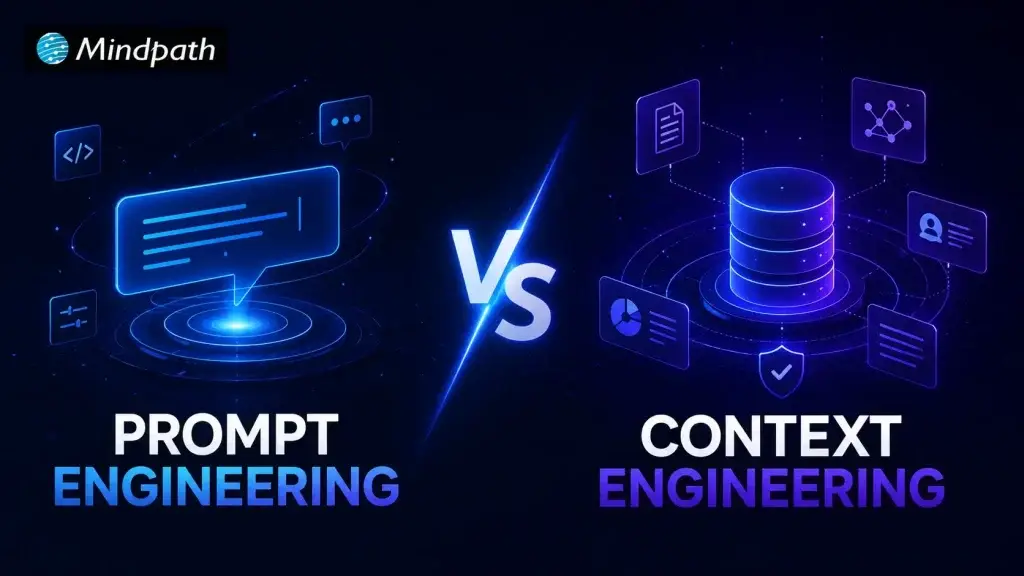
What happens when an AI model has the right instructions but lacks the information needed to act on them? This is where Context Engineering becomes important. As AI systems take on complex tasks, developers need to think beyond prompts and focus on what information models receive.
Key Takeaways
- 01
Prompt engineering improves AI responses by providing clear, specific, and well-structured instructions. - 02
Context engineering gives models relevant information needed to understand tasks and situations better. - 03
Prompt and context engineering work together to improve accuracy across complex AI workflows. - 04
MCP can connect AI applications with external tools, systems, and relevant business information. - 05
The right approach depends on data needs, task complexity, security, scalability, and maintenance requirements.
Prompt engineering still plays an important role in shaping AI responses, but modern systems need deeper context to make informed decisions. This shift is especially important for AI agents working with business data, tools, and changing information. In this blog, we will explore how both approaches differ and work together. Let’s keep reading further!
Ready to build AI systems that can work with reliable business context? Mindpath offers RAG Development Services to help businesses connect AI applications with relevant data and deliver more context-aware responses.
Understanding Both Approaches
Both approaches help developers get better results from AI, but they solve different problems. One improves the instructions, while the other improves the information available to the model.
1. Prompt Engineering
Prompt engineering is about writing clear instructions that guide an AI model toward the desired response. It involves choosing the right wording, adding useful constraints, setting expectations, and giving examples when needed. A well-crafted prompt helps the model understand the task, follow the intended direction, and produce more consistent results.
Here are the benefits it offers:
- Clear Instructions: Gives models a direct understanding of what needs completing.
- Better Outputs: Reduces vague responses by setting specific expectations upfront.
- Greater Control: Helps developers guide tone, format, reasoning, and response style.
- Faster Iterations: Makes it easier to test, refine, and improve outputs.
- Task Specific: Works well for focused tasks with clearly defined goals.
- Easy Adoption: Requires minimal changes to existing AI development workflows.
Challenges To Watch For
- Maintaining consistent outputs across different model versions.
- Managing complex instructions without making prompts overly lengthy.
- Preventing ambiguous wording from producing unexpected responses.
- Testing prompts across varied inputs and edge cases.
- Updating instructions when business requirements or workflows change.
2. Context Engineering
Context engineering focuses on selecting and organizing the information an AI model needs before responding. This can include documents, conversation history, business data, tools, user details, and retrieved information. The goal is to give the model relevant context at the right time, helping it respond with greater awareness.
Here are the benefits it offers:
- Relevant Knowledge: Provides information directly connected to the current task.
- Better Decisions: Gives AI systems stronger grounds for making informed decisions.
- Fewer Hallucinations: Reduces unsupported responses by supplying reliable information.
- Dynamic Responses: Allows models to work with changing information and situations.
- Agent Support: Helps AI agents understand tasks, tools, users, and environments.
- Scalable Workflows: Supports complex systems that depend on multiple information sources.
Challenges To Watch For
- Selecting relevant information from multiple available data sources.
- Keeping retrieved information accurate, current, and properly structured.
- Managing token limits while preserving essential context.
- Preventing sensitive information from entering unintended model interactions.
- Maintaining retrieval systems as business data continuously evolves.
Prompt vs Context Engineering: A Key Difference
The difference becomes clearer when we look at how AI context shapes the model’s understanding. While prompts guide the response, context gives the model the information it needs to respond appropriately.
| Comparison Point | Prompt Engineering | Context Engineering |
|---|---|---|
| Primary Focus | Shapes instructions given to the AI model | Shapes information available to the AI model |
| Main Purpose | Guides the model toward a specific response | Helps the model understand the situation |
| Information Used | Instructions, examples, rules, and constraints | Data, documents, memory, history, tools, and APIs |
| Scope | Usually focused on a specific task | Often supports entire workflows and systems |
| Data Dependency | Can work with limited external information | Often depends on relevant external information |
| Information Retrieval | Information is usually provided within prompts | Information can be retrieved dynamically when needed |
| Role in AI Agents | Defines tasks, goals, and expected behavior | Provides knowledge, state, tools, and situational awareness |
| Maintenance | Requires refining instructions as needs change | Requires managing sources, retrieval, memory, and context quality |
| Best For | Content generation, classification, summarization, and focused tasks | Customer support, knowledge systems, RAG pipelines, and AI agents |
Where Each Approach Fit in AI Workflows?
Both approaches have a place in modern AI workflows, but their roles are different. The right approach depends on what the system needs to understand, produce, or act on.
1. Where Prompt Engineering Fits?
Prompt engineering works best when the task is clearly defined and the desired output can be guided through instructions.
- Content Creation: Guides AI to follow a specific tone, structure, format, or writing style.
- Task Automation: Gives models clear steps for completing repetitive and predictable tasks.
- Data Analysis: Directs AI to identify patterns, summarize findings, or explain results.
- Customer Queries: Helps define how AI should respond to common and straightforward questions.
- Creative Work: Controls ideas, language, tone, and presentation across different creative tasks.
2. Where Context Engineering Fits?
Context engineering becomes valuable when AI needs information from different sources to understand the situation before responding.
- Customer Support: Combines customer history, product information, and previous interactions for relevant responses.
- Knowledge Retrieval: Supplies models with relevant documents instead of relying on general model knowledge.
- AI Agents: Gives agents access to business data, tools, memory, and information needed for decisions.
- Business Workflows: Connects AI with relevant systems, records, policies, and operational information.
- Dynamic Tasks: Provides updated information when decisions depend on changing business conditions.
Key Implementation Considerations
Choosing between prompt and context engineering depends on how your AI system handles information, tasks, and changing requirements. A practical implementation should consider the following factors before deciding how much weight to give each approach.
1. Token Limits
Prompts need to stay focused because unnecessary instructions can consume valuable tokens. Context also needs careful filtering, since sending too much information can increase costs and distract the model from relevant details.
2. Data Freshness
Prompts may need regular updates when instructions, rules, or business requirements change. Context engineering can pull fresher information from connected sources, but those sources must remain accurate and up to date.
3. Retrieval Accuracy
Prompt engineering can specify exactly what information the model should consider during a task. Context engineering depends on retrieving the right information, making search quality and retrieval accuracy important for reliable results.
4. System Integration
Prompts can define how an AI system should interact with connected applications and tools. Context engineering can bring information from those systems into the workflow, with protocols such as MCP helping AI applications connect with external tools and data.
5. Security and Access
Prompts should avoid exposing sensitive information unnecessarily and should clearly define permitted actions. Context engineering requires stronger controls around which users, systems, and agents can access specific data.
6. Maintenance
Prompt based systems often require ongoing testing and refinement as model behavior or requirements change. Context based systems also require maintaining data sources, retrieval pipelines, memory, and connected tools.
7. Latency and Cost
Well-structured prompts can reduce unnecessary processing by keeping instructions concise and focused. Context engineering may increase processing requirements when systems retrieve, filter, and pass additional information to the model.
Ready to Build AI Systems That Understand More?
Prompt engineering and context engineering solve different parts of the AI development challenge. Prompts shape how models respond, while context gives them the information needed to understand each situation. As AI workflows become more complex, combining both approaches can improve accuracy, consistency, and decision making across modern applications and AI agents.
Mindpath helps businesses build AI solutions that combine intelligent prompts with reliable context, connected data, and practical workflows. Our AI development services support RAG, AI agents, MCP integrations, and custom AI systems designed for real business needs. Partner with us if you are looking to build an AI solution that can understand your data and act with confidence. Contact Mindpath to discuss your AI requirements.
What happens when an enterprise AI system reaches production before the business is truly ready? Small gaps in data, security, infrastructure, or ownership can quickly turn into costly problems. An enterprise AI deployment checklist helps teams catch these gaps early and create a smoother path to production.
Key Takeaways
- 01Define clear business goals, ownership, and success measures before starting enterprise AI deployment.
- 02Validate data quality, infrastructure, access controls, and production requirements before moving AI systems into production.
- 03Build security, governance, compliance, monitoring, and rollback controls into the deployment process.
- 04Track technical performance, operational costs, and business value to measure AI success after deployment.
- 05Standardize deployment practices to scale AI securely across teams, systems, and business workflows.
Enterprise AI deployment needs careful planning because production systems must support real users, business workflows, sensitive information, and changing demands. A structured checklist brings these moving parts together and gives teams a practical way to review readiness before launch. In this blog, we explore the key areas every enterprise should review before deploying AI. Let’s keep reading further!
Why Enterprise AI Needs a Deployment Checklist?
Enterprise AI systems influence business decisions, workflows, customer experiences, and sensitive data. A deployment checklist gives teams a clear process for reviewing critical requirements before launch, helping them identify gaps that could affect performance, security, compliance, or business outcomes.
It also creates consistency across AI projects by giving technical and business teams shared expectations. As deployments become more complex, a checklist makes responsibilities clearer, reduces avoidable errors, and helps organizations establish a stronger foundation for reliable and scalable AI adoption.
An AI deployment checklist is important because it helps teams:
- Reduce deployment risks by identifying technical and operational gaps early.
- Strengthen security by reviewing access, data protection, and control requirements.
- Improve consistency by following a standard process across AI deployments.
- Clarify ownership by assigning responsibilities before the system reaches production.
- Support compliance by documenting governance and regulatory requirements.
- Measure readiness by validating performance, infrastructure, and business requirements.
- Prepare for scale by creating processes that can support future AI deployments.
Enterprise AI Deployment Readiness Checklist
A clear enterprise AI roadmap gives teams direction as they move toward an important stage of AI adoption. The following checklist brings together the key areas that deserve attention before moving forward.
1. Preparing the Business Case and Objectives
Before starting AI implementation, enterprises need a clear reason for investing in the technology. Defining the expected outcome, business owner, target users, and success measures helps teams stay focused and gives every stakeholder a shared understanding of what the deployment should achieve.
- Define the business problem the AI solution is expected to address.
- Assign clear ownership across business, technical, and operational teams.
- Set measurable outcomes that show whether the deployment is successful.
- Identify key stakeholders who influence adoption, approval, and ongoing use.
- Establish ROI targets based on expected business value and costs.
2. Assessing Data and Infrastructure Readiness
Strong data and reliable infrastructure create the foundation for successful AI implementation. Before deployment, teams should confirm that production data is accurate, accessible, protected, and ready for use. They should also verify that the technical environment can support expected workloads, integrations, and future requirements.
- Validate data quality for accuracy, completeness, consistency, and relevance.
- Check pipeline reliability to ensure data reaches AI systems consistently.
- Review access controls and limit data access to authorized users and systems.
- Apply data masking where sensitive or confidential information requires protection.
- Confirm versioning and infrastructure for models, data, compute resources, and production platforms.
3. Designing Security, Governance, and Compliance
A strong AI Deployment Checklist should cover the controls that keep enterprise AI secure, accountable, and compliant. Before launch, teams need clear ownership, defined policies, and safeguards that continue throughout the AI lifecycle. These measures help reduce exposure while supporting responsible and controlled AI use.
- Assign ownership for the AI system, data, security, and ongoing decisions.
- Define lifecycle controls for development, approval, deployment, updates, and retirement.
- Maintain audit trails to track important system activity, changes, and decisions.
- Apply responsible AI practices covering privacy, fairness, transparency, and model behavior.
- Align with requirements from applicable regulations and internal enterprise policies.
4. Building a Repeatable Deployment Process
A structured AI rollout process helps teams move from testing to production with fewer surprises. Instead of relying on individual judgment at every stage, organizations can use consistent checks to validate readiness, monitor performance, and respond quickly when something goes wrong after launch.
- Validate model readiness against agreed performance, quality, and reliability requirements.
- Complete release testing across workflows, integrations, security, and expected production conditions.
- Set monitoring and alerts for performance changes, errors, usage, and unusual behavior.
- Define rollback procedures so teams can quickly restore a stable version when required.
- Document release approvals to reduce human error and maintain accountability throughout deployment.
5. Measuring Performance, Cost, and Business Value
An AI system should continue proving its value after deployment. Teams need to track technical performance, operational costs, and business outcomes together to understand what is working and where improvements are needed. Regular reviews help keep AI investments aligned with changing business priorities and expected ROI.
- Track technical performance through accuracy, response quality, latency, reliability, and error rates.
- Monitor operational costs including infrastructure, model usage, maintenance, and support expenses.
- Measure business outcomes against the objectives and baseline established before deployment.
- Set review schedules to identify performance gaps, rising costs, or changing business needs.
- Optimize continuously by improving models, workflows, infrastructure, and resource usage based on results.
6. Scaling AI Across the Enterprise
As AI adoption grows, organizations need a consistent approach for expanding successful solutions across teams and workflows. An AI Deployment Checklist helps maintain common standards while new use cases are introduced, ensuring integrations, governance, user readiness, and performance remain aligned as adoption increases.
- Integrate existing systems with enterprise applications, APIs, data platforms, and business workflows.
- Enable teams through practical training, clear responsibilities, and ongoing technical support.
- Extend governance with consistent approval, security, monitoring, and lifecycle practices across deployments.
- Standardize deployment processes so teams can replicate successful AI solutions efficiently.
- Improve continuously using user feedback, performance data, business results, and changing requirements.
Common Enterprise AI Deployment Mistakes to Avoid
Enterprise AI deployments can lose momentum when teams focus heavily on the technology but overlook preparation and ongoing management. Recognizing common mistakes early helps organizations address weak points before they affect users, operations, security, or business outcomes.
1. Starting without clear objectives
Teams may deploy AI without defining what success should look like. This makes business impact difficult to measure and justify.
2. Ignoring data readiness
Poor quality or inconsistent data can affect AI performance from the beginning. Teams should validate data before moving into production.
3. Leaving ownership unclear
AI projects can stall when no one is accountable for key decisions or issues. Clear business and technical ownership keeps deployment responsibilities defined.
4. Skipping security and governance
Missing controls can expose sensitive data and create compliance risks. Security and governance should be addressed before the system goes live.
5. Neglecting post-launch monitoring
AI performance can change as data, users, and business conditions change. Regular monitoring helps teams identify problems and improve the system over time.
Ready to Make Your Enterprise AI Deployment More Reliable?
Enterprise AI deployment becomes easier to manage when every critical area is reviewed before launch. From business objectives and data readiness to security, governance, monitoring, and scalability, a structured checklist helps teams reduce risks and create a repeatable path toward reliable AI adoption. It also keeps technology decisions connected to measurable business outcomes.
Mindpath helps enterprises turn AI initiatives into secure, scalable, and production-ready solutions through our expert AI development services. Our team supports businesses across AI strategy, development, integration, deployment, and ongoing optimization. By combining technical expertise with business-focused planning, Mindpath helps organizations move from AI ideas to solutions that deliver practical value. Contact us to discuss your enterprise AI requirements.
Frequently Asked Questions
What happens when an AI agent makes the wrong decision, uses the wrong tool, or triggers an incorrect business action? Unlike traditional software, AI agents can respond differently to similar situations, making AI Agent Testing essential before they enter critical enterprise workflows.
Key Takeaways
- 01
AI Agent Testing helps identify workflow, decision-making, tool usage, and response issues before deployment. - 02
Strong test cases should cover routine scenarios, edge cases, failures, and unexpected user inputs. - 03
Enterprise validation must address security, privacy, compliance, integrations, performance, and operational risks. - 04
LLM evaluation combines automated metrics, tracing, performance checks, and human review for reliable results. - 05
Continuous monitoring and regression testing help maintain reliability as AI systems evolve after deployment.
As businesses rely on AI agents for customer service, operations, analytics, and automation, small errors can create larger business risks. Testing must go beyond checking outputs and examine how agents reason, act, use tools, and respond to unexpected situations. In this blog, we explore practical ways to validate AI agents before deployment.
Understanding AI Agent Testing
Testing an AI agent checks how an agent behaves while completing tasks, making decisions, using tools, and responding to changing inputs. Traditional software testing often focuses on predefined outputs and fixed rules. AI agents need broader evaluation because their actions can change based on context, instructions, and available information.
A reliable testing process examines the agent at every important stage of a workflow. This includes understanding user intent, planning the next step, selecting the right tool, processing retrieved information, and delivering an accurate response. It also checks whether the agent can recover when something goes wrong.
For enterprise AI, testing should also consider reliability, security, accuracy, latency, and consistency. An agent may produce a convincing response while still using incorrect data or taking an inappropriate action. AI QA therefore needs to evaluate the complete workflow rather than focusing only on the final response.
What Should AI Agents Be Tested For?
Testing should examine the complete behavior of an AI agent, not simply whether the final response looks correct. Different evaluation areas help teams identify weaknesses that may otherwise appear only after deployment.
- Decision making: Check whether the agent chooses appropriate actions based on the available information.
- Tool selection: Verify that the correct tools, APIs, and business systems are used for each task.
- Response accuracy: Ensure responses are relevant, factually correct, and aligned with approved business information.
- Task completion: Measure whether the agent successfully completes the intended workflow without unnecessary steps.
- Error handling: Test how the agent responds when information is missing, tools fail, or requests fall outside its capabilities.
- Security behavior: Check whether the agent respects permissions and avoids exposing restricted or sensitive information.
- Consistency: Run similar scenarios repeatedly to identify unpredictable or changing behavior.
How to Test AI Agents Before Deployment
Effective testing requires a structured process that checks how the agent performs across different situations and business conditions. The following steps explain how enterprises can build reliable evaluations and identify risks before deployment.
1. Building a Foundation for Evaluation
Before an AI agent testing in real workflows, teams need a clear evaluation foundation. A structured test set helps identify expected behavior and makes it easier to compare performance across different versions.
- Create golden test cases: Define reliable examples with expected actions, responses, and outcomes.
- Test common scenarios: Check whether the agent completes common tasks accurately and efficiently.
- Include edge cases: Test unusual inputs, incomplete information, unexpected requests, and workflow interruptions.
- Add adversarial scenarios: Challenge the agent with misleading prompts, conflicting instructions, and unsafe requests.
- Validate real workflows: Use realistic data flows, user interactions, and system integrations within a controlled environment.
- Document failure conditions: Record where the agent fails, why it fails, and what successful behavior should look like.
- Repeat critical tests: Run the same scenarios after updates to identify regressions before deployment.
2. Measuring Performance and Behavior
Testing an AI agent should go beyond checking whether it produces a correct final answer. Teams need to understand how the agent reaches that outcome, how reliably it uses available tools, and how it responds when conditions change.
- Track task accuracy: Measure whether the agent completes tasks correctly and delivers relevant results.
- Monitor tool usage: Check whether the agent selects the right tools and uses them correctly.
- Evaluate response quality: Assess accuracy, relevance, clarity, and consistency across different inputs.
- Use tracing: Review the agent’s actions, tools, decisions, and workflow steps to identify failures.
- Measure performance: Track response time, task completion rates, errors, and reliability across repeated tests.
- Apply LLM evaluation: Use structured metrics and automated evaluations to assess responses at scale.
- Include human review: Let domain experts assess complex decisions, reasoning quality, safety, and business suitability.
3. Navigating Enterprise Specific Challenges
Testing an AI agent in an enterprise environment brings challenges that simple test environments may overlook. Agents often interact with sensitive information, business systems, and processes where a small mistake can create operational or compliance risks.
- Protect sensitive data: Use anonymized or masked data when testing agents with confidential enterprise information.
- Check security controls: Verify permissions, authentication, access limits, and protection against unauthorized actions.
- Test compliance requirements: Ensure agent behavior follows industry regulations, internal policies, and governance standards.
- Replicate integrations: Test connections with CRMs, ERPs, databases, APIs, and legacy systems before production.
- Use controlled environments: Create sandbox environments that reflect real workflows without affecting live operations.
- Test failure scenarios: Check how agents respond when systems fail, data is unavailable, or tools return errors.
- Balance realism and safety: Use realistic workflows and conditions while keeping sensitive systems isolated during evaluation.
4. Selecting the Right Tools and Frameworks
The right tools and frameworks can make AI testing more consistent, measurable, and easier to scale. Instead of choosing a platform based only on features, enterprises should consider how well it fits their workflows, technical maturity, and evaluation requirements.
| Capability | Why It Matters |
|---|---|
| Tracing | Helps teams review agent actions, tools, and workflow decisions. |
| Evaluation | Measures response quality, task accuracy, and agent reliability. |
| Test Automation | Enables repeatable testing across large sets of scenarios. |
| Metric Tracking | Makes performance changes easier to identify and compare. |
| Integration Support | Connects testing with existing enterprise systems and workflows. |
| Scalability | Supports growing testing needs as more agents enter production. |
| Monitoring | Helps identify performance issues and unexpected behavior after deployment. |
5. Preparing for Safe Deployment
Passing initial tests does not mean an AI agent is ready for production. Before deployment, teams should review test results, address recurring failures, and establish safeguards that continue working after the agent goes live.
- Review evaluation results: Use LLM evaluation findings to identify accuracy, consistency, and behavioral issues before release.
- Run regression tests: Retest critical workflows after every significant model, prompt, tool, or system update.
- Deploy gradually: Start with limited users or controlled workflows before expanding the agent across the organization.
- Monitor production behavior: Track errors, unexpected actions, response quality, latency, and task completion after deployment.
- Create rollback protocols: Prepare clear procedures for disabling or reverting the agent when serious failures occur.
- Collect user feedback: Use real user experiences to identify gaps that controlled testing may not reveal.
- Build continuous improvement: Turn production insights into new test cases and repeat the evaluation cycle regularly.
Ready to Validate Your AI Agents Safely?
Reliable AI agents need structured validation before they become part of critical enterprise workflows. From building realistic test cases to evaluating decisions, tool usage, security, and performance, AI Agent Testing helps teams identify weaknesses before they affect users or business operations. Continuous monitoring then keeps that reliability intact after deployment.
Mindpath helps enterprises build and validate AI solutions with structured testing strategies, expert evaluation, and practical deployment guidance. Our team can help you assess agent behavior, strengthen AI QA processes, and prepare AI systems for reliable production use. For support with enterprise AI implementation and validation, contact us to discuss your requirements.
Businesses are adopting AI voice agent development to handle customer conversations, automate calls, and improve response times. Unlike traditional phone systems, AI voice agents can understand spoken language, respond naturally, and complete tasks during conversations. This makes voice automation a practical solution for businesses seeking faster service, lower operational workloads, and more consistent customer experiences.
Key Takeaways
- 01AI voice agents automate routine customer conversations efficiently.
- 02Custom solutions improve response times and customer experiences.
- 03Development costs depend on features, integrations, and complexity.
- 04Voice agents support sales, service, scheduling, and operations.
- 05Proper planning helps businesses build scalable voice automation.
Custom AI voice agents can support sales, customer service, appointment scheduling, lead qualification, and internal workflows. Their development cost and timeline depend on factors such as features, integrations, AI models, voice technology, and customization requirements. Businesses also need to consider scalability, security, and ongoing optimization when planning a voice AI solution. In this blog, we will explore the development process, key use cases, costs, timelines, and benefits of custom AI voice agents for businesses.
Ready to build a custom AI voice agent for your business? Mindpathtech offers AI development services to help you create intelligent, scalable voice agents tailored to your workflows and customer needs.
What is AI Voice Agent Development?
AI voice agents are software systems that use artificial intelligence to understand spoken language, process user requests, and respond through natural voice conversations. They can handle customer interactions, answer questions, collect information, and complete predefined tasks without requiring a human representative for every call.
Conversational AI development combines speech recognition, natural language processing, large language models, text to speech technology, and business system integrations. A custom solution can be designed around specific workflows, allowing businesses to automate conversations while maintaining context, accuracy, and a consistent customer experience.
Key Features of AI Voice Agents
Modern voice agents combine several technologies to deliver natural and efficient conversations. These capabilities allow businesses to automate routine calls while keeping interactions responsive and context aware.
- Speech recognition: Converts spoken language into text so the system can understand caller requests.
- Natural language understanding: Identifies the user’s intent and determines the appropriate response or action.
- Natural voice responses: Converts generated responses into realistic speech for smoother conversations.
- Context awareness: Maintains conversation context to provide relevant responses throughout a call.
- Business system integration: Connects with CRM, ERP, scheduling, and other business platforms to complete tasks.
- Call automation: Handles repetitive calls, customer queries, appointment scheduling, and follow ups automatically.
These capabilities make AI-powered voice assistants useful for businesses that want to improve customer communication while reducing repetitive manual work.
How to Build a Custom AI Voice Agent?
Building a custom voice agent requires careful planning to ensure the solution matches business requirements and customer expectations. The AI voice agent development process typically involves several stages, from defining the use case to deploying and improving the final solution.
1. Define the business requirements
Identify the calls, tasks, customer needs, and workflows the voice agent should handle.
2. Choose the technology stack
Select suitable AI models, speech recognition tools, text to speech technology, APIs, and cloud infrastructure while evaluating the best IT development approach for your team.
3. Design conversation flows
Create clear conversation paths that help the agent understand requests and respond appropriately.
4. Integrate business systems
Connect the agent with CRM, ERP, scheduling, payment, or other platforms required to complete tasks.
5. Train and test the agent
Test different conversations, accents, questions, and unexpected responses to improve accuracy and reliability.
6. Deploy and monitor
Launch the solution, utilize augmented analytics for performance insights, and continuously improve responses based on real user interactions.
With AI call automation, businesses can move beyond basic call handling and create voice agents that actively complete tasks and support business workflows.
How Much Does It Cost to Build a Custom AI Voice Agent?
The cost to build a custom AI voice agent depends on the complexity of the solution, required features, integrations, AI models, voice technology, and development effort. A basic voice agent handling simple queries will require less investment than an enterprise solution connected to multiple business systems and complex workflows.
| AI Voice Agent Type | Typical Features | Estimated Development Cost |
| Basic Voice Agent | FAQs, basic call handling, simple responses | $5,000–$15,000 |
| Business Voice Agent | Lead qualification, appointment booking, CRM integration | $15,000–$40,000 |
| Advanced Voice Agent | Multiple workflows, advanced integrations, context awareness | $40,000–$100,000 |
| Enterprise Voice Agent | Complex workflows, multiple integrations, analytics, security, scalability | $100,000–$250,000+ |
The final investment can vary based on the number of integrations, expected call volume, customization requirements, comprehensive security standards, and ongoing maintenance needs.
How Long Does It Take to Develop an AI Voice Agent?
The development timeline depends on the complexity of the voice agent, the number of features, integrations, and level of customization required. A simple agent can be launched relatively quickly, while an enterprise solution may require several months of development, testing, and optimization.
| Development Stage | Key Activities | Estimated Timeline |
| Planning & Discovery | Requirements, use cases, workflows, technology selection | 1–2 weeks |
| Prototype Development | Basic conversation flow, voice interface, initial AI setup | 2–4 weeks |
| Integration & Development | CRM, APIs, business systems, custom workflows | 3–8 weeks |
| Testing & Optimization | Accuracy, conversations, edge cases, performance testing | 2–4 weeks |
| Deployment | Production setup, monitoring, final configuration | 1–2 weeks |
For an AI voice agent for small business, the timeline can often be shorter because the solution may require fewer integrations and simpler workflows. However, advanced requirements such as multilingual support, complex call routing, custom business logic, or strict security requirements can extend the development timeline.
AI Voice Agent Use Cases Across Industries
Businesses across different industries are using voice AI to handle repetitive conversations, improve customer support, and streamline everyday operations. With AI voice agent development, organizations can create solutions tailored to their specific workflows, customer needs, and communication channels.
1. Customer Support
AI voice agents can answer common questions, provide information, and resolve routine customer requests without human intervention.
2. Sales and Lead Qualification
Voice agents can contact prospects, ask qualifying questions, capture details, and transfer promising leads to sales teams.
3. Appointment Scheduling
Businesses can automate appointment bookings, confirmations, cancellations, and reminders through natural voice conversations.
4. Healthcare Communication
Voice agents can assist with appointment reminders, basic patient queries, follow-ups, and administrative communication.
5. Banking and Financial Services
They can support routine account queries, transaction information, and customer service workflows while following defined security procedures.
6. E-commerce
Voice agents can help customers with order updates, product questions, delivery information, and post-purchase support.
7. Internal Business Operations
Organizations can use voice agents for employee queries, workflow requests, information retrieval, and routine administrative tasks.
Ready to Build a Custom AI Voice Agent for Your Business?
Custom AI voice agents help businesses automate conversations, improve response times, and handle repetitive calls efficiently. The right solution depends on business goals, required features, integrations, development complexity, and expected call volume. Careful planning can help businesses build scalable voice automation that delivers consistent and reliable customer experiences.
Mindpath helps businesses build AI solutions tailored to their workflows and operational needs. Our AI development expertise supports custom voice agents with intelligent conversations, system integrations, automation, and scalable architectures. From initial strategy to deployment, Mindpath can help businesses turn voice AI opportunities into practical, business-focused solutions.
Frequently Asked Questions
Artificial intelligence is becoming a strategic investment for businesses seeking better efficiency, faster decisions, and sustainable growth. However, understanding AI costing remains essential before committing resources to an AI initiative. A clear view of development, infrastructure, data, integration, and operational expenses help businesses create realistic budgets and avoid unexpected financial pressure.
Key Takeaways
- 01AI costing should include development, infrastructure, data, and maintenance.
- 02Clear objectives help businesses create realistic AI budgets.
- 03Hidden AI costs can affect long-term investment decisions.
- 04AI investments should align with measurable business outcomes.
- 05Regular budget reviews support sustainable AI growth.
Effective AI adoption requires more than allocating funds for technology development. Businesses must evaluate their objectives, expected returns, scalability needs, and ongoing operational requirements before investing. A structured budgeting approach helps decision makers prioritize valuable use cases while controlling unnecessary expenses. In this blog, we will explore the key costs, planning considerations, hidden expenses, and investment strategies businesses should understand before budgeting for AI.
Ready to turn your AI idea into a cost-effective solution? We offers custom AI development services to help businesses build scalable solutions aligned with your goals and budget.
What Does AI Costing Actually Include?
AI costing refers to the complete financial assessment required to plan, develop, deploy, and maintain an AI solution. It covers far more than the initial development expenses. Businesses need to consider technology, data, infrastructure, integrations, security, employee adoption, and ongoing maintenance when estimating their overall AI investment.
The total cost can vary significantly based on the business objective, solution complexity, data requirements, and expected scale. A simple AI automation may require limited resources, while an enterprise AI platform can involve extensive development and infrastructure. Understanding these factors helps businesses create realistic budgets and make informed investment decisions.
Key Factors That Influence AI Costing
- Business requirements: Complex business objectives usually require more planning and development resources.
- Data readiness: Poor quality or unstructured data can increase preparation and management costs.
- Solution complexity: Advanced AI applications often require specialized development and testing.
- System integration: Connecting AI with existing CRM, ERP, or business applications can add implementation costs.
- Infrastructure: Computing, storage, APIs, and cloud services contribute to ongoing expenses.
- Security and compliance: Businesses may need additional controls to protect sensitive information and meet regulatory requirements.
- Maintenance and scaling: AI systems require monitoring, updates, optimization, and additional resources as usage grows.
What Are the Main Costs of Implementing AI in Business?
The cost of implementing AI in business depends on the solution, technology, data, and resources required. Effective AI budget planning helps businesses account for these expenses before implementation begins.
1. AI Strategy and Planning
Businesses need to identify the right AI use case and define clear objectives. Strategy and feasibility planning help align the investment with business goals.
2. Data Preparation and Management
AI requires clean, structured, and relevant data to deliver reliable results. Data cleaning, labeling, storage, and governance can add to the overall investment, especially when leveraging augmented analytics for deeper insights.
3. AI Development and Customization
Development costs depend on the type and complexity of the AI solution. Custom applications, AI agents, and model customization generally require greater development resources, including hiring specialized developers.
4. Integration With Existing Systems
AI solutions often need to connect with existing business systems and applications. APIs, databases, CRM, ERP, and security integrations can increase implementation costs, particularly when aligning with modern IT infrastructure.
5. Infrastructure and Cloud Services
AI applications require computing power, storage, and other infrastructure resources. Cloud usage and API consumption can also create recurring operational expenses.
6. Maintenance and Optimization
AI systems require continuous monitoring, updates, testing, and performance improvements. Businesses should include these recurring expenses when calculating their overall AI budget.
How to Plan an AI Budget for Your Business?
Knowing how to plan an AI budget helps businesses control spending while keeping their AI initiatives aligned with measurable goals. A structured approach also makes AI investment planning easier by showing where resources are needed at each stage.
1. Define Your Business Objective
Start by identifying the specific business problem AI should solve. A clear objective helps determine the right technology and required investment.
2. Choose the Right AI Use Case
Prioritize use cases that offer measurable business value. Starting with a focused use case can help control initial spending and validate results.
3. Assess Your Data Readiness
Evaluate the quality, availability, and structure of your existing data. This helps identify additional data preparation costs before development begins.
4. Estimate Initial and Recurring Costs
Calculate development, integration, infrastructure, and deployment expenses. Also include recurring costs such as cloud usage, maintenance, and support.
5. Set a Realistic Contingency Budget
AI projects can encounter unexpected technical or operational requirements. Keeping a contingency amount helps manage these expenses without disrupting the project.
6. Define Expected ROI
Set measurable outcomes before approving the investment. These can include cost savings, productivity improvements, faster processes, or increased revenue.
7. Plan for Future Scaling
Consider how costs may change as users, data, and AI workloads increase. A scalable budget helps businesses expand their AI capabilities without major financial disruptions.
What Hidden Costs of AI Should Businesses Consider?
AI costing should account for expenses that may appear after implementation. Understanding the hidden costs of AI helps businesses create a more realistic budget.
1. Employee Training
Teams may need training to use new AI tools effectively. This can add training and productivity costs.
2. Data Improvement
Existing business data may require cleaning or restructuring. Additional data work can increase implementation expenses.
3. Security and Compliance
AI systems may require stronger security controls and compliance measures. These requirements can add development and operational costs.
4. Ongoing Maintenance
AI solutions need regular monitoring, updates, and optimization. These recurring expenses should remain part of the long-term budget.
5. Third-Party Services
AI applications may depend on external APIs, models, or cloud platforms. Usage-based charges can increase as adoption grows.
6. Change Management
Employees may need support when workflows change after AI adoption. Proper change management can improve adoption and reduce implementation challenges.
7. Scalability Costs
Growing usage can increase computing, storage, and infrastructure requirements. Businesses should account for these expenses when planning future AI expansion.
How Does AI Investment Planning Support Better Business Decisions?
AI investment planning helps businesses allocate resources based on expected value, business priorities, and long-term requirements. It allows decision makers to evaluate AI opportunities before committing significant resources.
1. Prioritize High Value Use Cases
Invest in AI initiatives that address important business challenges. This helps direct budgets toward measurable outcomes.
2. Start With a Focused Investment
Begin with a manageable AI initiative before expanding across the organization. Early results can guide future investment decisions.
3. Balance Initial and Recurring Costs
Consider development expenses alongside infrastructure, maintenance, and usage costs. This provides a more accurate view of the total investment.
4. Align Investment With Business Goals
AI spending should support clear organizational objectives. This keeps technology investments connected to business growth.
5. Evaluate Scalability
Consider future users, data volumes, and operational requirements before selecting a solution. A scalable approach can reduce the need for costly redevelopment later.
6. Review Investment Performance
Track business outcomes against the original investment goals. Regular reviews help identify where additional funding can create greater value.
AI Budget Planning Across Different Project Stages
AI budgets change as a project moves from initial planning to full-scale deployment. Businesses should review AI costing at every stage to maintain better control over their overall investment.
| Project Stage | Key Budget Areas | Business Focus |
| Discovery | Strategy, research, and feasibility | Identify the right AI opportunity |
| Proof of Concept | Development, data, and testing | Validate the solution and its potential |
| Development | AI development, integration, and security | Build a reliable business solution |
| Deployment | Infrastructure, training, and implementation | Introduce AI into daily operations |
| Scaling | Cloud usage, maintenance, and optimization | Support growing business requirements |
| Continuous Improvement | Monitoring, updates, and enhancements | Improve performance and long-term value |
Ready to Build a Smarter AI Budget?
Effective AI budget planning helps businesses understand total costs, prioritize valuable use cases, and prepare for ongoing expenses. A well-structured budget reduces financial uncertainty while keeping AI investments aligned with measurable business goals. Businesses that plan carefully can scale AI with greater confidence and achieve sustainable long-term value.
Mindpath helps businesses turn AI opportunities into practical, scalable solutions aligned with their goals and budgets. Our AI development expertise supports strategy, solution development, integration, deployment, and optimization. With the right technical guidance, businesses can invest in AI confidently while building solutions designed for measurable performance and sustainable growth.
Frequently Asked Questions
Every business leader today is asking the same question in some form: how do we bring AI agents into our workflows without breaking what already works? This is exactly where LangChain AI agent development enters the conversation. As companies move past simple chatbots and into agents that can plan, reason, and take action, choosing the right framework becomes a decision that shapes the entire product roadmap.
Key Takeaways
- 01 LangChain simplifies complex agent workflows. It reduces the need to build custom logic for memory, tools, and multi-step reasoning from scratch.
- 02 It fits best when tasks involve multiple steps. Simple single-response bots rarely need it, but workflows involving tools, memory, and data retrieval benefit significantly.
- 03 Multi agent architecture supports scalability. Splitting tasks across specialized agents improves accuracy and makes systems easier to manage as they grow.
- 04 Use cases span far beyond customer support. Businesses are applying it to document processing, internal knowledge assistants, and workflow automation across departments.
- 05 The right framework depends on your actual needs. LangChain works well for teams that want faster development without sacrificing flexibility or control.
Not every project needs the same tools, and not every AI initiative should default to the most popular option on the market. Some businesses need speed; others need control, and many need both at once. In this blog, we are going to explore when LangChain genuinely makes sense for your business and when it might not be the right fit.
Looking to build scalable AI agents with LangChain? At Mindpath, we provide AI agent development services that integrate seamlessly with your existing business systems.
How AI Agents are Shaping Business in 2026?
AI agents have moved far beyond scripted responses. In 2026, they are expected to understand context, call external tools, retrieve live data, and make decisions with minimal human input. A customer support agent today might check order history, apply a refund policy, and email a confirmation, all without a human touching the process. A research agent might pull data from five different sources, compare them, and summarize findings in a format a manager can actually use.
This shift has pushed businesses to look for frameworks that can orchestrate these complex, multi-step behaviors reliably. That is where LangChain has built its reputation. It gives development teams a structured way to connect large language models with memory, tools, APIs, and decision logic, rather than gluing everything together from scratch. Understanding how LangChain works helps explain why so many teams reach for it first when a project moves beyond a single prompt and response.
What is the LangChain Framework and How Does It Work?
The langchain framework is essentially a toolkit that helps developers chain together prompts, models, memory, and external data sources into a working pipeline. Instead of writing custom logic for every single interaction an AI agent needs to have, LangChain provides pre-built components that handle the repetitive parts, so teams can focus on the actual business logic.
At its core, it works by breaking a task into smaller steps. A user query comes in, the agent decides which tool or data source is needed, it retrieves the relevant information, and then it generates a response based on everything it has gathered. This modular approach is a big part of why LangChain AI agent development has become a preferred choice for teams building anything more advanced than a basic chatbot.
1. Chains Connect Logic in Sequence
A chain links one action to the next, so the output of a search step can feed directly into a summarization step without manual handoffs.
2. Memory Keeps Context Alive
The framework can retain earlier parts of a conversation, which means the agent does not lose track of what a user already said.
3. Tool Integration Extends Capability
LangChain lets an agent call APIs, databases, or search engines, turning it from a text generator into something that can actually perform tasks.
4. Prompt Templates Standardize Behavior
Teams can define reusable prompt structures, which keeps agent responses consistent across different use cases.
Key LangChain Use Cases Businesses Are Adopting
Once a team understands the basics, the next question is usually where it actually fits into daily operations. There are several langchain use cases that have become common across industries, and most of them share one thing in common: they involve multiple steps that would be difficult to manage with a single prompt alone.
1. Customer Support Automation
Agents can pull order details, check policies, and respond with accurate, personalized answers instead of generic scripted replies.
2. Internal Knowledge Assistants
Employees can ask questions and get answers pulled directly from internal documents, wikis, or databases, cutting down time spent searching.
3. Document Processing and Summarization
Long contracts, reports, or research papers can be broken down, analyzed, and summarized in a fraction of the time it would take a person.
4. Data Retrieval and Analysis Agents
Businesses use LangChain to connect language models with structured data sources, allowing agents to answer questions that require real-time information.
5. Workflow Automation Across Tools
Agents can trigger actions in other software, such as updating a CRM record or sending a notification, based on a single instruction.
When to Use LangChain for AI Agent Development?
Deciding when to use LangChain really comes down to the complexity of what you are trying to build. A simple FAQ bot does not need this level of infrastructure. But once a project involves multiple tools, ongoing context, or decision-making across several steps, LangChain starts to make a lot more sense.
1. Your Project Needs Multiple Tools
If your agent has to search, calculate, and then write a response, LangChain manages that coordination cleanly.
2. You Need Memory Across Interactions
Businesses building assistants that remember previous conversations benefit from LangChain’s built-in memory handling.
3. You Are Integrating With Several Data Sources
When an agent needs to pull from a database, an API, and a document store in one flow, LangChain simplifies that connection.
4. You Expect the System to Scale
As agent complexity grows, LangChain’s modular structure makes it easier to add new capabilities without rewriting everything.
5. Your Team Wants Faster Development Cycles
Because so many components already exist, teams often build and test working prototypes much faster than building everything from the ground up.
Understanding LangChain Multi-Agent Architecture
As businesses take on more ambitious projects, a single agent handling everything often becomes a bottleneck. This is where langchain multi agent architecture becomes relevant. Instead of one agent trying to do research, analysis, and writing all at once, the work gets split across specialized agents that each handle a specific part of the task and then hand off their results to the next one.
1. Specialized Roles Improve Accuracy
A research agent focused only on gathering data tends to perform better than one agent trying to do everything at once.
2. Parallel Processing Saves Time
Multiple agents can work on different parts of a task simultaneously instead of waiting in a single sequence.
3. Easier Debugging and Monitoring
When something goes wrong, it is far easier to trace the issue back to one specific agent rather than digging through a single massive workflow.
4. Better Scalability for Complex Systems
As business needs grow, new agents can be added to the architecture without disrupting the ones already working well.
This kind of setup is becoming increasingly common for businesses that are serious about long-term LangChain AI agent development, especially when the use case involves research, reporting, or any workflow with distinct stages.
Is LangChain the Right Choice for Your Business?
Choosing a framework is never just about following what is popular. It comes down to what your business actually needs to accomplish, how complex your workflows are, and how much your team wants to build versus manage. LangChain has earned its place as one of the strongest options for teams building agents that need to reason, remember, and act across multiple steps. For businesses working on genuine LangChain AI agent development rather than a simple one-off script, it offers a level of structure and flexibility that is hard to match with a lighter tool.
At Mindpath, we work closely with businesses to design and build AI agents that fit their actual operations, not a generic template. Whether you need a single well-trained assistant or a full multi-agent system handling different parts of your workflow, our team brings the technical depth to build it right. We provide AI agent solutions that are tailored to your data, your tools, and your goals, so the technology actually solves the problem you started with.
Join our Newsletter!
categories
Join the world's largest training library and unlock new opportunities!
Featured Posts
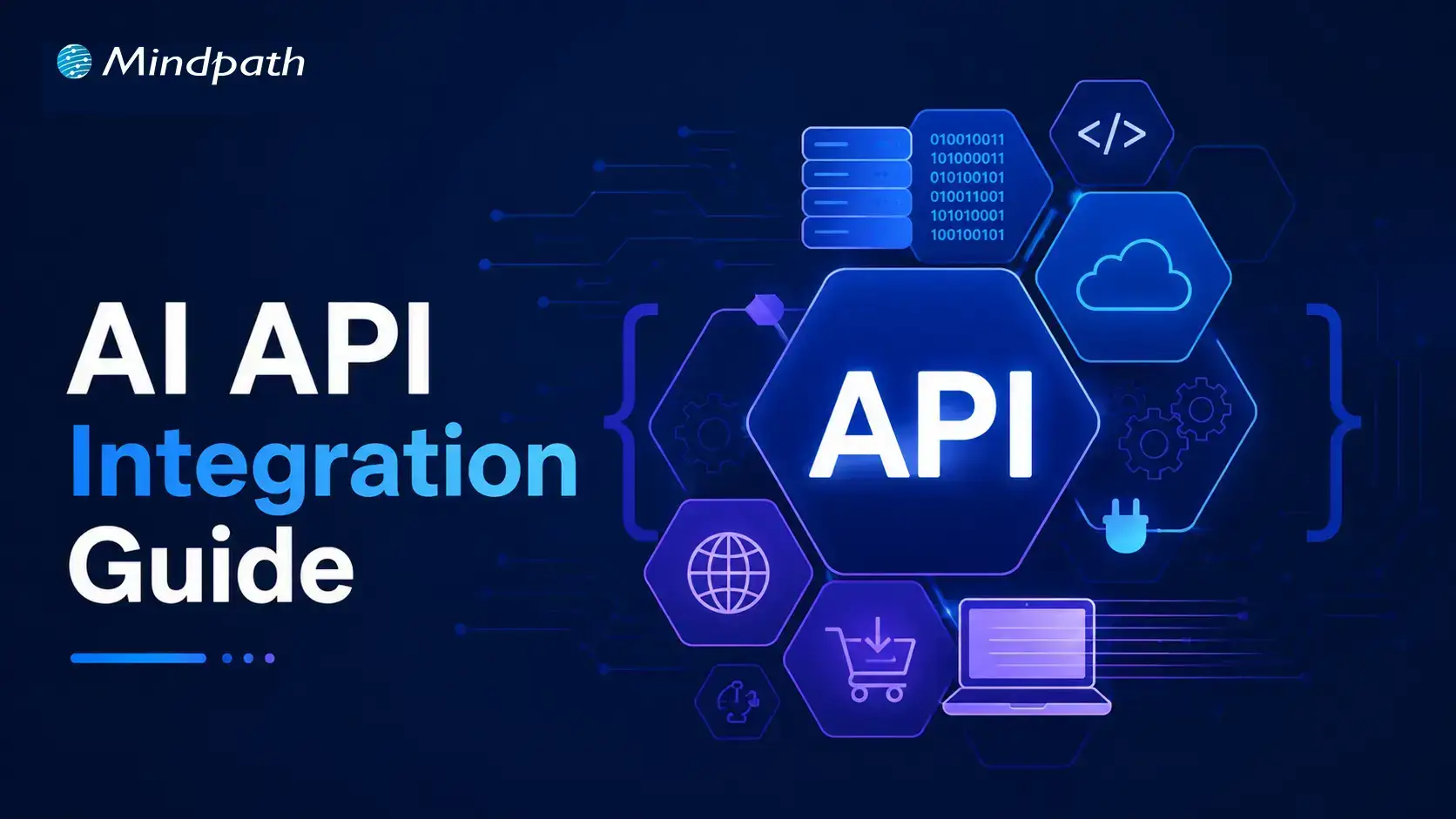
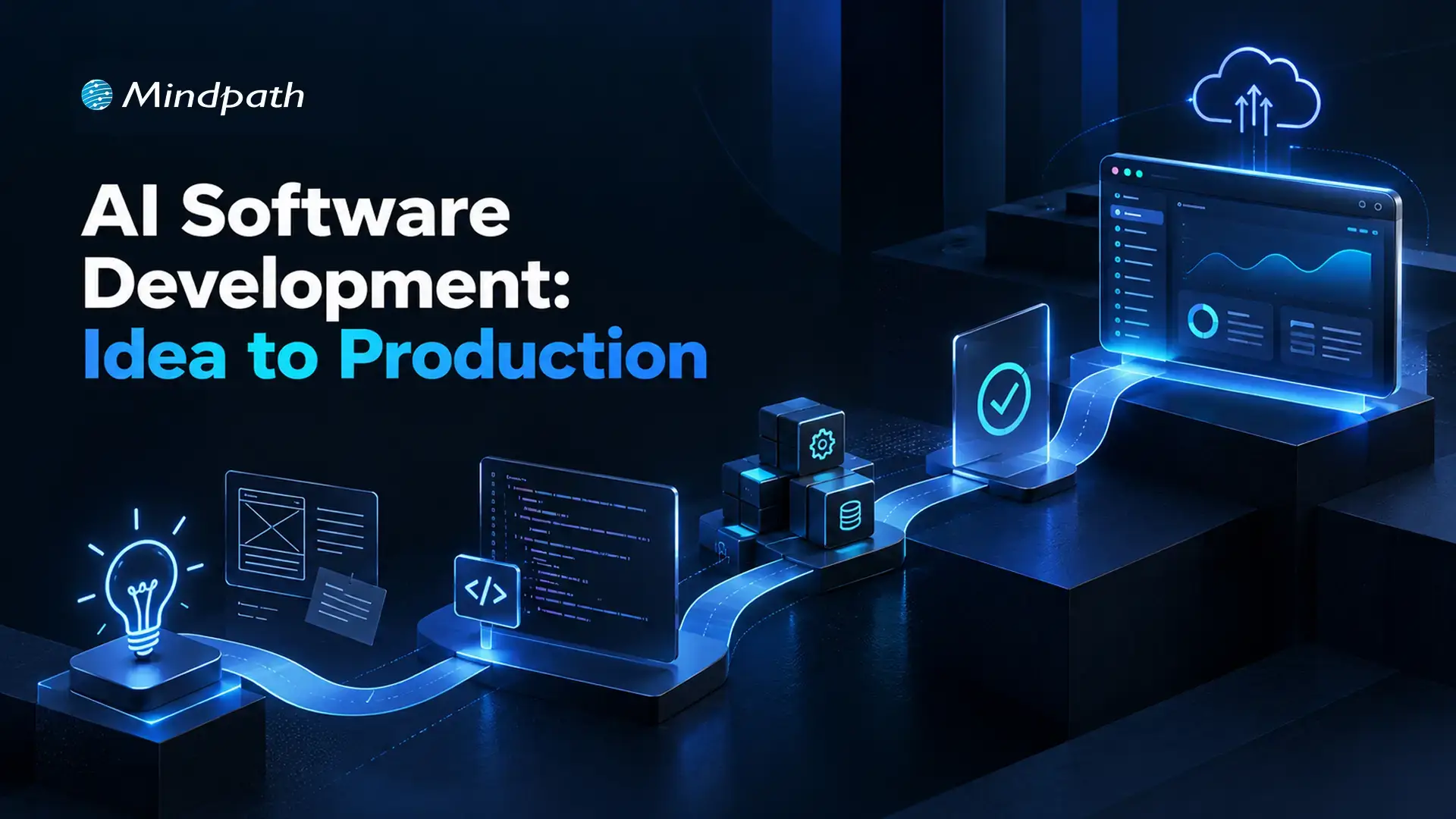


Turn Insights Into
Real Business Solutions
Exploring trends is only the beginning. Whether you’re planning AI adoption, modernizing legacy systems, or building scalable software, our experts help transform ideas into practical business outcomes.