
Latest Insights On
GenAI, Tech, and Digital Transformation
Stay updated with expert insights, success stories, and real-world applications of cutting-edge technology.
AI in manufacturing industry has experienced a fundamental transformation which now enables factories to operate differently in the digital age. Modern manufacturing operations benefit from smart systems which process production data to predict equipment breakdowns and enhance manufacturing precision throughout all production stages. The benefits of AI are evident in quicker production cycles, reduced costs, and higher quality outputs, making innovation the core of modern manufacturing.
Manufacturers are moving to the next level of connected intelligence as a result of persistent improvements in automation and data analytics. Basically, every process, choice, and way of working is being upgraded by AI-generated insights that are at the core of both efficiency and expansion. The change is going beyond tech; it’s a total revamp of how industries function. This article will look into the ways in which artificial intelligence is a main driver of Industry 4.0 and is influencing the manufacturing industry’s future.
Looking for a reliable solution to overcome bottlenecks and accelerate your business transformation? Mindpath offers AI development services that help manufacturers unlock new levels of operations excellence.
Understanding the Basics of AI in the Manufacturing Industry
AI in manufacturing is the integration of intelligent technologies, including machine learning, computer vision, and IoT, that work alongside factory operations to enhance efficiency and speed. It broadly means the employment of AI instruments across production, quality checks, supply chain, and machine maintenance. Such tools can reason, learn from data, and identify the most viable solution to a problem promptly, driving the shift toward what industry experts call “smart manufacturing.”
Manufacturers are able to save time, reduce waste, lower errors, and produce top-quality products through the use of AI. This is accomplished by giving the teams the ability to foresee equipment failures before they occur and, hence, maintain the efficiency of the processes. In general, AI is a key enabler of more efficient planning, quicker manufacturing and improved business expansion in the manufacturing sector.
Must Read: Top AI Trends
Role of AI in the Manufacturing Industry
Artificial intelligence significantly influences the manufacturing industry where it is used to make the factories more intelligent, quicker, and also more efficient. The following are the main functions of AI in the manufacturing sector.
1. Smarter Machine Maintenance
By analyzing the real-time data of the machines, AI can foresee the time when they will break down. Thus, producers are facilitated to troubleshoot the problem ahead of time, thereby, they do not experience heavy periods of non-operation, and they are able to keep the equipment in good working condition.
2. Better Quality Checking
With the help of cutting-edge visual analysis, AI technologies are able to detect even the minutest blemishes on products. Consequently, the quality of the products is enhanced, and the amount of discarded products or recalls resulting from the production process is lowered.
3. Efficient Supply Chain
AI enhances supply chain management by keeping an eye on stock, coordinating the transport of goods, and forecasting the requirements for shipments. In this way, factories are enabled to free time, reduce expenses, and maintain the continuity of the supply of materials.
4. Faster Product Innovation
Intelligent simulations and virtual testing are used by an AI-powered system to elevate product design. In this way, a manufacturer is able to produce a quality product in less time and at the same time reduce the defective production output.
5. Improved Demand Planning
Using AI in the manufacturing industry can significantly streamline the demand planning process by effectively analyzing consumer data and market trends. This practice is instrumental in ensuring that products are not only produced but also delivered on time, thereby saving material costs and increasing the earnings.
Want to ensure your manufacturing processes are guided by accurate, data-driven decisions? Explore AI in decision making and learn how AI enhances strategic choices across the factory floor.
How Does AI Improve Efficiency in Manufacturing?
Artificial Intelligence (AI) is the primary reason for the manufacturers working smarter and finishing the tasks in less time. It promotes the best utilization of the time, materials and the resources in each and every process. These are the main impacts of AI on manufacturing industry.
1. Faster Production Cycles
Manufacturers can use AI to increase the pace of their operations as it cuts down on process delays and enhances the interaction between machines. With AI, factories are capable of producing higher volumes in shorter periods of time without fluctuating product quality.
2. Reduced Downtime
Artificial intelligence can foresee when a machine will require service even without a malfunction if it monitors in real-time the data of the apparatus. Passing from this, the machinery will be able to operate for a more extended time, and the production schedules will be more stable.
3. Smarter Resource Management
Artificial intelligence in the manufacturing sector offers the possibility to firms of using their materials, time, and energy in a more efficient manner. As a result, the waste that is generated is minimized, the expenses of production are reduced, and the situation of environment-friendly running is facilitated.
4. Accurate Demand Planning
Through the analysis of customers’ habits and market trends by AI, a production plan can be drawn up reasonably. Hence, the company saves itself from overproduction, inventory is maintained at a proper level, and the efficiency of the whole system is improved.
5. Consistent Product Quality
The use of AI instrumentation in the monitoring of manufacturing lines helps to keep the standardization of each product at the same level. The result is that the reliability gets higher, mistakes become fewer, and customer loyalty is strengthened.
6. Enhanced Workforce Productivity
By taking over the monotonous tasks, AI in the manufacturing industry frees the workforce to concentrate on the creative and technically challenging aspects of their work. The combination of human expertise and advanced technology is a clear indication of how AI is increasingly influencing the manufacturing sector.
Want to see how AI can influence not just production but your entire business strategy? Explore AI in business strategy to learn how intelligent insights drive smarter decisions across manufacturing operations.
AI in Manufacturing Examples
AI in manufacturing is implementing in a variety of practical ways that lead to improvements are production speed, quality, and overall efficiency.
1. Predictive Maintenance
AI in manufacturing industry is instrumental in early detection of malfunction prediction of machines, like the case of GE and Siemens who are employing AI analytics to cut down on downtime.
2. Quality Control
AI-powered systems are employed by giants such as BMW and Foxconn to scrutinize products with great accuracy, thereby enhancing quality and reducing the number of production errors.
3. Supply Chain Forecasting
The use of AI in manufacturing industry facilitates more accurate demand forecasting and inventory management, which in turn enables companies like Coca-Cola to streamline their logistics.
4. Robotics and Automation
One of the key factors that has led to the improvement of both the safety and the efficiency of the production process. It is the AI-enabled robots that Tesla and other automakers use to perform complex tasks.
5. Product Design Innovation
Generative AI tools usage by engineers enables them to create smart and energy-saving products in a shorter period and also the product development cycle becomes faster.
Curious how AI is transforming industries beyond manufacturing? Explore Generative AI use cases in diverse industries to understand how companies are taking advantage of AI for innovation and efficiency.
Ready to Transform Your Manufacturing with AI?
Artificial Intelligence (AI) in the manufacturing industry is the main factor that is causing a transformation to very bright, fast, and more economical production. With the help of AI, companies are able to reduce downtime. Also improve the quality of their products, and also use resources in a more efficient way. AI will still be the prominent power that determines the shape of the worldwide manufacturing industry and the source of continuous improvement for every process.
At Mindpath, we specialize in crafting sophisticated AI development services that enable manufacturers to upgrade their operations and realize substantial efficiency gains. Our team engineers intelligent systems that increase productivity, quality, and business growth. Partner with Mindpath to infuse your manufacturing journey with the power of intelligent automation and innovation.
Frequently Asked Questions
Digital systems are now a business necessity, and that is why software maintenance is a fundamental aspect of long-term success. All applications require ongoing maintenance to remain stable, secure, and in line with changing user requirements. Even the powerful systems begin to demonstrate sluggishness and unforeseen problems that impact daily operations and customer experience without appropriate maintenance of software.
The concern then is not with the creation of software, but rather its effectiveness after release. Most companies invest in development, but they neglect continuous updates, fixes and improvements that ensure systems remain dependable. Technology is evolving at a fast rate and frequent check up maintains smooth operation and improved management of business performance. In this blog, we will understand why software maintenance matters for sustainable growth.
Looking to extend the life of your software while maintaining top performance? Mindpath offers maintenance and support services to keep everything optimized and running efficiently.
What is Software Maintenance?
Software maintenance is defined as the process of ensuring that a software product is running properly once it has been launched. It comprises updates, system checks, and performance improvement. Maintenance of software ensures that applications remain safe, effective, and in line with the evolving user requirements and business objectives. It also helps maintain stability in the system in the long term.
It is not just about correction of mistakes but also enhancement of features and performance. Consistency of updates minimizes risks and failures. In the software engineering, it entails scheduled modifications and emergency repairs. These initiatives maintain the system steady, dependable and capable of providing uniform value to users.
These are some of the software maintenance types:
1. Adaptive Maintenance
It is concerned with making the system work in the new environment. It is the mechanism by which software remains capable of operating alongside new operating systems, rules, and regulations.
2. Corrective Maintenance
It is the work of identifying and removing bugs, flaws, and errors. It helps to keep the system running without any hick-ups and to prevent disruptions in day-to-day operations.
3. Perfective Maintenance
It is a process by which the system is improved through the users’ feedback. It entails incorporating features that are helpful and getting rid of the ones that have lost their relevance.
4. Preventative Maintenance
It aims to prevent possible problems in the future. Apart from that, it also changes the system to be more manageable, scalable, and maintainable with time.
The Importance of Software Maintenance in Modern Businesses
Today software plays an essential role in the running of the businesses as without it, they would hardly be able to keep track of the management or improve the efficiency and the quality of the user experiences. The following are the few main reasons that demonstrate the necessity of software in the modern business world.
1. Enhanced Security Protection
Periodic upgrades keep a program up to date with the changes in hackers’ tactics and the latest cyber threats. Promptly implemented patches help mitigate vulnerabilities and potential security breach that can lead to exposing sensitive business data.
2. Improved System Performance
Software that is being continuously developed gets faster and more capable of doing the work efficiently. Besides that, code and system processes that have been optimized.
3. Better User Experience
Incorporating user feedback is one of the best ways to build new features that will resonate with users and significantly improve things that people really care about. This is one of the best ways to keep the software relevant, simple to use and satisfying for the users as their needs always evolve.
4. Reduced Long Term Costs
Addressing issues early on will prevent from later encountering bigger and more costly problems. Consistent maintenance also plays a part in reducing downtime, avoiding major breakdowns and helping the business save both time and operational costs.
5. Seamless Compatibility
System updates make it compatible with newly introduced technologies and devices. Users are therefore able to upgrade their systems without worrying about disruptions or compatibility issues.
6. Reliable Issue Handling
Addressing bugs swiftly helps keep the software stable and dependable. Software maintenance support ensures issues are tackled early, thus preserving trust and sustaining system performance consistently.
7. Stronger Compliance Management
Update regularly helps to align with constantly changing legal and industry standards thereby minimizing the risk of non-compliance related penalties and ensuring adherence to laid down guidelines at all time.
8. Extended Software Lifespan
Frequent enhancements make the system stay functional for a longer period. Software updating regularly enables the software to respond to change and keep providing benefits even in a competitive environment.
Ready to Strengthen Your Business with Software Maintenance?
Software is a major factor for business success today. Consistent monitoring and upgrading of the programs result in efficient, dependable machines. Maintaining software is also a way of enhancing security, supporting expansion, and overall bettering the products. Organizations that channel their resources into it are always on their toes and have an efficient mechanism of risk management.
At Mindpath, we provide software maintenance and support services for modern businesses. Our experts constantly perform updates and resolve issues promptly. We collaborate in keeping the systems stable and functional. Hence, your range of products will be always protected, dependable, and suitable for any changes.
Frequently Asked Questions
1. Why does software maintenance matter even after a successful launch?
Many businesses assume the job ends after deployment, but software needs ongoing care to perform well. Regular updates, fixes, and improvements help avoid slowdowns, security risks, and user frustration. It ensures the system stays reliable and continues to support business operations effectively.
2. How often should a business plan software maintenance activities?
The frequency depends on the system, its usage, and industry requirements. However, regular monitoring and scheduled updates are essential to prevent issues. Consistent attention helps maintain performance, reduce unexpected failures, and keep the software aligned with changing business and user needs.
3. What are the risks of ignoring software maintenance for too long?
Ignoring maintenance can lead to performance issues, security vulnerabilities, and system failures. Over time, small problems can grow into major disruptions that affect business continuity. This can also result in higher repair costs and a poor user experience that impacts customer trust.
4. How does software maintenance support business growth in the long run?
Software maintenance helps systems adapt to new technologies and user expectations. It allows businesses to improve features, enhance performance, and stay competitive. With proper care, software continues to deliver value and supports smooth operations as the business grows.
5. Is software maintenance expensive for small or growing businesses?
Many businesses worry about costs, but software maintenance often prevents larger expenses. Regular updates and fixes reduce the chances of major failures and downtime. Investing in maintenance helps control costs over time while ensuring the system remains stable and efficient.
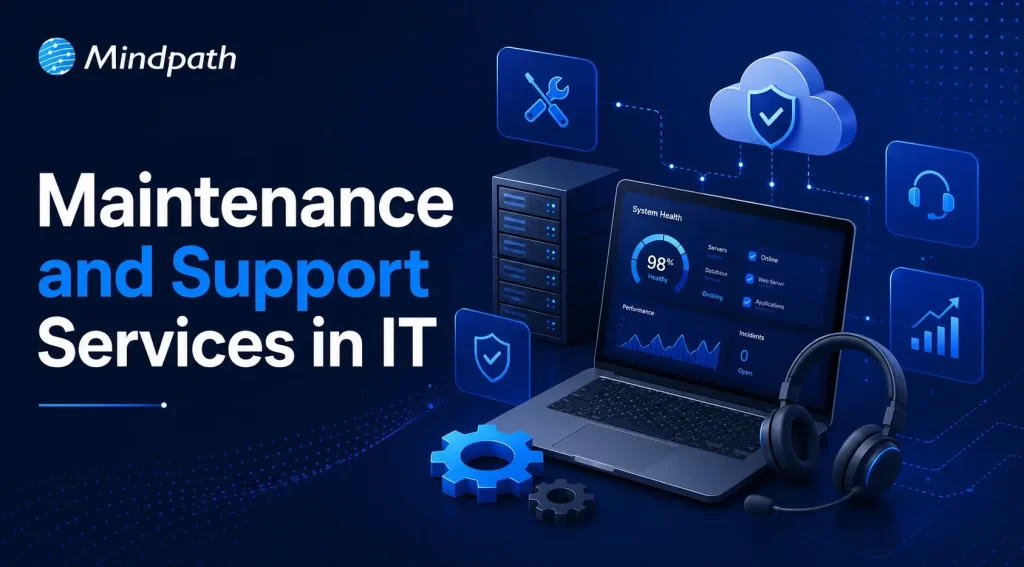
Technology is the source of business development, and any system requires frequent maintenance to remain dependable. Maintenance and support services assist businesses in maintaining, securing, and making software maintainable. A minor problem is likely to slow down the operations and influence the experience of the customers. Sophisticated companies understand that high IT performance requires continuous focus, on-time repairs, and professional management. So, how do companies keep their systems running smoothly while meeting rising digital demands?
Due to the complexity of technology, businesses cannot afford instant fixes to keep up with the competition. Teams need to monitor the health of systems, fix problems quickly, and implement updates in a timely manner. Such a strategy minimizes downtime and ensures that day-to-day activities are not slowed down. It also assists companies in safeguarding data and enhancing user satisfaction. This blog will discuss the ways these services contribute to long-term IT resilience and business performance.
Planning to reduce downtime and keep your business operations consistent? Our maintenance and support services at Mindpath help you manage updates, fixes, and performance with ease.
What are Maintenance and Support Services in IT?
IT support and maintenance services ensure that business technology operates efficiently at all times. Maintenance involves frequent updates, security checks, backups and repair of system problems before they escalate. It assists software to remain stable, secure and effective, thus businesses save time and do not face delays due to unexpected technical issues.
Support services intervene when users have technical problems or require assistance to use systems properly. Support teams resolve problems, answer questions, and direct users through issues within minutes. Maintenance and support together form a stable IT environment, which enhances performance, downtimes, and business needs of the day-to-day business.
Why are Maintenance and Support Services Important for Businesses?
Technology is important in businesses to support daily business activities. The subsequent points demonstrate why maintenance and support services are imperative towards stable IT performance. They assist in minimizing downtime and ensuring systems operate effectively.
1. Stronger Data Security
Companies should have effective security measures to safeguard confidential data against cybercrimes. IT maintenance services mitigate risks by performing frequent security inspections, maintenance, and security measures such as firewalls.
2. Quick Technical Help
Problems in technology require immediate response to prevent delays in work. Proficient support teams are able to resolve issues promptly and provide assistance to users in case they experience system malfunctions or have queries.
3. Better System Performance
Consistent check-ups ensure smooth operation of systems and detecting problems at an early stage. This minimizes delays and ensures that business run smoothly and effectively on a daily basis.
4. Improved Customer Experience
Customers demand rapid and continuous services in all cases. Good system support means less downtime, thus enabling businesses to provide higher quality and more coherent experiences.
5. Timely Bug Resolution
Bugs in the software can impact the performance and cause unpredictable disruptions. Support teams can find out the root cause in a short time and correct errors before they lead to more significant problems.
6. Easy Upgrades and Improvements
The world of technology is rapidly evolving and business software is not left behind. Constant updates and upgrades enhance capabilities, enhance efficiency, and remain competitive.
Types of Maintenance and Support Services
Maintenance and support services cover different areas that keep IT systems reliable and efficient. We can take a look at the primary types that assist businesses in the control of performance, security, and system stability.
1. Software Maintenance Support
Software maintenance services keep software updated, secure, and free from errors. They contain bugs, patches and updates that aid the smooth operation of systems.
2. Hardware Support Services
Hardware support deals with hardware such as servers, computers and network support. Periodic inspections are used to avert failures and maintain devices in proper operation.
3. Network Support Services
Network support ensures that internet connections are maintained in a stable and safe condition to be used in the day-to-day running of business. It also secures systems via firewall configuration and network watchdog.
4. Helpdesk Support and Troubleshooting
Helpdesk staffs offer rapid assistance when customers have technical issues. They find solutions quickly to allow work to proceed without delays.
5. Application Maintenance and Support
Application maintenance services ensure that business applications are maintained and operational. They enhance performance, correct problems, and assist applications to conform to evolving business demands.
6. WordPress Maintenance and Support
WordPress maintenance and support keeps websites secure, updated, and fully functional. It covers the updates of the plugins, security, backups, and error correction.
Factors to Consider While Choosing a Maintenance and Support Service Provider
The following are the factors that you should consider when selecting a Support and Maintenance service provider to your business. The right choice assists in providing quality service, quicker problem resolution, and extended IT stability.
- Select a provider who has the appropriate technical capabilities and actual industry experience.
- Ensure response and resolution times are clearly stated in service agreements.
- Seek positive support that corrects risks before it turns to a problem.
- Check reviews and client feedback to understand their reliability.
- Make sure they provide a flexible support that can be expanded with your business.
- Look at long-term value, rather than making a decision based on low cost.
- Work with a group that listens effectively and knows what you require.
Best Practices for Implementing Maintenance and Support Services
The right strategy is the best fit with strong maintenance and support. These are the best practices that can assist businesses to run systems smoothly and prevent unnecessary disruptions.
- Be proactive to find problems and resolve them before they lead to system downtime.
- Establish an effective ticketing system to monitor, control, and address support orders effectively.
- Automate common operations and provide self-service in order to handle issues faster.
- Establish clear objectives of service and regularly measure performance.
- Develop a robust knowledge base and educate support teams to manage issues.
Challenges of Maintenance and Support Services
Despite its many advantages, maintenance and support services also entail some operational obstacles. The following are some of the problems that businesses can encounter when handling such services.
- IT systems become more difficult to maintain when the old and the new technologies are managed. It tends to provide unnecessary complexity to support teams.
- Cybersecurity threats keep increasing and require constant monitoring. Companies should remain ready to safeguard information and comply with safety requirements.
- The absence of skills may complicate the management of new technologies. Regular training of teams is frequently necessary.
- Low budgets and resources may influence quality of support. Small teams can be unable to cope with increased workloads.
- Unforeseen downtime may derail day-to-day business operations at a short notice. Rapid response is required to minimize losses and delays.
- Ineffective communication may delay the resolution of issues and cause confusion. Proper documentation assists in making teams more effective.
Looking for Reliable IT Support That Keeps Your Business Ahead?
Support and Maintenance services play a vital role in keeping business systems secure, stable, and efficient. Strong maintenance and support services reduce downtime, improve performance, and help businesses adapt to changing technology demands. With the right approach, companies can protect operations and ensure long-term IT reliability.
At Mindpath, we provide maintenance and support services tailored to your business needs. Our expert team helps manage updates, resolve issues quickly, and keep your systems running smoothly. Partner with Mindpath to strengthen your IT environment and support continuous business growth.
Frequently Asked Questions
1. How do maintenance and support services help prevent unexpected system failures?
Maintenance and support services help detect small technical issues before they become major failures. Regular monitoring, timely updates, and preventive checks reduce the risk of sudden breakdowns. This keeps systems stable, avoids costly downtime, and helps businesses maintain smooth daily operations without unexpected disruptions.
2. How often should a business review its IT support and maintenance services?
Businesses should review IT support and maintenance services at least every few months or whenever major system changes happen. Regular reviews help ensure service quality, identify gaps, improve system performance, and keep technology aligned with growing business needs and changing operational demands over time.
3. What signs show that a company needs better maintenance and support services?
Frequent downtime, slow system speed, repeated software errors, and delayed technical responses often show that support needs improvement. If employees face regular disruptions or unresolved IT issues, stronger maintenance and support services become necessary to restore efficiency and protect daily business productivity.
4. Can maintenance and support services improve data security for growing businesses?
Yes, these services strengthen data security through regular patches, system updates, backups, and threat monitoring. Growing businesses face higher cyber risks, so proper maintenance helps protect sensitive information, reduce vulnerabilities, and create a safer IT environment that supports secure and reliable business growth.
5. Why are IT maintenance services important even when systems seem to work fine?
Even when systems appear stable, hidden issues can develop over time without warning. IT maintenance services help catch early risks, apply updates on schedule, and maintain strong performance. This preventive approach keeps technology secure, efficient, and less likely to fail during important business activities.

Modern businesses operate in a highly dynamic environment. They need to focus on resilience and flexibility while performing in the market. The high intensity of competition that they encounter in their path further complicates their situation. This is when a multi-cloud strategy comes into the picture.
A multi-cloud strategy is an ideal option for contemporary businesses. It empowers business entities by increasing their flexibility and optimizing their costs. Moreover, such a strategic approach can even enhance the resilience of businesses in the unpredictable business landscape. It is the perfect time to explore the core benefits of a multi-cloud strategy for modern enterprises.
Wanting to leverage modern cloud technologies to make your operations faster and more scalable? Mindpath provides cloud infrastructure services that help you build, deploy, and manage systems with confidence.
What is a Multi-Cloud Strategy?
Before looking at the benefits of a multi-cloud approach, you need to have a clear understanding of the specific concept. A multi-cloud strategy is when businesses do not rely on a single cloud service provider. Instead, they choose multiple cloud service providers, which helps to distribute the workload across these providers. You may be wondering why such a decision is essential. This is because a single cloud provider can restrict the full potential of the cloud strategy of a business.
A multi-cloud strategy is perfect for businesses that operate today since it helps to overcome the challenges that may arise while relying on a single provider. As a business, you can have greater control over your business operations, and you can make sure that the operational efficiency of your business improves.
You need to bear in mind that a multi-cloud strategy may involve private cloud, public cloud, and specialized cloud services. When businesses opt for a multi-cloud infrastructure, they are not tied to the limitations of a single cloud provider. Instead, they can exploit the strengths of diverse cloud providers and have better control over their infrastructure. This allows them to adapt to the market effectively and focus on high agility.
Wondering which cloud technologies will shape the future of your business? Explore our blog cloud computing trends to discover the latest innovations driving scalability, efficiency, and growth.
How is the Multi-Cloud Strategy Different from the Single Cloud and Hybrid Cloud Approaches?
In order to get a comprehensive insight into multi-cloud architectures, you must know that it is different from single-cloud and hybrid-cloud approaches. In a single cloud approach, a business depends on a single cloud provider for all its workload. In the case of a hybrid cloud, businesses combine on-premise infrastructure with a private or public cloud. While talking about multi-cloud vs hybrid cloud, you need to remember that multi-cloud involves using multiple cloud providers for different workloads.
In the case of a single cloud approach, the management is simplified. However, the issue relating to vendor lock-in may arise. It can automatically limit the overall flexibility for businesses. The hybrid cloud model, on the other hand, offers more balance between conventional IT and cloud solutions.
However, businesses must remember that there is limited producer diversity. The multi-cloud approach offers multi-cloud benefits since it minimizes dependency on a single provider and boosts resilience for businesses. Thus, out of all these options, the multi-cloud approach creates immense value for contemporary business entities.
Also Read: Multi Cloud vs. Hybrid Cloud
Benefits of a Multi-Cloud Strategy
Now that you know, what is multi-cloud? It is time to look at some of the associated benefits. It is fundamental for businesses to remember that a multi-cloud strategy can give rise to a plethora of benefits. The awareness of these benefits can help them decide whether they want such a solution or not.
1. Avoiding Vendor Lock-In
If businesses opt for the multi-cloud strategy, they can rest assured about the vendor lock-in issue. This issue mainly arises when businesses depend on a single provider; however, in the case of a multi-cloud strategy for businesses, they depend on diverse providers. Thus, the dependence on a single vendor gets reduced substantially. Thus, businesses are able to enjoy ample flexibility while operating in the dynamic and uncertain business environment.
2. Cost Efficiency
One of the main benefits of a multi-cloud strategy is related to cost efficiency. In fact, the multi-cloud strategy is ideal for businesses that intend to curb their IT spending. You need to remember that the public cloud option comes with less overhead. Moreover, it allows businesses to scale up or down as per their needs and requirements. Businesses can leverage a multi-cloud strategy and take advantage of the best pricing and performance options.
3. High Reliability
A multi-cloud strategy undoubtedly reduces the risks relating to unplanned downtime. This is because it minimizes the risk relating to a single point of failure. An outage in a single cloud will not necessarily have an adverse impact on the services on other clouds. In case the cloud goes down, businesses can route their computing needs to another cloud. Thus, the reliability is high when businesses choose the multi-cloud strategy.
4. Advanced Security
If businesses are looking for high security while leveraging cloud services, the multi-cloud strategy is an ideal option. This is because a multi-cloud strategy enables businesses to not only deploy and scale workloads but also implement robust security policies. You can also take advantage of compliance technologies in a consistent manner across all your workloads, irrespective of the service or vendor. In the highly unpredictable times, the role of heightened security cannot be negated for businesses.
5. Best Feature of Each Cloud Solution
The multi-cloud approach enables business entities to choose from many cloud vendors. Thus, it offers ample flexibility in order to match the specific capabilities and features to optimize the workload of businesses. You can take into consideration diverse factors such as speed and performance, and choose the best cloud solution that perfectly aligns with your business needs.
Looking to build applications that scale seamlessly across multiple clouds? Explore our blog cloud‑native development to discover how cloud-native architectures improve performance, flexibility, and business growth.
Disadvantages of a Multi-Cloud Approach
Businesses need to keep in mind both multi-cloud advantages and disadvantages while deciding on the multi-cloud strategy. It is necessary to be aware of the associated disadvantages so that businesses can set their expectations accordingly.
1. Management Complexity
One of the most common disadvantages is related to management complexity. It might not be easy for businesses to manage a multi-cloud strategy. They need to dedicate their time and effort so that the strategy can work in favor of the business.
2. Operational Overhead
Businesses may find it challenging to coordinate between diverse platforms. Furthermore, it may increase the management overhead for the business. There is a need for sophisticated tools to manage all the platforms in a perfect manner.
3. Heightened Cost
Although all the services may be cheaper, the total cost may be higher. This is mainly due to the added overheads relating to the management of diverse cloud platforms. Thus, businesses need to understand the importance of careful planning as well as management.
4. Heightened Security Risks
As each cloud provider has its own security and compliance model, ensuring consistency is not easy for businesses. The lack of consistency in terms of security can undoubtedly give rise to security risks. This is a serious disadvantage that businesses cannot ignore.
Struggling to make informed decisions about your cloud investments? Discover our blog importance of data-driven decision making for businesses to learn how analytics and data insights improve cloud strategy outcomes.
Final Words
In the competitive business setting, businesses need to adopt a multi-cloud strategy. Before implementing the strategy, insight into the related benefits as well as disadvantages is essential. The key benefits and disadvantages relating to a multi-cloud strategy have been presented, which can guide businesses to make their cloud-related decisions.
Mindpath’s top-notch cloud infrastructure services are ideal for modern businesses. The experts can make sure that the business can derive optimum value from their cloud approach. The strategy can certainly act as a source of competitive advantage in contemporary times.

The success of every business revolves around the products and services they offer to their target customers. Do you know what it takes to build a product that your customers will love and recommend to others? This is where every business, especially startups, must build a MVP to create the best products for their target audience. Building a minimum viable product provides a lean and targeted solution to gain market validation.
Many people must not be familiar with the fact that only one out of ten startups survive beyond ten years. The primary reasons for failure of startups include lack of research, presence in the wrong market and shortage of funds. You can leverage a MVP to find the feasibility of your product idea and strategically transform it into sustainable business. An overview of a step-by-step framework to create a MVP will help you see how simple it is to build one.
Planning to turn your product idea into a testable MVP? Mindpath offers MVP development services to help startup businesses design and develop MVPs that deliver real user insights.
Why Should You Build a Minimum Viable Product?
The biggest reason for which businesses fail to create a successful product revolves around diving directly into product development. If you invest almost all of your resources in creating a full-fledged product and your customers don’t like it, then you end up with a disaster. Most of the business owners who don’t know the answer to ‘what is an MVP?’ end up facing such situations. The MVP is a primary or the most basic version of the product you want to offer to your customers. It includes only the essential features and functionalities that will help you gain feedback from real users.
Businesses can use their MVP to identify the demand for their product in the target market. The minimum viable product also helps in identifying features that your customers love. As a result, you can ensure that the final product reaches the right market and aligns with your customer’s requirements. Every business owner should create a MVP or minimum viable product to reduce risks and establish the foundation for long-term growth. It not only helps you validate your product ideas but also facilitates efficient resource allocation and earns the trust of investors and stakeholders.
Ready to launch your MVP without delays? Visit our blog on hiring full-stack developers for MVP to learn how to find developers who can handle both front-end and back-end tasks with ease.
Unraveling the Ideal Framework to Build Your MVP
Any business owner with a product idea must follow a strategic approach to create their minimum viable product. You may assume that developing a MVP might come with a lot of technical complexities that are difficult to navigate. On the contrary, you can use the following steps to find the perfect roadmap to develop a minimum viable product for your business.
1. Identify Your Target Audience and Their Problems
The first step in building your MVP involves knowing your target audience and their requirements. It is important to remember that you are creating an MVP to identify whether your customers will like your product. Therefore, you should start with an understanding of the demographics and pain points of your target customers.
The insights from market and user research can provide the foundation for developing a product that meets the needs and preferences of your customers. Once you have identified the problems of your target audience, you can decide how you want to solve them with your product. Understanding the requirements of your target customers will help you create a product that provides real value.
2. Leverage the Benefits of Market Research
You can successfully complete the first step of building a MVP by using the most effective approaches for market research. Businesses cannot just guess the problems their target customers might have and build a product based on assumptions. A review of the different examples of minimum viable product will show you that market research is a critical tool in MVP development. Comprehensive market research offers a granular view of the demographics and problems of your target audience.
The more information you gain from market research, the more accurate your product idea will be. Market research not only helps you come up with the most effective product idea but also shows you what your competitors are offering. As a result, you can find different ways to make your product stand out from the crowd. Business owners should also know that having a strong product idea will help in attracting investors for their product.
3. Establish an Outline of Core Features of Your Product
After finalizing a product idea, you should start defining the core features and functionalities you need in your MVP. All the minimum viable product examples show how you should begin with an outline of basic features that your target market needs. The definition of core features for your MVP provides the ideal start to the process of creating a minimum viable product.
Once you have decided on the core features you want in the MVP, you should think about additional features. At this point of time in MVP development, you must also prioritize the features that you want to include immediately and the ones you can add later. Feature prioritization helps in enhancing the flexibility to define the optimal scope for your MVP development project.
Must Read: MVP for Startups
4. Develop the Prototype and Your MVP
Many of you might be thinking about the necessity of building a prototype when you can build the MVP directly. The prototype serves as an early version of the minimum viable product and offers a clear impression of how it would work. The basic prototype will help you find how the user interface will look and how users will experience your product. You can also leverage the prototype for early testing and feedback, thereby allowing room for refining the design and functionality of the MVP before full-scale development.
The successful testing and improvement of the prototype will lead you to your MVP. It is important to ensure that your MVP does not have any bugs and offers the best quality of customer experience. You should know that you have to introduce the MVP to your target users so that they can perceive the core value your product has to offer. During the development of the MVP, you must also specify the timeline and distinct milestones for the project.
5. Introducing Your MVP to Early Adopters
The most crucial step in the process of developing a MVP revolves around introducing it to the target users. Early users of the product can be regular customers or industry experts who represent your target audience and know your target market. Any guide on how to build a minimum viable product emphasizes the need for feedback from early adopters. The feedback from real users helps you determine whether your product is an ideal fit in the target market.
The best approach to ensure that your MVP reaches early adopters is through identifying communities of users. Professional networks, niche forums or social media communities are the top places where you can find the first users for your MVP. You should create open channels, such as dedicated forums or in-app surveys to gain feedback for your minimum viable product.
6. Collecting and Evaluating the Early Feedback
The feedback from early adopters for your MVP serves as a crucial resource to ensure that your product meets the expectations of users. You should use different types of feedback collection methods for your MVP product to obtain qualitative and quantitative data. The notable methods to collect feedback for your minimum viable product include surveys, usability tests and user interviews.
Once you have collected the feedback, you should categorize it into different aspects of your product. You can use the feedback to learn about usability, performance and functionality of the MVP and identify areas for improvement. Your development team should analyze feedback data comprehensively to understand user preferences and challenges. The insights gained from feedback analysis will guide you through the process of iterative product development.
7. Continuous Iteration and Improvement
Understanding the feedback from early users provides the ideal ground to start refining your MVP according to user expectations. You cannot learn how to build an MVP without focusing on iteration or repeating the development process again. It involves planning, development, testing and reviewing the product repetitively by using feedback from real users.
Developers can rely on user feedback to address the notable issues in the MVP and enhance its functionality. As a result, iteration serves as a valuable component in the MVP development process to improve the user experience. You should remember that engaging regularly with your target audience and using their feedback can help you achieve the right product-market fit.
Looking to bring your software idea to life without unnecessary delays or costs? Read our blog on MVP in software development to learn how to build, test, and refine your product efficiently.
Final Thoughts
The process to create a minimum viable product for your next big product idea follows a common set of steps. Irrespective of the industry, you can rely on professional MVP development services to translate your ideas into sustainable products. You can start by identifying your target audience and their problems, followed by comprehensive market research, to define the core features of the MVP. Subsequently, your development team can create the MVP and leverage feedback from early users to introduce necessary improvements.
Mindpath is one of the most popular platforms for providing MVP development services, with a successful record in helping various businesses. As a reliable MVP development company, we have helped startups and large corporations test their product ideas before full-scale development. Reach out to us for a free consultation and build your minimum viable product now.
Frequently Asked Questions
MVP in Software Development, also known as Minimum Viable Product, is an initial, functional version of a software application built with only the core features necessary to solve a primary problem and be released to early users. The fundamental goal of MVP development is to validate market demand, gather real-world user feedback, and reach the market quickly with minimal investment.
As innovation in the current market setting is growing at a rapid pace, it is essential for businesses to realize the importance of software development MVPs. You need to develop an MVP before investing a significant amount of money in the full-scale product. This strategic development methodology can be implemented by the development team without having to build a complete software product. It is the right time to explore the relevance of MVP in software development.
Wondering how to validate your software idea before committing full resources? Mindpath’s MVP development services help businesses build functional prototypes and gather real user feedback quickly.
What is MVP Development?
In the era of digitalization, startup businesses may wonder – what is MVP in software development? In simple words, MVP or Minimum Viable Product, is a development strategy where a new product or software is launched with only the core features necessary to satisfy early adopters. Unlike a beta version, an MVP is purpose-built to validate market demand and gather actionable user feedback with minimal time and financial investment.
This basic version consists of the essential features and functions. These elements are included by taking into consideration the pain points of clients. The core idea behind the MVP development process is to build customer-oriented software applications. It helps businesses to ascertain whether their product is up to the mark or if it requires improvement. MVP development focuses on minimizing costs and business operations. It even helps to build the software in a smarter and efficient manner.
Stages for Building an MVP
In order to build an MVP in the context of software development, a systematic approach has to be adopted. The MVP development process involves a series of stages that you need to be aware of. You need to follow the steps in a methodical manner so that you can succeed while developing an MVP.
1. Defining the Problem
The fundamental step is to know the problem or pain points of your users. If businesses do not have insight into this area, they may end up creating an app that no one will use. So you need to clearly define the specific problem that your software application is going to solve. At this stage, startup businesses can consider using MVP development services. Otherwise, they can sit and discuss with their development team the problem that the application is going to solve. It is also important to understand how important the application will be for people who will be using it.
2. Knowing the Target Audience
At this stage of the MVP development process, it is essential for you to decide who will be your target audience. A common mistake that some developers make is that they decide to create an app for everyone. It is advisable to target a niche group when startups develop an application. It can help narrow the focus of the project and develop well-functioning software. Businesses need to build the target audience persona and make it as detailed as possible. Some of the details that should be included in the persona include profession, age, and income group.
3. Ascertaining Key Features
Startups need to determine the key features that the first version of the product must have. It is an important thing you need to look at after defining the problem and identifying your target audience. At this stage, businesses need to list down all the possible features of the product. Then you must decide the essential features that need to be incorporated to make the software application usable. From the list of features, you can choose the most essential features that need to be included in the MVP.
Must Read: MVP for Startups
4. Building the MVP
Once you have clarity about the features of your MVP, it is time to start creating the product. At this stage, you have to determine the programming language, framework, and other tools that you plan to use. You can even consider taking the help of an MVP development company if you wish to build your MVP. At this particular stage, you do not have to think about making a perfect product. Instead, startup businesses must focus on building a product that is usable for the intended audience. The ultimate goal must be to develop a functional product within the shortest period of time.
5. Testing the Product
After you have created your MVP, it is time to test it. You must reach out to early adopters who are going to be the actual users of your software application. It is vital to search for the people who match the created buyer persona. You must request them to try out your MVP. If it is possible, you can reach out to them via social media or email. At this stage, your ultimate goal should be to get a good number of people and gather feedback from them. Collecting honest feedback is crucial to making improvements in the software application MVP.
6. Using Feedback for Product Improvement
Once users start giving feedback about your MVP, you need to start collecting it. Moreover, you need to see what the best way is to implement them so that your software can meet the needs of the target audience. Initially, you need to focus on how your software solves the problem for users. If you receive positive feedback, you need to look at additional features that you can incorporate into your actual product. The feedback loop can guide you to develop the ideal product that can effectively meet the needs of the intended users.
Ready to push your MVP from idea to functional product? Explore our blog on hiring full stack developers for MVP to learn what abilities truly drive strong outcomes.
Advantages of Developing a Successful MVP
The creation of an effective MVP can give rise to a host of advantages for startup businesses. You need to be aware of the chief benefits.
1. An MVP can help a business quickly decide whether the solution genuinely resonates with the target audience or not. It can save valuable time as well as resources of your business while helping you to test the core assumptions with the actual users.
2. An MVP can enable businesses to test their business concept with limited investment, as it can minimize the financial exposure that is associated with full-scale software development. So businesses can avoid making costly mistakes.
3. The invaluable feedback that businesses can gather can help in iterating and refining the product. So you can take into account the actual needs and preferences of your customers and create value for them through the software solution.
4. An MVP can help you launch your software application sooner in the market. This will be possible since you can focus on the essential features and key functionalities. The MVP can help you gain a competitive edge in the market setting.
In the current times, when the needs and preferences of customers are rapidly changing, businesses need to understand the importance of an MVP. A successful MVP can enable businesses to create something that can create value at a comprehensive level.
Curious about the different ways software can be built? Check out our guide on the types of software development to learn which approach fits your project best.
Final Words
In the context of software development, the relevance of a minimum viable product cannot be ignored. If businesses plan to develop a new software solution in the market, they need to adopt the MVP approach. The systematic development approach can enable businesses to create software that can create value for the ultimate users in the market. Businesses need to understand the strategic value of a minimum viable product. The knowledge can empower them to build software applications that perfectly match the needs of their target audience.
Mindpath’s MVP development services can help businesses develop their minimum viable product in an effective and efficient manner. Our experts will guide you to make refinements in your software by taking into account the needs of your target audience.
Frequently Asked Questions

Every entrepreneur believes that they have the next big “idea” that could disrupt an industry. The chances of success for your startup depend completely on how you translate that idea into a product that solves the problems of customers. This is where you need to think about the value of MVP of startups and their impact on your growth.
The MVP or minimum viable product is an important step in building the foundation required to achieve the desired goals for your startup. Without an MVP, you are likely to invest in developing products that may not be successful. Learning about the significance of a minimum viable product can help you identify the reasons to build one for your startup.
Are you a startup struggling to validate your idea before investing heavily? Mindpath offers MVP Development Services to help you test concepts and launch faster with minimal risk.
What is a Minimum Viable Product (MVP)?
Before you dive into the benefits of MVPs, you must understand its definition. The minimum viable product is the simplest version of the product you intend to sell to your customers. It includes only the basic features and helps you check the utility and relevance of the product with the help of feedback from actual users. The growing popularity of MVP development for startups across various industries has led many entrepreneurs to think about its benefits.
Is a MVP really necessary for your startup? Many startup owners will think that investment in developing a MVP may increase their financial burden. On the other hand, you should think about the consequences of creating a full-fledged product with everything you have and more, only to end up with failure. MVPs can help startups test their ideas without investing all their resources and make necessary improvements before creating final products.
Top Benefits of MVP Development for Startups
The notion of establishing your own startup might be an exciting one albeit with one big challenge. Did you know that almost 90% of startups fail? Therefore, many entrepreneurs choose MVP development services for startups to increase their chances of surviving the competition. An overview of the benefits of the minimum viable product can explain for why every startup must create one.
1. Aligning Your Product with the Target Market
One of the foremost reasons for which startups should develop an MVP revolves around ensuring that the final product is suited for the target market. Entrepreneurs should know “what is MVP” and how to use it to find the right market for their product and services. Testing the basic version of the product you want to build with real users gives you access to actual and relevant feedback.
Your MVP will tell you whether the target market needs your product and how to improve it with useful features. Startups can leverage MVPs to experiment with product design and refine it till they achieve the right product-market fit. The MVP can easily identify whether your product cannot solve a real problem for your target audience in early stages.
2. Developing Products for Your Core Audience
A minimum viable product not only helps you develop products for the market but also for your core audience. The core audience of a startup includes customers who are more likely to buy their products and services and contribute more to their revenue. Any entrepreneur searching for MVP startup meaning must know that creating products that cater to the core audience increases possibilities of success. Tailoring your product for the core audience ensures higher customer satisfaction as they will believe that their needs have been kept in mind while developing the product.
The MVP offers an opportunity to obtain valuable feedback from the core audience and make product improvement decisions on the basis of actual user experiences. You can not only identify the features that your customers want in a product but also discover relevant market trends. As a result, you can ensure that your product can evolve along with market demands while addressing the needs of your target audience.
3. Introducing Products at a Faster Pace
The next promising reason to look for opportunities to create an MVP is the assurance of faster time to market. Most of the startups struggle to accelerate the time to market due to various constraints. The utility of MVP solutions for startups becomes clearly visible in faster testing of product ideas. If you can identify how your product will solve the pain points of your target audience, then you will gain an early advantage over competitors.
The feedback received for an MVP from actual users help in refining your product by identifying exactly what works the best. Startup owners can avoid assumptions and use insights that help in making informed decisions for improving their products. It provides an ideal tool to reduce unwanted expenses during the development process and streamline your efforts. You can rely on the MVP for building a community of early adopters and their experiences will provide a strong foundation to attract new users.
Preparing to build software that truly matters, you need a clear and efficient starting point. Explore our blog on MVP in software development to learn how early validation and focused execution can turn your idea into a successful product.
4. Making Your Product More Flexible
Another top reason to hire a MVP development consultant for your startup focuses on creating more responsive products. The dynamic business landscape keeps changing constantly and so do your target audience’s needs. Startups cannot afford to build products that fail to adapt to changing user requirements. Your MVP plays a major role in adapting and refining your product on the basis of user feedback.
The minimum viable product provides the guarantee that your product can evolve according to changing preferences of your target users. Entrepreneurs can check whether their product is responsive to user-centric updates and enhances customer satisfaction. Product flexibility is a crucial advantage of the MVP approach that offers the assurance of success for your product in the long run.
5. Playing Safe with Your Investment in Product Development
Any startup that begins product development without a MVP is likely to invest everything in creating a full-fledged product. What if the product you have created with almost all of your resources does not meet your customer’s expectations? This is where MVP development can save you from unwanted expenses by helping you scale up investment as your product gains traction. Entrepreneurs can leverage MVPs as a more sustainable approach to product development with financial safety.
You can start with the basic version that will require minimal development costs and add features according to user feedback. The MVP reduces financial risk by avoiding a full-scale product launch before creating the ‘perfect’ product. On top of it, developing the MVP helps you with strategic allocation of resources. Startup owners can use their MVP to invest gradually in product development as the product design becomes more suitable for success.
6. Leveraging Short-Term Wins for Long-Term Success
The list of benefits associated with MVPs for any startup would be incomplete without including the short-term wins. The milestones in MVP development for startups not only provide an effective roadmap for product development but also enhance the momentum for your project. Startups can view the successful completion of milestones as a source of motivation for their teams and stakeholders.
Stakeholders and investors will perceive the short-term wins as the representation of a startup’s capabilities to deliver on their promises. When an investor notices tangible outcomes from the product development process, they are likely to continue supporting your product. Meeting user needs in early stages helps in building a strong user base for your product and guarantees long-term success.
7. Enhancing Precision in Product Development
Most of the explanations for MVP meaning in business emphasize the ways in which it helps in identifying relevant features. The minimum viable product serves as a useful tool to adapt the core features of your product to user expectations. The feedback obtained from real users of MVPs not only helps in identifying core features but also in refining them.
Startups can focus on features that their target users care the most about and ensure alignment with user needs. The MVP development cost can prove to be a successful investment as it enhances precision in product development. Apart from prioritizing features, your MVP also helps you understand technical complexities in the product. As a result, you can introduce improvements that help your users navigate the complexities with ease.
Want your MVP to move from concept to reality fast? Check out our blog on hiring full-stack developers for MVP to see what skills and qualities matter most, which leads to successful builds tailored to your needs.
Build a Strong Foundation for Your Startup with MVP Development
The benefits of a minimum viable product for startups offer strong reasons to build one for every startup product idea. Many startups fail to recognize the fact that starting small delivers massive benefits in the long run. When you build MVP for a new product, it helps you develop products that align with the preferences of your target audience. In addition, the MVP proves to be a formidable resource for earning the trust of your stakeholders and investors.
Mindpath is a MVP development company with years of experience in building minimum viable products for startups in different industries. We have guided startup owners through the process of creating their MVPs with our expertise and resources. Our strengths in creating MVPs can spell the difference between success and failure for your startup. Reach out to our consultants and create your MVP now.
Frequently Asked Questions

In the software development context, you must have come across the term MVP or minimum viable product. It is the simplest version of a product or application. MVP just has enough features so that initial users can test and provide their feedback. It is ideal for investors to look at the MVP of a product that is being pitched to them.
The importance of MVP development is vital in the prevailing business environment. Many startups fail today because they create products on the basis of assumptions. However, the best way to test those assumptions is by developing an MVP that the real users can see and use. It is the perfect time to learn about MVP and its relevance.
If you are looking to adopt MVP into your business, but don’t know where to start? Mindpath offers end-to-end MVP development services that help you validate ideas quickly while minimizing financial and technical risks.
What is a Minimum Viable Product (MVP)?
A Minimum Viable Product refers to the beta version of a new product that a business plans to create. It encompasses just enough features to capture the attention of early customers and collect feedback from them. The companies that adopt the MVP approach to collect as well as respond to user feedback are able to grow faster in the competitive market setting.
Businesses can use MVP in software development to test if customers are happy with their app before spending too much time and effort. As the needs and preferences of modern customers keep changing, it is fundamental for businesses to prioritize MVP development.
Benefits of Implementing MVP
You need to bear in mind that the concept of MVP product development comes from the lean startup methodology. It focuses on learning as well as building with scalability. When a business builds MVP, it is basically taking the first small step towards a new idea or product. This small step can enable businesses to understand the interest of the market in the product.
1. Gathering User Insights
Businesses can gain valuable insight from MVP development. It can teach them where to make improvements in their offering and scale back. Businesses can also add extra features in order to make their product or application more attractive and useful for the users.
2. Testing Business Idea
The key benefit of MVP is that it serves as a low-risk testing ground before businesses invest millions of dollars into a product. Startup businesses can validate their product through MVP development. It creates an opportunity to interact with customers and understand their needs.
3. Cost Efficiency
You need to remember that an MVP development company can help you in terms of cost-saving. Mature software products need years of development along with considerable investment. MVPs ensure that products are simple for coding as well as functionality, thereby reducing development cost. Once you start gaining customer feedback, you can start spending your money more wisely on the new product.
4. Assessing Market Demand
The MVP encompasses testing as well as analyzing the functionality of a product. Moreover, it helps in evaluating the market demand and helps in the acquisition of new customers in the market. It is vital for business organizations to understand the needs of their customers along with the existing solutions. The MVP approach empowers businesses to refine their offering and know whether their offering has a future in the market or not.
5. Securing Funding
Startups require funding in order to survive in the competitive market environment. MVP development for startups serves as a strategic method that can enable them to test the idea before reaching out to investors and other stakeholders. Such a systematic approach can help businesses to secure funds from investors who trust in their idea and Minimum Viable Product.
How Much Does MVP Development Cost?
The role of MVP development is indispensable for businesses. So it is time to focus on the MVP development cost. Businesses may wonder – How much does MVP development cost? The answer to the question is not straightforward. The average cost relating to MVP development depends on a number of factors, such as the scope of the project and team composition. Similarly, contractual dynamics may also play an important role in impacting the cost of MVP development.
When it comes to MVP, the cost can be categorized into specific features as well as development phases. The common categories that you may come across include market research, prototyping, and MVP development. It is crucial to bear in mind that the research phase is conducted in parallel with prototyping.
Difference Between MVP, Prototype, and Proof of Concept
In order to get a holistic insight into MVP, you must understand how it is different from Prototype and Proof of Concept. A layman may think that these terms are interchangeable. However, that is not true. Each of the terms has a different meaning that businesses should be familiar with.
1. MVP
MVP refers to a launchable product version. It includes core features. The purpose of MVP development is to validate the market potential of a product and gain valuable feedback from users.
2. Prototype
Prototype refers to a preliminary model of a product. It can also be described as a mock-up that is designed to test the design concepts and technical feasibility. It also helps to assess the functionality of a product before its complete development.
3. Proof of Concept
Proof of Concept is a small experimental project. It is undertaken to demonstrate the feasibility or viability of a concept. It is mostly tested internally before further investment is made.
The main difference between these three terms has been presented in the table below:
| Aspect | MVP | Prototype | Proof of Concept |
| Purpose | Market validation | Technical exploration | Feasibility testing |
| Complexity | Functional product | Non-functional model | Basic technical demonstration |
| Audience | Potential customers | Internal stakeholders | Technical team |
Misconceptions Relating to MVP
There are a number of misconceptions that startups may have about MVP. It is essential to have proper clarity about MVP so that businesses can take advantage of the approach while developing their offering.
1. A common misconception is that MVP is an inferior quality product. However, in reality, an MVP is crafted in a strategic manner. It focuses on the product or software that can deliver core value while maintaining user experience.
2. Another common myth is related to the investment aspect. You may believe that MVP in web development requires no major investment. However, that is not true. Although MVPs are more cost-effective than the final product, they require resource allocation and technical implementation.
3. Businesses may have the idea that one MVP may be sufficient while developing a product. But the truth is that MVP development is an iterative process. Businesses must continuously incorporate the feedback of users so that the best version of the product can be made.
4. You may think that an MVP is a universal solution for all startups. However, this is a common misconception. Not all startups might be able to validate their product or idea through an MVP.
Ready to launch your MVP without delays? Visit our blog on hiring full-stack developers for MVP to learn how to find developers who can handle both front-end and back-end tasks with ease.
Turn Your Product Idea into a Market-Ready MVP
In the current business landscape, the importance of MVP development cannot be negated. In order to sustain and survive in the complex business space, it is key for startups to develop a minimum viable product before investing completely in the actual product. It can empower businesses to refine their product or offering and create value for the end-users.
Businesses can take advantage of Mindpath’s minimum viable product development services. Our experts can help you develop your MVP in an efficient manner, and you can obtain relevant feedback to improve your offering. The MVP development process can play a strategic role, and it can give your business an edge.

Mobile app maintenance plays a key role in keeping the application stable, secure, and ready for real-world use. A new app can be created with great design and functionality, but its functionality is often determined by how well it is updated since it is released. The expectation of the users is flawless navigation, quick reaction, and no interruptions. Then how does an app keep these expectations going as technology, devices and user behaviour keep evolving?
This is where regular maintenance is necessary to achieve success in the long term. Regular updates assist in enhancing performance, repairing latent problems, and maintaining security as threats change. Simultaneously, it keeps the app running at the expectations of the user. In its absence, even a well-developed application may soon lose its worth in a competitive market. In this blog, we will be exploring the importance of mobile app maintenance.
Ready to reduce risks and keep your mobile app performing at its best? Mindpath offers maintenance and support services to support continuous performance and stability.
What is Mobile App Maintenance?
Mobile app maintenance is the continuous process that maintains an application after its release. It consists of performance enhancements, bug fixes and feature additions. Developers also tune UI and UX to user requirements. Moreover, applications can be updated regularly and checked to ensure that they remain compatible with new operating systems and versions of devices.
Mobile application maintenance helps reduce technical issues, security risks, and performance slowdowns. It makes the experience of users smooth and non-interrupted as well as crash-free. This leads to improved customer satisfaction and low uninstall rates. Ongoing maintenance makes the app stable, predictable, and up-to-date with the evolving technology and user needs.
Must Read: Proactive vs. Reactive
Types of Mobile App Maintenance
Maintenance of mobile applications involves various strategies that make an application stable, current and user friendly even after its launch. These are the categories of application maintenance services that will provide seamless operation and sustainability.
1. Corrective Maintenance
Corrective maintenance fixes post-release bugs, crashes and errors. It maintains a smooth running of the app in the hands of the users.
2. Preventive Maintenance
The preventive maintenance mitigates future problems by updating the codes and improving performance. It assists in preventing the issues before they arise.
3. Perfective Maintenance
Perfective maintenance enhances features, depending on user feedback. It also keeps the app in compliance with the evolving business requirements.
4. Adaptive Maintenance
Adaptive maintenance upgrades the app to new operating systems and devices. It maintains the compatibility of the app with evolving technology.
5. Emergency Maintenance
The emergency maintenance addresses urgent problems that influence the stability of the app. It promptly recovers normal functioning following critical failures.
Importance of Mobile App Maintenance
Mobile app maintenance keeps an application stable, secure, and high performing once it is launched. The following are the major significance of having mobile application:
1. App Security Updates
Mobile application maintenance enhances security by addressing vulnerabilities and preventing cyber threats. It protects the data of users and generates trust in the long term.
2. Performance Monitoring
Constant monitoring will assist in the monitoring of the performance of the apps and in the identification of problems in time. It guarantees the rapid repairs and maintains the smooth operation of the app.
3. Regular Feature Updates
The frequent updates are the features that make the app relevant and interesting. They also enhance usability and general user satisfaction.
4. App Store Compliance
It is necessary that apps adhere to the new app store policies to be available to users. Maintenance guarantees adherence and avoid removal or suspension.
5. Bug Fixing
Bug fixing is used to correct the errors that compromise the stability and performance of the apps. It enhances trustworthiness and delivers an easier user experience.
6. UI/UX Improvements
The UI/UX enhancements increase the design and usability of the app. They simplify navigation and enhance user interaction.
7. Downtime Reduction
Maintenance will assist in minimizing crashes and downtime surprises. This is to guarantee that users are not interrupted when availing services.
8. Technology Updates
Applications need to adapt to new technologies and operating system modifications. Maintenance will guarantee compatibility and maintain the app up to date.
9. Business Growth Support
A properly maintained app will attract and retain more users in the long run. This promotes business development and sustainability.
10. User Experience Enhancement
Frequent upgrades enhance user engagement with the application. They make the performance smoother and user satisfaction higher.
Best Practices for Mobile App Maintenance
Mobile application maintenance services is most effective when they are a well-planned and regularly followed process. The following are some of the most effective ways to maintain mobile applications.
1. Code Structure and Modularity
If the code is divided into distinct units, it becomes easier to resolve problems and make modifications. Also, when updating the main functions, the level of risk is minimized.
2. Continuous App Monitoring
If you use monitoring devices, they will assist you in following the application functioning in the real-time environment. They are capable of promptly identifying faults and failures.
3. User Feedback Analysis
Users’ comments and criticisms throw light on the genuine problems people experience using the app. So they allow developers to come up with the enhancement of the functions that respond to users’ specific requirements.
4. Issue Prioritization
The first thing to do is to classify the defects according to the extent to which they affect users. This will make sure that the most severe problems are resolved first.
5. Testing Before Release
It is important to do thorough testing to each and every updated version before making it available to the users. In doing so, you can be sure that users will not be subjected to any newly-introduced bugs.
6. Post Update Review
Checking performance and collecting user feedback after an update is a great way to make sure things are really working according to your expectations.
Ready to Keep Your App Strong and Future Ready?
App maintenance is extremely important if you want to keep your app running smoothly, securely and in a way that users would enjoy even after it has been launched. It leads to improved performance, lesser bugs, and a seamless user experience. Besides that, regular updates are a way of standing out in a digitally-advanced world that is changing fast and also, apps that are well-maintained tend to be on the path of success.
At Mindpath, we offer maintenance and support services, aiming at keeping your app up-to-date, secure, and running efficiently. Our team works on increasing the overall stability of the app, resolving the bugs, as well as improving the user experience. We assist businesses in minimizing the periods of downtime and ensuring that the app runs smoothly, which in turn promotes growth and customer satisfaction.
Frequently Asked Questions
1. Why does mobile app maintenance matter after launching an app?
Mobile app maintenance ensures the app stays stable, secure, and smooth after launch. It helps fix hidden issues, improve performance, and keep users satisfied. Without regular updates, even a good app can become outdated and lose users over time in a competitive market.
2. How often should an app be maintained for best performance?
Maintenance should happen regularly, not only when problems appear. Monthly checks and timely updates help prevent bugs and performance issues. Continuous monitoring also ensures the app stays compatible with new devices, operating systems, and changing user expectations for a smooth experience.
3. What are the common issues solved through app maintenance?
App maintenance mainly fixes crashes, slow performance, and security gaps. It also addresses UI issues and improves overall usability. These updates ensure users face fewer interruptions and enjoy a smooth, reliable experience every time they use the app.
4. How is mobile app maintenance cost usually decided for businesses?
The mobile app maintenance cost depends on app complexity, features, and update frequency. Apps with advanced features or high user traffic may need more frequent updates, which increases cost. Regular maintenance, however, helps avoid bigger issues and expensive fixes later.
5. Can poor maintenance affect user experience and app success?
Poor maintenance directly impacts user satisfaction and trust. Users may face bugs, crashes, or slow performance, leading to uninstalls. Over time, this reduces engagement and affects business growth, making consistent updates essential for long-term app success.
Failure can be indicated well before it is seen. Reliable delivery teams begin to become aware of minor disruptions at an early stage. When systems exhibit minor yet consistent problems, maintenance support is needed. Are there minor errors that are occurring more frequently than anticipated? Do the response times seem a little bit out of tune during normal operations? These signals do not tend to be loud; however, they reflect more technical gaps that require consideration.
Besides, regular delays, unplanned downtime, and user complaints are hard to come by on their own. They accumulate pressure against business continuity and trust, over time, by users. Consequently, a prompt response maintains systems as dependable and effective. By neglecting the early warning signs, risks and cost are likely to rise. In this blog, key indicators will highlight when immediate maintenance action becomes necessary.
Ready to fix recurring issues before they start affecting your customers and revenue? Mindpath offers maintenance and support services to quickly resolve problems and keep your product running smoothly.
Why are Maintenance and Support Services Essential for a Business Product?
Business products need consistent performance to meet user expectations and market demands. Even small issues can affect reliability and growth. Maintenance support keeps systems stable, secure, and aligned with changing needs, ensuring smooth operations over time.
As businesses grow, products face higher traffic, security risks, and shifting user behavior. Regular updates and monitoring improve efficiency. Strong support services help businesses adapt quickly, protect performance, and maintain long term value without unexpected setbacks.
Here are the key points why support and maintenance are important:
1. Stronger Security and Risk Control
Frequent updates are used to address vulnerabilities before they are a major problem. This safeguards data, compliance, and minimizes exposure to cyber risks.
2. Better User Experience
Ongoing improvements make interfaces smoother and faster to use. As a result, users stay satisfied and engage more with the product.
3. Reduced Costs Over Time
Regular upkeep averts serious problems that require costly repairs. This will reduce the long term costs and eliminate the surprises of costs of repairs.
4. Improved Performance and Scalability
Regular optimisation and monitoring of systems is more effective. They are also capable of managing more workloads as the business needs increase.
5. Less Downtime and Smooth Operations
Active surveillance detects problems earlier than they can impact performance. This will maintain uniform operation and minimize unplanned disruptions.
6. Continued Relevance and Flexibility
The updates maintain products in line with new technologies and market demands. This assists companies remain competitive and prepared to change.
Key Signs Your Product Needs Immediate Maintenance Support
Products are capable of alerting to a decrease in their performance through early signs, and fixing them with the help of maintenance and support at once is the best way to do that. Not reacting quickly to these signs can lead to instability, whereas, by taking timely actions, we can keep the systems dependable.
1. System Struggles to Handle Growth
When the user base increases, the application either runs very slow or stops working altogether. Software maintenance support can help not only in improving the scalability of the application but also in ensuring smooth performance during system growth.
2. Frequent Crashes and Downtime
During ordinary operation, the system crashes, sticking or having to be continually restarted. This is not only a reflection of its instability but also a signal for the need of quick measures that would strive to bring back the regular functioning.
3. Slow Speed and Response Issues
One of the main reasons why users get frustrated with an application is when pages take too long to load. Not only does it affect user experience, but it can also lead to low user engagement. In this regard, application maintenance support is a great solution to optimize performance and minimize latency.
4. Rising User Complaints
Another sign of a troubled product is when users start reporting problems more frequently such as errors, missing features, or poor usability. In fact, this could be a clear indication that the product is no longer satisfying the users and hence, requires immediate improvement.
5. Security Gaps and Risks
If updates are not implemented, the system becomes vulnerable to exposure and unauthorized access. Therefore, regular patches are not only vital for data security but are also the best way to keep the application safe from security loopholes.
6. Outdated Technology Stack
With technology advancing rapidly, the use of outdated frameworks and systems often becomes a major hindrance to performance and compatibility. This is why only technology updates lead to better efficiency and at the same time meet the needs of modern users.
7. Hard-to-Manage Code Structure
Simple changes take too long due to complex and unstructured code. This slows development and signals the need for code optimization.
8. Failed Backup and Data Risks
Backup processes fail or recovery tests do not work properly. This increases the risk of data loss and demands immediate attention.
9. Overloaded Support Team
The team spends most time fixing urgent issues instead of improving the product. This shows deeper system problems that need structured maintenance.
10. Broken Integrations and Features
Third-party tools or APIs stop working as expected. This not only affects the product operation but the entire functioning also gets disrupted.
Is Your Product Ready for Reliable Performance?
Ignoring early warning signs can impact performance, security, and user trust. Timely maintenance support helps businesses stay ahead of issues and ensure smooth operations. A proactive approach keeps systems stable, efficient, and aligned with changing business needs.
At Mindpath, we provide maintenance and support services to keep your product running without disruptions. Our team ensures consistent performance, quick issue resolution, and long-term stability, helping businesses focus on growth with confidence and reliability.
Frequently Asked Questions
1. How often should a product receive maintenance support to stay stable?
Regular maintenance depends on product complexity and usage levels. High traffic systems need more frequent monitoring and updates. Consistent checks help prevent unexpected issues, improve performance, and ensure the product continues to meet user expectations without interruptions.
2. What happens if early signs of product issues are ignored?
Ignoring small issues can lead to serious performance failures, security risks, and poor user experience. Over time, this increases downtime and repair costs. Addressing problems early helps maintain stability and avoids major disruptions that can affect business operations.
3. How does maintenance support help in improving user satisfaction?
Maintenance support ensures smooth performance, faster load times, and fewer errors. Users expect reliable and quick experiences. Continuous improvements and timely fixes help meet these expectations, leading to better engagement, trust, and long-term user retention.
4. Is maintenance support necessary even when the product is performing well?
Even well-performing products require regular updates and monitoring. Hidden issues can grow over time without visible signs. Proactive maintenance support helps prevent future problems, keeps systems secure, and ensures consistent performance as business needs evolve.
5. Can regular support reduce long-term product costs?
Yes, regular maintenance helps identify and fix small issues before they become expensive problems. It reduces the need for emergency repairs and system overhauls. This approach ensures better resource management and keeps overall operational costs under control.
Every prosperous company in today’s modern world relies on insights, not on instincts. The importance of data-driven decision-making is that it turns the daily choices made by human beings into strategic moves guided by genuine facts. Businesses that rely on data are better positioned to identify new opportunities, make decisions faster to adapt to change, and make decisions accordingly to grow. Data-driven decisions are the difference between guessing your next step and knowing your next step.
As companies embrace data as a trustworthy guide, they promote a culture of clarity and accountability. Decisions are sharper, and strategies are more in sync with customer and market needs. This pragmatic use of data helps organizations to keep their focus on the future and to remain competitive in today’s digital-first environment. In this blog, we are going to outline why data-driven decision-making is a crucial component of contemporary business success.
Looking to turn your business data into actionable insights? Explore Mindpath’s AI Data Analytics Services to uncover trends, improve decision-making, and drive measurable business growth.
What is Data-Driven Decision Making?
Data-driven decision making (DDDM) refers to making business decisions on the basis of facts, figures, and analysis rather than personal opinions or gut feelings. It reduces uncertainty by collecting data from various sources that examine the relationship between actions taken, such as customer behavior, sales tracking, or market data on trends, to identify what is really working for the business.
When organizations use this approach, they make data-based decisions with direct evidence that reduces risks and reveals new opportunities. Analyzing data patterns enables businesses to plan more effectively and achieve success easily.
Must Read: AI in Decision Making
Here are the key fundamentals of data-driven decision-making:
1. Focus on Business Goals
Every data initiative must have a direct link to business goals. When teams better define their objectives, they can evaluate data with intention and make decisions that result in observable growth for the business.
2. Keep Data Clean and Reliable
All insights must be accurate, and therefore, the data must be from a trusted source. Ongoing checks for data quality and best practices in data cleaning should be conducted to guarantee decisions are based on sound data and not on missing or stale data.
3. Use Data as Proof, Not Assumptions
Effective decisions are built on true evidence. The importance of data-driven decision-making is that it eliminates the guessing and offers visibility that leads the decision-maker to act faster and more reflectively.
4. Make It a Continuous Effort
Data-based decision-making is an integral process. Companies should be consistently collecting, monitoring, and analyzing data so they can keep pace with shifts in market trends and customer needs.
5. Encourage Team Collaboration
Strong insights often develop in collaboration. When departments share their insights and discuss results, they create a collective plan that produces better and more consistent outcomes.
Want to know how modern businesses manage and analyze large volumes of data efficiently? Explore cloud‑native development to understand how cloud-native systems optimize data-driven operations.
The Importance of Data-driven Decision Making
Understanding the importance of data-based decision-making supports businesses in formulating better rationales and better results. It instills a culture of fact-based, accountable decision-making to foster growth and transparency in increasingly dynamic markets.
1. Smarter Communication Across Teams
Effective communication is one of the main benefits of data-driven decision-making. When all departments are working with the same reliable insights, updates are easier to share and alignment of goals is simpler. With transparency, collaboration is fostered, and coordination is improved. This enables leaders to make quicker, smarter choices for improved business performance overall.
2. Continuous Growth and Progress
The importance of data-driven decision-making is tied to its support for constant growth in the business. By looking at across practice areas to identify patterns that drive success, teams can recognize what affects success and improve decisions. Each decision that relies on evidence is a barometer for the future and ensures steady improvement. With time, this will fortify the organization and provide continued success.
3. Unlocking New Business Opportunities
Making decisions based on data allows organizations to discover new areas of growth and opportunities. When teams analyze customer behavior and market trends, they may identify opportunities that they never considered. This approach can result in more confidence in expansions, partnerships, and innovations. When focused by data, it allows the organization to have a distinct competitive advantage.
Must Read: Benefits of Using AI for Customer Service
4. Building Knowledge and Innovation
Organizations that leverage data-based decisions regularly outperform firms that don’t. Studies have shown that data-driven firms have higher productivity and higher profitability. When we start considering information to be a valuable asset, teams begin to actually have a learning culture, where information flows both ways. This kind of culture leads to smarter thinking and out-of-the-box problem-solving.
5. Reducing Costs and Avoiding Mistakes
Choosing to make decisions based on gut feelings can lead to poor and costly outcomes in a business scenario. When leaders choose to make decisions based on data, they are making decisions based on certainty that is based on fact, instead of hunches. Relying on evidence instead of instincts leads to companies using their resources more efficiently. More clarity leads to reduced time and waste and naturally occurs in the flow of achieving sustainable cost efficiency.
6. Adapting to Market Changes Easily
Another importance of data-driven decision-making is its ability to assist organizations in being adaptable. Market conditions change and customer expectations fluctuate, and data keeps companies prepared. When companies can monitor trends and performance as they are happening, they can react quickly and with confidence. This ability to be adaptive will help to keep organizations competitive, relevant, and profitable.
Wondering how different AI systems impact decision-making in organizations? Discover types of Artificial Intelligence – ANI, AGI, and ASI and see which technologies can optimize your business insights.
Ready to Strengthen Your Business with Smarter Data Decisions?
The importance of data-driven decision-making is that it enables an entity to convert unprocessed data into efficient and effective measures. Businesses using data as their main resource are in a position to make decisions without hesitation, spot trends quickly, and hence, execute plans deftly to reach a steady level of growth. It becomes their corporate culture that they have fact-based support for every decision made, which eventually results in enhanced operational efficiency, greater flexibility, and durability in a very dynamic business environment.
At Mindpath, we empower businesses to harness the power of data through our advanced AI development services. Our experts design AI-driven tools that simplify complex processes, enhance decision accuracy, and drive smarter outcomes. By combining innovation with intelligent data use, Mindpath helps organizations improve productivity, streamline operations, and achieve measurable results that strengthen their competitive edge in the digital-first business world.
Frequently Asked Questions

In the e-commerce landscape, businesses need to make a number of critical decisions. In case you are planning to venture into the e-commerce space, it is imperative to choose the right platform. This decision can certainly influence the success of your business in the dynamic e-commerce arena.
The platform that you choose for your e-commerce store can undoubtedly influence the overall performance and success of your business. The top names that are ruling the e-commerce platform setting are Shopify WooCommerce. You need to dive into the world of WooCommerce Shopify so that you can make a proper comparison between these platforms. You need to know how these e-commerce platforms differ from one another so that you can make the ideal selection.
Planning to grow your online business and make a real difference in sales and customer experience? At Mindpath, we provide expert web development services that create user-friendly online stores designed to boost conversions and engage your customers.
An Insight into Shopify
Shopify is a subscription-based, cloud-hosted e-commerce platform that enables entrepreneurs, small businesses, and large brands to sell products online and in person. It provides an all-in-one suite of tools, including inventory management, payment processing, and order fulfillment, without requiring any coding or web development experience. As one of the most widely used e-commerce platforms globally, Shopify equips businesses with the features they need to build, manage, and grow their online store in a competitive digital marketplace.
You must get a holistic insight into Shopify and its features to understand its true capabilities as an e-commerce platform. One of its distinguishing features is related to the creation of a store. Businesses can also use their selling tools and payment processing features to streamline their practices and operations.
An Insight into WooCommerce
WooCommerce is a free, open-source e-commerce plugin built for WordPress. It enables users to transform any standard WordPress website into a fully functional online store. Beyond just adding products and payment options, WooCommerce supports selling physical goods, digital products, subscriptions, and services, making it one of the most versatile e-commerce solutions for WordPress users.
A unique thing about WooCommerce is that it is ideal for experienced sellers in the e-commerce domain. You can extend its functionality with the help of a number of add-ons and themes. Businesses need to familiarize themselves with the core features of WooCommerce so that they can make use of the platform in an optimal manner. Its key features that you need to know about include the availability of a large library of themes and high extensibility.
Must Read: AI in E-commerce
Difference Between WooCommerce and Shopify
Now that you have a basic understanding of Shopify and WooCommerce, it is time to look at them at a closer level. Businesses that plan to establish themselves on the online platform need to know the key differences between these platforms so that they can have clarity on WooCommerce vs Shopify. The insight into this area is crucial to choosing the suitable platform and thriving in the market.
1. Cost
While talking about WooCommerce vs Shopify, one of the key differences between the two options revolves around their cost. WooCommerce and Shopify have entirely different pricing structures. WooCommerce is entirely free for users, so you do not have to pay anything to use it for your online business. Thus, it offers ample flexibility with variable costs for users.
On the other hand, when it comes to Shopify, it has a subscription model for its users. WooCommerce vs Shopify pricing is a major point of difference that you need to take into consideration for your e-commerce business. The ultimate budget of businesses can play a catalytic role in choosing their ideal e-commerce option.
2. User-Friendliness
The ease of use or user-friendliness is a key dimension that you need to bear in mind while selecting between WooCommerce and Shopify. You must keep in mind that both these e-commerce solutions offer a diverse user experience. As WooCommerce is an open-source plugin for WordPress, which is self-hosted, it requires manual setup.
Every aspect has to be handled separately by businesses while using the plugin. Moreover, businesses should know that it requires ongoing management as well. When it comes to Shopify, it has an all-in-one dashboard that users can use for their needs. Thus, users can have a hassle-free experience if they choose Shopify.
Not sure which technologies will give your e-commerce business the best performance and scalability? Explore our blog tech stack for your web app success to learn how to choose the right tools for long-term growth.
3. Themes as well as Templates
While talking about shoplift vs WooCommerce, it is key to understand how they differ in terms of available themes and templates. WooCommerce offers a humongous library of premium as well as free WordPress themes. You can choose the specific theme that is ideal for your business. The good news for users is that there is an opportunity to customize the themes on WooCommerce.
When it comes to Shopify, businesses can use professionally designed themes. Such themes can certainly give an edge to your business. But you have to bear in mind that there are limited options to customize the themes. You need to take into account WooCommerce vs Shopify themes while choosing the ideal option out of the two options.
4. Scalability
Scalability is an important dimension that every e-commerce business needs to prioritize. You need to make sure that your online store grows in a seamless manner as your business expands. Your store must be able to handle additional product offerings and additional users. WooCommerce serves as a highly flexible option for e-commerce businesses.
However, in order to leverage the flexibility that it offers, businesses must be aware of how to use the available tools. Shopify undoubtedly simplifies the degree of flexibility by offering built-in tools for businesses. You can leverage these tools as they will handle most of the work for your business.
5. Security
Security is undoubtedly a non-negotiable element you need to look at while understanding the difference between WooCommerce and Shopify. If you plan to use WooCommerce, you need to know that, since it is a self-hosted solution, the onus of security lies with you. Although it offers certain security features, most of the security depends on elements such as the hosting environment and plugins.
Similarly, the manner in which businesses maintain their websites also influences the quality of security. On the other hand, Shopify offers robust security to e-commerce businesses. This specific platform has in place holistic security measures that can safeguard both customer and store-related data.
Concerned about keeping your online store and customer data secure? Read our blog application security best practices for web and mobile apps to learn proven methods to protect your business.
6. Payment Gateway
As a majority of online customers are making online payments, it is essential for e-commerce businesses to have in place a robust payment gateway mechanism. Both Shopify and WooCommerce offer a diverse range of payment gateway options that you need to be aware of. As WooCommerce is integrated with WordPress, it offers a high degree of flexibility when it comes to payment gateways.
It is possible to integrate almost any gateway. But the particular process may require additional setup for businesses. When it comes to Shopify, it comes with built-in options. The built-in payment option offered by Shopify makes it simpler for businesses to accept payments from customers without requiring additional setup. Moreover, it supports international payments, thereby creating value for modern businesses.
7. Customization
The difference between WooCommerce and Shopify arises when looking at the customization dimension. You can look at WooCommerce as a blank canvas. It offers high power to businesses to customize their online store based on their needs and requirements. On the other hand, Shopify keeps things simple for businesses.
It offers limited customization ability as a business. Without having to do much customization, businesses can have a professional-looking online store. You can take advantage of the drag-and-drop editor to build your store. However, this feature limits the ability to customize for users.
Looking for innovative ways to stand out in the crowded e-commerce space? Learn from our blog, augmented reality in e-commerce, and see how AR technology can transform your online store.
The table presented below gives an overview of the main differences between Shopify and WooCommerce. Businesses can certainly refer to it while making the selection between WooCommerce or Shopify.
| Basis | WooCommerce | Shopify |
| Cost | Free | Monthly subscription model |
| User-friendliness | Not beginner-friendly and requires manual setup | Beginner-friendly and intuitive |
| Themes and Templates | Offers a large library of WordPress themes and high customization ability | Offers professionally developed themes and low customization ability |
| Scalability | Flexible but requires good hosting and optimization | Effortless scaling with business |
| Security | Security level depends on hosting and manual updates | Security is fully managed and comprehensive |
| Payment Gateway | Multiple payment gateways with no additional charge | Shopify payments and external payments with applicable fees |
| Customization | High customization | Limited customization |
Selecting Between WooCommerce and Shopify
It is crucial for businesses to remember that the ultimate choice between WooCommerce and Shopify depends on the goals as well as the needs of businesses. You need to keep in mind your budget and WooCommerce vs Shopify payments while choosing the ideal platform for your e-commerce business. You must remember that both platforms offer a unique set of advantages for businesses.
As the pros and cons of each of these options vary, you need to carefully consider them while making your choice. WooCommerce empowers businesses to customize their online stores. On the other hand, Shopify offers a professional-looking store thanks to its drag-and-drop option.
Struggling to make informed platform decisions for your e-commerce business? Explore our blog on the importance of data-driven decision-making for businesses to learn how data insights can guide your choices.
Final Words
In the cut-throat competitive business space, it is mandatory to choose the ideal platform for e-commerce success. In order to make the right choice, you need to have clarity on your basic requirements. This insight can guide you to choose the best platform that perfectly meets your needs and expectations.
Mindpath provides web development services that understand the need to choose the right platform for e-commerce businesses. Businesses can undoubtedly rely on our experts to make use of high-quality WooCommerce and Shopify solutions. These high-quality solutions can make sure that your business can thrive in the unpredictable e-commerce realm and gain an edge over its competitors.
Frequently Asked Questions
Join our Newsletter!
categories
Join the world's largest training library and unlock new opportunities!


Turn Insights Into
Real Business Solutions
Exploring trends is only the beginning. Whether you’re planning AI adoption, modernizing legacy systems, or building scalable software, our experts help transform ideas into practical business outcomes.