Latest Insights On
GenAI, Tech, and Digital Transformation
Stay updated with expert insights, success stories, and real-world applications of cutting-edge technology.
The radical transformation of the education sector is clearly visible in how classrooms have changed along with the approaches for teaching. With the arrival of solutions like educational chatbots, the education landscape is shifting gradually towards innovative approaches. You can rely on conversational AI tools to get a completely new perspective on education. Learners can get personalized and engaging experiences, while educators can use AI chatbots to reduce their administrative burden.
Key Takeaways
- 01
Educational chatbots can personalize learning based on each student’s pace, needs, strengths, and learning style. - 02
AI chatbots give students access to learning support, explanations, and homework assistance beyond traditional classroom hours. - 03
Interactive quizzes, gamification, and simulations can make learning more engaging and encourage students to participate actively. - 04
Teachers can use educational chatbots to automate routine work, create learning materials, and understand student performance. - 05
AI-powered educational chatbots can support students, educators, and institutions while making learning more flexible and accessible.
In addition, chatbots can assist in providing instant feedback, guiding students through complex concepts, and supporting collaborative learning even outside the classroom. They also help institutions manage routine queries and streamline processes, giving teachers more time to focus on teaching. Let us learn more about the impact of AI chatbots on the learning experience.
Ready to transform learning with AI? Contact us to build an intelligent educational chatbot tailored to your students, educators, and institution.
Significance of Chatbots in Education
Educational chatbots use conversational AI to interact with students, educators, and administrators. Their ability to understand context from interactions allows them to provide relevant responses to questions and learning needs. These chatbots can answer simple queries as well as more complex questions related to subjects in the curriculum.
In simple terms, educational chatbots can act as digital learning assistants that provide personalized support, instant guidance, and learning resources while also helping educators manage routine tasks.
You can understand the importance of chatbots in education from the list of benefits they have to offer. The true capabilities of chatbots focus on personalizing the learning experience by providing personalized content and recommended resources for each student. Educators can also achieve better student engagement with chatbots alongside addressing challenges in administrative processes. It is important to note that almost 75% of educators acknowledge the potential of AI to transform learning through chatbots and other solutions.
How Educational Chatbots Are Transforming Learning
The education industry faces multiple challenges ranging from overcrowded classrooms to shortages of teaching staff and changes in learning preferences. The combination of artificial intelligence and education can serve as an effective solution to these challenges. Chatbots powered by artificial intelligence are examples of how AI can be used to revolutionize education.
Chatbots have become sophisticated AI partners that can adapt to diverse learning styles, offer instant feedback, and encourage the curiosity of learners. Their applications extend beyond answering questions, making them useful for personalized learning, student engagement, learning support, and teacher assistance.
Wondering how chatbots create measurable value beyond just answering student queries? Discover the powerful advantages outlined in our guide on the benefits of chatbots and see how they drive engagement and efficiency.
1. No More One-Size-Fits-All Learning
The most noticeable advantage of any educational chatbot app or platform is the assurance of personalized learning. Traditional classrooms face the challenge of catering to the learning needs of every student. Teachers cannot always create lessons that align with the learning style, pace, and knowledge level of all students. AI chatbots can serve as personalized tutors and offer multiple benefits that create a new perspective on the learning experience.
Chatbots can adapt to every learner and make changes in the depth, difficulty, and description of concepts in lesson content. If students experience trouble understanding specific topics, chatbots can provide additional explanations. This can help ensure that students receive support throughout their learning journey. AI chatbots can also analyze interactions with learners to identify their strengths and weaknesses.
Another distinctive reason to trust the use of AI in education through chatbots is their ability to cater to diverse learning styles. For instance, some learners may learn better from diagrams and videos, while others may benefit from speech synthesis or interactive simulations. Multilingual students can also rely on chatbots with NLP capabilities to help break down language barriers in education.
2. Learning Outside the Classroom
The conventional viewpoint on education paints the classroom as the place where you do all the learning. Interestingly, much of a person’s learning also happens outside the classroom. Teachers have their limits, and educational institutions cannot function beyond a specific time. The applications of AI in education make learning outside the classroom a more flexible experience.
Let us assume that a learner comes across an important question at midnight while studying for an exam. Chatbots can help find relevant answers to questions with detailed explanations. As a result, learners in different time zones or with other responsibilities can access learning support whenever they need it. Learners can also rely on chatbots as smart assistants for homework help.
AI chatbots can not only help students with their homework but also streamline administrative processes. They can empower administrative staff to focus on more complex issues. The impact of chatbots outside the classroom can open more opportunities to improve the learning experience for students.
3. Fostering Student Engagement
The next prominent aspect that proves the utility of edbot AI solutions is their ability to encourage student engagement. Imagine the level of frustration students can experience when they sit through endless hours of boring lectures. How far could a student go with the habit of rote memorization? Chatbots in education can help address this challenge by supporting interactive and dynamic learning experiences.
Many chatbots use gamification elements such as interactive quizzes, points, leaderboards, and badges. These features can make learning more engaging and encourage students to participate actively in lessons. Interactive dialogue with chatbots can also encourage students to ask questions and think differently rather than simply receiving information.
The impact of AI chatbots on student engagement is also visible in the advantages of simulations. Chatbots can create immersive simulations that boost engagement across different disciplines. For instance, medicine students can practice diagnosis of virtual patients, while engineering students can repair virtual machines. This risk-free environment can support skill development while promoting student engagement.
4. Serving as Teammates of Teachers
Educators have the biggest responsibility in the world as they nurture young minds who would build the world’s future. The consistent evolution of education trends has created significant challenges for educators in different educational contexts. Whether it is a school or a college, teachers experience various limitations that can affect their efficiency and productivity. Chatbots can address some of these challenges by automating routine tasks such as grading assignments.
Teachers can use AI chatbots to create personalized lesson plans and content for learning materials. Notable education chatbot examples such as Duolingo or Gradescope indicate how chatbots can make the work of teachers easier. Educators can also use chatbots to bookmark specific content on the internet and save valuable time for learners.
Educators can also use chatbots to obtain detailed insights into student performance through data on engagement patterns and areas of difficulty. Teachers can rely on these insights to identify individual student needs and customize their teaching approaches accordingly.
Want to ensure your AI-powered learning tools also contribute directly to student acquisition? Explore the benefits of implementing a lead generation chatbot for better conversion results.
Ready to Transform Learning with AI Chatbots?
The adoption of chatbots in educational institutions can bring a wide range of benefits for students, educators, and the institution itself. Chatbots can address challenges in education, such as lack of teaching staff, administrative overheads, and student disengagement. While most people believe that chatbots could work only as AI teaching assistants, they have diverse functionalities. AI chatbots can personalize the learning experience for students, provide learning support, and enable automated grading of student assignments.
At Mindpath, we provide AI development services to help institutions design and implement intelligent chatbots tailored to their unique educational needs. Our educational solution enables students to learn anytime and anywhere, with personalized support that adapts to each learner’s pace and style. It also helps educators reduce administrative tasks, engage students more effectively, and focus on teaching. So, partner with Mindpath today to transform the learning experience for both students and teachers.
A solid and consistent AI tech stack is crucial to building powerful AI applications that actually operate. It merges the right data tools, machine learning frameworks, cloud environments, and deployment platforms to ensure your app absorbs data, learns from it, and improves over time. Smart decisions made at each layer will create a smoother development cycle, giving you a more powerful and scalable final product.
Every component of an AI tech stack combines to enable your application to be precise, quick, and able to handle real-world obstacles. Understanding how each piece is put together will enable you to sidestep potential obstacles and build smarter solutions. In this blog, you will see how to combine all of these pieces to build AI-powered applications that pass the real-world test.
Want to enhance your product with intelligent features? From recommendation engines to predictive analytics, Mindpath’s AI development services bring advanced capabilities to your applications.
What is a Tech Stack?
A tech stack is the group of tools and technologies used to build and run a software application. It includes everything from the AI programming languages and frameworks to the databases, servers, and APIs that help different parts work together. Every choice you make for your tech stack shapes how your product works, how easily it can grow, and what skills your team will need to keep it running smoothly.
A good tech stack also makes it easier to track how people use your product and see where you can improve. For any company building software, investing in the right tech stack is an important step. It gives your team what they need to create, maintain, and improve your product, so it keeps meeting customer needs as you grow.
What Does AI Tech Stack Mean?
An AI tech stack encompasses all of the required tools, frameworks, libraries, and systems for the full development, deployment, and management of an AI-powered application. It covers the whole journey of an AI application from when you find and clean data, to training your model, to getting it in action. Whether it is a chatbot, image analysis, or a predictor, the right tech stack will seamlessly work in the background to optimize the performance of your solution while it learns.
Finding the right combination of tools can keep your team organized and the project prepared to scale. Having a clear tech stack allows you to spend less time fixing a glitch and more time creating a smart feature that provides value. Preparing a clear tech stack can also provide you with a solid foundation to better manage more users, test new ideas and iterate on the AI solution, while adapting to the changing requirements of the technology.
Looking to align your AI tech stack with the most impactful advancements in the industry? Discover the top AI trends shaping the next generation of intelligent solutions.
Types of AI Tech Stack
There are different types of Artificial Intelligence tech stacks, each designed to handle specific tasks and goals. Understanding these categories helps you choose the right tools for your project’s needs.
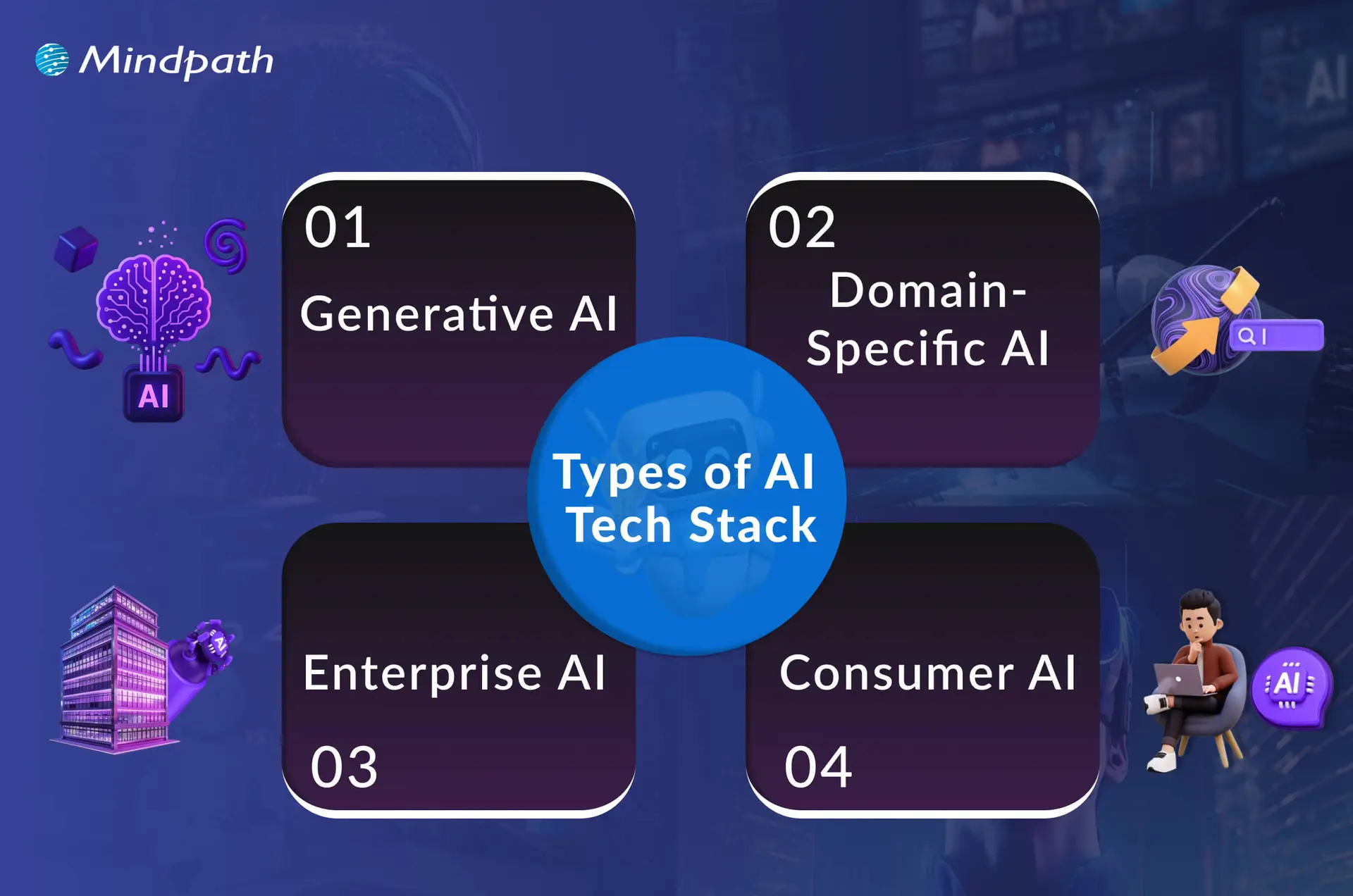
1. Generative AI
The GenAI tech stack provides the means to build intelligent systems that can produce new products like text, images, or audio. It blends together the powerful models available, the right data, and the handiest tools to streamline and improve development.
2. Domain-Specific AI
Some sectors require targeted stacks to accommodate specialized needs and regulations, such as healthcare, finance, and retail, that engage with trusted AI outcomes.
3. Enterprise AI
This works with large organizations and allows them to develop their own AI capabilities with respect to their internal processes and suitability for their growth. It integrates bespoke development, optimal operations, and seamless integration, providing an organized approach to their more complex requirements.
4. Consumer AI
It focuses on delivering users top-level, helpful, simple, and fast AI experiences they can engage with every day. Consumer AI taps into models, smart apps, and solid cloud or edge connections to produce a seamless experience for users.
Curious about where AI is headed? Head to our blog The Future of AI: How AI is Transforming the World to learn more!
Layers of an AI Tech Stack
Building an effective AI system means understanding how each layer supports the next. These layers work together to turn raw data into smart, reliable applications.
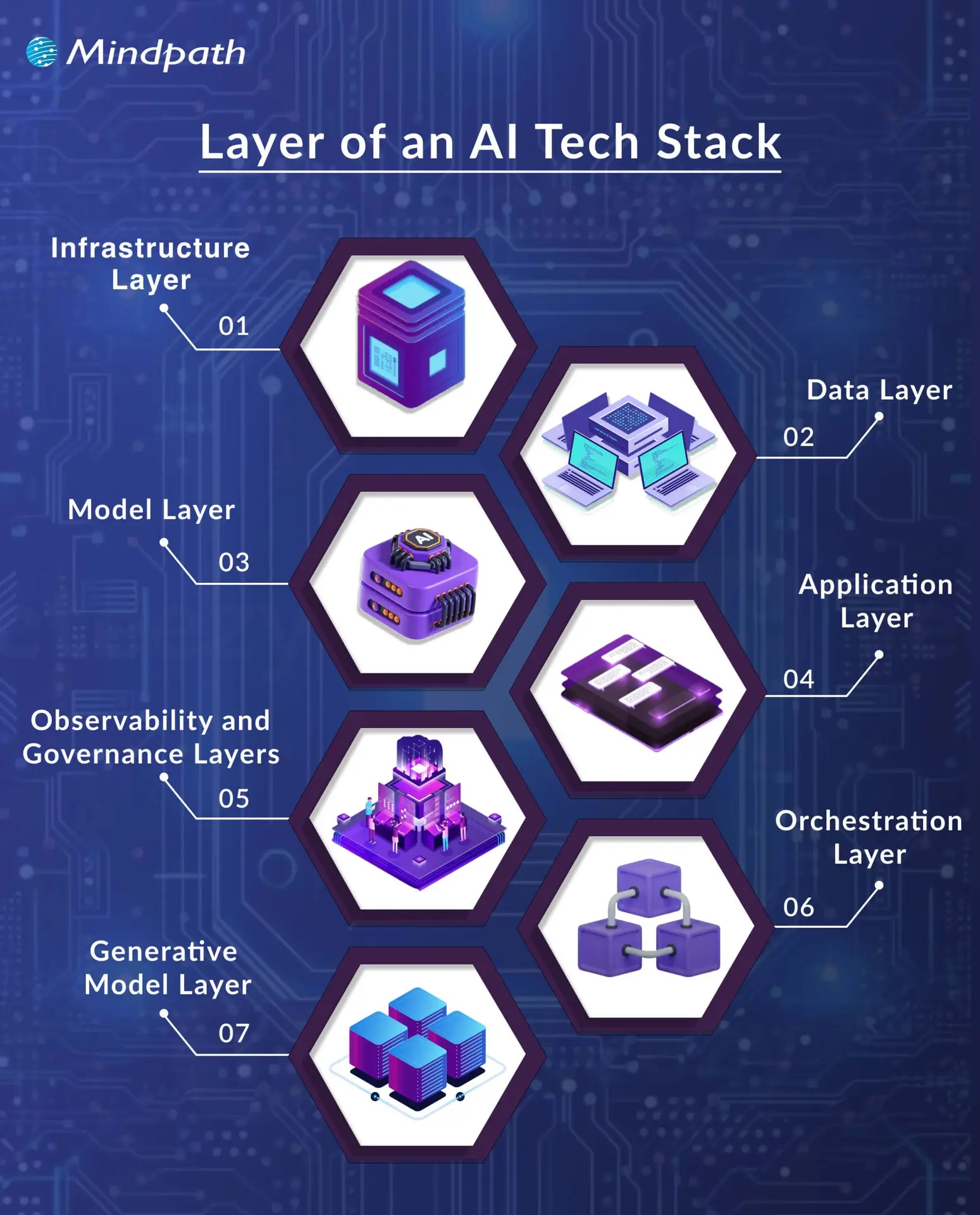
1. Infrastructure Layer
This layer forms the base of a modern AI stack, giving you the hardware and software needed to build and run AI systems. It covers everything from powerful processors to storage and operating systems that keep everything running smoothly. Without a strong foundation here, AI development would be slow and unreliable.
2. Data Layer
Good data is the heart of AI application development. This layer handles how data is collected, stored, cleaned, and prepared for use. Clean, well-organized data helps models learn accurately and perform better.
3. Model Layer
This layer is where you build and train the brains of your AI. It includes frameworks and tools that make it easier to design, test, and deploy models. A well-managed model layer speeds up AI app development and boosts results.
4. Application Layer
Here, all your hard work connects directly with users. This AI tech stack layer includes the user interface, APIs, and logic that bring your AI features to life. A clear application layer ensures people get real value from your AI.
5. Observability and Governance Layers
These layers help you keep an eye on how well your AI works and that it stays secure and fair. They cover monitoring, performance checks, and rules for data protection. Together, they build trust and long-term success.
6. Orchestration Layer
This part keeps every piece of your AI system working together smoothly. It manages workflows and automates tasks to save time. Proper orchestration means you spend less effort fixing things and more time improving them.
7. Generative Model Layer
This layer focuses on models that can create new content like text or images. It uses strong foundation models and customizes them for what your project needs. A good setup here drives innovation for creative AI solutions.
Struggling to choose the right AI model to power your AI-driven application? Explore our detailed guide on the top AI models to understand their capabilities, strengths, and real-world applications
Best Practices for Building an AI Technology Stack
Building an effective AI tech stack takes careful planning and the right approach for your goals. Following best practices helps you make smart choices and get the most out of your AI development tools and resources.
1. Define Your AI Goals Clearly
Start by knowing exactly what you want your AI tech stack to do. Clear goals help you choose the right tools and avoid wasting time on things you don’t need. It could be improving customer service, automating tasks, or predicting trends. When everyone understands the goal, the project runs smoother and stays focused.
2. Prioritize Good Data Early
Good AI starts with good data that’s clean, organized, and reliable. Make sure you have a strong system to collect and manage your data from day one. Accurate data helps your models learn better and make smarter decisions. Invest time in setting up clear data processes to get the best results.
3. Keep It Flexible and Automated
A flexible setup makes it easier to update or add new tools as your needs change. Modular systems let you swap parts without starting over, saving time and money. Use automation to handle boring, repetitive tasks, so your team can focus on important work. This approach helps you scale and stay ready for growth.
Wondering which generative AI tools are transforming modern AI application development? Learn more about the top GenAI tools for the future of AI development to strengthen your AI tech stack.
4. Ensure Security and Teamwork
Keeping your AI secure should always be a top priority, especially when handling private data. Follow all rules and regulations to stay compliant and avoid risks. Make sure your team works well together by setting clear roles and sharing information. Strong teamwork and security build trust in your AI system.
5. Keep Improving Your Models
Your AI models should never stand still. Create a process to check how they perform and update them with fresh data. This helps your system stay smart and relevant as things change. Regular updates mean better results and a competitive edge.
6. Plan for Easy Growth
Think ahead so your system can handle more users, bigger data, and new features as you grow. A scalable setup saves you from costly rebuilds later. Make sure your tools and infrastructure can expand without any problems. This way, your AI stays strong no matter how much your business grows.
Not sure how to strategically implement AI beyond just the technical stack? Explore our detailed guide on AI in business strategy to understand how to turn AI capabilities into measurable business value.
Looking to Power Your Business with Smart AI Tech Stack?
A clear and well-structured AI tech stack makes it easier to turn complex ideas into reliable AI applications. By choosing the right tools and following smart practices, you can handle data better, keep your systems secure, and scale with confidence. A good foundation now means your solutions will adapt smoothly as your needs and goals grow.
At Mindpath, we offer trusted AI development services to help you build and maintain AI solutions that work in real business scenarios. Our team combines the best tools and strategies to design applications that learn, perform, and deliver results. Let us help you leverage AI to achieve your goals and maximize the value of your investment.
Artificial intelligence is one of the most powerful technologies for business transformation in 2026. As more examples of AI integration in business come to the limelight, business owners and managers want to discover effective ways to embrace AI. Businesses have been adopting AI not only to automate tasks but also to find new solutions to foster innovation, enhance process efficiency, and drive customer engagement.
Organizations have been using AI in different capacities for over a decade, and the success of their AI initiatives paved the path for broader adoption. You can come across different use cases of AI in the domain of business, ranging from predicting market trends to developing marketing content. Let us find out how AI use cases deliver results for businesses in the real world.
Watching the use case of AI is not enough; want to adopt AI for your business? Mindpath, an AI Integration Services provider, has expertise in providing intelligent solutions that help businesses move towards real-world success.
Is AI Important for Businesses?
The biggest concern for any business in the existing technological landscape is about AI adoption. While AI use cases in business have been delivering promising results, business owners want to find out whether AI is necessary for their business. How will a business embrace AI? Artificial intelligence is still an elusive concept for many business owners owing to a lack of awareness. As a matter of fact, many people believe that the use of AI in business is only about automation. On the contrary, the utility of AI in business revolves around leveraging machine learning, natural language processing, and other AI technologies to streamline operations.
You can discover numerous use cases of artificial intelligence for business that help in resolving challenges in different departments. For example, AI can enhance customer satisfaction levels, enable intelligent workflows, and reduce the time invested in repetitive tasks. The applications of AI in almost every department of an organization, such as sales, customer service, and operations, lead to results that add more value to the business.
Unraveling the Top Use Cases of AI for Business
The advantages of AI for business in different real-world use cases encourage more companies to integrate AI into their operations. Artificial intelligence not only powers personalized ads and consumer-facing technologies like Alexa but also revolutionizes how businesses work, compete, and innovate. According to a survey by EY, almost 72% of executives have reported that employees use AI every day in the workplace for tasks like communication, software development, and data analysis (Source). The following real-world AI use cases will offer the best insights into the utility of artificial intelligence in the business landscape.
1. Enhancing Process Efficiency
Artificial intelligence helps in achieving significant improvements in the operational efficiency of businesses. AI plays a crucial role in automation repetitive tasks and optimizing resource allocation, thereby reducing waste. Artificial intelligence tools help in cutting costs and also contribute to the bottom line of a business. For instance, supply chain optimization tools can leverage AI to draw accurate predictions for demand and optimize the inventory.
Business leaders can also utilize AI business applications for the automation of document processing tasks, which are generally repetitive in nature. Automation of invoice processing and data entry offers an easy solution to enhance operational efficiency. On top of it, businesses can also enhance process efficiency through the use of AI in energy management. AI-powered solutions can analyze patterns of energy usage and automate processes like lighting, heating, and cooling according to usage trends.
2. Improved Workplace Productivity
The automation capabilities of artificial intelligence can also serve a crucial role in enhancing workplace productivity. Employees can use AI for automation of repetitive tasks that consume a lot of time, thereby finding the time to focus on strategic tasks. At the same time, the benefits of AI in business point to how employees can make more informed decisions with AI. Virtual meeting assistants are the most promising example of embracing artificial intelligence to make informed decisions.
AI tools can not only provide meeting transcriptions but also a summary of key points in the meetings. As a result, employees can focus on activities that bring more value to their organization. Artificial intelligence tools for task automation also serve as useful choices for the automation of project management workflows. For instance, Google Smart Compose allows employees to use AI for writing emails faster with better accuracy. Therefore, employees don’t have to waste a lot of time getting their emails right without compromising the quality of communication.
Curious about the different AI approaches companies are using today? Check out the types of AI and discover how they power automation, analytics, and customer engagement.
3. Predictive Analytics
The next most popular use case of artificial intelligence in the modern business landscape is predictive analytics. Companies can use AI for business growth by analysing historical data, identifying patterns, and predicting future outcomes. Businesses have been adopting AI to make smarter decisions, whether it is about identifying customer needs, reducing risk, or optimizing inventory. Artificial intelligence can tap into the power of advanced algorithms and real-time data streams to empower businesses with insights that help them make proactive decisions.
The utility of AI in predictive analytics not only helps in making informed decisions but also improves efficiency and empowers businesses to deliver better customer experiences. The value of AI for decision makers is visible in examples across retail, finance, and healthcare sectors. AI-powered predictive analytics can help businesses in the retail sector forecast demand and optimize their inventory to avoid running out of stock. Similarly, healthcare companies can use AI predictive analytics to evaluate patient history and determine the risk of diseases.
4. Content and Product Development
Artificial intelligence gained significant popularity owing to the arrival of generative AI tools. One of the most notable use cases of generative AI is content development, which can help businesses in many ways. The curiosity to learn how businesses use AI will also point to how artificial intelligence can help in generating content, product designs, and functional prototypes for product development. As a matter of fact, many businesses already use generative AI in marketing, product innovation, and software development.
The use cases of AI in marketing content generation involve creating blog posts, personalized emails, ad copies, and product descriptions. Businesses can also create custom training content and simulations with the help of generative AI. Artificial intelligence also provides a new direction for approaches to creating e-commerce product content based on customer behavior trends. On top of it, generative AI can offer product ideas, creative concepts, and UI mockups according to user instructions.
Want to accelerate content production and streamline coding tasks in your business? Discover generative AI tools for content creation and code creation to learn how they boost efficiency and creativity.
5. New Benchmarks of Security
The biggest impact of artificial intelligence in business is visible in the domain of cybersecurity. The advantages of AI integration in business can help in fighting against emerging security threats. Artificial intelligence can serve as a protective layer for businesses by improving threat detection capabilities with seamless analysis of datasets to recognize potential anomalies and risks of breaches. The proactive approach to cybersecurity with AI empowers businesses to respond quickly and address risks before they inflict damage.
Artificial intelligence can not only enhance detection but also facilitate automation of incident response and alerting mechanisms. As a result, businesses can reduce the burden on security teams by initiating countermeasures instantly. AI-powered simulations can also help businesses strengthen cybersecurity training and enhance their overall resilience. For instance, AI tools can detect fraudulent transactions and anomalies in user behavior for better security in finance.
6. Talent Acquisition and Management
Managing talent is one of the formidable challenges for business owners. Starting from the process of attracting talent to retention, businesses can use AI to empower their workforce with skilled resources. The different examples of AI implementation in companies showcase the automation capabilities of AI. Businesses can use AI-powered automation in different steps of the talent management cycle.
The use cases of AI for talent acquisition point to the use of AI tools for resume and portfolio analysis. In addition, recruiters can also use AI to review video interviews of candidates. The comprehensive assessment with AI helps in identifying the right talent for a company. Artificial intelligence also helps in boosting employee retention, as evident in the example of LinkedIn Talent Insights. It uses AI to offer accurate predictions for employee attrition rates and also offers recommendations to enhance employee retention.
Planning to integrate AI into your business strategy but unsure where to start? Discover AI solutions for small businesses and startups to learn how tailored technologies can deliver measurable results.
Want to Harness AI to Drive Real Business Growth?
The applications of artificial intelligence in the business landscape have helped business owners discover new perspectives on efficiency and innovation. As the demand for digital transformation with AI continues to gain momentum, more businesses will join the bandwagon. However, professional assistance can help a business identify the ideal strategic approach to leverage AI for its operations.
We at Mindpath have helped thousands of clients with AI adoption in different business departments. Our experts specialize in end-to-end AI solutions, and the experience of serving a wide range of clients enhances our strengths. We are committed to understanding the client’s requirements and vision to help them achieve the best outcomes for their business with AI. Consult with our experts and find the ideal use cases to embrace AI in your business right now.
Frequently Asked Questions
E-commerce is rapidly changing, and brands have to cope with it on a daily basis. Customer journeys need fast loading, effective information display, and dependable performance across all the devices. This compulsion makes e-commerce software development a fundamental business priority and not a peripheral activity. It influences product loading processes, payment processing, and growth of systems. We, as technology experts, are well aware of this change. It calls on teams to rebuild platforms in a purposeful, precise, and long-term growth perspective.
Key Takeaways
- 01
E-commerce software development helps businesses manage products, prices, orders, payments, and customer activities through connected digital systems. - 02
Custom e-commerce software can improve flexibility, scalability, performance, security, and control over the customer experience. - 03
Important features include simple navigation, product management, secure payments, order tracking, and mobile-ready experiences. - 04
Emerging trends include mobile-first shopping, AI-powered recommendations, virtual product experiences, voice commerce, and subscription models. - 05
When choosing a development company, businesses should consider experience, technology expertise, customization, scalability, communication, and ongoing support.
Based on this fact, attention turns to the planning and reinforcement of platforms. Intelligent e-commerce systems bridge the gap between business objectives and reality. They permit change and maintain performance. They also enhance brand confidence in an increasingly competitive environment. The connection between technology and strategy results in smarter decision-making. It initiates necessary debates in emerging businesses. So, this blog focuses on analyzing this field in detail and discussing what really makes e-commerce sites successful. Let’s dive in to know more!
What Does E-commerce Software Development Mean?
To put it simply, e-commerce software development implies the development of digital systems that can assist businesses in selling online without any issues. These systems handle products, prices, orders, and activities of customers centrally. They assist e-stores in loading quickly and operating without failure. They are created by developers to suit the needs of customers and business objectives. Due to increasing online demand, powerful software assists brands to remain organized, responsive and engage in daily sales activity.
The process also facilitates growth and flexibility as business goes online. Through e-commerce development services, teams create a platform to facilitate payments, track orders, and manage users conveniently. Quality software links all the store’s functions intelligently. It makes teamwork easy and customers’ shopping straightforward. Such transparency enables businesses to win trust and provide a uniform online experience.
Key Benefits of E-commerce Software Development
In the contemporary world, online selling requires more than a simple web site. Brands seek speed, control and growing demand platforms. The e-commerce software development services facilitate this transition with smarter digital basics. The following are some of the main advantages which make this method worth considering.
1. Built for Your Business Needs
Each business operates in its unique way, and software must be aware of that fact. E-commerce software development assists teams to mould features in accordance with actual workflow and objectives.
2. Ready to Grow with Demand
E-commerce stores evolve with the growth of products, customers, and purchase orders. E-commerce software development helps it grow without slowing down systems and disrupting normal operations.
3. Better Control Over Design and Experience
Brands desire stores that are appealing and feel right to the customers. This method offers complete ownership over layout and flow as well as shopping experience.
4. Smooth Connection with Existing Tools
Several companies are already utilizing accounting, inventory, or CRM software. All these systems are linked through a well-planned software that maintains smooth operations of the system.
5. Faster Performance for Shoppers
Speed is important when the customers are browsing or paying over the internet. Powerful development pays attention to a rapid load and seamless action in each step.
6. Stronger Protection for Customer Data
E-commerce sites deal with personal customer information on daily basis. Dedicated systems implement protection rules which secure data and establish enduring customer confidence.
Features of E-commerce Software Development
The demand of e-commerce software will keep increasing as the online firms continue to grow all over the world. Grand View Research estimated the market of e-commerce software in the world to be USD 7.12 billion in 2022. The market has the potential of reaching USD 20.90 billion in 2030 with a CAGR of 15.3 percent. This expansion is an indication that it requires functionality to handle inventory, taxation, and day-to-day operations.
1. Simple Navigation Flow
Good layouts enable the user to navigate through easily without wasting time. E-commerce software development makes categories and checkout user-friendly.
2. Smart Product Control
The stores update and sort listings effectively. This will enable customers to find products easier and also make shopping more enjoyable.
3. Secure Payment Handling
There are various payment methods, which enhances customer confidence. E-commerce software solution development assures that all dealings remain secure and intact.
4. Order Tracking System
Teams have a chance to track orders between placement and delivery. This enhances coordination, as well as minimizes errors in shipping.
5. Mobile-Ready Experience
Mobile users anticipate hassle-free browsing and purchase. Responsive design will ensure an easy experience across all gadgets.
Emerging Trends in E-commerce Software Development
E-commerce environment continues to evolve along with technology and consumer demands. The trends in e-commerce software development are currently geared towards enhancing growth and user satisfaction.
1. Mobile-First Shopping
Smartphones are now taking over the online purchases. E-commerce software development achieves seamless and quick experiences across all mobile devices.
2. Smarter Recommendations
AI and ML can assist platforms in recommending the products that the users desire. This enhances interaction and marketing prospects successfully.
3. Virtual Product Experience
AR allows customers to have a virtual experience on the use of products and then purchase. It enhances confidence and decreases returns in online shopping.
4. Voice-Activated Buying
Voice commerce enables purchases by commands. It accelerates and simplifies the process of shopping among the tech-savvy customers.
5. Subscription Models
Subscription-based services provide customers with products at regular intervals. Recurring orders and automated billing are efficiently supported on platforms.
What to Consider While Choosing the Right E-commerce Software Development Company?
Choosing the appropriate partner determines the success of your online shop. E-commerce software development requires skills, trustworthiness and business insight.
1. Find a company that has high competence in e-commerce software development and a track record. Check on their previous works so that they could be able to cope with their business requirements.
2. Ensure that the technology stack that they are based on is reliable and up to date. Ensure that they are adept at such popular platforms such as Shopify, Magento or WooCommerce.
3. Check out their capabilities regarding the capacity to customize solutions to your business needs. A dynamic strategy assists in developing a platform that actually suits your operations.
4. Make sure that the firm is capable of developing scaled systems that increase with your business. With time, your platform is supposed to support increased traffic, products, and transactions.
5. Pay attention to effective communication and cooperation during the project. The development process is smooth and predictable due to regular updates and open discussions.
6. Consider their after-launch services such as support and maintenance. Constant support makes your online store efficient and modern.
Ready to Take Your E-commerce to the Next Level?
E-commerce is changing at an alarming rate, and good software is one of the major factors to remain competitive. E-commerce software development assists companies to handle merchandise, finances and customer experiences effectively. It helps in growth, enhances performance, and establishes trust. Selecting suitable software and features is a guarantee of ease of operation, ease of use, and success over time. With intelligent planning and development, online stores become viable and scalable business platforms.
At Mindpath, we provide professional software development services that are specific to your business objectives. Our team is highly skilled in e-commerce software development and incorporates modern technologies in speed, security, and efficiency. They provide platforms that grow with your business, are easy to manage, and improve user experiences. Ongoing support and development means your online store will be competitive, receptive, and available to future possibilities.
The modern world requires rapidity, precision, and intelligent choices in the construction of excellent software. Teams tend to take breaks and reconsider the scaling of their work without the loss of control or quality. That is where the outsourcing software development comes into the discussion and alters the speed. It generates interest, brings up practical issues and encourages open-minded judgment. Consequently, making the appropriate development decision becomes a business decision, rather than a band-aid solution.
Additionally, this method leads to knowledge, adaptability and quicker advances when managed with caution. It helps leaders to think more incisively questions and demand more definitive results. Simultaneously, it requires planning, trust and effective communication. Then the question is how do you take a step in confidence and purpose? In this blog, we walk through the complete picture, helping businesses understand the path, mindset, and decisions involved.
Planning to outsource software development to accelerate growth and reduce operational costs? Mindpath’s software development services offer reliable and customized solutions that ensure timely delivery and excellent performance.
What is Outsourcing Software Development?
Software development outsourcing is the practice of hiring external firms or freelance developers to handle software projects, from building applications to system upgrades, testing, and optimization, instead of relying solely on an in-house team. Businesses use it as a strategic tool to cut costs, access specialized global talent, and speed up project timelines without long-term hiring commitments, while keeping internal teams focused on core priorities.
Nowadays, outsourcing software development is not only about saving money. They are able to reach efficient engineers and new technologies more quickly. This model minimizes pressure on hiring and day-to-day management. Teams are easily scaled according to the requirements of the project. Consequently, companies become more rapid and provide high-quality digital products.
The three types of outsourcing software development are as follows:
1. Offshore Outsourcing
Offshore outsourcing is associated with teams located in distant countries with distinct time zones. In outsourcing software development, businesses prefer this model to save money and grow more quickly with global talent.
2. Nearshore Outsourcing
Nearshore outsourcing collaborates with teams in local countries with close time zones. This model fosters outsourcing software development through enhanced communication and faster cooperation.
3. Onshore Outsourcing
Onshore outsourcing employs developers in the same country. This model of outsourcing software development is highly favored by companies due to its high compliance, security, and real-time coordination.
Looking to access specialized talent beyond your local market? Check out offshore software development and discover how it improves efficiency and project flexibility.
Key Benefits of Outsourcing Software Development
The current businesses desire quicker outcomes and greater technological skills. Software outsourcing enables businesses to remain focused and expand effectively, and below are the main advantages that businesses enjoy.
1. Lower Development Costs
By outsourcing software development, businesses save on the cost of hiring, training and infrastructure costs. Teams handle budgets more efficiently and have a stable project development.
2. Access to Skilled Talent
The companies network with seasoned developers in various technologies. This access enhances the quality of projects and sustains technical-specific requirements.
3. Flexible Team Scaling
Businesses can easily change the size of teams according to project needs. This flexibility ensures business continues uninterrupted when the business grows or slows down.
Also Read: Software Development Cost
4. Faster Hiring Process
External partners provide ready developers without long recruitment delays. Projects continue without interruptions caused by staffing gaps.
5. Specialized Technical Skills
Teams gain direct access to experts in advanced technologies. This approach saves time and avoids heavy internal training efforts.
6. Quicker Product Launch
Development moves faster through parallel work and clear coordination. Companies release products sooner and stay competitive in dynamic markets.
Want to choose the right approach before outsourcing your next tech project? Discover types of software development to learn which model best fits your business goals and budget.
Key Factors to Consider Before Outsourcing Software Development
Selecting the appropriate partner must be well planned and with good business alignment. Outsourcing software development services is most effective when the companies consider the needs, risks, and long term objectives.
1. Clear Project Requirements
First, define goals, features, and budget limits clearly. Outsourcing software development succeeds when teams share the same understanding early.
2. Transparent Pricing Structure
Next, review pricing models and payment terms carefully. This move prevents unnoticed expenses and contributes to assured financial decisions.
3. Proven Expertise and Portfolio
Then, study previous projects and industry experience closely. Outsourcing software development works best when partners show strong, relevant results.
Also Read: Software Development Trends
4. Reliable Delivery Timelines
After that, confirm the company meets deadlines consistently. Proper planning and skilled teams keep progress steady.
5. Company Reputation and Reviews
Also, read genuine client feedback on trusted platforms. These reviews show how the company handles challenges and commitments.
6. Strong Security and Communication
Finally, check data protection practices and communication tools. Regular updates and secure systems build trust throughout the project.
Curious how successful companies manage development from planning to deployment? Check out Software Development Life Cycle and discover how it improves transparency, control, and scalability.
Common Pitfalls to Avoid When Outsourcing Software Development
There are numerous companies that make haste decisions, and regret it subsequently. When teams are aware of likely risks and take action, outsourcing software development can result in success.
1. Most teams do not consider post-launch support and regret later. In the process of outsourcing software development, maintenance scope must always be verified to prevent security and performance problems.
2. There are companies that do not thoroughly investigate their partners and use Internet feedback as the only source. This shortcut tends to create low fit and project expectation failure.
3. Time zone issues and cultural differences are quick to decimate progress. These problems become severe in situations where projects require intense teamwork and expedited decision making.
4. Even in competent teams, weak communication leads to misunderstandings. Constant updates and discussions make the development stay on track with business objectives.
5. Most companies never pay attention to terms of NDA when signing contracts. This is an error that transfers the risk and restricts services even when fully paid.
Want to hire the right talent for your outsourced development projects? Discover the qualities of a good software engineer to learn what skills and traits ensure project success.
Ready to Make Smarter Software Decisions?
Outsourcing of software development assists businesses to operate at quicker speed without compromising on quality and control. It introduces talent and certain expertise, focus, and malleable development within a single strategy. This method is beneficial when organized effectively and helps to achieve improved outcomes and reduce risks. By making the right partner and goal alignment at an early stage, companies build confidence when selecting partners. Long-term success is defined by good communication and expectations.
At Mindpath, we support businesses with reliable teams and proven delivery experience. As a trusted software development outsource company, Mindpath focuses on clarity, speed, and quality. Our custom software development outsourcing services help you scale confidently while staying aligned with business goals. We value transparency, security, and strong collaboration at every step.
Modern digital experiences desire something dynamic and out of the box. So, front-end development trends have been shaping this shift while making the process highly optimized. In 2026, businesses and developers must adapt to the rapid changes in front-end technologies. Due to the rapid pace of front-end development, the rising demand for developers has reached 28.7 million.
Key Takeaways
- 01
AI coding assistants are changing how front-end developers generate code, identify errors, and build design systems. - 02
React Compiler, WebAssembly, and edge computing are helping teams improve application performance and responsiveness. - 03
Motion UI, micro-interactions, and Progressive Web Apps are creating more engaging and accessible digital experiences. - 04
Performance optimization and Core Web Vitals are becoming essential parts of modern front-end development. - 05
Developers need a mix of technical, UI/UX, accessibility, performance, and collaboration skills to stay competitive in 2026.
The upcoming year is going to encounter a series of viable trends, starting from AI-assisted development to immersive interfaces. The future of web development is going to be extensively smarter and more user-centric. This article explores the most essential front-end trends of 2026 and why they matter.
Most Essential Front-end Development Trends in 2026
The most important front-end development trends in 2026 include AI-assisted coding, React Compiler, edge computing, WebAssembly, Motion UI, performance optimization, Progressive Web Apps, and Core Web Vitals. These technologies and practices are helping developers build faster, smarter, and more user-focused web experiences.
The front-end ecosystem is continuously growing beyond static interfaces and traditional frameworks. Here, we have listed some of the most unique front-end technology trends you can experience in 2026.
1. AI Coding Assistants will be Your True Partners
If your team is still prioritizing debugging the edge cases manually, you are choosing the longer path than you need. 70% of leading developers have already started using AI coding assistants for this task. Further, this is one of the dedicated JavaScript frameworks trends in 2026.
2. React Compiler
This is another front-end development trend you can expect in 2026. React is adopting its own compiler. For several years, developers were manually adding useMemo and useCallback hooks. They were doing this to verify the ongoing performance. So, it’s a tedious task and hampers your flow while completely cluttering the codebase.
But React Compiler is going to handle this automatically during the creation process only. This is one of the most dedicated front-end development trends that is going to act as a performance expert assessing your code behind the process.
3. Dynamic Computing Paradigms that Reshape Infrastructure
Speed is one of the essential factors in web development. So, developers demand high limits when it comes to data travel. As per the recent Front-end news, more than 40% of valuable enterprises might have adopted hybrid computing with paradigm architectures.
With edge computing being reliable in the front-end development, you can bring computation closer to users while enabling quick response times and better experiences. Instead of every request reaching a central data center, edge nodes can handle them locally.
4. WebAssembly to Ensure High-Performing Interfaces
WebAssembly allows developers to run high-performing code directly in the browser. So, in the front-end development trends of 2026, it is expected to support more modern use cases like data visualization, complicated animations, and interactive tools. This appealing trend can strengthen the position of your website as a serious alternative to native apps.
5. Motion UI and Micro-Interactions
As per the recent front-end news, subtle animations and micro-interactions have become appealing rather than decorative features. Moreover, such simple design elements can guide your users and provide them with better usability without complicating the interfaces. If you implement them thoughtfully, the motion encourages clarity and makes digital experiences feel intuitive.
6. Performance-Rich Development
In this diverse digital network, users are expecting quick load times and seamless interactions. This is why front-end developers prefer performance optimization techniques like lazy loading, code splitting, and edge delivery. So, web development in 2026 is going to be fast and user-oriented. As a result, your faster website can improve engagement and conversions while pushing itself in the search rankings.
7. Progressive Web Apps
Progressive web apps have recently become famous because of their offline features and fast performance. So, the future of web development will combine emerging technologies like WebXR to generate immersive and cross-platform experiences directly from the browser.
However, to facilitate this trend, developers require a strong understanding of modern JavaScript frameworks. Further, they need expertise in performance optimization and UX awareness.
8. The Influence of Core Web Vitals
Core Web Vitals of Google are turning out to be more important in how applications are created and ranked. So, smart developers are optimizing such metrics from the start rather than treating them as afterthoughts. The performance improvements can benefit the users while encouraging your discoverability.
How AI is Pushing the Limits of Front-end Development?
Artificial Intelligence is no longer a future promise. It has already stoned its foundation in the recent era while reshaping how developers work and create features.
1. Code Generation and Suggestions
AI can simply automate your code while suggesting valuable components and refactorings.
2. Error Detection and Bug Fixing
In the future front-end trends of 2026, intelligent analyzers can verify bugs and suggest corrections to get rid of future obstacles.
3. Automated Design System
AI tools can seamlessly create UI components as per your required model. This makes your web development match your business requirements.
The Essentiality of Performance in Web Development
Speed and performance are necessary to uplift user engagement and conversion. So, if your interfaces slow down or lag, it might frustrate your users while making you lose conversions. So, to win the front-end trends, it is essential to extend your performance. It is necessary because your users expect instant feedback, and mobile experience dominates the usage stats.
Your team must be aware of doing edge computing that will serve assets closer to your users. Further, the developers must be aware of caching strategies to reduce load times. With the usage of smarter building tools, you can lessen the JavaScript and CSS sizes. Such patterns are featured regularly in Front-end news because high-performance experiences are becoming a necessity rather than optional enhancements.
What Skills Front-End Developers Require in 2026 to Be at the Competitive Edge?
With the changing front-end ecosystems, the front-end developers must evolve their skills.
1. Core Technical Knowledge
Talking about the technical skills, developers need to be experts in modern JavaScript and TypeScript. You need knowledge about component-based frameworks like React and Vue. Further, it is necessary to learn performance optimization techniques and responsive design knowledge.
2. Complementary Skills
To complement your core skills, you can nurture your knowledge regarding basic UI/UX understanding. Moreover, you should learn about version control and accessibility standards. Most importantly, you need to familiarize yourself with WebAssembly basics. Developers who abide by both technical and complementary skills can lead the future of web development.
Why Collaboration is a Must in Front-end Development?
You can’t initiate front-end work alone. So, you must maintain a good collaboration between the backend teams, designers, and DevOps experts. Proper collaboration can align your design vision with good engineering. It improves deployment workflows while making the product viable for your business vision. It can also help you catch integration issues at an early phase while encouraging shared ownership.
Modern front-end teams are generally adopting DevOps principles like automated testing and continuous deployment to include quality while making the product win the trends. With the collaborative measures, users in 2026 can expect instant performance and consistent experiences across devices. Further, it gives rise to interactive UI and accessible features.
Ready to Turn Front-End Trends into High-Performing Web Experiences?
Front-end development trends for 2026 are not just about chasing every trendy framework. The focus is on choosing tools and approaches that effectively address real-world challenges while streamlining development. Teams and developers must embrace continuous, intentional learning to stay ahead and make the most of emerging opportunities.
At Mindpath, our full-stack development services help businesses turn modern front-end trends into practical and high-performing digital solutions. Our experts combine advanced front-end technologies with strong backend development to build scalable and efficient web applications. With Mindpath, you can create fast, engaging, and future-ready digital experiences that support long-term growth.
AI-driven legacy system modernization is transforming how businesses approach aging technology. Firms are under increasing pressure to remain competitive and deal with complicated and old systems. Is it possible to make this process smarter with the help of technology? The dilemma is how to balance innovation and stability, and how several are looking at the active reformation of legacy workflow by AI and automation.
The adoption of smart solutions enables organizations to be agile and fast in integrating main systems. They are able to detect bottlenecks, minimize mistakes and streamline processes to a much greater accuracy. This solution triggers the debate of efficiency and future-proofing. In this blog, we will explore how AI and automation can bring the legacy systems up to date. Keep reading further!
Looking to future-proof your legacy applications with AI-driven solutions? Mindpath’s legacy modernization services help organizations upgrade systems efficiently and stay ahead in the digital landscape.
What is AI-Driven Legacy System Modernization?
AI-driven legacy system modernization is the use of artificial intelligence and machine learning to update, translate, and migrate outdated enterprise software into modern, cloud-native environments. It automates key activities such as code refactoring, documentation, and testing while identifying system dependencies and preserving core business logic without requiring high-risk “rip and replace” overhauls. This approach accelerates modernization, reduces errors, and lowers costs, helping organizations transition ageing systems into agile and cloud-ready infrastructure.
The adoption of AI in legacy modernization will allow decisions to be made more intelligently when upgrading the system. Machine learning suggests trends, risks forecasts and provides best optimized solutions. Generative AI can help generate proper code and documentation and minimal disruption. Through AI, organizations can modernize in a shorter time, continue working with the existing systems, and optimize them to grow in the future.
Why AI-Driven Legacy Modernization Matters?
Old systems have been known to slack innovation and amplify risks in operation. These are the advantages of AI and automation in legacy system modernization.
1. Faster Modernization Cycles
AI-driven legacy system modernization speeds up system upgrades by automating repetitive tasks. Organizations accomplish projects in lesser time, downtime is minimized and efficiency enhanced.
2. Cost Reduction
AI maximizes the investment of the resources and reduces errors that reduce the expenses of the modernization. The process of legacy application modernization is predictable and more cost-effective.
3. Improved Accuracy
AI is very accurate in analyzing code and data which minimizes human errors. This makes sure that the updates do not affect business logic and system stability.
4. Enhanced Security
Artificial intelligence-based devices identify threats immediately and indicate vulnerabilities. Companies enhance protection and comply successfully.
5. Scalability and Flexibility
AI allows legacy systems to manage increasing data and traffic. They are unified with modernization based on cloud, IoT, and advanced platforms.
6. Future-Proofing Operations
AI-driven legacy system modernization supports incremental upgrades, extending system lifespan while adapting to evolving technologies. This makes systems up to date and capable of future expansion.
Wondering how to balance AI innovation with a strong modernization plan? Discover the legacy modernization strategy to achieve a more effective transformation.
Role of AI in Legacy System Modernization
AI-driven legacy system modernization is reshaping how organizations update and optimize outdated systems. Here are the roles of AI-driven legacy system modernization in transforming legacy operations efficiently.
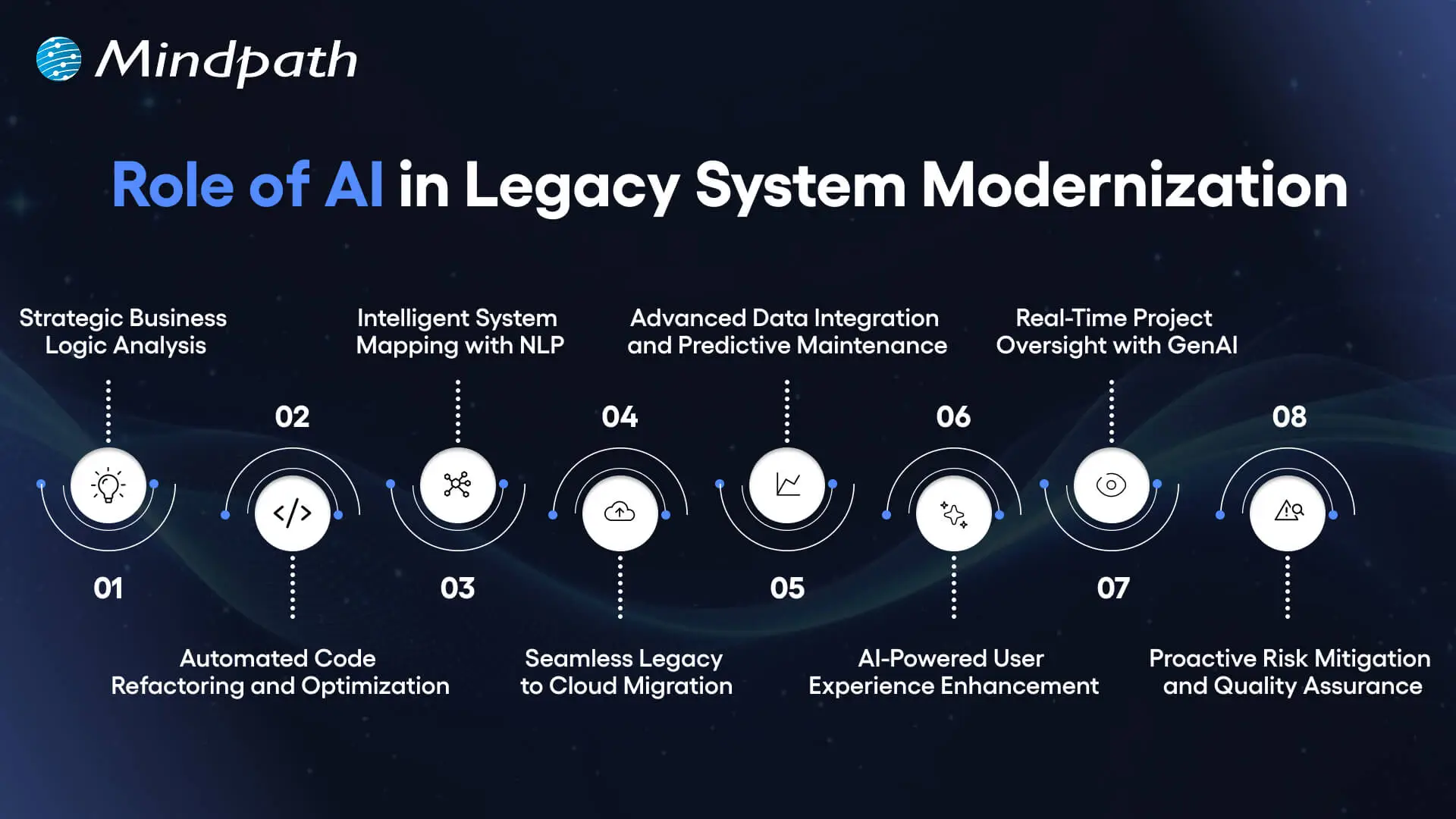
1. Strategic Business Logic Analysis
AI-driven legacy system modernization starts by uncovering hidden business logic. It plots dependencies and decision rules. Modernization becomes smarter and data-driven, and teams are given a clear understanding.
2. Automated Code Refactoring and Optimization
AI rewrites the old code to new cloud-ready codes. Refactoring is faster, fewer errors in the system, and the system itself is much better with generative AI.
3. Intelligent System Mapping with NLP
Natural language processing transforms the complex old code into canned knowledge. Inefficiencies and bottlenecks are promptly found and assist in accelerating modernization.
4. Seamless Legacy-to-Cloud Migration
AI-driven legacy system modernization enables smooth cloud transitions. It also re-architectures code to reflect the current architectures and best practices.
5. Advanced Data Integration and Predictive Maintenance
AI integrates multiple sources of data to allow a smooth integration. Predictive analytics will identify possible problems before they happen and minimize downtime and operational problems.
6. AI-Powered User Experience Enhancement
AI interprets the user behavior in order to streamline interfaces. Chatbots and virtual assistants automate the repetitive field of work making it more engaging and efficient.
7. Real-Time Project Oversight with GenAI
AI offers invaluable real-time insight into the state of modernization. Predictive analytics and automated documentation keep the stakeholders updated and project on schedule.
8. Proactive Risk Mitigation and Quality Assurance
AI reduces the human factor and promotes uniformity. Modernization with structures and low risk can have safety nets that are provided through automated testing and monitoring.
Looking to create a clear path for modernization powered by AI and automation? Check out the legacy modernization roadmap to organize your approach effectively.
Ready to Transform Your Legacy Systems?
AI-driven legacy system modernization empowers businesses to update old systems quickly and accurately. It reduces errors, lowers costs, and improves performance. Companies gain clear insights into business logic and system dependencies, enabling smarter decisions. Modernization also ensures systems stay scalable, secure, and ready to support future growth efficiently.
Mindpath legacy modernization services help organizations implement AI-driven solutions smoothly. Our team analyzes existing systems, refactors code, and enables cloud integration. We provide predictive analytics, risk mitigation, and real-time monitoring. With our services, companies can modernize legacy systems efficiently while preserving core business logic and maintaining operational continuity.
Frequently Asked Questions
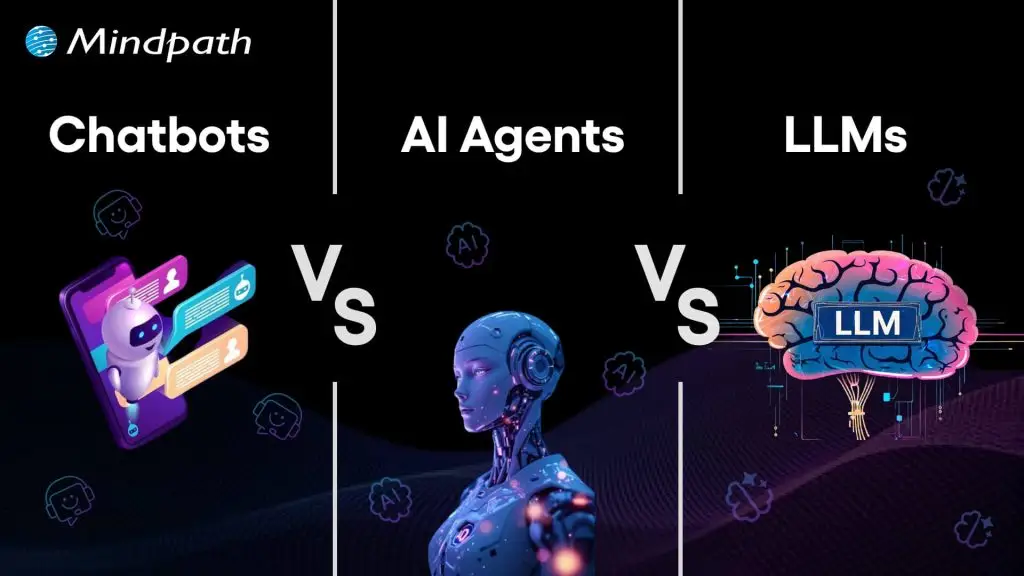
AI is transforming business communication, behavior, and decision-making. However, choosing the right intelligence layer can still be confusing. When teams compare chatbots vs AI agents vs LLMs, the choice can impact speed, cost, automation, and business growth. So, how do you align these technologies with actual business objectives?
Key Takeaways
- 01
Chatbots are primarily designed for conversations, customer support, FAQs, and straightforward user interactions. - 02
AI agents can reason, make decisions, use tools, and complete complex multi-step tasks with greater autonomy. - 03
LLMs provide language understanding and generation capabilities that can power chatbots, AI agents, and other AI systems. - 04
The right choice depends on task complexity, required autonomy, integration needs, budget, and business objectives. - 05
Understanding how chatbots, AI agents, and LLMs work together can help businesses choose a more suitable AI architecture.
Expectations are growing rapidly as the debate around automation continues. Customers want fast responses, smarter interactions, and consistent experiences. Meanwhile, business leaders want greater control, scalability, and measurable value. This makes choosing the right AI technology an important strategic decision. In this blog, we will compare chatbots, AI agents, and LLMs to help you understand their differences, strengths, and business use cases.
Ready to use the right AI technology to streamline and scale your business? Mindpath offers customised AI development services to build chatbots, AI agents, and LLM-powered solutions.
Choosing the Best: Chatbots vs AI Agents vs LLMs
In today’s industry, chatbots, AI agents, and LLMs play key roles in improving business operations. Each brings unique capabilities, but the right choice depends on your specific business needs.
In simple terms, chatbots are built primarily for user conversations, AI agents are designed to perform tasks and make decisions, while LLMs provide the language intelligence that can power these systems. Understanding this distinction makes it easier to select the right technology for a specific business requirement.
Let’s dive deeper into each technology to understand how it can best serve your goals.
What Is a Chatbot?
A chatbot is a computer application that converses with users through text or voice. It solves queries, provides information, and directs users in real time. Companies implement chatbots on websites and applications to assist customers, save time, and improve response speed.
Chatbots are particularly effective for direct and simple conversations. They can respond according to set patterns, rules, or trained responses, making them dependable for FAQs, bookings, and straightforward customer support tasks.
How Does a Chatbot Work?
Chatbots operate by reading user input and comparing it with trained data or predefined rules. They can apply AI, machine learning, and NLP to understand user intent. The chatbot then selects an appropriate response based on patterns, logic, or previous interactions.
There are two main chatbot types for chatbot for business use. Declarative chatbots act according to established rules and respond to frequently asked questions. Predictive chatbots are based on more advanced AI and learning capabilities. They can provide more dynamic, personalized, and predictive interactions.
What Are the Key Benefits of a Chatbot?
Chatbots are effective for addressing specific and repeatable tasks. Some of their notable advantages include the following:
- Offer 24/7 services that can enhance customer satisfaction.
- Provide quick and reliable customer experiences across channels.
- Drive growth and sales through personal and timely interactions.
- Gather customer information to improve business knowledge and practices.
- Minimize the expense of handling large volumes of customer queries.
Curious which chatbot capabilities deliver real value compared to AI agents and LLMs? Discover AI chatbot examples to check out practical use cases that support smarter decisions.
What Is an AI Agent?
An AI agent refers to a system that performs work with limited or no continuous human intervention through the use of tools and workflows. It can make decisions, resolve problems, respond to its environment, and take actions based on defined objectives.
In the chatbots vs AI agents vs LLMs comparison, AI agents are more effective for complex and multi-step tasks than simple chatbots. They can use LLMs for language and reasoning while connecting with tools, applications, and enterprise systems to automate workflows.
How Does an AI Agent Work?
AI agents operate based on a defined role, type of communication, and objectives. They follow instructions and use available tools to accomplish tasks. Depending on their design, agents can learn from interactions, improve accuracy, make decisions, and handle complex situations.
A clear persona can help maintain consistent behavior as the agent operates. Memories can store short-term, long-term, episodic, or shared information to support continuity. Tools enable access to data and systems, while LLMs can act as the reasoning and language engine that helps agents understand requests and generate responses.
What Are the Key Benefits of an AI Agent?
AI agents provide more intelligent automation and can work on advanced tasks beyond simple interactions. Some of their notable advantages include:
- Increase productivity by automating business tasks.
- Improve accuracy by identifying mistakes and producing consistent outputs.
- Work 24/7 to accomplish tasks and support teams at any time.
- Reduce expenses through workflow automation and fewer manual inefficiencies.
- Use business data to provide information and support better decisions.
Looking to decide whether AI agents are the right fit for your business operations? Check out the role of AI agents to learn how they handle complex tasks autonomously.
What Is an LLM?
Large language models (LLMs) are computer programs capable of understanding and producing text using deep learning algorithms. They learn from large amounts of data to identify patterns in language and understand human communication.
LLMs can form the language and reasoning foundation of chatbots and AI agents. They can interpret language, generate responses, summarize content, translate text, and support a wide range of business applications. Fine-tuning or integrating an LLM with other systems can improve its performance for specific tasks.
How Do LLMs Work?
LLMs learn language by training on massive text datasets. They apply Transformer neural networks and self-attention mechanisms to learn context, patterns, and relationships. This enables them to produce human-like text, respond to questions, summarize content, and perform other language-related tasks.
In LLMs for business, these models can support content creation, customer support, data analysis, and other language-intensive processes. They process patterns in language and generate responses based on the context provided. This can help companies save time, improve communication, and support smarter decisions.
What Are the Key Benefits of LLMs?
LLMs provide advanced language interpretation and generation capabilities that can redefine how businesses interact with data, customers, and internal systems. Some of their notable advantages include:
- Automate language and data processes to enhance productivity.
- Scale language-based operations to handle growing volumes of information.
- Provide fast responses for chatbot, assistant, and LLM-powered interactions.
- Support multiple languages for global communication and broader reach.
- Generate insights that can support informed business decisions.
Want to see how LLM capabilities will expand beyond text generation? Learn about the future of LLMs to discover trends redefining intelligent systems.
Chatbots vs AI Agents vs LLMs: Key Differences
Before settling on the appropriate AI technology, businesses should understand how chatbots, AI agents, and LLMs differ. The biggest distinction is their role within an AI system: chatbots primarily handle conversations, AI agents perform tasks and take actions, while LLMs provide language understanding and generation capabilities.
1. Functional Scope
Chatbots are based on guided responses and structured conversations. They are able to deal with direct user queries in day-to-day operations.
AI agents accomplish objectives through actions and decisions. They can work beyond simple conversations and control workflows with greater autonomy.
LLMs are language understanding and generation systems. They process language, generate content, and support analysis across different applications.
2. Intelligence Depth
In the Chatbots vs AI Agents vs LLMs comparison, chatbots can rely on predetermined logic and are competent in foreseeable and repetitive situations.
AI agents can use reasoning and contextual awareness to modify their behavior depending on objectives and results.
LLMs provide advanced language intelligence and can interpret intent, tone, and context.
3. Level of Autonomy
Chatbots are generally responsive and wait for users to prompt them. They do not independently initiate and manage tasks unless specifically designed to do so.
AI agents can operate with greater independence and act toward specified goals. Their planning and implementation do not require constant human guidance.
LLMs generally require prompts, applications, or integrations to perform tasks. They do not independently take action without being integrated into a broader system.
Also Read: LLaMA LLM
4. System Complexity
Chatbots can have relatively simple architectures and processes, making deployment and maintenance straightforward for basic use cases.
AI agents can involve multi-step systems containing memory, tools, planning, and integrations. They can control complex processes across platforms.
LLMs are based on advanced neural networks and can perform in-depth language processing.
5. Cost and Growth Readiness
Chatbots can provide cost-effective scaling for simple support requirements, and many teams can implement them relatively quickly.
AI agents can require greater investment because of their integrations, tools, memory, and automation capabilities. However, they can scale complex workflows across enterprise environments.
LLMs can be scaled through cloud APIs, with overall costs depending on factors such as model selection, usage volume, and application requirements.
6. Architectural Dependency
Chatbots can incorporate LLMs to support more advanced conversations. This relationship is important when comparing chatbots and LLMs.
AI agents can use LLMs as a reasoning and language engine while adding action, planning, memory, and tool-use layers.
LLMs can provide the language foundation across multiple AI systems. This relationship helps explain the differences between chatbots, AI agents, and LLMs.
Planning to deploy AI solutions that focus on instant communication and support? Discover conversational AI chatbot solutions and see how they fit modern business needs.
Chatbots vs AI Agents vs LLMs: Comparison Table
The following table provides a quick comparison of chatbots, AI agents, and LLMs across their core capabilities and business applications.
| Feature | Chatbots | AI Agents | LLMs |
| Interaction | Communicates with users through text or voice | Interacts with users and systems to complete tasks | Understands and generates language for multiple applications |
| Task Scope | Handles simple and repetitive tasks | Manages complex multi-step workflows independently | Performs advanced content, analysis, and language tasks |
| Decision-Making | Follows predefined rules and scripts | Makes autonomous decisions based on goals and context | Supports reasoning when integrated into systems or prompts |
| Learning | Learns through updates and rules | Can improve from past interactions and feedback | Learns from large datasets and identifies language patterns |
| Integration | Works alone or with basic systems | Integrates with tools, software, and workflows | Can power other systems and integrate into chatbots or AI agents |
| Efficiency | Provides quick responses for simple queries | Saves time through task automation | Processes large amounts of language data rapidly |
| Suitability | Ideal for basic customer support and FAQs | Best for enterprise automation and multi-step tasks | Suitable for advanced language intelligence and analysis |
| Scalability | Scales easily for repeated interactions | Handles growing workflows and processes | Scales through cloud APIs for large data and language tasks |
Ready to Choose the Right AI for Your Business?
The decision between chatbots, AI agents, and LLMs can influence how your business operates and develops. Each option addresses different problems and suits different objectives. Chatbots are effective at focused conversations and support tasks. AI agents are designed to handle complex tasks with greater autonomy. LLMs provide language comprehension and generation capabilities that can support both technologies.
Understanding your business requirements, task complexity, desired level of autonomy, integration needs, and budget can help you make a more informed AI technology decision. The right architecture should support your goals while delivering measurable value.
At Mindpath, our AI development services assist companies in converting AI concepts into practical solutions. Our professionals create chatbots, AI agents, and LLM-based systems designed around specific business objectives. We focus on speed, precision, scalability, and measurable value to help businesses improve operations, decision-making, and customer experiences.
FAQs
1. What Are the Major Differences Between Chatbots, AI Agents, and LLMs?
When comparing chatbots vs AI agents vs LLMs, each technology has a different role. Chatbots primarily focus on conversations and user guidance. AI agents perform tasks, make decisions, and interact with tools or systems. LLMs understand and generate language and can provide the intelligence layer for chatbots, agents, and other applications.
2. Can Chatbots Work Without LLMs?
Yes. Chatbots do not always require LLMs. A business chatbot can operate using predefined rules, scripts, or other AI approaches. LLMs can enhance chatbot capabilities by improving language understanding and enabling more flexible conversations.
3. Between Chatbots and AI Agents, Which Is More Advanced?
AI agents are generally more suitable for complex, multi-step tasks because they can use tools, make decisions, and take actions toward defined goals. Chatbots are primarily designed for conversations and predefined or focused interactions.
4. Do AI Agents Need LLMs to Function?
Not necessarily. AI agents can operate using rules, tools, workflows, and other technologies. However, LLMs can enhance agents by improving reasoning, language understanding, contextual responses, and natural language generation.
5. When Should a Business Choose an AI Agent, Chatbot, or LLM?
The right choice depends on the complexity of the task and the business objective. Chatbots are suitable for focused conversations and customer support. AI agents are better suited to complex workflows and autonomous task execution. LLMs are useful when advanced language understanding and generation are required.
Undoubtedly, the global retail landscape is going through a massive transformation. A major architect of this transformation is Artificial Intelligence, or AI. Today’s customers demand convenience, immediacy, and personalization. They expect companies to anticipate their needs. Well, AI in retail industry helps brands achieve that.
Key Takeaways
- 01
AI in retail helps businesses personalize shopping experiences, improve customer engagement, and make smarter data-driven decisions. - 02
Generative AI can support product recommendations, virtual assistants, personalized campaigns, visual search, and loyalty programs. - 03
Retailers use AI for demand forecasting, inventory optimization, customer segmentation, fraud prevention, pricing, and route planning. - 04
Technologies such as predictive analytics, NLP, computer vision, data management, and IoT form the foundation of retail AI solutions. - 05
The future of retail AI is moving toward hyper-personalization, virtual shopping assistants, emotion AI, sustainability insights, and smarter commerce.
If you want to create a seamless shopping experience and boost customer engagement, retail AI can be an excellent option. Today, we are moving beyond simple automation to a new phase of creative and predictive intelligence. This blog explores how generative AI in retail and other AI technologies are enhancing customer engagement, improving operations, and creating more personalized shopping experiences. Besides, we will discuss some AI in retail examples to get a better idea about this.
Looking to go beyond generic AI tools to create truly personalized retail experiences? Our AI development services help retailers build custom solutions that boost customer engagement and drive smarter growth.
AI in Retail Industry: A Short Brief
Artificial intelligence in retail stores means the use of technologies such as natural language processing, machine learning, generative AI, and computer vision to enhance or automate decision-making. These technologies also play a crucial role in streamlining operations and personalizing customer journeys.
In simple terms, AI in retail industry helps businesses understand customer behavior, personalize shopping experiences, automate repetitive processes, and make better decisions using data. From product recommendations and AI chatbots to demand forecasting and visual search, AI can be integrated across different stages of the retail customer journey.
Offering predictive recommendations and data-driven insights, AI in retail industry can boost customer satisfaction and revenue. As per a recent survey, the use of AI in the retail sector can increase customer experience by 59 percent (Source: World Tea News).
Besides, generative AI creates massive economic potential for retailers. It is projected to offer between USD 240 billion to USD 390 billion in economic value (Source: McKinsey).
Whether it is a recommendation engine suggesting useful products or a retail AI chatbot helping shoppers, AI can be embedded into multiple aspects of the customer journey.
Must Read: AI in E-commerce
Generative AI in Retail: A Game-Changer for Customer Engagement
Generative AI for retail is pushing boundaries by offering personalized and dynamic content at scale. It can help retailers create more relevant interactions, improve product discovery, and deliver personalized experiences across different customer touchpoints.
Some of the most impactful applications include personalized recommendations, AI-powered chatbots, demand forecasting, targeted campaigns, visual search, loyalty programs, and sentiment analysis.
1. Hyper-Personalized Product Recommendations
AI in retail industry effectively analyzes customers’ purchase history, preferences, and behavior. It can provide customized product recommendations based on the gathered data. In addition, such recommendations can appear in applications, emails, or websites, which can enhance conversion rates.
Customer satisfaction, shopping experience, and loyalty can be improved by offering customers relevant products at the right time. Personalized recommendations can also make product discovery more convenient by reducing the effort required to find suitable products.
2. Smart Virtual Assistants and Chatbots
Retailers are able to provide 24/7 customer support using generative AI chatbots. Bots can handle multiple queries while also helping shoppers find products, answer questions, and navigate purchasing decisions.
Over time, intelligent bots can learn from customer interactions, improving personalization and accuracy. Besides, retailers can reduce the cost of customer support when using a chatbot.
Want to offer instant and personalized support to your online shoppers? Explore conversational AI chatbots to learn how they improve customer engagement and boost conversions.
3. Demand Forecasting
AI-driven demand forecasting involves using ML and data and analytics trends to predict the future demand for products. Retailers can optimize inventory, improve logistics, and reduce waste by analyzing market data, sales, and customer behavior.
These models can be trained to respond to changes in the market, assisting retailers in planning more effectively. As a result, businesses can react more quickly to changes in demand.
4. Dynamic SMS and Email Campaigns
Advanced AI tools for the retail industry can create personalized SMS and email campaigns. For this, they consider various elements such as behavioral data, seasonal trends, and customer segments. Some useful AI-powered tools include OptiGenie, HubSpot, Canva, and AdCreative.ai.
These messages and emails can be more relevant and engaging, leading to higher click-through rates, open rates, and conversions. Furthermore, retailers can automate outreach using these tools.
5. Visual Search and Styling
Thanks to generative AI, customers can now find their desired products quickly. They can upload an image of a product, and the search engine can display similar products instantly.
Besides, these tools can offer styling suggestions based on customer input. Visual search can enhance product discovery and interaction while minimizing friction. It can help retailers create a shopping experience that feels more immersive and intuitive.
Planning to personalize every customer interaction at scale? Discover generative AI for customer service to learn how it delivers tailored responses and smarter assistance.
6. Custom Rewards and Loyalty Programs
AI assists retailers in designing custom loyalty and reward programs by analyzing the frequency and preferences of purchases. Special offers, targeted incentives, and personalized rewards can generate increased brand loyalty and repeat purchases.
The use of AI in retail industry ensures that customers receive offers and experiences that are more relevant to their preferences, helping establish stronger customer relationships.
7. Sentiment Analysis
The use of AI in retail industry promotes sentiment analysis to monitor customer emotions and opinions. These tools analyze social media, reviews, feedback, and other sources to understand how customers feel about products and brands.
With the right data, retailers can identify negative sentiment and respond more effectively. In addition, these insights can support marketing plans and brand communication that align more closely with customer expectations.
Artificial intelligence is no longer a futuristic concept. It is changing customer interaction through hyper-personalized recommendations, automated customer support, visual search, and other intelligent retail experiences.
Wondering how to connect customer data with long-term planning? Check out AI in business strategy and discover how it improves forecasting, personalization, and operational efficiency.
Key AI Use Cases in Retail
AI use cases in the retail industry extend beyond customer engagement. Retailers also use AI to improve inventory management, understand customers, prevent fraud, optimize pricing, enhance virtual shopping, and improve logistics.
The following use cases demonstrate how AI can support both customer-facing experiences and behind-the-scenes retail operations.
| Use Cases | Description |
| Inventory Optimization | AI helps retailers stock the right products using predictive analytics. This helps avoid stockouts and overstock issues. |
| Customer Segmentation | AI can categorize customers based on their demographics, preferences, and behavior for targeted marketing. |
| Fraud Prevention | AI tools regularly monitor transactions for suspicious activities, protecting customers and retailers. |
| Price Optimization | Retail AI tools adjust pricing based on competition, demand, and customer behavior. |
| Virtual Try-Ons | AI allows shoppers to try products digitally, lowering return rates and enhancing customer engagement. |
| Route Planning | AI-assisted route planning helps retailers reduce service disruptions and manage changing conditions. |
Real-World Examples of Generative AI in Retail
The influence of AI in retail industry revolves around customer behavior and business efficiency. Established retailers are using AI to offer more personalized experiences, optimize operations, and simplify shopping. The following AI in retail examples provide a clearer picture of how these technologies are being applied.
1. Amazon Go Stores
These stores use computer vision, deep learning, and sensors to help customers purchase their preferred products. AI tools monitor purchases and automatically charge the customer’s account.
2. Shopify
Shopify Magic is a product offered by Shopify that understands retail store requirements and creates content automatically.
3. Sephora
It supports AI-based virtual try-ons for beauty products, increasing sales and improving customer confidence in the product.
4. Walmart
Walmart has implemented AI for predictive analytics and inventory management.
5. Zara
It applies predictive modeling systems supported by AI to analyze fashion trends. These models track social media platforms, sales data, and other information to understand customer preferences. The company can also streamline supply chains with the help of AI.
6. The North Face
The North Face uses IBM’s Watson to offer customers a conversational shopping assistant.
Looking to anticipate market shifts before your competitors do? Discover Generative AI trends to learn how predictive insights shape smarter retail strategies.
Technologies and Tools Powering AI in Retail
AI in retail industry is driven by a robust ecosystem of tools and technologies. These technologies facilitate operational efficiency, customer understanding, and smarter decision-making. Read on to know a few major innovations supporting the retail sector.
1. Big Data & Predictive Analytics
These technologies evaluate large datasets to predict customer behavior, trends, and inventory requirements.
2. Data Management Tools
They help organize and retrieve both unstructured and structured data to support decision-making and personalization.
3. Salesforce Einstein
Salesforce Einstein offers features such as automated workflows, predictive analytics, and powerful generative AI tools.
4. NLP
Natural Language Processing helps understand and respond to customer queries, feedback, and reviews. It powers chatbots and enables personalized communication.
5. Computer Vision
This technology helps with shelf monitoring, smart mirrors, and visual search by processing video data and images in retail stores.
6. IoT or Internet of Things
IoT involves connected devices that can be used to detect foot traffic and monitor inventory.
Together, these technologies assist retailers in ensuring that customers remain the focal point of the interaction process, enabling them to stay competitive in a changing market.
Want to make faster and more accurate business choices in retail? Discover AI in decision making to learn how data-driven insights improve customer engagement and operational efficiency.
AI and Retail: What Comes Next?
Due to the ongoing development of AI technology, the future of AI in retail industry promises a more personalized shopping experience. Retailers worldwide will implement AI more often for operational efficiency, customer service, and personalization, further reducing the lines between digital and physical commerce.
Some areas expected to shape the future of retail AI include:
1. Application of Emotion AI
AI will be able to understand customer emotions and assist retailers in enhancing customer satisfaction.
2. Hyper-Personalization
Generative AI in retail will offer context-aware and real-time experiences across multiple channels.
3. Sustainability Insights
AI will assist retailers in tracking and lowering their environmental impact.
4. Virtual Shopping Assistants
AI-powered virtual shopping assistants will offer real-time and personalized shopping support.
5. Blockchain Integration
Retail and e-commerce sectors will become more transparent and secure with the help of blockchain and AI.
Retailers who leverage AI can better meet customer expectations through personalized experiences, faster support, and smarter operations. The result can be stronger customer engagement, loyalty, and business growth.
Curious why businesses are rapidly adopting intelligent technologies? Check out the benefits of AI and discover how it improves decision-making and competitive advantage in retail and e-commerce.
Ready to Transform Your Retail Business with AI?
Artificial intelligence is revolutionizing retail by enhancing customer engagement, personalizing shopping experiences, and improving operational efficiency. Retailers leveraging AI can gain a competitive edge, optimize processes, and deliver smarter, data-driven experiences that delight customers and support growth.
At Mindpath, we provide tailored AI development services for the retail sector. Our experts design custom AI solutions that streamline operations, enable predictive analytics, and boost customer engagement. Partner with us to harness AI strategically and create innovative, scalable retail experiences that drive measurable results.
Enterprise systems tend to have one unified architecture that facilitates early expansion. Gradually, construction gets heavy and hard to ascend. Releases slow down. Minor modifications require huge test cycles. Teams become under pressure to be more innovative. This is where monolith to microservices will be a strategic move towards enterprise legacy modernization. It is not a trend. It is a realistic reaction to actual operation constraints that influence operation, agility, and long-term development.
As businesses grow, they require systems that are flexible and capable of constant delivery and autonomous growth. Nevertheless, a monolithic building goes down only with solid architectural design and business focus. The technology leaders need to reconsider their deployment models, data management, and ownership of teams. Each step requires thorough consideration. In this blog, we will discuss how businesses may proceed in a practical manner to modernize architecture with clarity. So, keep reading!
Looking to simplify complex legacy systems for better agility? Mindpath’s legacy modernization services make it easier to break monoliths into microservices while keeping operations smooth.
What is Monolithic Architecture?
A monolithic architecture integrates all the application elements into a single piece of code. The database layer, business logic and user interface are a single system. Teams develop, test and deploy the application as a whole. It is a structure that promotes centralized control and easy management.
This model has been used by many enterprises to embark on their digital journey. Growth, however, makes the process more complex and causes the changes to slow down. Such a challenge tends to motivate the migration of monolith to microservices to enhance scalability and agility. Nevertheless, it is important to comprehend the monolithic basis before strategizing in terms of modernization.
Some of the advantages of monolithic architecture are listed here:
1. Quick initial development
2. Simple deployment process
3. Managing codes centrally
4. Reduced initial infrastructure price
5. Suitable for small teams
What is Microservice Architecture?
Microservice architecture forms an application of tiny, concentrated services. Every service deals with a certain business operation. They have teams that construct and operate. Services interact via APIs or messaging, which are lightweight. It is a structure that enables quicker releases and better ownership over teams.
Companies that switch from monolith to microservices have the goal of enhancing agility and scalability. Complex systems are broken down into services by teams. They enhance update control and performance control. This model facilitates constant delivery and the alignment of technology to evolving business needs.
Some of the advantages of microservice architecture are listed here:
1. An independent deployment of service.
2. Faster feature releases
3. Better fault isolation
4. Loosely planned technology options.
5. Targeted scalability
Want to ensure your move from monolith to microservices follows a clear direction? Explore legacy modernization strategy to build a structured and effective transformation plan.
Why do Organizations Switch from Monolith to Microservices?
As organizations become more and more application-driven, they become more complex. Monolith to microservices migration becomes a strategic decision when traditional architectures start limiting growth and flexibility.
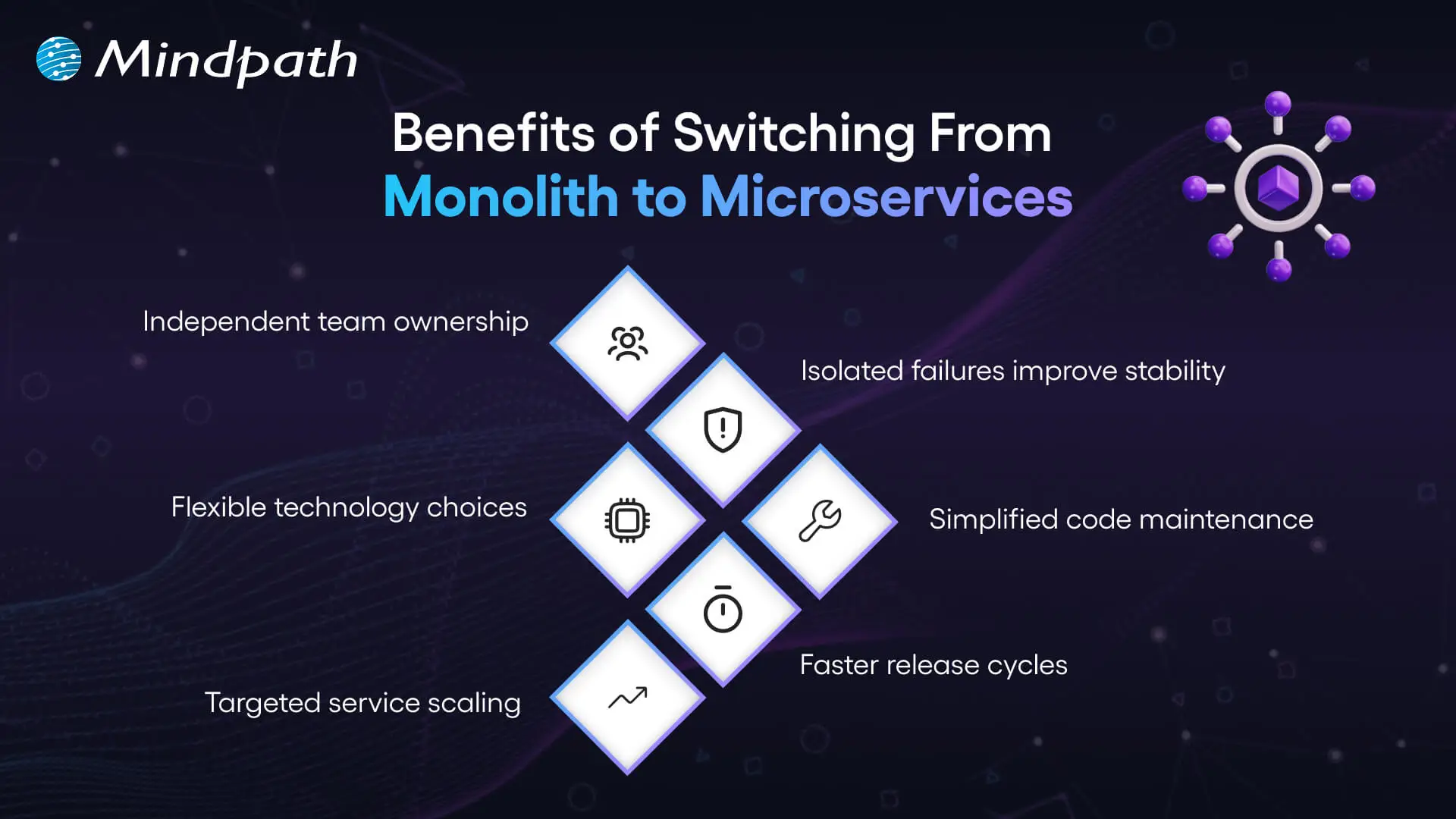
1. Independent Team Ownership
Microservices provide teams with a definite service scope. The teams are in charge of their updates and releases. This construction minimizes wasting of time and enhances concentration. Organizations that follow monolith-to-microservices patterns build stronger ownership models.
2. Flexible Technology Stack
The appropriate tools depend on the service selected by the teams. They do not rely on a common technology. This innovation and future development is supported by this flexibility. It makes architecture flexible to alterations.
3. Targeted Scalability
Monolithic systems need to scale the whole application. Microservices permit the scaling of particular services. This method enhances management of resources. This accuracy is why many enterprises are abandoning monolithic to microservices.
4. Better System Stability
Even a single problem within a monolith is capable of affecting all. Microservice provides isolation of failures in a single service. The teams address the issues without impacting the entire system. This improves reliability.
5. Faster Release Cycles
Teams create and implement services on their own. They make releases without necessarily having to recreate the system. This enhances the speed of delivery. Business enterprises migrate from monolithic to microservice to enhance momentum.
6. Easier Maintenance
The huge codebases become hard to handle. Microservices separate applications into smaller parts. Developers are able to maintain and update services with ease. This facilitates long-term clarity.
Planning to reduce system limitations while adopting modern architectures? Learn from the benefits of modernizing legacy systems to improve overall performance.
Key Steps for Migrating from Monolith to Microservices
Organizations need to strategize before they shred a monolithic system into smaller services. Successful migration to microservices is based on clear strategy and disciplined execution.
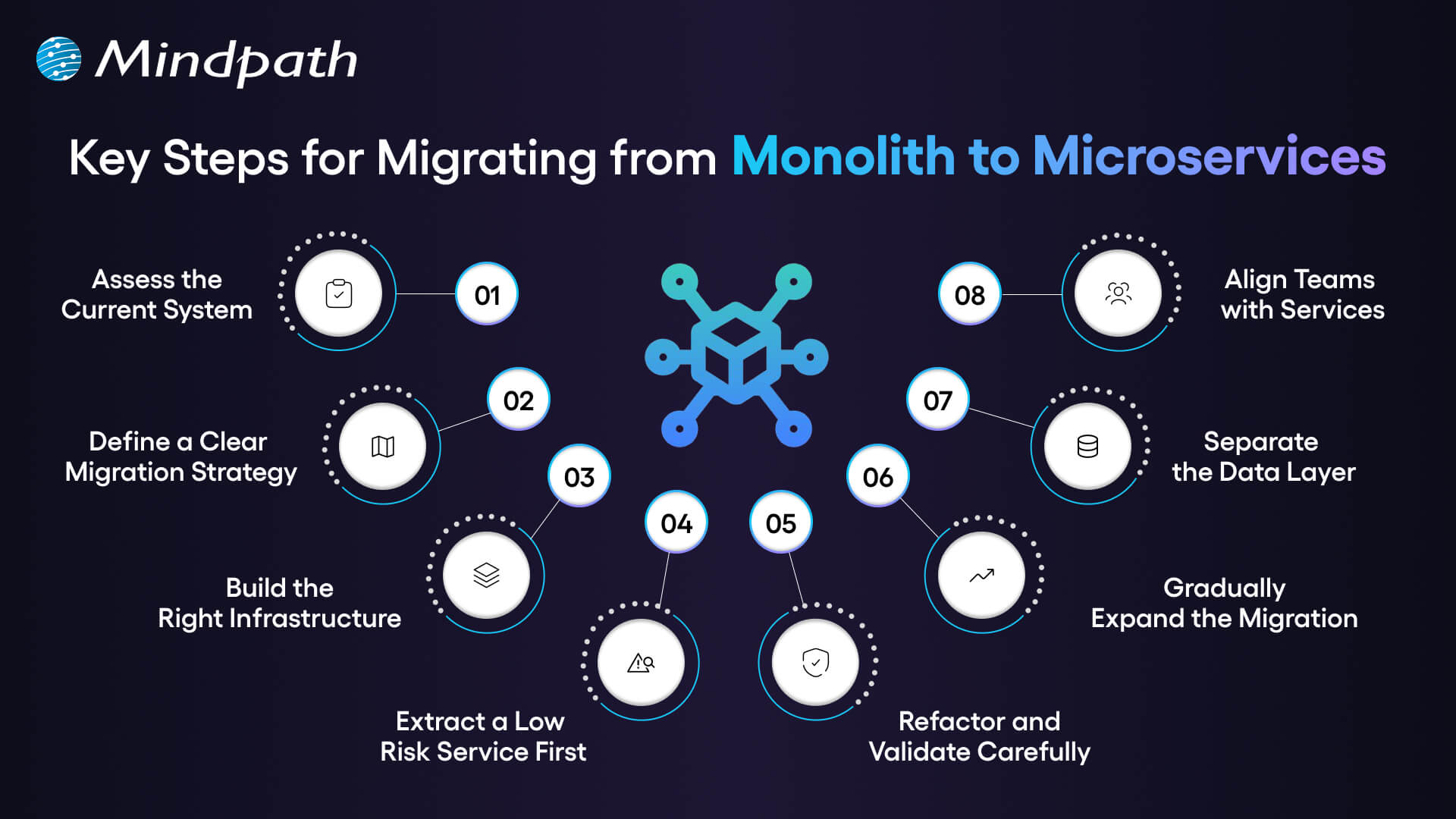
1. Assess the Current System
Begin by doing a line-by-line audit of your monolithic system. Check review services, dependencies, data flow, and performance gaps. This analysis forms the basis of successful monolithic to microservices migration.
2. Define a Clear Migration Strategy
Establish simple service boundaries on the capability of the business. Make decisions on the size of the service and the style of communication at the early stage. A strong monolithic to microservices migration strategy reduces confusion and prevents rework.
3. Build the Right Infrastructure
Finalize API gateway, service discovery and CI/CD pipelines. Insert containers and orchestration tools to introduce consistency. The powerful infrastructure promotes consistent monolithic to microservices conversion.
4. Extract a Low Risk Service First
Select a valuable module that is loosely coupled. Build it as a stand-alone service having its database. It is a risk-controlled step that is proving yourself.
5. Refactor and Validate Carefully
Refactor the chosen ones into a single service. Implement it and observe behavior closely. Logging and tracing helps to identify problems at an early stage.
6. Gradually Expand the Migration
Move other modules depending on the business priorities. Break-even monolith tasks gradually. This phased approach supports smooth monolithic application to microservices’ evolution.
7. Separate the Data Layer
Discontinue reliance on a corporate database. Allocate domain-owned datastores to each service. Synchronize the plan data keenly to ensure that it is consistent.
8. Align Teams with Services
Establish cross-functional teams for each microservice. Provide them with complete development and operations ownership. This is a structure that reinforces autonomy and long-term scalability.
Looking to enhance your modernization process with intelligent automation? Learn from AI-driven legacy system modernization to boost efficiency and performance.
Ready to Modernize Your Enterprise Architecture?
Contemporary business requires the ability to expand its systems as it grows and facilitate ongoing innovations. A clear shift from monolith to microservices improves agility, resilience, and operational control. The key to success lies in effective planning and implementation in phases and aligning a team. Through proper strategy, companies become simpler and create future ready digital platforms that underpin long-term business objectives.
At Mindpath, we provide legacy modernization services which help companies plan and implement legacy modernization with confidence and clarity. Our specialists evaluate architecture, establish migration roadmaps and deploy scalable microservices. We are performance-based, stability-centered and result-orientated. Collaborate with Mindpath to modify old systems into nimble, growth-motivated digital systems.
FAQs
1. Why should enterprises consider monolith to microservices today?
Enterprises face rapid market shifts and rising customer expectations. Monolith to microservices helps organizations build adaptable systems that support faster innovation. It also aligns technology with business domains, enabling better ownership, governance, and long-term digital growth without increasing structural complexity.
2. How do we know if our organization is ready for migration?
You should assess technical maturity, DevOps readiness, and team structure. Clear service boundaries and business alignment indicate strong readiness. Leadership commitment also plays a key role in successful transformation and sustainable architectural evolution.
3. Is monolith to microservices suitable for every business?
Not every system requires immediate migration. Smaller or stable applications may perform well as monoliths. However, enterprises planning aggressive scaling, multi-team collaboration, or global expansion often benefit from monolith to microservices as a long-term strategy.
4. What technical challenges arise during data separation?
Data decoupling often introduces consistency and transaction complexity. Teams must design domain owned databases and manage synchronization carefully. Event-driven patterns and API governance help maintain reliability during service level transitions.
5. How can Mindpath support our legacy transformation journey?
Mindpath’s legacy modernization services guide enterprises through assessment, planning, and execution. Our experts design scalable architectures and structured migration roadmaps. We help organizations transition confidently using proven monolith-to-microservices approaches aligned with measurable business outcomes.

Cloud expenses continue to grow with the expansion of apps, new services, and bolt-on speedy releases. Cloud cost optimization is now the core of every intelligent IT plan. You spend on flexibility and speed, but at the end of the month, you are surprised by the costs, which often exceed your budget due to unforeseen usage spikes and the complexity of managing multiple cloud services. So, what drives this gap? More importantly, how can you gain control without hindering innovation?
Contemporary companies require performance, safety, and swiftness simultaneously. Uncontrolled resources, idle work loads and lack of visibility, however, consume budgets very fast. Hence, leaders should reconcile finance and engineering using well-defined cost objectives. Intelligent budgeting turns cloud expenditure into quantifiable value. This blog will show a practical way of gaining control of cloud investments.
Ready to take control of your cloud costs and get more from your investment? Mindpath offers cloud managed services to help businesses optimize cloud usage, reduce waste, and scale efficiently.
What is Cloud Cost Optimization?
Cloud cost optimization is the strategic, ongoing process of reducing cloud computing expenses while maintaining or improving system performance. Companies check the usage, eliminate unnecessary services, and select appropriate pricing frameworks, ensuring resources are right-sized and properly utilized rather than left idle or oversized. This will enhance performance and minimize unwarranted expenditure as well as keep cloud investment in line with business objectives.
Cloud cost management helps in this endeavor to track, analyze, and plan cloud expenditure. Teams create the budgets, keep track of their usage, and reallocate the resources according to the demand. A combination of these practices aids companies in becoming financially clear, enhancing efficiency, and making superior decisions in long-term growth.
Must Read: Cloud Computing Trends 2026
Why is Cloud Cost Optimization Important?
Cloud services enable businesses to invest heavily in order to achieve growth, speed, and innovation. The reasons why cloud cost management is of critical importance in safeguarding budgets and enhancing financial control are as follows.
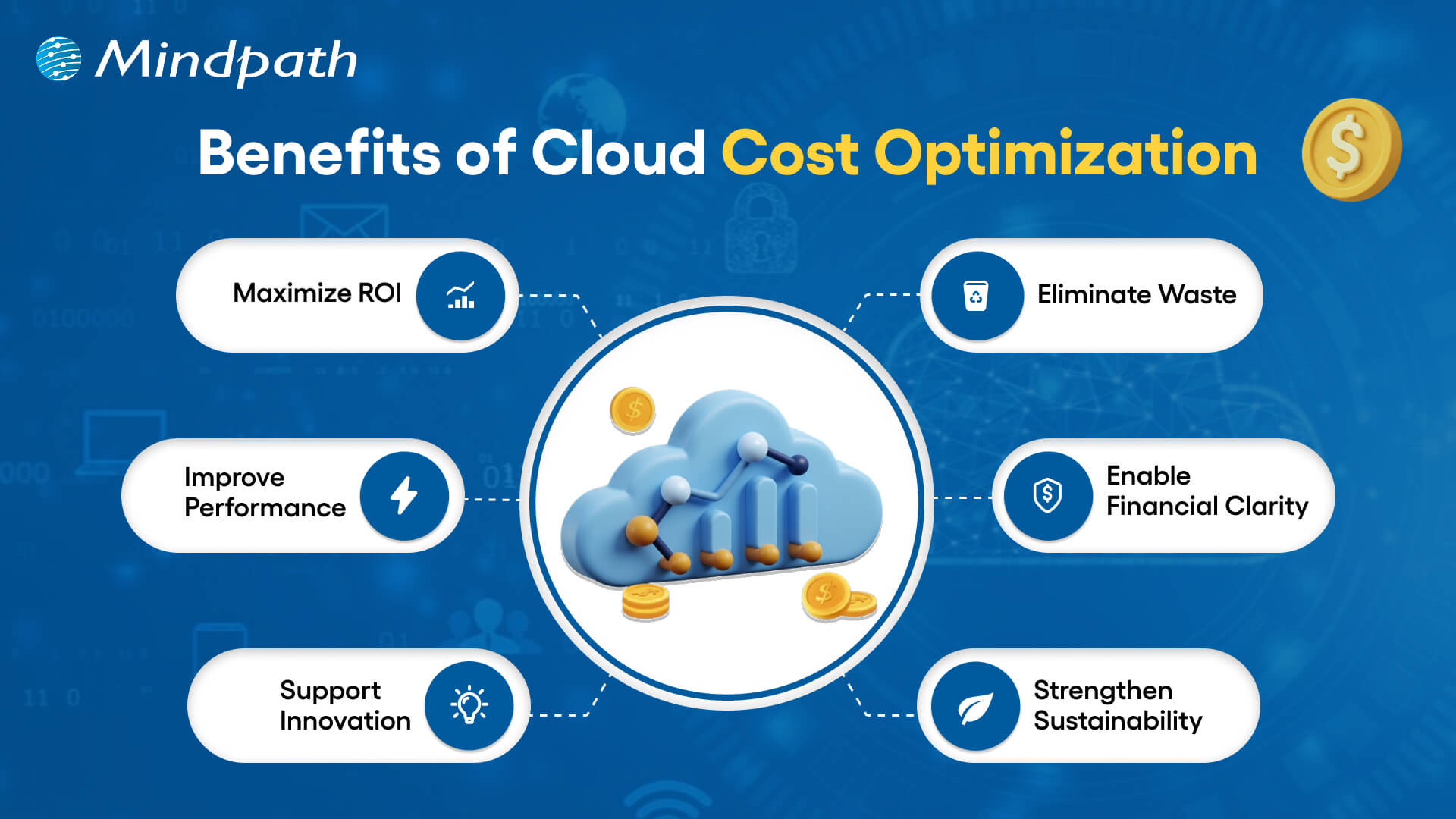
1. Maximize ROI
Cloud expense optimization enables businesses to match expenditures with objective goals. They make sure that each dollar helps in growth, performance, and quantifiable business worth.
2. Eliminate Waste
Teams eliminate wastage of resources and storage before their expenses increase. Cloud cost optimization assists businesses in ceasing spending on services that are unnecessary.
3. Improve Performance
Organizations right-size the workloads on the basis of actual demand. This balance is also fast and reliable, as it keeps the costs down, which ultimately supports the organization’s ability to invest in new projects and innovations.
4. Enable Financial Clarity
Leaders follow usage real-time and make budgets confidentially. Being visible will avert the presence of surprise bills and enable smarter forecasting, which allows leaders to make informed financial decisions and allocate resources more effectively.
5. Support Innovation
Firms invest saved amounts in product development and online expansion. Expenditures that are managed efficiently leave opportunity for new ideas and expediency.
6. Strengthen Sustainability
Economic utilization of resources minimizes energy wastage and decreases carbon influence. Clear governance also develops team and departmental accountability.
Want to reduce cloud costs while also making your infrastructure more eco-friendly? Explore sustainable technology to build efficient and environmentally responsible systems.
Cloud Cost Optimization Strategies for Modern Businesses
Contemporary companies require effective means to regulate cloud expenses without compromising performance and scalability. Some major strategies that help companies achieve effective cloud cost optimization include the following.
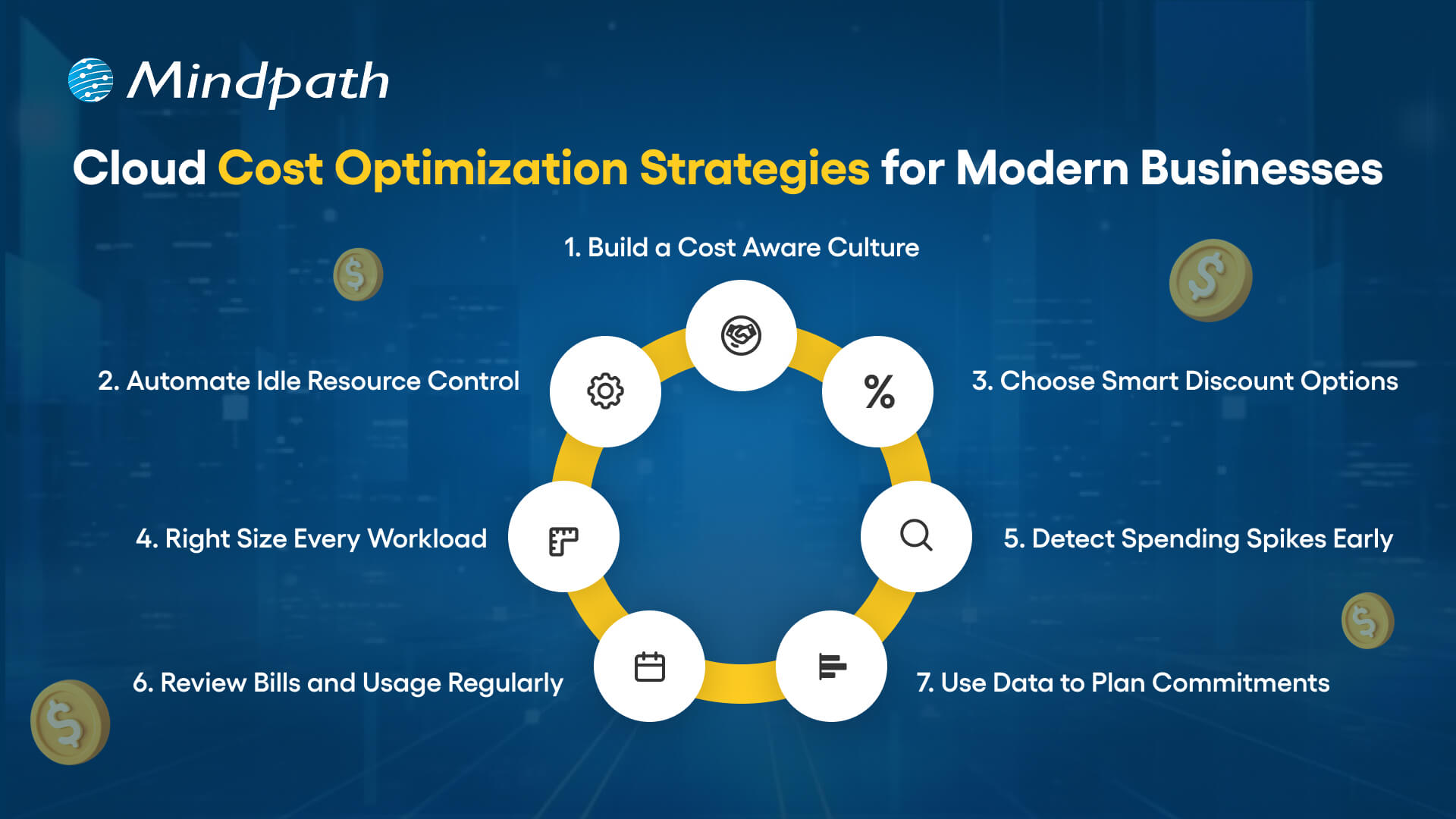
1. Build a Cost-Aware Culture
Clear ownership and shared responsibility are the beginning of strong cloud cost optimization. Leaders establish FinOps team and establish explicit spending policies. Teams go through regular reviews on usage and align the decisions with the business goals.
2. Automate Idle Resource Control
Unutilized servers and storage add up to high bills. Teams automate the scheduling of shutdowns and the removal of unused assets. Automation enhances the ability to optimize cost in the cloud because it avoids silent waste, which refers to the ongoing costs associated with unused resources that are not actively managed or monitored.
3. Choose Smart Discount Options
Cloud service providers also have savings plans and spot instances regarding flexibility in workloads. Workload stability is examined by teams, and then discount models are chosen. Smart commitments minimize the long-term expenses without jeopardizing performance.
Want to protect your cloud environment while optimizing costs? Explore cloud security to safeguard your systems and data effectively.
4. Right Size Every Workload
Excessively provisioned resources cost money and minimize efficiency. The teams keep tracking the CPU, memory, and storage usage. They align types of instances to actual workload requirements to facilitate cost optimization of clouds.
5. Detect Spending Spikes Early
Unplanned cost surges are hurtful to budgets and slow down planning. Real time alerts are used by teams to spot unusual usage in a short time. Timely behavior safeguards the financial control and enhances the cloud cost optimization.
6. Review Bills and Usage Regularly
The frequent examination of bills discloses outliers of costs and inefficiencies. The teams compare the present usage and the trends to identify gaps. This is followed up by constant monitoring of expenditure to ensure its congruence with approved budgets.
7. Use Data to Plan Commitments
Long-term contracts demand proper forecasting and clarity. Before commitment plans are locked teams analyze performance metrics. Data based decisions minimize risk and lead to a higher cost-efficiency.
Curious about how cloud migration supports cost optimization strategies? Check out the benefits of cloud migration to maximize your ROI.
Key Cloud Cost Optimization Tools
Businesses today need the appropriate tools to manage their expenditure and enhance visibility in the cloud setting. These are some of the important tools that can enable successful cloud cost optimization and smarter financial decisions.
1. Azure Cost Management + Billing assists teams to monitor their spending, budget and optimize Azure resources with visibility.
2. CloudZero relates cloud costs to products, features, and teams to make decisions related to the business.
3. AWS Cost Explorer and Trusted Advisor share cost-related information, usage data, and can offer recommendations applicable to make the process efficient.
4. Finout provides in-depth cost allocation analysis between various cloud and SaaS providers.
5. Google Cloud Cost Management helps to track spending and optimize usage in the GCP setups.
6. ProsperOps automates Savings Plans and Reserved Instances in order to make the maximum savings in the long term.
7. CloudHealth Victor by VMware provides business-level management, visibility and cost control in the environment.
8. Vantage provides visualized current multi cloud cost with straightforward and accurate reporting.
9. nOps applies AI based recommendations on the most economical AWS resources.
Wondering which cloud model can help you control costs and improve performance? Explore multi cloud vs. hybrid cloud to gain the clear insights.
Ready to Take Control of Your Cloud Spending?
Cloud cost optimization is beneficial to the modern business to perform cost control and enhance the performance and visibility. Businesses that audit usage, optimize resources, and automate the process of waste elimination obtain better financial control. Definite plans transform the investments in clouds into quantifiable value. By having teams focus on finance as well as engineering, teams eliminate surprise and develop long term and sustainable growth.
Mindpath is a leading provider of cloud infrastructure services, according to your business objectives. Our team is an analysis of how we use, and how we could use to waste less and be smarter with automation. We assist in the process of visibility enhancement, enhanced governance and increased returns on cloud investments. Collaborate with Mindpath to turn cloud spending into a competitive edge.
Frequently Asked Questions
The technology environment that you operate in determines the rate at which your firm develops and competes. A clear legacy modernization strategy gives structure to change and turns outdated systems into growth drivers. You might feel like upgrading, but you need to know and understand. So, where do you start and how are you balancing technology objectives and business performance?
Nevertheless, modernization goes beyond updating the system. It must have a dedicated strategy that enhances scalability, security, and performance. Consequently, leaders should reason in the future and be purposeful. Innovative choices now result in robust systems in the future. In this blog, we look at how to make the correct decision that would be helpful in sustainable business growth.
Ready to turn legacy systems into growth enablers? Mindpath’s legacy modernization services guide organizations in choosing and executing strategies that unlock operational efficiency and business value.
What is a Legacy Modernization Strategy?
A legacy modernization strategy is a structured plan to update, transition, or replace outdated software and IT infrastructure, transforming legacy systems into agile, scalable digital platforms. Its core goal is to align foundational technology with current business demands, helping companies minimize technical debt, strengthen security, improve cost efficiency, and boost overall performance. When technology is aligned with business objectives, organizations build a platform that supports innovation, easier integration of advanced technologies like AI and data analytics, and sustained long-term growth.
Legacy system modernization consists of more practical strategies, including rehosting, replacing the platform or refactoring into microservices, or replacing systems with SaaS offerings. All the methods facilitate the adoption of clouds and efficiency. Organizations will be able to modernize with the right direction and remain stable and deliver improved user experiences.
Wondering how legacy upgrades can improve security and system reliability? Explore the benefits of modernizing legacy systems to strengthen your infrastructure.
Key Strategies of Legacy System Transformation
1. Refactoring
Enhance current code to eliminate technical debt to increase the efficiency without altering the experience of users using the system.
2. Replacing
Existing system to replace the old system and install a new SaaS or commercial system.
3. Rehosting
The application can be moved to newer infrastructure such as cloud with minimal or no changes in code.
4. Encapsulation (API-enabled)
Sometimes wrap legacy code with APIs to allow them to interface well with modern applications.
5. Re-architecting
Re-design the system into a new structure, e.g. microservices, to open up new possibilities.
6. Replatforming
Change to a new platform with some slight alterations in order to enhance performance without changing the core code.
7. Rebuilding or Rewriting
Build the system with a new technology but keeping the same business logic.
Looking to improve system flexibility during your modernization journey? Learn from monolith to microservices to enable faster and easier updates.
How to Choose the Right Legacy Modernization Strategy?
To make the appropriate decision, one has to be clear, plan and well aligned with business objectives. The right legacy modernization strategy depends on your system complexity, budget, risk tolerance, and long-term growth plans.

1. Perform a Comprehensive Assessment
Start with an elaborate system, dependency, and technical debt audit. Trace the architecture and locate the performance bottlenecks. Isolate mission critical components and features that are old. This evaluation strengthens your legacy modernization framework and guides smart investment decisions.
2. Define Clear Business Goals
Align your Legacy modernization strategy with measurable business outcomes. Clarify the need of modernization such as cost control, agility, or improved security. Establish targets of performance and scalability. Then choose an Application modernization strategy that directly supports these goals.
3. Evaluate Risk Tolerance
Determine the extent to which your organization can cope. Few risk solutions are API encapsulation or cloud rehosting. High transformation goals may require a bold legacy modernization technique like rearchitecting. Striking a balance between innovation and operational consistency is advisable before taking the final decision.
Must Read: AI-Driven Legacy System Modernization
4. Prioritize Data Integrity and Security
Protect critical and historical data during every transition phase. Create a structured migration plan with validation checkpoints. Embed security controls while modernizing legacy systems. Adopt zero trust practices to reduce exposure to cyber threats.
5. Adopt a Phased Approach
Secure valuable and historical data at all levels of transition. Develop a systematic migration strategy that has checkpoints. Embed security controls while modernizing legacy systems. Employ the concept of zero trust in order to minimize exposure to cyber threats.
6. Assess Internal Capabilities and Partner Support
Analyze the internal knowledge of innovative tools and websites. Identify skill gaps that may delay your Legacy modernization strategy. Arrange training of the plan or external assistance where necessary. Collaborate with skilled professionals offering end to end solutions.
Looking to simplify your modernization process with a proven framework? Learn from the legacy modernization roadmap to move forward with confidence.
Ready to Build a Smarter Future with the Right Strategy?
Choosing the right legacy modernization strategy drives growth, resilience, and long-term performance. Companies that think strategically lower the risk and open other digital opportunities. Clarity, planned implementation, and good governance bring sustainable value. By combining technology with business vision, leaders enhance their agility, security, and scalability and remain competitive in a fast-changing market.
Being a reliable legacy modernization service provider, Mindpath delivers practical and growth-oriented solutions. Our specialists evaluate systems, build customized road maps, and implement contemporary modernization accurately. We assist organizations to minimize technical debt and increase innovation. Mindpath provides sustainable transformation, with immense technical know-how and strategic acumen, to strengthen operations and ensure quantifiable business success.
Join our Newsletter!
categories
Join the world's largest training library and unlock new opportunities!
Featured Posts
Turn Insights Into
Real Business Solutions
Exploring trends is only the beginning. Whether you’re planning AI adoption, modernizing legacy systems, or building scalable software, our experts help transform ideas into practical business outcomes.