Latest Insights On
GenAI, Tech, and Digital Transformation
Stay updated with expert insights, success stories, and real-world applications of cutting-edge technology.
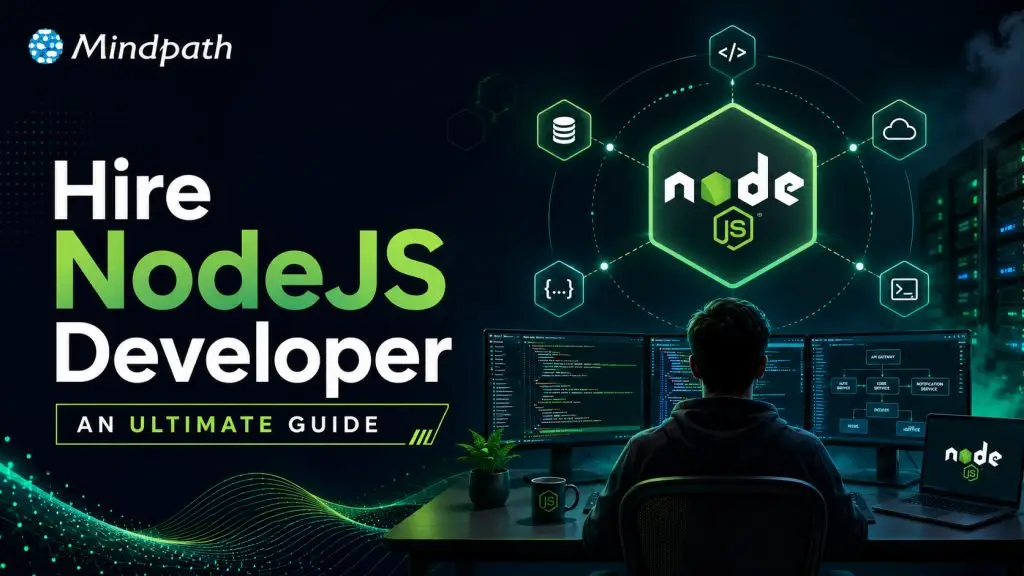
In today’s digital-first economy, companies are always under pressure to make apps that work well, can grow, and work in real time. Backend technology is very important for success, whether a startup is making its first product or a big company is updating its old systems. Node.js is one of the most popular backend technologies for making apps that can grow and run quickly.
Because of this, businesses all over the world are looking for NodeJS developers who can use this powerful runtime environment to make apps for the web and mobile devices. You can’t just hire someone who knows Node.js. You should make a plan, decide what skills you need, think about how much it will cost, and choose the best way to hire people.
This full guide will teach you everything you need to know about hiring a Node.js developer, including why companies like Node.js, what skills to look for, how to hire someone, how much it will cost, and the best ways to make sure your project is done on time.
Looking to turn your project idea into a powerful digital solution? Mindpath provides professional services where you can hire expert NodeJS developers for scalable and customized development.
Understanding Node.js: A Brief Overview
Node.js is a free, cross-platform runtime environment that lets developers run JavaScript on the server side. It uses Google’s V8 engine and is known for being fast and able to handle a lot of connections at once.
Everyone knows that Node.js has an event-driven, non-blocking I/O architecture. It lets Node.js handle more than one request at a time without having to wait for the first one to finish. This is great for apps that need to be able to grow quickly and work in real time.
Node.js doesn’t use more than one thread like other server-side languages do. It has an event loop and a model that only uses one thread. This speeds things up and cuts down on extra work, especially for apps that do a lot of input and output, like APIs, streaming platforms, and chat apps.
Node.js also supports the idea of “JavaScript everywhere,” which means that developers can write both the front end and the back end in the same language. This makes it easier to work together, makes projects less complicated, and makes it easier to develop.
Also Read: Advantages of NodeJS
Why Businesses Choose to Hire NodeJS Developers?
It’s not a coincidence that more and more people want Node.js; it really helps businesses. There are many good reasons for businesses to hire NodeJS developers.
1. Exceptional Scalability
Node.js can handle thousands of connections at once without getting slower. Apps stay responsive even when they’re under a lot of stress because of how they’re built. This is great for platforms that can grow, like e-commerce sites, SaaS apps, and social media sites.
2. High Performance
Node.js uses the V8 engine to turn JavaScript into machine code, which makes the program run faster. Node.js apps are popular because they are fast and responsive, which is how they work.
3. Real-Time Application Capabilities
Node.js is used a lot for chat programs, tools for working together, and online games that need to work right away. It is a great choice for apps that need live updates because it can process data right away.
4. Rich Ecosystem (NPM)
Node Package Manager (NPM) gives Node.js one of the biggest collections of open-source libraries. There are over a million packages available, so developers can save time by using pre-made modules instead of making everything from scratch.
5. Cost-Effective Development
Using Node.js can help businesses save a lot of money on development. You won’t need as many separate development teams if you use JavaScript for both the front end and the back end. Companies can also hire NodeJS developers who work from home in places where costs are lower and still get good work.
6. Strong Community Support
A lot of developers are always working on Node.js and adding to it. This makes sure you get regular updates, better security, and a lot of help and information.
Types of NodeJS Developers You Can Hire
It’s important to know what levels of experience a NodeJS developer has and what they can do for you before you hire them.
1. Junior NodeJS Developers (0 to 2 Years):
Most of the time, junior developers are new to the field and only know the basics of JavaScript and Node.js. They can do basic tasks like writing simple APIs, fixing bugs in code, and helping more experienced developers. They do best when they work on small projects or with a group.
2. Mid-Level NodeJS Developers (2–5 Years):
Mid-level developers have already built applications and navigated databases, APIs, and frameworks. They’re capable of independent work, contributing to architectural decisions, and tackling moderately complex tasks.
3. Senior NodeJS Developers (5+ Years):
Senior developers know a lot about how to build systems, improve their performance, and make them bigger. They can manage teams, choose the architecture, and make sure that development follows best practices. For big or important projects, it’s very important to hire senior developers.
Must-Have NodeJS Developer Skills
If you want to hire good NodeJS developers, you need to look at both their technical and soft skills.
1. Proficiency in JavaScript and TypeScript
Node.js is built on JavaScript, so developers need to know a lot about ES6+ features, promises, callbacks, and asynchronous programming. When you want to make apps that can grow, it’s helpful to know TypeScript.
2. Experience with Node.js Frameworks
Frameworks like Express.js, NestJS, and Koa help you build things faster. At least one of these frameworks should be known by a good developer.
3. Database Management Skills
Node.js developers should know how to use both SQL databases, like MySQL and PostgreSQL, and NoSQL databases, like MongoDB. It’s important to know how to model data and make queries work better.
4. API Development and Integration
One of the most important things Node.js developers do is build and connect RESTful APIs. Knowing GraphQL is also becoming more and more useful.
5. Understanding of DevOps and Cloud Platforms
People who work in modern development need to know how to use tools like Docker and Kubernetes, as well as cloud platforms like AWS, Azure, and Google Cloud.
6. Version Control Systems
If you want to work together on development, you need to know how to use Git and sites like GitHub or GitLab.
7. Problem-Solving and Communication Skills
You need more than just technical skills. Developers need to be able to communicate clearly, understand what the project needs, and fix problems right away.
Hiring Models: Choosing the Right Approach
When you hire dedicated NodeJS developers, it’s very important to pick the right hiring model.
1. Freelancers
Freelancers are great for short-term jobs or jobs that need to be done quickly. They might not stick around for long, but they can help you save money and give you more options.
2. In-House Developers
Full-time, in-house developers are easier to manage, talk to, and work with. But it costs more, like building things, paying people, and giving them benefits.
3. Outsourcing to Agencies
When companies outsource, they can quickly add to their teams and hire people who have already been checked out by other companies. It’s a good choice for businesses that want to focus on their main tasks.
4. Dedicated Developers
With a dedicated developer, you get the best of both worlds: they only work on your project. Many individuals opt for this approach when embarking on lengthy projects.
Step-by-Step Process to Hire NodeJS Developers
A structured hiring process makes it easier to find the right people.
Step 1: Define Your Requirements
Start by clearly outlining your project goals, scope, and expected outcomes. Identify the type of application you want to build, whether it’s a real-time platform, API, or web application. Define the required technologies, level of expertise (junior, mid, senior), and project timeline. A well-defined requirement helps you attract the right candidates and avoids confusion later in the hiring process.
Step 2: Choose the Right Hiring Model
Decide how you want to hire based on your project needs and budget. You can choose freelancers for short-term or small tasks, in-house developers for long-term collaboration, or outsource the project to a NodeJS development company for end-to-end solutions. Each model has its own advantages, so selecting the right one ensures better efficiency and cost management.
Step 3: Create a Detailed Job Description
Write a clear and comprehensive job description that includes required technical skills (JavaScript, NodeJS frameworks, APIs), experience level, roles, responsibilities, and expectations. Mention project details, work environment, and deliverables. A strong job description helps filter out unqualified candidates and attracts the right talent.
Step 4: Source Candidates Effectively
Use multiple platforms to find qualified developers. You can explore job portals, freelance platforms, LinkedIn, developer communities, and NodeJS development agencies. Leveraging different channels increases your chances of finding experienced and reliable candidates.
Step 5: Conduct Technical Screening
Evaluate candidates through coding tests, technical interviews, and portfolio reviews. Assess their understanding of NodeJS concepts, API development, database handling, and problem-solving skills. Real-world tasks or assignments can help you understand how they approach practical challenges.
Step 6: Assess Soft Skills
Technical knowledge alone is not enough. Evaluate communication skills, teamwork, adaptability, and time management. A developer with strong soft skills can collaborate effectively, understand business requirements, and contribute to a positive work environment.
Step 7: Finalize and Onboard
Once you select the right candidate, complete the hiring process with proper documentation, contracts, and onboarding. Provide clear guidelines, tools, and access to resources so they can start working efficiently. A smooth onboarding process ensures faster integration and better productivity.
Cost of Hiring NodeJS Developers
There are many things that affect the cost of hiring a NodeJS developer, such as their experience, where they live, and how you want to hire them.
1. Hourly Rates (USA)
(Based on U.S. Bureau of Labor Statistics data)
- Junior Developers: $22–$30/hour
- Mid-Level Developers: $30–$55/hour
- Senior Developers: $55–$75+/hour
2. Annual Salaries (USA)
(Source: U.S. Bureau of Labor Statistics)
- Junior: ~$48,000 – $70,000
- Mid-Level: ~$80,000 – $110,000
- Senior: $120,000 – $160,000+
Factors Affecting Cost
- Developer experience
- Project complexity
- Geographic location
- Engagement model
You can save a lot of money by hiring developers from India or Eastern Europe, and the work will still be good.
Where to Hire NodeJS Developers
Depending on what you need, you can hire NodeJS developers from a number of places.
1. Job Portals
LinkedIn, Indeed, and Stack Overflow are just a few of the places where you can find full-time developers.
2. Freelance Platforms
Freelancers from all over the world work on Upwork, Toptal, and Fiverr.
3. Development Agencies
Agencies often bring back developers they’ve previously collaborated with, streamlining the hiring process. This method is generally faster and less of a hassle.
4. Developer Communities
You can find good developers and see what they’ve done on GitHub, in tech forums, and at meetups.
Benefits of Hiring Dedicated NodeJS Developers
When you hire dedicated developers, you gain several advantages:
- Full commitment to your project
- Faster development cycles
- Better communication and collaboration
- Scalability and flexibility
In addition, dedicated NodeJS developers offer the following benefits:
1. Consistent focus and productivity
Dedicated developers work exclusively on your project, ensuring steady progress and minimal distractions.
2. Better understanding of your business needs
Over time, they gain deeper insights into your goals, leading to more tailored and effective solutions.
3. Improved code quality and maintainability
Continuous involvement helps maintain coding standards, resulting in cleaner and more reliable code.
4. Faster issue resolution and support
Since they are fully involved, bugs and issues are identified and resolved quickly.
5. Seamless team integration
Dedicated developers act as an extension of your in-house team, aligning with your workflows and tools.
6. Cost efficiency in the long run
Reduces overhead costs related to hiring, training, and managing multiple resources.
7. Greater control and transparency
You have direct communication and visibility over progress, timelines, and deliverables.
Dedicated developers act as an extension of your in-house team, ensuring consistent progress and high-quality results.
However, while hiring dedicated NodeJS developers, businesses should also be aware of common mistakes that can impact project success:
- Not defining clear requirements
- Hiring based solely on cost
- Ignoring communication and soft skills
- Skipping technical evaluations
- Choosing the wrong hiring model
Avoiding these mistakes ensures that you not only hire the right talent but also maximize the benefits of working with dedicated developers.
Ready to Hire the Right NodeJS Developer for Your Project?
Choosing the right Node.js developer is a big deal; the person you pick can make or break your project’s chances. Every step of the way is important, from grasping the technology to evaluating what candidates can do and figuring out the best way to hire them.
This guide provides a comprehensive overview, helping you navigate the decision-making process: should you bring on remote NodeJS developers, assemble your own team, or outsource the project entirely?
Businesses can hire expert NodeJS developers to make high-performance, scalable apps that help them grow if they follow best practices and put quality ahead of cost.
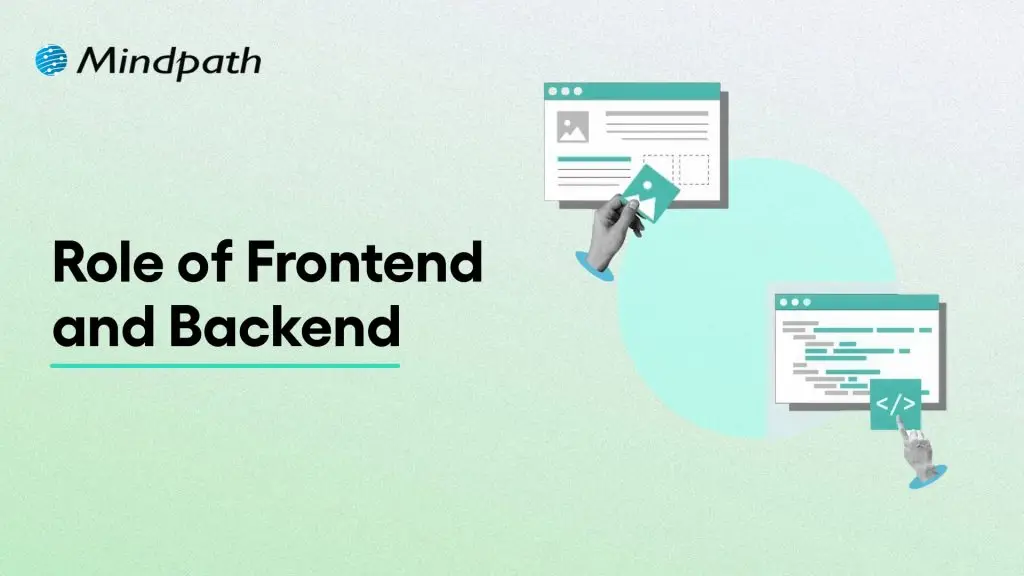
Building a scalable business application requires more than an attractive user interface or a powerful server. Businesses need both layers to work together effectively. The frontend and backend serve different purposes, but their integration influences application performance, security, usability, and the ability to support growing business needs.
The frontend manages what users see and interact with, while the backend handles business logic, data processing, authentication, and communication with databases and other services. When these layers are designed around clear responsibilities and reliable communication, businesses can build applications that are easier to maintain, extend, and scale.
Key Takeaways
- 01
The frontend delivers the user interface and interactions, while the backend manages business logic, data access, and server-side processing. - 02
APIs enable the frontend and backend to exchange data and coordinate application workflows. - 03
Caching, efficient data handling, asynchronous processing, and performance monitoring help applications remain responsive as usage grows. - 04
Security requires coordinated controls across both layers, including server-side authorization, input validation, secure sessions, and safe data handling. - 05
Choosing an appropriate architecture depends on business requirements, expected traffic, system complexity, budget, and long-term maintenance needs.
What are Frontend and Backend Development?
What Is Frontend Development?
Frontend development focuses on the parts of an application that users see and interact with. It includes page layouts, navigation, buttons, forms, dashboards, visual elements, and responsive behavior across different screen sizes.
Frontend developers use technologies such as HTML, CSS, and JavaScript, along with libraries and frameworks such as React, Angular, and Vue.js. Their work helps ensure that users can navigate the application, complete tasks, and access information through a clear and consistent interface.
For a business application, the frontend might include a customer dashboard, a product catalog, an account settings page, or an employee management interface. The design should consider usability, accessibility, responsiveness, and the needs of the intended users.
What Is Backend Development?
Backend development focuses on the server-side systems that process requests, enforce business rules, manage data, and connect applications with other services. It supports the operations users rely on when they sign in, submit a form, place an order, or retrieve information.
Backend developers may use technologies such as Node.js, Python, Java, PHP, and Ruby, alongside databases such as PostgreSQL, MySQL, and MongoDB. The appropriate technology depends on the application’s data model, performance requirements, integrations, team expertise, and operational constraints.
For example, when a customer submits an order, the backend can validate the request, check product availability, apply business rules, coordinate payment processing, and store the order record. The frontend then displays the relevant result to the customer.
To understand how the different development roles compare, read our guide to frontend vs. backend developers.
How Frontend and Backend Work Together to Build Scalable Applications
The frontend and backend communicate to turn user actions into application operations. The frontend collects input and presents results, while the backend validates requests, applies business logic, and retrieves or updates data. This interaction must be reliable, secure, and efficient if the application is expected to support more users and more complex workflows.
1. API Communication
Application programming interfaces (APIs) provide defined ways for the frontend and backend to exchange information. The frontend sends requests to backend endpoints, and the backend returns data or a response indicating the result of the operation.
REST APIs and GraphQL are two common approaches to application data communication. Depending on the requirements, systems may also use WebSockets or other communication patterns for real-time updates.
For example, an ecommerce frontend may request product information, submit cart updates, and retrieve order details through APIs. The backend checks permissions, validates input, applies business rules, and returns the appropriate response.
Clear API contracts help frontend and backend teams develop independently while reducing integration problems. Teams should document expected data formats, authentication requirements, error responses, and versioning policies.
2. Architecture That Supports Growth
An application’s architecture determines how its components are organized and how they communicate. A modular monolith can be a practical starting point for many business applications because it keeps related functionality in one deployable system while maintaining clear internal boundaries.
For more complex systems, a microservices architecture separates selected business capabilities into independently deployable services. For example, an application might have separate services for payments, user accounts, notifications, and product management.
Microservices can allow teams to scale or deploy specific services independently, but they also introduce additional operational complexity, network communication, monitoring, and data consistency challenges. Businesses should choose this approach when its benefits justify the extra effort rather than treating it as a requirement for every scalable application.
3. Asynchronous Processing
Some application operations take longer than a typical user interaction should require. Examples include generating reports, processing large files, sending bulk notifications, and running complex calculations.
Asynchronous processing allows an application to handle these tasks without making users wait for the entire operation to finish within the original request. A backend may place work in a queue and process it through a background worker while the frontend displays a pending status.
For example, a business dashboard could let a user request a large report, return a confirmation, and notify the user when the report is ready. The implementation should provide clear status updates, error handling, and a way to retry failed operations when appropriate.
4. Efficient Data Handling
The amount and structure of data exchanged between the frontend and backend can affect response times, bandwidth usage, and application responsiveness. Sending more data than a screen requires can increase processing costs and make interfaces feel slow.
Developers can improve data handling by selecting only the necessary fields, using pagination for large result sets, applying suitable filtering and sorting, and avoiding unnecessary API requests. Caching can also reduce repeated work when the data and freshness requirements allow it.
For example, an employee directory with thousands of records can return a limited page of results rather than sending every employee record to the browser. The frontend can request additional pages as users navigate the directory.
Data validation should take place on the backend even when the frontend already checks user input. Client-side validation improves usability, but it cannot replace server-side controls.
5. Scaling Frontend and Backend Resources
As an application gains users, different parts of the system may experience different types of demand. The frontend may need efficient asset delivery and content caching, while the backend may need additional processing capacity, database optimization, or more workers.
Frontend resources can often be delivered through a content delivery network (CDN), while backend services may scale by adding instances or allocating additional computing resources. Database scaling strategies depend on query patterns, data volume, consistency requirements, and the chosen database technology.
Independent scaling can help teams respond to specific bottlenecks, but it requires suitable architecture, monitoring, deployment practices, and capacity planning. A well-designed application scales according to measured demand rather than adding infrastructure without understanding the workload.
6. Secure Communication and Access Control
Security depends on the way the frontend, backend, APIs, databases, and connected services work together. The frontend can provide a secure and understandable sign-in experience, but the backend must enforce authentication and authorization before allowing access to protected resources.
For example, hiding an administrative button in the frontend does not prevent an unauthorized user from attempting to call the underlying API. The backend must verify the user’s permissions for each protected operation.
Important practices include:
- Use HTTPS to protect data transmitted between clients and services.
- Validate and sanitize untrusted input at appropriate system boundaries.
- Enforce authentication and authorization on the backend.
- Store passwords and secrets using suitable security practices; never expose private credentials in frontend code.
- Use parameterized database queries or equivalent protections against injection attacks.
- Manage sessions, tokens, dependencies, and error messages carefully.
- Log relevant security events while avoiding unnecessary exposure of sensitive information.
Security should be considered throughout development rather than added only before launch. Regular testing, dependency updates, access reviews, and incident-response planning help maintain protection as the application evolves.
For additional guidance, read our article on application security best practices.
7. State Management and Data Consistency
Frontend applications often need to manage information such as the current user, selected filters, form values, shopping cart contents, and data retrieved from APIs. State management helps components access and update the information they need in a predictable way.
For smaller applications, built-in React state and context may be sufficient. Larger applications may benefit from dedicated state management or data-fetching libraries, depending on their complexity.
It is important to distinguish temporary frontend state from persistent backend data. The frontend may cache a response or optimistically display an update, but the backend remains responsible for enforcing business rules and persisting authoritative records.
When multiple users can update the same data, the application may also need conflict handling, refresh strategies, or real-time updates to keep information consistent.
8. Performance Optimization Across Both Layers
Application performance is a shared responsibility. A frontend can be slowed by large JavaScript bundles, unoptimized images, excessive rendering, or unnecessary network requests. A backend can be slowed by inefficient database queries, expensive computations, external service delays, or insufficient capacity.
Frontend optimization may include:
- Reducing unnecessary JavaScript and loading code when it is needed.
- Optimizing images, fonts, and other static assets.
- Using appropriate caching and minimizing redundant requests.
- Measuring real user experience and addressing accessibility issues.
Backend optimization may include:
- Analyzing database queries and adding appropriate indexes.
- Caching frequently requested data where safe and useful.
- Moving suitable long-running operations to background workers.
- Setting sensible timeouts, retries, and resource limits for external services.
Teams should measure performance across the full request path. This helps them identify whether delays originate in the browser, network, API, database, or an external dependency.
Read our guide to optimizing React performance for large applications for related frontend performance considerations.
9. Load Balancing and Traffic Management
Load balancing distributes incoming requests across multiple available servers or service instances. It can help a backend handle higher traffic volumes and reduce dependence on a single instance, provided the application and its infrastructure are configured appropriately.
For example, a business application may receive a spike in traffic during a product launch or a promotional campaign. A load balancer can distribute requests across healthy backend instances while monitoring helps the team identify capacity issues.
Load balancing does not remove every bottleneck. Databases, third-party services, shared storage, and application-level limits may still constrain throughput. Businesses should combine traffic management with health checks, capacity planning, suitable caching, and performance monitoring.
10. Centralized Logging, Monitoring, and Observability
When an application spans the browser, APIs, backend services, databases, and third-party systems, identifying the cause of an issue can be difficult without coordinated monitoring.
Frontend monitoring can capture JavaScript errors, failed requests, and user-facing performance issues. Backend monitoring can track API latency, error rates, resource use, database performance, and background job failures.
Centralized logs, metrics, and distributed traces help teams follow a request across different components and identify where a failure or delay occurred. Correlation IDs can help connect related events across services.
Monitoring should also include meaningful alerts and operational procedures. Teams need to know which issues require immediate attention and how to investigate them without collecting unnecessary sensitive user data.
Frontend and Backend: Key Differences
Although frontend and backend development work closely together, their main responsibilities differ. Understanding these differences helps businesses plan teams, select technologies, and define system boundaries.
| Area | Frontend | Backend |
|---|---|---|
| Primary role | Presents the interface and handles user interactions. | Processes requests, enforces business rules, and manages data access. |
| Common technologies | HTML, CSS, JavaScript, React, Angular, Vue.js. | Node.js, Python, Java, PHP, Ruby, and other server technologies. |
| Typical responsibilities | Layouts, navigation, forms, accessibility, and client-side state. | Authentication, authorization, APIs, business logic, and data persistence. |
| Performance priorities | Rendering, asset delivery, responsiveness, and interaction speed. | API latency, database queries, processing capacity, and service reliability. |
| Security responsibilities | Safe interface behavior, appropriate handling of client-side data, and secure communication. | Server-side access control, input validation, secrets management, and data protection. |
The two layers are not completely independent. Decisions about data formats, authentication, caching, rendering, and error handling affect both. Collaboration and clear technical contracts help keep the complete application reliable.
How to Choose the Right Architecture for a Scalable Business Application?
The right architecture depends on the business problem, expected traffic, data requirements, integration needs, available skills, and budget. A small internal tool may need a straightforward application structure, while a complex enterprise platform may require separate services and more advanced operational controls.
1. Define Business and User Requirements
Identify the main workflows, user groups, integrations, data requirements, and expected usage patterns. These details help determine which frontend capabilities and backend responsibilities the application needs.
2. Select Technologies Based on Project Needs
Choose frontend frameworks, backend technologies, and databases according to the required functionality, team expertise, performance targets, and maintenance expectations. Avoid selecting a complex stack solely because it is popular.
3. Define API Contracts and Data Ownership
Document the information exchanged between the frontend and backend, including request formats, responses, errors, authentication, and versioning. Clear contracts help teams work independently and reduce integration issues.
4. Plan for Security and Reliability
Design authentication, authorization, input validation, logging, backup, recovery, and monitoring into the application. Consider how the system will handle failed requests, unavailable dependencies, and unexpected traffic.
5. Scale Based on Measured Demand
Begin with an architecture that matches current requirements while preserving practical options for growth. Use monitoring and load testing to identify bottlenecks before introducing additional infrastructure or splitting the application into multiple services.
6. Plan for Maintenance and Future Enhancements
Include testing, documentation, dependency updates, deployment practices, and ongoing support in the development plan. Maintainable code and clear ownership help businesses evolve the application without making every new feature unnecessarily difficult to deliver.
Why Full-Stack Development Can Help?
Full-stack development brings frontend and backend expertise together within a development team or individual role. This can help teams coordinate interface design, API development, data handling, and integration work across the application.
For businesses, a full-stack approach can be useful when building a new product, integrating existing systems, or extending an application with new functionality. The team still needs clear responsibilities, appropriate specialization, testing, and security reviews to ensure that both layers meet their requirements.
Read more about full-stack development and how it brings frontend and backend work together.
Final Thoughts
The frontend and backend are two essential parts of a modern business application. The frontend shapes how users interact with the product, while the backend handles data, business logic, integrations, and server-side operations. Their coordination influences usability, security, performance, and maintainability.
Businesses planning scalable applications should focus on clear API contracts, efficient data handling, appropriate architecture, coordinated security controls, and reliable monitoring. The best technical approach is the one that fits the application’s actual requirements and can evolve as those requirements change.
At Mindpath, we help businesses plan and build digital products with practical development approaches. Our full-stack development services can support projects that need coordinated frontend and backend expertise, integrations, and maintainable application architecture.
Artificial intelligence is rapidly transforming how the tech world operates, bringing a wave of changes that are reshaping the ways in which professionals work and innovate. The influence of AI redefining job roles in tech can be seen across every corner of the tech industry, where automation and human creativity are coming together to drive smarter, faster, and more efficient ways of building the future. This isn’t about replacing talent; it’s about enabling talent to reach new heights of access and productivity.
Organizations are changing rapidly, and traditional job roles are being redefined. Developers have become strategists, data analysts have become decision-makers, and engineers are collaborating more closely with advanced intelligent systems, leveraging AI in decision-making to drive smarter business outcomes. The pace of change will accelerate, and those who can adapt will lead the next generation of digital expansion. Let’s dive in and examine the impact of AI on the future of work and how it is changing the technology landscape like never before.
As AI transforms the tech workforce, businesses have more ways than ever to scale and innovate. Want to know how? Explore our AI development services to elevate productivity and stay competitive.
The Growing Influence of AI in Today’s Tech Industry
Artificial Intelligence is evolving into a transformational force in the contemporary technology sector. It will alter the ways businesses design products, optimize resource allocation for applications, and provide digital experiences. Companies are utilizing AI to not only automate tasks but also to make informed decisions and create new innovation opportunities. With the rise of AI in business strategy, organizations are now integrating intelligent systems to strengthen planning, improve efficiency, and gain a competitive edge. AI’s influence is extending into every dimension of technology.
A report published by McKinsey stated that the adoption of AI in IT functions increased from 27% to 36% in six months. The report also showed that 71% of organizations that use AI employ generative AI for at least one business function. Additionally, 38% of companies that use AI anticipate their overall workforce to remain the same over the next three years, while IT and product development teams are expected to see growth. This demonstrates the benefits of AI not just in operational efficiency but also in creating new skill-based jobs and redefining job roles in the tech sector, helping humans work more intelligently and strategically.
Must Read: Is Your Business Ready for AI?
How is AI Changing Job Roles?
The impact of artificial intelligence on employment is changing how people do their jobs and how organizations staff their teams. It’s creating new types of opportunities, and it is changing the types of skills that matter the most in today’s tech world. Here are the differences AI is making in job roles across the industry.
1. New Opportunities in AI-Driven Careers
As artificial intelligence expands, the emergence of new specialized careers in technology is beginning to take shape. People are now working as AI trainers, data scientists, and ethics officers, among other roles. These new job roles will be open for a workforce to be smarter and more resourceful going forward.
2. Smarter Work with Automation
AI is taking over repetitive work like data entry, research, and customer support. That frees up professionals to spend more time in the day on creativity, innovation, and decision-making. The trend of AI redefining job roles in tech captures the reshaping of work toward strategic and value-added work.
3. Shifting Skills and Smarter Roles
As AI tools are getting integrated into daily operations, workers are now the ones who supervise, analyze, and enhance the results provided by AI. They are acquiring skills in data interpretation, problem-solving, and collaboration. Their changing duties, thus, emphasize the impact of technology on the restructuring of the old job models.
4. Boosting Productivity Across Teams
AI tools increase both accuracy and speed with tasks like analysis of data and performance management of systems. Teams are now able to work more successfully and with higher levels of accuracy and speed. AI redefining job roles in tech is making the workplace more task efficient and performance focused, a sign of AI transforming the future of work.
5. Growing Value of Human Skills
With AI, handling most of the technical and monotonous tasks, the qualities of creativeness and emotional intelligence have become very important. Essentially, traits such as empathy, communication, and leadership have become the main factors in one’s professional development. These proficiencies are what make it possible for people to be leaders of innovation; thus, they are indispensable.
6. A Changing Job Market Landscape
Artificial intelligence is changing the way companies hire employees and how the workforce is managed. With the help of AI, recruiters can find the right candidates in less time and then focus on valuable interaction with the candidates. The AI redefining job roles in tech trend is an indication that the two, people and technology, are evolving hand in hand to build up the future workforce that will be more powerful.
Wondering how your business can actually implement these AI capabilities without overwhelming your team? Explore our detailed guide on AI consulting services explains how expert support can simplify adoption and accelerate results.
AI Job Roles in Tech
The increase of AI job opportunities in technology is changing how workers build careers and how innovation will occur. AI continues to expand and is also creating jobs that integrate technology, creativity, and human thinking.
1. Building Smarter Systems
Artificial intelligence (AI) engineers develop smart systems that enable businesses to become more efficient and intelligent in their processes. They build responsive solutions using machine learning and automation that will evolve and get better with time.
2. Turning Data into Decisions
Researchers and analysts work on research and analyze information gathered through AI tools. They provide companies with better decisions by leading them from complex data to business insights. Their work is essential across sectors, from finance to AI for customer services, where data-driven insights improve customer interactions.
3. Training the Machines
AI teachers and trainers help create guidelines for learning for AI systems. Their work guarantees that every algorithm works perfectly and aids actual applications.
4. Designing Better Algorithms
Algorithm engineers develop and improve algorithms that power features such as recommendations and predictions. They partner with software engineers and data scientists to implement efficient and precise models.
5. Leading AI Product Development
AI product managers handle the end-to-end development of AI solutions. They ensure those solutions support user needs, can scale across an organization’s technology stack, and support business objectives, demonstrating how AI is redefining job roles in tech and advancing growth across fields. Their contributions help drive advancements in multiple industries, including AI in e-commerce, where product managers shape smarter and more personalized shopping experiences.
Want to see how AI is reshaping not just tech jobs but also the way websites are built? Our blog on AI in Web Development breaks down how intelligent automation is transforming the entire development workflow.
Ready to Embrace the Future of AI in Tech?
Artificial intelligence has a vital role in changing the way we work, learn, and develop in the technology space. The trend of AI redefining job roles in technology shows how human creativity and machine intelligence can work together to build a smarter future. The individuals who adapt and retrain today will confidently participate in tomorrow’s digital transformation.
At Mindpath, we develop cutting-edge AI development solutions that help businesses grow faster and work smarter. Our skilled team focuses on developing intelligent systems that automate processes, apply data analysis, and improve decision-making. We help our clients leverage AI technology, allowing them to remain competitive in an ever-evolving technology-based world while achieving digital success that will last for a long time.
Every day, AI in mobile apps revolutionizes user interaction with technology. Just think of a single application that understands your behavior, foresees your requirements, and adjusts its capabilities for a smooth and unique experience. Enterprises are equipped with smart features such as conversational agents, personalized algorithms, and speech assistants to attract user interaction in a better way. As a result, regular applications are becoming intelligent friends that facilitate actions and offer answers that are convenient and timely.
Beyond convenience, AI in application development brings innovation and returns efficiency. In a nutshell, developers can analyze real-time data, discover patterns, and tailor personalized experiences for users. This keeps them more engaged for longer periods. Companies can gain insight into users through actionable data, while users enjoy quicker, seamless, and more meaningful interactions. As the future of AI continues to unfold, this new progress opens the doors to new opportunities in retailing, healthcare, education, and entertainment. This article shall delve into the positive impacts, utilization, and practical scenarios of AI in mobile apps. So, keep reading further!
Ready to bring AI into your mobile app development, but confused about where to start? Mindpath provides full guidance on mobile app development services to help you gain user attraction and create powerful digital experiences.
Evolution of AI in Mobile App Development
AI in mobile app evolution has changed the design of simple user tools into smart, user-engagement-focused experiences. The earliest examples of AI in mobile applications were predictive text and basic speech recognition. Later, mid-level AI brought in personalized recommendations, more intelligent search functions, and AI-enabled chatbots. All these technological innovations enabled user-behavior apps to comprehend and reply to users without wasting time.
Currently, artificial intelligence in mobile applications powers advanced features such as real-time analytics, augmented reality, and the ability for apps to operate autonomously. Besides, AI dramatically simplifies the development process through automatic testing, code generation, and cross-platform integration. These innovations reflect the consistent trend of AI eventually transforming mobile into more intelligent, rapid, and personalized user experiences. Hence, app usage is becoming a natural part of daily life.
Looking to understand how mobile apps can enhance the impact of AI and unlock greater value for your business? Discover more insights in our blog on the Mobile App Development, which benefits your business by improving customer engagement and driving measurable growth.
Benefits of Artificial Intelligence in Mobile Apps
AI-enabled mobile app development is a game-changer as it opens opportunities for intuitive, personalized and efficient apps. Developers can thus use smart features to build apps that not only attract users but also make their routine tasks effortless.
1. Tailored Experiences for Users
Mobile applications powered by Artificial Intelligence will eventually have the capability to study user behavior and preferences. This allows them to offer customized content and recommendations. As a result, the applications will be more engaging. Users will also have a custom-made experience that gives them the impression that the entire thing is just for them.
2. Stronger Security Measures
AI is one of the factors that revolutionize the environment of mobile applications. It helps uncover unconventional user behaviour patterns with the aid of artificial intelligence technology. This can help prevent unauthorized access and ensure the safety of the data. If you associate with a firm that is proficient in AI app development, then you will have security protocols implemented in a proper way.
3. Instant Customer Support
AI-driven virtual assistants solve problems right away, thus increasing user delight. Consequently, the need for human support is made smaller. At the same time, the speed and correctness of the answers are maintained.
4. Smarter Search and Navigation
The power of AI allows applications to interpret voice inputs, pictures and even the users’ thoughts in order to deliver more accurate search results. Thus, users are able to locate their desired items in less time. This means the experience is more fluid and user-friendly.
5. Predicting Trends and Behavior
AI in mobile apps is capable of studying user actions that were performed in the past. It can use this information to predict their future inclinations and the general trend of the market. Thus, enterprises will be able to have a clearer vision of the suitable decisions to take. This can further promote the involvement of clients.
6. Streamlined Tasks and Efficiency
Artificial intelligence can automate the execution of monotonous operations that include scheduling, setting of reminders, data handling, and so on. This saves valuable time and eliminates errors. A company can utilize AI app ideas to create apps that are both quality-excellence and user-friendly.
Curious how mobile apps can leverage AI to transform your business and stay ahead in 2025? Explore our blog on Mobile App Development Trends to discover how these innovations can enhance user experiences.
Use Cases of AI in Mobile App Development
Artificial Intelligence is transforming how mobile applications function and enabling them to become smarter, faster, and more adaptable. The use of artificial intelligence in mobile application development is progressing. It also promotes opportunities for interesting new applications across industries.
1. Personalized Content and Recommendations
AI in mobile apps can use advanced data analytics of users’ intent and behaviors to formulate personalized content and product recommendations and offerings. By suggesting items or services they might like, apps proactively enhance user engagement and satisfaction. They also help businesses utilize data to make informed decisions.
2. Intelligent Virtual Assistants
Applications incorporate artificial intelligence technology for mobile app development, and voice assistants now exist that can take user directions. These voice assistants can help navigate tasks quickly without even using your hands. They allow faster access to information and can speed up your daily tasks.
3. Automated Task Management
AI takes over basic responsibilities, such as scheduling and reminders or the organization of emails from mobile applications. This increases efficiency and minimizes the time a user will spend on monotonous tasks.
4. Enhanced Security and Fraud Detection
AI in mobile apps identifies unusual patterns of user behaviour and prevents fraud from happening right away. Businesses can leverage advanced monitoring and threat detection functionality to safeguard sensitive information and ensure user safety.
5. Industry-Specific Smart Solutions
Artificial intelligence powers the development of applications in the healthcare, finance, and e-commerce arenas. These applications can provide personalized services, forecasts, and automation. Working with an AI application development company can help ensure applications comply with industry standards while also improving the user experience.
Want to make sure that your applications are not only functional but also secure, compliant, and trustworthy for your users? Discover our blog on application security best practices to explore essential techniques for protecting your software and building trust.
Real-World AI in Mobile Application Examples
AI in mobile apps is transforming everyday interactions by making them smarter, faster, and more intuitive. Real-world examples show how AI improves user experiences, streamlines tasks, and delivers personalized solutions across different industries.
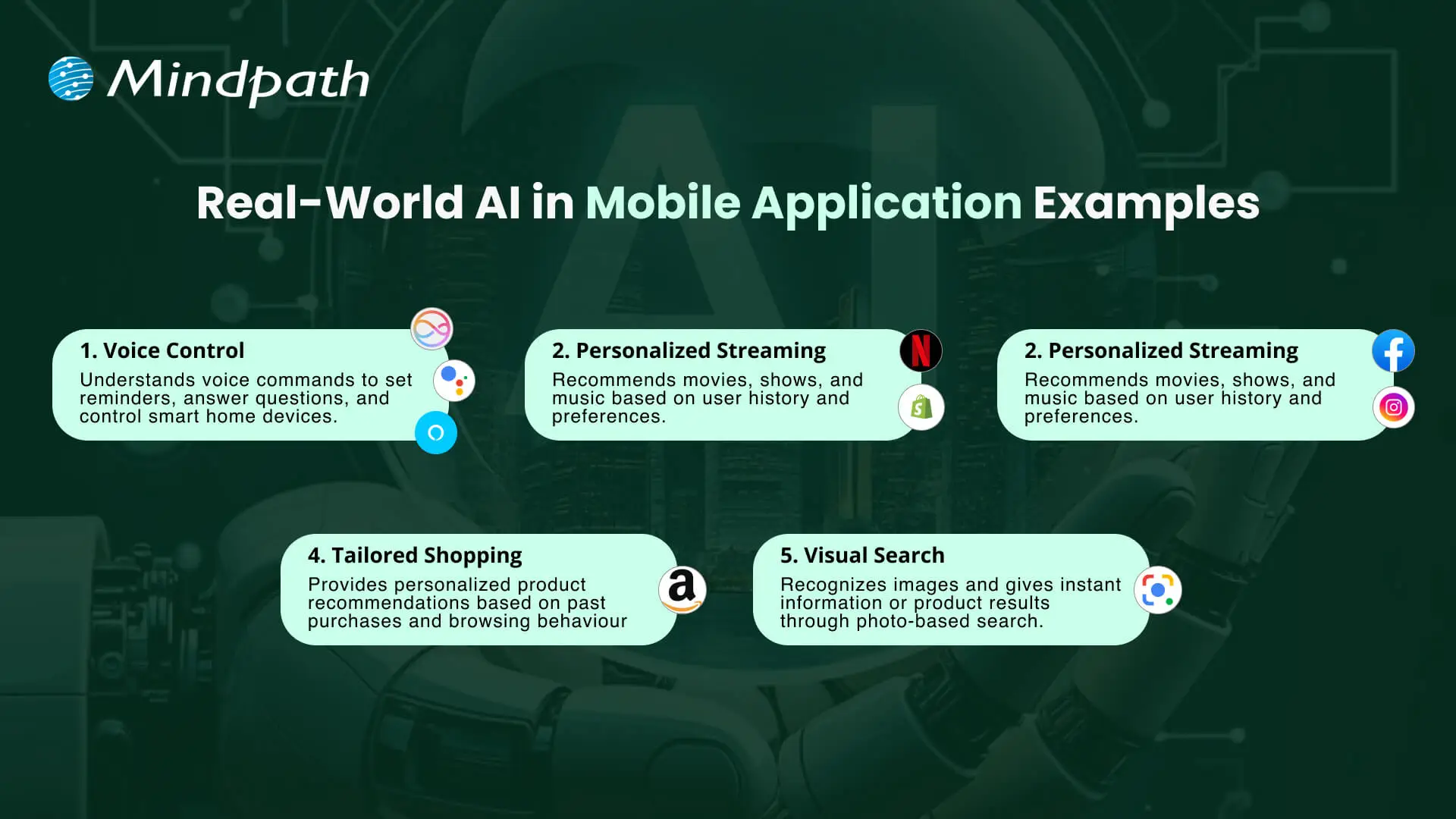
1. Voice Control with Siri, Google Assistant, and Alexa
These virtual assistants use artificial intelligence in mobile applications to understand voice commands and perform tasks like setting reminders or controlling smart home devices.
2. Personalized Streaming on Netflix and Spotify
Streaming apps use AI in mobile apps to analyze user behavior and recommend movies, shows, or music that match individual preferences.
3. Smart Social Feeds on Facebook and Instagram
Social media platforms use AI mobile app development to personalize news feeds and suggest relevant content, friends, and groups for each user.
4. Tailored Shopping on Amazon
Amazon uses AI in mobile apps to recommend products based on browsing history and past purchases. This creates a personalized shopping experience.
5. Visual Search with Google Lens
Google Lens uses AI technology for mobile app development to recognize images and provide instant results through photo-based searches.
Want to build a mobile app but don’t know which technology to use for better execution? Learn from the mobile app development technologies blog to understand what suits best for your business.
Ready to Build Smarter Mobile Apps with AI?
The use of AI in mobile apps introduces new opportunities for businesses and users. This advancement creates great user experiences, strengthens security, and provides more effective daily interaction. As industries pursue innovation, apps will work smarter and adapt more quickly. They will also become infinitely personal, helping brands engage with users in meaningful and authentic ways.
Working with Mindpath gives organizations access to superior AI mobile application development services built for measurement. We build intelligent, fast, and user-friendly applications to support your organizational priorities. In addition, we provide a blend of strategy, innovation, and technology to design digital solutions that drive growth and maintain user engagement.

Mobile app development technologies are important in the fast-paced environment of technology because they define how companies engage with users and keep them engaged. Each swipe, tap, and click is based on technology that is getting faster, smarter, and more interactive. If you’ve ever noticed, some apps feel effortlessly smooth, and others do not. The difference is usually related to the frameworks and platforms chosen for the business objectives and user expectations, and understanding these technologies provides a big advantage over others.
Delving into the newest trends in mobile application development often presents a plethora of choices that can seem confusing. However, choosing the appropriate technology can improve app performance, security, and the overall user experience. Developers routinely test technologies, frameworks, languages, and software solutions to create apps that can more easily rise above the fray. In this blog, we will explore the latest trends and the specific technologies that power the successful mobile app today.
Want to use top mobile app development technologies into a functional app? Mindpath offers mobile app development services, which will turn your imagination into a fully working, high-quality app.
What are Mobile App Development Technologies?
Mobile app development technologies are the programming languages, frameworks, and tools used to design, build, and deploy software applications for smartphones and tablets. These technologies enable developers to create compatible applications that run across platforms such as Android and iOS, while determining core factors like performance, development speed, and overall project budget.
The landscape of mobile development technologies broadly falls into two primary categories: native (platform-specific) tools and cross-platform frameworks, along with supporting backend services. The combination of these tools enables the development of applications that provide rich user experiences, work with cloud services, and utilize the native features provided by the device. Choosing the appropriate technology allows developers to build all of these easily, efficiently, and in a scalable way.
Also Read: AI in Mobile Apps
Top Mobile App Development Technologies in 2026
In order to remain competitive as an app developer, it is important to stay informed about the best technology for mobile app development in 2026. The choice of development tools can positively affect the performance, usability, and scalability of modern applications.
1. Flutter 3.22
Flutter 3.22 is a highly favored mobile app development platform to help developers develop applications for mobile devices, the web, desktop, and embedded devices. It provides high-performance and smooth animations that allow applications to run quickly and feel responsive. Developers also appreciate its professionally designed UI components, making it easy for developers to create stunning and consistent user interfaces.
2. Kotlin Multiplatform Mobile (KMM)
Kotlin Multiplatform Mobile (KMM) is a mobile app development framework that allows developers to share code for Android and iOS apps. It utilizes the modern, efficient programming language Kotlin to simplify the process of creating a mobile app for two platforms at once. This translates into a significant time saving, might help to reduce errors, and assure consistent behavior across your Android and iOS devices.
3. C++
C++ is among the most robust mobile app development technologies currently available for building high-performance applications. It enables developers to take direct control of system resources, which is often favored for complex applications or graphics-intensive applications. Also, by using C++, you can rest assured your apps are running as efficiently as possible, even as they traverse between different platforms.
4. Swift
Swift, a mobile application technology developed by Apple, is for building native iOS applications. It is fast, safe, and reliable, while also allowing seamless integration into AI and machine learning. With Swift, developers can build iPhone and iPad apps that are fast, safe, and modern.
5. AR/VR Integration Tools
AR/VR integration tools are tools for mobile app development that help developers add augmented reality and virtual reality features to an app. Integrating augmented and virtual reality features into apps is a valuable way to engage users while making an experience much more entertaining or immersive. These integrations are extremely popular in gaming and even found in some education and retail apps to enhance user experiences.
Ready to build smart mobile apps, but still wondering how AI can transform your development approach? Discover our blog on the benefits of AI in mobile app development to understand how AI can reshape modern app development.
6. AI-Assisted Development Tools
AI-Assisted Development Tools refer to tools such as GitHub Copilot and Amazon CodeWhisperer that support the automation of coding tasks. They streamline developers’ efforts in application development through code suggestions, error detection, and execution of tests. The upshot is that developers can create apps faster and also more efficiently.
7. React Native
React Native is another top mobile app development technology that enables developers to create apps for both iOS and Android using JavaScript. It provides a native look and feels with one complete codebase, reducing development time and duplication of effort. Companies are drawn to React Native because of its quick development period and strong support from the community.
8. Ionic
Ionic is a hybrid app framework and is a popular option among mobile app development technologies, allowing developers to write cross-platform apps using HTML, CSS, and JavaScript. It allows developers to write one codebase to operate on multiple devices. Ionic is very much favored by developers to create efficient and visually striking apps.
9. NativeScript
NativeScript is a flexible framework that matches the up-to-date trends in mobile application development with the ability to create fully native apps using JavaScript, TypeScript, Angular, or Vue.js. With NativeScript, you have full access to the native APIs offered by the OS, meaning that your application will work and perform like a truly native solution. NativeScript enables developers to build highly efficient and rich-featured mobile applications.
10. Xamarin (.NET MAUI)
Xamarin (.NET MAUI) is a framework aligned with mobile app development trends through the creation of native apps for Android, iOS, Windows, and macOS. While using C# and the .NET ecosystem, developers can share code and have a consistent experience across all platforms. Overall, this reduces development time, and provides high-quality apps.
Want to understand where custom mobile applications are creating real competitive advantages across the market? Discover our blog on the Custom Mobile Application Development Services to uncover high-impact opportunities and emerging trends.
Ready to Build the Next Successful Mobile App?
Mobile app development technologies continue to evolve, offering smarter tools and faster frameworks to help developers create better apps. Choosing the appropriate technology guarantees improved performance, security, and scalability. With the growth of innovation, staying up to date with current tools is critical for a company to provide seamless and engaging mobile experiences.
At Mindpath, we provide expert mobile app development services intended to turn your ideas into strong digital solutions. Our experienced developers create secure, high-performing, and easy-to-use applications by applying modern tools and proven approaches. Partner with us to build an app that empowers your brand and creates long-lasting value for your users.
Web design and development services help businesses build websites that do more than establish an online presence. A well-planned website makes it easier for customers to understand your offerings, find relevant information, contact your team, and complete important actions. Its design, functionality, performance, and security all influence how people interact with your business.
Professional web design and development bring visual design, user experience, technical implementation, and business strategy together. Whether you need a corporate website, an e-commerce platform, or a custom web application, the right approach can support customer acquisition, operational efficiency, and long-term growth.
Key Takeaways
- 01
Professional web design and development services combine usability, visual consistency, and technical functionality to support business goals. - 02
A responsive, accessible, and fast website helps customers navigate content and complete tasks across devices. - 03
Custom functionality, secure integrations, and scalable architecture can help a website adapt as business requirements change. - 04
Website performance, clear calls to action, and intuitive navigation can support lead generation and conversions, but results depend on the overall customer journey. - 05
Choosing the right development partner requires evaluating technical expertise, security practices, communication, maintenance, and long-term costs.
What are Web Design and Development Services?
Web design and development services cover the planning, design, construction, testing, launch, and ongoing improvement of websites and web applications. Web design focuses on the visual presentation and user experience, while web development implements the functionality, integrations, and technical systems that make a website work.
Depending on the project, these services may include website strategy, information architecture, UI/UX design, front-end development, backend development, content management systems, e-commerce functionality, accessibility, performance optimization, security, and ongoing maintenance.
| Service area | What it covers | Business purpose |
|---|---|---|
| Website strategy | Goals, audiences, requirements, and site structure | Align the website with business priorities |
| UI/UX design | Layouts, navigation, visual hierarchy, and interactions | Make information and tasks easier to understand |
| Front-end development | Responsive interfaces and browser interactions | Deliver a usable customer-facing experience |
| Backend development | Business logic, databases, APIs, and server-side functionality | Support website operations and data processing |
| Integrations | CRM platforms, payment gateways, and third-party systems | Connect website activity with business workflows |
| Maintenance | Updates, monitoring, bug fixes, and security improvements | Keep the website reliable over time |
The exact scope depends on the website’s complexity, business model, and technical requirements. A simple corporate website may need a different combination of services than a large e-commerce platform or an application with user accounts and complex integrations.
7 Key Benefits of Professional Web Design and Development Services
Professional web design and development can help businesses create a stronger digital presence when the website is built around clear user needs and measurable business objectives. The following benefits explain how thoughtful design and reliable engineering can support growth.
1. A Better User Experience
A website should help visitors find information and complete tasks without unnecessary effort. Professional design teams organize content, create clear navigation, establish visual hierarchy, and design interfaces around the needs of the target audience.
For example, a B2B company can organize its service pages around customer problems, explain its capabilities clearly, and make consultation requests easy to find. An e-commerce business can simplify product discovery, filtering, and checkout.
A consistent experience across mobile phones, tablets, and desktops also helps users interact with the website in the way that suits them.
Business impact: Easier navigation, fewer usability obstacles, and a clearer path from the first visit to the desired action.
2. Scalability as Your Business Grows
Business requirements change over time. A website may need additional service pages, new markets, customer portals, e-commerce capabilities, or integrations with internal systems. A suitable architecture makes these changes easier to plan and implement.
Professional developers assess expected traffic, content management needs, integration requirements, and future functionality before selecting a technical approach. Depending on the project, this may involve a content management system, a custom application architecture, or modular components that can be extended as requirements evolve.
Scalability does not mean choosing the most complex technology from the beginning. It means building an appropriate foundation that can accommodate realistic growth without unnecessary expense.
Business impact: A website that can adapt to new services, changing workflows, and additional functionality with a manageable level of rework.
3. Improved Website Performance
Website speed and responsiveness affect how easily visitors browse content, interact with forms, and complete transactions. Professional development teams can identify performance bottlenecks and address issues involving large images, excessive JavaScript, unnecessary requests, caching, and inefficient rendering.
Performance work should be based on measurement rather than assumptions. Teams can use real-user monitoring, browser tools, and Core Web Vitals reports to identify pages and interactions that need attention.
- Optimize image dimensions and delivery formats.
- Reduce unnecessary scripts and dependencies.
- Use caching and content delivery techniques where appropriate.
- Load non-essential resources only when needed.
- Monitor loading, responsiveness, and visual stability after launch.
Business impact: Faster, more responsive experiences that help visitors complete important tasks with less friction.
4. Stronger Security and Reliability
Websites may process contact information, customer records, account credentials, payments, and other sensitive data. Professional development practices help reduce risks through secure implementation, appropriate access controls, dependency management, and ongoing maintenance.
Security measures may include HTTPS, secure authentication, input validation, authorization checks, protected secrets, dependency updates, logging, backups, and monitoring. The specific controls depend on the application’s architecture and the sensitivity of the information it handles.
Security is not a one-time feature. Software dependencies, infrastructure, and threats change, so businesses need a plan for updates, incident response, and recovery.
Business impact: Better protection for customer information, reduced exposure to preventable vulnerabilities, and more reliable website operations.
5. Integration With Business Systems
A website becomes more useful when it connects to the systems that support daily operations. Professional development teams can integrate websites with CRM platforms, payment gateways, marketing tools, inventory systems, analytics platforms, and internal APIs when the requirements and available interfaces support those connections.
For example, a service business can send qualified form submissions to its CRM, while an online store can connect product availability and order information to inventory systems. These integrations can reduce duplicate data entry and improve visibility across business processes.
Integrations should include appropriate authentication, error handling, data validation, and monitoring. A poorly implemented connection can introduce operational risks even when the website’s interface appears to work correctly.
Business impact: More connected workflows, reduced manual administration, and better coordination between website activity and internal systems.
6. Better Lead Generation and Conversion Opportunities
A business website often supports specific actions, such as requesting a consultation, submitting an inquiry, booking a demonstration, or completing a purchase. Professional design and development help make these actions clear and reduce unnecessary steps.
Effective conversion-focused design includes relevant messaging, visible calls to action, trustworthy information, usable forms, and clear explanations of products or services. Teams can also use analytics and controlled experiments to identify where visitors abandon a journey.
A redesigned website does not automatically generate more revenue. Results depend on factors such as audience quality, offer relevance, pricing, traffic sources, sales follow-up, and the wider customer experience.
Business impact: A clearer path to inquiries and purchases, with measurable opportunities to improve conversion rates.
7. A Distinct and Consistent Brand Identity
A website communicates a company’s identity through its typography, colors, imagery, layout, content, and interactions. A consistent design system helps keep the experience recognizable across pages while supporting the brand’s positioning and communication style.
Professional design teams can create reusable components, establish visual guidelines, and ensure that service pages, landing pages, and other sections follow a consistent structure. This is particularly useful for businesses with multiple offerings or a growing content library.
Brand consistency should also support usability. Decorative elements, animations, and visual effects are most effective when they reinforce the message rather than distract from the content.
Business impact: A more recognizable digital presence and a consistent experience across important customer touchpoints.
Essential Features of an Effective Business Website
The right features depend on the website’s purpose, but most business websites benefit from a set of foundational capabilities that support usability, visibility, security, and ongoing improvement.
| Feature | Why it matters | What to check |
|---|---|---|
| Responsive design | Supports users across different screen sizes | Navigation, content, and forms work on mobile and desktop |
| Accessible interface | Helps people with different abilities use the website | Keyboard access, labels, contrast, and semantic structure |
| Performance optimization | Reduces delays during browsing and interactions | Core Web Vitals and important user journeys |
| Search-friendly structure | Helps search engines understand and index useful pages | Titles, headings, crawlability, canonical URLs, and internal links |
| Security controls | Protects systems and information | Authentication, permissions, updates, backups, and monitoring |
| Analytics | Helps teams understand website performance | Conversion events, traffic quality, and engagement metrics |
| Content management | Makes content updates easier | Publishing workflow, permissions, and maintainability |
Custom Website Development vs. Template-Based Websites
Businesses can build websites using pre-designed templates, customized content management systems, or fully custom development. The best option depends on the required functionality, budget, time frame, maintenance resources, and expected growth.
| Factor | Template-based approach | Custom development |
|---|---|---|
| Initial setup | Often faster when requirements match the template | Usually requires more planning and implementation |
| Design flexibility | Depends on the template and customization options | Can be tailored to specific brand and user requirements |
| Functionality | Uses available features, plugins, or extensions | Can support specialized workflows and integrations |
| Maintenance | Depends on the platform, theme, plugins, and support model | Depends on architecture, documentation, and ongoing support |
| Best suited for | Projects with common requirements and limited customization | Projects with distinct requirements or specialized functionality |
Custom development is not automatically better for every business. A well-maintained template-based website may be the more practical option when requirements are straightforward. Custom development becomes more valuable when standard solutions cannot adequately support the desired experience, integrations, or workflows.
For more detail, read about the benefits of custom website development services.
How to Choose the Right Web Design and Development Company
Choosing a development partner involves more than comparing portfolios or initial quotes. Businesses should evaluate whether the team understands their goals, can explain technical decisions, and has a reliable process for delivery and ongoing support.
1. Review Relevant Experience
Look for experience with projects that have similar business requirements, technical complexity, integrations, or audience needs. Ask how the team approached challenges and what evidence supports the results described in its case studies.
2. Evaluate the Discovery and Design Process
A capable partner should clarify business objectives, audience needs, functionality, content requirements, and success metrics before implementation. Wireframes and design reviews can help stakeholders identify problems before they become expensive development changes.
3. Ask About Technology and Integrations
Discuss the proposed platform, architecture, APIs, content management requirements, and future maintenance. The technology should suit the business rather than being selected simply because it is popular.
4. Check Security and Quality Assurance
Ask how the team handles testing, accessibility, performance, security updates, backups, and deployment. Clarify who is responsible for testing and how issues discovered after launch will be addressed.
5. Understand Communication and Project Ownership
Agree on project milestones, review cycles, responsibilities, documentation, source-code ownership, and handover requirements. Clear communication helps stakeholders identify risks and resolve decisions without unnecessary delays.
6. Compare Total Cost, Not Just the Initial Quote
Consider design and development, hosting, licenses, third-party services, content migration, maintenance, support, and future enhancements. A lower initial quote may not represent the lowest total cost over the website’s useful life.
Common Website Development Mistakes to Avoid
- Starting without clear goals: Define what the website should help the business achieve before selecting features or visual styles.
- Ignoring mobile usability: Test important pages and user journeys on different screen sizes and devices.
- Prioritizing appearance over usability: Visual design should help users understand content and complete tasks.
- Adding unnecessary functionality: Avoid features that introduce cost or complexity without solving a defined problem.
- Neglecting accessibility: Include accessible navigation, meaningful labels, readable content, and keyboard support.
- Launching without adequate testing: Check forms, integrations, links, redirects, performance, and security before release.
- Ignoring maintenance: Plan for updates, backups, monitoring, and ongoing technical support.
- Failing to measure results: Track relevant indicators after launch and use the findings to prioritize improvements.
How to Measure the Success of Your Business Website
A website’s effectiveness should be assessed against its intended business purpose. Traffic alone does not establish whether the site is generating qualified leads, supporting customer tasks, or contributing to revenue.
| Objective | Useful metrics |
|---|---|
| Generate leads | Qualified inquiries, form completion rate, and cost per lead |
| Increase online sales | Purchase conversion rate, checkout completion, and revenue |
| Improve usability | Task completion, form errors, and user feedback |
| Improve performance | Core Web Vitals, page loading behavior, and interaction responsiveness |
| Strengthen organic visibility | Relevant search impressions, clicks, rankings, and organic conversions |
| Support operations | Manual processing time, data errors, and successful system integrations |
Set a baseline before making significant changes, then compare performance over an appropriate period. This makes it easier to distinguish genuine improvements from changes caused by traffic mix, seasonality, marketing activity, or other external factors.
Build a Website That Supports Your Business Goals
Professional web design and development services help businesses create digital experiences that combine usability, functionality, performance, and security. The right approach can make it easier for customers to engage with your brand, complete important tasks, and access the services they need.
Mindpath provides web development services tailored to business requirements, from customer-facing websites to more complex digital solutions. By aligning design decisions with technical requirements and measurable objectives, businesses can build a website that supports their current needs and future growth.
Businesses often convert HTML to WordPress when they need an easier way to manage website content, update pages, add new features, and support future growth. A static HTML website can offer speed and control, but making frequent content changes may require technical assistance. WordPress provides a content management system (CMS) that allows authorized users to manage website content through an administrative dashboard.
However, converting an existing website involves more than transferring HTML files. The process may require rebuilding page templates, migrating content and media, preserving important URLs, recreating functionality, and testing the website before launch. A structured migration helps businesses retain useful website assets while preparing for future requirements.
Key Takeaways
- 01
Converting HTML to WordPress makes website content easier to manage and can support new business features without rebuilding every page from scratch. - 02
Businesses can choose a custom WordPress theme, a suitable existing theme, or a content migration approach based on their website requirements. - 03
A manual conversion involves separating reusable layouts, preparing theme files, integrating WordPress functions, and testing the new theme. - 04
Preserving URLs, metadata, internal links, analytics, and redirects helps reduce avoidable SEO issues during migration. - 05
Businesses should test website functionality, mobile usability, performance, security, and backups before switching the live website.
Is Converting an HTML Website to WordPress the Right Decision?
Converting an HTML website to WordPress can be useful when a business needs more control over content publishing, website maintenance, and future development. The decision should depend on the limitations of the existing website and the capabilities required from the new platform.
WordPress provides an administrative interface for managing pages, posts, media, and other content. Depending on the selected theme and plugins, businesses can also add forms, e-commerce features, marketing integrations, and custom functionality.
An HTML website may still be suitable when its content rarely changes, its functionality is limited, and the current setup meets performance and maintenance requirements. Migration is worth considering when the existing approach creates recurring work or prevents the business from implementing necessary improvements.
When Should a Business Consider HTML-to-WordPress Migration?
| Business requirement | How WordPress may help |
|---|---|
| Frequent content updates | Authorized team members can update pages and publish articles through the CMS. |
| Growing website content | Reusable templates and content management features can make larger websites easier to maintain. |
| New website functionality | Themes, plugins, integrations, and custom development can support additional features. |
| Marketing campaign management | Teams can manage landing pages and website content without editing every HTML file manually. |
| E-commerce requirements | WooCommerce can add product catalogs, checkout functionality, and online order management. |
| Centralized website management | Content, media, users, and selected site settings can be managed through the WordPress dashboard. |
Before deciding, review the existing website’s size, functionality, content structure, technical dependencies, and SEO performance. These details help determine whether a complete migration, a partial rebuild, or improvements to the existing website will provide the most practical outcome.
For more information about the business benefits, read our guide to the benefits of converting HTML to WordPress.
Three Ways to Convert HTML to WordPress
The best conversion method depends on the existing website design, the number of pages, the required functionality, the available budget, and the team’s technical experience. Businesses can choose from three common approaches.
1. Build a Custom WordPress Theme
A custom theme converts the existing website’s design into WordPress-compatible templates. The process involves separating shared layouts, preparing theme files, integrating WordPress functions, and connecting the templates to manageable content.
This approach provides greater control over the website’s design and functionality. It is suitable for businesses that want to retain an established visual identity while introducing a more flexible content management system.
2. Rebuild the Website Using an Existing Theme or Page Builder
Businesses can choose an appropriate WordPress theme or a page builder such as Elementor and recreate their existing layouts within that system. This can reduce the amount of custom theme development required when the website’s design and functionality fit the selected solution.
The team should still review layout differences, responsive behavior, performance, accessibility, and the amount of customization required. A ready-made theme may not be the most efficient option when the existing design depends on complex or highly specialized functionality.
3. Import Content Into WordPress
A content migration approach transfers existing HTML page content, text, images, and other supported assets into WordPress. Depending on the number of pages and their structure, this may involve manual transfer, a migration tool, or a custom import script.
Importing content does not automatically convert an entire HTML website into a working WordPress theme. The destination website still needs an appropriate design, templates, navigation, and any required functionality.
Which Conversion Method Should You Choose?
| Approach | Best suited for | Key consideration |
|---|---|---|
| Custom theme development | Businesses that need to retain a specific design or support custom requirements | Requires development, testing, and ongoing maintenance. |
| Existing theme or page builder | Websites whose layouts and functionality fit an available WordPress solution | Customization limits and performance should be evaluated. |
| Content import | Websites with substantial content that needs to move into WordPress | Content transfer alone does not recreate the complete website. |
A child theme is another option when customizing an existing WordPress theme. However, it is not a standalone conversion method for a static HTML website. A child theme extends a compatible parent theme and is useful when the selected parent theme already provides a suitable foundation.
Businesses that need tailored layouts or functionality can review custom WordPress development before selecting an approach.
What You Need Before Converting HTML to WordPress
Preparing the existing website before migration helps prevent missing content, broken links, and avoidable launch delays. Complete these checks before changing the live website.
- Back up the existing website: Keep copies of HTML files, CSS, JavaScript, images, documents, and any server-side components.
- Prepare a URL inventory: Record existing page URLs, titles, metadata, canonical tags, and important internal links.
- Review website functionality: Document contact forms, search features, account areas, integrations, and other interactive elements.
- Choose WordPress hosting: Confirm that the hosting environment supports the required WordPress and PHP versions, database, storage, and traffic.
- Set up a development environment: Build and test the new website on a local installation or staging environment before launch.
- Choose a conversion method: Decide whether to develop a custom theme, rebuild the layouts with an existing theme, or import the content.
- Plan the migration schedule: Assign responsibilities for development, content checks, SEO validation, testing, and launch approval.
Businesses should also identify the people responsible for domain access, hosting, analytics, and website administration. These accounts and assets should remain accessible to the organization throughout the migration.
How to Convert HTML to WordPress Manually: Step-by-Step Guide
Manual conversion is useful when the business wants to retain its existing design while making the website manageable through WordPress. The following process describes how to build a basic classic WordPress theme from an existing HTML layout. More complex websites may require custom post types, additional templates, plugins, or specialized development.
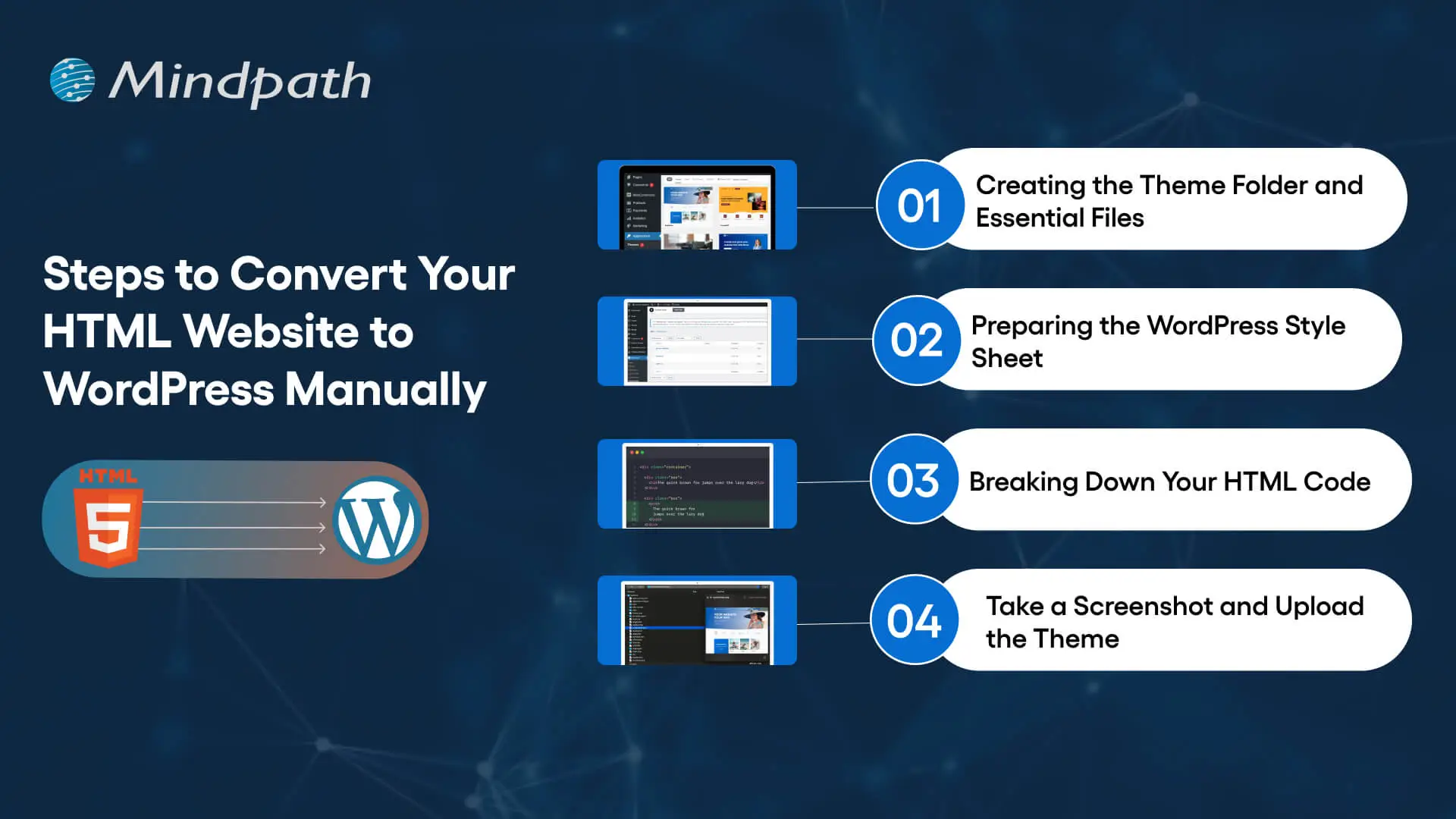
Step 1: Create the WordPress Theme Folder and Essential Files
Start by creating a dedicated folder for the custom theme inside the WordPress installation’s wp-content/themes/ directory. Use a descriptive folder name, such as business-custom-theme.
A basic classic theme can begin with the following files:
style.cssfor theme information and stylesheet rules.index.phpas the required fallback template for a classic theme.header.phpfor the shared header and opening page structure.footer.phpfor the shared footer and closing page structure.functions.phpfor registering theme features, loading assets, and adding theme functionality.front-page.phpwhen a dedicated homepage template is needed.page.phpfor standard static pages.single.phpfor individual blog posts when the website publishes articles.
Additional files may be required depending on the design and content structure. For example, archive templates can control category or post listing pages, while custom templates can support specialized landing pages.
Step 2: Prepare the WordPress Theme Stylesheet
Open style.css and add the theme header information. WordPress uses this information to identify the theme in the administration dashboard.
/*
Theme Name: Business Custom Theme
Description: A custom theme converted from an existing HTML website.
Version: 1.0
Text Domain: business-custom-theme
*/
Replace the example name and description with details relevant to your project. Then transfer the existing website’s CSS rules into the stylesheet, adjusting selectors where necessary to work with the new WordPress markup.
Avoid copying every style without reviewing it. Duplicate rules, fixed-width layouts, and styles that depend on the original HTML structure may cause problems after the templates are reorganized.
Step 3: Separate the Existing HTML Into Reusable Templates
Review the original HTML files and identify elements that appear across multiple pages, such as the header, navigation, footer, and shared scripts. Move these elements into the corresponding WordPress template files instead of repeating the same markup across every page.
For example, the header template can contain the document structure, site branding, navigation, and opening layout. The footer template can contain footer content and the closing structure. WordPress template functions can then include these shared files in the main templates.
A basic template structure can use the following functions:
<?php get_header(); ?>
<main id="main-content">
<!-- Add the page-specific template markup here. -->
</main>
<?php get_footer(); ?>
This is a structural example, not a complete website template. The page-specific markup must still be integrated with WordPress content, navigation, and the required theme functions.
Step 4: Connect the Templates to WordPress Content
A static HTML page contains content directly in its markup. In WordPress, content can be managed through the dashboard and displayed using template functions or the WordPress Loop.
For example, a basic page or post template can retrieve its content through the Loop:
<?php if ( have_posts() ) : ?>
<?php while ( have_posts() ) : the_post(); ?>
<h1><?php the_title(); ?></h1>
<div class="entry-content">
<?php the_content(); ?>
</div>
<?php endwhile; ?>
<?php endif; ?>
This example displays the title and content for the queried WordPress page or post. Additional template logic may be needed for featured images, custom fields, navigation, pagination, or other website features.
When moving a large website, decide which content should become WordPress pages, blog posts, or custom post types. This makes future content management easier and reduces the risk of treating every page as a manually maintained template.
Step 5: Load CSS, JavaScript, and Images Correctly
The existing HTML website may use stylesheets, JavaScript files, fonts, icons, and images stored in different directories. Update their paths and load theme assets through WordPress where appropriate.
For a classic theme, stylesheets and scripts can be registered or enqueued in functions.php. This helps WordPress manage dependencies and avoids hardcoding asset paths throughout the templates.
Review image paths, responsive image behavior, script dependencies, and any third-party services. Test navigation menus, interactive elements, forms, and other functionality that depends on JavaScript.
Step 6: Add WordPress Theme Features
Register the theme features required by the website. Depending on the project, these may include featured images, custom logos, navigation menus, title tags, and other supported capabilities.
Use WordPress functions for features that WordPress already manages. For example, register navigation menus rather than permanently hardcoding every navigation link when the business needs to manage them through the dashboard.
If the website uses custom fields, third-party APIs, contact forms, or e-commerce features, configure the appropriate plugins or custom development. Confirm that the implementation follows security and data-handling requirements.
Step 7: Create the Theme Preview and Activate the Theme
A theme screenshot can provide a visual preview in the WordPress administration interface. Save an appropriate image as screenshot.png in the theme folder. Check the current WordPress theme documentation for supported dimensions and formats.
Once the theme files are ready, open the WordPress dashboard and navigate to Appearance and then Themes. The theme should appear if its files and stylesheet header are valid. Preview it where the setup supports previewing, and activate it only after completing the initial checks.
Do not activate an unfinished theme on the live business website. Use a staging environment to verify templates, content, navigation, forms, and integrations before switching production traffic to the new site.
Step 8: Make the WordPress Website Responsive
The converted website should work across mobile phones, tablets, laptops, and desktop screens. Reusing the original HTML and CSS does not automatically guarantee responsive behavior in the new theme.
Use flexible layouts, appropriate CSS media queries, responsive images, readable typography, and accessible navigation. Test menus, buttons, forms, tables, and other interactive elements at different viewport sizes.
Check whether page builder styles, plugin interfaces, or custom components introduce layout problems. Also review keyboard navigation, focus states, contrast, and form labels to improve accessibility.
Step 9: Test the Website Before Launch
Once the theme is functional, compare the new WordPress website with the original HTML version. Confirm that the required design elements, content, images, and functionality have been preserved or intentionally improved.
- Check important pages and navigation links.
- Submit forms and test integrations.
- Verify image loading and responsive layouts.
- Review browser console errors and server-side errors.
- Check page performance and Core Web Vitals.
- Verify page titles, meta descriptions, canonical tags, and indexing settings.
- Confirm that analytics and conversion tracking work correctly.
- Test backups and confirm that the team can restore the site if needed.
For a more detailed quality review, refer to the WordPress developer checklist.
How to Protect SEO During an HTML-to-WordPress Migration
Changing a website’s CMS can affect its search visibility if URLs, page content, metadata, redirects, or indexing settings change unexpectedly. A migration plan should therefore include SEO checks before and after launch.
1. Preserve Existing URLs Where Possible
Keep existing URLs when they remain appropriate for the new website. If a URL must change, map the old address to the most relevant new page using a permanent redirect, usually a 301 redirect. Avoid redirecting every retired URL to the homepage when a more relevant destination exists.
2. Retain Important Page Content and Metadata
Record important headings, page titles, meta descriptions, canonical tags, image alt text, and structured data before migration. Recreate the relevant elements in WordPress and check that they render correctly on the final pages.
3. Review Internal Links and Media
Update internal links where page locations change. Check images, downloadable files, embedded media, and other assets to ensure they load correctly. Broken internal links and missing media can create usability problems and weaken the quality of the migration.
4. Check Indexing and XML Sitemaps
Verify that important pages are accessible to search engines and that production pages do not retain accidental noindex directives from the staging environment. Review the XML sitemap and canonical tags, and ensure that the sitemap lists the correct preferred URLs.
5. Monitor Search Performance After Launch
Use Google Search Console and website analytics to monitor indexing, organic traffic, landing-page performance, and conversion activity. Investigate unexpected changes, crawl errors, redirect problems, and missing pages after launch.
A technically sound migration helps reduce avoidable SEO risks, but it cannot guarantee that rankings or organic traffic will remain unchanged.
Common HTML-to-WordPress Migration Mistakes
A migration can create problems when the team focuses only on transferring the design. Businesses should address the following issues during planning and testing.
- Copying the entire HTML page into one template: This can prevent content from being managed properly and create duplicated layouts across pages.
- Ignoring existing URLs: Unplanned URL changes can lead to broken links and lost search traffic.
- Forgetting website functionality: Forms, search, interactive elements, and third-party integrations need to be rebuilt or reconfigured.
- Using unnecessary plugins: Excessive or poorly maintained plugins can add complexity and introduce security or compatibility risks.
- Skipping mobile testing: A desktop layout may not work well on smaller screens after conversion.
- Launching without backups: A verified backup and recovery process helps protect business data and website availability.
- Testing only the homepage: Service pages, blog posts, forms, archives, and other important page types also need validation.
Convert Your HTML Website to WordPress With a Clear Plan
Converting HTML to WordPress can give a business more control over content management and create room for new website capabilities. The most suitable approach depends on the existing design, content structure, required functionality, technical resources, and long-term business goals.
Before migration, back up the existing website, document its URLs and functionality, choose the right conversion method, and prepare a testing plan. After development, validate the new website across devices, preserve important SEO elements, and monitor performance following launch.
Businesses that need support with theme development, content migration, or specialized functionality can review Mindpath’s expert WordPress developers. A properly scoped migration can help align the website with current operational needs while preparing it for future improvements.

Companies are now seeking scalable and robust applications, which can meet both years of functional performance and user expectations. That’s when full-stack Node.js development comes into play, uniting the power of frontend and backend within a single environment. It allows developers to build faster and smarter while creating applications to remain adaptable as the business continues to grow.
In this way, constructing end-to-end solutions is more fluid and intelligent. With cohesive databases, APIs, and user interfaces integrating and interfacing, developers can automate some of the hassle proactively. Understanding full-stack Node.js ultimately gives developers an advantage to think forward as technology grows and gives organizations tangible opportunities to grow with applications that perform and scale easily. So, let’s dive in to know how this expertise truly makes a difference.
Want to build an advanced application without compromising performance? At Mindpath, our full-stack development services will help you provide the best solutions, handling both front-end and back-end with efficiency.
Understanding the Fundamentals of Full-Stack Development
Full-stack development means developing on the front end and back end of a web application. The front end refers to all the things that the user responds to and interacts with, such as buttons, layouts, designs, etc. The back end refers to all of the things that run in the background, like databases, servers, etc., and all the logic that makes it run smoothly, working together.
A full-stack developer has the capability to deal with both sides. They are capable of building UX and the technology that serves the app. This gives them agile skills that allow them to build comprehensive applications entirely from front to back.
Understanding the Basics of Node.js
Node.js is a platform that allows you to run JavaScript code in a JavaScript runtime outside of the browser. It is built on Google’s V8 engine, which is extremely fast and built to be efficient. Node.js allows developers to write server-side applications using the same exact language as for the front end, making development and management easier and smoother.
An advantage of Node.js is that it operates asynchronously, which allows tasks to not have to wait for one another to complete, meaning that applications can handle multiple requests at once. Because of this, the use of full-stack Node.js is quickly becoming a good choice when building scalable, real-time, and modern applications.
The success of using Node.js in full-stack development depends on hiring the best developer. Discover the key Factors to Consider while Hiring Node.js Developers.
Why is Node.js Important for Full-Stack Development?
Utilizing Node.js full-stack technology is an impressive approach to developing a complete web application. Here are reasons that Node.js is a valuable technology option in the full-stack.
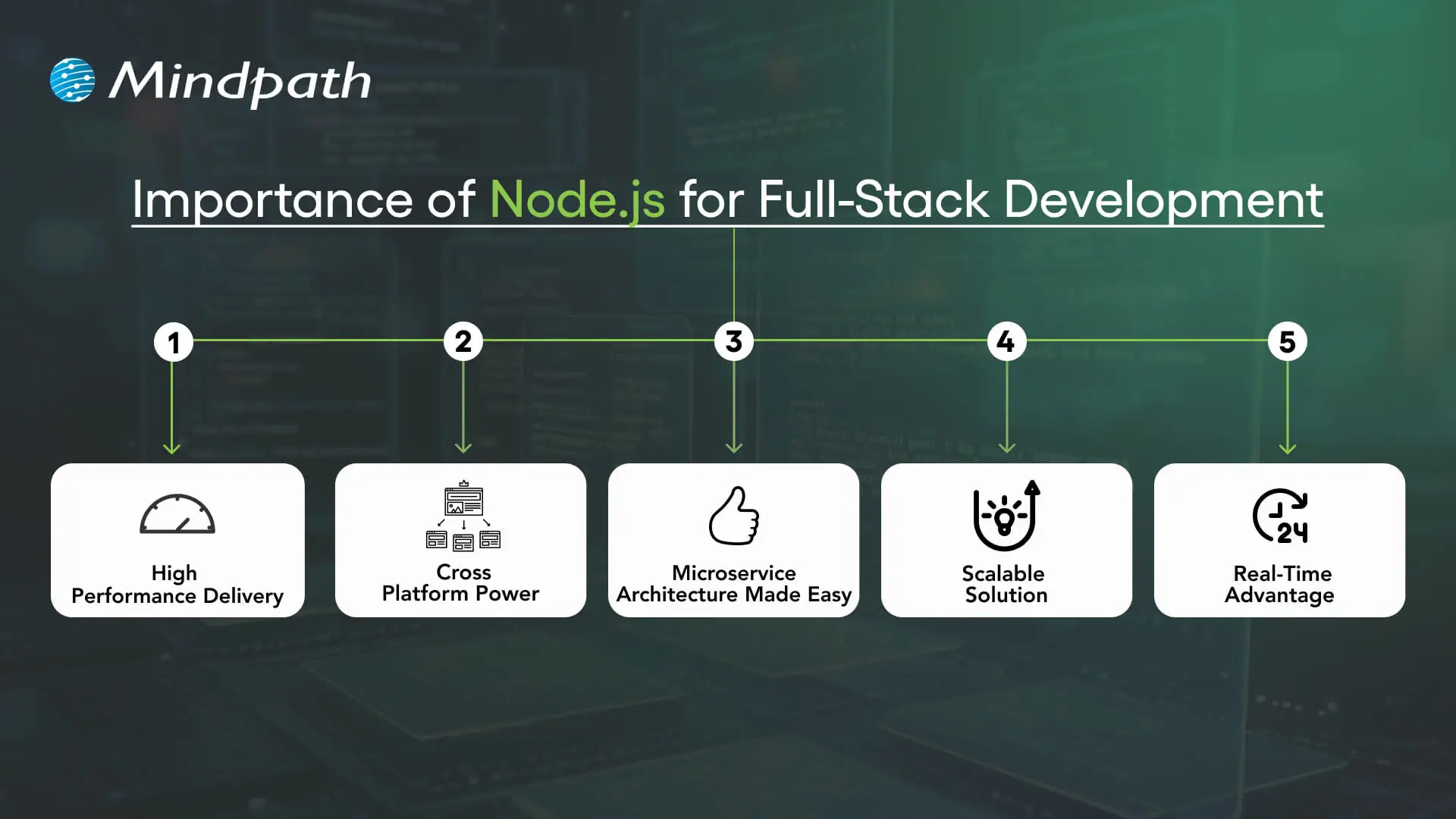
1. High Performance Delivery
Node.js utilizes a non-blocking I/O hardware model that can handle hundreds or even thousands of requests simultaneously, providing faster response times and greater user-specific.
2. Cross-Platform Power
With the Node.js full stack, developers can write mobile and desktop apps to run on Windows, macOS, Linux, and more. By relying on a single JavaScript code base, developers can save time and effort writing for multiple platforms.
3. Microservice Architecture Made Easy
Full-stack Node allows users to break one larger application down to multiple smaller independent services using infrastructure that is easier to work with. This approach lets developers build faster, stay flexible, and rely on proven solutions.
4. Scalable Solution
Full-stack Node.js is used by major players like Walmart, Uber, and Trello to handle millions of users. It helps to lower load time significantly, and it ensures your applications will scale seamlessly, as your demands increase.
5. Real-Time Advantage
When it comes to applications that leverage chat, live streaming, food delivery, or payments, Node.js full-stack is the way to go. It seamlessly provides real-time updates to keep the user engaged and connected.
Key Steps to Use Node.js in Full-Stack Development
A full-stack Node.js developer is involved in both the front end and the back end of web application development and will work to build complete web applications. Below is a synopsis of the primary steps to utilize Node.js in full-stack development that is easy and productive.
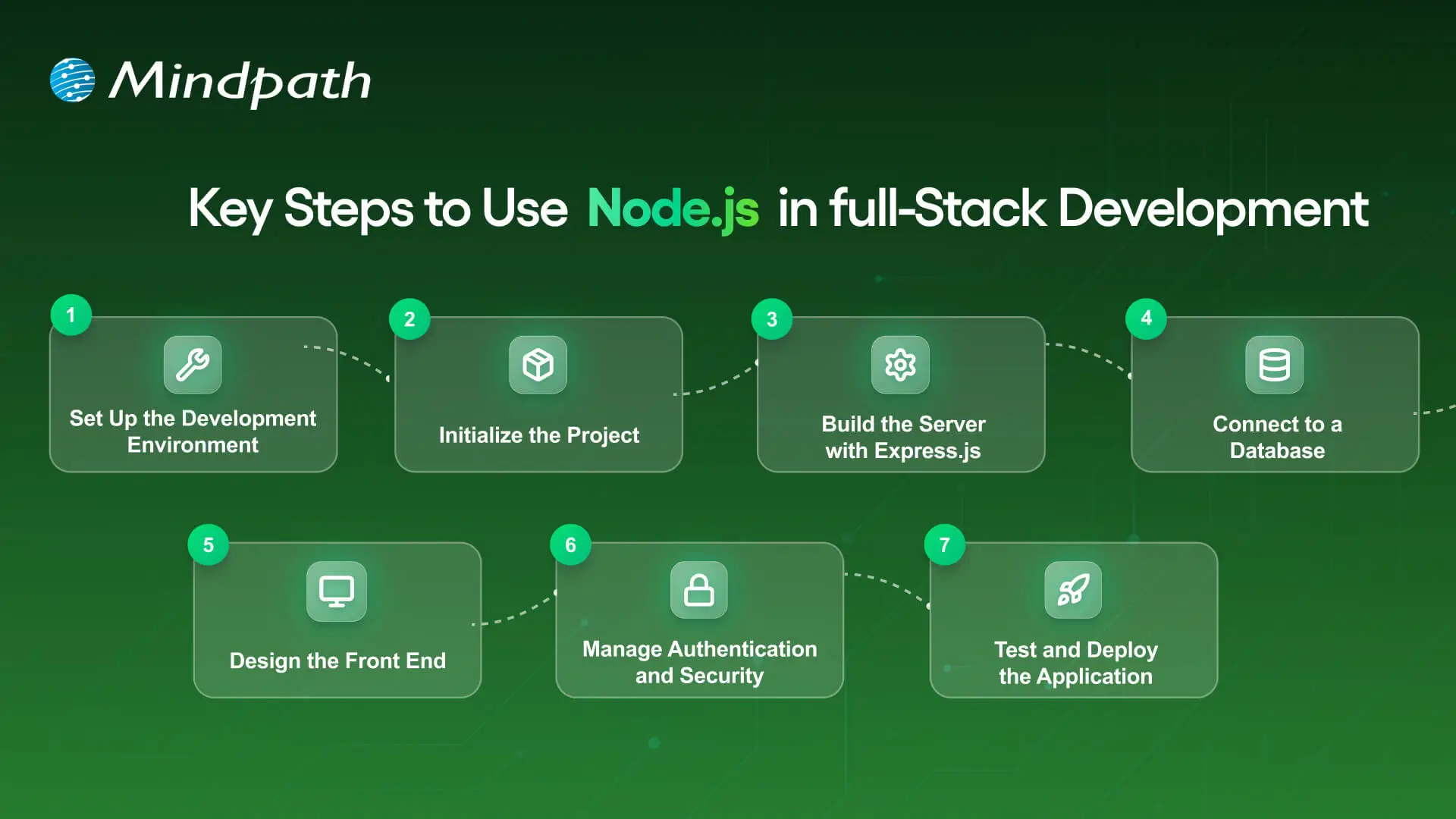
1. Set Up the Development Environment
To begin your application-building experience, you will need to install Node.js and npm (Node Package Manager). These tools will allow you to execute JavaScript beyond the browser, and they will also help manage libraries with ease. Verify the setup by checking versions with simple commands in your terminal.
2. Initialize the Project
Make a new folder for your app, and use ‘npm init’ to create a ‘package.json’ file. A package.json file holds important information, such as your project name, dependencies, and scripts. It will serve as the basis for managing everything in your project.
3. Build the Server with Express.js
Install Express.js so you’ll be able to set up the backend server and handle all of the different routes. Express.js makes handling requests, responses and APIs supposedly easy. This step will ensure the backend runs appropriately with the frontend.
4. Connect to a Database
Based on your needs for this project, select a database like MongoDB or PostgreSQL. This should be paired with a Node.js library like Mongoose or Sequelize, which will allow you to connect to and perform both read and write operations on your data. At this point, you will have the ability for your application to persist and retrieve your data.
5. Design the Front-End
Build the front-end using a library such as React, Angular, or Vue. You can link the front-end through RESTful APIs or GraphQL to your Node.js back end. At this point, players will finish the bridge for a Full-stack Node.js application.
6. Manage Authentication and Security
Use libraries like Passport.js or JWT to add secure login and registration. Secure necessary paths so that any authorized user can get to those routes. You should always consider security in any Full-stack Node.js application.
7. Test and Deploy the Application
Create unit and integration tests to ensure that your application does what you intended. Deploy the application to cloud hosting solutions like Google Cloud, AWS, or Heroku. To utilize your Full-stack Node.js application’s performance tool on different scales, you should monitor its performance!
Looking to integrate AI in your Node.js projects? Explore our Ultimate Guide to Node.js Libraries for AI Integration to discover the most effective libraries for building smart, scalable, and future-ready applications.
Ready to Unlock the Power of Full-Stack Node.js?
Full-stack Node.js has proved to be a smart choice for building scalable, high-performing, and real-time applications. It unites front-end and back-end seamlessly, helping developers create complete solutions with speed and flexibility. With its ability to handle microservices, cross-platform apps, and real-time updates, it has become an essential technology for modern web development.
At Mindpath, we provide expert full-stack development services designed to match your business goals. Our skilled Node.js developers bring deep technical knowledge and practical experience to build secure, scalable, and user-friendly applications. If you are looking to transform your digital ideas into reality, hiring a Node.js expert from our team ensures growth and lasting impact.
Artificial intelligence is rapidly transforming from a buzzword to a necessity for businesses in all industries. You must have noticed the impact of AI in mobile app development with examples of voice assistants like Google Assistant and Siri. Why is artificial intelligence useful for mobile app development? Mobile app developers can use AI to capitalize on a broad range of capabilities, including smart automation and better efficiency.
AI is no longer just about science fiction as businesses leverage it for different operations. The adoption of AI for developing mobile apps creates a new perspective on how companies pursue growth. Artificial intelligence not only simplifies the work of developers but also ensures seamless experiences for users. An overview of the benefits of AI in developing mobile apps can help you understand its significance.
Using AI in mobile applications can be beneficial, but many businesses struggle to implement it. Mindpath’s mobile app development services will deliver full-proof planning and execution, ensuring innovation and efficiency in every project.
Understanding the Fundamentals of AI in Mobile App Development
AI in mobile app development refers to integrating artificial intelligence into the process of building mobile applications and embedding smart features within them. By combining machine learning (ML), natural language processing (NLP), and computer vision, developers can create intuitive, self-improving apps, while also streamlining the development process itself.
AI-powered mobile apps analyze user data in real time to make intelligent, context-aware decisions — delivering personalized experiences without manual input. This allows apps to adapt dynamically to what each user actually needs. The best thing is that mobile apps can achieve all this without human intervention. The utility of different technologies in mobile apps can help you understand how AI revolutionizes mobile app development.
How AI Technologies Power Smarter Mobile Apps?
AI mobile apps use machine learning algorithms to continuously learn from user behavior and refine their performance over time, automatically aligning with evolving user expectations.
Developers can capitalize on the benefits of AI in mobile apps to deliver a broad range of functionalities to users. For instance, natural language processing (NLP) enables in-app chatbots to interpret user queries contextually and respond in natural, human-like language. AI mobile applications deliver more than just automation as you can rely on artificial intelligence to create next-gen apps that can adapt to the future.
Also Read: Benefits of Mobile App Development
How Have Developers Used AI for Mobile Apps?
The distinct functionalities of AI technologies for mobile app development reveal crucial insights about growing popularity of AI-powered mobile apps. You can come across many new AI features in mobile applications used by millions worldwide. The functionalities of artificial intelligence in modern mobile apps can help you understand why AI-powered mobile apps are a necessity now.
1. Chatbots and Virtual Assistants
You must have seen or used chatbots on many mobile apps that make intelligent conversations with users. Chatbots and virtual assistants use AI for customer service without the involvement of humans. For instance, healthcare apps can rely on AI chatbots to provide accurate medical diagnosis on the basis of symptoms. Voice assistants like Siri and Alexa can interact with users and help them with different tasks, like searching information and setting reminders.
2. Personalization of User Experiences
Developers have discovered that AI can play a major role in personalizing user experiences according to each user’s preferences. The use of AI tools for mobile app development ensures that artificial intelligence can analyze user behavior, past interactions and preferences to find personalized content and recommendations. As a result, your mobile app can be more engaging for users by delivering the relevant services. Netflix is one of the biggest examples of using AI for personalizing user experiences as it recommends content on the basis of your watch history.
3. Facial Recognition
Computer vision is one of the formidable AI technologies that have gained recognition in mobile app development workflows. An overview of new mobile app development trends reveals how facial recognition has become a necessity in modern apps. Developers can use computer vision in their mobile apps to recognize faces and patterns. AI-powered mobile apps can leverage facial recognition to offer better security. The best example of using AI for facial recognition in mobile apps is Instagram, which offers AR filters with computer vision.
4. Power of AI Automation
Developers cannot think about using artificial intelligence for developing mobile apps without incorporating automation. As a matter of fact, automation is the biggest strength of AI that helps in streamlining repetitive tasks. With AI taking care of manually intensive tasks, mobile apps can offer better efficiency and productive user experiences. You can notice the best example of AI automation in mobile apps in Gmail, which automatically classifies emails into different categories.
Want to streamline your operations and build smarter workflows using the latest tools? Explore our blog on mobile app development tools for a better understanding.
Why Should Developers Trust AI for Mobile App Development?
Artificial intelligence contributes to diverse aspects of mobile app development and offers numerous benefits. Businesses can rely on AI mobile app development experts to capitalize on these advantages and create cutting-edge apps. An overview of the advantages of AI in developing mobile apps can help you understand why AI-powered mobile apps are gaining traction.
1. Seamless Automation in Mobile Apps
Automation is one of the biggest advantages you can get from using artificial intelligence to create mobile apps. Your mobile app works on many background tasks, including data entry and content moderation, while delivering what the users want. Artificial intelligence can do the heavy lifting for your mobile apps by automating these tasks, thereby achieving better efficiency. At the same time, users can also get faster access to the app’s functionalities and services.
2. Creating Custom Experiences for Each User
Custom user experiences are the next big thing in mobile app development as user behavior trends favor personalization. Every mobile app user needs services and content personalized according to their behavior and preferences. The utility of AI in application development primarily revolves around creating apps that can adapt to each user and their needs. Artificial intelligence can empower your mobile app to provide personalized content and product recommendations to users.
3. Smarter Decision Making
Mobile apps are not autonomous agents who can take decisions independently on behalf of customers. AI in decision-making can empower mobile apps with the capability to analyze patterns and detect trends or anomalies. The growing popularity of AI app ideas depends significantly on how artificial intelligence provides actionable insights. Mobile apps can use the insights to optimize strategies for customer engagement and pricing with the ability to make better decisions.
4. Breaking the Language Barriers
Artificial intelligence also contributes significantly to expanding the global reach of mobile apps. Language is one of the biggest obstacles for the expansion of mobile apps in international markets. However, a reliable AI app development company can help you overcome these barriers as AI technology offers real-time language translation features in mobile apps. Artificial intelligence in mobile apps will emerge as a prominent trend to make mobile apps usable across all countries.
5. Enhanced Accessibility and Inclusivity
AI breaks the language barrier and also makes your mobile apps more accessible to different users. Users with disabilities can capitalize on voice recognition features to access all the functionalities in a mobile app. For instance, visually challenged users can access different features on your mobile app with speech-to-text typing and voice-controlled navigation. Artificial intelligence ensures that literally everyone can become a user of your mobile apps.
6. Improvements in Operational Efficiency
Artificial intelligence also helps in enhancing the operational efficiency of your mobile apps. You can rely on AI for boosting app performance with efficient resource allocation, performance monitoring and predictive maintenance tasks. It plays a crucial role in reducing downtime, optimizing backend processes and ensuring smooth functionality of your app.
Most of the guides on how to develop an AI mobile app also emphasize how AI can optimize app performance. Artificial intelligence can help in optimizing battery consumption, reducing unnecessary background processes and managing memory usage. The enhanced operational efficiency translates directly into a more responsive and faster user experience.
Want to build high-performance digital products and stay updated on the latest mobile app development technologies shaping modern businesses? Check out our guide on mobile app development technologies to explore the best tools and frameworks for creating scalable, future-ready applications.
What are the Challenges of Adopting AI for Mobile App Development?
The benefits of AI for developing mobile apps create a strong case for developers to embrace artificial intelligence. However, developing efficient and powerful mobile apps with AI brings some formidable challenges. First of all, the development costs will be higher as developers will need expensive AI tools. Developers will also have to think about issues with data quality and privacy. On top of it, mobile processing power is limited and using AI can lead to problems with performance and battery life.
Unlock the Full Potential of AI in Mobile Apps
The uses of AI in mobile app development will introduce a new perspective on mobile app user experiences. Artificial intelligence not only contributes to automation but also enhances scalability and performance of mobile apps in different scenarios. You can notice how AI makes mobile apps more accessible to users by removing language barriers and introducing facial recognition and speech-to-text typing features.
Mindpath is your trusted destination for mobile app development services with the AI advantage. We have been creating mobile apps for clients from different industry verticals with the assurance of efficiency and enhanced productivity. You can rely on our experts to develop mobile apps that reflect your brand identity and achieve excellence on all benchmarks. Consult with our experts and find the best services for AI-powered mobile app development now.
In the digital world of the 21st century, DevSecOps has undoubtedly become the backbone of secure software delivery. It has perfectly blended DevOps and security practices in order to protect applications from cyber threats without hampering innovation. With the surge in cloud DevSecOps organizations across diverse sectors are embedding automated testing and compliance, along with continuous monitoring, directly into CI/CD pipelines.
It is the right time for you to know how DevSecOps works and why it matters for DevOps cybersecurity. DevSecOps is now essential for resilience, whether you are developing cloud-native apps or securing your software supply chain. It is time to look at how businesses can implement DevSecOps in the real world.
Curious about how DevSecOps implementation helps businesses in achieving secure and scalable pipelines? Contact us and let our experts provide you with full guidance.
An Insight into DevSecOps
DevSecOps is the practice of integrating security into every stage of the software development lifecycle. Instead of treating security as a final checkpoint, DevSecOps combines development, operations, and security teams to identify and fix vulnerabilities throughout the CI/CD pipeline. This approach enables organizations to deliver software faster while maintaining strong security and compliance.
DevSecOps solutions make sure that security is shared across the development and security teams, in addition to the operations team. It is achieved through the automation of security processes and practices within CI/CD pipelines. This approach has gained massive popularity in the past few years since it fosters collaboration while empowering business entities to deliver secure and high-quality software solutions.
Also Read: Benefits of DevOps
Key Benefits of DevSecOps
The DevSecOps concept gives rise to a host of benefits for users, including professionals as well as businesses. Now that you know what is DevSecOps, it is time to get familiar with its key benefits.
1. Faster Delivery of Software
DevSecOps creates the opportunity for you to integrate security into the development pipeline. Thus, it allows businesses to rapidly deliver highly secure code. It is capable of addressing issues early on and while streamlining the release process.
2. Better Agility
Automation serves as a catalyst and reduces bottlenecks relating to manual security. It allows security teams to lay emphasis on high-value tasks. Moreover, they feel empowered to respond in a prompt manner to threats and risks.
3. Diminished Time to Market
The concept of cybersecurity DevOps is capable of catching as well as fixing vulnerabilities at an early stage. It therefore minimizes the requirement for expensive as well as time-consuming remedial actions at a later stage. It is good news for software developers since it accelerates software project timelines.
4. Top-Notch Security
You need to leverage DevSecOps so that you can strengthen the security posture when it comes to custom software development. Security gaps can be reduced exponentially as DevSecOps embeds security into each stage of the DevOps lifecycle.
6. Better Compliance with Laws and Regulations
You need to use DevSecOps tools since they ensure compliance at all stages of software development. With security checks that are automated and compliance tools, modern businesses can rest assured about their compliance requirements.
Curious about the latest shifts reshaping how software and websites are built and deployed? Check out our blog on DevOps trends to stay ahead of the curve and make sure your projects leverage modern best practices.
Steps to Implement DevSecOps
The implementation of DevSecOps means weaving security into each and every phase of the DevOps pipeline without compromising the delivery. At present, organizations face rising cyber risks along with stricter compliance standards, which makes a structured approach essential. You need to follow the steps below in order to effectively implement DevSecOps while developing a software solution.
Step 1 – Evaluate your Current Security Practices
While implementing DevSecOps, the very first step that you need to take involves the assessment of your current security practices. You need to do a careful and comprehensive evaluation of the security tools and processes that are in place. You also need to identify gaps along with appropriate areas of improvement while taking into account the organizational goals and context.
Step 2 – Establishment of Security Goals and Objectives
Now it is time to establish security objectives. You must keep in mind to define clear and well-defined security goals and objectives that are perfectly aligned with the vision of your organization. At this stage, you can even consider involving stakeholders from the development, security, and operations teams. It is vital to prioritize shared understanding along with unified commitment.
Step 3 – Implementation of Security Training and Awareness Programs
You need to conduct training programs at this stage of the implementation process. These training programs can play a strategic role and help the staff members to cultivate essential skills and capabilities. It is also essential to promote security awareness while fostering an accountable security culture within the organization.
Step 4 – Integration of Security into the Software Development Lifecycle
At this stage, you need to combine security practices and controls at every phase of the software development lifecycle. You must focus on implementing tools along with automation that are capable of facilitating secure code reviews as well as vulnerability scanning. The tools must also support threat modelling.
Step 5 – Emphasizing Continuous Security and Automation
It is vital to prioritize automation when it comes to cybersecurity DevOps. So you need to automate security testing, such as dynamic analysis and static analysis. You must also consider automating software composition analysis so that you can get feedback on an ongoing basis. It is a wise decision to integrate security into the continuous integration and deployment pipelines, as it can help ensure security checks at every stage.
Must Read: DevOps vs DevSecOps
Step 6 – Implementation of Infrastructure as a Code Security
You must also apply the security principles to Infrastructure as a Code (IaC) scripts and templates. It is undoubtedly a critical step when it comes to DevSecOps implementation. Businesses must ensure that they leverage version control for the Infrastructure as a Code template for maintaining traceability. You can even consider applying policy as code frameworks in order to enforce security baselines for cloud resources.
Step 7 – Fostering Communication and Collaboration
You need to encourage cross-team collaboration along with transparent communication. You can ensure this through regular meetings and by using shared tools. It is essential to prioritize joint decision-making. It is equally important to set up and maintain a DevSecOps culture so that it can promote trust along with accountability within the organization.
Step 8 – Implementation of Continuous Monitoring and Incident Response
It is critical at this stage to adopt continuous monitoring of applications and infrastructure. This is because such a practice can help in detecting as well as responding to security incidents in a prompt manner. You must also establish an incident response plan that can facilitate effective and efficient mitigation in case of a security breach.
Step 9 – Focus on Regular Assessment
One cannot overemphasize the importance of regular assessment and improvement while implementing DevSecOps. You must conduct assessments to evaluate the effectiveness of the implemented DevSecOps practices periodically. It is equally essential to improve the security processes and adjust to emerging threats on an ongoing basis. Businesses must also make sure to incorporate the feedback from the key stakeholders.
Step 10 – Remaining Abreast with the Latest Security Practices
It is imperative for modern businesses to stay updated with the latest security trends and industry standards. You need to bear in mind that your business needs to engage in continuous learning. So in your organization, you need to encourage security professionals to take an active part in training programs as well as online communities.
Facing hurdles in your deployment process? Read our guide on DevOps challenges and solutions to learn actionable strategies for smoother, more efficient workflows.
Best Practices While Implementing DevSecOps
There are a number of best practices that you need to keep in mind while implementing DevSecOps within your business. You need to adopt these practices so that you can derive optimum value from DevSecOps implementation.
1. Emphasis on Security
You need to shift security to the left. It means that the security component has to be integrated at an early stage in the software development lifecycle. Several practices, such as threat modelling and secure coding practices, need to take place during the development stage in order to reduce the risk before the production stage.
2. Automation
The role of automation is indispensable when it comes to DevSecOps implementation. You need to embed appropriate security controls into CI/CD pipelines and ensure static as well as dynamic code analysis.
3. Importance of Continuous Testing
Continuous testing is an essential component of DevSecOps as it allows teams to identify security gaps and vulnerabilities. You need to test code on a continuous basis so that the number of security issues can be reduced before that may reach the production stage.
Ready to modernize your tech operations and accelerate product delivery? Explore our blog on DevOps for Businesses to learn how DevOps helps businesses build, deploy, and scale with confidence.
Final Words
DevSecOps is no longer an optional thing for businesses when it comes to developing software solutions. It serves as the ultimate foundation for building secure and resilient software applications that are compliant in today’s world. Businesses need to integrate DevOps and security practices across the entire pipeline in order to reduce security risks and uncertainties. If DevSecOps implementation is done in the right manner, it can foster innovation and business resilience.
The top-notch DevOps services of Mindpath can ensure that your business can successfully adopt DevSecOps. With the help of expert guidance and support, your business can achieve innovation, which can give it an edge in its operational domain.
Frequently Asked Questions
You have a great business idea, and you have just discovered that WordPress can help you build high-quality websites from scratch. However, should you take the DIY approach or hire an expert for the job? Many businesses choose to hire a WordPress developer with the skills required to handle their projects. With a large pool of WordPress developers available worldwide, navigating the hiring process can be challenging.
Key Takeaways
- 01
Hiring a skilled WordPress developer helps businesses build customized, secure, responsive, and scalable websites. - 02
PHP, JavaScript, HTML, CSS, WordPress core, and theme and plugin development are essential technical skills to look for. - 03
Freelancers, in-house developers, and development agencies offer different advantages depending on project requirements, budget, and long-term goals. - 04
WordPress developer hiring costs vary based on experience, location, project complexity, and the chosen hiring model. - 05
Defining business goals, setting a clear budget, conducting technical assessments, and finalizing project contracts help ensure successful hiring.
The right WordPress developer can change the course of your web project by using available resources efficiently. Whether you are launching a new website or switching an existing site to WordPress, skilled developers can help you achieve your goals. This guide will help you understand the hiring process and identify the right WordPress professional for your team.
Unraveling the Reasons to Hire a WordPress Developer
The first thought that might come to your mind when planning a web project is the availability of website builders. You can use their drag-and-drop features and preset themes to create a website from scratch. However, why should you hire dedicated WordPress developers when you can do it yourself?
As your website grows, you will need additional features, specific design elements, and better performance. Therefore, professional development becomes increasingly important in the modern digital landscape.
1. Customized Website Design and Functionality
A professional developer can tailor your website design to reflect your brand identity and business requirements. Additionally, developers can introduce new features without relying entirely on third-party plugins. With custom WordPress development, businesses can create websites that work seamlessly across different devices and provide a more consistent user experience.
2. Better Performance and SEO
Experienced developers understand how to optimize website performance and technical structure. For example, they can improve loading speeds, implement responsive layouts, and follow SEO-friendly development practices. As a result, your website can provide a better experience for visitors while supporting search engine visibility.
3. Improved Website Security
Website security is another important reason to work with WordPress professionals. Developers can follow security best practices, maintain clean code, select reliable plugins, and implement secure login configurations. Furthermore, they can provide ongoing maintenance and support to keep your website updated and protected.
How Many Types of WordPress Developers Are There?
Hiring professionals for WordPress development can be challenging because you must identify the right person for your project. The required expertise depends on your website’s functionality, design, and technical requirements. Therefore, understanding the different types of WordPress developers can help you make a better hiring decision.
1. Frontend WordPress Developers
Frontend developers work on the user interface and visual design of websites. They use technologies such as JavaScript, HTML, and CSS to create layouts, interactive elements, and responsive experiences. Consequently, they help ensure that visitors can navigate and interact with your website easily.
2. Backend WordPress Developers
Backend developers handle server-side logic, website functionality, and database management. They generally work with technologies such as PHP and MySQL to build and maintain the systems that power a WordPress website. In addition, they can develop custom functionality to support specific business requirements.
3. Full-Stack WordPress Developers
Full-stack developers handle both frontend and backend development tasks. They can work across the complete website development process, from designing user interfaces to implementing server-side functionality. If your project requires expertise across both areas, you can hire a full-stack developer.
4. WordPress Theme Developers
WordPress theme developers specialize in creating and customizing themes for websites. They focus on layouts, styling, responsive design, and visual consistency. As a result, businesses can create website experiences that align with their brand identity.
5. WordPress Plugin Developers
Plugin developers create custom extensions that add functionality to WordPress websites. For example, they can develop features for booking systems, payment integrations, and custom business workflows. This approach allows businesses to extend website capabilities according to their requirements.
What Does a WordPress Developer Do?
Anyone with general knowledge of WordPress knows that creating a basic website does not necessarily require coding. However, businesses often hire WordPress programmers with development and design skills to manage more complex web projects. These professionals write code to customize WordPress functionality and adapt websites to specific requirements.
1. Website Development and Customization
WordPress developers customize website themes, templates, and core functionality to match project requirements. They can also develop custom features that are not available through standard themes or plugins. Consequently, businesses get greater control over their website functionality and design.
2. Testing and Debugging
Developers are also responsible for testing and debugging WordPress websites. They identify technical issues, resolve compatibility problems, and check whether website functionality works as expected. In addition, regular testing helps maintain a consistent experience across browsers and devices.
3. Maintenance and Updates
Another important responsibility involves maintaining WordPress websites and keeping their components updated. Developers coordinate with different stakeholders to implement improvements and resolve technical issues. They also create themes and plugins according to client requirements.
Which Skills Should You Look for in a WordPress Developer?
Every business looking for a WordPress developer wants to find professionals with the right technical expertise. However, identifying an experienced developer from a large pool of applicants requires a clear evaluation process. Recruiters should prepare a candidate profile that outlines the essential skills needed for their web projects.
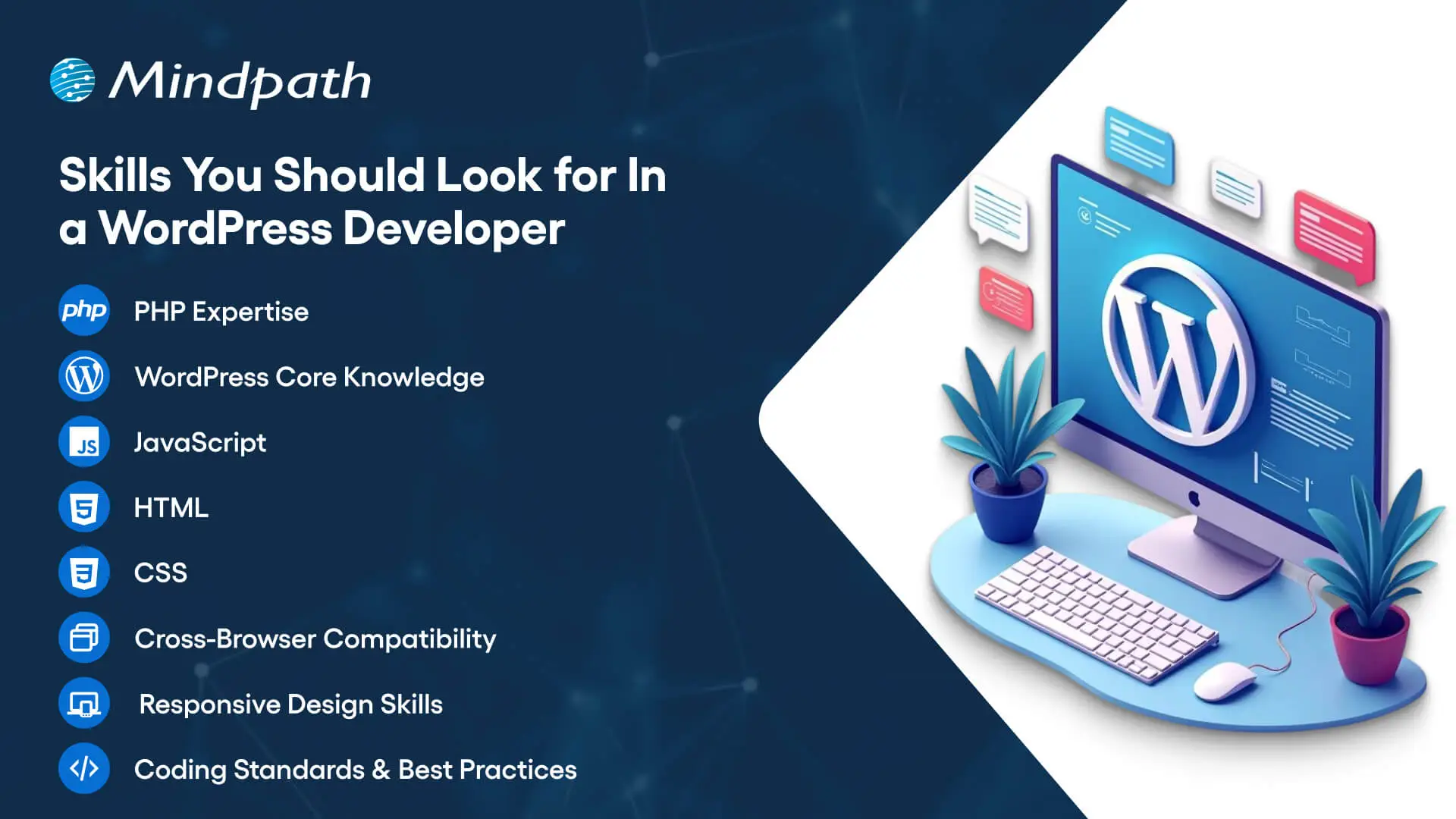
Start by evaluating the core technical competencies required for WordPress development. These skills help determine whether a candidate can work with the platform’s essential technologies and deliver reliable website functionality.
Essential Technical Skills
1. A skilled WordPress developer must be proficient in PHP, WordPress core, JavaScript, HTML, and CSS. These technologies form the foundation of WordPress website development.
2. The developer should have a strong understanding of WordPress themes and plugins. Practical experience in building and customizing these components is particularly valuable for projects requiring custom functionality.
3. Cross-browser compatibility and responsive design are equally important. Developers should understand how to create websites that function consistently across different browsers, screen sizes, and devices.
4. A WordPress developer should also understand coding standards and development best practices. This knowledge helps maintain clean, secure, and manageable code throughout the project.
Are Core Competencies Enough for a WordPress Developer?
Core technical skills represent only one part of a developer’s capabilities. Recruiters should also evaluate additional expertise that can bring more value to web projects. Whether you hire remote WordPress developers or dedicated in-house professionals, candidates who offer skills beyond basic development can handle different project requirements with less assistance.
1. Version Control and Performance Optimization
Look for candidates with practical experience in version control and website performance optimization. These capabilities help developers manage code changes, collaborate with teams, and improve website speed. Additionally, familiarity with performance monitoring can help identify technical issues before they affect users.
2. SEO and Database Knowledge
A developer with an understanding of SEO principles can be a valuable asset to your business. They should know how website structure, page speed, mobile responsiveness, and technical implementation influence search performance. Furthermore, familiarity with SQL and database management helps developers handle website data more effectively.
Knowledge of the WordPress REST API and other RESTful APIs is also beneficial. These skills allow developers to connect websites with external applications and build more flexible digital experiences.
3. Business Understanding and Soft Skills
Technical expertise is essential, but business understanding and communication skills also influence project success. A developer with business acumen can better understand the objectives and expectations behind a website project. Therefore, they can make development decisions that align with the overall business vision.
Communication and time management are equally important when working with a team. Developers should be able to explain technical concepts, coordinate with stakeholders, and deliver tasks within agreed timelines. These qualities support smoother collaboration throughout the development process.
Which Hiring Model Should You Choose?
Choosing a hiring model before starting recruitment can help businesses avoid unnecessary delays and additional expenses. Business owners and hiring managers should understand the advantages and limitations of each option. Generally, you can choose between freelancers, in-house developers, and professional WordPress development agencies.
1. Hiring Freelance WordPress Developers
Freelance developers can be a suitable option for small businesses, startups, and projects with limited requirements. They often offer flexible engagement models and can work within relatively tight budgets. Therefore, freelancers may be a practical choice for one-time development tasks and short-term projects.
However, the freelance model also has certain limitations. Freelancers may handle multiple clients simultaneously, which can affect project availability and delivery timelines. Additionally, managing communication and ensuring consistent support may become challenging during longer projects.
2. Hiring an In-House WordPress Developer
An in-house developer works directly with your organization and can become familiar with your business goals and customer expectations. This closer involvement can help create solutions that align with your internal workflows. Moreover, businesses gain greater control over development priorities and day-to-day collaboration.
On the other hand, hiring an in-house WordPress developer requires additional investment. Apart from salary expenses, businesses must consider recruitment, infrastructure, employee benefits, and onboarding time. Consequently, this model may not be suitable for organizations with limited or occasional development requirements.
3. Working with a WordPress Development Agency
Professional WordPress development agencies provide access to teams with different technical skills and project management expertise. They can handle complex requirements through a combination of frontend, backend, and full-stack development capabilities. As a result, businesses can access broader technical support without hiring every specialist internally.
Furthermore, agencies can provide structured project management, ongoing maintenance, and technical support. This makes them a suitable option for businesses that need comprehensive development services without the overhead of building a permanent in-house team.
What Are the Costs of Hiring WordPress Developers?
The hiring model you choose has a significant impact on the overall cost of bringing WordPress developers into your project. However, location, experience, and project complexity also influence pricing. Businesses can generally choose between hourly and fixed-price arrangements depending on their requirements.
1. Freelancer Hiring Costs
Freelancers may charge around $20 to $100 per hour for their services. Alternatively, some professionals may work under annual salary arrangements ranging from $65,000 to $70,000, depending on their experience and engagement model. These figures are indicative and can vary across markets and project requirements.
2. WordPress Developer Salaries by Location
Geographical location also plays an important role in determining hiring costs. For example, the average WordPress developer salary in the United States can vary between $42,000 and $103,000. Meanwhile, salaries in Australia may range from $91,000 to $179,000.
These salary ranges can change with market demand, professional experience, and project complexity. Therefore, businesses should compare current compensation expectations before preparing their hiring budgets. Understanding these differences can help you make competitive offers while managing development expenses.
Roadmap for Hiring an Expert WordPress Developer
Once you understand the skills and experience required for your project, finding a suitable WordPress developer becomes easier. A structured hiring process can help you evaluate candidates, avoid unnecessary recruitment delays, and select the right professional. Here are the key steps to follow.
1. Know Your Business Goals
The first step is to identify the problems you want to solve with WordPress development. Are you planning to build a new website, improve an existing platform, or introduce custom functionality? Having clear objectives will help you identify developers with the right technical expertise.
Additionally, define the expected website functionality, target audience, and project outcomes. These details will make it easier to communicate your requirements and evaluate whether a candidate is suitable for the role.
2. Establish a Clear Budget
Budget planning is another important part of hiring WordPress development professionals. Your available budget will influence the hiring model, developer experience, and overall project scope. Therefore, establish a realistic spending limit before starting the recruitment process.
Consider factors such as project complexity, required functionality, development timelines, and ongoing maintenance. In addition, remember that experienced senior developers may charge more because of their specialized knowledge and ability to handle complex requirements.
3. Conduct Rigorous Testing and Interviews
One common recruitment mistake is overlooking the technical assessment and interview process. Instead of relying only on resumes, evaluate candidates through practical tests covering PHP, HTML, JavaScript, and SQL. For example, you can provide hands-on assignments that reflect the actual requirements of your project.
Furthermore, interviews should evaluate problem-solving abilities, business understanding, and communication skills. This approach provides a clearer picture of how candidates handle real development challenges and collaborate with other team members.
4. Finalize the Hiring Process
After identifying the right candidate, the next step is to finalize the hiring agreement. Prepare a verified contract that clearly outlines the project scope, payment terms, deliverables, and development timeline. This documentation helps both parties understand their responsibilities.
Additionally, include confidentiality clauses, ownership rights, and contract termination conditions. Once both parties agree to the terms, you can complete the hiring process and begin working together.
Ready to Hire the Right WordPress Developer for Your Project?
Working with a professional WordPress developer can significantly improve the outcome of your web project. You can hire offshore WordPress developers or choose an in-house professional based on your requirements, budget, and long-term goals. Regardless of the hiring model, a structured evaluation process will help you identify the right candidate.
Build Your Website with Mindpath
Mindpath is a WordPress development company helping businesses build and improve their digital presence. Our experience across different WordPress development projects allows us to address varied technical and business requirements. We focus on combining creative design, technical expertise, and reliable development practices to deliver tailored solutions.
Whether you need a new website, custom functionality, or improvements to an existing platform, our WordPress development services are designed around your business goals. Connect with our team to discuss your requirements and make the most of WordPress for your next web development project.

As a result of the rapid evolution of the digital landscape, businesses nowadays want faster, efficient, and more scalable options. This is why many companies choose to hire NodeJS developers who are able to develop high-performing applications without limitations of real-time responsiveness. As businesses compete for efficiency and seamless digital offerings, the demand for NodeJS expertise is increasing. But when hiring a NodeJS Developer, it isn’t just about technical knowledge; it’s about a deeper understanding of your business aims and objectives.
So, how do you make the right choice when the market is filled with so many options? This is the point where many decision-makers stop and consider. With numerous talented developers available, knowing what differentiates the right developer can be a challenge. Filling a role quickly is easy, but finding a developer who contributes positively to your long-term growth is different. Before proceeding to the next step, you should slow down and investigate the key factors to consider in making the right decision.
Looking for a Node.js developer who ensures your app performs at scale without compromising speed and security. Hire Node JS developers from Mindpath who strive to provide you the best, world-class solutions.
Who is a NodeJS Developer?
A NodeJS developer is a technical professional who uses Node.js to create fast, scalable applications server-side. They’re responsible for everything from building prototypes to writing clean code that supports applications that power our world. Their responsibilities also include connecting back-end services with front-end systems to provide users with maximum efficiency and reliability.
Node.js developers are crucial for contemporary software projects because Node.js enables developers to utilize one programming language, JavaScript, for both the client side and server side. They develop great solutions thanks to the ability to do it quickly. They also have strong problem-solving skills and know how to utilize this technology to further enhance an application and prepare it for scale.
What are the Responsibilities of a NodeJS Developer?
Companies wanting to grow often look to hire dedicated Node.js developers as part of their technology teams. Node.js developers do more than code; they are an integral part of delivering solutions that will amplify your digital products.
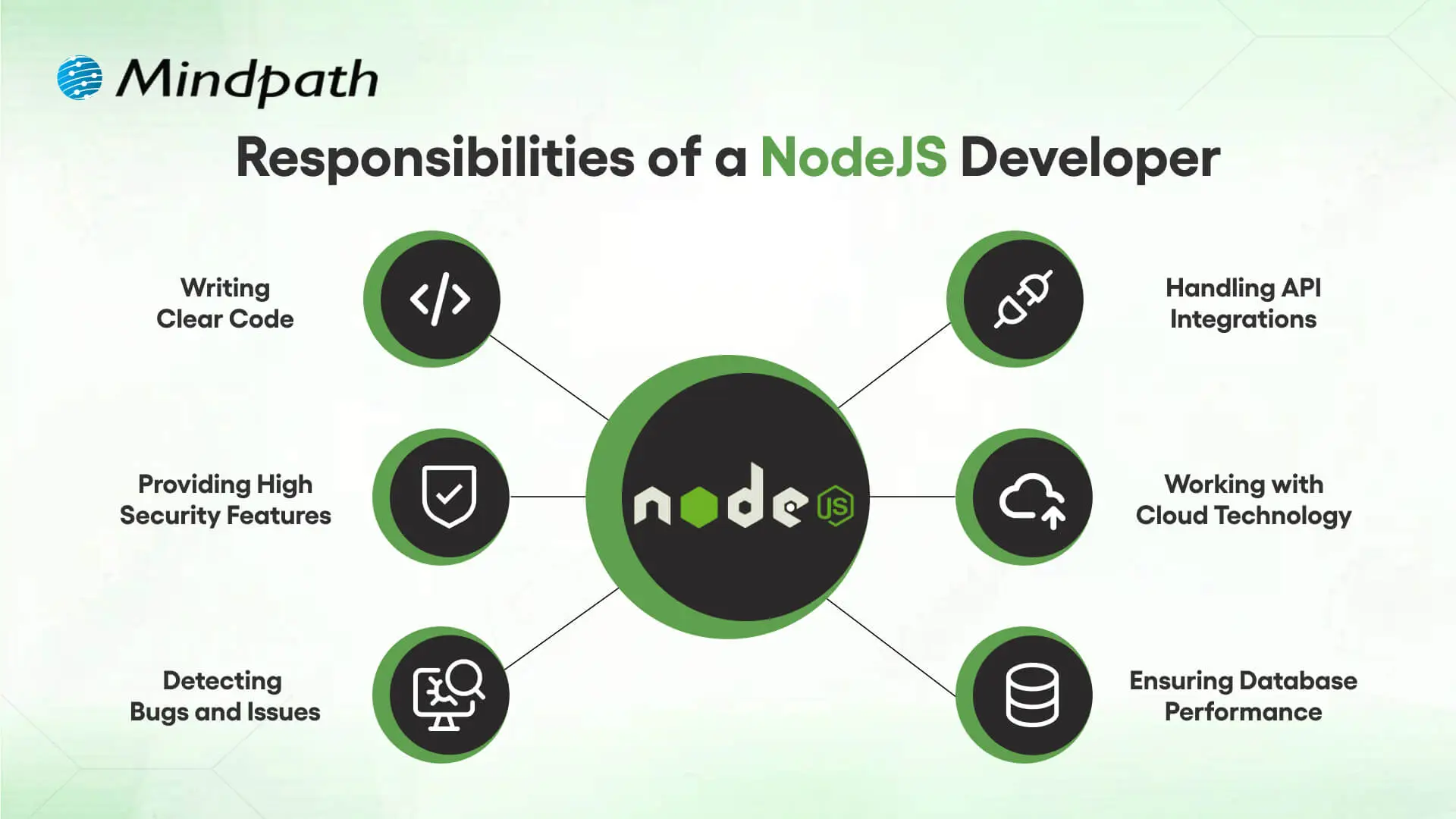
1. Writing Clear Code
When you hire Node.js developers, their job is to write clean and readable code. This will make it easier for other developers to maintain and grow the application.
2. Providing High-Security Features
Security is also a core part of a Node.js developer’s job. Developers need to identify their risks and add features that protect data and users.
3. Detecting Bugs and Issues
Bugs can give rise to slowed-down applications and degradation of performance. NodeJS developers are then also able to quickly identify and fix bugs to maintain stability on the systems.
4. Handling API Integrations
Most modern applications require API integration to add some functionality. Proficient NodeJS developers know how to use API integrations such as HTTP, buffers, and simple file handling.
6. Working with Cloud Technology
When you hire Node.js developers, it is common for these developers to work on the backend and, therefore, will work with cloud deployment. They will configure a cloud platform (such as AWS or Azure) to run the application to ensure it runs properly.
7. Ensuring Database Performance
A Node.js developer will oversee your databases so that the responses are quick. They ensure the back-end interacts with your front-end requests appropriately.
Unlock the new opportunities by Full-Stack Development with Node.js, the key to building a reliable application. Explore now and elevate your business to the next level.
Key Factors to Consider While Hiring Node.js Developers
Choosing the right talent can dictate whether or not your digital projects achieve ultimate success. If you are going to hire a Node.js developer, here are the important things to keep in mind before you do.
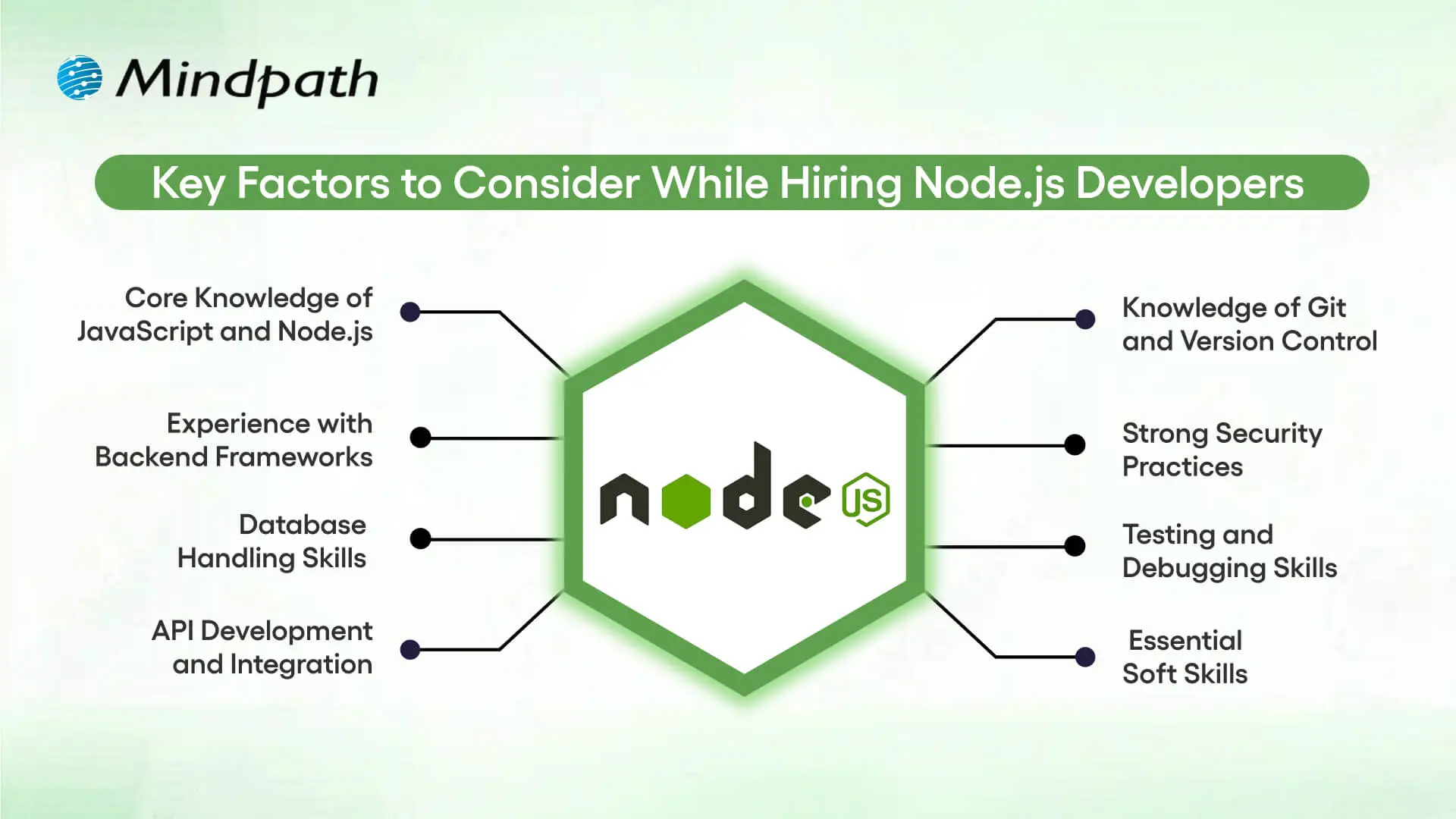
1. Core Knowledge of JavaScript and Node.js
When hiring Node.js developers, the first thing is to check their understanding of the basics of JavaScript and Node.js foundations. They should understand asynchronous programming, Node event loop, and code management through NPM, as well as managing dependencies, which is a large part of the Node.js developer roadmap related to developing scalable applications.
2. Experience with Backend Frameworks
A top-notch developer should really have practical experience with frameworks like Express.js, Koa.js, or Nest.js. The key benefit of these frameworks is that they make projects faster, and framework-less projects have no organization. If you’re hiring Node.js developers, you can easily test their framework knowledge with some simple tasks or some Node.js developer interview questions.
3. Database Handling Skills
All applications require databases, so any competent developer must know their databases MySQL, PostgreSQL, and they must know some NoSQL databases such as MongoDB. They need to understand caching as well as real-time data processing by having basic knowledge of tools like Redis. If you hire a Node.js developer with good database skills, your application will respond faster and stay robust.
4. API Development and Integration
APIs connect applications to additional services, and Node.js is often a popular choice to build those APIs as well. Developers must be familiar with RESTful APIs, GraphQL, and secure protocols like OAuth. Before you hire Node.js developers, be sure to ask them how they create APIs and manage API integration.
5. Knowledge of Git and Version Control
Git is an everyday tool for every developer, and they should be able to manage branches, pull requests, and conflicts without hindering the development. The knowledge of Git is a prerequisite for hiring Node.js developers for teamwork purposes.
6. Strong Security Practices
Security is always a primary concern. Developers need to understand encryption, input validation, and token-based authentication. When employing Node.js developers, look at how they implement these practices to protect applications and sensitive information.
7. Testing and Debugging Skills
Reliable applications need effective debugging and testing. Developers can leverage tools (such as Mocha, Jest, or Cypress) to find bugs early in application development. Knowledge of testing is a vital skill if you are planning to hire Node.js developers to help with long-term applications.
8. Essential Soft Skills
Technical skills are not enough to qualify for Node.js Developer jobs. Communication, collaboration, and problem-solving all make progress much easier on a project. These skills are equally important each time employers hire Node.js developers, as many projects will have challenging aspects.
As user experiences is evolving day by day, businesses need to adopt technologies that ensure speed, scalability, and reliability. Discover how Hiring Expert NodeJS Developers can help you deliver high-performance digital solutions.
Steps to Hire a Node.js Developer
While the search for the perfect talent can seem daunting, breaking the process down into clear steps makes it much easier. Below are the key steps to take when hiring a Node.js developer for your project.
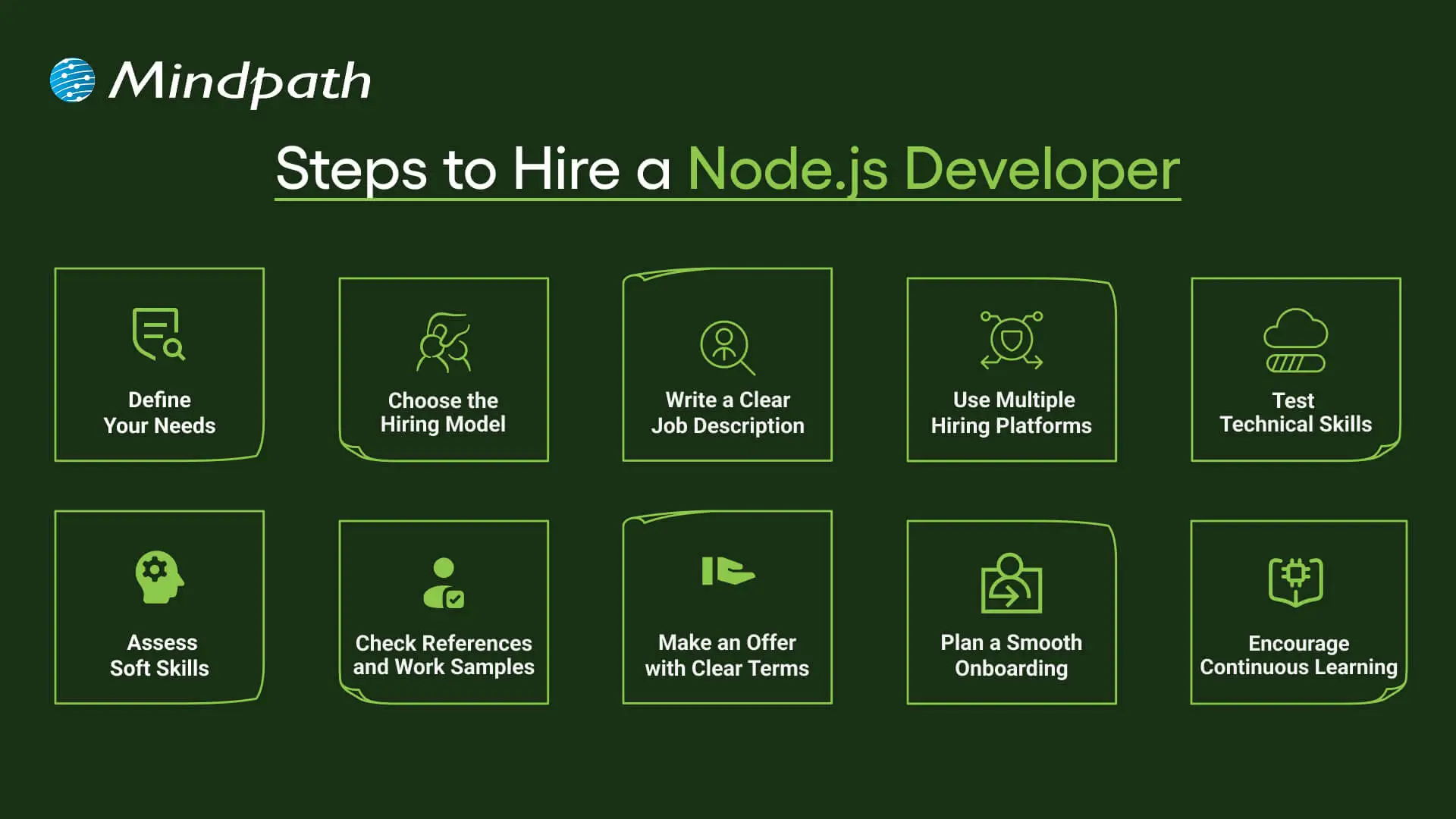
1. Define Your Needs
Start by defining your project scope, features, and tech stack. When you hire NodeJS developers, identifying clear requirements can save time and attract the right candidates.
2. Choose the Hiring Model
Determine whether you need in-house, remote, or offshore developers. Many companies hire NodeJS developers offshore for more flexibility and lower costs.
3. Write a Clear Job Description
A well-written job description allows candidates to know what they are applying for. Include as much as possible in the description, who you want, including the skills, the experience you expect, and if you are looking for a full-stack Node.js developer.
4. Use Multiple Hiring Platforms
Search for talent on LinkedIn, GitHub, and job boards that identify talented developers. These platforms enable developers to connect because of their special skill set.
5. Test Technical Skills
Evaluate coding expertise with tasks, interviews, or online coding challenges. This evaluates whether the developer can work with Node.js concepts properly.
6. Assess Soft Skills
Good communication and teamwork are as essential as coding, because they also allow the project to flow without delay.
7. Check References and Work Samples
It’s important to understand what the developer has done in the past, so it is good to check references and speak to previous clients or employers. This develops an understanding of the developer’s reliability and quality of effects.
8. Make an Offer with Clear Terms
Discuss salary, benefits, and expectations openly. Transparency builds trust and helps retain the developer.
9. Plan a Smooth Onboarding
Provide tools, resources, and guidance to new hires. A structured onboarding makes developers productive faster.
10. Encourage Continuous Learning
Support your team in learning new Node.js updates and practices. This keeps skills sharp and projects future-ready.
Want to enhance your website presence in today’s fast-paced digital world? Explore our detailed blog on how you can Increase Web Performance with Node.js Development Services.
Looking to Hire Expert Node.js Developers for Your Next Project?
Hiring the right Node.js talent can define the success of your digital projects. Skilled developers bring more than technical expertise; they align with business goals and deliver scalable, secure, and high-performing applications. By following clear steps and evaluating both technical and soft skills, you ensure your projects are built for long-term growth and innovation.
Mindpath stands out as a trusted Node.js development company offering top-tier Node.js development services. With a team of skilled developers, we help businesses build scalable applications tailored to their unique needs. By choosing Mindpath, you gain a partner focused on delivering secure, efficient, and future-ready solutions that accelerate your digital success.
Join our Newsletter!
categories
Join the world's largest training library and unlock new opportunities!
Featured Posts
Turn Insights Into
Real Business Solutions
Exploring trends is only the beginning. Whether you’re planning AI adoption, modernizing legacy systems, or building scalable software, our experts help transform ideas into practical business outcomes.